anaheim-gazette 1875-10-23
Scanned page
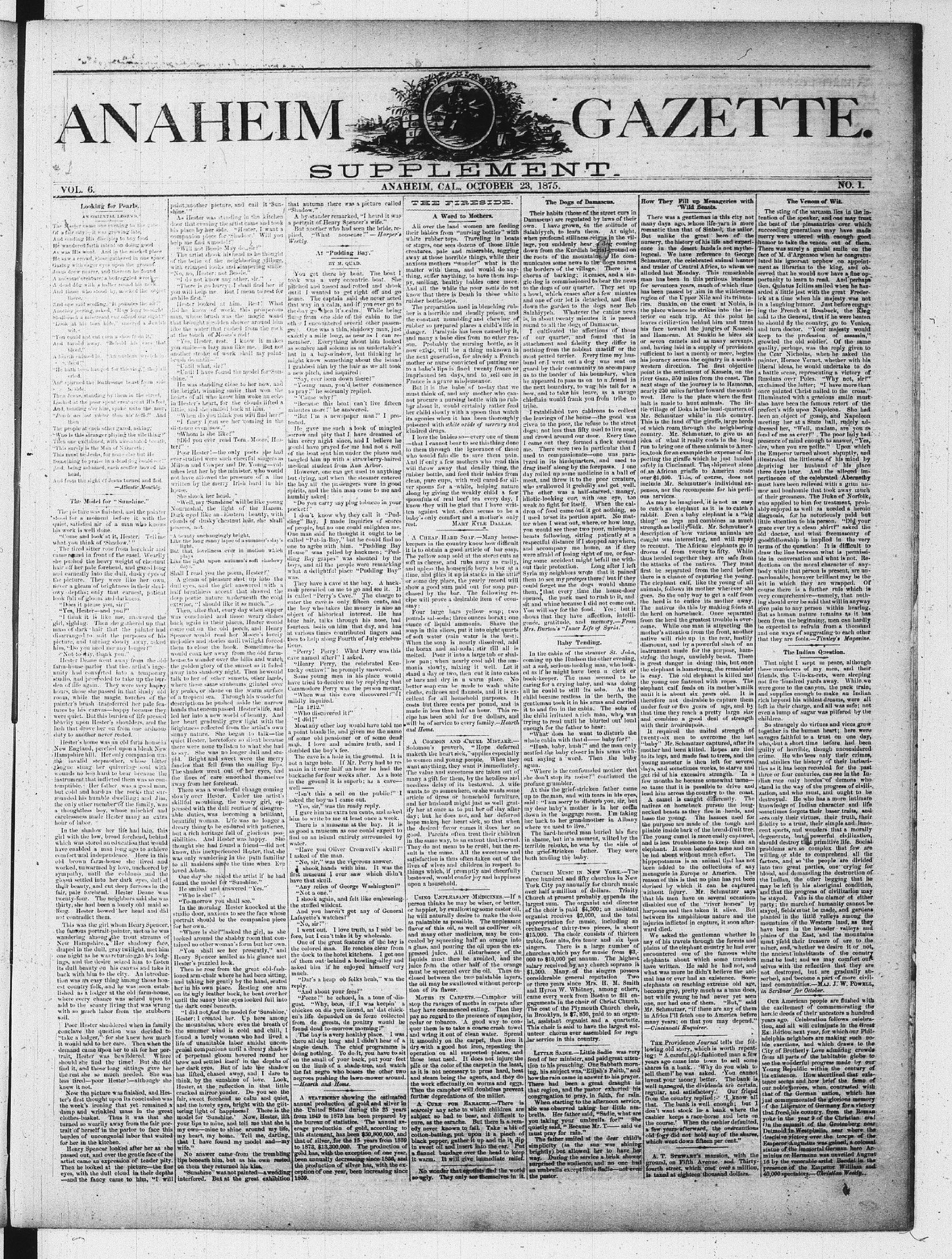
Searchable text
Looking for Pearls.
An Oriental Legend.
The Master came one evening to the gate of a fair city—it was growing late, and sending His disciples to buy food. He wandered forth intent on doing good. As was His wont. And in the market place he saw a crowd, close gathered in one space. Gazing with eager eyes upon the ground, Jesus drew nearer, and thereon he found no some creature; a bedraggled wreck—a dead dog with a halter round his neck. And those who stood by, mocked the object there.
And one said soffling, "It pollutes the air." Another jeering, asked, "How long to night shall such a miserant cur offend our sight?" "Look at his turn hide," sneered a Jewish wit, "You could not eat even a shoe from it."
And turned away. "Behold his ears that bleed."
A fourth enmired in, "An unclean wretch or doodle!"
He hath been hanged for thieving, they all eried.
And spurned the loathsome beast from side to side.
Then Jesus, standing by them in the street, looked at the poor spent creature at His feet. And, bending over him, spoke unto the man, "Pearls are not whiter than his teeth." And then
The people at each other gazed, asking: "Who is this stranger pllying the vile thing? Then one exclaimed, with awake attentive breath, 'This surely is the Man of Nazareth.' This must be Jeshs, for none else but He Something to praise in a dead dog would see.' And, being ashamed, each scoffer bowed his paint another picture, and call it Sunshine."
As Hester was standing in the kitchen door that evening the artist came and took his place by her side. "Hester, I want a companion piece for 'Shadow.' Will you help me find a model?"
"Will not Bessie May do sir?"
The artist shook his head as he thought of the belief of the neighboring village with crimped looks and simmering smile. "No, no, Hester; not Bessie."
"I do not know any other, sir."
There is no hurry: I shall find her if you will help me. But I mean to rest for awhile first.
Hester looked at him. Rest! What did he know of work, this prosperous man, whose brush was the magic wand that brought a golden shower around him like the water that rushed from the rock at the touch of Moses's rod?
"Yes, Hester, rest. I know it makes you smile—a lazy man like me. But not another stroke of work shall my paint brush do until—"
"Until what, sir?"
"Until I have found the model for Sunshine."
He was standing close to her now, and the bright, winning smile that won the hearts of all who knew him woke an echo in Hester's heart; for the clouds lifted a little, and she smiled back at him.
"When do you think you will find her?"
"I fancy I can see her coming in the distance even now."
"Whom is she like?"
"Did you ever read Tom Moore, Hester?"
Poor Hester!—the only poets she had ever studied were such cheerful singers as Milton and Cowper and Dr. Young—that autumn there was "Shadow."
A by-stander remarked a portrait of Henry Spencer. But another who had applied, "What nonsense Weekly."
At "Pudding by M. Quan"
You get there by boat took was a very eclectic pitched and tossed and rolled until I wanted to get home. The captain said that way in a calm, and the bay go when it's calming from one side of the other I encountered several greeks. One was a thin, exactly a mile long, as no member. Everything abides as sombre and solemn as hat in a bay-window, might know something I grabbed him by the hail a new pitch, and inquired "Say, ever been down?
"Young man, you'd be prayed." he solemnly replied.
"Cause why?"
Because this boat can minutes more!" he answered.
But I'm a newspapertested.
He gave me such a sorrow and pity that I held him every night since he would have prayed for me of the boat sent him undangled him up with a medical student from A
The Model for "Sunshine."
The picture was finished, and the painter stood for a moment before it with the quiet, satisfied air of a man who knows his work is well done.
"Come and look at it, Hester. Tell me what you think of 'Shadow.'"
The tired sitter rose from her chair and came round in front of the easel. Wearily she pushed the heavy weight of chestnut hair off her pale forehead, and gazed long and earnestly into the dull, dusky eyes of the picture. They were like her own, never a gleam of brightness in their shadowy depth; only that earnest, patient look full of gloom and darkness.
"Does it please you, sir?"
"Yes, Hester—and you?"
"I think it is like me, answered the girl, sighing. Then she gathered up that mass of dark hair that the painter had disarranged to suit the purposes of his picture, and turning slowly away, asked him, 'Do you need me any longer?'
"Not to day, thank you."
Hester Deane went away from the old farm-house parlor that the artist's ingenuity had converted into a temporary studio, and proceeded to take up the burden of life again. They were very happy hours, those she passed in that shady old room, while the magic touches of the painter's brush transferred her pale features to his canvas—happy because they were quiet. But this burden of life pressed heavily upon Hester's shoulders, and the lash that drove her on from one arduous duty to another never rested.
Hester's home was an old farm house in New England, perched upon a bleak New Hampshire hill. Her only companion was the invalid stepmother, whose bitter tongue stung her quivering soul with wounds no less hard to bear because the instrument that indicted them was so contemptible. Her father was a good man, but cold and hard as the rocks that surrounded his humble dwelling; and Jim, the only other member of the family, was a thoughtless boy, whose mischief and carelessness made Hester many an extra hour of labor.
In the shadow her life had lain, this girl with the low, broad forehead, behind which was stored an education that would have enabled a man long ago to achieve comfort and independence. Here in this old brown farm-house she lived and worked, unwarmed by love, uncheered by sympathy, until the coldness and the gloom settled into her dark eyes, dull si their beauty, and cut deep furrows in the
"Until I have found the model for 'Sunshine.'"
He was standing close to her now, and the bright, winning smile that won the hearts of all who knew him woke an echo in Hester's heart, for the clouds lifted a little, and she smiled back at him.
"When do you think you will find her?"
"I fancy I can see her coming in the distance even now."
"Whom is she like?"
"Did you ever read Tom Moore, Hester?"
Poor Hester!—the only poets she had ever studied were such cheerful singers as Milton and Cowper and Dr. Young—volumes lent her by the minister, who would not have allowed the presence of a line written by the merry Irish bard in his house.
She shook her head.
"Well, my 'Sunshine' will be like young Nourmahal, the light of the Harem. Dark eyed like an Eastern beauty, with clouds of dusky chestnut hair, she shall possess, not.
"A beauty unchangingly bright, like the long sunny lapse of a summer's day's light,
but that loveliness ever in motion which plays.
Like the light upon autumn's soft shadowy days."
Shall I read you the poem, Hester?
A gleam of pleasure shot up into the dull eyes, and the girl answered with a half breathless accent that showed the deep poetic nature underneath the cold exterior. "I should like it so much."
Then, after that, every day when supper was concluded and those weary dishes back again in their places, Hester would come out on the old porch, and Henry Spencer would read her Moore's lovely melodies and stories until twilight forced them to close the book. Sometimes he would coax her away from the old farmhouse to wander over the hills and watch the golden glory of the sunset as it faded away into shadowy night. Then he would talk to her of other sunsets, other lands; where these same sunbeams glinted over jey peaks, or shone on the warm surface of a tropical sea. Through his wonderful descriptions he pushed aside the narrow bands that encompassed Hester's life, and led her into a new world of beauty. And her heart gradually grew light with the brightness reflected from the artist's own sunny nature. She began to talk—the quiet Hester, heretofore so silent because there were none to listen to what she had to say. She was no longer dull and stupid. Bright and sweet were the merry fancies that fell from the smiling lips. The shadow went out of her eyes, and the lines of care smoothed themselves away from her forehead.
There was a wonderful change coming slowly over Hester. Under the artist's skillful moulding, the weary girl, oppressed with the dull routine of disagreeable duties, was becoming a brilliant, beautiful woman. Life was no longer a dreary thing to be endured with patience, but a rich heritage full of glorious possibilities. And Hester was happy. She thought she had found a friend—did not know, this inexperienced Hester, that she was only wandering in the path familiar to all maidens since the time when Eve loved Adam.
One day she asked the artist if he had found the model for "Sunshine."
He smiled and answered "Yes."
but cold and hard as the rocks that surrounded his humble dwelling; and Jim, the only other member of the family, was a thoughtless boy, whose mischief and carelessness made Hester many an extra hour of labor.
In the shadow her life had lain, this girl with the low, broad forehead, behind which was stored an education that would have enabled a man long ago to achieve comfort and independence. Here in this old brown farm-house she lived and worked, unwarmed by love, uncheered by sympathy, until the coldness and the gloom settled into her dark eyes, dulled their beauty, and cut deep furrows in the fair, pale forehead. Hester Deane was twenty-four. The neighbors said she was thirty, she had been a lonely old maid so long. Hester bowed her head and did not contradict them.
This was the girl whom Henry Spencer, the famous portrait-painter, met as he was wandering among the trout streams of New Hampshire. Her shadowy face, draped in the dull, gray twilight, met him one night as he was returning to his lodgings, and the desire seized him to fasten its dull beauty on his canvas and take it back with him to the city. An introduction was an easy thing among those honest country folk, and he was soon established as a lover at the old farm-house, where every chance was seized upon to add to the scanty living that was wrung with so much labor from the stubborn soil.
Poor Hester shuddered when in family conclave the question was decided to "take a lodger," for she knew how much it would add to her care. Then when the demand came upon her to sit for her portrait, Hester was bewildered. Where should she find the time? But she did find it, and those long sittings gave her the rest she so much needed. She was less tired—poor Hester!—although she knew it not.
Now the picture was finished, and Hester's first thought upon its conclusion was the week's ironing that yet remained a damp and wrinkled mass in the great clothes-basket. Thus it was that she turned so wearily away from the fair portrait of herself in the parlor to face this burden of uncongenial labor that waited for her in the kitchen.
Henry Spencer looked after her as she passed out, and over the gentle face of the artist came an expression of tender pity. Then he looked at the picture—the fine eyes, with the dull cloud in their depths—and the fancy came to him, "I will there was a wonderful change coming slowly over Hester. Under the artist's skillful moulding, the weary girl, oppressed with the dull routine of disagreeable duties, was becoming a brilliant, beautiful woman. Life was no longer a dreary thing to be endured with patience, but a rich heritage full of glorious possibilities. And Hester was happy. She thought she had found a friend—did not know, this inexperienced Hester, that she was only wandering in the path familiar to all maidens since the time when Eve loved Adam.
One day she asked the artist if he had found the model for "Sunshine."
He smiled and answered "Yes."
"Who is she?"
"To-morrow you shall see."
In the morning Hester knocked at the studio door, anxious to see the face whose portrait should be the companion piece for her own.
"Where is she?" asked the girl, as she looked around the shabby room that contained no other woman's form but her own.
"You shall see her presently," and Henry Spencer smiled as his glance met Hester's puzzled look.
Then he rose from the great old-fashioned arm-chair where he had been sitting, and taking her gently by the hand, seated her in his own place. Resting one arm on its ugly leather back, he bent over her until the sunny blue eyes looked full into the dark ones beneath.
"I did not find the model for 'Sunshine,' Hester; I created her. Up here among the mountains, where even the breath of the summer wind is cold and chill, I found a lonely woman who had lived a life of unsuitable labor amidst uncongenial companions until a dreary shadow of perpetual gloom hovered round her brow and settled itself in the depths of her dark eyes. But of late the shadow has lifted, chased away, and I dare to think, by the sunshine of love. Look, Hester, at the reflection in that little cracked mirror yonder. Do you see the fair, sweet forehead so calm and quiet, and the lovely eyes, bright with the glittering light of happiness? There is the model for 'Sunshine.' Now, Hester, lift your lips to mine, and tell me that she is my own—mine to shine around my life, my heart, my home. Tell me, darling, that I have found my model and—my wife."
No answer came from the trembling lips beneath him, but as his own rested on them they returned his kiss.
"Sunshine" was not painted—a wedding interfered. But at the great exhibition
"Isn't this a sell once asked the boy as I came to Yes, sir," was the real I gave him an extra ten him to write to me at least There is a museum at as good a museum as one find on an island entire water.
"Have you Oliver Crane I asked of the man?
"No, sir," was the vigor I shook hands with first museum I ever saw have that skull.
"Any relies of George Not a one."
I shook again, and felt the stuffed wildcat. And you haven't got Lafayette's watches?
"No, sir!" I went out. I love trefoire but I can't take it One of the great features the colored man. He relied on the dock to the hotel kite of them out behind a bed asked him if he enjoyed much.
"Dar's a heap ob folly reply."
And about your feez "Feeze!" he echoed gust. "Why, boss, if chicken on dis yere lieuen's life depended on me from de guests, do found dead to-morrow The bay is a very heavy there all day long and single death. The child doing nothing. To do on the small of your body on the limb of a shade the fat negro who boss negroes pushing the lace—Hearth and Home."
that autumn there was a picture called "Shadow."
A by-stander remarked, "I heard it was a portrait of Henry Spencer's wife."
But another who had seen the bride, replied, "What nonsense!" — Harper's Weekly.
At "Pudding Bay."
BY M. QUAD.
You get there by boat. The boat I took was a very eccentric boat. She pitched and tossed and rolled and shook until I wanted to get right off and go home. The captain said she never acted that way in a calm, and if you ever go to the bay go when it's calm. While being flung from one side of the cabin to the other I encountered several other passengers. One was a thin, shadowy man, just exactly a mile long, as near as I can remember. Everything about him looked as sombre and solemn as an undertaker's hat in a bay-window, but thinking he might know something about the island I grabbed him by the hair as we all took a new pitch, and inquired:
"Say, ever been down there?"
"Young man, you'd better commence to pray," he solemnly replied.
"Cause why?"
"Because this boat can't live fifteen minutes more?" he answered.
"But I'm a newspaper man!" I protested.
He gave me such a look of mingled sorrow and pity that I have dreamed of him every night since, and I believe he would have prayed for me had not a roll of the boat sent him under the piano and tangled him up with a strawberry-haired medical student from Ann Arbor.
THE FIRESIDE.
A Word to Mothers.
All over the land women are feeding their babies from "nursing bottles" with white rubber tops. Traveling in boats or stages, one sees dozens of those little creatures, pale and miserable, tagging away at those horrible things, while their anxious mothers "wonder" what is the matter with them, and would do anything, suffer anything, to have them happy, smiling, healthy babies once more. And all the while the poor souls do not know that there is Death in those white rubber bottle-tops.
The preparation used in bleaching rubber is a horrible and deadly poison, and the constant mumbling and chewing of rubber so prepared places a child's life in danger. Paralysis has been caused by it, and many a babe dies from no other reason. Probably the nursing bottle, as it now exists, will be a thing unknown in the next generation, for already a French mother or nurse convicted of putting one to a babe's lips is fined twenty francs or imprisoned ten days, and to sell one in France is a grave misdemeanor.
But it is the babe of to-day that we must think of, and any mother who cannot procure a nursing bottle with no rubber about it, would certainly rather feed her child slowly with a spoon than watch its agonies when it has been thoroughly poisoned with white oxide of mercury and kindred drugs.
I love the babies so—every one of them—that I cannot bear to see this thing done to them through the ignorance of those who would fain die to save them pain. And if only a few mothers who read this will throw away that deadly thing,
The Dogs of Damascus.
Their habits (those of the street curs in Damascus) are regulated by laws of their own. I have grown, in the solitude of Salahiyyeh, to learn them. At night, when profound stillness reigns in the village, you suddenly hear a dog coming down from the Kurdish burial ground on the roots of the mountains. He communicates some news to the dogs nearest the borders of the village. There is a chorus of barking; it ceases, and a single dog is commissioned to bear the news to the dogs of our quarter. They set up a howl, which ceases after a few minutes and one of our lot is detached, and flies down the garden to the dogs near Beb Salahiyyeh. Whatever the canine news is, in about twenty minutes it is passed round to all the dogs of Damascus.
I cultivated the affections of those of our quarter, and found that in attachment and fidelity they differ in nothing from the noblest mastiff or the most petted terrier. Every time my husband or I went out a dog was sent on guard by their community to accompany us to the border of his boundary, when he appeared to pass us on to a friend in the next boundary, to wag his tail for a bow, and to take his leave, as a savage chieftain would frank you from tribe to tribe.
I established two caldrons to collect the leavings of the house—the good was given to the poor, the refuse to the street dogs; not less than fifty used to live near, and crowd around our door. Every time I came out they formed a clock around me. There were two in particular that I used to compassionate—one was paralyzed in its hindquarters, and used to drag itself along by the forepaws. I one
How They
There was many days without romantic time. But unlike nursery, there once in the logical W Schmutzer, and trader o alluded last man has been pa region of thries. Suakit the place where interior on e leaves civil his face to Hammor or seven ca and having sufficient to his journey d western dir point is the river Gaza, next stage on nearly 250 m west. Here halt is made the village of Mr. Schmutter. This is the l of which roi country. M idea of wh run to bring ica,tok for porting t he safely in Ci
a new pitch, and inquired:
"Say, ever been down there?"
"Young man, you better commence to pray!" he solemnly replied.
"Cause why?"
"Because this boat can't live fifteen minutes more!" he answered.
"But I'm a newspaper man." I protested.
He gave me such a look of mingled sorrow and pity that I have dreamed of him every night since, and I believe he would have prayed for me had not a roll of the boat sent him under the piano and tangled him up with a strawberry-haired medical student from Ann Arbor.
However, one can get used to anything but dying, and when the steamer entered the bay all the passengers were in good spirits, and the thin man came to me and humbly asked:
"Do you carry any plug tobacco in your pocket?"
I don't know why they call it "Pudding" Bay. I made inquiries of scores of people, but no one could enlighten me. One man said he thought it ought to be called "Put-in Bay," but he could find no one to agree with him. "Pudding Bay House" was yelled by hackmen; "Pudding Bay grapes" was shouted by the boys, and all the people were remarking what a delightful place "Pudding Bay" was.
They have a cave at the bay. A hackman prevailed on me to go and see it. It is called "Perry's Cave." The charge to enter the cave is only fifteen cents, and the boy who takes the money is also an object of historical interest. He has blue hair, talks through his nose, had fourteen boils on him that day, and has at various times contributed fingers and toes to help along Fourth of July celebrations.
"Perry! Perry! What Perry was this cave named after?" I asked.
"Henry Perry, the celebrated Kentucky outlaw!" he promptly answered.
Some young men in his place would have tried to deceive me by replying that Commodore Perry was the person meant.
"When was this cave discovered?" I mildly inquired.
"在1812."
"Who discovered it?"
"I did!"
Most any other boy would have told me a point blank lie, and given me the name of some old pensioner or of some dead man. I love and admire truth, and I doubled the boy's fee.
The cave is a hole in the ground. It is not a large hole. If Mr. Perry had to remain in it over half an hour he had the backache for four weeks after. As a hole in the ground it is superb; as a cave—well——
"不Isn't this a sell on the public?" I asked the boy as I came out.
"Yes, sir," was the ready reply.
I gave him an extra ten cents, and asked him to write to me at least once a week.
There is a museum at the bay. It is as good a museum as one could expect to find on an island entirely surrounded by water.
"Have you Oliver Cromwell's skull?" I asked of the man.
"No, sir," was the vigorous answer.
I shook hands with him. It was the first museum I ever saw which didn't have that skull.
"Any relies of George Washington!"
But it is the babe of to-day that we must think of, and any mother who cannot procure a nursing bottle with no rubber about it, would certainly rather feed her child slowly with a spoon than watch its agonies when it has been thoroughly poisoned with white oxide of mercury and kindred drugs.
I love the babies so—every one of them—that I cannot bear to see this thing done to them through the ignorance of those who would fain die to save them pain. And if only a few mothers who read this will throw away that deadly thing, the rubber bottle, and feed their babies from clean, pure cups, with well cared-for silver spoons for a while, helping nature along by giving the weakly child a few spoonfuls of real beef tea every day. I know they will be glad that I have written against what often seems to be a baby's only comfort and a mother's only rest.
Mary Kyle Dallas.
A Cheap Hard Soap—Many housekeepers in the country know how difficult it is to obtain a good article of bar soap. The yellow soap sold at the stores cuts as soft as cheese, and rubs away as easily, and unless the housewife buys a box at a time, and piles it up in stacks in the attic or some dry place, the yearly record will show a good sum paid out for soap purchased by the bar. The following recipe will prove a desirable item of economy:
Four large bars yellow soap; two pounds sal-soda; three ounces borax; one ounce of liquid ammonia. Shave the soap in thin slices, put it into eight quarts of soft water (rain water is the best). When the soap is nearly dissolved, add the borax and sal-soda; stir till all is melted. Pour it into a large tub or shallow pan; when nearly cool add the ammonia slowly, mixing it well. Let it stand a day or two, then cut it into cakes or bars and dry in a warm place. No better soap can be made to wash white cloths, calicoes and flannels, and it is excellent for all household purposes. It costs but three cents per pound, and is made in less than half an hour. This recipe has been sold for five dollars, and will be of service to every family.—Hearth and Home.
A Common and Cruel Mistake—Solomon's proverb, "Hope deferred maketh the heart sick," applies especially to women and young people. When they want anything they want it immediately. The value and sweetness are taken out of many a gift for them, by the headless and needless delay of its bestowal. A wife wants to go somewhere, or she wants some article of dress or household furniture, and her husband might just as well gratify her at once as to put her off day after day; but he does not, and her deferred hope makes her heart sick, so that when the desired favor comes it does her no good. Parents often treat their children in the same way, to an extent that is cruel. They do not mean to be cruel, but the result is the same. All the sweetness and satisfaction is thus often taken out of the lives of wives and children in respect to things which, if promptly and cheerfully bestowed, would confer joy and happiness upon a household.
In the cabin of the steamer St. John, coming up the Hudson the other evening, sat a sad, serious-looking man, who looked as if he might have been a clerk or book-keeper. The man seemed to be caring for a crying baby, and was doing all he could to still its sobs. As the child became restless in the berth, the gentleman took it in his arms and carried it to and fro in the cabin. The sobs of the child irritated a rich man, who was trying to read until he blurted out loud enough for the father to hear:
“What does he want to disturb the whole cabin with that d——baby for?”
“Hush, baby, hush!” and the man only nestfed the baby closer in his arms without saying a word. Then the baby again.
“Where is the confounded mother that she don't stop its noise?” continued the profane grumbler.
At this the grief-stricken father came up to the man, and with tears in his eyes, said: "I am sorry to disturb you, sir, my dear baby's mother is in her coffin down in the baggage room. I'm taking her back to her grandmother in Albany where we used to live."
The hard-hearted man buried his face in shame, but in a moment, wilted by the terrible rebuke, he was by the side of the grief-stricken father. They were both tending the baby.
Church Music in New York.—The three hundred and fifty churches in New York City pay annually for church music to us to the border of his boundary, when he appeared to pass us on to a friend in the next boundary, to wag his tail for a bow, and to take his leave, as a savage chieftain would frank you from tribe to tribe.
I established two caldrons to collect the leavings of the house—the good was given to the poor, the refuse to the street dogs; not less than fifty used to live near, and crowd around our door. Every time I came out they formed a flock around me. There were two in particular that I used to compassionate—one was paralyzed in its hindquarters, and used to drag itself along by the forepaws. I one day rolled up some medicine in a ball of meat, and threw it to the poor creature, who swallowed it greddily and got well. The other was a half-starved; mangy, idiotic-looking cur, with one eye, too weak to fight for itself. When the caldron of food came out it got nothing, so I used to set its portion apart. No matter when I went out, where, or how long you would see these two poor, misshapen beasts following, sitting patiently at a respectful distance if I stopped anywhere, and accompany me home, as if they were afraid of losing sight of me or fearing some accident might befall me without their protection. Long after I left Syria my neighbors wrote that it pained them to see my proteges there; but if they could forget me the dogs would shame them, that every time the house-door opened, the pack used to rush it and sit and whine because I did not come out. You will say for the food. Yes; but it shows that they have affection, intelligence, gratitude, and memory.—From Mrs. Burton's "Inner Life of Syria."
Baby Tending.
In the cabin of the steamer St. John, coming up the Hudson the other evening, sat a sad, serious-looking man, who looked as if he might have been a clerk or book-keeper. The man seemed to be caring for a crying baby, and was doing all he could to still its sobs. As the child became restless in the berth, the gentleman took it in his arms and carried it to and fro in the cabin. The sobs of the child irritated a rich man, who was trying to read until he blurted out loud enough for the father to hear:
“What does he want to disturb the whole cabin with that d——baby for?”
“Hush, baby, hush!” and the man only nestfed the baby closer in his arms without saying a word. Then the baby again.
“Where is the confounded mother that she don't stop its noise?” continued the profane grumbler.
At this the grief-stricken father came up to the man, and with tears in his eyes, said: "I am sorry to disturb you, sir, my dear baby's mother is in her coffin down in the baggage room. I'm taking her back to her grandmother in Albany where we used to live."
The hard-hearted man buried his face in shame, but in a moment, wilted by the terrible rebuke, he was by the side of the grief-stricken father. They were both tending the baby.
Church Music in New York.—The three hundred and fifty churches in New York City pay annually for church music to us tothe border of his boundary when he appeared to pass us on to a friend in the next boundary, to wag his tail for a bow,and to take his leave as a savage chieftain would frank you from tribe to tribe.
I established two caldrons to collect the leavings of the house—the good was given to the poor, the refuse to the street dogs; not less than fifty used to live near,and crowd around our door. Every time I came out they formed a flock around me. There were two in particular that I used to compassionate—one was paralyzed in its hindquarters,and used to drag itself along by the forepaws. I one day rolled up some medicine in a ball of meat,and threw it to its creaturement which is so hardened at safety in Chicago of an Africa over $1,$000; include Mr.penses,nor any services.
As may be to catch an rabbit.Every thing" on strength as his description caught was to recount.droves of this herdedthe attacks first be seep there is a clich.The elephant animals,fold goes.So therhe herd is this.The nativeherd on her ownfrom her come.While mother's attitude will dismount,a instrument stringthe lighthouseis great dantherelephantis easy.THe young onewlephantcanuntilitis thusherdedthe attacks first be seep there is a clich.The elephant animals,fold goes.So therhe herd is this.The nativeherd on her ownfrom her come.While mother's attitude will dismount,a instrument stringthe lighthouseis great dantherelephantis easy.THe young onewlephantcanuntilitis thusherdedthe attacks first be seep there is a clich.The elephant animals,fold goes.So therhe herd is this.The nativeherd on her ownfrom her come.While mother's attitude will dismount,a instrument stringthe lighthouseis great dantherelephantis easy.THe young onewlephantcanuntilitis thusherdedthe attacks first be seep there is a clich.The elephant animals,fold goes.So therhe herd is this.The nativeherd on her ownfrom her come.While mother's attitude will dismount,a instrument stringthe lighthouseis great dantherelephantis easy.THe young onewlephantcanuntilitis thusherdedthe attacks first be seep there is a clich.The elephant animals,fold goes.So therhe herd is this.The nativeherd on her ownfrom her come.While mother's attitude will dismount,a instrument stringthe lighthouseis great dantherelephantis easy.THe young onewlephantcanuntilitis thusherdedthe attacks first be seep there is a clich.The elephant animals,fold goes.So therhe herd is this.The nativeherd on her ownfrom her come.While mother's attitude will dismount,a instrument stringthe lighthouseis great dantherelephantis easy.THe young onewlephantcanuntilitis thusherdedthe attacks first be seep there is a clich.The elephant animals,fold goes.So therhe herd is this.The nativeherd on her ownfrom her come.While mother's attitude will dismount,a instrument stringthe lighthouseis great dantherelephantis easy.THe young onewlephantcanuntilitis thusherdedthe attacks first be seep there is a clich.The elephant animals,fold goes.So therhe herd is this.The nativeherd on her ownfrom her come.While mother's attitude will dismount,a instrument stringthe lighthouseis great dantherelephantis easy.THe young onewlephantcanuntilitis thusherdedthe attacks first be seep there is a clich.The elephant animals,fold goes.So therhe herd is this.The nativeherd on her ownfrom her come.While mother's attitude will dismount,a instrument stringthe lighthouseis great dantherelephantis easy.THe young onewlephantcanuntilitis thusherdedthe attacks first be seep there is a clich.The elephant animals,fold goes.So therhe herd is this.The nativeherd on her ownfrom her come.While mother's attitude will dismount,a instrument stringthe lighthouseis great dantherelephantis easy.THe young onewlephantcanuntilitis thusherdedthe attacks first be seep there is a clich.The elephant animals,fold goes.So therhe herd is this.The nativeherd on her ownfrom her come.While mother's attitude will dismount,a instrument stringthe lighthouseis great dantherelephantis easy.THe young onewlephantcanuntilitis thusherdedthe attacks first be seep there is a clich.The elephant animals,fold goes.So therhe herd is this.The nativeherd on her ownfrom her come.While mother's attitude will dismount,a instrument stringthe lighthouseis great dantherelephantis easy.THe young onewlephantcanuntilitis thusherdedthe attacks first be seep there is a clich.The elephant animals,fold goes.So therhe herd is this.The nativeherd on her ownfrom her come.While mother's attitude will dismount,a instrument stringthe lighthouseis great dantherelephantis easy.THe young onewlephantcanuntilitis thusherdedthe attacks first be seep there is a clich.The elephant animals,fold goes.So therhe herd is this.The nativeherd on her ownfrom her come.While mother's attitude will dismount,a instrument stringthe lighthouseis great丹therelephantis easy.THe young onewlephantcanuntilitis thusherdedthe attacks first be seep there is a clich.The elephant animals,fold goes.So therhe herd is this.The nativeherd on her ownfrom her come.While母亲's态度will dismount,a instrument stringthe lighthouseis great丹therelephantis easy.THe young onewlephantcanuntilitis thusherdedthe attacks first be seep there is a clich.The elephant animals,fold goes.So therhe herd is this.The nativeherd on her ownfrom her come.While母亲's态度will dismount,a instrument stringthe lighthouseis great丹therelephantis easy.THe young onewlephantcanuntilitis thusherdedthe attacks first be seep there is a clich.The elephant animals,fold goes.So therhe herd is this.The nativeherd on her ownfrom her come.While母亲's态度will dismount,a instrument stringthe lighthouseis great丹therelephantis easy.THe young onewlephantcanuntilitis thusherdedthe attacks first be seep there is a clich.The elephant animals,fold goes.So therhe herd is this.The nativeherd on her ownfrom her come.While母亲's态度will dismount,a instrument stringthe lighthouseis great丹therelephantis easy.THe young onewlephantcanuntilitis thusherdedthe attacks first be seep there is a clich.The elephant animals,fold goes.So therhe herd is this.The nativeherd on her ownfrom her come.While母亲's态度will dismount,a instrument stringthe lighthouseis great丹therelephantis easy.THe young onewlephantcanuntilitis thusherDED THE ATTACKS OF THE GIRLISH STRUGGER THAT HE WAS TRIED TO READ UNTIL HE BLURTED OUT LOUD ENOUGH FOR THE FATHER TO HARE:
“What does he want to disturb the whole cabin with that d——baby for?”
“Hush,baby,hush!” and the man only nestfed the baby closer in his arms without saying a word. Then the baby again.
“Where is the confounded mother that she doesn't stop its noise?” continued the profane grumbler.
At this the grief-stricken father came up to the man,and with tears in his eyes,said: “I am sorry to disturb you,sir,但 my dear baby's mother is in her coffin down in the baggage room.I'm taking her back to her grandmother in Albany where we used to live.”
The hard-hearted man buried his face in shame,但在a moment,wilted bythe terrible rebuke,他was bythe sideofthegrief-strickenfather。They werebothtendingthebaby.
Church Music in New York.-The three hundred和 fifty churches in New York City pay annually for church musicto us.tothe borderofhis boundarywhenheappearedtopassusontoafriendinthenextboundarytowaghistailforabow,andtotakehis leaveasa savagechieftainwouldfrankyouasa savagechieftainwouldfrankyouasa savagechieftainwouldfrankyouasa savagechieftainwouldfrankyouasa savagechieftainwouldfrankyouasa savagechieftainwouldfrankyouasa savagechieftainwouldfrankyouasa savagechieftainwouldfrankyouasa savagechieftainwouldfrankyouasa savagechieftainwouldfrankyouasa savagechieftainwouldfrankyouasa savagechieftainwouldfrankyouasa savagechieftainwouldfrankyouasa savagechieftainwouldfrankyouasa savagechieftainwouldfrankyouasa savagechieftainwouldfrankyouasa savagechieftainwouldfrankyouasa savagechieftainwouldfrankyouasa savagechieftainwouldfrankyouasa savagechieftainwouldfrankyouasa savagechieftainwouldfrankyouasa savagechieftainwouldfrankyouasa savagechieftainwouldfrankyouasa savagechieftainwouldfrankyouasa savagechieftainwouldfrankyouasa savagechieftainwouldfrankyouasa savagechieftainwouldfrankyouasa savagechieftainwouldfrankyouasa savagechieftainwouldfrankyouasa savagechieftainwouldfrankyouasa savagechieftainwouldfrankyouasa savagechieftainwouldfrankyouasa savagechieftainwouldfrankyouasa savagechieftainwouldfrankyouasa savagechieftainwouldfrankyouasa savagechieftainwouldfrankyouasa savagechieftainwouldfrank你asa savagechieftainwouldfrank你asa savagechieftainwouldfrANK他没有military equipment.他没有military equipment.他没有military equipment.他没有military equipment.他没有military equipment.他没有military equipment.他没有military equipment.他没有military equipment.他没有military equipment.他没有military equipment.他没有military equipment.他没有military equipment.他没有military equipment.他没有military equipment.他没有military equipment.他没有military equipment.他没有military equipment.他没有military equipment.他没有military equipment.他没有military equipment.他没有military equipment.他没有military equipment.他没有military equipment.他没有military equipment.他没有military equipment.她没有military equipment.她没有military equipment.她没有military equipment.她没有military equipment.她没有military equipment.她没有military equipment.她没有military equipment.她没有military equipment.她没有military equipment.她没有military equipment.她没有military equipment.她没有military equipment.她没有military equipment.她没有military equipment.她没有military equipment.她没有military equipment.她没有military equipment.她没有military equipment.她没有military equipment.她没有military equipment.她没有military equipment.她没有military equipment.她没有military equipment.她没有military equipment.她没有military equipment.她没有military equipment.她没有military equipment.她没有military equipment.她没有military equipment.她没有military equipment.她没有military equipment.她没有military equipment.她没有military equipment.她没有military equipment.她没有military Equipment.她没有military Equipment.她没有military Equipment.她没有military Equipment.她没有military Equipment.她没有military Equipment.她没有military Equipment.她没有military Equipment.她没有military Equipment.她没有military Equipment.她没有military Equipment.她没有military Equipment.她没有military Equipment.她没有military Equipment.她没有military Equipment.她没有military Equipment.她没有military Equipment.她没有.military Equipment.她没有.military Equipment.她没有.military Equipment.她没有.military Equipment.她没有.mlitrary Equipment.她没有.mlitrary Equipment.她没有.mlitrary Equipment.她有.mlitrary Equipment.她有.mlitrary Equipment.她有.mlitrary Equipment.她有.mlitrary Equipment.她有.mlitrary Equipment.她有.mlitrary Equipment.她有.mlitrary Equipment.她有.mlitrary Equipment.它有.mlitrary Equipment.它有.mlitrary Equipment.它有.mlitrary Equipment.它有.mlitrary Equipment.它有.mlitrary Equipment.它有.mlitrary Equipment.它有.mlitrary Equipment.它有.mlitrary Equipment.它有.mlitrary Equipment.它有.mlitrary Equipment.它有.mlitrary Equipment.它有.mlitrary Equipment.它有.mlitrary Equipment.它有.mlitrary Equipment.它有.mlitrary Equipment.它有.mlitrary Equipment.它有.mlitrary Equipment.它有.mlitrary Equipment.它有.mlitrary Equipment.它有.mlitrary Equipment.它有.mlitrary Equipment.它有.m litrary Equipment.它有.m litrary Equipment.它有.m litrary Equipment.它有.m litrary Equipment.它有.m litrary Equipment.它有.m litrary Equipment.它有.m litrary Equipment.它有.m litrary Equipment.它有.m litrary Equipment.它有.m litrary Equipment.它有.m litrary Equipment.它有.m litrary Equipment.它有.m litrary Equipment.它有.m litrary Equipment.它有.m litrary Equipment.它有.m litrary Equipment.它有.m litrary Equipment.它有.m litrary Equipment.它有.m littery Equipment.它有.m littery Equipment.它有.m littery Equipment.它有.m littery Equipment.它有.m littery Equipment.它有.m littery Equipment.它有.m littery Equipment.它有.m littery Equipment.它有.m littery Equipment.它有.m littery Equipment.它有.m littery Equipment.它有.m littery Equipment.它有.m littery Equipment.它有.m littery Equipment.它有.m littery Equipment.它有.m littery Equipment.它有.MITRY EQUIPMENT.-The three hundred and fifty churches in New York City pay annually for church musicto us.tothe borderofhis boundarywhenheappearedtopassusontoa朋友inthenextboundarytowaghistailforabow,andto takehis leaveasa savagechieftaintwo other friends.their roots are not deep enough for time.two other friends.their roots are not deep enough for time.two other friends.their roots are not deep enough for time.two other friends.their roots are not deep enough for time.two other friends.their roots are not deep enough for time.two other friends.their roots are not deep enough for time.two other friends.their roots are not deep enough for time.two other friends.their roots are not deep enough for time.two other friends.their roots are not deep enough for time.two other friends.their roots are not deep enough for time.two other friends.their roots are not deep enough.for time.two other friends.their roots are not deep enough for time.two other friends.their roots are not deep enough for time.two other friends.their roots are not deep enough for time.two other friends.their roots are not
"Isn't this a sell on the public?" I asked the boy as I came out.
"Yes, sir," was the ready reply.
I gave him an extra ten cents, and asked him to write to me at least once a week.
There is a museum at the bay. It is as good a museum as one could expect to find on an island entirely surrounded by water.
"I have you Oliver Cromwell's skull?" I asked of the man.
"No, sir," was the vigorous answer.
shook hands with him. It was the first museum I ever saw which didn't have that skull.
"Any relics of George Washington?"
"Not a one."
I shook again, and felt like embracing, the stuffed wildcat.
And you haven't got any of General Lafayette's watches?
"No, sir!"
I went out. I love truth, as I said before, but I can't take it by wholesale.
One of the great features of the bay is the colored man. He reaches clear from the dock to the hotel kitchens. I got one of them out behind a bowling-alley and asked him if he enjoyed himself very much.
"Dar's a heap ob folks heah," was the reply.
"And about your fees?"
"Feeze!" he echoed, in a tone of disgust.
"Why, boss, if I was keepin' a chicken on dis yere ileund, an' dat chicken's life depended on de feeze collected from de guests, de poultry would be found dead to-morrow morning!"
The bay is a very healthy place. I was there all day long and I didn't hear of a single death. The chief programme is doing nothing. To do it, you have to sit on the small of your back, put your feet on the limb of a shade-tree, and watch the fat negro who bosses the other two negroes pushing the lawn-mower around.
—Hearth and Home.
A statement showing the estimated annual production of gold and silver in the United States during the 25 years from 1849 to 1873 has been prepared by the bureau of statistics. The annual average production of gold, according to this statement, has been $50,800,000, and that of silver, for the 15 years from 1859 to 1873, $13,300,000. The production of gold has, with the exception of one year, been annually decreasing since 1856, and the production of silver has, with the exception of one year, been increasing since 1859.
Using UNPLEASANT MEDICINES.—If a person thinks he may be wiser, or better, or happier, by swallowing some castor oil, he will naturally desire to make the dose as palatable as possible. The unpleasant flavor of this oil, as well as cod liver oil and many other medicines, may be concealed by squeezing half an orange into a glass, and pouring the oil upon the expressed juice. All disturbance of the liquids must then be avoided, and the juice from the other half of the orange must be squeezed over the oil. Thus enclosed between the two palatable layers, the oil may be swallowed without perception of its flavor.
MOTHS IN CARPETS.—Camphor will stop the ravages of moths in carpets after they have commenced eating. Then they pay no regard to the presence of camphor, cedar or tobacco. A good way to conquer them is to take a coarse crash towel and wring it out of clean water. Spread it smoothly on the carpet, then iron it dry with a good hot iron, repeating the operation on all suspected places, and those least used. It does not injure the pile or the color of the carpet in the least, as it is not necessary to press hard, heat and steam being the agents, and they do the work effectually on worms and eggs. Then the camphor will doubtless prevent further depredations of the miller.
A CURE FOR EARACHE.—There is scarcely any ache to which children are subject so bad to bear, and difficult to cure, as the earache. But there is a remedy never known to fail. Take a bit of cotton-batting, put upon it a pinch of black pepper, gather it up and tie it, dip in sweet oil and insert into the ear. Put a flannel bandage over the head to keep it warm. It will give immediate relief.
No wonder that egotists find the world so ugly. They only see themselves in it.
At this time grief-striken father came up to the man, and with tears in his eyes, said: "I am sorry to disturb you, sir, but my dear baby's mother is in her coffin down in the baggage room. I'm taking her back to her grandmother in Albany where we used to live."
The hard-hearted man buried his face in shame, but in a moment, wilted by the terrible rebuke, he was by the side of the grief-striken father. They were both tending the baby.
CHURCH MUSIC IN NEW YORK.—The three hundred and fifty churches in New York City pay annually for church music over half a million of dollars. Trinity Church at present probably expends the largest sum. The organist and director of the choir is paid $4,500; an assistant organist receives $2,000, and the total appropriation for music, including an orchestra-of thirty-two pieces, is about $15,000. The choir consists of thirteen treble, four alto, five tenor and six bass singers. There is a large number of churches which pay for music from $3,-000 to $10,000 per annum. The highest salary received by any church soprano is $1,500. Many of the singers possess considerable general reputation. Two or three years since Mrs. H. M. Smith and Hyron W. Whitney, among others, came every week from Boston to fill engagements in the choir of Christ Church. The cost of the Plymouth Church choir, in Brooklyn, is $7,850, paid to an organist, assistant organist and a quartette. This choir is said to have the largest volunteer chorus ever assembled for regular service in this country.
LITTLE SADIE.—Little Sadie was very fond of her minister, and paid great attention to his preaching. One Sabbath morning, his subject was "Elijah's Faith," and how she rain came in answer to his prayer. There had been a great drought in that region, and the pastor exhorted his congregation to pray in faith for rain.
When starting to the afternoon service, she was observed taking her little umbrella. Her father said, "Sadie what are you taking your umbrella for?" She quietly said, "Because Mr. T——said we must pray for rain."
The father smiled at the dear child's simplicity (as the sun was shining brightly) but allowed her to have her way. During the service a brisk shower surprised the audience, and no one had an umbrella except little Sadie—not even the pastor.
A cannel natives on menagerie-reason of their devised by without fiend that his mind disabled her harpoons between its injuries inflicted ward died.
We ask any of his plains of encountere elephants have written what was most useful has or elephants become greedy but while one nor Mr. Schmidt in Africa I many years—Cincinnati.
The Prologowing olding: "A century ago shares in sell them? invest your well-informed regular,a from the city.The don't waucher cashier keehe coursest a few years old fogy owhich wear."
GAZETTE.
NO. 1.
How They Fill up Menageries with Wild Beasts.
There was a gentleman in this city not many days ago, whose life-yarn is more romantic than that of Sinbad, the sailor. But unlike the great hero of the nursery, the history of his life and experience in the desert lands is not mythological. We have reference to George Schmutzer, the celebrated animal hunter and trader of Central Africa, to whom we alluded last Monday. This remarkable man has been in this perilous business for seventeen years, much of which time has been passed by aim in the wilderness region of the Upper Nile and its tributaries. Suakin, on the coast at Nubia, is the place whence he strikes into the interior on each trip. At this point he leaves civilization behind him and turns his face toward the jungles of Kassela and Hamoran. At Suakin he hires six or seven camels and as many servants, and having laid in a supply of provisions sufficient to last a month or more, begins his journey across the country in a southwestern direction. The first objective point is the settlement of Kassela, on the river Gaza, 350 miles from the const. The next stage of the journey is to Hamoran, nearly 250 miles further toward the southwest. Here is the place where the first halt is made to hunt animals. The little village of Doka is the head-quarters of Mr. Schmutzer while in this country. This is the land of the giraffe, large hords of which roam through the neighboring country. Mr. Schmutzer, to give us an idea of what it really costs in the long run to bring one of these animals to America, took for an example the expense of importing the giraffe which he just landed safely in Cincinnati. The shipment alone
The Venom of Wit.
The sting of the sarcasm lies in the intention of the speaker, and one may trust the best of the pleasantries over which succeeding generations may have made merry were uttered with enough good humor to take the venom out of them. There was surely a genial smile on the face of M. d'Argenson when he congratulated his ignorant nephew on appointment as librarian to the king, and observed that he would now have a fine opportunity to learn to read. And perhaps Gen. Quintus Icillius smiled when he hazarded a little jest with the great Frederick at a time when his majesty was not in a laughing humor. Just before engaging the French at Rossback, the King said to the General, that if he were beaten he should fly the country, go to Venice, and turn doctor. "Your majesty would keep to the profession of assassin," growled the old soldier. Of the same quality, perhaps, was the reply given to the Czar Nicholas, when he asked the painter, Horace Vernet, whether with his liberal ideas, he would undertake to do a battle scene, representing a victory of Russians over Poles. "Why not, sir?" exclaimed the latter; "I have more than once painted Christ nailed to the cross." Illuminated with a gracious smile must also have been the famous retort of the prefect's wife upon Napoleon. She had been an object of gossip, and Napoleon meeting her at a State ball, rudely addressed her, "Well madam, are you as fond of me as ever?" The poor lady had presence of mind enough to answer, "Yes, sir, when you are polite." Upon which the Emperor turned about abruptly, and illustrated the littleness of his mind by depriving her husband of his place...
When the calf got nothing, so heart. No matter, or how long, poor, misshapen patiently at a掂 anywhere, as if they of me, or fearful me with long after I left that it pained there; but if they would shame one house-door brush to it, and not come out.
Yes; but it infection, intelligence.—From of Syria.”
Inner St. John, mother evening, man, who looked on a clerk or seemed to be and was doing sobs. As the berth, the arms and carried. The sobs of man, who was hurt out loud ear:
to disturb the baby for?” And the man only this arms withen the baby good mother that continued the father came tears in his eyes, sob you, sir, but in her coffin. I'm taking another in Albany curried his face, wilted by the side of. They were New York.—The churches in New church music Trinity.
point is the settlement of Kassela, on the river Gaza, 350 miles from the coast. The next stage of the journey is to Hamoran, nearly 250 miles further toward the southwest. Here is the place where the first halt is made to hunt animals. The little village of Doka is the head-quarters of Mr. Schmutzer while in this country. This is the land of the giraffe, large herds of which roam through the neighboring country. Mr. Schmutzer, to give us an idea of what it really costs in the long run to bring one of these animals to America, took for an example the expense of importing the giraffe which he just landed safely in Cincinnati. The shipment alone of an African griaffe to America costs over $1,600. This, of course, does not include Mr. Schmutzer's individual expenses, nor the recompense for his perilous services.
As may be imagined, it is not as easy to catch an elephant as it is to catch a rabbit. Even a baby elephant is a "big thing" on legs and combines as much strength as bodily bulk. Mr. Schmutzer's description of how various animals are caught was interesting, and will repay to recount. The African elephants go in droves of from twenty to fifty. While thus herded together they are safe from the attacks of the natives. They must first be separated from the herd before there is a chance of capturing the young. The elephant calf, like the young of all animals, follows its mother wherever she goes. So the only way to get a calf from the herd is to entice its mother away. The natives do this by making feints at the herd on horseback. Once separated from the herd the greatest trouble is overcome. While one man is attracting the mother's attention from the front, another native will ride up in the rear, hustily dismount, and by a powerful slash of an instrument made for the purpose, hamstring the huge, unwieldy beast. There is great danger in doing this, but once the elephant is hamstrung, the remainder is easy. The old elephant is killed and the young one fastened with ropes. The elephant calf feeds on its mother's milk until it is about six years old. It is therefore not desirable to capture them under four or five years of age, and by that time they reach a pretty large size and combine a good deal of strength with their avoirdupois.
It required the united strength of twenty-six men to overcome the last "baby" Mr. Schmutzer captured, after its mother had been killed. Ropes are tied to its legs, and made fast to trees, and the young monster is then left for several days, and sometimes weeks, to starve and get rid of his excessive strength. In a few months he became somewhat tame—so tame that it is possible to drive and lead him across the country to the coast.
A camel is caught differently. The natives on horseback pursue the long-necked beasts as they flee in herds, and lasso the young. The lassoes used for the purpose are made of the tough and pliable inside bark of the bread-fruit tree. The young camel is more easily captured, and is less troublesome to keep than an elephant. It soon becomes tame and can be led about without much effort. The hippopotamus is an animal that has not been added to the collections of any menagerie in Europe or America. The reason of this is that no plan has yet been devised by which it can be captured a battle scene, representing a victory of Russians over Poles. "Why not, sir?" exclaimed the latter; "I have more than once painted Christ nailed to the cross." Illuminated with a gracious smile must also have been the famous retort of the prefect's wife upon Napoleon. She had been an object of gossip, and Napoleon meeting her at a State ball, rudely addressed her, "Well, malam, are you as fond of me as ever?" The poor lady had presence of mind enough to answer, "Yes, sire, when you are polite." Upon which the Emperor turned about abruptly, and illustrated the littleness of his mind by depriving her husband of his place three days later. And the alleged impertinence of the celebrated Abernathy must have been relieved with a grim humor and bonhomie that took away much of their grossness. The Duke of Norfolk, who applied to him for treatment, probably enjoyed as well as needed a heroic diagnosis, for he notoriously paid but little attention to his person. "Did your grace ever try a clean shirt?" asked the old doctor, and what freemasonry of good fellowship is implied in the very terms of the question! It is difficult to draw the line between what is permissible in conversation and what is not. Reflections on the moral character of anybody while that person is present are unpardonable, however brilliant may be the wit in which they are wrapped. Of course there is a further rule which is very comprehensive—namely, that nothing should ever be said that will in anyway give pain to any person within hearing. But as human nature remains as it has been from the beginning, men can hardly be expected to refrain from a thousand and one ways of suggesting to each other that they are fools—Tinsley's Magazine.
The Indian Question.
That night I slept in peace, although these murderers of my men, and their friends, the U-in-ka-rets, were sleeping not five hundred yards away. While we were gone to the canyon, the pack train; and supplies enough to make an Indian rich beyond his wildest dreams, were all left in their charge, and all was safe; not even a lump of sugar was pilfered by the children.
So strangely do virtues and vices grow together in the human heart; here were savages faithful to a trust on one day, who, but a short time before had been guilty of horrible, though unconsidered crime. He who sees only their crimes, and studies the history of their barbarities as it has been recorded for the past three or four centuries, can see in the Indian race only hordes of demons who stand in the way of the progress of civilization; and who must, and ought to be destroyed. He who has a more intimate knowledge of Indian character and life sometimes forgets their baser traits, and sees only their virtues, their truth, their fidelity to a trust, their simple and innocent sports, and wonders that a morally degenerate, but powerful civilization should destroy that primitive life. Social problems are so complex that few are willing or able to comprehend all the factors, and so the people are divided into two great parties, one crying for blood, and demanding the destruction of the Indian, the other begging that he may be left in his aboriginal condition,
New York.—The churches in New York church music callers. Trinity may expands the past and director; an assistant and the total including an pieces, is aboutists of thirteen and six bass large number of music from $3. The highest church soprano is singingers possess institution Two H. M. Smith among others, Boston to fill enclosing Christ Church. Church choir, said to an organ and a quartette, the largest voluminous for regular.
Sadie was very paid great attention Sabbath morning's Faith," and never to his prayer that draught in or exhorted his faith, for rain, afternoon service, her little name "Sadie, what are弥拉 for?" She Mr. T——said we
the dear child's son was shining better to have her a brisk shower and no one has Sadie—not even lead him across the country to the coast.
A camel is caught differently. The natives on horseback pursue the long-necked beasts as they flee in herds, and hasso the young. The lasseos used for the purpose are made of the tough and pliable inside bark of the bread-fruit tree. The young camel is more easily captured, and is less troublesome to keep than an elephant. It soon becomes tame and can be led about without much effort. The hippopotamus is an animal that has not been added to the collections of any menagerie in Europe or America. The reason of this is that no plan has yet been devised by which it can be captured without injury. Mr. Schmutzer says that his men have on several occasions disabled one of the "river horses" by harpoons and then taken it alive. But between its amphibious nature and the injuries inflicted in capture, it soon afterward died.
We asked the gentleman whether in any of his travels through the forests and plains of the elephant country he had ever encountered one of the famous white elephants about which some travelers have written. He said he had not, and what was more he didn't believe the animal has or ever had an existence. Some elephants on reaching extreme old age, become gray, pretty much as a man does, but while young he had never yet seen one, nor had one of them. "But," said Mr. Schmutzer, "if there are any of them in Africa I'll fetch one to America before many years; on that you may depend." —Cincinnati Enquirer.
The Providence Journal tells the following old story, which is worth repeating: "A careful, old-fashioned man a few years ago came into town to sell some shares in a bank. 'Why do you wish to sell them?' he was asked. 'You cannot invest your money better.' The bank is well managed, the dividends are certain, regular, and satisfactory.' Our friend from the country replied: 'I know all that. The bank is well enough; but I don't want stock in a bank where the cashier keeps a race-horse and bets on the course.' When the cashier defaulted, a few years afterward, the overcautious old fogy did not hold any of the shares, which went down fifteen per cent."
A.T. Stewart's mansion, with the ground, on Fifth Avenue and Thirty-fourth street, which cost over a million, is taxed at eighteen thousand dollars.
He who has a more intimate knowledge of Indian character and life sometimes forgets their baser traits, and sees only their virtues, their truth, their flexibility to a trust, their simple and innocent sports, and wonders that a morally degenerate, but powerful civilization should destroy that primitive life. Social problems are so complex that few are willing or able to comprehend all the factors, and so the people are divided into two great parties, one crying for blood, and demanding the destruction of the Indian, the other begging that he may be left in his aboriginal condition, and that the progress of civilization may be stayed. Vain is the clamor of either party; the march of humanity cannot be stayed, fields must be made, and gardens planted in the little valleys among the mountains of the Western land, as they have been in the broader valleys and plains of the East, and the mountains must yield their treasure of ore to the miner, and whether we desire it or not, the ancient inhabitants of the country must be lost; and we may comfort ourselves with the reflection that they are not destroyed, but are gradually absorbed, and become a part of more civilized communities.—MAJ. J. W. Powell, in Scribner' for October.
Our American people are flushed with the excitement of commemorating the heroic deeds of their ancestors a hundred years ago. Celebration follows celebration, and all will culminate in the Great Exhibition next year, for which our Philadelphia neighbors are making such noble exertions, and which draws to the City of Brotherly Love admiring crowds from all parts of the habitable globe to see the wonderful progress made by our Young Republic within the century of its existence. How short-lived that existence seems and how brief the fame of our noble giroes, when contrasted with that of the German nation, which has just commemorated the glorious memory of the Liberator of Germany for a victory that freed his country from the Roman yoke in the year 9 of the Christian era On the summit of the Grotemberg near Detmold in Westphalia, near where the decisive victory over the troops of the Emperor Augustus was gained, a colossal statue of the immortal German hero Arminius or Hermann was unveiled August 16 by the venerable artist Bandal in the presence of the Emperor William and 40,000 spectators.—Christian Weekly.,