anaheim-gazette 1875-10-02
Scanned page
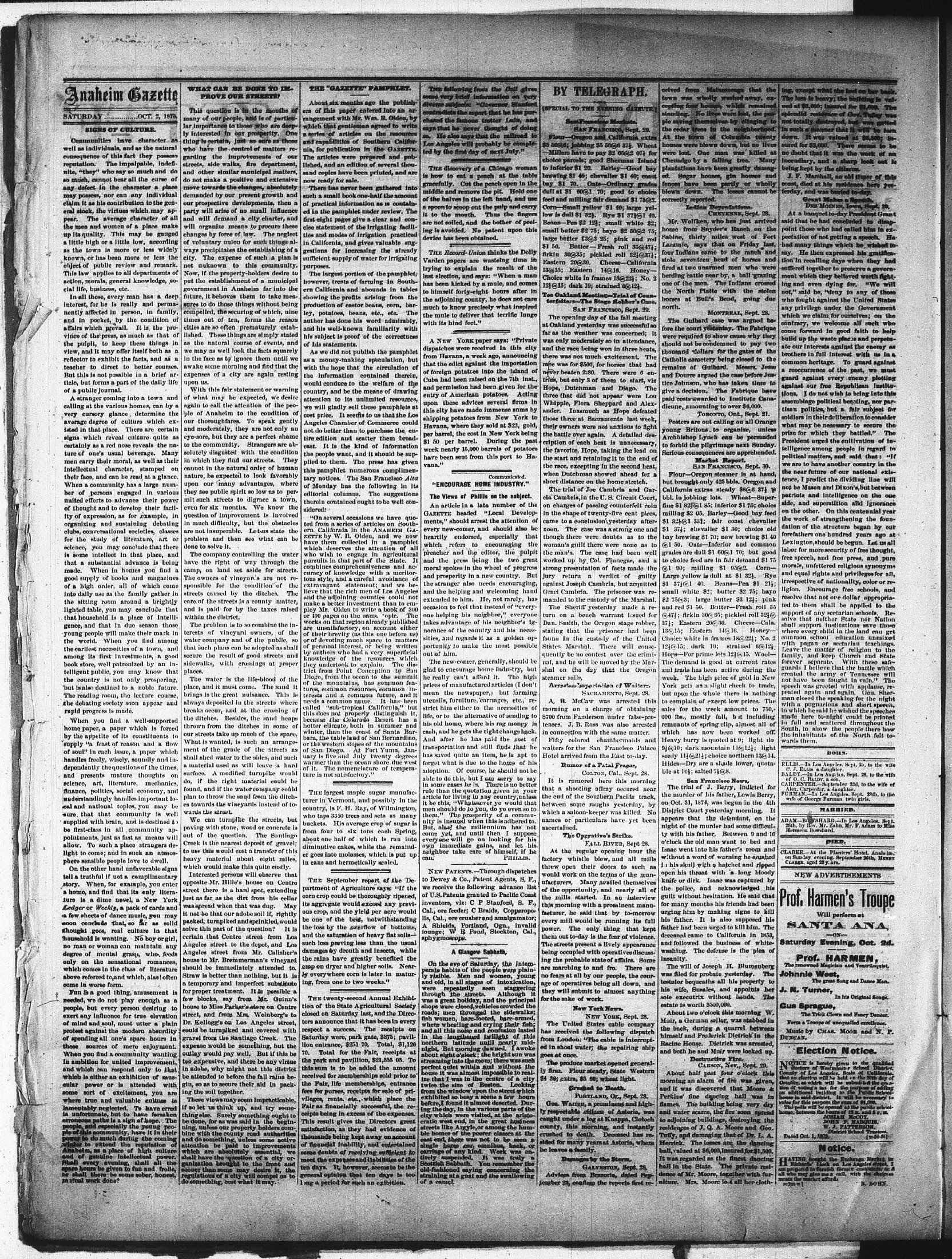
Searchable text
Anaheim Gazette
SATURDAY...OCT. 2, 1875.
SIGNS OF CULTURE.
Communities have character as well as individuals, and as the natural consequence of this fact they possess reputation. The impalpable, indefinite, "they" who say so much and do so much, cannot bear all the curse of any defect in the character a place may possess, nor can any individual claim it as his contribution to the general stock, the virtues which may appear. The average character of all the men and women of a place make up its quality. This may be gauged a little high or a little low, according as the town is more or less widely known, or has been more or less the object of public review and remark. This law applies to all departments of action, morals, general knowledge, social life, business, etc.
In all these, every man has a deep interest, for he is really and permanently affected in person, in family, and in pocket, by the condition of affairs which prevail. It is the province of the press, as much as that of the pulpit, to keep these things in view, and it may offer itself both as a reflector to exhibit the facts, and as a teacher to direct to better courses. But this is not possible in a brief article, but forms a part of the daily life of a public journal.
A stranger coming into a town and calling at the various homes, can by a very cursory glance determine the average degree of culture which existed in that place. There are certain signs which reveal culture quite as certainly as a red nose reveals the nature of one's usual beverage. Many men carry their moral, as well as their intellectual character, stamped on
WHAT CAN BE DONE TO IMPROVE OUR STREETS!
This question is in the mouths of many of our people, and is of particular importance to those who are deeply interested in our prosperity. One thing is certain, just so sure as those who have the control of matters regarding the improvements of our streets, side walks, fire department, and other similar municipal matters, do not make a positive and extensive move towards the changes, absolutely demanded by our present growth and our prospective developments, then a party will arise of no small influence and will demand a city charter, and will organize means to procure these changes by force of law. The neglect of voluntary union for such things always precipitates the establishing of a city. The expense of such a plan is not unknown to this community.
Now, if the property-holders desire to put the establishment of a municipal government in Anaheim far into the future, it behoves them to take measures to do those things without being compelled, the securing of which, nine times out of ten, forms the reason cities are so often prematurely established. These things are simply stated as the natural course of events, and we may as well look the facts squarely in the face as to ignore them until we awake some morning and find that the expenses of a city are again resting upon us.
With this fair statement or warning of what may be expected, we desire again to call the attention of the people of Anaheim to the condition of our thoroughfares. To speak gently and moderately, they are not only an eye-sore, but they are a perfect shame to the community. Strangers are absolutely disgusted with the condition in which they find our streets. They cannot in the natural order of human
But this is not possible in a brief article, but forms a part of the daily life of a public journal.
A stranger coming into a town and calling at the various homes, can by a very cursory glance determine the average degree of culture which existed in that place. There are certain signs which reveal culture quite as certainly as a red nose reveals the nature of one's usual beverage. Many men carry their moral, as well as their intellectual character, stamped on their face, and can be read at a glance. When a community has a large number of persons engaged in various united efforts to advance their power of thought and to develop their facility of expression, as for example, in organizing and sustaining debating clubs, conversational societies, classes for the study of literature, art or science, you may conclude that there is some intellect in that place, and that a substantial advance is being made. When in homes you find a good supply of books and magazines of a high order, all of which come into daily use as the family gather in the sitting room around a brightly lighted table, you may conclude that that household is a place of intelligence, and that in due season those young people will make their mark in the world. When you find among the earliest necessities of a town, and among its first investments, a good book store, well patronized by an intelligent public, you may know that the country is not only prospering, but is also destined to a noble future. The reading room, the lecture course, the debating society soon appear and rapid progress is made.
When you find a well-supported home paper, a paper which is forced by the appetite of its constituents to supply "a feast of reason and a flow of soul" in each issue, a paper which handles freely, wisely, soundly and independently the questions of the times, and presents mature thoughts on science, art, literature, mechanics, finance, politics, social economy, and understandingly handles important local and national topics, you may be sure that that community is well supplied with brain, and is destined to be first-class in all community appointments. Just as fast as means will allow. To such a place strangers delight to come; and in such an atmosphere sensible people love to dwell.
On the other hand unfavorable signs tell a truthful if not a complimentary story. When, for example, you enter expenses of a city are again resting upon us.
With this fair statement or warning of what may be expected, we desire again to call the attention of the people of Anaheim to the condition of our thoroughfares. To speak gently and moderately, they are not only an eye-sore, but they are a perfect shame to the community. Strangers are absolutely disgusted with the condition in which they find our streets. They cannot in the natural order of human nature, be expected to look favorably upon our many advantages, where they see public spirit so low as to permit such streets to digrace a town, even for six months. We know the question of improvement is involved in much difficulty, but the obstacles are not insuperable. Let us state the problem and then see what can be done to solve it.
The company controlling the water have the right of way through the camp, on land set aside for streets. The owners of vineyards are not responsible for the condition of the streets caused by the ditches. The care of the streets is a county matter, and is paid for by the taxes raised within the district.
The problem is to so combine the interests of vineyard owners, of the water company and of the public, so that such plans can be adopted as shall secure the result of good streets and sidewalks, with crossings at proper places.
The water is the life-blood of the place, and it must come. The sand it brings is the great nuisance. This is always deposited in the streets where breaks occur, and at the crossing of the ditches. Besides, the sand heaps thrown from the ditches in some of our streets take up much of the space. What is wanted, is such an arrangement of the grade of the streets as shall shed water to the sides, and such a material used as will leave a hard surface. A modified turnpike would do, if the right material could be found, and if the water company could plan to throw the sand from the ditches towards the vineyards instead of towards the street.
We can turnpike the streets, but paving with stone, wood or concrete is out of the question. The Santiago Creek is the nearest deposit of gravel; to use this would cost a transfer of this heavy material about eight miles, which would make this quite costly.
Interested persons will observe that opposite Mr. Hille's house on Centre street there is a hard spot extending
"On several occured from a series o'r California in ZETTE by W. R. C have them collect which deserves who wish to eng pursue in that p combines comprehensioy of knowledge style,and a extravagant state lie that the rich and the adjoining make a better invoil Mr. Olden ther or 400 pages on ther works on that reguare unsatisfactoryof their brevity (or or devoting muhof personal interestby authors who hie knowledge of tht they undertook ttrict from Point Diego,from othofthe mountainsurems common reertersand a connecnsa common rcalled "sub-tropiicthis does not propr because The Colder hotter elimate,bow winter than ther barn,the table landor the western slopeof San Diego.A January is five and J warmer than the cOf it.The nomenure is not satisfacf
finance, politics, social economy, and understandingly handles important local and national topics, you may be sure that that community is well supplied with brain, and is destined to be first-class in all community appointments, just as fast as means will allow. To such a place strangers delight to come; and in such an atmosphere sensible people love to dwell.
On the other hand unfavorable signs tell a truthful if not a complimentary story. When, for example, you enter a home, and find that its only literature is a dime novel, a New York Ledger or Weekly, a pack of cards and a few sheets of dance music, you may soon conclude that so far as solid thought goes, real culture in that household is wanting. No boy or girl, no man or woman can maintain any degree of mental grasp, who feeds only on the sensational romances, which comes in the class of literature above referred to, and which, alas! often come in worse form.
Fun is a good thing, amusement is needed, we do not play enough as a people, but every person desiring to exert any influence for true elevation of mind and soul, must utter a plain protest against the modern absurdity of spending all one's spare hours in these sources of mere enjoyment. When you find a community wanting in ambition for united improvement, and which can respond only to that which is either an exhibition of muscular power or is attended with some sort of excitement, you are where true and valuable culture is lamentably neglected. To have erred is unfortunate, but to have forsaken erroneous paths is a sign of hope. The people, and especially the young people of this community, have it in their power to do much during the coming winter to extend the reputation of Almaheim, as a place of high culture and of genuine intellectual power. Shall every evening, shall all the spare hours be given to fun and frolic, or shall there be some sober, honest, mutual work done?
We can turnpike the streets, but paving with stone, wood or concrete is out of the question. The Santiago Creek is the nearest deposit of gravel; to use this would cost a transfer of this heavy material about eight miles, which would make this quite costly.
Interested persons will observe that opposite Mr. Hille's house on Centre street there is a hard spot, extending just as far as the dirt from his cellar was spread when that was dug. May it not be that our adobe soil if, rightly packed, turnpiked and sprinkled, would solve this part of the question? It is certain that Centre street from Los Angeles street to the depot, and Los Angeles street from Mr. Calisher's house to Mr. Bremmerman's vineyard should be immediately attended to. Straw is better than nothing, but it is a temporary and imperfect substitute for proper treatment. It is possible a few blocks, say from Mr. Guinn's house to Miss Parker's store on Centre street, and from Mrs. Weinberg's to Dr. Kellogg's on Los Angeles street, could be turnpiked and covered with gravel from the Santiago Creek. The expense would be something, but the outlay would pay well. But if this be too expensive, and there be any virtue in adobe, why might not this district be attended to before the fall rains begin, so as to secure their aid in packing the soil together.
These views may seem impracticable, if so let us think up, and try something else. Surely something ought to be done, for as was said in the beginning, unless our property holders combine with the county road authorities and do something, unless some active attention be paid to improvements which are absolutely essential, we shall have the question of a city organization brought to the front and sooner than some may desire it, the regulations of a city will compel us to do something, cost what it may.
The largest manurer in Vermont, country, is F. H., who taps 3350 tree buckets. His ave. from four to six about one half of diminutive cakes, er goes into molasses in cans and herms.
The September department of Agriculture corn crop could be its aggregate worth ous crop, and the y be one of the best the loss by the sx and the saturation such loss proving damages by drought the rains have given crop on dryer and everywhere corning, from one to th
The twenty-second station of the State closed on Saturday tors announce that respect a success. Saturday were, pavilion entrance,$2570. Total for the park and pavilion this sum is to be received for membh the Fair, life men fees for purses, recvilleg renta stair Fair as financially ceplts being in exce This result gives satisfaction, as th thousands being kof financial inability some doubts of ro meet the expenses ten days. It how general opinion th long a period for m
THE "GAZETTE" PAMPHLET.
About six months ago the publishers of this paper entered into an arrangement with Mr. Wm. R. Olden, by which that gentleman agreed to write a series of articles on the resources and capabilities of Southern California, for publication in the GAZETTE. The articles were prepared and published, and an edition of several thousand copies have been printed, and are now ready for sale.
There has never been gathered into such a small book one-half the amount of practical information as is contained in the pamphlet under review. The first eight pages give a clear and concise statement of the irrigating facilities and modes of irrigation practiced in California, and gives valuable suggestions for increasing the already sufficient supply of water for irrigating purposes.
The largest portion of the pamphlet, however, treats of farming in Southern California and abounds in tables showing the profits arising from the production of castor beans, corn, barley, potatoes, beans, etc., etc. The author has done his word admirably, and his well-known familiarity with his subject is proof of the correctness of his statements.
As we did not publish the pamphlet as a money-making speculation, but with the hope that the circulation of the information contained therein, would conduce to the welfare of the country, and be the means of drawing attention to its unlimited resources, we will gladly sell these pamphlets at cost price. It seems to us that the Los Angeles Chamber of Commerce could not do better than to purchase the entire edition and scatter them broadcast. It is the kind of information the people want, and it should be supplied to them. The press has given this pamphlet numerous amplitudes.
The following from the Call gives some very brief information on very diverse subjects: "Governor Stanford contradicts the report that he has purchased the famous trotter Lain, and says that he never thought of doing so. He also says that the railroad to Los Angeles will probably be completed by the first day of next July."
The discovery of a Chicago woman is how to eat a peach at the table gracefully. Cut the peach open in the middle and remove the pit. Hold one of the halves in the left hand, and use a spoon to scoop out the pulp and carry it to the mouth. Thus the fingers are not soiled, and the bother of peeling is avoided. No patent upon this device has been obtained.
THE Record-Union thinks the Dolly Varden papers are wasteing time in trying to explain the result of the last election, and says: "When a man has been kicked by a mule, and comes to himself forty-eight hours after in the adjoining county, he does not care much to know precisely what inspired the mule to deliver that terrific lunge with its hind feet."
A New York paper says: "Private dispatches were received in this city from Havana, a week ago, announcing that the edict against the importation of foreign potatoes into the island of Cuba had been raised on the 7th inst., and permission had been given for the entry of American potatoes. Acting upon these advices several firms in this city have made immense sums by shipping potatoes from New York to Havana, where they sold at $22, gold, per barrel; the cost in New York being $150 per barrel. During the past week nearly 15,000 barrels of potatoes have been sent from this port to Havana."
the information contained therein, would conduce to the welfare of the country, and be the means of drawing attention to its unlimited resources, we will gladly sell these pamphlets at cost price. It seems to us that the Los Angeles Chamber of Commerce could not do better than to purchase the entire edition and scatter them broadcast. It is the kind of information the people want, and it should be supplied to them. The press has given this pamphlet numerous complimentary notices. The San Francisco Alta of Monday has the following in its editorial columns. The suggestions therein contained ought to be well considered:
"On several occasions we have quoted from a series of articles on Southern California in the Anaheim Gazette by W. R. Olden, and we now have them collected in a pamphlet which deserves the attention of all who wish to engage in agricultural pursuits in that part of the State. It combines comprehensiveness and accuracy of knowledge with a meritorious style, and a careful avoidance of extravagant statement; and we believe that the rich men of Los Angeles and the adjoining counties could not make a better investment than to employ Mr. Olden to write a book of 300 or 400 pages on the same topic. The works on that region already published are unsatisfactory, on account either of their brevity (as this one before us) or of devoting much space to matters of personal interest, or being written by authors who had a very superficial knowledge of the resources which they undertook to explain. The district from Point Conception to San Diego, from the ocean to the summit of the mountains, has common features, common resources, common interests and a common future, and it needs a common name. It has been called "sub-tropical California," but this does not properly distinguish it, because the Colorado Desert has a hotter climate, both in summer and winter, than the coast of Santa Barbara, the table land of San Bernardino, or the western slopes of the mountains of San Diego. At Fort Yuma, January is five and July twenty degrees warmer than the ocean shore due west of it. The nomenclature of temperature is not satisfactory."
The largest maple sugar manufacturer in Vermont, and possibly in the country, is F. H. Ray, of Wilmington, who taps 3350 trees and sets as many buckets. His average crop of sugar is from four to six tons each Spring, about one half of which is run into diminutive cakes, while the remainder goes into molasses, which is put up in cans and hermetically sealed.
The September report of the Department of Agriculture says: "If the information contained therein, would conduce to the welfare of the country, and be the means of drawing attention to its unlimited resources, we will gladly sell these pamphlets at cost price. It seems to us that the Los Angeles Chamber of Commerce could not do better than to purchase the entire edition and scatter them broadcast. It is the kind of information the people want, and it should be supplied to them. The press has given this pamphlet numerous complimentary notices. The San Francisco Alta of Monday has the following in its editorial columns. The suggestions therein contained ought to be well considered:
"On several occasions we have quoted from a series of articles on Southern California in the Anaheim Gazette by W. R. Olden, and we now have them collected in a pamphlet which deserves the attention of all who wish to engage in agricultural pursuits in that part of the State. It combines comprehensiveness and accuracy of knowledge with a meritorious style, and a careful avoidance of extravagant statement; and we believe that the rich men of Los Angeles and the adjoining counties could not make a better investment than to employ Mr. Olden to write a book of 300 or 400 pages on the same topic. The works on that region already published are unsatisfactory, on account either of their brevity (as this one before us) or of devoting much space to matters of personal interest, or being written by authors who had a very superficial knowledge of the resources which they undertook to explain. The district from Point Conception to San Diego, from the ocean to the summit of the mountains, has common features, common resources, common interests and a common future, and it needs a common name. It has been called "sub-tropical California," but this does not properly distinguish it, because the Colorado Desert has a hotter climate, both in summer and winter, than the coast of Santa Barbara, the table land of San Bernardino, or the western slopes of the mountains of San Diego. At Fort Yuma, January is five and July twenty degrees warmer than the ocean shore due west of it. The nomenclature of temperature is not satisfactory."
The article in a late number of the Gazette headed "Local Developments," should arrest the attention of every new-comer, and should also be heartily endorsed, especially that which refers to encouraging the preacher and the editor, the pulpit and the press being the two great moral spokes in the wheel of progress and prosperity in a new country. But the stranger also needs encouraging, and the helping and welcoming hand extended to him. He, not rarely, has occasion to feel that instead of "everyone helping his neighbor," everyone takes advantage of his neighbor's ignorance of the country and his necessities, and regards it as a golden opportunity to make the most possible out of him.
The new-comer, generally, should be glad to encourage home industry, but he really can't afford it. The high prices of manufactured articles (I don't mean the newspaper), but farming utensils, furniture, carriages, etc., restrict him either to the necessities of life, or to the alternative of sending to his old home, where his rag money is cash, and he gets right change back. And after he has paid the cost of transportation and still finds that he has saved quite an item, he is apt to forget what is due to the home of his adoption. Of course, he should not be able to do this, but I am sorry to say in some cases he is. There is no better rule than the quotation given in your article for living in any country, unless it be this: "Whatsoever ye would that men should do to you, do ye even so to them." The prosperity of a community is insured when this is adhered to. But, alas! the millennium has not come yet, and until then I suppose everyone will go on looking for his own immediate gains, and let his neighbor take care of himself, if he can.
NEW PATENTS.—Through dispatches to Dewey & Co., Patent Agents, S. F., we receive the following advance list
Communicated.
"ENCOURAGE HOME INDUSTRY."
The Views of Phillis on the subject.
An article in a late number of the Gazette headed "Local Developments," should arrest the attention of every new-comer, and should also be heartily endorsed, especially that which refers to encouraging the preacher and the editor, the pulpit and the press being the two great moral spokes in the wheel of progress and prosperity in a new country. But the stranger also needs encouraging, and the helping and welcoming hand extended to him. He, not rarely, has occasion to feel that instead of "everyone helping his neighbor," everyone takes advantage of his neighbor's ignorance of the country and his necessities, and regards it as a golden opportunity to make the most possible out of him.
The new-comer generally, should be glad to encourage home industry, but he really can't afford it. The high prices of manufactured articles (I don't mean the newspaper), but farming utensils, furniture, carriages, etc., restrict him either to the necessities of life, or to the alternative of sending to his old home, where his rag money is cash, and he gets right change back. And after he has paid the cost of transportation and still finds that he has saved quite an item, he is apt to forget what is due to the home of his adoption.
Of course, he should not be able to do this, but I am sorry to say in some cases he is. There is no better rule than the quotation given in your article for living in any country, unless it be this: "Whatsoever ye would that men should do to you, do ye even so to them." The prosperity of a community is insured when this is adhered to. But, alas! the millennium has not come yet, and until then I suppose everyone will go on looking for his own immediate gains, and let his neighbor take care of himself, if he can.
PHILLIS.
The trial of Joe Cambria and Garcia Cambria, in the U.S. Circuit Court, on charges of passing counterfelt coin in the shape of twenty-five cent pieces, came to a conclusion yesterday afternoon. The case was a strong one and though there were doubts as to the woman's guilt there were none as to the man's. The case had been well worked up by Col. Finnegas, and a strong presentation of facts made the jury return a verdict against Joseph Cambria, but acquitted Graci Cambria. The prisoner was remanded to the custody of the Marshal.
The Sheriff yesterday made a return on a bench warrant issued for Dan Smith. The Oregon stage robber stating that the prisoner had been found in the custody of the United States Marshal. There will consequently be no contest over criminal, and he will be moved by the Marshal steamer sails.
Arrests Importation of Waters.
SACRAMENTO, Sept. 28.
A B. McCaw was arrested this morning on a charge of obtaining $700 from Fanderson under false pretenses. J.B. Ross was also arrested in connection with the same matter.
Fifty colored chambermaids and waiters for the San Francisco Palace Hotel arrived from the East to-day.
Rumor of a Fatal Fragrant.
COLTON, Cal., Sept. 28.
It is rumored here this morning that a shooting affray occurred near the end of the Southern Pacific track between some roughs yesterday, by which a saloon-keeper was killed. No names or particulars have yet been ascertained.
The Operative's Strike.
FALL RIVER, Sept 28.
At the regular opening hour the factory whistle blew, and all mills threw open their doors to such as would work on the terms of the manufacturers. Many availed themselves of opportunity and nearly all
The largest maple sugar manufacturer in Vermont, and possibly in the country, is F. H. Ray, of Wilmington, who taps 3350 trees and sets as many buckets. His average crop of sugar is from four to six tons each Spring, about one half of which is run into diminutive cakes, while the remainder goes into molasses, which is put up in cans and hermetically sealed.
The September report of the Department of Agriculture says: "If the corn crop could be thoroughly ripened, its aggregate would exceed any previous crop, and the yield per acre would be one of the best, notwithstanding the loss by the overflow of bottoms, and the saturation of heavy flat soils—such loss proving less than the usual damages by drought and insects, while the rains have greatly benefited the crop on dryer and higher soils. Nearly everywhere corn is later in maturing, from one to two weeks."
The twenty-second Annual Exhibition of the State Agricultural Society closed on Saturday last, and the Directors announce that it has been in every respect a success. The receipts on Saturday were, park gate, $875; pavilion entrance, $251 70. Total, $1,126 70. Total for the Fair, receipts at the park and pavillion, $21,555 05. To this sum is to be added the amount received for memberships sold prior to the Fair, life memberships, entrance fees for purses, receipts for sale of privileges, rents etc., which place the Fair as financially successful, the receipts being in excess of the expenses. This result gives the Directors great satisfaction, as they had evidence of thousands being kept away on account of financial inability, and entertained some doubts of receiving sufficient to meet the expenses and liabilities of the ten days. It, however, seems to be the general opinion that ten days is too long a period for such an exhibition.
NEW PATENTS.—Through dispatches to Dewey & Co., Patent Agents, S. F., we receive the following advance list of U.S.Patents granted to Pacific Coast inventors, viz: C P Stanford, S. F., Cal., ore feeder; C Braids, Copperopolis, Cal., ore crusher and amalgamator; A Shields, Portland, Ogn., invalid lounge; W B Pond, Stockton, Cal., sphygmoscope.
A Glasgow Sabbath.
On the eye of Saturday, the intemperate habits of the people were plainly visible. Men and women, young and old, in all stages of intoxication, were repeatedly seen staggering through the streets. Although it was a great holiday, and the principal shops were closed, vehicles crowded the roads; men thronged the sidewalks; fish women, bare-footed, bare-armed, where wheeling and crying their fish; and all this noise and confusion lasted in the lengthened twilight of this northern latitude until nearly midnight. But morning dawned. I awoke about eight o'clock; the bright sun was streaming into the room; there was such perfect quiet within and without the house it was almost impossible to realize that I was in the centre of a city twice the size of Boston. Looking from the window upon the street which exhibited so busy a scene a few hours before, I found it almost deserted. During the day, in the various parts of the city which were visited, at the aristocratic west end, in the great business streets like Argyle, or among the humble homes of the poorer classes at the east end, there was not to be seen a single large car, omnibus, hack, or carriage of any kind. Work was entirely suspended. It was truly a Scottish Sabbath. You remember the old-fashioned saying concerning the straining at a gnat and the swallowing of a camel.
THE OPERATIVE'S STRIKE.
FALL RIVER, Sept 28.
At the regular opening hour the factory whistle blew, and all mills threw open their doors to such as would work on the terms of the manufacturers. Many availed themselves of the opportunity, and nearly all of the mills started. In an interview this morning with a prominent manufacturer, he said that by to-morrow every mill would be running its full power. The only thing that kept them out to-day is the fear of violence. The streets present a lively appearance being occupied with operatives discussing the probable state of affairs. Some are marching to and fro. There are no fears at all by our people, the courage of operatives being all down, and they will submit to almost anything for the sake of work.
NEW YORK NEWS.
NEW YORK, Sept. 28.
The United States cable company has received the following dispatch from London: "The cable is interrupted in shoal water; this repairing ship goes at once.
The produce market opened generally firm. Flour steady, State Western $4 30; extra, $5 60; wheat light.
GRASED TO DEATH.
PORTLAND, Or., Sept. 28.
Goe. Warren, a prominent and highly respectable citizen of Astoria, was caught under a log at Knappa, Clotoch county, this morning, and instantly crushed to death. Decensed has resided for many years at Astoria, where he leaves a family.
DAMAGED BY THE MARK.
GALVESTON, Sept. 28.
Advice from Brazoria, dated September 23, confirm the reports first re-
EGRAPH.
FEVERING GAZETTE
FACINCISCO, Sept. 29.
and California extra
$5 50@6 37$. Whent pay $2 05@2 07$ for Good Sherman Island Barley—Good bay reveller $1 40; const ordinary grades 70; good to choice air demand $1 75@2.
new $1 40; large yel- Rye $1 37@1 40.
small white $2;
bayo $2 50@2 75;
pink and red Fresh roll 35@47];
blanked roll 32@37};
Cheese—California 14@16. Honey—James 18@22}; No. 2 strained 6@12}.
Trial of Countage Robber's Cause.
FACINCISCO, Sept. 29.
Of the fall meeting day was successful so it was concerned; it only so in attendance, he won in three heats, with excitement. The for horses that had there were 6 end them to start, viz and Diago. The it appear were Lou Sheppard and Alexen as Hope defeated sacramento last week, not anxious to fight him. A detailed deseat is unnecessary, taking the lead on ning it to the end of ing in the second heat,
received from Malamora that the town was wholly washed away, excepting four houses, which remained standing. No lives were lost, the people saving themselves by clinging to the cedar trees in the neighborhood. At the town of Columbia twenty houses were blown down, but no lives were lost. One man was killed at Chenadgo by a falling tree. Many plantations have been greatly damaged. Sugar houses, gin houses and fences have been partly or wholly blown down. The losses cannot be correctly reported.
Indian Depredations.
CHEYENNE, Sept. 28.
Mr. Wolfken, who has just arrived home from Snyder's Ranch on the Sabine, thirty miles west of Fort Laramie, says that on Friday last, four Indians came to the ranch and stole seventeen head of horses and fired at two unarmed men who were herding cattle near by, a ball grazing one of the men. The Indians crossed the North Platte with the stolen horses at Bull's Bend, going due north.
MONTREAL, Sept. 28.
The Guibard case was argued before the court yesterday. The Fabrique were required to show cause why they should not be condemned to pay two thousand dollars for the gates of the Catholic cemetery being closed to the remains of Guibard. Messrs. Jesse and Dourre argued the case before Justice Johnson, who has taken time to give a decision. The Fabrique have paid costs awarded to Institute Canadienne, amounting to over $6,000.
TORONTO, Ont., Sept. 21.
Posters are out calling on all Orange young Britons to organize, unless Archbishop Lynch can be persuaded to forbid the pilgrimage next Sunday. Serious consequences are apprehended.
Market Report.
SAN FRANCISCO, Sept. 30.
ing, except what she had on her back. The loss is heavy; the building is valued at $5,000; insured for $1,000. The splendid residence of Gov. Tufley was not totally destroyed, but was gotten in such a manner that it will be turn down. It was valued at $6,000; insured for $3,000. There seems to be no doubt that it was the work of an incendiary, and a sharp look out is being kept by the citizens.
J. F. Marshall, an old timer of this const, died at his residence here yesterday, and was buried to-day.
Grant Makes a Speech.
DEN MOINE, Iowa, Sept. 31.
At a banquet to-day President Grant said that he had concluded to disapoint those who had called him in expectation of not getting a speech. He had many things which he wished to say. He then expressed his gratification in recalling days when they had suffered together to preserve a government which they believed worth fighting and even dying for. "We will not," said he, "deny to any of those who fought against the United States any privilege under the Government which we claim for ourselves; on the contrary, we welcome all such who come forward in good faith to help build up the waste places and perpetuate our interests against the enemy as brothers in full interest with us in a common heritage. To guard against a reoccurrence of the past, we must guard against every enemy plotting against our free Republican institutions. I do not wish to bring into this assemblage political boasting, nor partisan politics, but a fair subject for soldiers in their deliberation to consider what may be necessary to secure the prize for which they battled." The President urged the cultivation of intelligence among people in regard to political matters, and said that: "If we are to have another country in the
There were 6 entries of them to start, viz.
and Diago. The
last appear were Lou
Sheppard and Alexson as Hope defeated
Cambria and Gardine U.S. Circuit Court,
using counterfelt coin
centy-five cent pieces,
yesterday afterwas a strong one and
doubts as to the
fire were none as to
case had been well
finnegas, and a
man of facts made the
verdict of guilty
Cambria, but acquitted
The prisoner was restory of the Marshal.
yesterday made a rewarrant issued for
Oregon stage robber,
the prisoner had been
holly of the United
There will consetest over the crimime moved by the Marthat the Oregon
Nation of Walterz.
RAMENTO, Sept. 28.
He was arrested this
charge of obtaining
on under false-presence was also arrested
in the same matter.
Rechambermaids and
San Francisco Palace
in the East to-day.
Fatal Fragaz.
ROX, Cal., Sept. 28.
Here this morning
affray occurred near
Northern Pacific track,
throughs yesterday, by
peper was killed. No
dears have yet been
Live's Strike.
AL RIVER, Sept. 28.
For opening hour the
olew, and all mills
doors to such as
the terms of the manvailed themselves
and nearly all of
and Dourre argued the case before Justice Johnson, who has taken time to give a decision. The Fabrique have paid costs awarded to Institute Canadienne, amounting to over $6,000.
TORONTO, Ont., Sept. 21.
Posters are out calling on all Orange young Britons to organize, unless Archbishop Lynch can be persuaded to forbid the pilgrimage next Sunday. Serious consequences are apprehended.
Market Report.
SAN FRANCISCO, Sept. 30.
Flour—Oregon steamer is at hand,
but brought only 425 bbls. Oregon and California extras steady $6@6 37½ bbl. in jobbing lots. Wheat—Superfine $1 82½@1 85; Inferior $1 70; choice milling $2 05. Barley—Good bay feed $1 32½@1 33½; fair coast chevallier $1 37½; chevalier $1 30; choice old bay brewing $1 70; new brewing $1 40 @1 50. Oats—Inferior and common grades are dull $1 90@1 70; but good to choice feed are in fair demand $1 75 @1 90; milling $1 05@2 Corn—Large yellow is dull at $1 32½. Rye $1 37½@1 40. Beans—Pea $1 21¼; small white $2; butter $2 75; bayo $2 75@3; large butter $3 12½; pink and red $1 50. Butter—Fresh roll $47½; firkin $30@35; pickled roll $32½@37; Eastern $20@30. Cheese—Cala. 13@15; Eastern $14@16. Honey—Choice white in frames 18@22½; No. 2 12½@15; dark 10; strained 6@12½. Hops—For prime lots 12½@15. Wool—The demand is good at current rates and trade has been active during the week. The high price of gold in New York acts as a slight check to trade, but upon the whole there is nothing to complain of except low prices. The sales for the week amount to 750,-000 lbs., mostly fall, but including remnants of spring clip, almost all of which has now been worked off. Heavy burry is quoted at 9; light doy 9½@10; dark mountain 11½@12½; light seedy 11½@21½; choice northern 13½@14. Hides—Dry are a shade lower, quotable at 10½; salted 7½@8.
San Francisco News.
The trial of J. Berry, indicted for the murder of his father, Lewis Berry, on Oct. 31, 1874, was begun in the 4th District Court yesterday morning. It appears that the defendant, on the night of the murder had some difficulty with his father. Between 9 and 10 o'clock the old man want to bed and Isaac went into his father's room and without a word of warning he crushed in his skull with a hatchet and ripped open his throat with 'a long bloody knife or dirk. Isaac was captured by the police, and acknowledged his a recurrence of the past, we must guard against every enemy plotting against our free Republican institutions. I do not wish to bring into this assemblage political boasting, nor partisan politics, but a fair subject for soldiers in their deliberation to consider what may be necessary to secure the prize for which they battled." The President urged the cultivation of intelligence among people in regard to political matters, and said that: "If we are to have another country in the near future of our national existence, I predict the dividing line will not be Mason and Dixon's, but between patriots and intelligence on the one side, and superstition and ignorance on the other. On this centennial year the work of strengthening the foundation of the structure began by our forefathers one hundred years ago at Lexington, should be begun. Let us all labor for more security of free thought, free speech, and free press, and pure morals, unfettered religious synonyms and equal rights and privileges for all, irrespective of nationality, color or religion. Encourage free schools, and resolve that not one dollar appropriated to-them shall be applied to the support of any sectarian schools. Resolve that neither State nor Nation shall support institutions save those where every child in the land can get common school education unmixed with pagan or sectarian teachings. Leave the matter of religion to the family, and keep Church and State forever separate. With these safeguards I believe that the battle which created the army of Tennessee will not have been fought in vain." The speech was greeted with applause, repeated again and again. Gen. Sherman closed the speaking for the night with a pugnacious and short speech, in which he said he wished the speeches made here to-night could be printed. In full and scattered throughout the South, to show the people there how the inhabitants of the North felt towards them.
BOURN.
ELLIS.-In Los Angeles, Sept. 25, to the wife C.J. Ellen a daughter.
BALDY.-In Los Angeles, Sept. 28, to the wife of O.C. Baldy, a son.
CARPENTER.-September 23d, to the wife of Alex. Carpenter, a daughter.
FURMAN.-In Los Angeles, Sept. 28th, to the wife of George Purman twin girls.
MARRIED.
ADAM-BOWSHARD.-In Los Angeles, Sept. 28th, by Rev. Mr. Zahn, Mr. F. Adam to Miss Hermena Bowshard.
DIED.
CLARKE.-At the Planters' Hotel Anaheim;
on Sunday evening September 26th, Henry Clarke, aged 28 yrs.
NEW ADVERTISEMENTS
Prof. Harmen's Troupe
Will perform at
SANTA ANA
ON
Saturday Evening, Oct. 2d.
Prof. HARMEN,
The renowned Magician and Ventriloquist,
Johnnie West,
The great Song and Dance Man.
J. N. Turner,
In his Original Songs.
Cus Sprague,
The Trick Clown and Fancy Dancer.
Form a Troupe of unequalled excellence.
Music by CHAR. MOOR and N. P. DUNCAN.
Election Notice.
NOTICE is hereby given to the qualifiedECTORS of Westminster School District,
County of Los Angeles, State of California,
that an election will be held on the 20th day of October, at which will be submitted the question of voting a tax for the purpose of adding an additional building to the Public school-house in said district. It will be necessary to raise for this purpose the sum of $1,000.
This path will be opened as the public school-house between the boards of 12 M. and 8 S. M.
JOSIAH McCOY.
JOHN P. MARQUIS.
W. J. PATTERSON.
District School Trustees.
Dated Oct. 1, 1875.
Notice.
HAYING bought the Exchange Market in Richards' block on Los Angeles street. I am prepared to furnish former customers; at all who may give me a call, with the charges as means the market afforded.
R. BOHN.