anaheim-gazette 1875-09-25
Scanned page
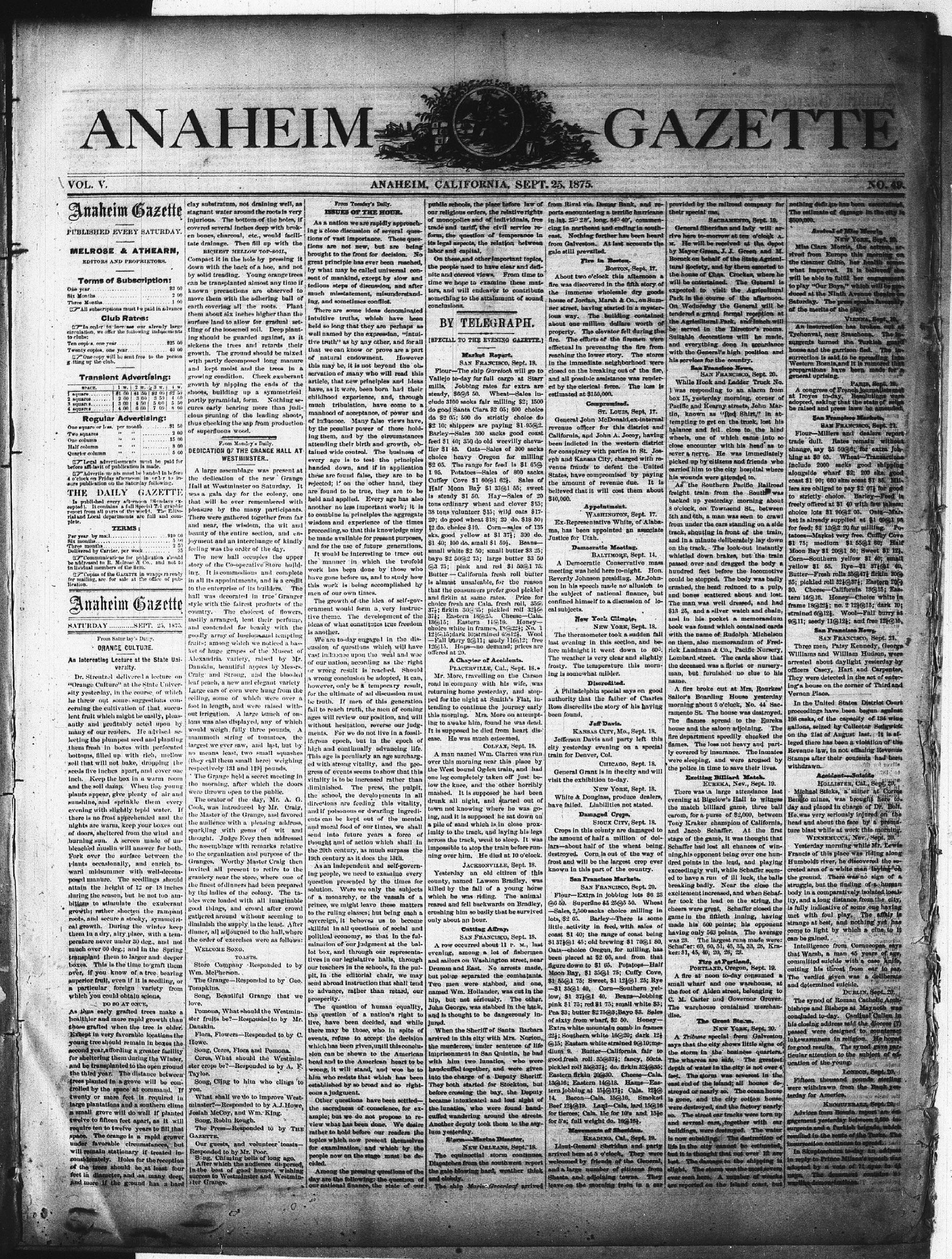
Searchable text
ANAHEIM
VOL. V.
Anaheim Gazette
PUBLISHED EVERY SATURDAY.
MELROSE & ATHEARN,
EDITORS AND PROPRIETORS.
Terms of Subscription:
One year ... $3 00
Six Months ... 2 00
Three Months ... 1 00
All subscriptions must be paid in advance
Club Rates:
In order to increase our already large circulation, we offer the following inducements to clubs:
Ten copies, one year ... $25 00
Twenty copies, one year ... 40 00
One copy will be sent free to the person getting up the club.
Transient Advertising:
SPACE. 1 w. 2 w. 3 w. 4 w.
1 square ... $1 00 $1 50 $2 00 $2 50
2 squares ... 2 00 3 00 3 50 4 00
3 squares ... 3 00 4 50 5 00 5 50
4 squares ... 4 00 6 00 7 00 8 00
Regular Advertising:
One square or less, per month ... $1 50
Two squares ... 2 00
One column ... 15 00
Half column ... 8 00
Quarter column ... 5 00
Legal advertisements must be paid for before all lavit of publication is made.
clay substratum, not draining well, as stagnant water around the roots is very injurious. The bottom of the holes, if covered several inches deep with broken bones, charcoal, etc., would facilitate drainage. Then fill up with the RICHEST MELLOW TOP-SOIL,
Compact it in the hole by pressing it down with the back of a hoe, and not by solid treading. Young orange trees can be transplanted almost any time if known precautions are observed to move them with the adhering ball of earth covering all the roots. Plant them about six inches higher than the surface land to allow for gradual settling of the loosened soil. Deep planting should be guarded against, as it sickens the trees and retards their growth. The ground should be mixed with partly decomposed long manure and kept moist and the trees in a growing condition. Check exuberant growth by nipping the ends of the shoots, building up a symmetrical partly pyramidal form. Nothing secures early bearing more than judicious pruning of the leading shoots, thus checking the sap from production of superfluous wood.
From Monday's Daily.
DEDICATION OF THE GRANGE HALL AT WESTMINSTER..
Transient Advertising:
SPACE 1 w. 2 w. 3 w. 4 w.
Regular Advertising:
One square or less, per month. $1 50
Two squares. $2 00
One column. $15 00
Half column. $8 00
Quarter column. $5 00
Legal advertisements must be paid for before all lavish publication is made.
Advertisements must be handed in before a o'clock on Friday afternoon in order to insure publication on the Saturday following.
THE DAILY GAZETTE
Is published every afternoon (Sundays excepted). It contains a full Special Tel graphic report from all parts of the world. The Editorial and Local departments are full and complete.
TERMS:
Per year by mail. $10 00
Bix months. $5 00
Three months. $2 50
Delivered by Carrier, per week. $25
Communications for publication should be addressed to R. Melrose & Co., and not to individual members of the firm.
Copies of the Gazette in wrappers ready for mailing, are for sale at the office of publication.
Anaheim Gazette
SATURDAY ... SEPT. 25, 1875.
From Saturday's Daily.
ORANGE CULTURE.
An interesting Lecture at the State University.
Dr. Streutzel delivered a lecture on "Orange Culture" at the State University yesterday, in the course of which he threw out some suggestions concerning the cultivation of that succulent fruit which might be easily, pleasantly and profitably acted upon by many of our readers. He advised selecting the plumpest seed and planting them fresh in boxes with perforated bottoms, filled up with rich, mellow soil that will not bake, dropping the seeds five inches apart, and cover one inch. Keep the box in a warm room and the soil damp. When the young plants appear, give plenty of air and sunshine, and sprinkle them every evening with slightly tepid water. If there is no frost apprehended and the nights are warm, keep your boxes out of doors, sheltered from the wind and burning sun. A screen made of unbleached muslin will answer for both. Fork over the surface between the plants occasionally, and enrich toward midsummer with well-decomposed manure. The seedlings should attain the height of 12 or 18 inches.
A large assemblage was present at the dedication of the new Grange Hall at Westminster on Saturday. It was a gala day for the colony, one that will be ever remembered with pleasure by the many participants. There were gathered together from far and near, the wisdom, the wit and beauty of the entire section, and enjoyment and an interchange of kindly feeling was the order of the day.
The new hall occupies the upper story of the Co-operative Store building. It is commodious and complete in all its appointments, and is a credit to the enterprise of its builders. The hall was decorated in true Granger style with the fairest products of the country. The choice of flowers, tastily arranged, lent their perfume, and contended for beauty with the goodly array of luscious and tempting fruits; among which we noticed a basket of huge grapes of the Museat of Alexandria variety, raised by Mr. Danskin, beautiful apples by Messrs Craig and Strong, and the blooded leaf peach, a new and elegant variety. Large ears of corn were hung from the ceiling, some of which were over a foot in length, and were raised without irrigation. A large bunch of onions was also displayed, any of which would weigh fully three pounds. A mammoth string of tomatoes, the largest we ever saw, and last, but by no means least, two small squashes (they call them small here) weighing respectively 131 and 1194 pounds.
The Grange held a secret meeting in the morning, after which the doors were thrown open to the public.
The orator of the day, Mr. A. G. Cook, was introduced by Mr. Craig, the Master of the Grange, and favored the audience with a pleasing address, sparkling with gems of wit and thought. Judge Evey then addressed the assembly with remarks relative to the organization and purpose of the Granges. Worthy Master Craig then invited all present to retire to the granary near the store, where one of the finest dinners had been prepared growing condition. Check exuberant growth by nipping the ends of the shoots, building up a symmetrical partly pyramidal form. Nothing secures early bearing more than judicious pruning of the leading shoots, thus checking the sap from production of superfluous wood.
From Monday's Daily.
DEDICATION OF THE GRANGE HALL AT WESTMINSTER...
A large assemblage was present at the dedication of the new Grange Hall at Westminster on Saturday. It was a gala day for the colony, one that will be ever remembered with pleasure by the many participants. There were gathered together from far and near, the wisdom, the wit and beauty of the entire section, and enjoyment and an interchange of kindly feeling was the order of the day.
The new hall occupies the upper story of the Co-operative Store building. It is commodious and complete in all its appointments, and is a credit to the enterprise of its builders. The hall was decorated in true Granger style with the fairest products of the country. The choice of flowers, tastily arranged, lent their perfume, and contended for beauty with the goodly array of luscious and tempting fruits; among which we noticed a basket of huge grapes of the Museat of Alexandria variety, raised by Mr. Danskin, beautiful apples by Messrs Craig and Strong, and the blooded leaf peach, a new and elegant variety. Large ears of corn were hung from the ceiling, some of which were over a foot in length, and were raised without irrigation. A large bunch of onions was also displayed, any of which would weigh fully three pounds. A mammoth string of tomatoes, the largest we ever saw, and last, but by no means least, two small squashes (they call them small here) weighing respectively 131 and 1194 pounds.
The Grange held a secret meeting in the morning, after which the doors were thrown open to the public.
The orator of the day, Mr. A. G. Cook, was introduced by Mr. Craig, the Master of the Grange, and favored the audience with a pleasing address, sparkling with gems of wit and thought. Judge Evey then addressed the assembly with remarks relative to the organization and purpose of the Granges. Worthy Master Craig then invited all present to retire to the granary near the store, where one of the finest dinners had been prepared growing condition. Check exuberant growth by nipping the ends of the shoots, building up a symmetrical partly pyramidal form. Nothing secures early bearing more than judicious pruning of the leading shoots, thus checking the sap from production of superfluous wood.
It would be in time for work has been done have gone before this work is being men of our own nature.
The growth of erosion would be active theme. The ideas of what coexist another.
We are to-day cession of question vast influence upon our nation, and or wrong result a wrong conclusion however only for the ultimate truth. If my fail to reach tru ages will review without hesitation For weiferous epoch high and continue This age is peculiar with strong vessity is to be diminished.T The school,the directions are fine and if poisonous ents can be kept and moral food send into future thought and of oldthe 20th century 19th century as another.
As an independent people we need question present solution.Were
plants appear, give plenty of air and sunshine, and sprinkle them every evening with slightly tepid water. If there is no frost apprehended and the nights are warm, keep your boxes out of doors, sheltered from the wind and burning sun. A screen made of unbleached muslin will answer for both. Fork over the surface between the plants occasionally, and enrich toward midsummer with well-decomposed manure. The seedlings should attain the height of 12 or 18 inches during the season, but be not too ambitious to stimulate the exuberant growth; rather shorten the rampant roots, and secure a stocky, symmetrical growth. During the winter keep them in a dry, alry place, with a temperature never under 30 deg., and not much over 60 deg.; and in the Spring transplant them to larger and deeper boxes. This is the time to graft them over, if you know of a tree bearing superior fruit, even if it is seedling, or a particular foreign variety from which you could obtain selons,
DO SO AT ONCE,
As thus early grafted trees make a healthier and more rapid growth than those grafted when the tree is older. Except in very favorable locations the young tree should remain in boxes the second year, affording a greater facility for sheltering them during the Winter, and be transplanted to the open ground the third year. The distance between trees planted in a grove will be controlled by the space at command. If twenty or more feet is required in large plantations and a southern clime a small grove will do well if planted twelve to fifteen feet apart, as it will require ten to twelve years to fill that space. The orange is a rapid grower under favorable circumstances, but will remain stationary if treated inconsiderately. Holes for the reception of the trees should be at least four feet in diameter, and as many deep, and more if the ground has a hard
The orator of the day, Mr. A. G. Cook, was introduced by Mr. Craig, the Master of the Grange, and favored the audience with a pleasing address, sparkling with gems of wit and thought. Judge Evey then addressed the assen;blage with remarks relative to the organization and purpose of the Granges. Worthy Master Craig then invited all present to retire to the granery near the store, where one of the finest of dinners had been prepared by the ladies of the colony. The tables were loaded with all imaginable good things, and crowd after crowd gathered around without seeming to diminish the supply in the least. After dinner, all adjourned to the hall, where the order of exercises were as follows:
WELCOME SONG.
TOASTS.
Store Company - Responded to by Wm. McPherson.
The Grange—Responded to by Geo. Tompkins.
Song, Beautiful Grange that we love.
Pomona, What should the Westminster fruits be?—Responded to by Mr. Danskin.
Flora, Flowers—Responded to by C. Howe.
Song, Ceres, Flora and Pomona.
Ceres, What should the Westminster crops be?—Responded to by A. F. Taylor.
Song, Cling to him who clings to you.
What shall we do to improve Westminster?—Responded to by A.J.Howe, Josiah McCoy, and Wm.-King.
Song, Robin Rough.
The Press—Responded to by THE GAZETTE.
Our guests, and volunteer toasts—Responded to by Mr. Poor.
Song, Chiming bells of long ago.
After which the audience dispersed, in the best of good humor, wishing success to Westminster and Westminster Grange.
EIM GA
ANAHEIM, CALIFORNIA, SEPT. 25, 1875.
From Tuesday's Daily.
ISSUES OF THE HOUR.
As a nation we are rapidly approaching a close discussion of several questions of vast importance. These questions are not new, but are being brought to the front for decision. No great principle has ever been reached, by what may be called universal consent of mankind, except by slow and tedious steps of discussion, and after much misstatement, misunderstanding, and sometimes conflict.
There are some ideas denominated intuitive truths, which have been held so long that they are perhaps as well named by the expression, "intuitive truth" as by any other, and for all that we can know or prove are a part of natural endowment. However this may be, it is not beyond the observation of many who will read this article, that new principles and ideas have, as it were, been born had their childhood experience, and, through much tribulation, have come to a manhood of acceptance, of power and of influence. Many false views have, by the popular power of those holding them, and by the circumstances attending their birth and growth, obtained wide control. The business of every age is to test the principles handed down, and if in application public schools, the place before law of our religious orders, the relative rights of monopolies and of individuals, free trade and tariff, the civil service reform, the question of temperance in its legal aspects, the relation between labor and capital.
On these, and other important topics, the people need to have clear and definite and correct views. From time to time we hope to examine these matters, and will endeavor to contribute something to the attainment of sound conclusions.
BY TELEGRAPH.
[SPECIAL TO THE EVENING GAZETTE.]
Market Report.
SAN FRANCISCO, Sept. 18.
Flour—The ship Gareloch will go to Vallejo to-day for full cargo at Starr mills. Jobbing rates for extra are steady, $6@6 50. Wheat—Sales include 3100 sacks fair milling $2; 1500 do good Santa Clara $2 05; 600 choice do $2 05; 500 do striptly choice do $2 10; shippers are paying $1.95@2. Barley—Sales 300 sacks good coast feed $1 40; 350 do old weevilly chevallier $1 45. Oats—Sales of 300 sacks choice heavy Oregon for milling $2 05. The range for feed is $1 05@
from Rival via Danger Bank, and reports encountering a terrible hurricane in lat. 25°28′, long. 84°40′, commencing in northeast and ending in southeast. Nothing further has been heard from Galveston. At last accounts the gale still prevailed.
Fire in Boston.
Boston, Sept. 17.
About two o'clock this afternoon a fire was discovered in the fifth story of the immense wholesale dry goods house of Jordan, Marsh & Co., on Summer street, having started in a mysterious way. The building contained about one million dollars worth of property. The elevator fell during the fire. The efforts of the firemen were effectual in preventing the fire from reaching the lower story. The stores in the immediate neighborhood were closed on the breaking out of the fire, and all possible assistance was rendered by the clerical force. The loss is estimated at $150,000.
Compromised.
St. Louis, Sept. 17.
General John McDonald, ex-internal revenue officer for this district and California, and John A. Jocoy, having been indicted in the western district for conspiracy with parties in St. Joseph and Kansas City, charged with revenue frauds to defeat the United
servation of many who will read this article, that new principles and ideas have, as it were, been born had their childhood experience, and, through much tribulation, have come to a manhood of acceptance, of power and of influence. Many false views have, by the peculiar power of those holding them, and by the circumstances attending their birth and growth, obtained wide control. The business of every age is to test the principles handed down, and if in application these are found false, they are to be rejected; if on the other hand, they are found to be true, they are to be held and applied. Every age has also another no less important work; it is to combine in principles the aggregate wisdom and experience of the times preceding, so that this knowledge may be made available for present purposes, and for the use of future generations.
It would be interesting to trace out the manner in which the twofold work has been done by those who have gone before us, and to study how this work is being accomplished by men of our own times.
The growth of the idea of self-government would form a very instructive theme. The development of the ideas of what constitutes true freedom is another.
We are to-day engaged in the discussion of questions which will have vast influence upon the weal and woe of our nation, according as the right or wrong result is reached. Should a wrong conclusion be adopted, it can, however, only be a temporary result, for the ultimate of all discussion must be truth. If men of this generation fail to reach truth, the men of coming ages will review our position, and will without hesitation, reverse our judgments. For we do not live in a fossiliferous epoch, but in the epoch of high and continually advancing life. This age is peculiarly an age surcharged with strong vitality, and the progress of events seems to show that this vitality is to be increased rather than diminished. The press, the pulpit, the school, the developments in all directions are feeding this vitality, and if poisonous or dwarfing ingredients can be kept out of the mental and moral food of our times, we shall send into future years a force of thought and action which shall in the 20th century, as much surpass the 19th century as it does the 13th.
As an independent and self-governing people, we need to examine every question presented by the times for solution. Were we only the subjects
Flour—The ship Garetoch will go to Vallejo to-day for full cargo at Starr mills. Jobbing rates for extra are steady, $6@350. Wheat—Sales include 3100 sacks fair milling $2; 1500 do good Santa Clara $205; 600 choice do $205; 500 do striotly choice do $210; shippers are paying $1.95@2. Barley—Sales 300 sacks good coast feed $140; 350 do old weevilly cheveller $145. Oats—Sales of 300 sacks choice heavy Oregon for milling $205. The range for feed is $165@195. Potatoes—Sales of 800 sacks Cuffey Cove $160@162. Sales of Half Moon Bay $133@155; sweet is steady $150. Hay—Sales of 20 tons ordinary wheat and clover $15; 38 tons volunteer $15; wild oats $17-20; do good wheat $18; 20 do. $1850) 12 do. choice $19. Corn—sales of 135 skins, good yellow at $137; 300 do. $140; 100 do. small $159. Beans—small white $250; small butter $225; bayo $250@275; large butter $350@375; pink and red $150@175. Butter — California fresh roll butter is almost unsaleable, for the reason that the consumers prefer good pickled and firkin at same rates. Price for choice fresh are Cala. fresh roll, 35@377; firkin 30@355; pickled roll 32@377; Eastern 18@255. Cheese—Cala. 13@15; Eastern 14@19. Honey—choice white in frames, 18@224; No. 112@15; dark 10; strained 6@124. Wool—Fall burry 9@11; spunly 11@12; free 12@15. Hops—no demand; prices are offered at 20.
A Chapter of Accidents.
PLACERVILLE, Cal., Sept. 18.
Mr. More, travelling on the Carson road in company with his wife, was returning home yesterday, and stopped for the night at Smith's Flat, intending to continue the journey early this morning. Mrs. More on attempting to awake him, found he was dead. It is supposed he died from heart disease. He was much esteemed.
COLFAX, Sept. 18.
A man named Wm. Clarren was run over this morning near this place by the Westbound Oglen train, and had one leg completely taken off just below the knee, and the other horribly mashed. It is supposed he had been drunk all night, and started out of town not knowing where he was going, and it is supposed he sat down on a pile of sand which is in close proximity to the track, and laying his legs across the track, went to sleep. It was impossible to stop the train before running over him. He died at 10 o'clock.
JACKSONVILLE, Sept. 18.
Yesterday an old citizen of this county, named Lawson Bradley, was killed by the fall of a young horse closed on the breaking out of the fire, and all possible assistance was rendered by the clerical force. The loss is estimated at $150,000.
Compromised.
ST. LOUIS, Sept. 17.
General John McDonald, ex-internal revenue officer for this district and California, and John A. Jocoy, having been indicted in the western district for conspiracy with parties in St. Joseph and Kansas City, charged with revenue frauds to defeat the United States, have compromised by paying the amount of revenue due. It is believed that it will cost them about $40,000.
Appointment.
WASHINGTON, Sept. 17.
Ex-Representative White, of Alabama, has been appointed an associate Justice for Utah.
Democratic Meeting.
BALTIMORE, Sept. 14.
A Democratic Conservative mass meeting was held here to-night. Hon. Reverly Johnson presiding. Mr.Johnson in his speech made no allusion to the subject of national finance, but confined himself to a discussion of local subjects.
New York Climate.
NEW YORK, Sept. 18.
The thermometer took a sudden fall last evening in this section, and before midnight it went down to 60°. The weather is very clear and slightly frosty. The temperature this morning is somewhat milder.
Discredited.
A Philadelphia special says on good authority that the father of Charles Ross discredits the story of his having been found.
Jeff Davis.
KANSAS CITY, Mo., Sept. 18.
Jefferson Davis and party left this city yesterday evening on a special train for Denver, Col.
CHICAGO, Sept. 18.
General Grant is in the city and will visit the exhibition to-day.
NEW YORK, Sept. 18.
White & Douglass, produce dealers, have failed. Liabilities not stated.
Damaged Crops.
SIoux CITY, Sept. 18.
Crops in this county are damaged to the amount of half a million of dollars—about half of the wheat being destroyed. Corn is out of the way of frost and will be the largest crop ever known in this part of the country.
San Francisco Markets.
SAN FRANCISCO, Sept. 20.
the school, the developments in all directions are feeding this vitality,
and if poisonous or dwarfing ingredients can be kept out of the mental and moral food of our times, we shall send into future years a force of thought and of action which shall in the 20th century, as much surpass the 19th century as it does the 13th.
As an independent and self-governing people, we need to examine every question presented by the times for solution. Were we only the subjects of a monarchy, or the vassals of a prince, we might leave these matters to the ruling classes; but being each a sovereign, it behoves us to become skillful in all questions of social and political economy, so that in the fulmination of our judgment at the ballot box, and through our representatives in our legislative halls, through our teachers in the schools, in the pulpit, in the editorial chair, we may send abroad instruction that shall tend to advance, rather than retard, our prosperity.
The question of human equality, the question of a nation's right to live, have been decided, and while there may be those who in spite of events, refuse to accept the decision which has been given, until this conclusion can be shown to the American head and to the American heart to be wrong, it will stand, and woe be to him who resists that which has been established by so broad and so righteous a judgment.
Other questions have been settled—the sacredness of conscience, for example; but we do not propose to review what has been done. We desire rather to hold before our readers the topics which now present themselves for examination, and which by the people now on the stage must be decided.
Among the pressing questions of the day are the following: the question of our national finance, the state of our
It is supposed he had been drunk all night, and started out of town not knowing where he was going, and it is supposed he sat down on a pile of sand which is in close proximity to the track, and laying his legs across the track, went to sleep. It was impossible to stop the train before running over him. He died at 10 o'clock.
JACKSONVILLE, Sept. 18.
Yesterday an old citizen of this county, named Lawson Bradley, was killed by the fall of a young horse which he was riding. The animal reared and fell backwards on Bradley, crushing him so badly that he survived only about an hour.
Cutting Affray,
SAN FRANCISCO, Sept. 18.
A row occurred about 11 P.M., last evening, among a lot of fishermen and sailors on Washington street, near Drummond and East. No arrests made, but police separated the combatants. Two men were stabbed, and one, named Wm. Hollander, was cut in the hip, but not seriously. The other, John George, was stabbed in the back, and is thought to be dangerously injured.
When the Sheriff of Santa Barbara arrived in this city with Mrs. Norton, the murderess, under sentence of life imprisonment in San Quintin, he had with him two lunatics, who were handcuffed together, and were given into the charge of a Deputy Sheriff. They both started for Stockton, but before crossing the bay, the Deputy became intoxicated and lost sight of the lunatics, who were found handcuffed wandering around the streets. Another deputy took them to the asylum yesterday.
STORM—Marina Dimaster,
NEW ORLEANS, Sept. 18.
The equinoctial storm continues. Dispatches from the southwest report the gale blowing hard, weather thick and cloudy.
The ship Marie-Greerleaf arrived
White & Douglass, produce dealers, have failed. Liabilities not stated.
Damaged Crops,
SIoux City, Sept. 18.
Crops in this county are damaged to the amount of half a million of dollars—about half of the wheat being destroyed. Corn is out of the way of frost and will be the largest crop ever known in this part of the country.
San Francisco Markets,
SAN FRANCISCO, Sept. 20.
Flour—Extra in jobbing lots $6 25 @6 50. Superfine $5 25@5 50. Wheat—Sales, 2,500 sacks choice milling in lots, $2 05. Barley—There is some little activity in feed, with sales of coast $1 40; the range of coast being $1 37@1 45; old brewing $1 70@1 80. Oats—choice Oregon, for milling, has been placed at $2 05, and from that figure down to $1 65. Potatoes—Half Moon Bay, $1 35@1 75; Cuffy Cove, $1 55@1 75; Sweet, $1 12@1 25; Rye—$1 35@1 49. Corn—Southern yellow, $1 37@1 40. Beans—Jobbing pink $1 75; red $1 75; small white $3; Pea $3; butter $2 75@3; Bayo $3. Sales of sixty from wharf, $2 50. Honey—Extra white mountain comb in frames 22%; Southern white 19@20; dark 12@15; Eastern white strained 9@10; medium 9. Butter—California fair to good fresh roll. 35@37%; fancy, 50cts pickled roll. 35@37%; do. firkin 32@35; Eastern firkin 20@30. Cheese—Cala. 13@18; Eastern 14@18. Hams—Eastern jobbing at 15@17%; Cala. 12@14. Bacon—Cala. 15@16. Smoked Beef 12@19. Lard—Cala. lard 15@16 for tliers; Cala. 15e for 10's and 15'e for 5'e; full weight do. 19@16'.
Movements of Sherridan.
READING, Cal., Sept. 19.
Liaut-General Sheridan and party arrived here at 5 o'clock. They were welcomed by friends of the General, and a large number of citizens from Shanta and adjoining towns. They leave on the morning train in a car
GAZETTE
NO. 49.
Danger Bank, and reing a terrible hurricane
long. 84° 40', comment and ending in southfurther has been heard
At last accounts the
led.
Boston,
Boston, Sept. 17.
Lock this afternoon a
red in the fifth story of
wholesale dry goods
Marah & Co., on Summing started in a mysterbuilding contained
on dollars worth of
elevator fell during the
s of the firemen were
venting the fire from
ever story. The stores
the neighborhood were
breaking out of the fire,
assistance was renderal force. The loss is
50,000.
St. Louis, Sept. 17.
McDonald, ex-internal
for this district and
John A. Jocoy, having
in the western district
with parties in St. JosCity, charged with redefeat the United
provided by the railroad company for
their special use.
SACRAMENTO, Sept. 19.
General Sheridan and lady will arrive here to-morrow at ten o'clock a.m.
He will be received at the depot
by Mayor Green, J. I. Green and M.
Bornck on behalf of the State Agricultural Society, and by them escorted to
the house of Chas. Crocken, where he
will be entertained. The General is
expected to visit the Agricultural
Park in the course of the afternoon.
On Wednesday the General will be tendered a grand formal reception at
the Agricultural Park, and lunch will
be served in the Director's rooms.
Suitable decorations will be made,
and everything done in accordance
with the General's high position and
his services for the country.
San Francisco News,
SAN FRANCISCO, Sept. 20.
While Hook and Ladder Truck No.
I was responding to an alarm from box 15, yesterday morning, corner of Pacific and Kearny streets, John Martin, known as "Red Shirt," in attempt to get on the truck, lost his balance and fell close to the hind wheels, one of which came into so close encounter with his head as to sever a nerve. He was immediately picked up by citizens and friends who carried him to the city hospital where nothing deflite has been entertained.
The estimate of damage in the city is $500,000.
Arrival of Miss Morrison,
NEW YORK, Sept. 23.
Miss Clara Morris, the actress, arrived from Europe this morning on the steamer Celtic, her health somewhat improved. It is believed she will be able to fulfill her engagement to play "Our Boys," which will be produced at the Ninth Avenue theatre on Saturday. The press speaks favourably of the merits of the play.
Vienna, Sept. 18.
An insurrection has broken out of Tychoval, near Sraschona. The insurgents burned the Turkish guard house and the garrison sled. The insurrection is said to be spreading into Western Bosnia, and it is rumored that preparations have been made for a general uprising.
Paris, Sept. 18.
A congress of French journalists met at Iroyes to-day. Resolutions were adopted, asking that the state of seige be raised and press laws be amended.
San Francisco News,
SAN FRANCISCO, Sept. 21.
Flour—Millers and dealers report trade dull. Rates remain without change, say $5 50@6; for extra jobbing at $0 05. Wheat—Transactions include 2000 snacks good shipping
While Hook and Ladder Truck No. 1 was responding to an alarm from box 15, yesterday morning, corner of Pacific and Kearny streets, John Martin, known as "Red Shirt," in attempting to get on the truck, lost his balance and fell close to the hind wheels, one of which came into so close encounter with his head as to sever a nerve. He was immediately picked up by citizens and friends who carried him to the city hospital where his wounds were attended to.
As the Southern Pacific Railroad freight train from the South was backed up yesterday morning about 8 o'clock, on Townsend St., between 5th and 6th, a man was seen to crawl from under the cars standing on a side track, shouting in front of the train, and in a minute deliberately lay down on the track. The look-out instantly whistled down brakes, but the train passed over and dragged the body a hundred feet before the locomotive could be stopped. The body was badly crushed, the head reduced to a pulp, and bones scattered about and lost. The man was well dressed, and had $13 25, and a silver watch and chain, and in his pocket a memorandum book was found which contained cards with the name of Rudolph Michelson on them, also memorandum of Fredrick Laudman & Co., Pacific Nursery, Lombard street. The cards show that the deceased was a florist or nursery-man, but furnished no clue to his name.
A fire broke out at Mrs. Rourkes' Sailor's Boarding House yesterday morning about 5 o'clock, No. 44 Sacramento St. The house was destroyed. The flames spread to the Eureka house and the saloon adjoining. The fire department speedily checked the flames. The loss not heavy and partly covered by insurance. The inmates were sleeping, and were aroused by the police in time to save their lives.
Exciting Billiard Match.
EUREKA, Nev., Sept. 19.
There was a large attendance last evening at Bigelow's Hall to witness the match billiard game, three ball carom, for a purse of $2,000, between Tony Kraker champion of California, and Jacob Schaffer. At the first stage of the game, it was thought that Schaffer had lost all chances of winning, his opponent being over one hundred points in the lead, and playing exceedingly well, while Schaffer seemed to have a run of ill luck, the balls breaking badly. Near the close the preparations have been made for a general uprising.
Paris, Sept. 18.
A congress of French journalists met at Iroyes to-day. Resolutions were adopted, asking that the state of France be raised and press laws be amended.
San Francisco Market.
SAN FRANCISCO, Sept. 21.
Flour—Millers and dealers report trade dull. Rates remain without change, say $5 50@6; for extra jobbing at $0 05. Wheat—Transactions include 2000 sacks good shipping alongside wharf $2; 200 sks good coast $1 90; 060 sks coast $1 95. Millers are obliged to pay $2 07; for good to strictly choice. Barley is freely offered at $1 40 with few takings; choice lots $1 90@2 05. Oats—Market is already supplied at $1 60@1 94 for feed; $2 12@2 20 for milling. Potatoes—Market very free. Cuffray Cove $1 75; medium $1 55@1 80; Half Moon Bay $1 20@1 50; Sweet $1 12; Corn—Southern yellow $1 40; small yellow $1 55. Rye—$1 37@1 40; Butter—Fresh rolls 85@47; firkin 30@35; pickled roll 32@37; Eastern 20@30. Cheese—California 13@15; Eastern 14@10. Honey—Choice white in frame 18@22; no. 2 12@15; dark 10; strained 0@12). Wool—Fall burry at 9@11; seedy 11@12); and free 12@15.
San Francisco News.
SAN FRANCISCO, Sept. 21.
Three men, Patsy Kennedy, George Williams and William Hudson, were arrested about daylight yesterday by officers Casey, Hart and Carpenter. They were detected in the act of entering a house on the corner of Third and Vernon Place.
In the United States District Court proceedings have been begun against 108 casks, of the capacity of 134 wine gallons, seized by Collector Sedgwick on the 21st of August last. It is alleged there has been a violation of the Revenue law, in not offending Revenue Stamps after their contents had been withdrawn.
Accident—Suicide.
HOLLISTER, Cal., Sept. 20.
Michael Sticks, a miner at Correa Benito mines, was brought here today and placed in charge of Dr. Bolt. He was very seriously injured on the head and about the face by a premature blast while at work this morning.
WINNEMUCCA, Nev., Sept. 20.
Yesterday morning while Mr. Lewis Francis of this place was riding along Humboldt river, he discovered the secreted arm of a white man laying on the ground. There was no sign of a struggle, but the finding of a human
There was a large attendance last evening at Bigelow's Hall to witness the match billiard game, three ball carom, for a purse of $2,000, between Tony Kraker champion of California, and Jacob Schaffer. At the first stage of the game, it was thought that Schaffer had lost all chances of winning, his opponent being over one hundred points in the lead, and playing exceedingly well, while Schaffer seemed to have a run of ill luck, the balls breaking badly. Near the close the excitement increased, and when Schaffer took the lead on the string, the cheers were great. Schaffer closed the game in the fifth inning, having made his 600 points; his opponent having only 563 points. The average was 23. The largest runs made were: Schaffer: 69, 60, 51, 46, 35, 33, 28, Kraker: 31, 45, 40, 20, 28, 23.
Fire at Portland,
PORTLAND, Oregon, Sept. 19.
A fire at noon to-day consumed a small wharf and one warehouse, at the foot of Alden street, belonging to C. M. Carter and Governor Grover. The warehouse contained merchandise.
The Great Storm.
NEW YORK, Sept. 20.
A Tribune special from Galveston says that the city shows little signs of the storm in the business quarters. The wharves are safe. The greatest depth of water in the city is not over 4 feet. The storm was severe in the east end of the island; all houses destroyed or nearly so. The ocean house is gone, and the city cotton house were destroyed, and the factory nearly so. The street car tracks were torn up and several cars together with car buildings, were destroyed. The water is now subduing. The destruction of life in the city cannot be estimated, but it is thought that not over 12 are lost. The damage to the shipping is slight. The storm was the most severe ever seen here. A number of wrecks are reported on the island coast, but
Michael Stokes, a miner at Correa Bengo mines, was brought here today and placed in charge of Dr. Bolt. He was very seriously injured on the head and about the face by a premature blast while at work this morning.
WINNEMUCCA, Nev., Sept. 20.
Yesterday morning while Mr. Lewis Francis of this place was riding along Humboldt river, he discovered the secreted arm of a white man laying on the ground. There was no sign of a struggle, but the finding of a human body in a comparatively isolated locality, and a long distance from the city, is fully indicative of some one having met with foul play. The affair is strange at best, and nothing yet has come to light by which a clue to it can be gained.
Intelligence from Cornucopia says that Warsh, a man 45 years of age committed suicide with a case knife, cutting his throat from ear to ear. The verdict given was a deliberate and determined suicide.
DUBLIN, Sept. 20.
The synod of Roman Catholic Archbishops and Bishops at Maynoth was concluded to-day. Cardinal Calton in his closing address said the doctrine (7) passed were designed to counteract lukewarmness in religion. He hoped for good results. The synod gave particular attention to the subject of education of the young.
LONDON, Sept. 20.
Fifteen thousand pounds sterling were withdrawn from the Bank yesterday for America.
KRONMERALZ, Sept. 20.
Advice from Banns report an engagement yesterday between 2,600 insurgents and a Turkish brigade, which resulted in the rout of the Turks. The insurrection continues to spread.
In Shiptonburgh today an address in reply to Prince Milanus's speech was adopted by a vote of 71 years to 41 nays. The document contains no warlike demonstrations.