anaheim-gazette 1875-07-24
Scanned page
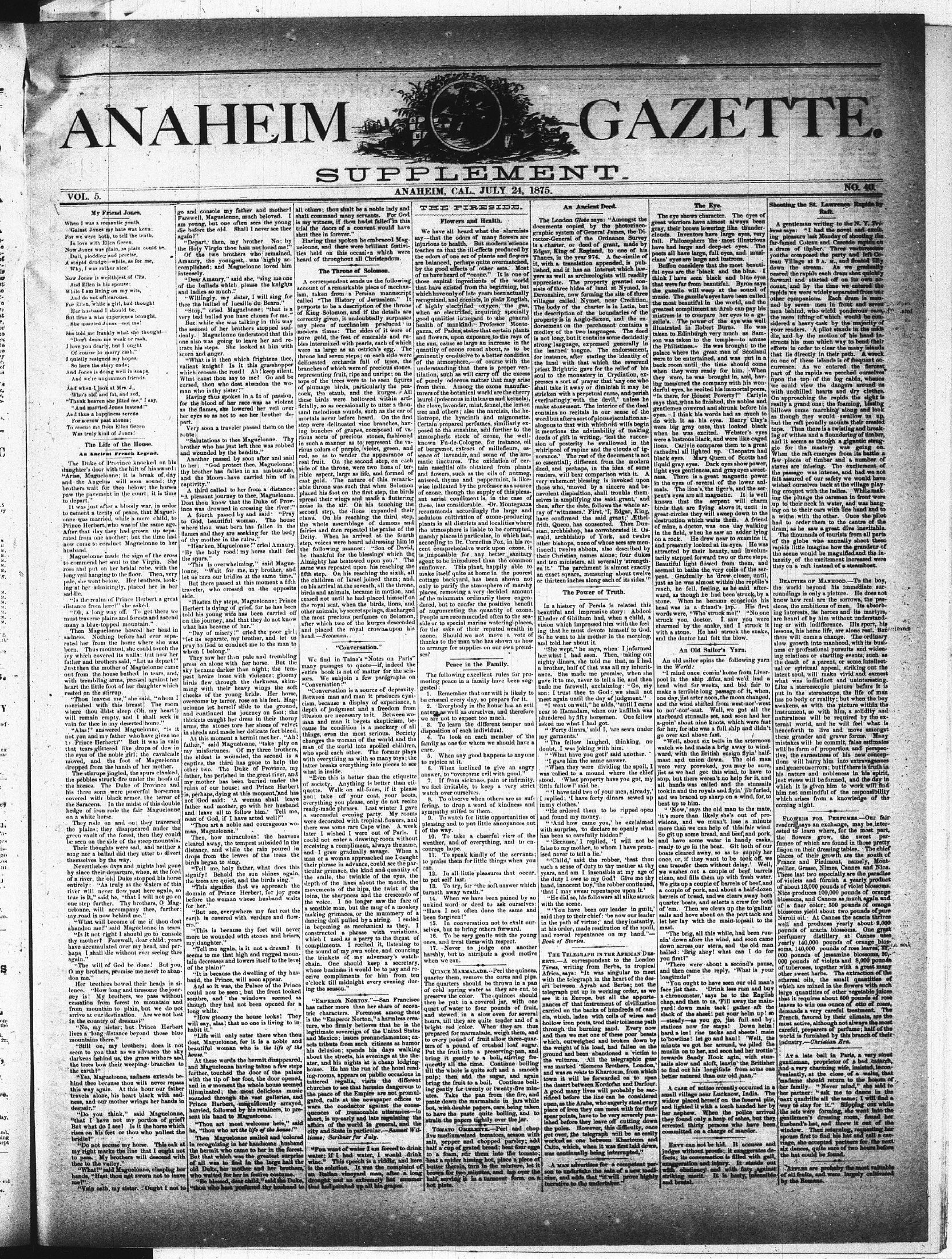
Searchable text
ANAHEIM
VOL. 5.
My Friend Jones.
When I was a romantic youth,
"Gainst Jones my hate was keen;
For we were both, to tell the truth,
In love with Ellen Green.
Now Jones was plain, as plain could be,
Dull, plodding and precise,
A stupid drudge—while, as for me,
Why, I was rather nice!
Now Jones is wealthiest of Cits,
And Ellen is his spouse;
While I am living on my wits,
And do not oft carouse.
For Ellen, while a girl, had thought
Her husband I should be.
But time a wise experience brought,
She married Jones—not me!
She told me frankly what she thought—
"Don't deem me weak or rash,
I love you dearly, but I ought
Of course to marry cash."
I quietly resigned my hopes,
So here the story ends;
And Jones is doing well in soaps,
And we're uncommon friends.
And when I look at Mrs. J.,
Who's old, and fat, and red,
"Thank heaven she jilted me," I say,
"And married Jones instead!"
And thus a happiness serene
For sorrow past atones;
To rescue me from Ellen Green
Was truly kind of Jones!
The Life of the House.
An Ancient French Legend.
The Duke of Province knocked on his daughter's door with the hilt of his sword:
go and console my father and mother?
Farewell, Maguelonne, much beloved. I am young, but one often sees the young die before the old. Shall I never see thee again?"
"Depart; then, my brother. No; by the Holy Virgin thou hast not loved me!"
Of the two brothers who remained, Amaury, the youngest, was highly accomplished; and Maguelonne loved him intensely.
"Dear Amaury," said she, "sing me one of the ballads which please the knights and ladies so much."
"Willingly, my sister, I will sing for thee the ballad of Inesille du Bearn."
"Stop," cried Maguelonne; "that is a very bad ballad you have chosen for me."
But while she was talking in this way the second of her brothers stopped suddenly. Maguelonne understood that this one also was going to leave her and retrace his steps. She looked at him with scorn and anger.
"What is it then which frightens thee, valient knight? Is it this grasshopper which crosses the road? Ah! keep silent. What canst thou say to me? Go and be cursed, thou who dost abandon the woman who is thy sister."
Having thus spoken in a fit of passion, for the blood of her race was as violent as the flames, she lowered her veil over her eyes so as not to see her brother depart.
Very soon a traveler passed them on the route:
"Salutations to thee Maguelonne. Thy brother who has just left thee was robbed and wounded by the bandits."
Another passed by soon after and said to her: "God protect thee, Maguelonne."
all others; thou shalt shalt command many is my witness, if thou shut thee in forever."
Having thus spoken uelonne, and there were ties held on this oak heard of throughout.
The Throne of
A correspondent sent account of a remarkalism, taken from a called "The History purports to be a desecration of King Solomon, and correctly given, it under any piece of mechanical modern times: The pure gold, the feet of bies intermixed with were as large as an throne had seven steps delineated orchards branches of which were representing fruit, ripops of the trees were of plumage birds, poke cock, the etaub, and these birds were hoofficially, so as occasionally sand melodious sound mortals never before step were delineated ing bunches of grapesious sorts of precious in such a manner as various colors of purple red, so as to render real fruit. On the side of the throne, we
The Life of the House.
An Ancient French Legend.
The Duke of Province knocked on his daughter's door with the hilt of his sword: "Arise, Maguelonne; it is break of day and the Angelus will soon sound; thy brothers wait for thee below; the horses paw the pavement in the court; it is time to depart."
It was just after a bloody war, in order to cement a treaty of peace, that Maguelonne was married, while a mere child, to Prince Herbert, who was of the same age. After that day they had grown separated from one another; but the time had now come to conduct Maguelonne to her husband.
Maguelonne made the sign of the cross to commend her soul to the Virgin. She rose and put on her bridal robe, with the long veil hanging to the floor. Then, very pale, she went below. Her brothers, looking at her admiringly, placed her in her saddle.
"Is the realm of Prince Herbert a great distance from here?" she asked.
"Oh, a long way off. To get there we must traverse plains and forests and ascend many a blue-topped mountain."
Then Maguelonne bowed her head in sadness. Nothing before had ever separated her from the home where she was born. Thus mounted, she could touch the ivy which covered its walls; but now her father and brothers said, "Let us depart!" Just then the mother of Maguelonne came out from the house bathed in tears, and with trembling arms, pressed against her heart the little foot of her daughter which rested on the stirrup.
"Thou leavest me," she said, "whom I nourished with this breast! The room where thou didst sleep (Oh, my heart!) will remain empty, and I shall seek in vain for thee in my deserted home."
"Alas!" answered Maguelonne, "is it not you and my father who have given me to Prince Herbert?" But it was in vain that tears glittered like drops of dew in the eyes of the noble girl; the cavalcade moved, and the foot of Maguelonne dropped from the hands of her mother.
The stirrups jingled, the spurs clanked, the pebbles struck fire under the hoofs of the horses. The Duke of Province and his three sons were powerful horsemen covered with black armor, the terror of the Saracens. In the midst of this double hedge of iron rode the fair Maguelonne on a white horse.
They rode on and on; they traversed the plains; they disappeared under the green vault of the forest, then they could be seen on the side of the steep mountain.
Their thoughts were sad, and neither a song nor a ballad did they utter to divert themselves by the way.
Nevertheless days and nights had gone by since their departure, when, at the fork of a river, the old Duke stopped his horse entirely: "As truly as the waters of this
which crosses the road? Ah! keep silent. What canst thou say to me? Go and be cursed, thou dost abandon the woman who is thy sister."
Having thus spoken in a fit of passion, for the blood of her race was as violent as the flames, she lowered her veil over her eyes so as not to see her brother depart.
Very soon a traveler passed them on the route:
"Salutations to thee Maguelonne. Thy brother who has just left thee was robbed and wounded by the bandits."
Another passed by soon after and said to her: "God protect thee, Maguelonne! thy brother has fallen in an ambuscade, and the Moors have carried him off in captivity."
A third called to her from a distance: "A pleasant journey to thee, Maguelonne. Dost thou know that the Duke of Province was drowned in crossing the river."
A fourth passed by and said: "Pray to God, beautiful woman. The house where thou wast born has fallen in the flames and they are soaking for the body of thy mother in the ruins."
"Hearken, Maguelonne!" cried Amaury. "By the holy rood! my horse shall feel the spurs."
"This is overwhelming," said Maguelonne. "Wait for me, my brother, and let us turn our bridles at the same time."
But there passed at this moment a fifth traveler, who crossed on the opposite side.
"Hasten thy steps, Maguelonne; Prince Herbert is dying of grief, for he has been told his young wife has been carried off on the journey, and that they do not know what has become of her."
"Day of misery!" cried the poor girl; "let us separate, my brother, and let us pray to God to conduct me to the man to whom I belong."
They saw her then pale and trembling press on alone with her horse. But the sky became darker than night; the tempest broke loose with violence; gloomy birds flew through the darkness, skimming with their heavy wings the soft cheeks of the young bride. Her horse, overcome by terror, rose on his feet. Maguelonne let herself slide to the ground, and continued the journey on foot; the thickets caught her dress in their thorny arms, the stones tore her shoes of velvet in shreds and made her delicate feet bleed.
At this moment a hermit met her. "Ah! father," said Maguelenne, "take pity on my misfortunes. Of my three brothers, the eldest is wounded, the second is a captive, the third has gone to help the other two. The Duke of Province, my father, has perished in the great river, and my mother has been buried under the ruins of our house; and Prince Herbert is perhaps dying at this moment,and has not God said: 'A woman shall leave father and mother, go with her husband and leave all to follow him.' Tell me, man of God, if I have acted well?"
"Thou art a noble and courageous woman, Maguelonne."
Then, how miraculous! the heavens cleared away, the tempest subsided in the distance, and while the rain poured in drops from the leaves of the trees the birds began to sing.
"Tell me, holy father, what does this signify! Behold the sun shines again, the trees are quiet, and the birds sing." "This signifies that we approach which crosses the road? Ah! keep silent. What canst thou say to me? Go and be cursed, thou dost abandon the woman who is thy sister."
Having thus spoken in a fit of passion, for the blood of her race was as violent as the flames, she lowered her veil over her eyes so as not to see her brother depart.
Very soon a traveler passed them on the route:
"Salutations tothee Maguelonne. Thy brother who has just leftthee was robbed and wounded bythebandits."
Another passed by soon after and said to her: "God protectthee,Maguelonne! thy brother has fallenin anambuscade,andtheMoorshavecarriedhimoffincaptivity."
A third called to her from a distance: "A pleasant journey tothee,Maguelonne.Dostthu knowsthattheDukeOfProvincewasdrownedincrossingtheriver."
A fourth passed by and said: "PraytoGod,bautifulwoman.Thehousewherethuwastbornhasfallenintheflamesandtheyaresookingforthebodyofthymotherintheruins."
"Hearken,Maguelonne!"criedAmaury. "Bytheholyrood!myhorseshallfeelthespurs."
"Thisisoverwhelming,"saidMaguelonne. "Waitforme,mysbrother,andletusturnourbridlesatthistime."
But there passed at this moment a fifth traveler, who crossed on the opposite side.
"Hastentythysteps,Maguelonne;PrinceHerbertisdyingofgrief,forkehavebeentholdhisyoungwifehassbeencarriedoffonthejourney,andthattheydonotknowwhathasbeenofher."
"Dayofmisery!"criedthepoorgirl; "letusseparate,mysbrother,andletuspraytoGodtoconductmetothemantowhomIbelong."
They sawherthenpaleandtremblingpressonalonewithherhorse.Buttheskybecamedarkerthannight;thetempestbrokeloosewithviolence;gloomybirdsfleewiththedarkness,skimmingwiththeireverywingsofthecheeksoftheyoungbride.Herhorseovercomebyterror,roseonhisfeet.Maguelonneletherselfslidetotheground,andcontinuedthejourneyonfoot;thethicketscaughtherdressinthierthornyarms,thestonestorehershoesofvelvetinshredsandmadeherdelictefeetbleed.
Atthismomentahermitmether.Ah!father,"saidMaguelonne,"takepityonmymisfortunes.Ofmythreebrothers,theeldestiswounded,thesecondisacaptive,thethirdhasgonetohelptheothertwo.TheDukeOfProvince,mysfather,hasperishedinthegreatriver,andmymotherhasbeenburiedundertheruilsofourhouse;andPrinceHerbertisperhaps,dyingatthismoment,andhasnotGodsaid:'Awomanshallleavefatherandmother,gowithherhusbandandleavealltofollowhim.'Tellme,mansofGod,iifhaveactedwell?'"
"Thouarta Nobleandcourageouswoman,Maguelonne."
Then,howmiraculous!the heavens cleared away,thetempestsubsidedinthedistance,andwhiletherainpouredindropsfromtheleavesofthetreesthebirdsbegantosing.
"Tellme,holyfather,whatdoesthissignify!Beholdthesunshinesagain,thetreesarequiet,andthebirdsing." "Thissignifiesthatweapproachwhichcrossestheroad?Ah!keepsilent.Whatcanstthusthousendabandonthewomanwhoisthy sister."
Having thus spoken in a fit of passion, for the blood of her race was as violent as the flames, she lowered her veil over her eyes so as not to see her brother depart.
Very soon a traveler passed them on the route:
"Salutations totheeMaguelonne. Thybrotherwhohasjustlefttheewasrobbedandwoundedbythebandits."
Another passed by soon after and said to her: "Godprotectthee,Maguelonne! thybrotherhasfalleninanambuscade,andtheMoorshavecarriedhimoffincaptivity."
A third called to her from a distance: "A pleasant journey tothee,Maguelonne.DostthuknowsthattheDukeOfProvincewasdrownedincrossingtheriver."
A fourth passed by and said: "PraytoGod,bautifulwoman.Thehousewherethuwastbornhasfallenintheflamesandtheyaresookingforthebodyofthymotherintheruins."
"Hearken,Maguelonne!"criedAmaury. "Bytheholyrood!myhorseshallfeelthespurs."
"Thisisoverwhelming,"saidMaguelonne. "Waitforme,mysbrother,andletuspraytoGodtoconductmetothemantowhomIbelong."
They sawherthenpaleandtremblingpressonalonewithherhorse.Buttheskybecamedarkerthannight;thetempestbrokeloosewithviolence;gloomybirdsfleewiththedarkness,skimmingwiththeireverywingsofthecheeksoftheyoungbride.Herhorseovercomebyterror,roseonhisfeet.Maguelonneletherselfslidetotheground,andcontinuedthejourneyonfoot;thethicketscaughtherdressinthierthornyarms,thestonestorehershoesofvelvetinshredsandmadeherdelictefeetbleed.
Atthismomentahermitmether.Ah!father,"saidMaguelonne,"takepityonmymisfortunes.Ofmythreebrothers,theeldestiswounded,thesecondisacaptive,thethirdhasgonetohelptheothertwo.TheDukeOfProvince,mysfather,hasperishedinthegreatriver,andmymotherhasbeenburiedundertheruilsofourhouse;andmymotherhasbeenburiedundertheruilsofourhouse."
Even this is bestof society. Anythingquette.Walk on on you; take off your everything you please ready-made phrases,a successful event were decorated with there was some rare later I wished I would not enter a receiving a complaint and I grew graduated man or a woman after their phrase in advicular grimice,the smile,the two depth of the lines movements of them
his three sons were powerful horsemen covered with black armor, the terror of the Saracens. In the midst of this double hedge of iron rode the fair Maguelonne on a white horse.
They rode on and on; they traversed the plains; they disappeared under the green vault of the forest, then they could be seen on the side of the steep mountain.
Their thoughts were sad, and neither a song nor a ballad did they utter to divert themselves by the way.
Nevertheless days and nights had gone by since their departure, when, at the fork of a river, the old Duke stopped his horse entirely: "As truly as the waters of this river will never flow past here again, so true is it," said he, "that I will not go on one step further. Thy brothers, O Maguelonne, will accompany thee, further; my road is now behind me."
"What will become of me if thou dost abandon me?" said Maguelonne in tears.
"Is it not right I should go to console thy mother! Farewell, dear child; years have accumulated over my head, and perhaps I shall die without ever seeing thee again."
"The will of God be done! But you, O my brothers, promise me never to abandon me."
Her brothers bowed their heads in silence. "How long and tiresome the journey is! My brothers, we pass without cessation from forest to mountain and from mountain to plain, but we do not arrive at our destination. Are we not lost in the country of dreams?"
"No, my sister; but Prince Herbert lives a long distance beyond those blue mountains there."
"Still on, my brothers; does it not seem to you that as we advance the sky darkens behind us, the grass withers and the trees bow their weeping branches to the earth!"
"Yes, Maguelonne, sadness extends behind thee because thou wilt never repass this way again. At this hour our father travels alone, his heart black with sadness, and our mother wrings her hands in despair."
"Do you think," said Maguelonne, "that I have not my portion of grief! But what do I see? Is it the horse which rises on his feet or thou who pullest the bridle!"
"Do not accuse my horse. This oak at my right marks the line that I ought not to pass. My brothers will descend with thee to the valley."
"What!" said Maguelonne, clasping her hands, "Hast thou agit sworn not to leave me!"
"Vain oath, my sister." Ought I not to
is perhaps dying at this moment, and has not God said: 'A woman shall leave father and mother, go with her husband and leave all to follow him.' Tell me, man of God, if I have acted well?
"Thou art a noble and courageous woman, Maguelonne."
Then, how miraculous! the heavens cleared away, the tempest subsided in the distance, and while the rain poured in drops from the leaves of the trees the birds began to sing.
"Tell me, holy father, what does this signify? Behold the sun shines again, the trees are quiet, and the birds sing."
"This signifies that we approach the domain of Prince Herbert, for joy goes before the woman whose husband waits for her."
"But see, everywhere my feet rest the earth is covered with verdure and flowers."
"This is because thy feet will never more be wounded with stones and briars, my daughter."
"Tell me again, is it not a dream? It seems to me that high and rugged mountain decreases and lowers itself to the level of the plain!
"It is because the dwelling of thy husband, the Prince, will soon appear.
And so it was, the Palace of the Prince could now be seen; but the front looked sombre, and the windows seemed as though they had not been opened for a long while.
"How gloomy the house looks! They will say, alas! that no one is living to inhabit it."
"Life will only enter there when thou dost, Maguelonne, for it is a noble and beautiful woman who is the life of the house."
At these words the hermit disappeared, and Maguelonna having taken a few steps further, touched the door of the palace with the tip of her foot, the door opened, and in a moment the whole house seemed illuminated; the most delicious music sounded through the vast galleries, and Prince Herbert, magnificently arrayed, hurried, followed by his retainers, to present his hand to Maguelonne.
"Thou art most welcome here," said he, "thou who art the life of the house!"
Then Maguelonna smiled and colored in recognizing in her handsome husband the hermit who came to her in the forest. But that which was the greatest surprise of all was to find in the large hall the old Duke, her mother and her brothers, who waited for her in festive costume.
"Be blessed, dear child," said this Duke, "thou who hast preferred thy husband to
walk on you; take off your everything you please ready-made phrases; a successful event were decorated with there was some rare later I wished I could not enter a receiving a complaint and I grew graduate man or a woman at their phrase in adjective grimace; thus she smile; two depth of lines movements of their loins; the sharpness of the voice. I no longer a sensible man; but making grimaces; dancing doll pulley; in becoming as much constructed as his compliments. I am the sound of my putt into trinkets of my chain. One shot whose business it is receive complimentary o'clock till midnight in the season."
"EMPEROR NOBLE has rather more tric characters. is the 'Emperor Nature,' who firmly legitimate sovereignty and Mexico; issues acts tribute from his delusion; speaks about the streets; later, and his night house. He has this ing-rooms; appears tattered regalia; churches to see them; the peace of the Ligature; calls at them warn the condemnances of trust short; is up early affairs of the world city and State in palliams; Scribner fills."
IM GATE
SUPPLEMENT.
ANAHEIM, CAL., JULY 24, 1875.
all others; thou shalt be a noble lady and shalt command many servants. For God is my witness, if thou hadst failed in this trial the doors of a convent would have shut thee in forever."
Having thus spoken he embraced Maguelonne, and there were brilliant festivities held on this occasion which were heard of throughout all Christendom.
The Throne of Solomon.
A correspondent sends us the following account of a remarkable piece of mechanism, taken from a Persian manuscript called "The History of Jerusalem." It purports to be a description of the throne of King Solomon, and if the details are correctly given, it undoubtedly surpasses any piece of mechanism produced in modern times: The sides of it were of pure gold, the feet of emeralds and rubies intermixed with pearls, each of which were as large as an ostrich's egg. The throne had seven steps; on each side were delineated orchards full of trees, the branches of which were of precious stones, representing fruit, ripe and unripe; on the tops of the trees were to be seen figures of plumage birds, particularly the peacock, the etaubel, and the kurges. All these birds were hollowed within artificially, so as occasionally to utter a thousand melodious sounds, such as the ear of mortals never before heard. On the first step were delineated vine branches, having bunches of grapes, composed of various sorts of precious stones, fashioned in such a manner as to represent the various colors of purple, violet, green, and red, so as to render the appearance of real fruit. On the second step, on each side of the throne, were two lions of ter-
THE FIRESIDE.
Flowers and Health.
We have all heard what the alarmists say—that the odors of many flowers are injurious to health. But modern science teaches us that the ill-effects produced by the odors of one set of plants and flowers are balanced, perhaps quite overmatched, by the good effects of other sets. Most of us have heard of "ozone." It is one of those capital ingredients of the world that have existed from the beginning, but which have only of late years been actually recognized, and consists, in plain English, of highly electrified oxygen, the gas, when so electrified, acquiring specially good qualities in regard to the general health of mankind. Professor Montegazza, of Padua, states that certain plants and flowers, upon exposure to the rays of the sun, cause so large an increase in the quantity of ozone round about, as to be eminently conducive to a better condition of the atmosphere,—of course with the understanding that there is proper ventilation, such as will carry off the excess of purely odorous matter that may arise from them. Among the ozone manufacturers of the botanical world are the cherry laurel (poisonous in its leaves and kernels), the clove, lavender, mint, fennel, the lemon tree and others; also the narcissis, the heliotrope, the hyacinth and mignonette. Certain prepared perfumes, similarly exposed to the sunshine, add further to the atmospheric stock of ozone, the well-known Fu-de-Cologne, for instance, oil of bergamot, extract of millefleurs, essence of lavender, and some of the aromatic tinctures. The oxidation of certain essential oils obtained from plants
An Ancient Deed.
The London Globe says: "Amongst the documents copied by the photozincographic system of General James, the Director-General of the Ordnance Survey is a charter, or deed of grant, made by Edgar, King of England, to one of his Thanes, in the year 974. A fac-simile of it, with a translation appended, is published, and it has an interest which lawyers as well as archaeologists will readily appreciate. The property granted consists of three hides of land at Nymed, in Devonshire, now forming the site of three villages called Nymet, near Credition. The body of the charter is in Latin, but the description of the boundaries of the property is in Anglo-Saxon, and the endorsement on the parchment contains a medley of the two languages. The deed is not long, but it contains some decidedly strong language, expressed generally in the learned tongue. The endorsement for instance, after stating the identity of the land with that which the reverend priest Brightric gave for the relief of his soul to the monastery in Crydiation, expresses a sort of prayer that 'any one who shall take it away or diminish it may be stricken with a perpetual curse, and perish everlastingly with the devil,' unless he make atonement. The interior of the deed contains no recitals in our sense of the word but after a sort of pious ejaculation analogous to that with which old wills begin it mentions the advisability of making deeds of gift in writing; 'least the succession of posterity be swallowed in the whirlpool of rapine and the clouds of ignorance.' The rest of the document is not so essentially different from the modern deed, and perhaps, in the idea of some
representing fruit, ripe and unripe; on the tops of the trees were to be seen figures of plumage birds, particularly the peacock, the etaub, and the kurges. All these birds were hollowed within artificially so as occasionally to utter a thousand melodious sounds, such as the ear of mortals never before heard. On the first step were delineated vine branches, having bunches of grapes, composed of various sorts of precious stones, fashioned in such a manner as to represent the various colors of purple, violet, green, and red, so as to render the appearance of real fruit. On the second step, on each side of the throne, were two lions of terrible aspect, large as life, and formed of cast gold. The nature of this remarkable throne was such that when Solomon placed his foot on the first step, the birds spread their wings and made a fluttering noise in the air. On his touching the second step, the lions expanded their claws. On his reaching the third step, the whole assemblage of demons and fairies and then repeated the praise of the Deity. When he arrived at the fourth step, voices were heard addressing him in the following manner: "Son of David, be thankful for the blessings which the Almighty has bestowed upon you." The same was repeated upon his reaching the fifth step. On his reaching the sixth, all the children of Israel joined them; and, on his arrival at the seventh, all the throne, birds and animals, became in motion, and ceased not until he had placed himself on the royal seat, when the birds, lions, and other animals, by secretsprings, discharged the most precious perfumes on Solomon, after which two of the kurges descended and placed the royal crown upon his head.—Scotman.
"Conversation."
We find in Taine's "Notes on Paris" many passages to quote—if indeed the entire book is not of matter for the scissors. We subjoin a few paragraphs on "Conversation:"
"Conversation is a source of depravity. Between man and man it produces cynicism, because a display of experience, a depth of judgment and a freedom from illusion are necessary to it. Between woman and man it begets skepticism, because its condition is a mockery of all things, even the most serious. Society changes the woman of the world and the man of the world into spoiled children who spoil each other. The former plays with everything as with so many toys; the latter breaks everything into pieces to see what is inside.
"Even this is better than the etiquette of society. Anything is better than etiquette. Walk on all-fours, if it please you; take off your coat, your boots, everything you please, only do not recite ready-made phrases. Last winter I gave a successful evening party. My rooms were decorated with tropical flowers, and there was some rare Cape wine. A week later I wished I were out of Paris. I could not enter a drawing-room without receiving a compliment, always the same, and I grew gradually savage. When a man or a woman approached me I caught their phrase in advance, could see the particular grimice, the kind and quantity of the smile, the twinkle of the eyes, the depth of the lines about the mouth, the movements of the hips, the twist of titilation, such as will carry off the excess of purely odorous matter that may arise from them. Among the ozone manufacturers of the botanical world are the cherry laurel (poisonous in its leaves and kernels), the clove, lavender, mint, fennel, the lemon tree and others; also the narcisis, the heliotrope, the hyacinth and mignonette. Certain prepared perfumes, similarly exposed to the sunshine, add further to the atmospheric stock of ozone, the well-known Fu-de-Cologne, for instance, oil of bergamot, extract of milllefruit, essence of lavender, and some of the aromatic tinctures. The oxidation of certain essential oils obtained from plants and flowers, such as the oils of nutmeg, aniseed, thyme and peppermint, is likewise indicated by the professor as a source of ozone, though the supply of this pleasant aerial condiment is, in case of these, less considerable. Dr. Montegazza recommends accordingly the large and sedulous cultivation of ozone-producing plants in all districts and localities where the atmosphere is liable to be corrupted, marshy places in particular, in which last, according to Dr. Cornellus Fox, in his recent comprehensive work upon ozone, it is impossible for any better sanitary agent to be introduced than the common sunflower. This plant, happily able to make itself quite at home in the poorest cottage backyard, has been shown not only to purify the atmosphere of marshy places, removing a very decided amount of the miazmata ordinarily there engendered, but to confer the positive benefit of augmenting the quantity of ozone. People are recommended often to the sea-side or to special marine watering-places, for the sake of their reputed wealth in ozone. Should we not move a vote of thanks to the man who has shown us how to arrange for supplies on our own premises?
Peace in the Family.
The following excellent rules for promoting peace in a family have been suggested:
1. Remember that our will is likely to be crossed every day, so prepare for it.
2. Everybody in the house has an evil nature as well as ourselves, and therefore we are not to expect too much.
3. To learn different temper and disposition of each individual.
4. To look on each member of the family as one for whom we should have a care.
5. When any good happens to anyone to rejoice at it.
6. When inclined to give an angry answer, to "overcome evil with good."
7. If from sickness, pain or infirmity, we feel irritable, to keep a very strict watch over ourselves.
8. To observe when others are so suffering, to drop a word of kindness and sympathy suited to them.
9. To watch for little opportunities of pleasing and to put little annoyances out of the way.
10. To take a cheerful view of the weather, and of everything, and to encourage hope.
11. To speak kindly of the servants; to praise them for little things when you can.
12. In all little pleasures that occur, to put self last.
13. To try for "the soft answer which soul to the monastery in Crylation, expresses a sort of prayer that 'any one who shall take it away or diminish it may be strenken with a perpetual curse,and perish everlastingly with the devil,' unless he make atonement. The interior of the deed contains no recitals in our sense of the word but after a sort of piouse ejaculation analogous to that with which old wills begin mentions the advisability of making deeds of gift in writing; 'lest the succession of posterity be swallowed in the whirlpool of rapine and the clouds of ignorance.' The rest of the document is not so essentially different from the modern deed, and perhaps, in the idea of some readers, will bear comparison with it. A very vehement blessing is invoked upon those who 'moved by a sincere and behalved disposition,' shall trouble themselves in amplifying the said grant', and then after the date follows whole array of 'witnesses.' First,'I Edgar King have confirmed the said grant'; Ethelfrith, Queen has consented. Then Dunstan archbishop has corroborated it. Oswald archbishop of York,and twelve other bishops,none of whose sees are mentioned;twelve abbots,也 described by their Christian names alone; four dukes and ten ministers,a severally 'strengthen it.' The parchment is almost exactly an exact square, measuring about twelve or thirteen inches along each of its sides."
The Power of Truth.
In a history of Persia is related this beautiful and impressive story: Abdool Khader of Ghillham had,when a child,a vision which impressed him with the feeling that he must devote himself to God.So he went to his mother in the morning,and told her about it.
"She wept," he says,when I informed her what I had seen. Then,taking out eighty dinars,she told me that,as I had a brother,half of that was all my inheritance.She made me promise,when she gave it to me,never to tell a lie,and then bade me farewell,exclaiming: "Go,myson;I trust they to God:we shall not meet again until the day of judgment."
"I went on well,"he adds,"until I came near to Hamadam,when our kaffallah was plundered by fifty horsemen. One fellow asked me what I had got.
"Forty dinars,"said I,'are sewn under my garments."
"The fellow laughed,thinking,no doubt.I was joking with him.
'What have you got?' said another.
"I gave him the same answer."
When they were dividing the spoil,我 was called to a mount where the chief stood.
'What property have you got,my little fellow?' said he.
"I have told two of your men,already,'I replied; 'I have forty dinars sewed up in my clothes.'"
He ordered them to be ripped open and found my money.
"And how came you,'he exclaimed with surprise,'to declare so openly what has been so carefully hidden?"
"Because,'I replied,'I will not be false to my mother,to whom I have promised never to tell a lie."
"Child,"said the robber,'hast thou such a sense of duty to thy mother at thy years,and am I insensible at my age of the duty I owe to my God! Give me thy hand,innocent boy,'the robber continued,
it's not visions more So girls read books once can we clean We
"EMPEROR NORTON."—San Francisco has rather more than her share of eccentric characters. Foremost among these is the "Emperor Norton," a harmless creature, who firmly believes that he is the legitimate sovereign of the United States and Mexico; issues pronunciamentos; exacts tributes from such citizens as humor his delusion; spends his days walking about the streets, his evenings at the theater, and his nights at a cheap lodging-house. He has the run of the hotel reading-rooms, appears on public occasions in tattered regalia, visits the different churches to see that heresies dangerous to the peace of the Empire are not promulgated, calls at the newspaper offices to warn the conductor against the consequences of treasonable utterances—in short, is up early and late regulating the affairs of the world in general, and the city and State in particular.—Samuel Williams; Scribner for July.
"Fon want of water I am forced to drink water; if I had water, I would drink wine." This speech is a riddle, and here is the solution. It was the complaint of an Italian vineyard man, after a long drought and an extremely hot summer that had parched up all his grapes.
TO MATO OMELLETE—Peel and chop five medium-sized tomatoes, season with salt, pepper and chopped parsley; add half a cup of grated bread; heat four eggs to a foam, stir them into the tomato; heat a spider hissing hot, place a piece of butter therein, turn in the mixture, let it brown for two minutes, and lap over the half, serving it in a turnover form on a hot plate.
"I have told two of your men, already, I replied; 'I have forty dinars sewed up in my clothes.'"
He ordered them to be ripped open and found my money.
"And how came you," he exclaimed with surprise, "to declare so openly what has been so carefully hidden?"
"Because," I replied, "I will not be false to my mother, to whom I have promised never to tell a lie."
"Child," said the robber, "hast thou such a sense of duty to thy mother at thy years, and am I insensible at my age of the duty I owe to my God! Give me thy hand, innocent boy," the robber continued, "that I may swear repentance upon it."
He did so, his followers all alike struck with the scene.
"You have been our leader in guilt," said they to their chief: "be now our leader in the path of virtue;" and they instantly, at his order, made restitution of the spoil, and vowed repentance on my hand."—Book of Stories.
THE TELEGRAPH IN THE AFRICAN DESERTS.—A correspondent to the London Times, writing from Berba, in tropical Africa, says: "It was singular to meet with the telegraph in the heart of the desert between Ayrab and Berba; not the telegraph put up in working order, as we see it in Europe, but all the appurtenances of that instrument of civilization carried on the backs of hundreds of camels, which, laden with coils of wires and hollow iron posts, trod their toilome path through the burning sand. Every now and then we met one of those poor beasts which, outweighed and broken down by the weight of his load, had fallen on the ground and been abandoned a victim to the vultures. All the telegraphic gear was marked 'Siomens Brothers,' London, and was en route to Khartoum, from which town it will be forwarded on to span the desert between Kordofan and Darfour. A good many lives will probably be sacrificed before the line can be considered open, as the Arabs, who eagerly steal every piece of iron they can meet with for their spear points, have to be very severely punished before they leave off cutting down the poles. However, this difficulty, once got over, the telegraph will be as easily worked as one between Khartoum and Caito, which when it was first laid down, was continually being interrupted."
A man advertises for a competent person to undertake the sale of a new medicine, and adds that "if will prove highly lucrative to the undertaker."
GAZETTE.
NO. 40.
The Eye.
The eye shows character. The eyes of great warriors have almost always been gray, their brows lowering like thunderclouds. Inventors have large eyes, very full. Philosophers the most illustrious have had large and deep-set eyes. The poets all have large, full eyes, and musicians' eyes are large and lustrous.
Buffon considers that the most beautiful eyes are the 'black and the blue. I think I have seen black and blue eyes that were far from beautiful. Byron says the gazelle will weep at the sound of music. The gazelle's eyes have been called the most beautiful in the world, and the greatest compliment an Arab can pay his mistress is to compare her eyes to a gazella's. The power of the eye was well illustrated in Robert Burns. He was taken to Edinburgh very much as Samson was taken to the temple—to amuse the Philistines. He was brought to the palace where the great men of Scotland were to be entertained, and was put in a back room until the time should come when they were ready for him. When they were, he was brought in, and having measured the company with his wonderful eyes, he recited his immortal poem, "Is there, for Honest Poverty?" Carlyle says that when he finished, the mobles and gentlemen cowered and shrunk before his eyes. I think his words had as much to do with it as his eyes. Henry Clay's were big gray ones, that looked black when he was excited. Webster's eyes were a lustrous black, and were like caged lions. Carlyle compares them to a great cathedral all lighted up. Cleopatra had black eyes. Mary Queen of Scotts had liquid gray eyes. Dark eyes show power, lightness and grace sweet.
Shooting the St. Lawrence Rapids by Raft.
A gentleman writing to the N. Y. Truburn says: "I had the novel and exalting pleasure last Monday of shooting the far-famed Coteau and Cascade rapids on a dram of timber. Three venturesome youths composed the party and left Coteau Village at 8 A.M., and floated silly down the stream. As we gradually neared the rapids each dram shot quickly forward and started off on its own account, and by the time we entered the rapids we were widely separated from our other companions. Each dram is manned by seven men in front and seven men behind, who wield ponderous oars, the mere lifting of which would be considered a heavy task by the majority of your readers. A pilot stands in the middle, and by the motion of his hand instructs his men which way to bend their efforts in order to clear the many islands that lie directly in their path. A wreck on one of these islands is of frequent occurrence. As we entered the florest part of the rapids we perched ourselves upon the top of the log cabin, whence we could view the dangers around us with unchilled hearts and dry clothes. On approaching the rapids the sight is really a grand one; the foaming, blissful billows come marching along and look as though they would swallow us up, but the raft proudly mounts their created tops. Then there is a twisting and breaking of withes and a floundering of timber, and it seems as though a gigantic struggle for the mastery was going on. When the raft emerges from its battle a few pieces of timber and a number of staves are missing. The excitement of
When they were ready for him, when they were, he was brought in, and having measured the company with his wonderful eyes, he recited his immortal poem, "Is there, for Honest Poverty?" Carlyle says that when he finished, the nobles and gentlemen cowered and shrunk before his eyes. I think his words had as much to do with it as his eyes. Henry Clay's were big gray ones, that looked black when he was excited. Webster's eyes were a lustrous black, and were like caged lions. Carlyle compares them to a great cathedral all lighted up. Cleopatra had black eyes. Mary Queen of Scotts had liquid gray eyes. Dark eyes show power, light eyes gentleness, and gray eyes sweetness. There is a great magnetic power in the eyes of several of the lower animals. The lion's, the tiger's, and the serpent's eyes are all magnetic. It is well known that the serpent will charm birds that are flying above it, until in great circles they will sweep down to the destruction which waits them. A friend of mine, a doctor, was one day walking in the field, when he saw an adder lying on a rock. He drew near to examine it, and presently looked at its eyes. He was attracted by their beauty, and involuntarily stepped forward two or three steps. Beautiful light flowed from them, and seemed to bathe the very coils of the serpent. Gradually he drew closer, until just as he was almost within the reptile's reach, he fell, feeling, as he said afterward, as though he had been struck by a stone. When he became conscious his head was in a friend's lap. His first words were, "Who struck me!" "No one struck you, doctor. I saw you were charmed by the snake, and I struck it with a stone. He had struck the snake, and the doctor had felt the blow.
An Old Sailor's Yarn.
An old sailor spins the following yarn in the World:
"I mind once comin' home from Liverpool in the ship Atlas, and we'd had a head wind for weeks, and bid fair to make a terrible long passage of it, when one day, jist arter noon, the moon changed, and the wind shifted from west-nor'-west to nor'-nor'-east. Well, we got all the starboard stunsails set, and soon had her a-goin' about nine knots, which were fast for her; for she was a full ship and didn't go over and above fast.
"Well, about six bells in the arteroon watch we had made a brig away to windward, with the British ensign flyin' half-mast and union down. The old man were very provoked, you may be sure, jist as we had got this wind, to have to stop, but there weren't no help for it, and all hands was called and the stunnsails took in and the royals and flyin' jib furled, and we braced up sharp on a wind, for to beat up to him.
"Now,' says the old man to the mate, 'it's more than likely she's out of provisions, and we musn't lose a minute more than we can help of this fair wind. So git up some bread, and beef, and pork, and have some water in handy casks, ready to go in the boat. Git both of our boats cleared away, so as to supply her once, or if they want to be taken off, we can transfer them without delay.' Well, we wash out a couple of beef barrels clean, and fills them up with fresh water. We gits up a couple of barrels of beef, and a couple of pork and about a half-dozen part of the rapids we perched ourselves upon the top of the log cable, whence we could view the dangers around us with unchilled hearts and dry clothes. On approaching the rapids the sight is really a grand one; the foaming, hissing billows come marching along and look as though they would swallow us up, but the raft proudly mounts their created tops. Then there is a twisting and breaking of withes and a floundering of timber, and it seems as though a gigantic struggle for the mastery was going on. When the raft emerges from its battle a few pieces of timber and a number of staves are missing. The excitement of the passage was intense, and had we not assured of our safety we would have wished ourselves back at the village playing croquet with the ladies. Whilst making the plunge oarsmen in front were up to their neck in water, and was hanging on to their oars with one hand and to a withe with the other. Once the pilot had to order them to the centre of the dram, as he saw a great dive inevitable.
The thousands of tourists from all parts of the globe who annually shoot these rapids little imagine how the grandeur of the scene would be magnified and the intensity of the excitement increased were they on a raft instead of a steamboat.
BEAUTIES OF MANHOOD.-To the boy, the world beyond his immediate surroundings is only a picture. He does not know how real are the sorrows, the passions, the ambitions of men. Its absorbing interests, its heroes and its martyrs are heard of by him without understanding or with indifference. His sport, his lessons, his home life, are alone real: But there will come a change. The ordinary slow growth into manhood, with its business or professional pursuits and widening relations or startling events, such as the death of a parent, or some intellectual or spiritual appeal, striking out the latent soul, will make vivid and earnest what was indistinct and uninteresting. Like a stereoscopic picture before it is put in the stereoscope, the life of man has no body or reality; but when the boy awakens, as with the picture within the instrument, so with him, a solidity and naturalness will be required by the external world, and he will feel what is henceforth to live and move amongst these grander and graver forms. Many mistakes will he commit; false estimates will he form of proportion and perspective; the earnestness of his new conceptions will hurry him into extravagances and generous errors; but if there is truth in his nature and nobleness in his spirit, just views will be formed, and the day in which it is given him to work will find him not unmindful of the responsibility which arises from a knowledge of the coming night.
FLOWERS FOR PERFUMES.-Our fair reader says an exchange, may be interested to learn where, for the most part, the flowers grow, the sweet perfumes of which are found in those pretty flagons on their dressing tables. The chief places of their growth are the south of France and Piedmont, namely Montpellier, Grasse, Nimes, Cannes and Nica. These last two especially are the paradise of violets and furnish a yearly product of about 13,000 pounds of violet blossoms.
IN THE AFRICAN DESPENDENT to the London in Berba, in tropical was singular to meet on the heart of the deserts and Berba; not the working order, as we about all the appurtenament of civilization was of hundreds of camels with coils of wires and prod their toilsome path sand. Every now one of these poor beasts and broken down by head, had fallen on the abandoned a victim to the telegraphie gear trains Brothers, London,' Khartoum, from which forwarded on to span Kordofan and Darfour. will probably be saccine can be considered who eagerly steal every man meet with for their be very severely punished off cutting down her, this difficulty, once graph will be as easily between Khartoum and it was first laid down, being interrupted."
A case of suitcase recently occurred in a small village near Lucknow, India. The widow placed herself on the funeral pile, and lighted it with a torch handed her by her nephew. When the police arrived they found only a heap of ashes, but they arrested thirty persons who have been committed on a charge of murder.
Early can not be hid. It accuses and judges without proof; it exaggerates defects; its conversation is filled with gall, enragement and injury. It stands out with obstinacy and with fury against striking merit. It is harsh, insensible and brutal.
FLOWERS FOR PERFUMES.—Our fair reader says an exchange, may be interested to learn where, for the most part, the flowers grow, the sweet perfumes of which are found in those pretty flagon on their dressing tables. The chief places of their growth are the south of France and Piedmont, namely Montpellier, Grasse, Nimes, Cannes and Nice. These last two especially are the paradise of violets and furnish a yearly product of about 18,000 pounds of violet blossoms. Nice produces 100,000 pounds of orange blossoms, and Cannes as much again and of a finer color; 500 pounds of orange blossoms yield about two pounds of pure Noroli oil. At Cannes the acacia thrives well and produces yearly about 9,000 pounds of acacia blossoms. One great perfumery distillery at Cannes uses yearly 140,000 pounds of orange blossoms, 140,000 pounds of rose leaves, 20,000 pounds of jessamine blossoms, 20,000 pounds of violets and 8,000 pounds of tuberoses, together with a great many other sweet herbs. The extraction of the ethereal oils, the small quantities of which are mixed in the flowers with such large quantities of other vegetable juices that it requires about 600 pounds of rose leaves to win one ounce of etto of roses, demands a very careful treatment. The French, favored by their climate, are the most active, although not always the most careful, preparers of perfume; half of the world is furnished by this branch of their industry.—Christian Era.
At a late ball in Paris, a very stout gentleman, proprietor of a bad catarrh, and a very charming wife, insisted, inconveniently, at the close of a walk, that madame should return to the booth of her family. "Never mind," she said to her partner: "ask me to dance in the next quadrille all the same; I will find a way to stay for it." Slipping out while the sets were forming, she went into the gentlemen's dressing room, found her husband's hat, and threw it out of the window. Then returning, requesting her spouse first to find his hat and call a carriage, she accepted partners for the next six dances, quite sure of two hours before the hat could be found.
Arles are probably the most valuable of all fruits, and were largely cultivated by the Romans.