anaheim-gazette 1875-07-17
Scanned page
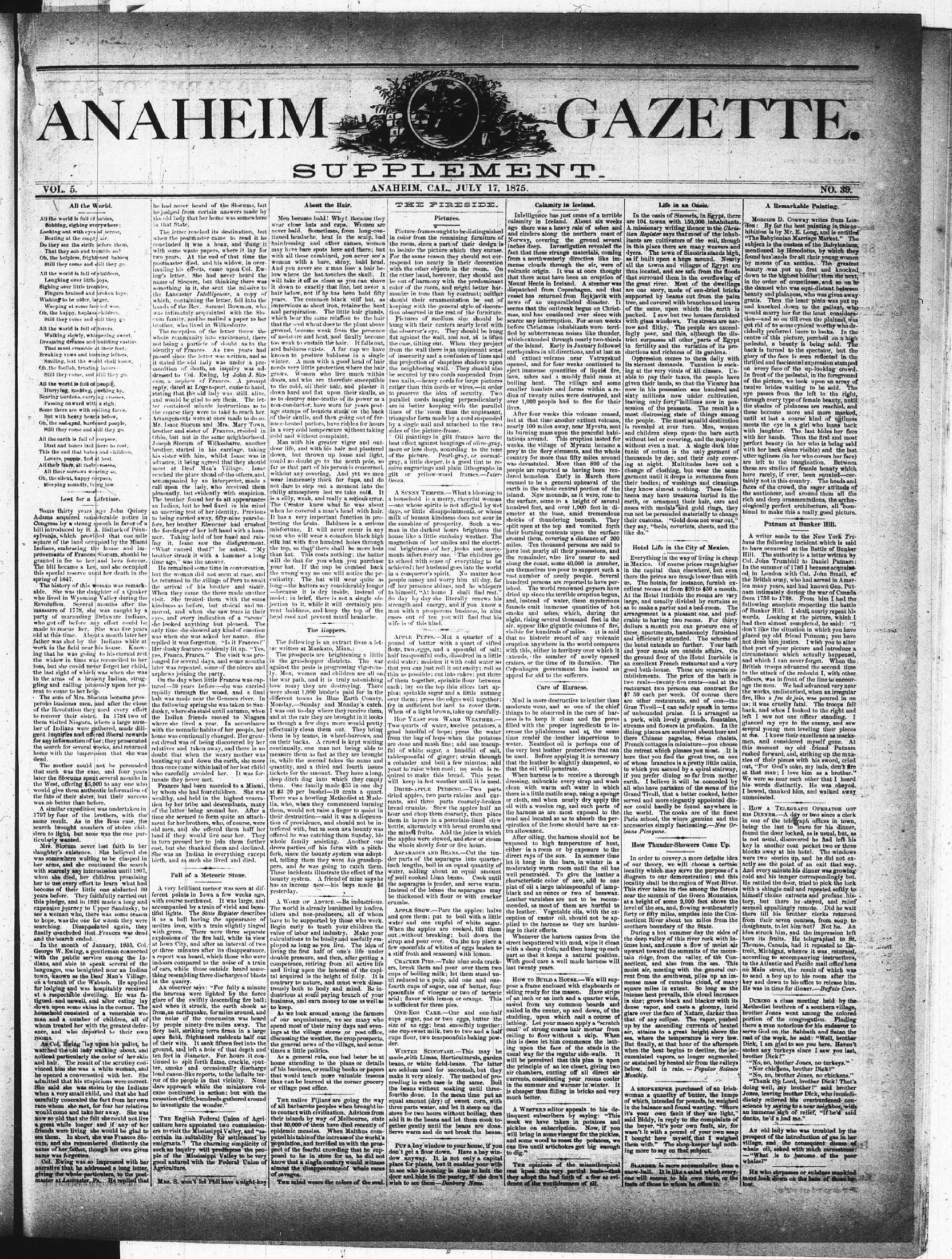
Searchable text
ANAHEIM
VOL. 5.
All the World.
All the world is full of babies,
Sobbing, sighing everywhere;
Looking out with eyes of terror,
Beating at the empty air.
Do they see the strife before them,
That they sob and tremble so?
Oh, the helpless, frightened babies,
Still they come and still they go.
All the world is full of children,
Laughing over little joys,
Sighing over little troubles,
Fingers bruised and broken toys;
Wishing to be older, larger,
Weeping at some fancied woe.
Oh, the happy, hapless children,
Still they come and still they go.
All the world is full of lovers,
Walking slowly, whispering sweet,
Dreaming dreams and building castles;
That must crumble at their feet;
Breaking vows and burning letters,
Smiling, lost the world shall know,
Oh, the foolish, trusting lovers—
Still they come, and still they go.
All the world is full of people,
Hurrying, rushing, pushing by,
Bearing burdens, carrying crosses,
Passing onward with a sigh;
Some there are with smiling faces,
But with heavy hearts below,
Oh, the sad-eyed, burdened people,
Still they come and still they go.
All the earth is full of corpses,
Dust and bones laid there to rest;
This the end that babe and children,
Lovers, people, find at best.
All their fears, all their crosses,
he had never heard of the Slocums, but he judged from certain answers made by the old lady that her home was somewhere in that State.
The letter reached its destination, but when the postmaster came to read it he concluded it was a hoax, and hung it with some waste papers, where it lay for two years. At the end of that time the postmaster died, and his widow, in overhauling his effects, came upon Col. Ewing's letter. She had never heard the name of Slocum, but thinking there was something in it, she sent the missive to the Lancaster Intelligencer, a copy of which, containing the letter, fell into the hands of the Rev. Samuel Bowman, who was intimately acquainted with the Slocum family, and he mailed a paper to her brother, who lived in Wilkesbarre.
The reception of the letter threw the whole community into excitement, there not being a particle of doubt as to the identity of Frances. As two years had passed since the letter was written, and as it stated the old lady was under a premonition of death, an inquiry was addressed to Col. Ewing, by John J. Slocum, a nephew of Frances. A prompt reply, dated at Logansport, came to hand, stating that the old lady was still alive, and would be glad to see them. The letter contained minute instructions as to the course they were to take to reach her. Arrangements were at once made to do so. Mr. Isaac Slocum and Mrs. Mary Town, brother and sister of Frances, resided in Ohio, but not in the same neighborhood. Joseph Slocum of Wilkesbarre another brother, started in his carriage, taking his sister with him, whilst Isaac was in advance, it being agreed that they should meet at Deaf Man's Village. Isaac
About the Hair.
Men become bald! Why? Be wear close hats and caps. Never bald. Sometimes, from tinued headache, heat in the hairdressing and other causes may have bare spots here and with all these combined, you will woman with a bare, shiny hair. And you never see a man lose low where the hat touches the will take it off as clean as you it down to exactly that line, hair below, not if he has been years. The common black stain impervious as sheet iron, retains and perspiration. The little hair which bear the same relation to that seed wheat does to the ground, become weak from the moisture and heat, and finally too weak to sustain the hair. And baldness exists. A fur coat known to produce baldness in winter. A man with a good hair needs very little protection when grows. Women who live my doors, and who are therefore sick to the cold, oil their hair, and down hard and flat upon their skin to destroy nine-tenths of its non-conductor, have worn for age stamps of bonnets stuck on of their skulls, and then going nace-heated parlors, have ridden in a very cold temperature with cold and without complaint.
Man with his greater vigor door life, and with his hair no down, but thrown up loose could no doubt go to the north far as that part of his person is
Still they come, and still they go.
All the world is full of people.
Hurrying, rushing, pushing by.
Bearing burdens, carrying crosses,
Passing onward with a sigh;
Some there are with smiling faces.
But with heavy hearts below,
Oh, the sad-eyed, burdened people.
Still they come and still they go.
All the earth is full of corpses.
Dust and bones laid there to rest;
This the end that babies and children,
Lovers, people, find at best.
All their fears, all their crosses,
All their sorrows wearing so,
Oh, the silent, happy corpses,
Sleeping soundly, living low.
Lost for a Lifetime.
Some thirty years ago John Quincy Adams acquired considerable notice in Congress by a strong speech in favor of a bill introduced by B. A. Bidlack of Pennsylvania, which provided that one mile square of the land occupied by the Miami Indians, embracing the house and improvements of Frances Slocum, should be granted in fee to her and hers forever. The bill became a law, and she occupied this special reserve until her death in the spring of 1847.
The history of this woman was remarkable. She was the daughter of a Quaker who lived in Wyoming Valley during the Revolution. Several months after the massacre of 1778, she was caught by a party of marauding Delaware Indians, who got off before any effort could be made to rescue her. She was five years old at this time. About a month later her father was shot by the Indians while at work in the field near his house. Knowing that he was going to his eternal rest the widow in time was reconciled to her loss, but she could never forget her child, the last sight of which was when she was in the arms of a brawny Indian, struggling and calling pitiously upon her parent to come to her help.
The sons of Mrs. Slocum became prosperous business men, and after the close of the Revolution they used every effort to recover their sister. In 1784 two of them visited Niagara, where a large number of Indians were gathered, made diligent inquiries and offered liberal rewards for any information of her; they prosecuted the search for several weeks, and returned home with the impression that she was dead.
The mother could not be persuaded that such was the case, and four years later the Slocums spent several months in the West, offering $5,000 to any one who would give them authentic information of the fate of their sister, but their success was no better than before.
A similar expedition was undertaken in 1797 by four of the brothers, with the same result. As in the Ross case, the search brought numbers of stolen children to light, but none was the one particularly wanted.
Mrs. Slocum never lost faith in her daughter's existence. She believed she was somewhere waiting to be clasped in her arms, and she continued the search with scarcely any intermission until 1807, when she died, her children promising her to use every effort to learn what had become of their little one abducted 30 days earlier.
Dressed to Col. Ewing, by John J. Slocum, a nephew of Frances. A prompt reply, dated at Logan-sport, came to hand, stating that the old lady was still alive, and would be glad to see them. The letter contained minute instructions as to the course they were to take to reach her. Arrangements were at once made to do so. Mr. Isaac Slocum and Mrs. Mary Town, brother and sister of Frances, resided in Ohio, but not in the same neighborhood. Joseph Slocum of Wilkesbarre another brother, started in his carriage, taking his sister with him, whilst Isaac was in advance, it being agreed that they should meet at Deaf Man's Village. Isaac reached the place ahead of-the others, and accompanied by an interpreter, made a call upon the lady, who received them pleasantly, but evidently with suspicion. The brother found her to all appearances an Indian, but he had fixed in his mind an unerring test of her identity. Previous to being carried away, fifty-nine years before, her brother Ebencer had crushed the forefinger of her left hand with a hammer. Taking hold of her hand and raising it, Isaac saw the disfigurement: "What caused that?" he asked. "My brother struck it with a hammer a long time ago," was the answer.
He remained some time in conversation, but the woman did not seem at ease, and he returned to the village of Peru to await the arrival of his brother and sister. When they came the three made another visit. She treated them with the same kindness as before, but stoical and unmoved, and when she saw tears in their eyes, and every indication of a "scene" she looked anything but pleased. The only time she showed any kind of emotion was when she was asked her name. She replied it was forgotten. "Is it Frances? Her dusky features suddenly lit up." Yes, yes, Franca Franca." The visit was prolonged for several days, and some months later was repeated, some of the nieces and nephews joining the party.
On the day when little Frances was captured—50 years before—the she was carried rapidly through the wood, and a final halt was made near the Geneseo river. In the following spring she was taken to Sandusky, where she staied until autumn, when the Indian friends moved to Niagara where she lived a year. In accordance with the nomadic habits of her people, her home was continually changed. Her greatest dread was of being discovered by her relatives and taken away, and there is no doubt that when the weary mother was hunting up and down the earth, she more than once came within hail of her lost child who carefully avoided her. It was fortunate they never met.
Frances had been married to a Miami by whom she had four children. She was wealthy, and held in the highest veneration by her tribe and descendants, many of the latter being around her. After a time she seemed to form quite an attachment for her brothers, who, of course, were old men, and she offered them half her land if they would live near her. They in turn pressed her to join them far east, but she thanked them and declined. She was an Indian in everything except birth, and as such she lived and died.
Fall of a Meteoric Stone.
A very brilliant meteor was seen at diffrented to Col. Ewing, by John J. Slocum, a nephew of Frances. A prompt reply, dated at Logan-sport, came to hand, stating that the old lady was still alive,and would be glad to see them. The letter contained minute instructions as to the course they were to take to reach her. Arrangements were at once made to do so. Mr. Isaac Slocum and Mrs. Mary Town, brother and sister of Frances, resided in Ohio, but not in the same neighborhood.Joseph Slocum of Wilkesbarre another brother, started in his carriage,taking his sister with him ,whilst Isaac was in advance,它 being agreed that they should meet at Deaf Man's Village.Isaac reached the place ahead of-the others,and accompanied by an interpreter,made a call upon the lady,the received them pleasantly,但 evidently with suspicion.The brother found her to all appearances an Indian,但 he had fixed in his mind an unerring test of her identity.Previous to being carried away,fifty-nine years before,她 brother Ebencer had crushed the forefinger of her left hand with a hammer.Taking hold of her hand and raising it,Isaac saw the disfigurement:"What caused that?" he asked.“My brother struck it with a hammer a long time ago,”was the answer.
He remained some time in conversation,but the woman did not seem at ease,and he returned to the village of Peru to await the arrival of his brother and sisterWhen they came the three made another visit.She treated them with the same kindness as before,但 stoical and unmoved,and when she saw tears in their eyes,and every indication of a “scene”she looked anything but pleased.The only time she showed any kind of emotion was when she was asked her name.She replied it was forgotted.“Is it Frances?”Her dusky features suddenly lit up.“Yes,yes,Franca,Franca.”The visit was prolonged for several days,and some months later was repeated,some of the nieces and nephews joining the party.
On the day when little Frances was captured—50 years before—the she was carried rapidly through the wood,and a final halt was made near the Geneseo river.In the following spring she was taken to Sanduskywhere she staied until autumn,the Indian friends moved to Niagara where she lived a year.In accordance with the nomadic habits of her people,她 home was continually changed.Her greatest dread was of being discovered by her relatives and taken away,and there is no doubt that when she weary mother was hunting up and down the earth,她 more than once came within hail of her lost child who carefully avoided her.它 Was fortunate they never met them.
One family made $55 at $320 per bushel—10 cents There was a howling Methodist liaison,who,when they commence them,would not raise a finger their destruction—said it was a violation of providence,and should be interfered with,但 as soon as a boy offered he was catching them.She whole family assisting.And drove parties off his farm with fork,since the bounty system wived telling them they were his peers,and he was going to catch These incidents illustrate the effect bounty system.A friend of man has an income now—his boys
A similar expedition was undertaken in 1707 by four of the brothers, with the same result. As in the Ross case, the search brought numbers of stolen children to light, but none was the one particularly wanted.
Mrs. Slocum never lost faith in her daughter's existence. She believed she was somewhere waiting to be clasped in her arms, and she continued the search with scarcely any intermission until 1807; when she died, her children promising her to use every effort to learn what had become of their little one abducted 30 years before. They faithfully carried out this pledge, and in 1826 made a long and expensive journey to Upper Sandusky, to see a woman who, there was some reason to hope, was the one for whom they were searching. Disappointed again, they finally concluded that Frances was dead and the search ended.
In the month of January, 1835, Col. George W. Ewing, a gentleman connected with the public service among the Indians, and able to speak several of the languages, was benighted near an Indian town, known as the Deaf Man's Village, on a branch of the Wabash. He applied for lodging and was hospitably received at a respectable dwelling. He was fatigued and unwell, and after eating lay down upon some skins in the corner. The household consisted of a venerable woman and a number of children, all of whom treated her with the greatest deference, and who departed to their own rooms.
As Col. Ewing lay upon his pallet, he watched the old lady walking about, and not least particularly the color of her skin and hair. The result of the scrutiny convinced him she was a white woman, and he opened a conversation with her. She admitted that his suspicions were correct. She said she was stolen by the Indians when a very small child, and that she had carefully concealed the fact from her own race whom she met, for fear her relatives would come and take her away. She was now so old that she felt she could not live a great while longer and if any of her friends were living she would be glad to see them. In short, she was Frances Slocum, and she remembered distinctly the name of her father, though her own given name was forgotten.
Col. Ewing was so impressed with her narrative that he addressed a long letter, giving the whole particulars to the postmaster at Lancaster, Pa. He replied that by whom she had four children. She was wealthy, and held in the highest veneration by her tribe and descendants, many of the latter being around her. After a time she seemed to form quite an attachment for her brothers, who, of course, were old men, and she offered them half her land if they would live near her. They in turn pressed her to join them farther east, but she thanked them and declined. She was an Indian in everything except birth, and as such she lived and died.
Fall of a Meteoric Stone.
A very brilliant meteor was seen at different points in Iowa a few weeks ago, with course northwest. It was large, and accompanied by a train of vivid and beautiful lights. The State Register describes it as a ball having the appearance of molten iron, with a train slightly tinged with green. There were three separate explosions of the fire ball, while in view at Iowa City, and after an interval of two or three minutes after its disappearance, a report was heard, which those who were indoors compared to the noise of a train of cars, while those outside heard something resembling three discharges of blasts in the quarry.
An observer says: "For fully a minute the heavens were lighted by the fierce glare of the swiftly descending fire ball; and when it struck, the earth shook as from an earthquake, for miles around, and the noise of the concussion was heard by people ninety-five miles away. The fiery ball, striking terra firma in a large open field, frightened residents half out of their wits. It sank fifteen feet into the ground, and left a hole of that depth and ten feet in diameter. For hours it continued to spit forth flame, crackle, sputter, smoke and occasionally discharge loud canon-like reports, to the infinite terror of the people in that vicinity. None dare approach while the miniature volcano continued in action; but with the cessation of life, hundreds gathered around to investigate the wonder."
The English Federal Union of Agriculture have appointed two commissioners to visit the Mississippi Valley, and "as certain its suitability for settlement by emigrants." The charming simplicity of such an inquiry will predispose the people of the Mississippi Valley to be very good natured with the Federal Union of Agriculture.
Mrs. S. won't let Phil have a night-key
MEN BEcome bald! Why? Because they wear close hats and caps. Women are never bald. Sometimes, from long-conduited headache, heat in the scalp, bad dressing and other causes, women have bare spots here and there; but with all these combined, you never see a man with a bare, shiny, bald head. And you never see a man lose a hair beyond where the hat touches the skull. It takes it off as clean as you can shave down to exactly that line, but never a hair below, not if he has been bald fifty years. The common black stiff hat, as pervious as sheet iron, retains the heat and perspiration. The little hair glands, which bear the same relation to the hair at the seed wheat does to the plant above ground, become weak from the presence moisture and heat, and finally become weak to sustain the hair. It falls out, and baldness exists. A fur cap we haveOWN to produce baldness in a single matter. A man with a good head of hair tends very little protection where the hair grows. Women who live much within ears, and who are therefore susceptible to the cold, oil their hair, and plaster it on hard and flat upon their skulls, so they destroy nine-tenths of its power as a conductor, have worn for years post-stamps of bonnets stuck on the back of their skulls, and then going out of fur-free-heated parlors, have ridden for hours in a very cold temperature without taking care and without complaint.
Man with his greater vigor and outward life, and with his hair not plastered down, but thrown up loose and light, did no doubt go to the north pole, so as that part of his person is concerned.
THE FIRESIDE.
Pictures.
Picture-frames ought to be distinguished in color from the remaining furniture of the room, since a part of their design is to isolate the picture which they encase. For the same reason they should not correspond too nearly in their decoration with the other objects in the room. On the other hand, however, they should not be out of harmony with the predominant color of the room, and might better harmonize in tone than by contrast; neither should their ornamentation be out of keeping with the general style of decoration observed in the rest of the furniture.
Pictures of medium size should be hung with their centers nearly level with the observer's eye. They should be hung flat against the wall, and not, as is often the case, tilting out. When they project from the wall there is an unpleasant sense of insecurity and a confusion of lines and the projection of shapeless shadows upon the neighboring wall. They should also be secured by two cords suspended from two nails,—heavy cords for large pictures rather than thin cords or wires,—in order to preserve the idea of security. Two parallel cords hanging perpendicularly are in better keeping with the parallel lines of the room than the unpleasant, triangular form made by a cord suspended by a single nail and attached to the two sides of the picture-frame.
Oil paintings in gilt frames have the best effect against hangings of olive-gray, more or less deep, according to the tone of the picture. Pearl-gray, or normal-gray, a little deeper, is a good tint to receive engravings and plain lithographs in Calamity in Iceland.
Intelligence has just come of a terrible calamity in Iceland. About six weeks ago there was a heavy rain of ashes and cinders along the northern coast of Norway, covering the ground several inches deep. Investigation revealed the fact that these strange materials, coming from a northwesterly direction like immense clouds through the air, were of volcanic origin. It was at once thought that there must have been an eruption of Mount Hecla in Iceland. A steamer was dispatched from Copenhagen, and that vessel has returned from Rejkjavik with news of an unparalleled disaster. It seems that the outbreak began on Christmas, and has continued ever since with scarce any interruption. For seven weeks before Christmas inhabitants were terrified by subterranean noises like thunder, which extended through nearly two-thirds of the island. Early in January followed earthquakes in all directions, and at last an old extinct volcano near Vatrayskud opened, and for four weeks continued to eject immense quantities of liquid fire, lava, ashes and a muddy fluid mass at boiling heat. The village and some smaller hamlets and farms within a radius of twenty miles were destroyed, and over 1,000 people had to flee for their lives.
After four weeks this volcano ceased, but at that time another extinct volcano, nearly 100 miles away, near Myvatu, sent its burning mass upon the peaceful habitations around. This eruption lasted for weeks, the village of Myvatu became a prey to the fiery elements, and the whole country for more than fifty miles around was devastated. More than 800 of the people are reported having been raped at night.
Life
In the oasis of are 104 towns weA missionary writeritian Register saysitants are cultivatedin this place their dyers. The townas if built uponall the townsand thus located,andthat surroundthegreat riverare one story,manysupportedbybeetree,andcoveredofthe same.upacked.I sawbithough glass windowrow and filthinglypoor,andtrict surpassesalin fertility andtuctionsand richness.
Oppression concernsits sternest demandat at the very viable able to pay their given their landsnowin his possesssixty millions releaving only fortysession ofthe pea most distressingthepeople.Theis revealed at evenschilden sleepwithout bed orcowithout even a munticus of cottonthousands by dayingatnight.
Women who live much within wars, and who are therefore susceptible to the cold, oil their hair, and plaster it on hard and flat upon their skulls, so they destroy nine-tenths of its power as a conductor, have worn for years post-stamps of bonnets stuck on the back their skulls, and then going out of fur-heated parlors, have ridden for hours in a very cold temperature without taking aid and without complaint.
Man with his greater vigor and outward life, and with his hair not plastered down, but thrown up loose and light, did no doubt go to the north pole, so that part of his person is concerned without any covering. And yet we men are immensely thick fur caps, and do dare to step out a moment into the fully atmosphere lest we take cold. It is silly, weak, and really a serious error. The Creator knew what he was about when he covered a man's head with hair, has a very important function in proving the brain. Baldness is a serious fortune. It will never occur in any man who will wear a common black high hat with five hundred holes through top, so that there shall be more hole in hat. This costs nothing; the hatter did that for you when you purchase a hat. If the nap be combed back wrong way no one will notice the peculiarity. The hat will wear quite as long—the hatters say considerably longer because it is dry inside, instead of dust; in brief, there is not a single objection to it, while it will certainly predate baldness, and keep the top of the cool and prevent muell headache.
The Hoppers.
The following is an extract from a letter written at Mankato, Minn.: The prospects are brightening a little grasshopper districts. The war instil the pests is progressing vigorous Men, women and children are all on war path, and it is truly astonishing many they are destroying. There are about 1,000 bushels paid for in the central towns in Blue Earth County, Sunday, Sunday's catch, as out-to-day where they receive them, at the rate they are brought in it looks though a few days more would pretty actually clean them out. They bring in by teams, in wheel-barrows, and their backs. A crowd is kept waiting initially, one man not being able to ensure them as fast as they are brought while the second takes the name and identity, and a third and fourth issues gets for the amount. They have a long dip dug into which they empty man. One family made $55 in one day. 32 per bushel—10 cents a quart. Here was a howling Methodist at Made who, when they commenced burning men, would not raise a finger to assist in our destruction—said it was a dispensation of providence, and should not be interested with, but as soon as a bounty was received he was catching them Sunday, his whole family assisting. Another one two parties off his farm with a pitchkick, since the bounty system was adopt-telling them they were his grasshoppers, and he was going to catch them. These incidents illustrate the effect of the county system. A friend of mine says she can income now—his boys made $6
A Sunny Temper. —What a blessing to a household is a merry, cheerful woman—one whose spirits is not affected by wet days, or little disappointments, or whose milk of human kindness does not sour in the sunshine of prosperity. Such a woman in the darkest hours brightens the house like a little sunshiny weather. The magnetism of her smiles and the electrical brightness of her looks and movements infect every one. The children go to school with sense of everything to be achieved; her husband goes into the world in a conqueror's spirit. No matter how people annoy and worry him all day, far off her presence shines, and he whispers to himself, "At home I shall find rest." So day by day she literally renews his strength and energy, and if you know a man with a prosperous business, in nine cases out of ten you will find that his wife is of this kind.
Apple Puffs. —Mix a quarter of a pound of butter with a quart of sifted flour, two eggs, and a spoonful of salt; half teaspoonful soda, dissolved in a little cold water; moisten it with cold water so that you can just roll it out easily; roll as thin as possible; cut into cakes; put three of them together, sprinkle flour between each; bry on the top thin slices tart apples; sprinkle sugar and a little nutmeg over them; press the edges well together; try in sufficient hot hard to cover them. When of a light brown, take up carefully.
Hop Yeast For Warm Weather. —Two quarts of water, twelve potatoes, a good handful of hops; press the water from the bag of hops when the potatoes are done and mash fine; add one teacupful of white sugar, a handful of salt, tablespoonful of ginger; strain through a colander and boil a few minutes; add yeast to raise when cool; no soda is required to make this bread. This yeast will keep in hot weather until it is used.
Dried-apple Pudding. —Two parts dried apples, two parts raisins and currants, and three parts coarsely-broken bread crumbs: Stew the apples half an hour and chop them coarsely; then place them in layers in a porcelain-lined stew kettle, alternately with bread crumbs and the mixed fruits. Add the juice in which the apples were stewed, and stew or steam the whole slowly four or five hours.
Asparagus and Beans. —Cut the tender parts of the asparagus into quarter-inch lengths, boil in an equal quantity of water, adding about an equal amount of well cooked Lima beans. Cook until the asparagus is tender, and serve warm.
Oil paintings in gilt frames have the best effect against hangings of olive-gray, more or less deep, according to the tone of the picture. Pearl-gray, or normal-gray, a little deeper is a good tint to receive engravings and plain lithographs in gilt or yellow-wood frames. Inter-Ocean.
A Sunny Temper. —What a blessing to a household is a merry, cheerful woman—one whose spirits is not affected by wet days, or little disappointments, or whose milk of human kindness does not sour in the sunshine of prosperity. Such a woman in the darkest hours brightens the house like a little sunshiny weather. The magnetism of her smiles and the electrical brightness of her looks and movements infect every one. The children go to school with sense of everything to be achieved; her husband goes into the world in a conqueror's spirit. No matter how people annoy and worry him all day, far off her presence shines, and he whispers to himself, "At home I shall find rest."
So day by day she literally renews his strength and energy, and if you know a man with a prosperous business, in nine cases out of ten you will find that his wife is of this kind.
Apple Puffs. —Mix a quarter of a pound of butter with a quart of sifted flour, two eggs, and a spoonful of salt; half teaspoonful soda, dissolved in a little cold water; moisten it with cold water so that you can just roll it out easily; roll as thin as possible; cut into cakes; put three of them together, sprinkle flour between each; bry on the top thin slices tart apples; sprinkle sugar and a little nutmeg over them; press the edges well together; try in sufficient hot hard to cover them. When of a light brown, take up carefully.
Hop Yeast For Warm Weather. —Two quarts of water, twelve potatoes, a good handful of hops; press the water from the bag of hops when the potatoes are done and mash fine; add one teacupful of white sugar, a handful of salt, tablespoonful of ginger; strain through a colander and boil a few minutes; add yeast to raise when cool; no soda is required to make this bread. This yeast will keep in hot weather until it is used.
Dried-apple Pudding. —Two parts dried apples, two parts raisins and currents, and three parts coarsely-broken bread crumbs: Stew the apples half an hour and chop them coarsely; then place them in layers in a porcelain-lined stew kettle; alternately with bread crumbs and the mixed fruits. Add the juice in which the apples were stewed, and stew or steam the whole slowly four or five hours.
Asparagus and Beans. —Cut the tender parts of the asparagus into quarter-inch lengths, boil in an equal quantity of water, adding about an equal amount of well cooked Lima beans. Cook until the asparagus is tender, and serve warm.
Oil paintings in gilt frames have the best effect against hangings of olive-gray, more or less deep, according to the tone of the picture. Pearl-gray, or normal-gray, a little deeper is a good tint to receive engravings and plain lithographs in gilt or yellow-wood frames. Inter-Ocean.
A Sunny Temper. —What a blessing to a household is a merry,cheerful woman—one whose spirits is not affected by wet days,or little disappointments,or whose milk of human kindness does not sour in the sunshine of prosperity. Such a woman in the darkest hours brightens the house like a little sunshiny weather. The magnetism of her smiles和the electrical brightnessofher looksandmovements infecteveryone.Thechildrengotoschoolwiththeideaofneedersonsealsthesessionofthepeople.Theisrevealedatevenandchildrensleepwithoutbedorcounteunicofcottonthousandbydayingatnight.Thechangeofclothinggarmentuntilithethebodies;oftheyknowalmostheensmayhaveearth.orornameneosnotbepersuendthecustoms.“Theysay,"beds,coulddoit.”
Apple Puffs. —Mix a quarter of a pound of butter with a quart of sifted flour,two eggs,anda spoonfulof salt; half teaspoonful soda,dissolvedina little cold water;moistenitwithcoldwatersothatyoucanjustrollitouteasily;rollasthinaspossible;cutintocakestupsthreeofthemen together,sprinkleflourbetweeneach;bryonthetopthinslimsslicetartapples;sprinkle sugaranda littlenutmegoverthem;presstheedgeswelltogether;tryinSufficienthothardtocoverthem.Whenofalightbrown,takeupcarefully.
Hop Yeast For Warm Weather. —Two quarts of water,twelve potatoes,agoodhandledofhops,pressedthewaterfromthebagofhopswhenthepotatoesaredoneandmashfine;addoneteacupfulofwhite sugar,ahandledof盐,tablespoonfulofginger;strainthroughacolanderandboilafewminutes;addyeasttoraisewhencool;no sodiasrequiredtomakethisbreadThisyeastwillkeepinhotweatheruntilitisused.
Dried-apple Pudding. —Two parts dried apples,two parts raisinsandcurrents,andthreepartscoarsely-brokenbreadcrumbs:Stewtheappleshalfan-hourandchopthecmearsallythenplacetheminlaysinaporechain-linedstewkettle alternatelywithbreadcrumbsandthemixedfuels.Addthejuiceinwhichtheappleswerestewed,andsteworstreamthewholeslowlyfour或五hours.
AsparagusandBeans. —Cutthetenderpartsofthesparagusintoquarter-inchlengths,bowlinanEqualquantityofwater,intodaddinganEqualamountofwellcookedLimabeans.Cookunthelasparagusistender,andservewarm.
Oil paintings in gilt frames have the best effect against hangings of olive-gray,more or less deep,accordingtothe toneofthe picture.Pearl-gray,或normal-gray,a little deeperisagoodtinttoreceiveengravingsandplainlithographsingiltor黄-woodframes.EarlyinMarchthere seemedtobeageneralupheavaloftheearthinwhitelocalpartofthe岛.Inwhitelocalpartofthe岛someotaheightofseveralhundredfeet,andover1,000feetin diameteratthebase,theamidtreemostfifelowdevastated.Morethan800ofthepeoplearereportedashaving beenrendered homeless.EarlyinMarchthere seemedtobeageneralupheavaloftheearthinwhitelocalpartofthe岛.Inwhitelocalpartofthe岛someotaheightofseveralhundredfeet,andover1,000feetin diameteratthebase,theamidtreemostfifelowdevastated.Morethan800ofthepeoplearereportedashaving beenrendered homeless.EarlyinMarchthere seemedtobeageneralupheavaloftheearthinwhitelocalpartofthe岛.Inwhitelocalpartofthe岛someotaheightofseveralhundredfeet,andover1,000feetin diameteratthebase,theamidtreemostfifelowdevastated.Morethan800ofthepeoplearereportedashaving beenrendered homeless.EarlyinMarchthere seemedtobeageneralupheavaloftheearthinwhitelocalpartofthe岛.Inwhitelocalpartofthe岛someotaheightofseveralhundredfeet,andover1,000feetin diameteratthebase,theamidtreemostfifelowdevastated.Morethan800ofthepeoplearereportedashaving beenrendered homeless.EarlyinMarchthere seemedtobeageneralupheavaloftheearthinwhitelocalpartofthe岛.Inwhitelocalpartofthe岛someotaheightofseveralhundredfeet,andover1,000feetin diameteratthebase,theamidtreemostfifelowdevastated.Morethan800ofthepeoplearereportedashaving beenrendered homeless.EarlyinMarchthere seemedtobeageneralupheavaloftheearthinwhitelocalpartofthe岛.Inwhitelocalpartofthe岛someotaheightofseveralhundredfeet,andover1,000feetin diameteratthebase,theamidtreemostfifelowdevastated.Morethan800ofthepeoplearereportedashaving beenrendered homeless.EarlyinMarchthere seemedtobeageneralupheavaloftheearthinwhitelocalpartofthe岛.Inwhitelocalpartofthe岛someotaheightofseveralhundredfeet,andover1,000feetin diameteratthebase,theamidtreemostfifelowdevastated.Morethan800ofthepeoplearereportedashaving beenrendered homeless.EarlyinMarchthere seemedtobeageneralupheavaloftheearthinwhitelocalpartofthe岛.Inwhitelocalpartofthe岛someotaheightOfseveralhundredfeet,andover1,000feetin diameteratthebase,theamidtreemostfifelowdevastated.Morethan800ofthepeoplearereportedashaving beenrendered homeless.EarlyinMarchthere seemedtobeageneralupheavalOfseveralhundredfeet,andover1,000feetin diameteratthebase,theamidtreemostfifelowdevastated.Morethan800ofthepeoplearereportedashaving beenrendered homeless.EarlyinMarchthere seemedtobeageneralupheavalOfseveralhundredfeet,andover1,000feetin diameteratthebase,theamidtreemostfifelowdevastated.Morethan800ofthepeoplearereportedashaving beenrendered homeless.EarlyinMarchthere seemedtobeageneralupheavalOfseveralhundredfeet,andover1,000feetin diameteratthebase,theamidtreemostfifelowdevastated.Morethan800ofthepeoplearereportedashaving beenrendered homeless.EarlyinMarchthere seemedtobeageneralupheavalOfseveralhundredfeet,andover1,000feetin diameteratthebase,theamidtreemostfifelowdevastated.Morethan800ofthepeoplearereportedashaving beenrendered homeless.EarlyinMarchthere seemedtobeageneralupheavalOfseveralhundredfeet,andover1,000feetin diameteratthebase,theamidtreemostfifelowdevastated.Morethan800ofthepeoplearereportedashaving beenrendered homeless.EarlyinMarchthere seemedtobeageneralupheavalOfseveralhundredfeet,andover1,000feetin diameteratthebase,theamidtreemostfifelowdevastated.Morethan800ofthepeoplearereportedashaving beenrendered homeless.EarlyinMarchthere seemedtobeageneralupheavalOfseveralhundredfeet,andover1,000feetin diameteratthebase,theamidtreemostfifelowdevastated.Morethan800ofthepeoplearereportedashaving beenrendered homeless.EarlyinMarchthere seemedtobeageneraluphevalOfseveralhundredfeet,andover1,000feetin diameteratthebase,theamidtreemostfifelowdevastated.Morethan800ofthepeoplearereportedashaving beenrendered homeless.EarlyinMarchthere seemedtobeageneraluphevalOfseveralhundredfeет,andover1,000feетin diameteratthebase,theamidtreemostfifelowdevastated.Morethan800ofthepeoplearereportedashaving beenrendered homeless.EarlyinMarchthere seemedtobeageneraluphevalOf severallongitudinalflower,eitherinroomorbyexposuretothestory.insummertimeletithangsoftwaterinhighwayinteriorwhereitextends,thenumberofnewlyopenedcratersorothermaterialsarepresentedfordailyuse.ofsuchmaterialsaspenaltyandefficiencyattractethotelextensions.thebestvalueforbuyingoffertailstoredfordailyuse.ofsuchmaterialsaspenaltyandefficiencyattractethotelextensions.thebestvalueforbuyingoffertailstoredfordailyuse.ofsuchmaterialsaspenaltyandefficiencyattractethotelextensions.thebestvalueforbuyingoffertailstoredfordailyuse.ofsuchmaterialsaspenaltyandefficiencyattractethotelextensions.thebestvalueforbuyingoffertailstoredfordailyuse.ofsuchmaterialsaspenaltyandefficiencyattractethotelextensions.thebestvalueforbuyingoffertailstoredfordailyuse.ofsuchmaterialsaspenaltyandefficiencyattractethotelextensions.thebestvalueforbuyingoffertailstoredfordailyuse.ofsuchmaterialsaspenaltyandefficiencyattractethotelextensions.thebestvalueforbuyingoffertailstoredfordailyuse.ofsuchmaterialsaspenaltyandefficiencyattractethotelextensions.thebestvalueforbuyingoffertailstoredfordailyuse.ofsuchmaterialsaspenaltyandefficiencyattractethotelextensions.thebestvalueforbuyingoffertailstoredfordailyuse.ofsuchmaterialsaspenaltyandefficiencyattractethotelextensions.thebestvalueforbuyingoffertailstoredfordailyuse.ofsuchmaterialsaspenaltyandefficiencyattractethotelextensions.thebestvalueforbuyingoffertailstoredfordailyuse.ofsuchmaterialsaspenaltyandefficiencyattractethotelextensions.thebestvalueforbuyingoffertailstoredfordailyuse.ofsuchmaterialsaspenaltyandefficiencyattractethotelextensions.thebestvalueforbuyingoffertailstoredfordailyuse.ofsuchmaterialsaspenaltyandefficiencyattractethotelextensions.thebestvalueforbuyingoffertailstoredfordailyuse.ofsuchmaterialsaspenaltyandefficiencyattractethotelextensions.thebestvalueforbuyingoffertailstoredfordailyuse.ofsuchmaterialsaspenaltyandefficiencyattractethotelextensions.thebestvalueforbuyingoffertailstoredfordailyuse.ofsuchmaterialsaspenaltyandefficiencyattractethotelextensions.thebestvalueforbuyingoffertailstoredfordailyuse.ofsuchmaterialsaspenaltyandefficiencyattractethotelextensions.thebestvalueforbuyingoffertailstoredfordailyuse.of suchmaterialsaspenaltyandefficiencyattractethotelextensions.thebestvalueforbuyingoffertailstoredfordailyuse.of such materialssaspenaltyandefficiencyattractethotelextensions.thebestvalueforbuyingoffertailstoredfordailyuse.of such materialssaspenaltyandefficiencyattractethotelextensions.thebestvalueforbuyingoffertailstoredfordailyuse.of such materialssaspenaltyandefficiencyattractethotelextensions.thebestvalueforbuyingoffertailstoredfordailyuse.of such materialssaspenaltyandefficiencyattractethotelextensions.thebestvalueforbuyingoffertailstoredfordailyuse.of such materialssaspenaltyandefficiencyattractethotelextensions.thebest value for buy ing offertail stored for daily use.of such materialssaspenaltyandefficiencyattractethotel extensions.the best value for buy ing offertail st stored for daily use.of such materialssaspenaltyandefficiencyattractethotel extensions.the best value for buy ing offertail st stored for daily use.of such materialssaspenaltyandefficiencyattractethotel extensions.the best value for buy ing offertail st stored for daily use.of such materialssaspenaltyandefficiencyattractethotel extensions.the best value for buy ing offertail st stored for daily use.of such materialssaspenaltyandefficiencyattractethotel extensions.The best value for buy ing offertail st stored for daily use.of such materialssaspenaltyandefficiencyattractethotel extensions.The best value for buy ing offertail st stored for daily use.of such materialssaspenaltyandefficiencyattractethotel extensions.The best value for buy ing offertail st stored for daily use.of such materialssaspenaltyandefficiencyattractethotel extensions.The best value for buy ing offertail st stored for daily use.of such materialssaspenaltyandefficiencyattractethotel extensions.The best value for buy ing offertail st stored for daily use.of such materialssaspenaltyand efficienciatifyactathotility.insummertimeletithangsoftwaterinhighwayinteriorwhereitextends,thenumberofnewlyopenedcratersorothermaterialsarepresentedfordailyuse.ofsuchmaterialsaspenaltyandefficiencyattractethotel extensions.the best value for buy ing offertail st stored for daily use.of such materialssaspenaltyand efficienciatifyactathotility.insummertimeletithang softwaterinhighwayinteriorwhereitextends,the numberofnewlyopenedcratersorothermaterialsarepresentedfordailyuse.ofsuchmaterialsaspenaltyand efficienciatifyactathotility.insummertimeletithang softwaterinhighwayinteriorwhereitextends,the numberofnewlyopenedcratersorothermaterialsarepresentedfordailyuse.ofsuchmaterialsaspenaltyand efficienciatifyactathotility.insummertimeletithang softwaterinhighwayinteriorwhereitextends,the numberofnewlyopenedcratersorothermaterialsarepresentedfordailyuse.ofsuchmaterialsaspenaltyand efficienciatifyactathotility.insummertimeletithang softwaterinhighwayinteriorwhereitextends,the numberofnewlyopenedcratersorothermaterialsarepresentedfordailyuse.ofsuchmaterialsaspenaltyand efficienciatifyactathotility.insummertimeletithang softwaterinhighwayinteriorwhereitextends,the numberofnewlyopenedcratersorothermaterialsarepresentedfordailyuse.ofsuchmaterialsaspenaltyand efficienciatifyactathotility.insummertimeletithang softwaterinhighwayinteriorwhereittextends,the numberofnewlyopenedcratersorothermaterialsarepresentedfordailyuse.ofsuchmaterialsaspenaltyand efficienciatifyactathotility.insummertimeletithang softwaterinhighwayinteriorwhereittextends,the numberofnewlyopenedcratersorother材料arepresentedfordailyuse.ofsuchmaterialsaspenaltyand efficienciatifyactathotility.insummertimeletithang softwaterinhighwayinteriorwhereittextends,the numberofnewlyopenedcratersorother材料arepresentedfordailyuse.ofsuchmaterialsaspenalty和 efficienciatifyactathotility.insummertimeletithang softwaterinhighwayinteriorwhere它textends,the numberofnewlyopenedcratersorother材料arepresentedfordailyuse.ofsuchmaterialsaspondery.insummertimeletithang softwaterinhighwayinteriorwhere它textends,the numberofnewlyopenedcratersorother材料arepresentedfordailyuse.ofsuchmaterialsaspondery.insummertimeletithang softwaterinhighwayinteriorwhere它textends,the numberofnewlyopenedcratersorother材料arepresentedfordailyuse.ofsuchmaterials aspondery.insummertimeletithang softwaterinhighwayinteriorwhere它textends,the numberofnewlyopenedcratersorother材料arepresentedfordailyuse.ofsuchmaterials aspondery.insummertimeletithang softwaterinhighwayinteriorwhere它textends,the numberofnewlyopenedcratersorother材料arepresentedfordailyuse.ofsuch materials aspondery.insummertimeletithang softwaterinhighwayinteriorwhere它textends,the numberofnewlyopenedcratersorother材料arepresentedfordailyuse.ofsuch materials aspondery.insummertimeletithang softwaterinhighwayinteriorwhere它textends,the numberofnewlyopenedcratersorother材料arepresentedfordailyuse.ofsuch materials aspondery.insummertimeletithang softwaterinhighwayinteriorwhere它textends,the numberofnewlyopenedcratersorother材料 are present ed for dany use ed for dany use ed for dany use ed for dany use ed for dany use ed for dany use ed for dany use ed for dany use ed for dany use ed for dany use ed for dany use ed for d
A WORLD OF ADVICE.—Be industrious. The world is already burdened by loafers, bakers and non-producers, all of whom have to be supported by those who work. In early to teach your children the use of labor and industry. Make your calculations to be busily and usefully employed as long as you live. The idea of being the first half of one's life under pressure, and then, after getting a aptitude, retiring from all active life living upon the interest of the capita-acquired is the height of folly. It is trary to nature, and must work disasynchrony both to body and mind. Be intrusive at sonic paying branch of your business, and earn money to use as well as keep.
As we look around among the farmers our acquaintance, we see many who most of their rainy days and even at the village stores or post office,cussing the weather, the crop prospects, general news of the village, and sometimes a little politics.
As a general rule, one had better be at one attending to the plans or details this business, or reading books or papers it would teach more valuable lessons can be learned at the corner grocery village post office.
The native Fijians are going the way all barbarous peoples when brought in contact with civilization. Advices from our islands by way of Melbourne, state at 50,000 of them have died recently of academic measles. When Malthus combed his table of the increase of the world's population, and terrified us with the prospect of the fearful crowding that he supposed to be in store for us, he did not know that a single century would witness most the disappearance of whole races savages.
The mind wears the colors of the soul.
Dried apples, two parts raisins and currants, and three parts coarsely-broken bread crumbs. Stew the apples half an hour and chop them coarsely, then place them in layers in a porcelain-lined stew kettle, alternately with bread crumbs and the mixed fruits. Add the juice in which the apples were stewed, and stew or steam the whole slowly four or five hours.
Asparagus AND BEANS.—Cut the tender parts of the asparagus into quarter-inch lengths, boil in an equal quantity of water, adding about an equal amount of well cooked Lima beans. Cook until the asparagus is tender, and serve warm. Instead of the beans the asparagus may be thickened with flour or with cracker crumbs.
Apple Snow.—Pare the apples; halve and core them; put to boil with a little water and one cupful of white sugar. When the apples are cooked, lift them out without breaking; boil down the sirup and pour over. On the top place a few spoonfuls of whites of eggs beaten to a stiff froth and seasoned with lemon.
Cracker Pies.—Take nine soda crackers, break them and pour over them two cups of boiling milk; let them stand until reduced to a pulp, add one and one-fourth cups of sugar, one of butter, four-spoonfuls of vinegar or two of tartric acid; flavor with lemon or orange. This is sufficient for three pies.
One-Egg Cake.—One and one-half cups sugar, one or two eggs, butter the size of an egg; beat smoothly together; one cup sweet milk, two to two and a half cups flour, two teaspoonfuls baking powder.
Winter Succotash.—This may be made with Limas, Horticulturals, garden beans, or white field-beans. The latter are seldom used for succotash, but they make it very nicely. The method of proceeding in each case is the same. Boil the beans without soaking until three-fourths done. In the mean time put an equal amount (dry) of sweet corn, with three parts water, and let it steep on the stove for two hours without boiling; then add it to the beans and let them cook together gently until the beans are done. Serve warm and do not break the beans.
Put a bay window to your house, if you don't get a floor down. Have a bay window anyway. It is not only a capital place for plants, but it enables your wife to see who is coming in time to bolt the door and hide in the pantry, if she don't wish to see them—Danbury News.
There is a little castile soap, using a sponge or cloth, and when nearly dry apply the oil with a woolen rag, and such parts of the harness as are most exposed to the mud and located so as to absorb the perspiration of the horse should have an extra allowance.
After oiling, the harness should not be exposed to high temperature of heat, either in a room or by exposure to the direct rays of the sun. In summer time let it hang in the barn, in winter in a moderately warm room until the oil has well penetrated. To give the leather a characteristic color of new, add to one pint of oil a large tablespoonful of lamp-black and an ounce or two of beeswax. Leather varnishes are not to be recommended, as most of them are hurtful to the leather. Vegetable oils, with the exception of castor oil, should not be applied to the harness as they are hardening in their effects.
Whenever the harness comes from the street bespattered with mud, wipe it clean with a damp cloth; and then hang up each part so that it keeps a natural position. With good care a well made harness will last twenty years.
How TO BUILD A HOUSE.—We will suppose a frame enclosed with clapboards or siding ready for the mason. Have strips of an inch or an inch and a quarter wide, sawed from any common boards and nailed in the center, up and down, of the studding, upon which nail a course of lathing. Let your mason apply a "scratch coat" of strong coarse hair mortar from ceiling to floor without a skip. When this is done let him commence the lathing upon the face of the studs in the usual way for the regular side-walls. It will be perceived that this plan is upon the principle of an ice closet, giving two air chambers, cutting off all direct air currents, constituting your rooms cooler in the summer and warmer in winter. It is cheaper than filling in bricks and very much better.
A Western editor appeals to his delinquent subscribers by saying: "This week we have taken in potatoes and pickles on subscription. Now, if you will bring in some vinegar for the pickles, and some wood to roast the potatoes, we can live until artichokes get big enough to dig."
The opinions of the misanthropical rest upon this very partial basis—that they adopt the bad faith of a few as evidence of the worthlessness of all.
Grand Tivoli, that served and more eater could hardly die world. The Paris school, the accessories simply lean's Picayune.
How Thunder
In order to convey our theory, we locality which man diagram to our d locality shall be this River takes it near the summit o at a height of some level of the sea, an forty or fifty miles necticut River ab southern boundary.
During a hot spotthe deep valley o tense heat,and cas upward toward tha tain Ridge,from necticut,and also moist air,meting rent from tha soumense mass o c square miles in e intense heat prevail in size;grows bla dense vapor,and glare over the face thatof any eclipse up bythe ascend air,attains to al sea where tha ta But finally,a tha whenthe heat be cumulated vaporo or sustained by he below fall in Monthly.
A shopkeeper woman o quantitiof which,intenderin tha balance and its' own foe said Biddy,rin rephethe buyer,"it's y wasn't it with a p I bought here them with."Tha ing more to say o
Slankder is moe snow-ball. It is one will season taste of those to w
AZETTE.
NO. 39.
Life in an Oasis.
In the oasis of Sinooris, in Egypt, there are 104 towns with 150,000 inhabitants. A missionary writing thence to the Christian Register says that most of the inhabitants are cultivators of the soil, though in this place there are many weavers and dyers. The town of Sinooris stands high, as if built upon a huge mound. Nearly all the towns and villages of Egypt are thus located, and are safe from the floods that surround them in the overflowing of the great river. Most of the dwellings are one story, made of sun-dried bricks supported by beams cut from the palm tree, and covered with branches and leaves of the same, upon which the earth is packed. I saw but two houses furnished with glass windows. The streets are narrow and filthy. The people are exceedingly poor, and this, although the district surpasses all other parts of Egypt in fertility and the varieties of its productions and richness of its gardens.
Oppression comes to them daily with its sternest demands. Taxation is sucking at the very vitals of all classes. Unable to pay their taxes, the people have given their lands, so that the Viceroy has now in his possession one hundred and sixty millions now under cultivation, leaving only forty millions now in possession of the peasants. The result is a most distressing state of things among the people. The most squalid destitution is revealed at ever turn. Men, women and children sleep upon the bare earth without bed or covering, and the majority without even a mat. A single dark blue tunic of cotton is the only garment of thousands by day, and their only covering at night. Multitudes have not a chance of clothing but mean no means.
A Remarkable Painting.
Moncure D. Conway writes from London: By far the best painting in this exhibition is by Mr. E. Long, and is entitled "The Babylonian Marriage Market." The subject is the custom of the Babylonians, mentioned by Herodotus, by which they found husbands for all their young women by means of an auction. The greatest beauty was put up first and knocked down to the highest bidder; then the next, in the order of comeliness, and so on in the damsel who was equi-distant between beauty and plainness, who was given away gratis. Then the least plain was put up and knocked down to the gallant, who would marry her for the least consideration—and so on till even the plainest was got rid of to some cynical worthy who decidedly preferred lucre to looks. In the centre of this picture, perched on a high pedestal, a beauty is being sold. The back is turned to the spectator, but the glory of the face is seen reflected in the thrilled and fascinated expression stamped on every face of the up-looking crowd.
In front of the pedestal, in the foreground of the picture, we look upon an array of twelve brides waiting to be sold. The eye passes from the left to the right, through every type of female beauty, until the shades of plainness are reached, and these become more and more marked, until at last a coarse kind of ugliness meets the eye in a girl who leans back with laughter. The last hides her face with her hands. Thus the first and most perfect beauty (in her who is being sold with her back alone visible) and the last utter ugliness (in her who covers her face) are left to the imagination. Between these are studies of female beauty which
Hotel Life in the City of Mexico.
Everything in the way of living is cheap in Mexico. Of course prices range higher in the capital than elsewhere, but even there the prices are much lower than with us. The hotels, for instance, furnish excellent rooms at from $20 to $50 a month. At the Hotel Iturbide the rooms are very large, and usually divided by curtains so as to make a parlor and a bed-room. The arrangement is a pleasant one, and preferable to having two rooms. For thirty dollars a month you can procure one of these apartments, handsomely furnished and efficiently attended. The scheme of the hotel extends no further. Your bath and your meals are outside affairs. On the ground floor of the Hotel Iturbide is an excellent French restaurant and a very good bath-house. These are separate establishments. The price of the bath is two reals—twenty-five cents—and at the restaurant two persons can contract for $7 50 each per week. Of course there are other restaurants, and of one—the Gran Tivoli—I can safely speak in terms of unbounded praise. It is arranged as a park, with lovely grounds, fountains, streams and flowers in profusion. In the dining places are scattered about here and there Chinese pagodas, Swiss chalets, French cottages in miniature—you choose the retreat which pleases you most. It is here that you find the great tree, on one of whose branches is a pretty little cabin, to which you ascend by a spiral stairway, if you prefer dining so far from mother earth. I believe it will be conceded by all who have partaken of the menu of the Grand Tivoli, that a better cooked, better served and more elegantly appointed dinner could hardly be found anywhere in the world. The cooks are of the finest Paris school, the wines genuine and the accessories simply fascinating.—New Orleans Picayune.
How Thunder-Showers Come Up.
In order to convey a more definite idea of our theory, we will choose a certain locality which may serve the purpose of a diagram to our demonstration; and this locality shall be the region of West River. This river takes its rise among the forests.
In front of the pedestal, in the foreground of the picture, we look upon an array of twelve brides waiting to be sold. The eye passes from the left to the right, through every type of female beauty, until the shades of plainness are reached, and these become more and more marked, until at last a coarse kind of ugliness meets the eye in a girl who leans back with laughter. The last hides her face with her hands. Thus the first and most perfect beauty (in her who is being sold with her back alone visible) and the last utter ugliness (in her who covers her face) are left to the imagination. Between these are studies of female beauty which have rarely, if ever, been equaled—certainly not in this country. The heads and faces of the crowd, the eager attitude of the auctioneer, and around them all the rich and deep ornamentations, the archaeologically perfect architecture, all combined to make this a really good picture.
Putnam at Bunker Hill.
A writer sends to the New York Tribune the following incident which is said to have occurred at the Battle of Bunker Hill. The authority is a letter written by Col. John Trumbull to Daniel Putnam: In the summer of 1786 I became acquainted in London with Col. John Small, of the British army, who had served in America many years, and had known Gen. Putnam intimately during the war of Canada from 1750 to 1768. From him I had the following anecdote respecting the battle of Bunker Hill. I shall nearly repeat his words. Looking at the picture, which I had then almost completed, he said: "I don't like the situation in which you have placed my old friend Putnam; you have not done him justice. I wish you to alter that part of your picture and introduce a circumstance which actually happened, and which I can never forget. When the British troops advanced the second time to the attack of the redoubt I, with other officers, was in front of the line to encourage the men. We had advanced very near the works, undisturbed, when an irregular fire, like a feu de joie, was poured in on us; it was cruelly fatal. The troops fell back, and when I looked to the right and left I saw not one officer standing. I glanced my eye to the enemy, and saw several young men leveling their pieces at me. I knew their excellence as marksmen, and considered myself gone. At this moment my old friend Putnam rushed forward, and striking up the muzzles of their pieces with his sword, cried out, "For God's sake, my lads, don't fire at that man; I love him as a brother." We were so near each other that I heard his words distinctly. He was obeyed. I bowed, thanked him, and walked away unmolested.
How A Telegraph Operator Got His Dinner—a day or two since a clerk in one of the telegraph offices in town, being the last to leave for his dinner, found the door locked, as is usual, but, as is not usual, discovered he had left his key in another coat pocket two or three blocks away at his hotel. The windows were two stories up, and he did not exactly see the point of an exit that way. And every minute his dinner was growing cold and his temper correspondingly hot. He rattled the door, tried to pick the lock with a shingle nail and repeated softly to
Grand Tivoli, that a better cooked, better served and more elegantly appointed dinner could hardly be found anywhere in the world. The cooks are of the finest Paris school, the wines genuine and the accessories simply fascinating.—New Orleans Picayune.
How Thunder-Showers Come Up.
In order to convey a more definite idea of our theory, we will choose a certain locality which may serve the purpose of a diagram to our demonstration; and this locality shall be the region of West River. This river takes its rise among the forests near the summit of the Green Mountains, at a height of some 2,000 feet above the level of the sea, and flowing southeasterly forty or fifty miles, empties into the Connecticut River about ten miles from the southern boundary of the State.
During a hot summer day the sides of the deep valley of this river reek with intense heat, and cause a flow of moist air upward toward the summits of the mountain ridge, from the valley of the Connecticut, and also from the sea. This moist air, meeting with the general current from the southwest, piles up an immense mass of cumulus cloud, of many square miles in extent. So long as the intense heat prevails, this cloud increases in size; grows black and blacker with its dense vapor, and casts a gloomy, lurid glare over the face of Nature, darker than that of any eclipse. The vapor, pushed up by the ascending currents of heated air, attains to a great height above the sea, where the temperature is very low. But finally, at that hour of the afternoon when the heat begins to decline, the accumulated vapors, no longer augmented or sustained by heated air from the valleys below, fall in rain.—Popular Science Monthly.
A shopkeeper purchased of an Irishwoman a quantity of butter, the lumps of which, intended for pounds, he weighed in the balance and found wanting. "Shure it's your own fault if they are light," said Biddy, in reply to the complaints of the buyer, "it's your own fault, sir, for wasn't it with a pound of your own soap I bought here myself, that I weighed them with." The shop-keeper had nothing more to say on that subject.
Slander is more accumulative than a snow-ball. It is like a salad which everyone will season to his own taste, or the taste of those to whom he offers it.
How A Telegraph Operator Got His Dinner.—A day or two since a clerk in one of the telegraph offices in town, being the last to leave for his dinner, found the door locked, as is usual, but, as is not usual, discovered he had left his key in another coat pocket two or three blocks away at his hotel. The windows were two stories up, and he did not exactly see the point of an exit that way. And every minute his dinner was growing cold and his temper correspondingly hot. He rattled the door, tried to pick the lock with a shingle nail and repeated softly to himself choice extracts and profane history, but there he stayed, and relief seemed appallingly remote. Did he wait there till his brother clerks returned from their seven courses, from soup to doughnuts, to let him out? Not he. An idea struck him, and the impression left bore its fruits. He telegraphed to St. Thomas, Canada, had it repeated to Detroit, Michigan, whence it was returned, according to accompanying instructions, to the Atlantic and Pacific mail office here on Main street, the result of which was to send a boy up to his room after the key and down to his office to release him. He was in time for dinner.—Buffalo Cour.
During a class meeting held by the Methodist brethren of a southern village, brother Jones went among the colored portion of the congregation. Finding there a man notorious for his endeavor to serve God on the Sabbath and Satan the rest of the week, he said: "Well, brother Dick, I am glad to see you here. Haven't stolen any turkeys since I saw you last, brother Dick?" "No, no, brother Jones, no turkeys." "Nor chickens, brother Dick?" "No, no, brother Jones, no chickens."
"Thank the Lord, brother Dick! That's doing well, my brother!" said brother Jones, leaving brother Dick who immediately relieved his overburdened conscience by saying to a near neighbor, with an immense sigh of relief, "If he'd said ducks, he'd a had me."
An old lady who was troubled by the prospect of the introduction of gas in her village, and the consequent diasease of whale oil, asked with much earnestness: —"What is to become of the poor whales?
He who surpasses or subdues mankind must look down on the hate of those below.