anaheim-gazette 1875-07-10
Scanned page
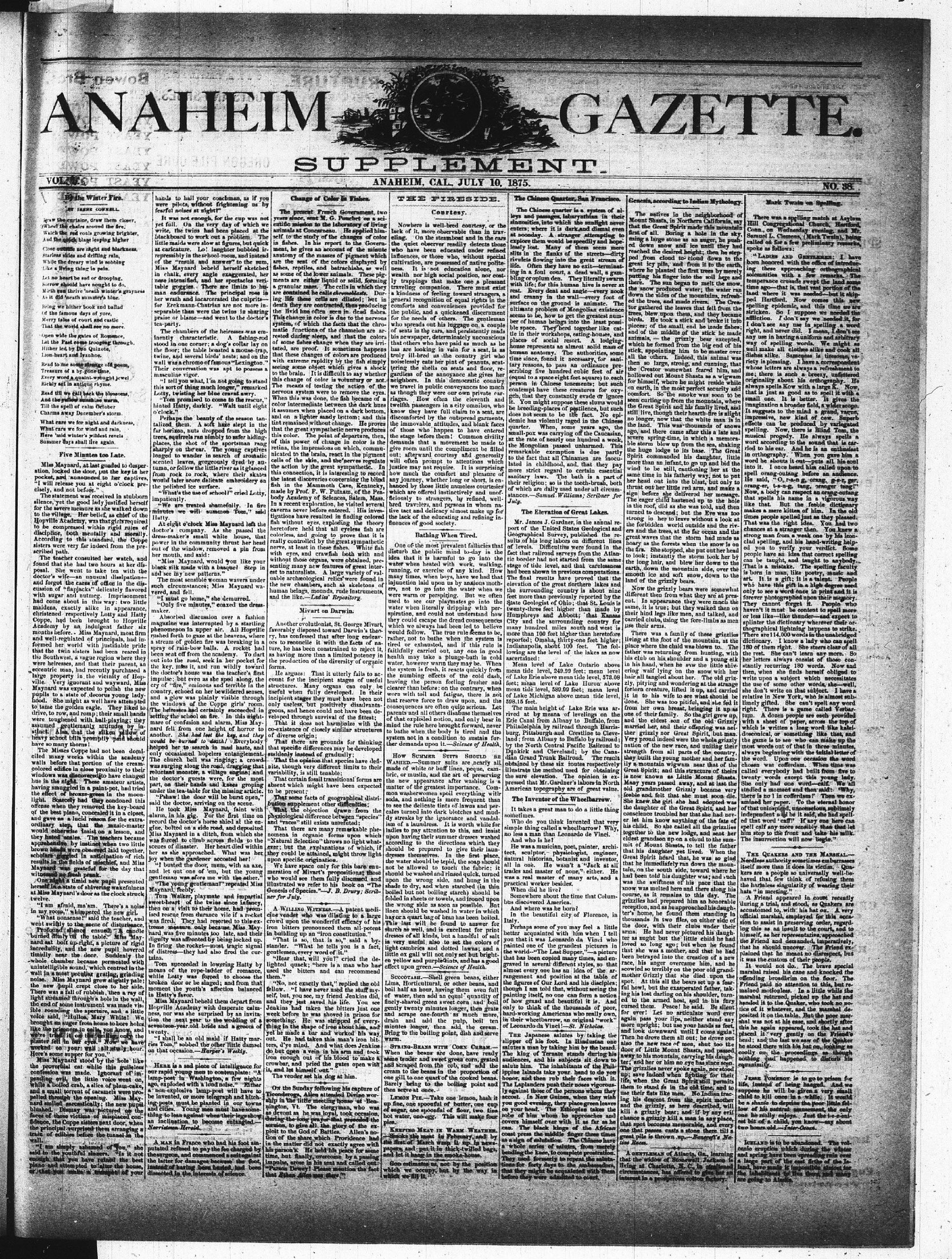
Searchable text
By the Winter Fire.
BY IRENE CORNELL
Draw the curtains, draw them closer,
Wheel the chairs around the fire.
Watch the red coals growing brighter,
And the quick blaze leaping higher
Close outside are sight and blackness,
Starless skies and drifting rain,
While the dreary wind is sobbing
Like a living thing in pain.
Let no heart be sad or drooping,
Sorrow should have nought to do,
Mirth can thrive 'neath winter's grayness
As it did 'neath summer's blue.
Bring we bither book and ballad
Of the famous days of yore,
Merry tales of court and castle
That the world shall see no more.
Open wide the gates of Romance,
Let the Past come trooping through.
Hither led by Don Quixote,
Lion-heart and Ivanhoe.
Read to me some strange old poem,
Treasure of a by-gone time,
Every word a quaint-wrought jewel
Richly set in antique rhyme.
Read till we call back the blossoms,
And the yellow sunshine warm,
Till the spell of calm October
Charms away December's storm.
What care we for night and darkness,
What care we for wind and rain,
Here 'mid winter's wildest revels
Summer days shall live again.
Five Minutes too Late.
Miss Maynard, at last goaded to desper-
Five Minutes too Late.
Miss Maynard, at last goaded to desperation, locked the door, put the key in her pocket, and announced to her captives, "I will release you at eight o'clock precisely, and not before."
The statement was received in stubborn silence, yet the good lady justified herself for the severe measure as she walked down to the village. Her belief, as chief of the Hopville Academy, was that girls required to be compressed within rigid rules of discipline, both mentally and morally. According to this standard, the Coppe sisters were very far indeed from the prescribed path.
The teacher consulted her watch, and found that she had two hours at her disposal. She went to take tea with the doctor's wife—an unusual dissipation—and forgot the cares of office in the discussion of "flapjacks" delicately flavored with sugar and nutmeg. Imprisonment had come about in this way: two little maidens, exactly alike in appearance, christened respectively Lotty and Hatty Coppe, had been brought to Hopville Academy by an indulgent father six months before. Miss Maynard, most firm and well-regulated of principals, had informed her world with justifiable pride that the twin sisters had been reared in the Southwest, a vague region where they were heirresses, and that their parent, an eccentric man, had recently purchased a large property in the vicinity of Hopville. Very ignorant and wayward, Miss Maynard was expected to polish the new pupils to a state of decorum young ladyhood. She might as well have attempted to tame the golden eagle. They liked to drive, to row, and romp; their small hands were toughened with ball-playing; they assumed gentlemanly attitudes by instinct. Also, that the silken pillow of heavy school bills promptly paid should have so many thorns!
The Misses Coppe had not been domiciled many weeks within the academy walls before that portion of the cream-colored edifice in close proximity to their windows was discovered to have changed hue in the night. These amateur artists having smuggled in a paint-pot, had tried the effect of bronze-green in the moonlight. Scarcely had they condoned this offense when they removed the key-board of the best piano, concealed it in a closet, and gave as a lucid reason for the extraordinary step, that the music-master would otherwise insist on a lesson, and they hated scales. The teachers became apprehensive by instinct when two little brown heads were observed laid together, scholars giggled in anticipation of rich results in the fields of mischief, and Miss Maynard was grateful for the day that witnessed no flesh prank.
One night a timid pupil presented herself in a state of shivering wakefulness
"I tell you what, I'm not going to stand this sort of thing much longer," remarked Lotty, twisting her blue cavat awry.
"Tom promised to come to the rescue," hinted Hatty, darkly. "Walt until eight o'clock."
Perhaps the beauty of the season tantalized them. A soft haze slept in the far horizon, nuts dropped from the high trees, squirrels ran nimply to safer hiding-places, the shot of the sportsman rang sharply on the ear. The young captives longed to wander in search of aromatic scented leaves, gorgeously dyed by autumn, or follow the little river as it glanced from rock to rock, where their skates would later score delicate embroidery on the polished ice surface.
"What's the use of school!" cried Lotty, impatiently.
"We are treated shamefully. In five minutes we will summon Tom," said Hatty.
At eight o'clock Miss Maynard left the doctor's company. As she passed the dress-maker's small white house, that power in the community thrust her head out of the window, removed a pin from her mouth, and said:
"Miss Maynard, would you like your black silk made with a basque! Step in and see my new patterns."
The most sensible woman wavers under such circumstances; Miss Maynard wavered, and fell.
"I must go home," she demurred.
"Only five minutes," coaxed the dress-maker.
Absorbed discussion over a fashion magazine was interrupted by a startling phenomenon in upper air. All Hopville rushed forth to gaze at the heavens, where a stream of golden fire was breaking in a spray of rain-bow balls. A rocket had been seat off from the academy. To dart out into the road, seek in her pocket for the key, miss it, and run wildly toward the doctor's house was the teacher's first impulse; but even as she sped along, the cry of "fire," ominous and terrible in the country, echoed on her bewildered senses, and a glow was plainly visible through the windows of the Coppe girls' room. The heifesses had certainly succeeded in setting the school on fire. In this nightmare of confusion and alarm, Miss Maynard fell from one height of horror to another. She had lost the key, and they would be burned to death! Everybody helped her to search in mad haste, and only occasionned hopeless entanglement.
The church bell was ringing; a crowd was surging along the road, dragging that reluctant monster, a village engine; and the doctor's guests were, for the most part, on their hands and knees groping under the tea-table for the missing article.
"Pahaw! the door will be burst open," said the doctor, arriving on the scene.
He took Miss Maynard, faint with alarm, in his gig. For the first time on record the doctor's horse shied at the engine, bolted on a side road, from which she was forced to climb across fields to the scenes of disaster. Her heart died within her as she approached. What was her joy when the gardener accosted her!
"I busted the door, mum, with an axe, and let out one of 'em, but the young gentleman was afore me with the other."
"The young gentleman" repeated Miss Maynard feeble.
"It tell you what, I'm not going to stand this sort of thing much longer," remarked Lotty, twisting her blue cavat awry.
"Tom promised to come to the rescue," hinted Hatty, darkly. "Walt until eight o'clock."
Perhaps the beauty of the season tantalized them. A soft haze slept in the far horizon, nuts dropped from the high trees, squirrels ran nimply to safer hiding-places, the shot of the sportsman rang sharply on the carar.
The young captives longed to wander in search of aromatic scented leaves, gorgeously dyed by autumn, or follow the little river as it glanced from rock to rock, where their skates would later score delicate embroidery on the polished ice surface.
"What's the use of school!" cried Lotty, impatiently.
"We are treated shamefully. In five minutes we will summon Tom," said Hatty.
At eight o'clock Miss Maynard left the doctor's company. As she passed the dress-maker's small white house, that power in the community thrust her head out of the window, removed a pin from her mouth, and said:
"Miss Maynard would you like your black silk made with a basque! Step in and see my new patterns."
The most sensible woman wavers under such circumstances; Miss Maynard wavered, and fell.
"I must go home," she demurred.
"Only five minutes," coaxed the dress-maker.
Absorbed discussion over a fashion magazine was interrupted by a startling phenomenon in upper air. All Hopville rushed forth to gaze at the heavens, where a stream of golden fire was breaking in a spray of rain-bow balls. A rocket had been seat off from the academy. To dart out into the road, seek in her pocket for the key, miss it, and run wildly toward the doctor's house was the teacher's first impulse; but even as she sped along, the cry of "fire," ominous and terrible in the country, echoed on her bewildered senses, and a glow was plainly visible through the windows of the Coppe girls' room. The heifesses had certainly succeeded in setting the school on fire. In this nightmare of confusion and alarm, Miss Maynard fell from one height of horror to another. She had lost the key, and they would be burned to death! Everybody helped her to search in mad haste, and only occasionned hopeless entanglement.
The church bell was ringing; a crowd was surging along the road, dragging that reluctant monster, a village engine; and the doctor's guests were for the most part, on their hands and knees groping under the tea-table for the missing article.
"Pahaw! the door will be burst open," said the doctor, arriving on the scene.
He took Miss Maynard, faint with alarm, in his gig. For the first time on record the doctor's horse shied at the engine, bolted on a side road, from which she was forced to climb across fields to the scenes of disaster. Her heart died within her as she approached. What was her joy when the gardener accosted her!
"I busted the door, mum, with an axe, and let out one of 'em, but the young gentleman was afore me with the other."
"The young gentleman" repeated Miss Maynard feeble.
"It tell you what, I'm not going to stand this sort of thing much longer," remarked Lotty, twisting her blue cavat awry.
"Tom promised to come to the rescue," hinted Hatty, darkly. "Walt until eight o'clock."
Perhaps the beauty of the season tantalized them. A soft haze slept in the far horizon, nuts dropped from the high trees, squirrels ran nimply to safer hiding-places, the shot of the sportsman rang sharply on the carar.
The young captives longed to wander in search of aromatic scented leaves, gorgeously dyed by autumn, or followthe little river as it glanced from rock to rock, where their skates would later score delicate embroidery on the polished ice surface.
"What's use of school!" cried Lotty, impatiently.
"We are treated shamefully. In five minutes we will summon Tom," said Hatty.
At eight o'clock Miss Maynard left the doctor's company. As she passedthe dress-maker's small white house, that power inthe community thrust her head out ofthe window,removeda pinfromhermouth,andsaid:
"Miss Maynard would you like your black silk made with a basque! Step in and see my new patterns."
The most sensible woman wavers under such circumstances; Miss Maynard wavered,and fell.
"I must go home,"she demurred.
"Only five minutes,"coaxedthe dress-maker.
Absorbed discussion over a fashion magazine was interrupted by a startling phenomenon in upper air. All Hopville rushed forth to gaze atthe heavens,wherea streamof goldenfirewasbreakinginasprayofrainbowballs.A rockethadbeenseatofffromtheacademy.Todartouttheroad,theseindownfortheschoolandpineforksundertheteaball.forthemissingarticleformetheproductionofthediversityformeforme.
He argues: That it utterly fills count fortheincipientstagescanusefulwhenfullydeveloped.Inincipientstagesmusthaveonlyuselessbutpositivelydigested,andhencecouldnothavelovedthroughsurvivalofthethatitdoesnotharmlizeco-existenceofcloselysimilarruralorigin;
That there are grounds forthatspecificdifferencemaybeauduallentlyinstudiedofgradually;
Thatthe opinionthatspeciesmitealthoughverydifferentlimitt variabilityis stilltenable;
Thatcertainfossiltransitionalabsentwhichmighthavebeentobepresent;
That some factsofgeographicbutsupplementotherdiffusion;
Thattheobjectiondrawnbyphysiologicaldifferencebetweenand"races"'stillexistsunrefuted;
ThattherearemanyremarksomenainorganicformsuppeNaturalSelection"throwsnolieder;但theexplanationsofthey couldbeattained,mightthought uponspecificorigination。
We have space only forthisbleremationofMivart'spropositionwhowouldseethemfullydiscuss illustratedwe refertohisbookConversionofhearsionwavefulness
the effect of bronze-green in the moonlight. Scarcely had they condoned this offense when they removed the key-board of the best piano, concealed it in a closet, and gave as a lucid reason for the extraordinary step, that the music-master would otherwise insist on a lesson, and they hated males. The teachers became apprehensive by instinct when two little brown heads were observed laid together, schofari giggled in anticipation of rich results in the fields of mischief, and Miss Maynard was grateful for the day that witnessed no fresh prank.
One night a timid new pupil presented herself in a state of shivering wakefulness at Miss Maynard's door as the clock struck twelve.
"I am afraid, ma'am. There's a noise in my room," whispered the new girl.
"What nonsense!" said the teacher, and went swiftly to the scene of disturbance.
Profound silence ensued. A candle burned dimly on the table. Miss Maynard sat bolt up-right, a picture of rigid incredulity, and the new pupil hovered timidly near the door. Suddenly the whole chamber became permeated with unintelligible sound, which centred in the wall in a most peculiar grating, grinding noise. Miss Maynard grew slightly pale; the new pupil crept close to her side. There was a fall of rubbish, then a ray of light streamed through a hole in the wall, the end of some instrument was made visible rounding the aperture, and a little voice said, "Hullon Mary White! We brought an auger from home to bore holes like the prisoners in calls you know, and we tried it on the ceiling only the plaster fell in our eyes. Now we have worked on your wall all study hour. Here's some supper for you."
Miss Maynard stood by the hole like the providential cat while this guileless confession was made. Ignorant of impending evil, the little voice went on, while a boiled crab, a slice of plum-cake, and a small torrent of caramels were propelled through the opening. Miss Maynard smiled sarcastically; the new pupil blushed. Dismay was pictured on the faces of these victims of misplaced confidence, the Coppe sisters next door, when the principal surprised them arranging a train of edibles before the tunnel in the wall.
"I am simply ashamed of you," she said to the youthful sinners. "Is it not enough that you have ruined the best piano and attempted to alter the house, or that you make a insult of your
A man in France who had his foot amputated refused to pay the fee charged by the surgeon, and commenced a suit against the latter for damages because the foot, instead of having been hurt, had been dissected in the interests of science.
"Pahaw! the door will be burst open," said the doctor, arriving on the scene.
He took Miss Maynard, faint with alarm, in his gig. For the first time on record the doctor's horse shied at the engine, bolted on a side road, and deposited Miss Maynard in a ditch, from which she was forced to climb across fields to the scenes of disaster. Her heart died within her as she approached. What was her joy when the gardener accosted her!
"I busted the door, mum, with an axe, and let out one of 'em, but the young gentleman was afro me with the other."
"The young gentleman?" repeated Miss Maynard, feebly.
Tom Walker, playmate and impartial sweet-heart of the twins since infancy, then on a visit to their home, had promised rescue from durance vile if a rocket was fired. They had resorted to this extreme measure only because Miss Maynard was five minutes too late, and their dignity was affronted by being locked up. In firing the rocket—most tragic signal of distress—they had also fired the curtains.
Tom succeeded in lowering Hatty by means of the rope-ladder of romance, while Lotty was forced to choose the broken door or be singed; and from that moment the youth's affection balanced in Hatty's favor.
Miss Maynard beheld them depart from Hopville Academy with desperate calmness, nor was she surprised by an invitation the next year to the wedding of a seventeen-year-old bride and a groom of twenty.
"I shall be an old maid if Hatty marries Tom," sobbed the other little damsel on that occasion.—Harper's Weekly.
Here is a sad piece of intelligence for our rapid young men to contemplate: "A lamp-post in Washington, a few nights ago, exploded with a loud noise." Either a non-explosive lamp-post will have to be invented, or more telegraph and hitching-posts must be planted in our towns and cities. Young men must have something to lean against when their legs show an inclination to become entangled.—Narristen Herald.
A man in France who had his foot amputated refused to pay the fee charged by the surgeon, and commenced a suit against the latter for damages because the foot, instead of having been hurt, had been dissected in the interests of science.
That some facts of geography but supplement other differences.
That the objection drawn physiological difference between men and "races" still exists unrefuted.
That there are many remarkable nomena in organic forms upon "Natural Selection" throws no life ever; but the explanations of they could be attained might thus upon specific origination.
We have space only for this beringement of Mivart's proposition who would see them fully discern illustrated we refer to his book Genesis of Species."—J. B. Drummond for July.
A WILLING WITNESS.—A patte cine vender who was dilating to crowd upon the wonderful efficacy iron bitters pronounced them as in building up an "iron constitution."
That is so, that is so," said stander. "What he tells you in gentlemen, every word of it."
"Hear that, will you?" cried lighted quack; "here is a man used the bitters and can recite them."
"No, not exactly that," replied fellow. "I have never used them self, but you see my friend Jenks and they just saved his life. Jenkins had taken the bitters week before he was showed in painting. He was stripped off thing in shape of iron about yet he made a bar and worked out. He had taken this man's ters, d'ye mind. And what does do but open a vein in his arm or iron enough out of his blood to crowbar, and pried the gates out it, and let himself out."
The vender set his dog at him.
On the Sunday following his entry The conderoge, Allen attended Dairy ship in the little meeting house Nington, Vt. The clergyman, as devout as he was loyal, took during the long prayer that praised him to give all the glory of ploit to the God of Battles. Allion of the share which Provided in the matter did not exactly agree his parson's k. He held his peace time, but finally overcome by a impulse, arose in his seat and called "Parson Deway! Please mention that Ether Allen was there."
M GAZ
SUPPLEMENT.
ANAHEIM, CAL., JULY 10, 1875.
Change of Color in Fishes.
The present French Government, two years since, sent M. G. Ponchet on a scientific mission to the laboratory of living animals at Concarneau. He applied himself to the study of the changes of color of fishes. In his report to the Governor, he gives an account of the minute anatomy of the masses of pigment which lie in the seat of the colors displayed by fishes, reptiles, and batrachians, as well some of the lower animals. These pigments are either liquid or solid, forming granular mass. The cells in which they are contained he calls chromolasts. During life these cells are dilated; but in death they are contracted, thus producing vivid hue often seen in dead fishes. Its change in color is due to the nervous system, of which the facts that the chronic functions of the chamelon are arrested during sleep, and that the colors some fishes change when they are irritated, are proof. It sometimes happens that these changes of colors are produced with extreme rapidity by the fish simply seeing some object which gives a shock to the brain. It is difficult to say whether a change of color is voluntary or not. The means of testing the action of the nervous system were to remove the eyes when this was done, the fish became of a color intermediate between the dark hues assumes when placed on a dark bottom, and on a lighter sandy bottom; and this remained without change. He proves that the great sympathetic nerve produces its color. The point of departure, then, this power of change in color is the main, the impressions on which, communicated to the brain, react in the pigment of the skin, and the nerves regulate action by the great sympathetic. In
THE FIRESIDE.
Courtesy.
Nowhere is well-bred courtesy, or the lack of it, more observable than in traveling. On the steamboat and in the cars the quiet observer readily detects those who have been educated under refined influences, or those who, without special cultivation, are possessed of native politeness. It is not education alone, nor wealth nor high social position, nor costly trappings that make one a pleasant traveling companion. There must exist a kindness of feeling toward strangers, a general recognition of equal rights in the comforts and conveniences provided for the public, and a quickened discernment for the needs of others. The gentleman who spreads out his luggage on a couple of seats in the cars, and persistently reads his newspaper, determinately unconscious that others who have paid as much as he has are looking in vain for a seat, is as truly ill-breed as the country girl who noiselessly eats her pint of peanuts, scattering the shells on seats and floor, regardless of the annoyance she gives her neighbors. In this democratic country we travel in public conveyances too much as though they were our own private carriages. How often the eleventh and twelfth passengers in a city omnibus, who know they have full claim to a seat, are discomforted by the outspread garments, the immovable attitudes, and blank faces of those who happen to have entered the stage before them! Common civility demands that a movement be made to give room until the compliment be filled out; afterward courtesy and generosity will often prompt to attentions which justice may not require. It is surprising
The Chinese Quarter, San Francisco.
The Chinese quarter is a system of alleyways and passages, labarynthian in their sinnoities, into which the sunlight never enters; where it is dark and dismal even at noonday. A stranger attempting to explore them would be speedily and hopefully lost. Many of them seem mere slits in the flanks of the streets—dirty rivulets flowing into the great stream of life. Often they have no exit—terminating in a foul court, a dead wall, a gambling or opium den. They literally swarm with life; for this human hive is never at rest. Every dent and angle—every nook and cranny in the wall—every foot of surface on the ground is animate. The ultimate problem of Mongolian existence seems to be, how to get the greatest number of human beings into the least possible space. They herd together like cattle in their workshops, eating-houses, and places of social resort. A lodging-house represents an almost solid mass of human anatomy. The authorities, some time since, found it necessary for sanitary reasons, to pass an ordinance prescribing five hundred cubic feet of air (equal to a space eight feet square) to each person in Chinese tenements; but such contempt have these creatures for oxygen, that they constantly evade or ignore it. You might suppose these slums would be breeding-places of pestilence, but such does not seem to be the fact. No epidemic has violently raged in the Chinese quarter. When, some years ago, the small-pox was carrying off the Caucasian, at the rate of nearly one hundred a week, the Mongolian passed unharmed. This remarkable exemption is due partly to the fact that all Chinamen are incubated in childhood, and that they pay more strict restraint to continue.
Genesis, according
The natives in Mount Shasta, in that the Great Sage first of all. Boys using a large stool reached the desired ped from cloudy great icy pile; where he planted putting his finger there. The sun's snow product down the sides owed the trees, and tor gathered these trees, blew upon birds. He took pieces; of the sea and of the midday animals —the which he formed stick, appointing all the others then so large, so Creator sound hollowed out Moor for himself, when on earth, in the comfort. So thence curling up for the Great Spirit still live, though no longer now to land. This ago, and there come severe spring-time bleak storm blew through huge lodge Spirit command more than an infestion wind to be still
It is difficult to say whether the change of color is voluntary or not; we mean of testing the action of the nervous system were to remove the eyes when this was done, the fish became a color intermediate between the dark hues assumed when placed on a dark bottom, and on a lighter sandy bottom; and this remained without change. He proves that the great sympathetic nerve produces color. The point of departure, then, is power of change in color is the pain, the impressions on which, communicated to the brain, react in the pigment cells of the skin, and the nerves regulate action by the great sympathetic. In connection, it is interesting to record latest discoveries concerning the blind in the Mammoth Cave, Kentucky, made by Prof. F. W. Putnam, of the Penny Academy of Sciences, Salem, Mass., a recent exploration, he visited several lerns never before entered. His investigations have resulted in finding colored without eyes, exploding the theory metofore held that all eyeless fish are obless, and going to prove that it is fully controlled by the great sympathetic vee, at least in these fishes. White fish with eyes, and crawfish both with and without those organs, were obtained, preying many new features of great interto naturalists. A large variety of valuable archaeological relics were found in new chambers, such as skeletons of man beings, mounds, rude instruments, the like.—Ladies’ Repository.
Mivart on Darwin.
Another evolutionist, St. George Mivart, braily disposed toward Darwin’s theories confessed that after long endeavor to reconcile it with the facts of nature, he has been constrained to reject it, having more than a limited potency in production of the diversity of organic matter.
He argues: That it utterly fails to accept for the incipient stages of useful pictures. Many organs can only be used when fully developed. In their patient stages they must have been not useless, but positively disadvantageous, and hence could not have been deepened through survival of the fittest; that it does not harmize with the existence of closely similar structures diverse origin; that there are grounds for thinking specific differences may be developed slowly instead of gradually; that the opinion that species have defied though very different limits to their viability is still tenable; that certain fossil transitional forms are not which might have been expected at present; that some facts of geographical distribution supplement other difficulties; that the objection drawn from the biological difference between “species” “races” still exists unrefuted; that there are many remarkable phenomena in organic forms upon which natural Selection” throws no light whatsoever; but the explanations of which, if could be attained, might throw light on a specific origination.
We have space only for this bare animation of Mivart’s propositions; those would see them fully discussed and attributed we refer to his book on “The brain.
It is difficult to say whether its change of color is voluntary or not; we mean of testing the action of the nervous system were to remove the eyes when this was done, the fish became a color intermediate between the dark hues assumes when placed on a dark bottom, and on a lighter sandy bottom; and this remained without change. He proves that the great sympathetic nerve produces color. The point of departure, then, is power of change in color is the pain, the impressions on which, communicated to the brain, react in the pigment cells of the skin, and the nerves regulate action by the great sympathetic. In connection, it is interesting to record latest discoveries concerning the blind in the Mammoth Cave, Kentucky, made by Prof. F. W. Putnam, of the Penny Academy of Sciences, Salem, Mass., a recent exploration, he visited several lerns never before entered. His investigations have resulted in finding colored without eyes, exploding the theory metofore held that all eyeless fish are obless, and going to prove that it is fully controlled by the great sympathetic vee, at least in these fishes. White fish with eyes, and crawfish both with and without those organs, were obtained, preying many new features of great interto naturalists. A large variety of valuable archaeological relics were found in new chambers, such as skeletons of man beings, monds, rude instruments, the like.—Ladies’ Repository.
Bathing When Tired.
One of the most prevalent fallacies that disturb the public mind to-day is the idea that it is harmful to go into the water when heated with work, walking, running, or exercise of any kind. How many times, when boys, have we had that injunction laid upon us by anxious mothers, not to go into the water when we were warm or perspiring. But we often used to see our playmates go into the water when literally dripping with perspiration, and could not understand how they could escape the dread consequences which we always had been led to believe would follow. The true rule seems to be rather, not to bathe when the system is tired or exhausted, and if this rule is faithfully carried out, any one in good health may take a plunge-bath in cold water, however warm they may be. When the system is fresh, it reacts quickly from the numbing effects of the cold dash, leaving the person feeling fresher and clearer than before; on the contrary, when worn with toil and fatigue, there is not that reserve force to draw upon, and the consequences are often quite serious. Let parents and all others disabuse themselves of that exploded notion, and only bear in mind the rule here brought forward, never to bathe when the body is tired and the system not in a condition to sustain further demands upon it.—Science of Health.
How Summer Suits Should Be Washed.—Summer suits are nearly all made of white or buff linen, pequea cambric, or muslin, and the art of preserving the new appearance after washing is a matter of the greatest importance. Common washerwomen spoil everything with soda, and nothing is more frequent than to see the delicate tints of lawns and percales turned into dark blotches and muddy streaks by the ignorance and vandalism of a laundress. It is worth while for ladies to pay attention to this, and insist upon having their summer dresses washed according to the directions which they should be prepared to give their laundresses themselves. In the first place, the water should be tepid, the soap should not be allowed to touch the fabric; it should be washed and rinsed quick, turned upon the wrong side, and hung in the shade to dry, and when starched (in thin gardless of the annoyance she gives her neighbors. In this democratic country we travel in public conveyances too much as though they were our own private carriages. How often the eleventh and twelfth passengers in a city omnibus, who know they have full claim to a seat, are discomforted by the outspread garments, the immovable attitudes, and blank faces of those who happen to have entered the stage before them! Common civility demands that a movement be made to give room until the compliment be filled out; afterward courtesy and generosity will often prompt to attentions which justice may not require. It is surprising how much the comfort and pleasure of any journey, whether long or short, is enhanced by those little nameless courtesies which are offered instinctively and unfociously to strangers, hy refined, wellbred travelers, and persons in whom native tact and delicacy almost make up for the lack of the educating and refining influences of good society.
Mr. James J. Gardner, in the annual report of the United States Geological Survey, published the results of his long labors on different lines of levels. Difficulties were found in the fact that railroad surveys from the Atlantic border had not started from the same stage of tide level, and that carelessness had been shown in previous computations. The final results have proved that the elevation of the great northern lakes and the surrounding country is about nine feet more than previously reported by the State Geologist of Ohio; that St. Louis is twenty-three feet higher than made by Humphreys and Abbott; that Kansas City and the surrounding country for many hundred miles south and west is more than 100 feet higher than heretofore reported; Omaha, thirty-one feet higher; Indianapolis, about 100 feet. The following are the level of the lakes as now ascertained:
Mean level of Lake Ontario above mean tide level, 249.99 feet; mean level of Lake Erie above mean tide level, 573.08 feet; mean level of Lake Huron above mean tide level, 589.99 feet; mean level of Lake Michigan above mean tide level, 598.15 feet.
The main height of Lake Erie was arrived at by meana of levelings on the Erie Canal from Albany to Buffalo from Philadelphia by railroad through Harrisburg, Pittsburgh and Crestline to Cleveland; from Albany to Buffalo by railroad; by the North Central Pacific Railroad to Dunkirk and Cleveland; by the Canadian Grand Trunk Railroad. The result obtained by these six routes respectively illustrate the method used for obtaining the sure elevation. The opinion is expressed that Mr. Gardner’s labors in North American topography are of great value.
The Inventor of the Wheelbarrow.
It takes a great man to do a little thing sometimes.
Who do you think invented that very simple thing called a wheelbarrow? Why, no less a man than Leonardo de Vinci.
And who is he?
He was a musician, poet, painter, architect, sculptor, physiologist, engineer, natural historian, botanist and inventor, all in one. He wasn’t a “Jack at all trades and master of none,” either. He was a real master of many arts, and a practical worker besides.
When did he live?
WILLING WITNESS.—A patent medivender who was dilating to a large
upon the wonderful efficacy of his
bitters pronounced them all-potent
building up an "iron constitution."
That is so, that is so," said by
derer. "What he tells you is a fact,
lemen, every word of it."
Dear that, will you?" cried the deed quack; "here is a man who hare
the bitters and can recommend
no, not exactly that," replied the old
w. "I have never used the stuff mybut, you see, my friend Jenkins did,
they just saved his life. You see
insis had taken the bitters Just one
before he was shoved in prison for
thing. He was stripped of every
In the shape of iron about him, and
he made a bar and worked his way.
He had taken this man's iron bitdye mind. And what does Jenkins
but open a vein in his arm and took
enough out of his blood to make a bar,
and pried the gates open with
and let himself out."
The vender set his dog at him.
In the Sunday following his capture of
underoga, Allen attended Divine worning in the little meeting house at Benson, Vt. The clergyman, who was awont as he was loyal, took occasion,
gong the long prayer that preceeded the
son, to give all the glory of the exto the God of Battles. Allen's noof the share which Providence had
matter did not exactly agree with
personk. He held his peace for some
but finally, overcome by a passing
arose in his seat and called out:
"Son Dewey! Please mention the fact
Ethan Allen was there."
Mon washersomen spoil everything withr soda, and nothing is more frequent than to see the delicate tints of lawns and per-cales turned into dark blotches and muddy streaks by the ignorance and vandalism of a laundress. It is worth while for ladies to pay attention to this, and insist upon having their summer dresses washed according to the directions which they should be prepared to give their laundresses themselves. In the first place, the water should be tepid, the soap should not be allowed to touch the fabric; it should be washed and rinsed quick, turned upon the wrong side, and hung in the shade to dry, and when starched (in thin boiled but not boiling starch) should be folded in sheets or towels, and ironed upon the wrong side as soon as possible. But linen should be washed in water in which hay or a quart bag of bran has been boiled. This last will be found to answer for starch as well, and is excellent for print dresSES of all kinds, but a handful of salt is very useful also to set the colors of light cambries and dotted lawns; and a little ox gall will not only set but brighten yellow and purple dints, and has a good effect upon green.—Science of Health.
Succotash.—Shell green beans, either Lima, Horticultural, or other beans, and boil half an hour, having them even full of water, then add an equal quantity of finely-shaved green sweet corn and boil gently twenty minutes longer, then grate and scrape one-fourth as much more, drain and add the pulp, boil ten minutes longer, then add the cream. Bring to the boiling point, dish and serve warm.
String-Beans WITH Corn Cream.—When the beans are done, have ready some tender and sweet green corn, grated and scraped from the cob, and add the cream to the beans in the proportion of one gill to one quart of the cooked beans. Barely bring to the boiling point and then serve at once.
Lemon Pie.—Take one lemon, hash it up fine, one spoonful of butter, one cup of sugar, one spoonful of flour, two tins hot water, one egg. This will make four pies.
Keeping Meat IN Warm Weather.—Snake the meat in February, and by the flats of March wrap it up in newspapers, and put it in thick-twilled bags, and let it hang in the smoke-house.
God estimates us, not by the position which we occupy, but by the way in which we fill it.
The Inventor of the Wheelbarrow.
It takes a great man to do a little thing sometimes.
Who do you think invented that very simple thing called a wheelbarrow? Why, no less a man than Leonardo de Vinci.
And who is he?
He was a musician, poet, painter, architect, sculptor,- physiologist, engineer, natural historian, botanist and inventor, all in one. He wasn't a "Jack at all trades and master of none," either. He was a real master of many arts, and a practical worker besides.
When did he live?
Somewhere about the time that Columbus discovered America.
And where was he born?
In the beautiful city of Florence, in Italy.
Perhaps some of you may feel a little better acquainted with him when I tell you that it was Leonardo da Vinci who painted one of the grandest pictures in the world."—The Last Supper,"—a picture that has been copied many times, and graved in several different styles, so that almost every one has an idea of the arrangement and position at the table of the figures of Our Lord and his disciples; though I am told that, without seeing the painting itself, no one can form a notion of how grand and beautiful it is. And only to think of the thousands of poor, hard-working Americans who really own, in their wheelbarrow, an original "work" of Leonardo da Vinci!—St. Nicholas.
The Japanese salutes by taking the slipper off his foot. In Hindustan one salutes a man by taking him by the beard. The king of Ternate stands during his audiences, and his subjects sit down to salute him. The inhabitants of the Philippine Islands take your hand to do you honor, and then rub their faces with it. The Laplanders push their noses vigorously against those of persons whom they accost. In New Guinea, when they wish you good evening, they place green leaves on your head. The Ethiopians takes the nose of him whom he approaches and covers himself over with it as far as he can. The black kings of the African coast press the middle finger three times as a sign of salutation. The Chinese have a whole series of salutes from merely handling the knee, to complete prostration. They used formerly to repeat the salutations for forty days to the ambsanders, that they might be acquainted with them before they were admitted to court.
A gentleman of that the widow of f-living at Charlotte circumstances, has interest in a prophecy
GAZETTE.
NO. 38
Genesis, according to Indian Mythology.
The natives in the neighborhood of Mount Shasta, in Northern California, say that the Great Spirit made this mountain first of all. Boring a hole in the sky, using a large stone as an auger, he pushed down snow and ice until they had reached the desired height; then he stepped from cloud to cloud down to the great icy pile, and from it to the earth, where he planted the first trees by merely putting his finger into the soil here and there. The sun began to melt the snow, the snow produced water; the water ran down the sides of the mountains, refreshing the trees, and made rivers. The Creator gathered the leaves that fell from the trees, blew upon them, and they became birds. He took a stick and broke it into pieces; of the small end he made fishes; and of the middle of the stick he made animals — the grizzly bear excepted, which he formed from the big end of his stick, appointing him to be master over all the others. Indeed, this animal was then so large, strong, and cunning, that the Creator somewhat feared him, and hollowed out Mount Shasta as a wigwam for himself, where he might reside while on earth, in the most perfect security and comfort. So the smoke was soon to be seen curling up from the mountain, where the Great Spirit and his family lived, and still live, though their hearth-fire is alight no longer, now that the white man is in the land. This was thousands of snows ago, and there came after this a late and severe spring-time, in which a memorable storm blew up from the sea, shaking the huge lodge to its base. The Great Spirit commanded his daughter, little more than an infant, to go up and bid the wind to be still, cautioning her at the
Mark Twain on Spelling.
There was a spelling match at Aylom Hill Congregational Church, Hartford, Conn., on Wednesday evening, and Mr. Samuel L. Clemens (Mark Twain), being called on for a few preliminary remarks, spoke as follows:
"LADIES AND GENTLEMEN: I have been honored with the office of introducing these approaching orthographical solemnities with a few remarks. The temperance crusade swept the land some time ago—that is, that vast portion of the land where it was needed—but it skipped Hartford. Now comes this new spelling epidemic, and this time we are stricken. So I suppose we needed the affliction. I don't say we needed it, for I don't see any use in spelling a word right, and never did. I mean, I don't see any use in having a uniform and arbitrary way of spelling words. We might as well make all clothes alike and cook all dishes alike. Sameness is tizsome variety is pleasing. I have a correspondent whose letters are always a refreshment to me; there is such a breezy, unfettered originality about his orthography. He always spells Kow with a large R. Now, that is just as good as to spell it with a small one. It is better. It gives the imagination a broader field, a wider scope. It suggests to the mind a grand vague, impressive, new kind of cow. Superb effects can be produced by variegated spelling. Now, there is Blind Tom, the musical progedy. He always spells a word according to the sound that is carried to his ear. And he is an enthrastant in orthography. When you gave him a word he shouted it out—puts all his soul into it. I once heard him called upon to
The Quakers and the Marshal—Needless authority sometimes embarrases itself more than it does its victim. Quakers are a people so universally well-heaved that few think of refusing them the harmless singularity of wearing their hollowed out Mount Shasta as a wigwam for himself, where he might reside while on earth, in the most perfect security and comfort. So the smoke was soon to be seen curling up from the mountain, where the Great Spirit and his family lived, and still live, though their hearth-fire is alight no longer, now that the white man is in the land. This was thousands of snows ago, and there came after this a late and severe spring-time, in which a memorable storm blew up from the sea, shaking the huge lodge to its base. The Great Spirit commanded his daughter, little more than an infant, to go up and bid the wind to be still, cautioning her at the same time in his fatherly way, not to put her head out into the blast, but only to thrust out her little red arm, and make a sign before she delivered her message. The eager child hastened up to the hole in the roof, did as she was told, and then turned to descend; but the Eve was too strong in her to leave without a look at the forbidden world outside and the rivers and the trees, at the far ocean and the great waves that the storm had made as hoary as the forests when the snow is on the fire. She stopped, she put out her head to look; instantly the storm took her by the long hair, and blew her down to the earth, down the mountain side, over the smooth ice and soft snow, down to the land of the grizzly bears.
Now the grizzly bears were somewhat different then from what they are at present. In appearance they were much the same, it is true; but they walked then on their hind legs like men, and talked, and carried clubs, using the fore-limbs as men use their arms.
There was a family of these grizzlies living at the foot of the mountain, at the place where the child was blown to. The father was returning from hunting, with his club on his shoulder and a young elk in his hand, when he saw the little shivering waif lying on the snow with her hair all tangled about her. The old grizzly, pitying and wondering at the strange forlorn creature, lifted it up, and carried it in to his wife to see what should be done. She was too pitiful, and she fed it from her own breast, bringing it up as one of their family. So the girl grew up, and the eldest son of the old Grizzly married her, and their offspring was neither grizzly nor Great Spirit, but man. Very proud indeed were the whole grizzly nation of the new race, and uniting their strength from all parts of the country, they built the young mother and her family a mountain wigwam near that of the Great Spirit; and this structure of theirs is now known as Little Mount Shasta. Many years passed away, and at last the old grandmother Grizzly became very feeble and felt that she must soon die. She knew the girl she had adopted was the daughter of the Great Spirit, and her conscience troubled her that she had never let him know anything of the fate of his child. So she called all the grizzlies together to the new lodge, and sent her eldest grandson up on a cloud to the summit of Mount Shasta, to tell the father that his daughter yet lived. When the Great Spirit heard that, he was so glad that he immediately ran down the mountain, on the south side, toward where he had been told his daughter was; and such was the swiftness of his pace that the snow was melted here and there along his me; there is such a breery, unfettered originality about his orthography. He always spells Kow with a large K. Now, that is just good as to spell it with a small one. It is better. It gives the imagination a broader field, a wider scope. It suggests to the mind a grand, vaque, impressive, new kind of cow. Superb effects can be produced by variegated spelling. Now, there is Blind Tom, the musical progedy. He always spells a word according to the sound that is carried to his ear. And he is an enthusiast in orthography. When you gave him a word he shouta it out—puts all his soul into it. I once heard him called upon to spell orang-outang before an audience. He said, "O,r-a-n g.orang,g-e-r.ger.orang-er,t-a-n-g.tang.oranger tang!" Now, a body can respect an orang-outang that spells his name in a vigorous way like that. But the feeble dictionary makes a mere kitten of him. In the old times people spelled just as they pleased. That was the right idea. You had two chances at a stranger then. You knew a strong man from a weak one by his iron-clad spelling, and his hand-writing helped you to verify your verdict. Some people have an idea that correct spelling can be taught, and taught to anybody. That is a mistake. The spelling faculty is born in man, like poetry, music and art. It is a gift; it is a talent. People who have this gift in a high degree need only to see a word once in print and it is forever photographed upon their memory. They cannot forget it. People who haven’t it must be content to spell more or less like—like thunder—and expect to splinter the dictionary wherever their orthographical lightning happens to strike. There are 114,000 words in the unabridged dictionary. I know a lady who can spell 180 of them right. She steers clear of all the rest. She can't learn any more. So her letters always consist of those constantly recurring 180 words. Now and then, when she finds herself obliged to write upon a subject which necessitates the use of some other words, she—well, she don't write on that subject. I have a relative in New York, who is almost sublimely gifted. She can't spell any word right. There is a game called Verharum. A dozen people are each provided with a sheet of paper, across the top of which is written a long word like kalsidosconical, or something like that, and the game is to see who can make up the most words out of that in three minutes, always beginning with the initial letter of the word. Upon one occasion the word chosen was cofferdam. When time was called everybody had built from five to twenty words except this young lady. She only had one word—calf. We all studied a moment and then said: "Why, there is no 1 in cofferdam!" Then we examined her paper. To the eternal honor of that uninspired, unconscious sublimely independent skill be it said, she had spelled that word 'caff!' If any one here can spell calf any more sensibly than that let him stop to the front and take his milk. The insurrection will now begin."
THE QUAKERS AND THE MARSHAL—Needless authority sometimes embarrasses itself more than it does its victim. Quakers are a people so universally well-heaved that few think of refusing them the harmless singularity of wearing their hollowed out Mount Shasta as a wigwam for himself, where he might reside while on earth, in the most perfect security and comfort. So the smoke was soon to be seen curling up from the mountain, where the Great Spirit and his family lived, and still live, though their hearth-fire is alight no longer, now that the white man is in the land. This was thousands of snows ago, and there came after this a late and severe spring-time, in which a memorable storm blew up from the sea, shaking the huge lodge to its base. The Great Spirit commanded his daughter, little more than an infant, to go up and bid the wind to be still, cautioning her at the same time in his fatherly way, not to put her head out into the blast, but only to thrust out her little red arm, and make a sign before she delivered her message. The eager child hastened up to the hole in the roof, did as she was told, and then turned to descend; but the Eve was too strong in her to leave without a look at the forbidden world outside and the rivers and the trees, at the far ocean and the great waves that the storm had made as hoary as the forests when the snow is on the fires. She stopped, she put out her head to look; instantly the storm took her by the long hair, and blew her down to the earth, down the mountain side, over the smooth ice and soft snow, down to the land of the grizzly bears.
Now the grizzly bears were somewhat different then from what they are at present. In appearance they were much the same, it is true; but they walked then on their hind legs like men, and talked, and carried clubs, using the fore-limbs as men use their arms.
There was a family of these grizzlies living at the foot of the mountain, at the place where the child was blown to. The father was returning from hunting, with his club on his shoulder and a young elk in his hand, when he saw the little shivering waif lying on the snow with her hair all tangled about her. The old grizzly, pitying and wondering at the strange forlorn creature, lifted it up,and carried it in to his wife to see what should be done. She was too pitiful,and she fed it from her own breast,bringing it up as one of their family. So she girl grew up,andthe eldest son ofthe old Grizzly married her,and their offspring was neither grizzly nor Great Spirit,但man.Very proud indeed werethewhole grizzly nationofthenewrace,andunitingthestrengthfromallpartsofthecountry,theybuilttheyoungmotherandherfamilyamountiwigwamnearthatoftheGreatSpirit;andthisstructureoftheirsisnowknownasLittleMountShasta.Manyyearspassedaway,andatlasttheoldgrandmotherGrizzlybecameveryfeebleandfeltthatshemustsoondie.SheknewthegirlshehadadoptedwasthedaughteroftheGreatSpirit,andherconsciencetroubledherthatshehadneverlethimknowanythingofthefateofhischild.Soshecalledallthegrizzliestogethertothenewlodge,andsenthereldestgrandsonuponcouldtothesummitofMountShasta,totelltherfatherthathiss daughteryetlived.WhentheGreatSpiritheardthat,hewassogladthatheimmediatelyrandownthemountain.onthesouthside,towardwherehehadbeentoldhis daughterwas;andsuchwastheswiftnessofhispacethatthesnowwasmeltedhereandtherealonghismeet;thereissuchabreery.unfetteredoriginalityabouthisorthography.HealwaysspellsKowwithalargeK.Nowthatisjustgoodastospellitwithasmallone.Iitisbetter.Isgivestheimaginationabroaderfield,awiderscope.它suggeststotheminda Grand,vagueimpressive,新kindofcow。Superbeffectscanbeproducedbyvariegatedspelling.Now,theisBlindTom,themusicalprogedy。他alwaysspellsawordaccordingtothesoundthatiscarriedtohisearn.AndheisanenthilianstoryWhenyougavehimawordheshootaitsout—putsallhis soulintoit.Ionceheardhimcalledupontospellorang-outangbeforean audience.他said,"O,r-a-n g.orang,g-e-r.ger.orang-er,t-a-n-g.tang.oranger tang!"Now,abodycanrespectanorang-outangthatspellshisnameinavigorouswaylikethat.Butthefeebledictionarymakesamerekittenofhim.Intheoldtimespeoplespelledjustastheypleased.Thewastherightidea.Youcan'tlearnanymore.Soherlettersalwaysconsistofthoseconstantlyrecurring180words.Nowandthenwhenshefindsherselfobligedtowriteuponassubjectnecessitatestheuseofsomeotherwords,she—well,shedon'twriteonthatsubject.IhavearelativeinNewYork,whoisalmostsublimelygifted.Shecann'tspellanywordrightThereisagamecalledVerharum.Adozenepeopleareeachprovidedwithasheetofpaper.acrossthetopofwhichiswrittenalongwordlikekalsidosconical,或 something like that,andthegameistoseewhocanmakeupthemostwordsoutofthatinthreeminutes.alwaysbeginwiththeinitialletteroftheword.Upononeoccasionthewordchosenwascofferdam.Whentimewascalledeverybodyhadbuiltfromfivetotwentywordsexceptthisyoung lady.Sheonlyhadoneword—calf.Wewillstudieda momentandthensaid:"Why,thethereisno1incofferdam!"Thenweexaminedherpaper.Toothe eternal honorofthatuninspired,不conscionelyindependentskillbeit said,她hadspelledthatword‘caff!’Ifanyoneherecanspellcalfanymoresensiblythanthatlethimstoptothefrontandtakehismilk.Theinsurrectionwillnowbegin."
THE QUAKERS AND THE MARSHAL—Needless authority sometimes embarrasses itself more than it does its victim. Quakers are a people so universally well-heaved that few think of refusing them the harmless singularity of wearing their hats "in meeting."
A Friend appeared in court recently during a trial, and stood, as Quakers are accustomed to, with his hat on. A very official marshal, employed for this occasion to assist in preserving order, regarding this as an insult to the court, and to himself, as her representative; approached the Friend and demanded, imperatively, that he should uncover. The Friend explained that he meant no disrespect, but it was the custom of their people.
It would not do. The brave special marshal raised his cane and knocked the offending broadbrim on the floor. The Friend paid no attention to this, but remained motionless. In a little while the marshal returned, picked up the hat and handed it to the Quaker, who took no notice of it whatever, and the marshal deposited it on the table. But the poor marshal was not at his ease, and shortly after this he again appeared, took the hat and placed it very gently on the Friend's head; and the last we saw of the Quaker he stood there with his hat on, looking as coolly on the proceedings as though nothing had happened to disturb his equanimity.
JESSE POMINROY is to go to prison for life, instead of being hanged. And we suppose he will be given a very small child to kill once in a while. It would be a shamie to depress the poor little fellow of his natural amusement, the only one he really enjoys. Just the te-a-n-e-last bit of a child, you know—any about two hours old—Inter-Ocean.
Iceland is to be abandoned. The volcanic eruption which during the winter and spring have been spreading rain over a large part of the east firth of the Island, have made it impossible almost for the inhabitants to live there, and many are going to Alaska.