anaheim-gazette 1875-06-26
Scanned page
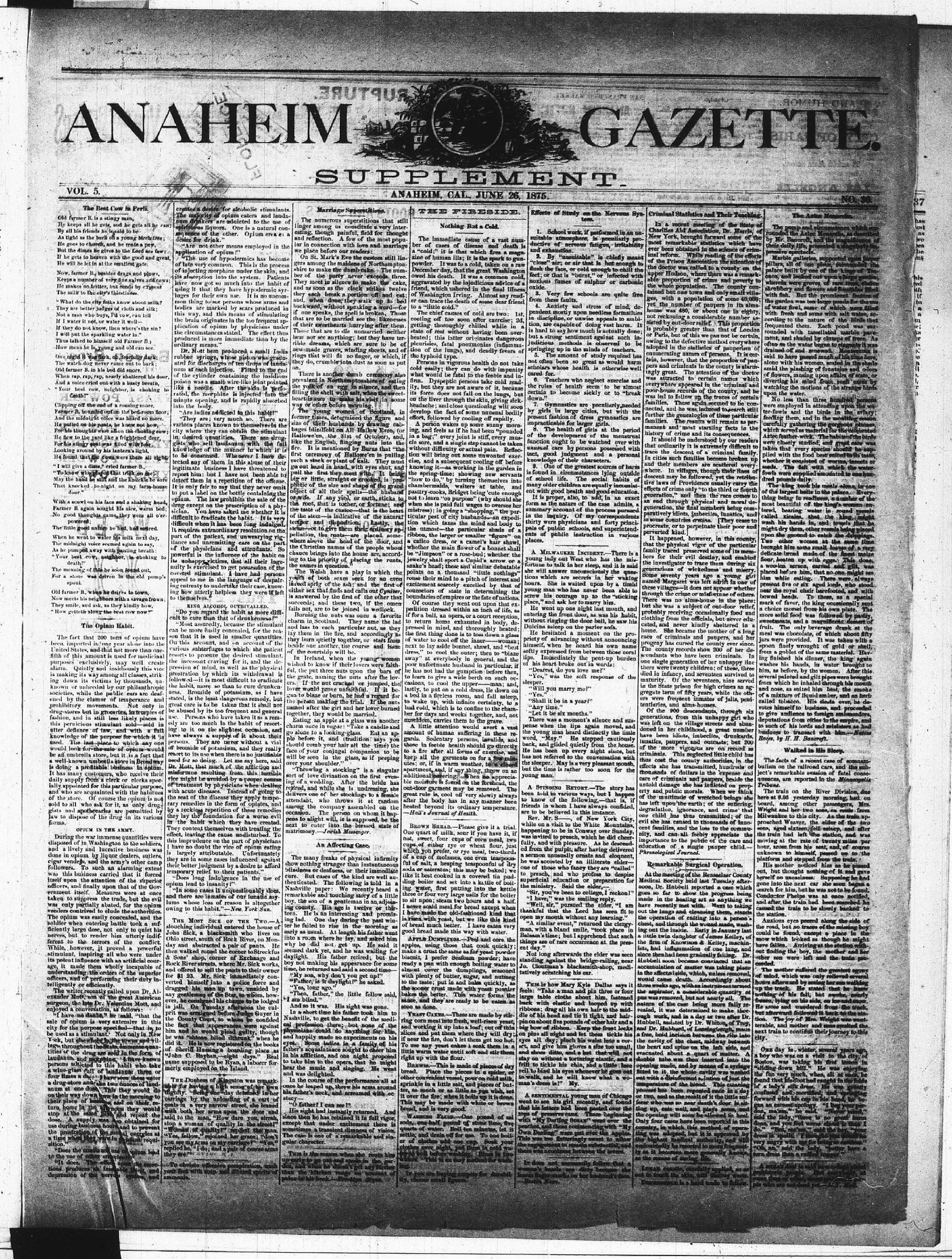
Searchable text
The Best Cow in Perli.
Old farmer B. is a stingy man,
He keeps all he gets, and he gets all he can;
By all his friends he lagged to be
As tight as the bark on a young birch tree;
He goes to church, and he rents a pew,
But the dimes he gives to the Lord are few;
If he gets to heaven with the good and great,
He will be let in at the smallest gate.
Now, farmer B., besides drags and plows,
Keeps a number of very fine calves and cows;
He makes no butter, but sends by express
The milk to the city's thirstiness.
"What do the city folks know about milk?
They are better judges of cloth and silk;
Not a man who buys, I'd vow, can tell
If I water it not, or water it well—
If they do not know, then where's the sin?
I will put the sparkling water in."
Thus talked to himself old Farmer B.)
How mean he is, young and old can see.
One night it was dark, ob, fearfully dark;
The watch dog never came out to bark;
Old farmer B. in his bed did snore,
When rap, rap, rap, nearly shattered his door,
And a voice cried out with a hazy breath,
"Your best cow, neighbor, is choking to death!"
Clipping off the end of a rosing snore,
Farmer B. bounded out on the bed-room floor;
And the midnight voice was heard no more.
He pulled on his panties, he knew not how;
For his thoughts were all on the choking cow;
He flew to the yard like a frightened deer,
For his stingy soul was filled with fear;
Looking around by his lantern's light,
He found that the cows were there all right.
"I will give a dime," cried farmer B.,
creates a desire for alcoholic stimulants.
The majority of opium eaters and laudanum drinkers are addicted to the use of spiritualis liquors. One is a natural consequence of the other. Opium creates a desire for drink."
"Are not other means employed in the application of opium?"
"The use of hypodermics has become of late very common. This is the process of injecting morphine under the skin, and its absorption into the system. Patients have now got so much into the habit of using it that they have hypodermic syringes for their own use. It is no uncommon thing to see persons whose arms and bodies are marked by scars produced in this way, and this means of stimulating the brain originates in the too frequent application of opium by physicians under the circumstances stated. The effect thus produced is more immediate than by the ordinary means."
Dr. Mott here produced a small India rubber syringe, whose piston was graduated for discharges of ten drops of laudanum at each injection. Fitted to the end of the cylinder containing the insidious poison was a small wire-like joint pointed like a needle. After the skin is perforated, the morphine is injected into the minute opening, and is rapidly absorbed into the body.
"Are ladies addicted to this habit?"
"They are; very much so. There are various places known to themselves in the city where they can obtain the stimulant in desired quantities. There are drug-gists who sell laudanum with the full knowledge of the manner in which it is to be consumed. Whenever I have detected any of them in this abuse of their legitimate business I have threatened to
Marriage Superiors
The numerous superiors linger among us comeating, though painful and reflection. A few lar in connection with we place before our re
On St. Mark's Eve t
gers among the maidenshire to make the daunber of the party new.
They meet in silence f
and as soon as the clothey each break a poand, when done, they backward, without speif if one speaks, the spethat are to be married dof their sweethearts huThose that are to die whe hear nor see anything; rible dreams, which a new-made graves, winrings that will fit nothey do, crumble into oon.
There is another dar prevalent in Northamptonshire the yolk of an egg hfilling the shell with saheart is sure to make way or other before mo
The young women former times, deturning size of their husbands' bags blindfold on All Hallowe'en, the 31st like the English, flinging fire. It is mentioned bfirst ceremony of Halloe each a stock or plant of go out hand in hand, w
Clipping off the end of a rousing snore,
Farmer B. bounded out on the bed-room floor;
And the midnight voice was heard no more.
He pulled on his pants, he knew not how.
For his thoughts were all on the choking cow;
He flew to the yard like a frightened deer;
For his stingy ceil was filled with fear;
Looking around by his lantern's light,
He found that the cows were there all right.
"I will give a dime," erled farmer B.
"To know who played that trick on me;
May the hand be still and the knuckle be sore
That knocked to-night on my farm-house door."
With a scowl on his face and a shaking head,
Farmer B. again sought his nice, warm bed;
No good thoughts came, they were all o'er-powered;
The little good nature he had, had sorred.
When he went to water his milk next day,
The midnight voice seemed again to say,
As he pumped away with panting breath:
"Your best cow, neighbor, is choking to death"
The meaning of this he soon found out,
For a stone was driven in the old pump's spout.
Old farmer B., when he drives to town,
Now meets his neighbors with a savage frown;
They smile, and ask, as they kindly bow,
"How getteth along the best cow now."
The Opium Habit.
The fact that 200 tons of opium have been imported in one year alone into the United States, and that not more than one-fifth of this amount is used for medicinal purposes exclusively, may well create alarm. Quietly and insidiously this vice is making its way among all classes, striking down its victims by thousands, unknown or unheeded by our philanthropic societies, while the public ears are deafened by the clamor of temperance and prohibitory movements. Not only in drug-stores but in groceries, in temples of fashion, and in still less likely places is this pernicious stimulant sold—sold in utter defiance of law, and with a full knowledge of the purpose for which it is used.
The last place to which any one would look for the sale of opium would be an umbrella store, but it is a fact that a well-known umbrella store in Broadway is doing a profitable business in opium. It has many customers, who receive their daily supply from a clerk or clerks specially appointed for this particular purpose, and who are acquainted with the habitues of the store.
Of course the opium is not sold to all who ask for it, as only drug-gists and apothecaries are permitted by law to dispose of the drug in its various forms.
OPIUM IN THE ARMY.
During the war immense quantities were disposed of in Washington to the soldiers, and a lively and lucrative business was done in opium by liquor dealers, cutlers, cigar venders, and the army's other camp followers. To such an alarming extent was this business carried that it forced itself upon the attention of the superior officers, and finally upon that of the Gov't.
Clipping off the end of a rousing snore,
Farmer B. bounded out on the bed-room floor;
And the midnight voice was heard no more.
He pulled on his pants, he knew not how.
For his thoughts were all on the choking cow;
He flew to the yard like a frightened deer;
For his stingy ceil was filled with fear;
Looking around by his lantern's light,
He found that the cows were there all right.
"I will give a dime," erled farmer B.
"To know who played that trick on me;
May the hand be still and the knuckle be sore
That knocked to-night on my farm-house door."
With a scowl on his face and a shaking head,
Farmer B. again sought his nice, warm bed;
No good thoughts came, they were all o'er-powered;
The little good nature he had, had sorred.
When he went to water his milk next day,
The midnight voice seemed again to say,
As he pumped away with panting breath:
"Your best cow, neighbor, is choking to death"
The meaning of this he soon found out,
For a stone was driven in the old pump's spout.
Old farmer B., when he drives to town,
Now meets his neighbors with a savage frown;
They smile, and ask, as they kindly bow,
"How getteth along the best cow now."
KING ALCOHOL OUTRIVALLED.
"Do you regard the habit as more difficult to cure than that of drunkenness?"
Most assuredly, because the stimulant can be more easily concealed, for the reason that it is used in smaller quantities. On this account, and on account of the various subterfuges to which the patient resorts to procure the desired stimulant, the incessant craving for it, and the depression of mind, as well as the physical prostration by which its withdrawal is followed—it is most difficult to eradicate the habit, more so than to cure drunkenness. Bromide of potassium, as I have stated, is the least dangerous remedy, but great care is to be taken that it shall not be abused by its too frequent and general use. Persons who have taken it as a remedy are too much in the habit of resorting to it on the slightest occasion, and have always a supply of it about their persons. They are never without a vial of bromide of potassium, and they really resort to its use when there is justifiable need for so doing. Let me say here, said Dr. Mott, that much of the affliction and misfortune resulting from this terrible vice might be avoided by a proper course of treatment by physicians when dealing with acute diseases. Instead of going to the seat of the disease they apply temporary remedies in the form of opiates, and by a reckless repetition of these remedies they lay the foundation for a worse evil in the habit which they have created. They content themselves with treating the effect, leaving the cause undisturbed. To this imprudence on the part of physicians I have no doubt the vice of opium eating is largely attributable. Unfortunately they are in some cases influenced against their better judgment by a desire to afford temporary relief to their patients."
Does long indulgence in the use of opium lead to insanity?
There is another dull prevalent in Northampton; the yolk of an egg in filling the shell with salt heart is sure to make way or other before morn.
The young women former times, determining size of their husbands' bags blindfold on All Hallowe'en, the 31st fire like the English flinger fire. It is mentioned by first ceremony of Hall each a stock or plant of go out hand in hand, we pull the first they meet big or little, straight or phetic of the size and object of all their speeches or wife. If any yirl, or the root, that is toocherte the taste of the custoe-of the stem—is indicative temper and disposition stems—or to give them pellation, the rants—and where above the head of the Christian names of chance brings into the hatch to the priority of phishing names in question."
The Welsh have a pearly youth of both sexes seated sprig of the ash; either sex finds and does answer by the first succeeds; and these two fails not, are to be joined.
Burning the nuts was charm in Scotland. The and lasse to each participant lay them in the fire, and they burn quietly together beside one another, the coat of the courtship will be.
In Ireland, when they wished to know if their lifeful, put three nuts up for grate, naming the nuts. If the nut cracked lover would prove unfailig gan to blaze or burn, he did the person making the trunk named after the girl and together they would be nailed.
Eating an apple at a gird charm once in vogue: "To go alone to a looking-glass before it, and (trade) should comb your hair aloft face of your conjural coat will be seen in the glass over your shoulder."
"Throwing a stocking sort of love divination on ing of a wedding. After retired, and while she is delivered one of her stockings attendant, who throws among the company assoc occasion. The person o pens to alight will it is sent next to enter into the matrimony."—Jewish Messenger.
OPIUM IN THE ARMY.
During the war immense quantities were disposed of in Washington to the soldiers, and a lively and lucrative business was done in opium by liquor dealers, outlitters, cigar vendors, and the army's other camp followers. To such an alarming extent was this business carried that it forced itself upon the attention of the superior officers, and finally upon that of the Government itself. Measures were at once taken to suppress the trade, but the evil was only partially abated, for the opium vendors contrived to elude the authorities. The opium was easily concealed, and the soldier when entering battle took a sufficiently large dose, not only to quiet his nerves, but to render him utterly indifferent to the terrors of the conflict. While, however, it proved a powerful stimulant, inspiring all who were under its potent influence with an artificial courage, it made them wholly incapable of understanding the orders of the superior officers, and of performing their duty intelligently or efficiently.
The writer recently called upon Dr. Alexander Mott, son of the great American surgeon, the late Dr. Valentine Mott, and enjoyed a conversation, as follows:
"I have no doubts," he said, "that the sale of opium is very extensive in this city for the purpose specified—that is to be used as a stimulant." Not only in New York, but elsewhere in the towns and villages throughout the state, immense quantities of the drug are sold in the form of laudanum, and morphine. I have known persons addicted to this habit who take a wine-glass full of laudanum three or four times a day. I have seen them enter a drug-store and take two ounces of land-anum at one dose. This they would do on their way down home in the morning to their place of habitation, and on their return home in the afternoon they would stop at the same place and repeat the dose. A supply was also obtained for use during business hours, and to prevent the prostration of the mental energies at a time when they were in constant requisition."
"Does the continued use of opium lead to the use of other stimulants?"
"It does. The effect upon the substances produces an insatiable desire, and depression of the nervous system, and with acute diseases. Instead of going to the seat of the disease they apply temporary remedies in the form of opiates, and by a reckless repetition of these remedies they lay the foundation for a worse evil in the habit which they have created. They content themselves with treating the effect, leaving the cause undisturbed. To this imprudence on the part of physicians I have no doubt the vice of opium eating is largely attributable. Unfortunately they are in some cases influenced against their better judgment by a desire to afford temporary relief to their patients."
"Does long indulgence in the use of opium lead to insanity!"
"In some cases it unquestionably does, and there are inmates of our lunatic asylums whose loss of reason is altogether owing to this habit." — New York Sun.
THE MOST SICK OF THE TWO. — A slouching individual entered the house of John Sick, a blacksmith who lives on Ohio street, south of Rock River, on Monday and abstracted a pair of pants. He then walked round the corner to Streckfus & Sons' shop, corner of Exchange and Rock River streets, where Mr. Sick works, and offered to sell the pants to their owner for $1 25. Mr. Sick immediately converted himself into a police force and dragged his man up town, unaided by any gentleman of the Star, to whom, however, he considered his charge to be lodged in jail. On Tuesday afternoon the culprit was arrested before Judge Guyer in the County Court, to whom he confided the fact that appearances were against him and he would plead guilty, though he was "shitone blind dthrunk" when he did it. He is now registered on the books of Sheriff Huesing's boondling place as "John C. Hayhan—eight days." Real name supposed to be Ryan, a laborer formerly employed on the Island.
THE Duchess of Kingston was remarkable for having a high sense of own dignity. Being one-day delinquent in her carriage by the unloading of a cart of coal in a very narrow street, she leased with both her arms upon the door and said to the man, "How dare you sirrah, stop a woman of quality in the street!" "Woman of quality!" replied the man. "Yes, fellow," rejoined her grace; "don't you see my arms on my carriage!" "Yes," replied he. "I do; and a pair of course arms they are."
To obviate offensive persecution, wash your feet with soap and diluted spirits of ammonia.
An Affecting
The many freaks of physis show nothing stranger than blindness or deafness, or cure. But cases of the kinktenicated Nashville paper: We remember remarkable and touching boy, the son of a gentleman ing county. His age is ten teen. He is an interesting lad. One day darliner he failed to rise in the early as usual. At length into a room where he lay, why he did not get up seemed dark yet, and he woke daylight. His father rest boy not making his appearance time, he returned and said:
"My son, why don't you Father, is it daylight? Yes, long ago."
Then, father," the little I am blind."
And so it was. His sight In a short time his father Nashville, to get the benefit profession there; but physician could do any and happily made no expense eyes. Some ladia in father's acquaintance sought in his affliction, and one had to take him to the opera, hear the music and sing and was delighted.
In the course of the period once he leaped up, throw his father's neck, and scream stacy—
"O father! I can see!"
His sight had instantly since then he has retained except that under excite sometimes a transient dim The case is one of a remainder character.
This is the season when up early to go out and spend time with his family range in pain in his back—Broadway
IM GA
SUPPLEMENT.
ANAHEIM, CAL., JUNE 26, 1875.
Marriage Superstitions.
The numerous superstitions that still linger among us constitute a very interesting, though painful, field for thought and reflection. A few of the most popular in connection with love and marriage we place before our readers:
On St. Mark's Eve the custom still lingers among the maidens of Northamptonshire to make the dumb cake. The number of the party never exceeds three. They meet in silence to make the cake, and as soon as the clock strikes twelve they each break a portion off and eat; and when done, they walk up to bed backward, without speaking a word—for if one speaks, the spell is broken. Those that are to be married see the likenesses of their sweethearts hurrying after them. Those that are to die unmarried neither heat nor see anything; but they have terrible dreams, which are sure to be of new-made graves, winding sheets, and of rings that will fit no finger, or which, if they do, crumble into dust as soon as put on.
There is another dumb ceremony also prevalent in Northamptonshire of eating the yolk of an egg in silence, and then filling the shell with salt, when the sweetheart is sure to make his visit in some way or other before morning.
The young women of Scotland, in former times, determined the figure and size of their husbands by drawing cabages blindfolded on All Hallow Even, (or Hallowe'en, the 31st of October), and, like the English, flinging nuts into the fire. It is mentioned by Burns that "the first ceremony of Hallowe'en is pulling each a stock or plant of kail. They must go out hand in hand, with eyes shut, and
THE FIRESIDE.
Nothing But a Cold.
The immediate cause of a vast number of cases of disease and death is a "cold." it is that which fires a magazine of human ills; it is the spark to gunpowder. It was to a cold, taken on a raw December day, that the great Washington owed his death. It was a common cold, aggravated by the injudicious advice of a friend, which ushered in the final illness of Washington Irving. Almost any reader can trace the death of some dear friend to a "little cold."
The chief causes of cold are two: 1st, cooling off too soon after exercise; 2nd, getting thoroughly chilled while in a state of rest without having been overheated; this latter originates dangerous pleurisies, fatal pneumonias (inflammation of the lungs), and deadly fevers of the typhoid type.
Persons in vigorous health do not take cold easily; they can do with impunity what would be fatal to the feeble and infirm. Dyspeptic persons take cold readily, but they are not aware of it, because its force does not fall on the lungs, but on the liver through the skin, giving sick-headache; and close questioning will soon develop the fact of some unusual bodily effort, followed by cooling off rapidly.
A person wakes up some sunny morning, and feels as if he had been "pounded in a bag;" every joint is stiff, every muscle sore, and a single step cannot be taken without difficulty or actual pain. Reflection will bring out some unwonted exercise, and a subsequent cooling off before knowing it—as working in the garden in
Effects of Study on the Nervous System.
1. School work, if performed in an unsuitable atmosphere, is particularly productive of nervous fatigue, irritability and exhaustion.
2. By "unsuitable" is chiefly meant "close" air; or air that is not enough to finish the face, or cold enough to chill the feet; or that is "burnt," or infected with noxious fumes of sulphur or carbonic oxide.
3. Very few schools are quite free from these faults.
4. Anxiety and stress of mind, dependent mostly upon needless formalities in discipline, or unwise appeals to ambition, are capable of doing vast harm. It is hard to say how much is actually done; but a strong sentiment against such injudicious methods is observed to be springing up in the minds of teachers.
5. The amount of study required has not often been so great as would harm scholars whose health is otherwise well cared for.
6. Teachers who neglect exercise and the rules of health seem to be almost certain to become sickly or to "break down."
7. Gymnastics are peculiarly needed by girls in large cities, but with the present fashion of dress gymnastics are impracticable for larger girls.
8. The health of girls at the period of the development of the menstrual function ought to be watched over with unusual care by persons possessed with tact, good judgment and a personal knowledge of their characters.
9. One of the greatest sources of harm
There is another dumb ceremony also prevalent in Northamptonshire of eating the yolk of an egg in silence, and then filling the shell with salt, when the sweet-heart is sure to make his whist in some way or other before morning.
The young women of Scotland, in former times, determined the figure and size of their husbands by drawing cabages blindfold on All Hallow Even (or Hallowe'en, the 31st of October), and, like the English, flinging nuts into the fire. It is mentioned by Burns that "the first ceremony of Hallowe'en is pulling each a stock or plant of kail. They must go out hand in hand, with eyes shut, and pull the first they meet with. It being big or little, straight or crooked, is prophetic of the size and shape of the grand object of all their spells—the husband or wife. If any girl, or earth, sticks to the root, that is tocher, or fortune; and the taste of the custoe—that is the heart of the stem—is indicative of the natural temper and disposition. Lastly, the stems—or to give them their ordinary appellation, the rants—are placed somewhere above the head of the door, and the Christian names of the people whom chance brings into the house are, according to the priority of placing the runs, the names in question."
The Welsh have a play in which the youth of both sexes seek for an even leaved sprig of the ash; and the first of either sex that finds and calls out Cynister, is answered by the first of the other that succeeds; and these two, if the omen fails not, are to be joined in wedlock.
Burning the nuts was once a favorite charm in Scotland. They name the lad and lass to each particular nut, as they lay them in the fire, and accordingly as they burn quietly together, or start from beside one another, the course and issue of the courtship will be.
In Ireland, when the young women wished to know if their lovers were faithful, the put three nuts upon the bars of the grate, naming the nuts after the lovers. If the nut cracked or jumped, the lover would prove unfaithful. If it began to blaze or burn, he had a regard for the person making the trial. If the nuts named after the girl and her lover burned together, they would be married.
Eating an apple at a glass was another charm once in vogue: "Take a candle and go alone to a looking-glass. Eat an apple before it, and (tradition says you should comb your hair all time) the face of your conjugal companion to be will be seen in the glass, as if peeping over your shoulder."
"Throwing a stocking" is a singular sort of love divination on the first evening of a wedding. After the bride has retired, and while she is undressing, she delivers one of her stockings to a female attendant, who throws it at random among the company assembled on the occasion. The person on whom it happens to alight will, it is supposed, be the next to enter into the blessed state of matrimony. — Jewish Messenger.
An Affecting Case.
The many freaks of physical infirmity show nothing stranger than instantaneous blindness or deafness, or their immediate cure. But cases of the kind are well authenticated. The following is told in a Nashville paper: We recently heard a person wakes up some sunny morning, and feels as if he had been "pounded in a bag;" every joint is stiff, every muscle sore, and a single step cannot be taken without difficulty or actual pain. Reflection will bring out some unwonted exercise, and a subsequent cooling off before knowing it—as working in the garden in the spring-time; showing new servants "how to do," by turning themselves into chambermaids, waiters at table, and pastry-cooks, Bridget being 'cute enough not to learn "on purpose" (why should she when she is paid full wages to overseer her mistress); in going "shopping," the particular pest of city husbands—an expedition which taxes the mind and body to the utmost—the particular shade of a ribbon, the larger or smaller "figure" on a calico dress, or a camel's hair shawl, whether the main flower of a bonnet shall be "Jimpson" or a rose-bud; whether the jewelry shall sport a Cupid's arrow or a snake's head; these and similar debatable points on a thousand "little nothings" rouse their mind to a pitch of interest and excitement scarcely excelled by that of counselors of state in determining the boundaries of empires or fate of nations.
Of course they went out upon expedition dressed within an inch of life, as if for a ball, an opera, or a court reception, to return home exhausted in body, depressed in mind, and thoroughly heated; the first thing done is to toss down a glass of water to cool off the inner—woman; next to lay aside bonnet, shawl, and "best dress," to cool the outer; then to "blaze away" at everybody in general, and the poor unfortunate husband in particular, if he has not had the gumption before then, to learn to give a wide berth on such occasions, to cool the upper—man; and lastly, to put on a cold dress, lie down on a bed in a fireless room, and fall asleep, to wake up, with infinite certainty, to a bad cold, which is to confine to the chamber for days and weeks together, and not unseldom, carries them to the grave.
A little attention would avert a vast amount of human suffering in these regards. Sedentary persons, invalids, and those in feeble health should go directly to a fire after all forms of exercise, and keep all the garments on for a few minutes; or, if in warm weather, to a closed apartment, and if any thing, throw on an additional covering. When no appreciable moisture is found on the forehead, the out-door garment may be removed. The great rule is, cool off very slowly always after the body has in any manner been heated beyond its ordinary temperature. —Hall's Journal of Health.
Brown Bread. — Please give it a trial. One quart of milk, sour if you have it, if not sweet, four cups of corn meal, two cups of either rye or wheat flour, just which you prefer, or rye meal, two-thirds of a cup of molasses, one even teaspoonful of salt, a heaping teaspoonful of dry soda or saleratus; this may be baked; we like it best cooked in a covered tin pudding boiler and set into a kettle of boiling water, first putting into the kettle what would be fatal to the feeble and infirm. Dyspeptic persons take cold readily, but they are not aware of it because its force does not fall on the lungs, but on the liver through the skin, giving sick-headache; and close questioning will soon develop the fact of some unusual bodily effort, followed by cooling off rapidly.
A person wakes up some sunny morning, and feels as if he had been "pounded in a bag;" every joint is stiff, every muscle sore, and a single step cannot be taken without difficulty or actual pain. Reflection will bring out some unwonted exercise, and a subsequent cooling off before knowing it—as working in the garden in the spring-time; showing new servants "how to do," by turning themselves into chambermaids, waiters at table, and pastry-cooks, Bridget being 'cute enough not to learn "on purpose" (why should she when she is paid full wages to overseer her mistress); in going "shopping," the particular pest of city husbands—an expedition which taxes the mind and body to the utmost—the particular shade of a ribbon, the larger or smaller "figure" on a calico dress, or a camel's hair shawl, whether the main flower of a bonnet shall be "Jimpson" or a rose-bud; whether the jewelry shall sport a Cupid's arrow or a snake's head; these and similar debatable points on a thousand "little nothings" rouse their mind to a pitch of interest and excitement scarcely excelled by that of counselors of state in determining the boundaries of empires or fate of nations.
Of course they went out upon expedition dressed within an inch of life, as if for a ball, an opera, or a court reception, to return home exhausted in body, depressed in mind, and thoroughly heated; the first thing done is to toss down a glass of water to cool off the inner—woman; next to lay aside bonnet,shawl,and "best dress," to cool the outer;then to "blaze away" at everybody in general,and the poor unfortunate husband in particular,if he has not had the gumption before then,to learn to give a wide berth on such occasions,to cool the upper—man;and lastly,to put on a cold dress,lie down on a bed in a fireless room,and fall asleep,to wake up,with infinite certainty,to a bad cold,which is to confine to the chamber for days and weeks together,and not unseldom,carries them to the grave.
A little attention would avert a vast amount of human suffering in these regards. Sedentary persons,invalids,and those in feeble health should go directly to a fire after all forms of exercise,and keep all the garments on for a few minutes; or,if in warm weather,to a closed apartment,and if any thing,throw on an additional covering. When no appreciable moisture is found on the forehead,the out-door garment may be removed. The great rule is,cool off very slowly always after the body has in any manner been heated beyond its ordinary temperature. —Hall's Journal of Health.
A Stinging Retort. —The story has been told in various ways,但 I happen to know of the following—that is,if friends in whom I have always confided,are to be believed in this instance.
Rev. Mr. S——of New York City,while on a visit to The White Mountains,happening to be in Conway over Sunday,was invited to preach,which he did cheerfully,and with pleasure. As he descended from the pulpit;after having delivered a sermon unusually or eloquent,he was accosted by an illiterate elder—one of those who fancy they are "called" to preach,and who profess to despise superficial education or preparation for ministry。Said the elder—
ingly great was attracted everywhere poor-houses was led to families,
nected,and anfamilies,
maintains an history of
care for.
6. Teachers who neglect exercise and
the rules of health seem to be almost certain to become sickly or to "break down."
7. Gymnastics are peculiarly needed by girls in large cities,但 with the present fashion of dress gymnastics are impracticable for larger girls.
8. The health of girls at the period of development of the menstrual function ought to be watched over with unusual care by persons possessed with tact,good judgment and a personal knowledge of their characters.
9. One of greatest sources of harm is found in circumstances lying outside of school life.
The social habits of many older children are equally inconsistent with good health and good education.
It is proper also,to add,在 an exact form as nature of the case admits,a summary account of the process pursued in the inquiry.
Of my correspondents thirty were physicians and forty principals of public schools,和 superintendents of public instruction in various places.
A Milwaukee Incident. —There is a young lady out West who has misfortune to talk in her sleep,and it is said she will answer unconsciously the questions which are secrets in her waking hours.
She is waited upon by a timid young man who has never been able to screw his courage up to the "sticking place,"和 ask her to marry him.
He went up one night last month,and entering front door,as was his habit,
without ringing the door bell,他 saw his Dulcinia asleep on the parlor sofa.
He hesitated a moment on the propriety of advancing without announcing himself,当 he heard his own name softly expressed from between those coral lips。Immediately the pent-up burden of his heart broke out in words:
"Dearest,do you love me?"
"Yes,” was the soft response of the sleeper.
"Will you marry me?"
"Yes."
"Shall it be in a year?"
"Any time."
"Let it be six months."
There was a moment's silence and suspense whenthe lips again moved,和the young man heard distinctlythe little word,“May.” He stopped cautiously back,和glided quietly fromthe house。
He has been up every night since,但 has not referred tothe conversation withthe sleeper.May isavery pleasantmonth,但the timeis rather too soonfortheyoungman.
A Stinging Retort. —The story has been told in various ways,但 I happen to know ofthe following—that is,if friends in whom I have always confided,are to be believed in this instance.
Rev. Mr. S——of New York City,
while on a visit to The White Mountains,
happening to be in Conway over Sunday,
was invited to preach,which he did cheerfully,and with pleasure.As he descended fromthe pulpit;after having delivereda sermon unusually or eloquent,he was accosted by an illiterate elder—one of those who fancy they are "called" to preach,and who profess to despise superficial education or preparation for ministry。Saidthe elder—
Remark:
Attheme Medical Society noon Dr.Henry Messenger.
An Affecting Case.
The many freaks of physical infirmity show nothing stranger than instantaneous blindness or deafness, or their immediate cure. But cases of the kind are well authenticated. The following is told in a Nashville paper: We recently heard a remarkable and touching story of a little boy, the son of a gentleman in an adjoining county. His age is twelve or thirteen. He is an interesting and promising lad. One day during the past winter he failed to rise in the morning as early as usual. At length his father went into a room where he lay, and asked him why he did not get up. He said it seemed dark yet, and he was waiting for daylight. His father retired; but the boy not making his appearance for some time, he returned and said a second time—"My son, why don't you get up!" "Father, is it daylight?" he asked. "Yes, loner ago." "Then, father," the little fellow said, "I am blind."
And so it was. His sight was gone. In a short time his father took him to Nashville, to get the benefit of the medical profession there; but none of the physicians could do anything for him, and happily made no experiments on his eyes. Some ladies in a family of his father's acquaintance sought to cheer him in his affliction, and one night proposed to take him to the opera, that he might hear the music and singing. He went and was delighted.
In the course of the performance all at once he leaped up, threw his arms around his father's neck, and screamed with ecstacy—"O father! I can see!" His sight had instantly returned. And since then he has retained it in full vigor, except that under excitement there is sometimes a transient dimness of vision. The case is one of a remarkable and singular character.
This is the season when she routs him up early to go out and spade in the garden, and when he doesn't get any further than the kitchen range on account of pain in his hand—Brown Dread.
Brown Dread—Please give it a trial. One quart of milk, sour if you have it, if not sweet, four cups of corn meal, two cups of either rye or wheat flour, just which you prefer, or rye meal, two-thirds of a cup of molasses, one even teaspoonful of salt, a heaping teaspoonful of dry soda or saleratus; this may be baked; we like it best cooked in a covered tin pudding boiler and set into a kettle of boiling water, first putting into the kettle three or four very large nails for the boiler to sit upon; steam two hours and a half. I never scald meal for bread except when I have made the old-fashioned kind that is risen with yeast, but we like this kind of bread much better. I have eaten very good bread made this way with water.
Apple Dumplings—Peel and core. the apples, using those that cook quickly; make a crust the same as for yeast powder biscuit. I prefer Seafoam powder; have ready a pan with enough boiling water to almost cover the dumplings, seasoned with plenty of butter, sugar, and nutmeg to the taste; put in and bake quickly, as the sooner crust made with yeast powder bakes the better. This water forms the sauce, and they are ready to eat as done.
YEAST CAKES—These are made by stirring corn meat into fresh, well-risen yeast, and working it up into a loaf; cut off thin slices and put them where they will dry; if near the fire, don't let them get too hot. To use any yeast cakes a soak them in a little warm water until soft and stir them right up with the flour.
BREWING—This is made of pieces of dry bread. Place the pieces in a spider, or other convenient vessel, pour on cold milk, sprinkle in a little salt, and pieces of butter, as much or as little as you wish, set it over the fire; when it boils up it is done. This may be made with white or brown bread, and is vary good.
WARNING FLUID—One pound of al soda, one-half pound of stone lime, five quarts of water. Bail ten minutes, let it settle, and drain off for use. To one boiler of clothes add one cup. Soak your clothes over night, put them in cold water before washing. Bline in waffles. This is an easy method for waffling.
If you are buying carpets for durability, choose small figures.
Rev. Mr. S——of New York City, while on a visit to the White Mountains, happening to be in Conway over Sunday, was invited to preach, which he did cheerfully, and with pleasure. As he descended from the pulpit; after having delivered a sermon unusually orate and eloquent, he was accosted by an illiterate elder—one of those who fancy they are "called" to preach, and who profess to despise superficial education or preparation for the ministry. Said the elder,
"Sir, you've been to college, I reckon?"
"I have," was the smiling reply.
Well, sir," pursued the elder," "I am thankful that the Lord has seen fit to open my mouth without any learning."
"A similar event," returned the clergyman, with a bland smile, "took place in Balaam's time; but I apprehend that such things are of rare occurrence at the present day."
Not long afterwards the elder was seen standing against the bridge-railing, near Jo. Cloutman's blacksmith-shop, meditatively scratching his ear.
This is how Mary Kyle Dallas says it feels: "Take a man and pin three or four large table cloths about him, fastened back with elastic and looped up with ribbons; drag all his own hair to the middle of his head and tie it tight, and hairpin on about five pounds of other hair and a big bow of ribbon. Keep the front locks on pins all night and let them tickle his eyes all day; pinch his waist into a correct, and give him gloves a size too small, and shose ditto, and a hat that will not stay on without a torturing elastic, and a frill to tickle his chin, and a little hone bell to bind his eyes whenever he goes out in walk, and he will know what a woman's dress is!" My.
A sentimental young man of Chicago went to see his girl recently, and found that his letters had been pasted over the tops of preservaceans. These beginning with "My Darling Susan" were over the peaches, and these commencing with "My Own Darling" were put over the apples. This was two fatteningly sweet to allow the engagement to remain substantial; and there was accordance between the terms.
In does not necessarily follow that a woman's hands are dirty because she leaves finger marks on her husband's face—Justice Keen.
GAZETTE.
NO. 30.
Criminal Statistics and Their Teaching.
In a recent meeting of the State of Charities Aid Association, Dr. Harris, of New York, brought forward some of the most remarkable statistics which have ever been obtained in the science of criminal reform. While reading of the efforts of the Prison Association the attention of the doctor was called to a county on the upper Hudson, where there was a remarkable proportion of crime and poverty to the whole population. The county contained but one town and only small villages, with a population of some 40,000; yet the number of paupers in its almshouse was 480, or about one in eighty, not reckoning a considerable number assisted by out-door relief. This proportion is probably greater than that of London or Paris, but of this we can not be certain, owing to the defective method everywhere adopted in the statistics of pauperism of enumerating names of persons. It is certain, however, that the proportion of paupers and criminals in the county is alarmingly great. The attention of the doctor was attracted to certain names which everywhere appeared in the criminal and poor-house records of the county, and he was led to follow up the traces of certain families. These again seemed to be connected, and he was induced to search still further the genealogies of these particular families. The results will remain as permanent and most startling facts in the history of crime and its consequences.
It should be understood by our readers that ordinarily it is extremely difficult to trace the descent of a criminal family. In cities such families become broken up and their members are scattered everywhere.
The Aztec Monarchs.
The pomp and circumstance which surrounded the Aztec Monarchs, as described by Mr. Bancroft, and the magnificence of their daily life, presented a singularly impressive spectacle.
Marble galleries, supported upon jasper pillars, all of one place, surrounded the palace built by one of the kings of Tequila, and looked out upon a large garden, wherein were groves of rare trees, shaded shrubbery and flowers and fountains filled with fish. But the prominent feature of the garden was ten large ponds for the use of water fowl, some of which were filled with fresh and some with salt water, according to the nature of the birds that frequented them. Each pond was surrounded with tassellated marble pavement, and shaded by clumps of trees. As often as the water began to stagnate it was drained off and renewed. Montemuria is said to have passed much of his time here, alone with his women, seated in the shade amid the plashing of fountains and colors of flowers, musing upon affairs of state, or diverting his mind from such causes by watching the motions of the strange birds upon the water.
No less than three hundred persons were employed in attending upon the water-flows and the birds in the aviary; feeding them, and in the mounting station carefully gathering the gorgeous plumes, which served as material for the celebrated Aztec feather-work. The habits of the birds were closely studied, and great care was taken that every species should be supplied with the food best suited to its taste; whether it consisted of worms, insects or seeds. The fish with which the water-
The attention of the doctor was attracted to certain names which everywhere appeared in the criminal and poor-house records of the county, and he was led to follow up the traces of certain families. These again seemed to be connected, and he was induced to search still further the genealogies of these particular families. The results will remain as permanent and most startling facts in the history of crime and its consequences.
It should be understood by our readers that ordinarily it is extremely difficult to trace the descent of a criminal family. In cities such families become broken up and their members are scattered everywhere. In villages, though their lines of descent may be followed, yet the retributive laws of Providence usually carry the effects of crime only "to the third or fourth generation," and then the race comes to an end through physical and moral degeneration, the final members being comparatively idiots, inmbeciles, lunatics, and in some countries cretine. [They cease to procreate, or to perpetuate their poor and perverted kind.]
It happened, however, in this county, that the physical vigor of the particular family traced preserved some of its members for their evil destiny, and enabled the investigator to trace them during six generations of wickedness and misery. Some seventy years ago a young girl named Margaret was left adrift in one of these villages—it does not appear whether through the crime or misfortune of others. There was no alms-house in the place; but she was a subject of out-door relief, probably receiving occasionally food and clothing from the officials, but never educated, and never kindly sheltered in a home. She became the mother of a long race of criminals and paupers, and her progeny has cursed the county ever since. The county records show 200 of her descendants who have been criminals. In one single generation of her unhappy line there were twenty children; of these, three died in infancy, and seventeen survived to maturity. Of the seventeen, nine served in the State prison for high crimes an aggregate term of fifty years, while the others were frequent inmates of jails, penitentiaries, and alms-houses.
Of the 900 descendants, through six generations, from this unhappy girl who was left on the village streets and abandoned in her childhood, a great number have been idiots, inmbeciles, drunkards, lunatics, paupers, and outcasts; but 200 of the more vigorous are on record as criminals. This neglected little child has thus cost the county authorities, in the effects she has transmitted, hundreds of thousands of dollars in the expense and care of criminals and paupers, beside the untold damage she has inflicted on property and public morals. When we think of the multitude of wretched beings she has left upon the earth; of the suffering, degradation, ignorance, and crime that one child has thus transmitted; of the evil she has caused to thousands of innocent families, and the loss to the community, and can all feebly appreciate the importance to the public of the care and education of a single pauper child—Phrenological Journal.
Remarkable Surgical Operation.
At the meeting of the Renassauer County Medical Society held last Tuesday afternoon, Dr. Hubbell reported a case which was greatly great. The attention of the doctor was attracted to certain names which everywhere appeared in the criminal and poor-house records of the county, and he was led to follow up the traces of certain families. These again seemed to be connected, and he was induced to search still further the genealogies of these particular families. The results will remain as permanent and most startling facts in the history of crime and its consequences.
It should be understood by our readers that ordinarily it is extremely difficult to trace the descent of a criminal family. In cities such families become broken up and their members are scattered everywhere. In villages, though their lines of descent may be followed, yet the retributive laws of Providence usually carry the effects of crime only "to the third or fourth generation," and then the race comes to an end through physical and moral degeneration, the final members being comparatively idiots, inmbeciles, lunatics, and in some countries cretine. [They cease to procreate, or to perpetuate their poor and perverted kind.]
It happened, however, in this county, that the physical vigor of the particular family traced preserved some of its members for their evil destiny, and enabled the investigator to trace them during six generations of wickedness and misery. Some seventy years ago a young girl named Margaret was left adrift in one of these villages—it does not appear whether through the crime or misfortune of others. There was no alms-house in the place; but she was a subject of out-door relief, probably receiving occasionally food and clothing from the officials, but never educated, and never kindly sheltered in a home. She became the mother of a long race of criminals and paupers, and her progeny has cursed the county ever since. The county records show 200 of her descendants who have been criminals. In one single generation of her unhappy line there were twenty children; of these, three died in infancy, and seventeen survived to maturity. Of the seventeen, nine served in the State prison for high crimes an aggregate term of fifty years, while the others were frequent inmates of jails, penitentiaries, and alms-houses.
Of the 900 descendants, through six generations, from this unhappy girl who was left on the village streets and abandoned in her childhood, a great number have been idiots, inmbeciles, drunkards, lunatics, paupers, and outcasts; but 200 of the more vigorous are on record as criminals. This neglected little child has thus cost the county authorities, in the effects she has transmitted, hundreds of thousands of dollars in the expense and care of criminals and paupers, beside the untold damage she has inflicted on property and public morals. When we think of the multitude of wretched beings she has left upon the earth; of the suffering, degradation, ignorance, and crime that one child has thus transmitted; of the evil she has caused to thousands of innocent families, and the loss to the community, and can all feebly appreciate the importance to the public of the care and education of a single pauper child—Phrenological Journal.
Remarkable Surgical Operation.
At the meeting of the Renassauer County Medical Society held last Tuesday afternoon, Dr. Hubbell reported a case which was greatly great. The attention of the doctor was attracted to certain names which everywhere appeared in the criminal and poor-house records of the county, and he was led to follow up the traces of certain families. These again seemed to be connected, and he was induced to search still further the genealogies of these particular families. The results will remain as permanent and most startling facts in the history of crime and its consequences.
It should be understood by our readers that ordinarily it is extremely difficult to trace the descent of a criminal family. In cities such families become broken up and their members are scattered everywhere. In villages, though their lines of descent may be followed, yet the retributive laws of Providence usually carry the effects of crime only "to the third or fourth generation," and then the race comes to an end through physical and moral degeneration, the final members being comparatively idiots, inmbeciles, lunatics, and in some countries cretine. [They cease to procreate, or to perpetuate their poor and perverted kind.] It happened, however, in this county, that the physical vigor of the particular family traced preserved some of its members for their evil destiny, and enabled the investigator to trace them during six generations of wickedness and misery. Some seventy years ago a young girl named Margaret was left adrift in one of these villages—it does not appear whether through the crime or misfortune of others. There was no alms-house in the place; but she was a subject of out-door relief, probably receiving occasionally food and clothing from the officials, but never educated, and never kindly sheltered in a home. She became the mother of a long race of criminals and paupers, and her progeny has cursed the county ever since. The county records show 200 of her descendants who have been criminals. In one single generation of her unhappy line there were twenty children; of these, three died in infancy, and seventeen survived to maturity. Of the seventeen, nine served in the State prison for high crimes an aggregate term of fifty years, while the others were frequent inmates of jails, penitentiaries, and alms-houses.
Of the 900 descendants, through six generations from this unhappy girl who was left on the village streets and abandoned in her childhood, a great number have been idiots, inmbeciles, drunkards, lunatics, paupers,and outcasts; but 200 ofthe more vigorous are on record as criminals. This neglected little child has thus costthe county authorities,the effects she has transmitted,hundredsof thousandsof dollarsintheexpenseandcareofcriminalsandpaupersbesideuntolddamageshehasinflictedonpropertyandpublicmoralsmWhenwethinkofthemultitudeofwretchedbeingsshehasleftupontheearth:ofthe sufferingdegradationignorance,andcrimethatonechildhasthustransmitted:oftheevilshehascausedtothousandsofinnocentfamilies,andthelosstothecommunity,andcanallfeeblyappreciatetheimportancetothepubliceofthecareandeducationofasinglepauperchild-PhrenologicalJournal.
Remarkable Surgical Operation.
AtthemeetingoftheRenassauerCountymedicalSocietyheldlastTuesdayafternoonDr.Hubbellreportedacasewhichwasgreatlygreat.Theattentionofthedoctorwasattractedtocertainnameswhicheverywhereappearedintheminerialandpoorbusehistowatchingthemotionsofthestrangebirdsuponthewater.No less thanthreehundredparentswereemployedinattendingupthewater-flowlsandthebirdsintherivary;feedtingthem,andinmoultingseasoncarefully gatheringthegurgiousplantswhichservedasmaterialforthecelebratedAztecfeatherwork.Thehabitsofthebirdswerecloselystudied,andgreencarewastakenthateveryspeciesshouldbestsuppliedwiththefoodbestsuitedtoits taste;whetheritconsistedofworms,hansftoseds.Thefallwiththewater-flowslweresuppliedamounttedtoonehundredpoundsdaily.
Theking tookhismealsalma.inoneofthelargesthallsinthepalace.Everythingbeinginreadiness,anumberofthemostbeautifuloftheking'swomanentered,bearingwaterinroundguiselscalesxicales,thekingwrightwhishimdryshowshimhandsin,andtwettheim吃atingTherewerealwayspresentfiveorsexagedlordswho stoodnearthe royalchairbarefooted,andwithbowedheads.Tothese.asapecialmarkoffavor,thekingoccasionallysentachoicemorselfromhisownplate.Themoresolidsfoodwasfollowedbypastry,sweetments,andaquillicentdessertoffruit.Theonlybeveragedrankatthemealwaschocolate,(ofwhichaboutfiftyjarswereprovided).Itwastakenwithaspoonfinelywroughtofgoldorshell,从a gobletofthe same material.Havingfinishedhisdinner,thekingagainwasheshimhandsin.waterbroughttohim.asbefore,bylewomen.Afterthisseveralpaintedandgiltpipestwere broughtfromwhichheinhaledthroughhismouthandnose.assuitedhimbest,thesmokeofa mixtureofliquidamber,andanhercalledtobacco.Hissteetsover,hdevoteshimselftobusiness,andproceedtod giveaudiencetoforeignambassadors,deputationsfromcitiesintheempire,andtosuchofhislordsandministersashadbusinesstoconsultwithhim.-MathesRaices,bY.H.H.Baneroft.
WalkedinHisSleep.
Thefactsofa recentcaseofsomeambulismontherailroadcarssandthesubject'sremarkableevasionoffatalconsequences AREreportedIntheMinneapolisTribune.
ThetrainontheRiverDivision,duehereat8:05 yesterday morning,had onboard,m among other passengers,Mrs.Wrightandhertwo sons,countrysinceMilwaukee.tothiscity.AsthetrainapproachedWeaver,theelderofthetwo sons,signedixteen,fellsleep,andafterthetrainhadleftthestation,andwasmovingattherateoftwentymilesper hour,arosefromhis seat,and.ofcourseunknowntohimself,passedon'theplatformandsteppedfromthetrain.
Hismothernoticedhimashepassedout,bbutthoughtnothingofitandgaveherselfnomeasiness.Suppressinghehad goneintonextcarshe soon beganasearchfor himbuthewasnotbeenfound
Remarkable Surgical Operation.
At the meeting of the Rensselaer County Medical Society held last Tuesday afternoon, Dr. Hubbell reported a case which goes so far to show the progress being made in the healing art as anything we have recently met with. Next to taking out the lungs and cleaning them, stands the operation of cutting into a person's chest, and through the wound made, washing out the inside. Early in January last a little twin daughter of James Kellay, of the firm of Knowison & Kelley, machinists, had inflammation of one lung, and since then had been gradually failing. Dr. Hubbell soon became convinced that an accumulation of matter was taking place in the affected side, which, unless removed, would cause death. Accordingly about three weeks ago, with an instrument termed the aspirator, a considerable quantity of pus was removed, but not nearly all. The nature of the case being more fully revealed, it was determined to make thorough work, and in a day or two after Dr. Hubbell, assisted by Dr. Whiton, of Troy, and Dr. Hubbard, of Lansingburgh, made a free, hold incision between the ribs into the cavity of the chest, midway between the heart and spine on the left side, and evacuated about a quart of matter. A double tube was then inserted into the opening made, and by means of a syringe fitted to it, the whole cavity was washed out with a disinfectant solution of just the temperature of the blood. This cleaning process has been repeated once in a day or two, and as a result of it the little sufferer who was no near death's door is sitting up, ears well, and plays some, and the opening will soon be allowed to heal. Only four cases have been reported in this country, in which this method of operating was adopted, but it is approved by the highest medical authority, and will automatically be retested to more frequently as it becomes more generally known, as the means of saving life.
Lunatic cannula carefully applied, so not to bruise the skin, will usually wear.
Harmonicum is a hard trade to follow.
The train on the River Division, due here at 9:05 yesterday morning, had on board, among other passengers, Mrs. Wright and her two sons, on route from Milwaukee to this city. As the train approached Weaver, the elder of the two sons, aged sixteen, fell asleep, and after the train had left the station, and was moving at the rate of twenty miles per hour, arose from his seat, and, of course unknown to himself, passed on to the platform and stepped from the train.
His mother noticed him as he passed out, but thought nothing of it and gave herself no uneasiness. Supporting he had gone into the next car she soon began a search for him, but he was not to be found. Conductor Phelps was at once notified, and after the train had been manned he caused the train to be slowly backed to the station.
Anxious eyes peered along the side of the road, but no traces of the missing boy could be found, except a place in the snow which looked as though he might have fallen. Arriving at the station without finding the boy, the mother and her other son were left and the train proceeded.
The mother suffered the greatest agony of mind, which was only relieved several hours afterward by making her arm walking up the track. He stated that he knew nothing of his fall, but awoke, nearly framed, lying on his side, on his back and nose. He arrose and wandered from the track, but afterward followed it back to the station. The joy of Mrs. Weight was unutterable, and mother and son awaited the next train to continue their journey to this city.
One day is winter; several years ago, a boy who was on a visit to the city of Boston, was taking his first lesson in "sliding down hill." He was enjoying the fun very much when all at once he found that his foot had caught in the folds of a lady's silk dress. He was greatly confused and mortified, and springing forward with his cap in his hand; he began an earnest apology. "I buy your pad," said the lady; "there is no great harm done, and you feel worse than I do." "But, ma'am," said the boy; "your dress is spaltt." I thought you should be very angry with me for being so distressed."
"Oh no," said the lady; "butter have a turn dress than a raffle temper."
A small detail in mild form: child mischievous people who are not dead yet—M.T. Mad.