anaheim-gazette 1875-06-19
Scanned page
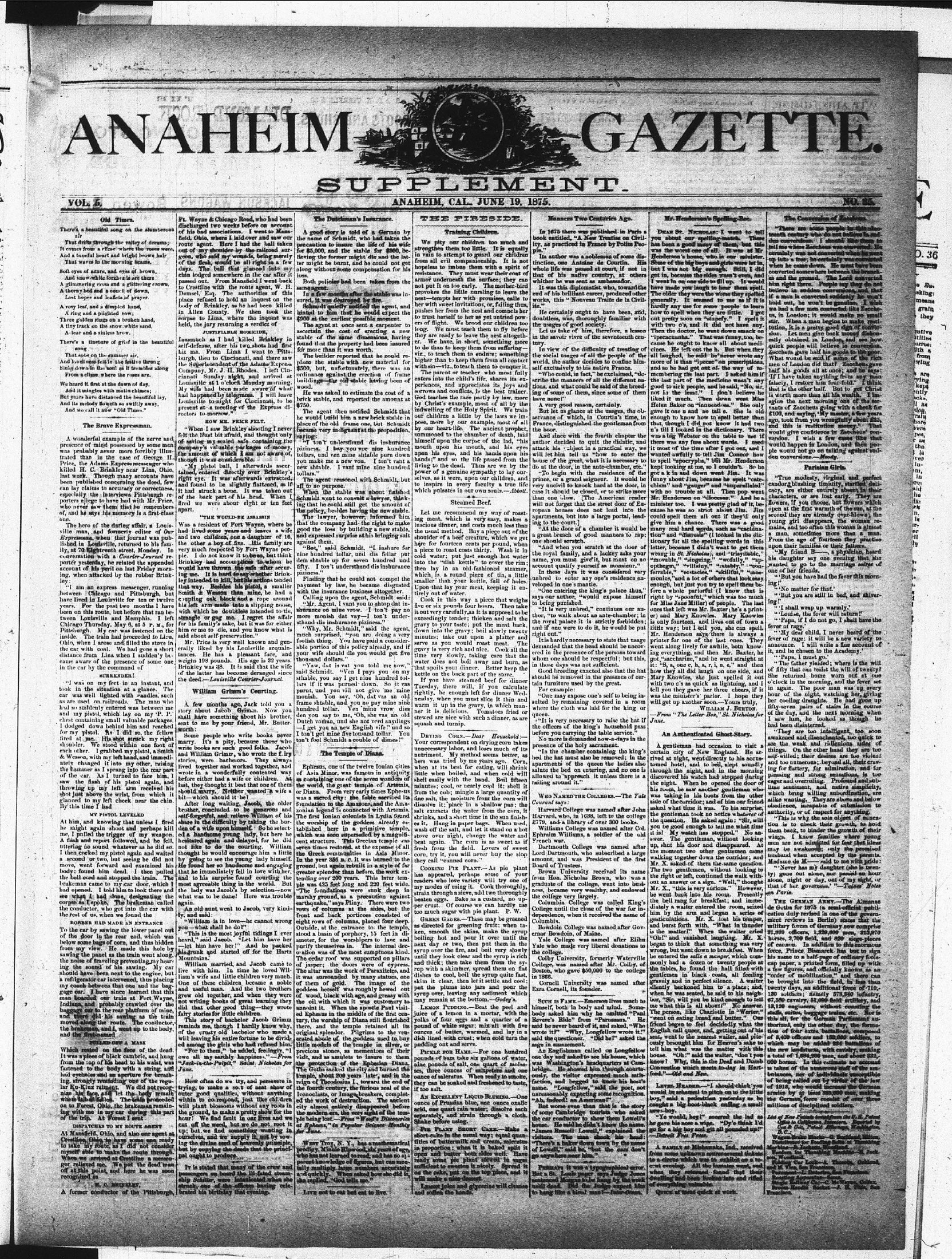
Searchable text
ANAHEIM
VOL. 5.
Old Times.
There’s a beautiful song on the slumberous air
That drifts through the valley of dreams;
It comes from a elime where the roses were.
And a tuneful heart and bright brown hair
That waves in the morning beams.
Bolt eyes of azure, and eyes of brown,
And snow-white forbears are there
A glimmering cross and a glittering crown.
A thorny bed and a couch of down,
Lost hopes and leaflets of prayer.
A rosy leaf, and a simple hand,
A ring and a plighted vow;
Three golden rings on a broken hand,
A tiny crack on the snow-white sand,
A tear and a sinless brow.
There’s a tincture of grief in the beautiful song.
That soils on the summer air,
And loneliness felt in the festive throng
Sinks down in the soul as it trembles along
From a elime where the roses are.
We heard it first at the dawn of day,
And it mingles with matin chimes;
But years have distanced the beautiful lay,
And its melody floweth so swiftly away,
And we call it now “Old Times.”
The Brave Expressman.
A wonderful example of the nerve and presence of mind possessed by some men was probably never more forcibly illustrated than in the case of George H. Price, the Adams Express messenger who killed H. C. Brinkley near Lima, Ohio.
Pt. Wayne & Chicago Road, who had been discharged two weeks before on account of his bad associations.
I went to Mansfield, Ohio, where I laid over and saw our route agent. Here I had the ball taken out of my shoulder by the railroad surgeon, who said my wounds, being merely of the flesh, would be all right in a few days. The ball that glanced into my chin lodged somewhere in the car after it passed out. From Mansfield I went back to Crestline with the route agent, W. H. Damsel, Esq. The authorities of this place refused to hold an inquest on the body of Brinkley, as he had been killed in Allen County. We then took the corpse to Lima, where the inquest was held, the jury returning a verdict of justifiable homicide.
Inasmuch as I had killed Brinkley in self-defense, after his two shots had first hit me. From Lima I went to Pittsburgh, then to Cincinnati, and there saw the Superintendent of the Adams Express Company, Mr. J. H. Rhodes. I left Cincinnati Sunday night, and arrived at Louisville at 1 o’clock Monday morning. My wife had been made aware of what had happened by telegrams. I will leave Louisville to-night for Cincinnati, to be present at a meeting of the Express directors to-morrow."
HOW MR. PRICE FELT.
“When I saw Brinkley shooting I never felt the least bit afraid, and thought only of saving my scaled safe containing the company’s valuable packages of money, the amount of which I am not aware of, though it was considerable.”
“My pistol ball, I afterwards ascertained.”
The Dutchman.
A good story is told the name of Schmidt; precaution to insure for $5,000, and the suffering the former miner might be burnt, along without some loss.
Both policies had been same agent.
In a few months after sued, it was destroyed.
Schmidt quietly moved to him that $200 at the earliest price.
The agent at once ascertain the cost of stable of the same found that the proper for more than it was.
The builder reported place the stable with $500, but, unfortunate ordinance against the buildings—the old stove wood.
He was asked to esquire stable, and repay $750.
The agent then no longer would build him a place of the old frame because very indignant saying:
“I don’t understand piziness. I buy you tollars, and ven mines you make me a new stable. I want
The Brave Expressman.
A wonderful example of the nerve and presence of mind possessed by some men was probably never more forcibly illustrated than in the case of George H. Price, the Adams Express messenger who killed H. C. Brinkley near Lina, Ohio, last week. Though many accounts have been published concerning the deed, few can lay claims to accuracy or correctness, especially the interviews Pittsburgh reporters alleged to have had with Mr. Price, who never saw them that he remembers of, and he says his memory is a first-class one.
The hero of the daring affair, a Louisville man, and formerly editor of Our Expressman, when that journal was published in Louisville, returned to his family, at 70 Eighteenth street, Monday. In conversation with a Courier-Journal reporter yesterday, he related the appended account of his peril on last Friday morning, when attacked by the robber Brinkley:
"I am an express messenger, running between Chicago and Pittsburgh, but have lived in Louisville for ten or twelve years. For the past two months I have been on this route, but before that ran between Louisville and Memphis. I left Chicago Thursday, May 6, at 5 P.M., for Pittsburgh. My car was fastened on the inside. The train had proceeded to Lina, Ohio, when I arose and filled the stove in the car with coal. We had gone a short distance from Lina when I suddenly became aware of the presence of some one in the car by the command of
SURRENDER!
"I was on my feet in an instant, and took in the situation at a glance. The car was well lighted with candles, such as are used on railroads. The man who had so suddenly entered was between me and my pistol, which lay on my P.P. chest containing small valuable packages. I dodged down behind him and reached for my pistol. As I did so, the fellow fired at me. His shot struck my right shoulder. We stood within one foot of each other. I grabbed my pistol, a Smith & Wesson, with my left hand, and immediately changed it into my other, raising the hammer as I sprang into the rear part of the car. As I turned to face him, I saw the flash of his pistol again, and throwing up my left arm received his shot just above the wrist, from which it glanced to my left cheek near the chin. By this time I had
MY PISTOL LEVELED
At him, and knowing that unless I fired he might again shoot and perhaps kill me, I pulled the trigger of my weapon. A flash and report followed, and he fell, uttering no sound whatever as he did so. I then cooked my pistol again and waited a second or two, but seeing he did not move, went forward and examined his body: found him dead. I then pulled the bell cord and stopped the train. The brakeman came to my car door, which I had opened. I told him to look there and Company, Mr. J. H. Rhodes. I left Cincinnati Sunday night, and arrived at Louisville at 1 o'clock Monday morning. My wife had been made aware of what had happened by telegrams. I will leave Louisville to-night for Cincinnati, to be present at a meeting of the Express directors to-morrow."
HOW MR. PRICE FELT.
"When I saw Brinkley shooting I never felt the least bit afraid, and thought only of saving my scaled safe containing the company's valuable packages of money, the amount of which I am not aware of, though it was considerable.
"My pistol ball, I afterwards ascertained, entered directly over Brinkley's right eye. It was afterwards extracted, and found to be slightly flattened, as if it had struck a bone. It was taken out of the back part of his head. When I fired we were about eight or ten feet apart.
"The WOULD-BE ASSASSIN"
Was a resident of Port Wayne, where he had lived some years and leaves a wife and two children, one a daughter of 16, the other a boy of five. His family are very much respected by Fort Wayne people. I do not know it to be no, but think Brinkley had accomplices to whom he would have thrown the safe after securing me. It is hard to say whether Brinkley intended to kill, but his actions tended that way. Besides his pistol, a smaller Smith & Wesson than mine, he had a coupling oak block and a rope around his left arm made into a slipping noose, with which he doubtless intended to tie, strangle or gag me. I regret the affair for his family's sake, but it was for either him or me to die, and you know what is said about self-preservation."
Mr. Price is very well known and generally liked by his Louisville acquaintances. He has a pleasant face, and weighs 198 pounds. His age is 32 years. Brinkley was 38. It is said that the wife of the latter has become deranged since the deed.
William Grimm's Courting.
A few months ago, Jack told you a story about Jacob Grimm. Now you shall have something about his brother, sent to me by your friend, Mr. Butterworth:
Some people who write books never marry. It's a pity, because those who write books are such good folks. Jacob and William Grimm who wrote the Liry stories, were bacheiros. They always lived together and worked together, and wrote in a wonderfully contented way before either had a wife or children. At last they thought it best that one of them should marry. Neither wanted a wife a bit—which should it be?
After long waiting, Jacob, the older brother, concluded to be generous and self-forgetful, and relieve William of his share in the difficulty by taking the burden of a wife upon himself. So he selected a handsome young lady, but here he hesitated again and delayed; for he did not like to do the courting. William thought he would encourage him a little by going to see the young lady himself. He found her so handsome and engaging that he immediately fell in love with her, and to his surprise found courting the most agreeable thing in the world. But Company, Mr. J. H. Rhodes.
I'll Cincinnati Sunday night, and arrived at Louisville at 1 o'clock Monday morning. My wife had been made aware of what had happened by telegrams. I will leave Louisville to-night for Cincinnati, to be present at a meeting of the Express directors to-morrow.
"The WOULD-BE ASSASSIN"
Was a resident of Port Wayne, where he had lived some years and leaves a wife and two children, one a daughter of 16, the other a boy of five. His family are very much respected by Fort Wayne people. I do not know it to be no, but think Brinkley had accomplished to whom he would have thrown the safe after securing me. It is hard to say whether Brinkley intended to kill, but his actions tended that way.
Resides his pistol, a smaller Smith & Wesson than mine, he had a coupling oak block and a rope around his left arm made into a slipping noose, with which he doubtlessly intended to tie, strangle or gag me. I regret the affair for his family's sake, but it was for either him or me to die, and you know what is said about self-preservation."
Mr. Price is very well known and generally liked by his Louisville acquaintances. He has a pleasant face, and weighs 198 pounds. His age is 32 years. Brinkley was 38. It is said that the wife of the latter has become deranged since the deed.
Louisville Courier-Journal.
The Temple
Ephesus, one of the cities of Asia Minor, was less as containing one of the world's great or Diana. From very early foundation to the Amorion legend is common.The first ionian color the worship of the god tabished here in which was soon supercent structure This seven times restored,the Greek community.In the year 386 a.c.,ground,but again rebels greater splendor than tending over 200 years pleasured 425 feet long
MY PISTOL LEVELED
At him, and knowing that unless I fired he might again shoot and perhaps kill me, I pulled the trigger of my weapon. A flash and report followed, and he fell, uttering no sound whatever as he did so. I then cocked my pistol again and waited a second or two, but seeing he did not move, went forward and examined his body: found him dead. I then pulled the bell cord and stopped the train. The brakeman came to my car door, which I had opened. I told him to look there and see what I had done, designating the corpse as I spoke. The brakeman called the conductor, who got into the car with the rest of us, when we found the
ROBBER HAD MADE AN ENTRANCE
To the car by sawing the lower panel out of the door in the rear end, which was below some bags of corn, and thus hidden from my view. He made this hole by sawing the panel as the train went along, the noise of travelling preventing my hearing the sound of his sawing. My car should have been next to the engine, but a refrigerator car intervened, thus placing my coach between that one and the baggage car. I have since learned that this man boarded our train at Fort Wayne, Indiana, and probably crawled over the baggage car to the rear platform of mine, and there did his sawing as the train moved along the route. The conductor, the brakeman, and I, went up to the body, and the first named
PULLING ON A MASK
Which rested on the face of the dead. It was a piece of black cambric, and hung from the top of his head to his waist, was fastened to the body with a string, and had eyeboles and an aperture for breathing, strongly reminding one of the regular Ku-Klux raiment. We did not recognize his face, and let the body remain where he fell. The train proceeded on to Forest, Ohio, the brakeman remaining with me in my car during this part of the trip. At Forest I sent
DISPATCHES TO MY ROUTE AGENT
At Mansfield, Ohio, and also our agent at Crestline, Ohio, to have some one ready to take my route; as I did not consider myself able to make the route through. When we arrived at Crestline a messenger relieved me. We put the dead man off at this point, and here he was soon recognized as
M. C. BRUNKLEY,
A former conductor of the Pittsburgh,
After long waiting, Jacob, the older brother, concluded to be generous and self-forgetful, and relieve William of his share in the difficulty by taking the burden of a wife upon himself. So he selected a handsome young lady, but here he hesitated again and delayed, for he did not like to do the courting. William thought he would encourage him a little by going to see the young lady himself. He found her so handsome and engaging that he immediately fell in love with her, and to his surprise found courting the most agreeable thing in the world. But the lady was Jacob's by selection—now what was to be done? Here was trouble again.
An old saint went to Jacob, very kindly, and said:
"William is in love—he cannot wrong you—what shall he do?"
"This is the most joyful tidings I ever heard," said Jacob. "Let him have her—let him have her!" And he packed his trunk and started off for the Hartz Mountains.
William married, and Jacob came to live with him. In time he loved William's wife and little children very much. One of these children became a noble and useful man. And the two brothers grew old together, and when they were not writing books of great learning they did that other good thing—they wrote fairy stories for little children.
This story of bachelor Jacob Grimm reminds me, though I hardly know why, of the crusty old bachelor who made a will leaving his entire fortune to be divided among the girls who had refused him.
"For to them," he added, feelingly, "I owe all my earthly happiness." —From "Jack-in-the-Pulpit," Saint Nicholas for June.
How often do we try, and persevere in trying, to make a sort of neat show of outer good qualities without anything within to correspond, just like child dress will plant blossoms without any roots in the ground, to make a pretty show for the hour! We find fault in our lives and we cut off the weed, but we do not root it up; but we find something wanting in ourselves, and we supply it not by sowing the divine seed of heavenly principle, but by copying the seeds that the principal ought to produce.
It is stated that many of the crew and passengers on board the ill-fated steamship Schiller were intolerated when she stank, one of the officials having celebrated his birthday that evening.
IM GAT
SUPPLEMENT.
ANAHEIM, CAL. JUNE 19, 1875.
The Dutchman's Insurance.
A good story is told of a German by the name of Schmidt, who had taken the precaution to insure the life of his wife for $5,000, and the stable for $800, believing the former might die and the latter might be burnt, and he could not get along without some compensation for his loss.
Both policies had been taken from the same agent.
In a few months after the stable was insured, it was destroyed by fire.
Schmidt quietly notified the agent, and hinted to him that he would expect the $200 at the earliest possible moment.
The agent at once sent a carpenter to ascertain the cost of erecting a new stable of the same dimensions, having found that the property had been insured for more than it was worth.
The builder reported that he could replace the stable with new material for $500, but, unfortunately, there was an ordinance against the erection of frame buildings—the old stable having been of wood.
He was asked to estimate the cost of a brick stable, and reported the amount at $750.
The agent then notified Schmidt that he would build him a new brick stable in place of the old frame one, but Schmidt became very indignant at the proposition, saying:
"I don't understand disinsurance piziness. I buy you vor nine hundred tollars, und ven mine shtable purn down you make me a new von. I don't want a new shtable. I want mine nine hundred
THE FIRESIDE.
Training Children.
We pity our children too much and strengthen them too little. It is equally in vain to attempt to guard our children from all evil companionship. It is not hopeless to imbue them with a spirit of resistance. They must wear their coat of armor underneath the surface; they can not put it on too early. The mother-bird provokes the little nursing to leave the nest—temps her with promises, calls to her with sweet invitations, or, failing thus, pushes her from the nest and compels her to trust herself to her as yet untried powers of flight. We brood our children too long. We must teach them to fly before they are ready to leave the nest altogether. We have, in short, something more to do than to keep them from suffering—viz., to teach them to endure; something higher than to keep them from all contact with sin—viz., to teach them to conquer it.
The parent or teacher who most fully enters into the child's life, shares its experiences, and appreciates its joys and sorrows and conflicts, is the best trainer. God teaches the race partly by law, more by Christ's example, most of all by the indwelling of the Holy Spirit. We train our children a little by the laws we impose, more by our example, most of all by our heart-life. The ancient prophet, summoned to the chamber of death, laid himself upon the corpse of the lad, "his mouth upon his mouth, and his eyes upon his eyes, and his hands upon his hands;" and so the life passed from the living to the dead. Thus are we by the
Manners Two Centuries Ago.
In 1675 there was published in Paris a book entitled, "A New Treatise on Civility, as practiced in France by Polite People."
Its author was a nobleman of some distinction, one Antoine de Courtin. His whole life was passed at court, if not in that of his native country, at others whither he was sent as ambassador.
It was this diplomatist who, toward the end of his brilliant career, produced other works, this "Nouveau Traite de la Civilite."
He certainly ought to have been, and doubtless, was, thoroughly familiar with the usages of good society.
Let us take of him, therefore, a lesson in the savoir vivre of the seventeenth century.
In view of the difficulty of treating of the social usages of all the people of the world, the author decides to confine himself exclusively to his native France.
"Who could, in fact," he exclaimed, "describe the manners of all the different nations, and what could be said of the breeding of some of them, since some of them have none?"
A very good reason, certainly.
But let us glance at the usages, the observance of which, in Courtnia's time, in France, distinguished the gentleman from the boor.
And since with the fourth chapter the author decided to quit the didactic, and attack his subject in a practical way, we will let him tell us "how to enter the house of the great, what it is necessary to do at the door, in the ante-chamber, etc."
The Temple of Diana.
Ephesus, one of the twelve Ionian cities of Asia Minor, was famous in antiquity as containing one of the seven wonders of the world, the great temple of Artemis, or Diana. From very early times Epheus was a sacred city; the fable described its foundation to the Amazon, and the Amazonian legend is connected with Artemis. The first Ionian colonists in Lydia found the worship of the goddess already established here in a primitive temple, which was soon supervised by a magnificent structure. This Grecian temple was seven times restored, at the expense of all the Greek communities in Asia Minor. In the year 386 b.c., it was burned to the ground, but again rebuilt in a style of far greater splendor than before, the work extending over 200 years. This later temple was 425 feet long and 220 feet wide.
The agent then notified Schmidt that he would build him a new brick stable in place of the old frame one, but Schmidt became very indignant at the proposition, saying:
"I don't undersfiln dis insurance piziness. I buy you vor nine hundred tollars, und ven mine shtable parn down you make me a new von. I don't want a new shtable. I want mine nine hundred tollars."
The agent reasoned with Schmidt, but all to no purpose.
When the stable was about finished Schmidt went to consult a lawyer, thinking that he could get the amount of the policy, besides having the new stable.
The lawyer, however, informed him that the company had the right to make good the loss by building a new stable, and expressed surprise at his bringing suit against them.
"But," said Schmidt, "I insure for nine hundred tollar, und dis fellar put dem shtable up for seven hundred und fifty. I can't understand dis insurance piziness."
Finding that he could not compel the payment by law, he became disgusted with the insurance business altogether.
Calling upon the agent, Schmidt said:
"Mr. Agent, I want you to stop dat insurance on mine vrow. I ton't pay no more monish dat vay—I tonn't understand dis insurance piziness."
"Why, Mr. Schmidt," said the agent, much surprised, "you are doing a very foolish thing. You have paid a considerable portion of this policy already, and if your wife should die you would get five thousand dollars."
"Yaw, dat is sat you told me now," said Schmidt.
"Ven I pays you on my shtable, you say I get nine hundred tollars if it was purned down. So it was purnt, und you will not give me mine monish. You say, Oh, dat was an old frame shtable, und you no pay mine nine hundred tollar. Ven mine vrow dies den you to me, 'Oh, she was an old Dutch vomian, und she not verd anydings — I get you an new English vife!' and so I ton't get mine five tonsand tollar. You ton't fool Schmidt a couple of dimes."
Steamed Beef.
Let me recommend my way of roasting meat, which is very easy, makes a luscious dinner, and costs much less than the usual method. Buy a piece out of the shoulder of a beef creature, which we get for fourteen cents per pound, when a piece to roast costs thirty. Wash it in cold water; put just enough hot water into the "dish kettle" to cover the rim; then lay in an old-fashioned steamer, which is a round piece of tin, a little smaller than your kettle, fall of holes. Upon that lay your meat, keeping it entirely out of water.
Cook in this way a piece that weighs five or six pounds four hours. Then take it out very carefully, as it is supposed to be exceedingly tender; thicken and salt the gravy to your taste; put the meat back, down into the gravy; boil slowly twenty minutes; take up upon a platter and serve as you would roast meat. The gravy is very rich and nice. Cook all the time very slowly, taking care that the water does not boil away and burn, as that spoils your dinner. Better keep the kettle on the back part of the stove.
If you have steamed beef for dinner Tuesday, there will, if you calculate rightly, be enough left for dinner Wednesday, when you must slice it thin and warm it up in the gravy, in which manner it is delicious. Tomatoes fried or stewed are nice with such a dinner, as are squash and turnip.
DRYING CORN.—Dear Household: Your correspondent on drying corn takes unnecessary labor, and loses much of its nutriment. My method seems better, as hers was tried by me years ago. Corn, when at its best for eating, will shrink little when boiled, and when cold will shell easily with the hand. Boil fifteen minutes; cool, or nearly cool it; shell it from the cob; mingle a large quantity of fine salt, the moisture from the corn will dissolve it; place in a shallow pan; the salt extracts the water from the corn, it shrinks, and a short time in the sun finishes it. Hang in paper bags. When used, wash off the salt, and let it stand on a hot stove over night, change the water and beat again. The corn is as sweet as if fresh from the field. Lovers of sweet corn, try it, you will never buy the slow they call "canned corn."
COOKING PIE PLANT.—As pie plant has appeared, perhaps some of your readers who love variety will try one of my modes of using it. Cook thoroughly,
"Who could, in fact," he exclaimed, "describe the manners of all the different nations, and what could be said of the breeding of some of them, since some of them have none?"
A very good reason certainly.
But let us glance at the uses, the observance of which, in Courtin's time, in France, distinguished the gentleman from the boor.
And since with the fourth chapter the author decided to quit the didatic, and attack his subject in a practical way, we will let him tell us "how to enter the house of the great, what it is necessary to do at the door, in the ante-chamber, etc."
To begin with the residence of the prince, or a grand seigneur. It would be very uncivil to knock hard at the door, in case it should be closed, or to strike more than one blow.[The American reader will not forget that the street door of European houses does not lead into the apartments, but into a large portal, leading to the court.]"
At the door of a chamber it would be a great breach of good manners to rap; one should scratch.
And when you scratch at the door of the royal family, and a lackey asks your name, you must give it; but must on no account qualify yourself as monsieur."
In these days it was considered very unbroken to enter any one's residence enveloped in one's mantle.
One entering the king's palace thus," says our author," would expose himself to being punished.
"It is very unbred," continues our author," to walk about an ante-chamber; in the royal palace it is strictly forbidden; and if one were to do it, he would be put right out."
It is hardly necessary to state that usage demanded that the head should be uncovered in the presence of the persons toward whom one should be respectful; but this, in those days was not sufficient.
Good breeding exacted also that the hat should be removed in the presence of certain furniture used by the great.
For example:
"One may expose one's self to being insulted by remaining covered in a room where the cloth was laid for the king or queen."
"It is very necessary to raise the hat if the officers of the king's household pass before you carrying the table service."
No more is demanded now-a-days in the presence of the holy sacrament.
In the chamber containing the king's bedthe hat must also be removed; in the apartments of the queenthe ladies also salute the bed on entering; and no one is allowed to approach it unless there is a railing around it."
Who NAMED THE COLLEGES.—The Yale Courant says:
Harvard College was named after John Harvard, who in 1638 left to the college £779,and a library of over 300 books.
Williams College was named after Col Ephraim Williams,a soldier of the old French war.
Dartmouth College was named after Lord Dartmouth,the universitywas PresidentofthefirstBoardofTrustees.
Brown University received its name from Hon.Nicholas Brownwho was a graduateofthecollegewentintobusinessevermorereducedandrewed
From very early times Epheus was a sacred city; the fablecribed its foundation to the Amazonian legend is connected with Artemis. The first Ionian colonists in Lydia found the worship of the goddess already established here in a primitive temple, which was soon supervised by a magnificent structure. This Grecian temple was seven times restored, at the expense of all the Greek communities in Asia Minor. In the year 358 m.c., it was burned to the ground, but again rebuilt in a style of far greater aplendance than before, the work extending over 200 years. This later temple was 425 feet long and 220 feet wide. The foundations were sunk deep in marshy ground, as a precaution against earthquake," says Pliny. There were two rows of columns at the sides, but the front and back porticoes consisted of eight rows of columns, placed four deep. Outside, at the entrance to the temple, stood a basin of porphory, 15 feet in diameter, for the worshipers to lave and purify themselves in. The internal decoration was of the most sumptuous kind. The cedar roof was supported on pillars of jasper; the doors were of cypress. The altar was the work of Paraxiteles, and it was surrounded by many statues, one of them gold. The image of the goddess herself was roughly hewed out of wood, black with age, and greasy with the oil with which it was customary to annoint it. When the apostle Paul visited Ephesus in the middle of the first century, the worship of Diana still flourished there, and the temple retained all its original splendor. Pilgrims to the venerated abode of the goddess used to buy little models of the temple in silver, or precious stones, as mementoes of their visit, and as amulets to insure to them the protection of the Ephesian Diana. The Goths sacked the city and burned the temple, about 200 years later, and in the reign of Theodosius I, toward the end of the fourth century, the furious zeal of the Iconoclasts, or Image breakers, completed the work of destruction. The ancient city almost entirely disappeared before the modern era, the very sight of the temple being lost."—From "Woolf's Discoveries at Ephesus," in Popular Science Monthly for June.
What Troy, N.Y., has a mathematical prodigy, Minnie Hipwood, six years of age, who has not learned to read, and has no apparent knowledge of figures, but can mentally multiply large numbers accurately and quickly. When asked how she did it, she replied, "God tells me."
Live not to eat but eat to live.
Cooking Pie Plant.—As pie plant has appeared, perhaps some of your readers who love variety will try one of my modes of using it. Cook thoroughly, strain through a sieve, add two thoroughly beaten eggs. Bake as a custard, no upper crust. Of course we can hardly use too much sugar with pie plant. P.W.
Green Gages.—These may be greened as directed for greening fruit; when taken, smooth the skins, make the syrup boiling hot and pour it over until the next day or two, then put them in the syrup over the fire, and boil very slowly until they look clear and the syrup is rich and thick; then take them from the syrup with a skimmer, spread them on flat dishes to cool, boil the syrup quite fast, skim it clear, then let it settle and cool; put the plums into jars and pour the syrup over, leaving any sediment which may remain at the bottom.—Godey's.
Lemon Pudding.—Beat the peel and juice of a lemon in a mortar, with the yolks of four eggs and a quarter of a pound of white sugar; mix all with five ounces of butter, warmed, and lay in a dish lined with crust; when cold turn the pudding out and serve.
Pickle For Hams.—For one hundred pounds of ham take six gallons of water, nine pounds of salt, one quart of molasses, three ounces of saltpeters and one ounce of saleratus. When ready to smoke, they can be soaked and freshened to taste, if too salt.
An Excellent Liquid Blurring.—One ounce of Prussian blue, one ounce oxalic acid, one quart rain water; dissolve each separately, and strain through a cloth. Shake before using.
Pine Plant Short Cake.—Make a short-cake in the usual way; equal quantities of buttermilk and cream; temperate in proportion; when it is baked split it open and butter both sides well. Have ready some pie plant stewed in sugar sufficient to sweeten it nicely. Spread it on the cake; put on the top place, and it will make a nice dessert.
Lemon juice and glycerine will cleanse and soften the hands.
Who Named The Colleges.—The Yale Courant says:
Harvard College was named after John Harvard, who, in 1638, left to the college 779, and a library of over 300 books.
Williams College was named after Col. Ephraim Williams, a soldier of the old French war.
Dartmouth College was named after Lord Dartmouth, who subscribed a large amount, and was President of the first Board of Trustees.
Brown University received its name from Hon. Nicholas Brown, who was a graduate of the college, went into business, became very wealthy, and endowed the college very largely.
Columbia College was called King's College until the close of the war for independence, when it received the name of Columbia.
Bowdoin College was named after Governor Bowdoin, of Maine.
Yale College was named after Elihu Yale who made very liberal donations to the college.
Colby University, formerly Waterville College, was named after Mr. Colby, of Boston, who gave $50,000 to the college in 1866.
Cornell University was named after Ezra Cornell, its founder.
Such is Fame.—Emerson lives much to himself, both in body and mind. Somebody asked him why he omitted "Paul Revere's Hide" from "Parnassus." He said he never heard of it, and asked "Who wrote it?" "Why Longfellow wrote it!" said the questioner. "Did he?" asked the sage in an amazement.
An Englishman called on Longfellow one day and asked to see his house, which was Washington's headquarters at Cambridge. He showed him through courteously, the visitor expressed much satisfaction, and begged to know his host's name. "Longfellow," said the poet, not unreasonably expecting some recognition. "Ah indeed! an American!"
But worse even than in the story of some Cambridge tourists who asked the car conductor to show them Lowell's house. He said he didn't know the name. "James Russell Lowell," explained the visitors. The man shook his head: "There's a bakter down town by the name of Lowell," said he; "but the case don't go anywhere near him."
Pennsylvania was a typographical error. But a St. Louis paper says Judge Jones sentenced Morgan to be hung by the week until dead. Did the Judge suspect him to hang like a hinal man?—Inter-Ottawa.
GAZETTE.
NO. 25
centuries Ag.
published in Paris a Treatise on Civilization by Polite Peoleman of some dismade Courtin. His court, if not in country, at others ambassador.
Just who, toward the mer, produced other Traite de la Civillo have been, and, highly familiar with ety.
therefore, a lesson the seventeenth cenalty of treating of the people of the cities to confine himmative France.
he exclaimed, "deall the different name said of the breedance some of them
certainly.
the usages, the obCourtin's time, in the gentleman from fourth chapter the it the didatic, and practical way, we know to enter the it is necessary to ante-chamber, etc."
Mr. Henderson's Spelling-Bee.
DEAR St. NICHOLAS: I want to tell you about our spelling-match. There has been a good many of them, but this was the worst one of all. It was at Mr. Henderson's house, who is our minister. Some of the big boys and girls were let in, but I was not big enough. Still, I did get in, because the sider wasn't even, and I went in on one side to fill up. It would have made you laugh to hear them spell. The older they were the worse they spelled generally. It seemed to me as if it is hardly any use for some people to learn how to spell when they are little. I got out pretty soon on "stupefy," I spelt it with two o's, and it did not have any. Then the doctor, he went down smack on "ipecacuanha." That was funny, too, because he ought to know all about medicines. He left out the h. But when they all laughed, he said he never wrote any more of it than "ipecane" on prescriptions, and so he had got out of the way of remembering the last part. I asked him if the last part of the medicine wasn't any good to sick people, and he said, "No, air, not in the least." I don't believe he liked it much. Then down went Miss Helen Baker on "innuendoes." She only gave it one n and no tall e. She is old enough to know how to spell better than that, though I did not know it had two n's till I looked in the dictionary. There was a big Webster on the table to use if there was any fuss about words. I used it most of the time after I got out, and I wanted awfully to tell Jim Connor how to spell "apocrypha," but Mr. Henderson kept looking at me, so I couldn't. So he
The Conversion of Zaccheus.
"There are some people in this seventh century who do not believe in sudden conversions. I should like them to tell me where Zaccheus was converted. He certainly was not converted when he went into a tree; he certainly was converted when he came down. He must have been converted somewhere between the branches and the ground. The Lord converted him right there. People say they do not believe in sudden conversions, and that if a man is converted suddenly he won't hold out, he won't be gannahne. I wish we had a few men converted like Zaccheus, in London; it would make no small star. When a man begins to make restitution, it is a pretty good sign of conversion. Let men give back money dishonestly obtained in London, and see how quick people will believe in conversion. Zaccheus gave half his goods to the poor. What would be said if some of the rich men of London did that? Zaccheus gave half his goods all at once; and he says: 'If I have taken anything from any man falsely, I restore him four-fold.' I think that is the other half. But to get Christ is worth more than all his wealth. I imagine the next morning one of the servants of Zaccheus going with a check for £100, and saying, 'My master, a few years ago, took from you wrongfully about £25, and this is restitution money.' That would give confidence in Zaccheus' conversion. I wish a few cases like that would happen in London, and then people would not go on talking against sudden conversions." Moody.
Parisian Girl.
certainly.
the usages, the obCourtin's time, in
the gentleman from
fourth chapter the
at the didatic, and
practical way, we
how to enter the
it is necessary to
ante-chamber, ete.
residence of the
meur. It would be
ward at the door, in
or to strike more
American reader
street door of Eunot lead into the
large portal, leadmember it would be
manners to rap;
watch at the door of
lackey asks your,
but must on no
if as monsieur."
is considered very
peace's residence engling's palace thus," and expose himself
continues our auquate-chamber; in
districtly forbidden;
it, he would be put
to state that usage
should be uncoverthe persons toward
spectful; but this,
sufficient.
and also that the hat
the presence of certhe great.
its self to being incovered in a room
for the king or
to raise the hat if
its household pass
table service."
now-a-days in the
arment.
aining the king's
be removed; in the
when the ladies also
is, and no one is
unless there is a
An Authenticated Ghost-Story.
A gentleman had occasion to visit a certain city of New England. He arrived at night, went directly to his accustomed hotel, and to bed, slept soundly through the night, and in the morning discovered his watch stopped during the night. When he opened the door of his room, he saw another gentleman who was taking in his boots from the other side of the corridor; and of him our friend asked what time it was. To his surprise, the gentleman took no notice whatever of the question. He asked again: "Sir, will you be good enough to tell me what time it is? My watch has stopped." No answer. The gentleman, without looking up, shut his door and disappeared. At the moment two other gentlemen came walking together down the corridor; and Mr. X. asked of them the same question. The two gentlemen, without looking to the right or left, continued the walk without an answer or a sign. "Well," thought Mr. X. "this is very curious." However,
hair his goods all at once; and no says:
"IIf have taken anything from any man falsely, I restore him four-fold." I think that is the other half. But to get Christ is worth more than all his wealth. I imagine the next morning one of the servants of Zaccheus going with a check for £100, and saying, "My master, a few years ago, took from you wrongfully about £5, and this is restitution money." That would give confidence in Zaccheus' conversion. I wish a few cases like that would happen in London, and then people would not go on talking against sudden conversions.—Moody.
Parisian Girls.
"True modesty, virginial and perfect candor, blushing timidity, startled delicacy, are either entirely absent in their characters, or are lost early. They are flowers, if you choose, but flowers which open at the first warmth of the sun, at the second they are already over-blown; the young girl disappears, the woman remains, and too often this woman is almost a man, sometimes more than a man. From the age of fourteen they practise upon their families or their fathers.
"My friend B——a physician, heard his daughter say one evening that she wanted to go to the marriage soires of one of her friends.
"But you have had the fever this morning!
"No matter for that."
"But you are still in bed, and shivering."
"I shall wrap up warmly."
"Louise, the fever will return."
"Papa, if I do not go, I shall have the fever of rage."
"My dear child, I never heard of the fever of rage; it will be a new variety to announce. I will write a fine account of it, and be chosen to the Academy."
"Papa, I must go."
"The father yielded; where is the will of fifty that can resist the will of twenty? She returned home worn out at one o'clock in the morning, and the fever set in again. The poor man was up every hour of the night, watching her giving her cooling draughts. He had gone up fifty-seven pairs of stairs in the course of the day, and the next morning when I saw him, he looked as though he had been disinterred.
They are too intelligent, too soon awakened and disenchanted, too quick to see the weak and ridiculous sides of things. On the other hand they are too self-willed; their desires are too violent and too numerous; beyond all, their craving for flattery, for admiration, and for pleasing and strong sensations, is too eager and overruling. Profound and sublime sentiment, and native simplicity, which bring willing subordination, are alike wanting. They are above and below obedience, incapable of submission to authority, or of respect for anything.
"This is why the sole object of education is to check their growth, to hold them back, to hinder the growth of their wings. I know families where young men are not admitted for fear that ideas may be awakened; only the promised husband when accepted by the parents. Madame de M——said to me with pride:
"Never has my daughter (she is twenty) gone out alone; nor passed an hour alone, night or day, out of my sight, or that of her governess." —Taiwan Notes
named after John left to the college over 300 books.
named after Col. soldier of the old was named after subscribed a large resident of the first received its name known who was a went into bushy, and endowed was called King's of the war for inceived the name of named after Gov. named after Elihu liberal donations to formerly Waterville after Mr. Colby, of 100 to the college was named after person lives much to mind. Some omitted "Paul Parnassus." He and asked, "Who greggellow wrote it!" did he?" asked the on Longfellow his house, which headquarters at Canada through courteened much attis know his host's told the poet, not some recognition mean!"
that is the story narrator who asked how them Lowell's knew the name," explained the hook his head: down by the name at the ears don't geographical error, says Judge Jones being by the work judge expect him—Inter-Ocean.
LEVEN HEADMAN—"I should think you would be ashamed to pitch on to the little boy," said a pedestrian yesterday as he caught a big boot-black enclosing a small news-boy.
"Ye would, hey!" answered the lad as he gave his nose a wipe. "Dy'e think I'd go for a big boy and git all pounded up!"—Detroit Press Poem.
A FAMILY at Michamaka, Ind., received from some unknown source several tickets to a drama which was to exhibit on a recent evening. All the inmates went, and when they returned found that their dwelling had been broken into and riffed of everything valuable.
Quick at most quick at work.
which bring willing subordination, are alike wanting. They are alone and below obedience, incapable of submission to authority, or of respect for anything.
"This is why the sole object of education is to check their growth, to hold them back, to hinder the growth of their wings. I know families where young men are not admitted for fear that illness may be awakened; only the promised husband when accepted by the parents. Madame de M—said to me with pride:
"Never has my daughter (she is twenty) gone out alone, nor passed an hour alone, night or day, out of my sight, or that of her governor." —Tulane Notes Paris.
THE GERMAN ARMY—The Almanac de Gotha for 1875 (a semi-official publication duly revised in one of the government reviews in Berlin) states that the military forces of Germany now comprise 31,860 officers, 1,329,000 men, 815,970 horses, 2,700 field, and 820 stage-pieces of cannon. In addition to this enormous force, Prince Bismarck has but to sign his name to a half-page of ordinary foolscap paper, a printed form, filled up with a few figures, and officially known as an "order of mobilization," and there can be brought into the field, in less than twenty days, an additional force of 710,-120 soldiers; namely 578,340 infantry, 67,580 cavalry, 51,000 field artillery, and 12,120 engineers without counting the staffs, suites, baggage trains, etc. Nor is this all, for the German Parliament authorized, only the other day, the formation of four extra battalions, composed of 8,400 officers and 182,000 soldiers, to which may be added 264 battalions of the new landturns, with casualty, making a total of 1,004,000 men, and about 822,-000 horses. In this estimate no account is taken of the numerous staff of the amunities, nor of individuals susceptible of being called out by virtue of the law of 1818, who would increase the German armies by at least 850,000 men, making the German forces consist of our three millions of disciplined soldiers.
List of New Patents issued from the U.S. Patent Office in California, Indiana. Reported by Cox & Co., Patent Attorney Washington, D.C.
Wagner-Braun Worcester—O. Nuttland, Milton,
District for Reading Ball at Tulanning Machine—Baldachin Woodland.
Rodling Car Lock—A. Thomas, Oakland,
and M. Vien. San Francisco.
Tremont—L. Butterfield San Francisco.
Reading Argentine—San Francisco.
Single Railway Car—C. McWayne, Calif.
Brown Hardie Susan—J. K. Title, San Francisco.