anaheim-gazette 1875-04-10
Scanned page
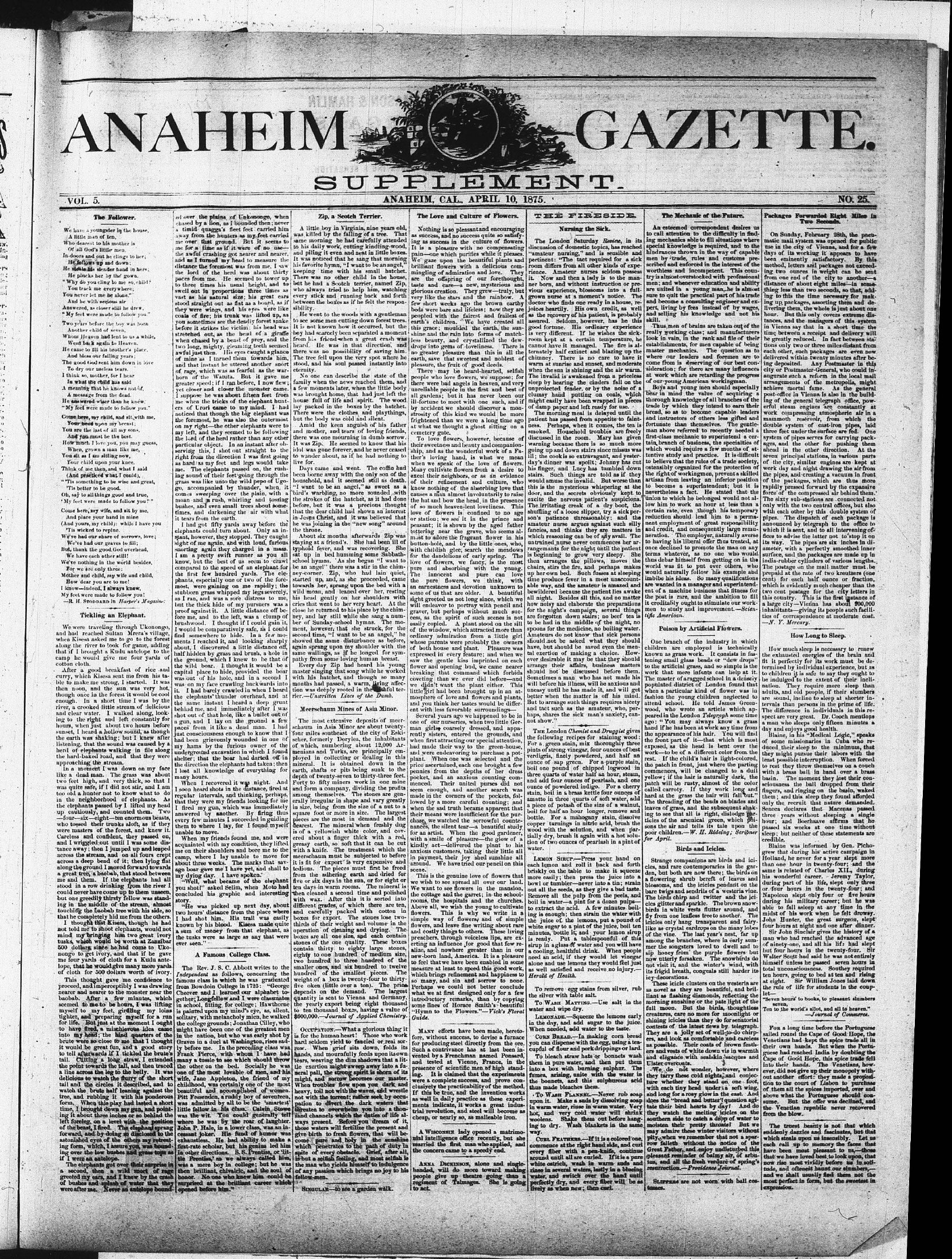
Searchable text
ANAHEIM
VOL. 5.
The Follower.
We have a youngster in the house,
A little man of ten,
Who dearest to his mother is
Of all God's little men.
In doors and out he clings to her;
He follows up and down;
He stands his slender hand in hers;
He plucks her by the gown.
"Why do you cling to me so, child?
You track me everywhere;
You never let me be alone."
And he with serious air
Answered, as closer still he drew,
"My feet were made to follow you."
Two years before the boy was born
Another child of seven,
Whom Heaven had lent to us a while,
Went back again to Heaven.
He came to fill his brother's place,
And bless our failing years;
The good God sent him down in love
To dry our useless tears.
I think so, mother, for I hear
In what the child has said
A meaning that he knows not of,
A message from the dead.
He answered wiser than he knew;
"My feet were made to follow you."
Come here, my child, and sit with me,
Your head upon my breast;
You are the last of all my sons,
And you must be the best.
How much I love you, you may guess,
When, grown a man like me,
You sit as I am sitting now,
Your child upon your knee.
Think of me then, and what I said
oh over the plains of Unkonongo, when chased by a lion, as I bounded then; never a timid quagga's fleet feet carried him away from the hunters as my feet carried me over that ground. But it seems to me for a time as if it were of no use—the awful crashing got nearer and nearer, and as I turned my head to measure the distance the foremost was from me. I saw the lord of the herd was about thirty paces from me. He seemed to tower up to three times his usual height, and to swell out in proportions three times as vast as his natural size; his great ears stood straight out as flat as a board, as if they were wings, and his eyes were like coals of fire; his trunk was lifted up, as you sometimes see the deadly forest snake before it strikes the victim: his head was stretched out, as the head of a giraffe when chased by a beast of prey, and the two long, mighty, gleaming teeth seemed awful just then. His eyes caught a glance of mine as I turned them towards him, and that instant he uttered another snort of rage, which was as fearful as the warhorn of the Watuta. But it gave me greater speed; if I ran before, I now flew; yet closer and closer the monster came. I suppose he was about fifteen feet from me when the tricks of the elephant hunters of Urori came to my mind. I had noticed that though the big elephant was the foremost, he was also the outermost on my right—the other elephants were to my left, and they seemed to be following the lord of the herd rather than any other particular object. In an instant after observing this, I shot out straight to the right from the direction I was first going as hard as my feet and legs would take me. The elephants passed on the rush-
Zip, a Scotch
A little boy in Virginia was killed by the falling same morning he had to his daily work, cutting and piling it even and it was noticed that he his favorite hymn, "I will keeping time with him There was no other coy but he had a Scotch t who always tried to hit every stick and run between the boxes as if sibility.
He went to the woods to see some men cutting It is not known how it boy had scarcely been seen from his friend when he heard. He was in there was no possibility The tree fell upon the stood, and his soul pur eternity.
No one can describe family when the news is a few moments later, we was brought home, that house full of life and lay packed in the box There were the clothes but the body was cold Amid the keen angel and mother, and tears there was one mourning It was Zip. He seemed idol was gone forever, to wander about, as if live for.
Days came and went
Tickling an Elephant.
We were traveling through Ukonongo, and had reached Sultan Mrera village when Kisesa asked me to go to the forest along the river to look for game, adding that if I brought a Kudu antelope to the camp he would give me four yards of cotton cloth.
After a good breakfast of rice and curry, which Kisesa sent me from his table to make me strong, I started. It was then noon, and the sun was very hot, though once in the forest it would be cool enough. In a short time I was by the river, a crooked little stream of delicious and clear water. I walked along, looking to the right and left constantly for hours, when just about two hours before sunset, I heard a hollow sound, as though the earth was shaking; but I knew after listening, that the sound was caused by a herd of elephants walking in file along the hard-baked road, and that they were approaching the stream.
In a moment I was down on my face like a dead man. The grass was about two feet high, and very thick, so that I was quite safe, if I did not stir, and I am too old a hunter not to know what to do in the neighborhood of elephants. As the elephants passed by I lifted my head up cautiously, and counted them. Two—four—six—eight—ten enormous beasts, who tossed their trunks aloft, as if they were masters of the forest, and knew it. Careless and confident, they passed on, and I wrigled out until I was some distance away; then I jumped up and leaped across the stream, and on all fours crept across a deep bend of it; then lying flat along the ground I moved forward towards a great tree, a baobab, that stood between me and them. If the elephants had all stood in a row drinking from the river I think so, mother, for I hear In what the child has said A meaning that he knows not of A message from the dead He answered wiser than he knew "My feet were made to follow you."
Come here, my child, and sit with me Your head upon my breast; You are the last of all my sons And you must be the best How much I love you, you may guess When grown a man like me You sit as I am sitting now Your child upon your knee Think of me then, and what I said (And practiced what I could), "Tis something to be wise and great, Tis better to be good. Oh, say to all things good and true, 'My feet were made to follow you!'" Come here, my wife, and sit by me And place your hand in mine (And yours, my child): while I have you Tis wicked to repine. We've had our share of sorrows, love; We've had our graves to fill; But, thank the good God overhead, We have each other still! We've nothing in the world besides For we are only three: Mother and child, my wife and child, How dear you are to me! I know—indeed, I always knew My feet were made to follow you! —R. H. Stoddard in Harper's Magazine.
Tickling an Elephant.
We were traveling through Ukonongo, and had reached Sultan Mrena village when Kisesa asked me to go to the forest along the river to look for game, adding that if I brought a Kudu antelope to the camp he would give me four yards of cotton cloth.
After a good breakfast of rice and curry, which Kisesa sent me from his table to make me strong, I started. It was then noon, and the sun was very hot, though once in the forest it would be cool enough. In a short time I was by the river, a crooked little stream of delicious and clear water. I walked along, looking to the right and left constantly for hours, when just about two hours before sunset, I heard a hollow sound, as though the earth was shaking; but I knew after listening, that the sound was caused by a herd of elephants walking in file along the hard-baked road, and that they were approaching the stream.
In a moment I was down on my face like a dead man. The grass was about two feet high, and very thick, so that I was quite safe, if I did not stir, and I am too old a hunter not to know what to do in the neighborhood of elephants. As the elephants passed by I lifted my head up cautiously, and counted them. Two—four—six—eight—ten enormous beasts, who tossed their trunks aloft, as if they were masters of the forest, and knew it. Careless and confident, they passed on, and I wrigled out until I was some distance away; then I jumped up and leaped across the stream, and on all fours crept across a deep bend of it; then lying flat along the ground I moved forward towards a great tree, a baobab, that stood between me and them. If the elephants had all stood in a row drinking from the river I think so, mother, for I hear In what the child has said A meaning that he knows not of A message from the dead He answered wiser than he knew "My feet were made to follow you!"
Come here, my wife, and sit by me And place your hand in mine (And yours, my child): while I have you Tis wicked to repine. We've had our share of sorrows, love; We've had our graves to fill; But, thank the good God overhead, We have each other still! We've nothing in the world besides For we are only three: Mother and child, my wife and child, How dear you are to me!
I know—indeed, I always knew My feet were made to follow you! —R. H. Stoddard in Harper's Magazine.
Tickling an Elephant.
We were traveling through Ukonongo, and had reached Sultan Mrena village when Kisesa asked me to go to the forest along the river to look for game, adding that if I brought a Kudu antelope to the camp he would give me four yards of cotton cloth.
After a good breakfast of rice and curry, which Kisesa sent me from his table to make me strong, I started. It was then noon, and the sun was very hot, though once in the forest it would be cool enough. In a short time I was by the river, a crooked little stream of delicious and clear water. I walked along, looking to the right and left constantly for hours, when just about two hours before sunset, I heard a hollow sound, as though the earth was shaking; but I knew after listening, that the sound was caused by a herd of elephants walking in file along the hard-baked road, and that they were approaching the stream.
In a moment I was down on my face like a dead man. The grass was about two feet high, and very thick, so that I was quite safe, if I did not stir, and I am too old a hunter not to know what to do in the neighborhood of elephants. As the elephants passed by I lifted my head up cautiously, and counted them. Two—four—six—eight—ten enormous beasts, who tossed their trunks aloft, as if they were masters of the forest, and knew it. Careless and confident, they passed on, and I wrigled out until I was some distance away; then I jumped up and leaped across the stream, and on all fours crept across a deep bend of it; then lying flat along the ground I moved forward towards a great tree, a baobab, that stood between me and them. If the elephants had all stood in a row drinking from the river I think so,mother,forⅠhear In whatthechildhassaidAmeaningthatheknowsthisfeelsofawarenessandclosermonstercame.IsupposehewasaboutfifteenfeetfrommewhenthetricksoftheelephanthuntersofUori cametomyindI.Hadnoticedthatthoughthebigelephantwastheforemost,hewasalsotheoutermostonmyright—theotherelephantsweretomyleft,andtheyseemedtobearfollowinglordofthererdratherthananyotherparticularobject.Inaninstantafterobservingthis,IshotoutstraighttotherightfromthedirectionIwasfirstgoingashardasmyfeetandlegswouldtakeme.Theelephantspassedon,therush-ingsoundoftheirfeetgoingthroughthegrasswaslikeuntothewildpepoofUgo-go,accompaniedbythunder,whenitcomes sweepingovertheplain,withamoonandcrush,whirlingandtossingbushes,andovensmalltreesaboutsometimes,anddarkeningtheairwithwhatittearsfromtheearth.
Ihadgot fiftyyardsawaybeforetheelephantscouldturnabout。Onlyaninstanthowever,theystopped.Tley caught sightofmeagain,andwith loud,furiousshortingagaintheychargedinamass.Iamaprettyswiftrunnerasyouallknow,但thebestofusseemtocrawlcomparedtothespeedofanelephantforthefirstfewhundredyards.Theelephants,speciallyoneortwooftheforemost,weregainingonmerapidly;thestubborngrasswhippedmylegsseverely,asIran,andwasa soredistresstome,但thethickhideofmypursuerswasaproofagainstit.Alittledistanceoffbeforeme,andtotheleft,wasaclumpofbrushwood.IthoughtifIcouldgainit,Iwouldbecomparativelysafe,asIcouldfindsomewheretohide.Ina few momentsIreachedit,andlooking sharplyabout,Idiscoveredalittledistanceoff,halfhiddenbygrassandbrush,a holeintheground,whichIknewtobewhatofthewildboar.Ithoughtitwouldbeacapitalplacetohide,p PROVIDEDtheboarwasoutofhishole,andinasecondIwasonmyfacecrawlingbackwardsintoit.IhadbarelycrawledinwhenIheardtheelephants'thunderdirecthead,andatthesameinstantIheardadeepgruntbehindme,andimmediatelyafterIwasshotoutofthathole-likeabulletoutofagun,andIlayonthegroundafewpacesfromitlikeadeadman.IhadjustconsciousnessenoughtoknowthatIhad beengrievouslywoundedinoneofmyhambsbythefuriousownerofthe undergroundexcavationinwhichIchoushelter;thattheboarhaddartedoffinthen道irectiontheelephantshad taken;thenI lostallknowledgeofeverythingfordaily.howallknewitshange.oftwenty-seventortoise.fiftyminerswouldform acompany,damongthemselves.Therallyirregularinshapeinsize.beingfromthesquarefootormoreinpiecesarethemostindearest.Themineralisofayellowishwhiteeredaboutafingergreasyearth,sosoftwithaknife.Thetreemeerschaumaustbesaiditisfitforexportivettodielectricious.Thepiecesmrmfromtheadheringeastfive或六daysinthes tendaysinwarmroom
too old a hunter not to know what to do in the neighborhood of elephants. As the elephants passed by I lifted my head up cautiously, and counted them. Two—four—six—eight—ten enormous beasts, who tossed their trunks aloft, as if they were masters of the forest, and knew it. Careless and confident, they passed on, and I wriggled out until I was some distance away; then I jumped up and leaped across the stream, and on all fours crept across a deep bend of it; then lying flat along the ground I moved forward towards a great tree, a baobab, that stood between me and them. If the elephants had all stood in a row drinking from the river I could never have come up to them unseen, but one greedily thirsty fellow was standing in the middle of the stream, almost touching the baobab tree with his side, so that he completely hid from the others.
I thought that Kisessa, though he had not told me to shoot elephants, would not mind my bringing him two great ivory tusks, which would be worth at Zanzibar 500 dollars since he had come to Ukonongo to get ivory, and that if he gave me four yards of cloth for a Kudu antelope, that he would give many more yards of cloth for 500 dollars worth of ivory.
This thought gave me confidence to proceed, and imperceptibly I was drawing nearer and nearer to the monster near the baobab. After a few minutes, which seemed to me to be hours, I was lifting myself to my feet, girdling my loins tighter, and preparing myself for a run for life. But just at the moment I ought to have fired a mischievous idea came into my head; the hind quarters of the brute were so close to me that I thought it would be great fun, and a good story to tell afterwards if I tickled the brute's tail. Cutting a long straw, I extended the point towards the tall, and then traced a line across the leg to the belly. It was delicious to watch the flurry of the short tail and the circles it described, and to watch the brute half leaning against the tree, and rubbing it with his ponderous form. When this play had lasted a short time, I brought down my gun, and pointing it about three inches or so behind the left foreleg, on a level with the position of the beast, I fired. The elephant sprang forward, and by doing so disclosed to the astonished eyes of the others my retreating form, which I assure you was bounding over the low bushes and grass tops as if I were an antelope.
The elephants got over their surprise in a second, then a wild short of rage greeted my ears, and I knew by the crash of bushes and splash of water that they were after me. Never an antelope bound-
I soon heard shots in the distance, regular intervals, and thinking perhaps that they were my friends looking for me. I fired my gun, which was immediately answered by another. By firing thus every few minutes I succeeded in guiding them to where I lay, for I found myself unable to move.
When my friends found me, and were acquainted with my condition, they lifted me on their shoulders and bore me to the camp, where I lay unable to move for about three weeks. The marks that savage boar gave me I have yet, and shall to my dying day. I have spoken."
"Well, what became of the elephant you shot?" asked Selim, when Moto had concluded his graphic and interesting story.
"He was picked up next day, about two hours' distance from the place where I had shot him. His trail was easily known by his blood. Kisesa made quite a sum of money from that elephant, as the tusks were as large as any that were ever seen."
A Famous College Class.
The Rev. J. S. C. Abbott writes to the Independent as follows, concerning the famous class in which he was graduated from Bowdoin College in 1725: "George Cheever and I learned our alphabet together; Longfellow and I were classmates in school, fitting for college; Hawthorne is painted upon my mind's eye, as silent, solitary, with melancholy mien, he walked the college grounds; Jonathan Cilley, who might have been one of the greatest men in the nation, but who was early shot by Graves in a duel at Washington, rises sadly before me. In the preceding class was Frank Pierce, with whom I have had many a tussle to see which should throw the other on the bed. Socially he was one of the most lovable of men, and his wife Jane Appleton, the friend of my childhood, was certainly one of the most beautiful and accomplished of women. Pitt Fessenden, a ruddy boy of seventeen, was admitted by all to be the 'smartest' little fellow in his class. Calvin Stowe was the wit. You could generally tell where he was by the roar of laughter. John P. Hale, in a lower class, was an incasan joker. His fund of humor was exhastless. He had ability to make a first-rate scholar, but his genius led him in other directions. S. S. Prentiss, or 'little Prestina,' as we always called him, was a mere boy in college; but he was then brilliant, chivalric, and the soul of honor. No one who knew him could be surprised at the brilliant career which opened before him."
IM GAZ
SUPPLEMENT.
ANAHEIM, CAL., APRIL 10, 1875.
Zip, a Scotch Terrier.
A little boy in Virginia, nine years old, was killed by the falling of a tree. That same morning he had carefully attended to his daily work, cutting kindling-wood, and piling it even and neat in little boxes. It was noticed that he sang that morning his favorite hymn, "I want to be an angel," keeping time with his small hatchet. There was no other child in the house, but he had a Scotch terrier, named Zip, who always tried to help him, watching every stick and running back and forth between the boxes as if he felt the responsibility.
He went to the woods with a gentleman to see some men cutting down forest trees. It is not known how it occurred, but the boy had scarcely been separated a moment from his friend when a great crash was heard. He was in that direction, and there was no possibility of saving him. The tree fell upon the very spot where he stood, and his soul passed instantly into eternity.
No one can describe the state of the family when the news reached them, and a few moments later, when the little body was brought home, that had just left the house full of life and spirit. The wood lay packed in the boxes by the hatchet. There were the clothes and playthings, but the body was cold and silent.
Amid the keen anguish of his father and mother, and tears of loving friends, there was one mourning in dumb sorrow. It was Zip. He seemed to know that his idol was gone forever, and he never ceased to wander about, as if he had nothing to live for.
Days came and went. The coffin had
The Love and Culture of Flowers.
Nothing is so pleasant and encouraging as success, and no success quite so satisfying as success in the culture of flowers. It is a pleasure with no compensating pain—one which purifies while it pleases. We gaze upon the beautiful plants and brilliant flowers with a delicious commingling of admiration and love. They are the offspring of our forethought, taste and care—a new, mysterious and glorious creation. They grew—truly, but very like the stars and the rainbow. A few short weeks ago the brown earthy beds were bare and lifeless; now they are peopled with the fairest and frailest of earth's children. We have created all this grace; moulded the earth, the sunshine and the rain into forms of matchless beauty, and crystallized the dew-drops into gems of loveliness. There is no greater pleasure than this in all the earth, save that sweetest and noblest of pleasure, the fruit of good deeds.
There may be heard-hearted, selfish people who love flowers, we suppose; for there were bad angels in heaven, and very unreliable people in the first and best of all gardens; but it has never been our ill-fortune to meet with one such, and if by accident we should discover a monstrosity of this kind we would be more frightened than we were a long time ago at what we thought a ghost sitting on a cemetery gate.
To love flowers, however, because of their sweetness and beauty and companionship, and as the wonderful work of a Father's loving hand, is what we mean when we speak of the love of flowers. Many cultivate flowers from a desire to
THE FIRESIDE
Nursing the Sick.
The London Saturday Review, in its discussion of domestic topics, has reached "amateur nursing," and is sensible and pertinent: "The tact required for a sick room differs from all other kinds of experience. Amateur nurses seldom possess it. Now and then a lady is to the manner born, and without instruction or previous experience, blossoms into a full-grown nurse at a moment's notice. The doctor who finds one ready in a house, rejoices heartily. His own credit, as well as the recovery of his patient, is probably assured. Seldom, however, has he this good fortune. His ordinary experience is very different. If he wishes the sickroom kept at a certain temperature, he cannot have it managed. The fire is alternately half extinct and blazing up the chimney. There is no care to have it warm at sunrise and sunset, and moderate when the sun is shining and the air warm. The invalid is awakened from a priceless sleep by hearing the cinders fall on the unprotected fender, or by the noise of a clumsy hand putting on coals, which might easily have been wrapped in pieces of damp paper and left ready for use.
The morning meal is delayed until the patient has passed from appetite to faintness. Perhaps, when it comes, the tea is smoked. Household troubles are freely discussed in the room. Mary has given warning because there is so much more going up and down stairs since missus was ill; the cook is so extravagant, and yesterday's dinner was spoilt; Johnny has cut his finger, and Lucy has tumbled down
An ester to call attaining mechanical special hindrance men by scribes and worthless try is almost men; and are united sure to quarrel with become pert, living and selling skill.
Thus my really won't look in vain establishing master me where our come from sidereation at work w/o you.
Boys an bear in my thorough trade by bread, so instruct fortunate man above first-class train brand which woft tentive strife to believe ostensibly.
No one can describe the state of the family when the news reached them, and a few moments later, when the little body was brought home, that had just left the house full of life and spirit. The wood lay packed in the boxes by the hatchet. There were the clothes and playthings, but the body was cold and silent.
Amid the keen anguish of his father and mother, and tears of loving friends, there was one mourning in dumb sorrow. It was Zip. He seemed to know that his idol was gone forever, and he never ceased to wander about, as if he had nothing to live for.
Days came and went. The coffin had been borne away with the only son of the household, and it seemed still as death. "I want to be an angel," as sweet as a bird's warbling, no more sounded with the strokes of the hatchet, as it had done before, but it was a precious thought that the dear child had shown an interest in Jesus Christ, and it was believed that he was joining in the "new song" around the throne.
About six months afterwards Zip was staying at a friend's. She had been ill of typhoid fever, and was recovering. She sat up in bed humming some Sabbath-school hymns. As she began "I want to be an angel" there was a stir in the chimney-corner. Zip, who had lain quiet, started up, and, as she proceeded, towards her, sprang upon the bed with a wild moan, and leanced over her, resting his head gently on her shoulders with cries that went to her very heart. At the close he returned to his place by the chimney, and lay still while she sang a number of Sunday-school hymns. The moment, however, that she struck, for the second time, "I want to be an angel," he showed the same disturbance as before, again sprang upon my shoulder with the same wallings, as if he longed for sympathy from some living human breast.
Every day Zip had heard his young master singing that song while he worked with his hatchet, and though so many months had passed, a warm, living affection was deeply rooted in the faithful terrier.—Unwritten Lives of the Dumb.
Meerschaum Mines of Asia Minor.
The most extensive deposits of meerschau in Asia Minor are about twenty-four miles southeast of the city of Eskischer, formerly Dorylea, the inhabitants of which, numbering about 12,000 Armenians and Turks, are principally employed in collecting or dealing in this mineral. It is obtained down in the earth, shafts or pits being sunk to the depth of twenty-seven to thirty-three feet. Forty to fifty miners work in one mine and form a company, dividing the profits among themselves. The stones are generally irregular in shape and vary greatly in size, being from the size of a nut to a square foot or more in size. The largest pieces are the most in demand and the dearest. The mineral when freshly dug is of a yellowish white color, and covered about a finger thick with a red greasy earth, so soft that it can be cut with a knife. The treatment which the meerschau must be subjected to before it is fit for export is very expensive and tedious. The pieces must first be freed from the adhering earth and dried for five or six days in the sun, or for eight or ten days in warm rooms. The mineral is
There may be heard-hearted, selfish people who love flowers, we suppose; for there were bad angels in heaven, and very unreliable people in the first and best of all gardens; but it has never been our ill-fortune to meet with one such, and if by accident we should discover a monstrosity of this kind we would be more frightened than we were a long time ago at what we thought a ghost sitting on a cemetery gate.
To love flowers, however, because of their sweetness and beauty and companionship, and as the wonderful work of a Father's loving hand, is what we mean when we speak of the love of flowers. Many cultivate flowers from a desire to excel their neighbors, or as an evidence of their refinement and culture, who know nothing of the absorbing love that causes a man almost involuntarily to raise the hat and bow the head in the presence of so much heaven-lent loveliness. This love of flowers is confined to no age or station; we see it in the prince and peasant; it is shown by the aged father nottingering near the grave, who seems almost to adore the fragrant flower in his button-hole, and by the little ones, who with childish glee, search the meadows for the dandelions of early spring. The love of flowers, we fancy, is the most pure and absorbing with the young. The innocent and pure can love the pure flowers, we think, with an earnestness and devotion unknown to some of us that are older. A beautiful sight greeted us not long since, which we will endeavor to portray with pencil and graver, but perhaps without much success, as the spirit of such scenes is not easily copied. A plant stood on the sill of the window, which attracted more than ordinary admiration from a little girl whose parents were probably the owners of both house and plant. Pleasure was expressed in every feature; and when we saw the gentle kiss imprinted on each flower and opening bud, we came nearer breaking that command which forbids coveting than we ever did before—and we didn't want the plant either. This little girl had been brought up in an atmosphere of love and flowers and plants, and you think her tastes would be different with less favorable surroundings—
Several years ago we happened to be in one of our nurseries, when two little German girls coarsely dressed, and apparently sisters, entered the grounds, and when first attracting our special attention, had made their way to the green-house, and were endeavoring to purchase a potplant. When one was selected and the price ascertained, each one brought a few pennies from the depths of her dress pocket, and an anxious counting commenced. Their united purses did not seem enough, and another search was made in the corners of the pockets, followed by a more careful counting; and when the sad truth became apparent that their means were insufficient for the purchase, we watched the sorrowful countenances, the silent tear—a beautiful study for an artist. When the good gardener, with a smile of pleasure—the glow of a kindly act—delivered the plant to his anxious customers, taking their little all in payment, their joy shed sunshine all around. We have tried our pencil on this scene.
This is the genuine love of flowers that we wish to see spread all over our land. We want to see flowers in the mansion.
There may be heard-hearted, selfish people who love flowers, we suppose; for there were bad angels in heaven, and very unreliable people in the first and best of all gardens; but it has never been our ill-fortune to meet with one such, and if by accident we should discover a monstrosity of this kind we would be more frightened than we were a long time ago at what we thought a ghost sitting on a cemetery gate.
To love flowers, however, because of their sweetness and beauty and companionship, and as the wonderful work of a Father's loving hand, is what we mean when we speak of the love of flowers. Many cultivate flowers from a desire to excel their neighbors, or as an evidence of their refinement and culture, who know nothing of the absorbing love that causes a man almost involuntarily to raise the hat and bow the head in the presence of so much heaven-lent loveliness. This love of flowers is confined to no age or station; we see it in the prince and peasant; it is shown by the aged father nottingering near the grave, who seems almost to adore the fragrant flower in his button-hole, and by the little ones, who with childish glee, search the meadows for the dandelions of early spring. The love of flowers, we fancy, is the most pure and absorbing with the young. The innocent and pure can love the pure flowers, we think, with an earnestness and devotion unknown to some of us that are older. A beautiful sight greeted us not long since, which we will endeavor to portray with pencil and graver, but perhaps without much success, as the spirit of such scenes is not easily copied. A plant stood on the sill of the window, which attracted more than ordinary admiration from a little girl whose parents were probably the owners of both house and plant. Pleasure was expressed in every feature; and when we saw the gentle kiss imprinted on each flower and opening bud, we came nearer breaking that command which forbids coveting than we ever did before—and we didn't want the plant either. This little girl had been brought up in an atmosphere of love and flowers and plants,and you think her tastes would be different with less favorable surroundings—
The London Chemist and Druggist gives the following recipes for staining wood: For a green stain, mix thoroughly three pints of strong vinegar, four ounces of verdigris, finely powdered,and half an ounce of sap green. For a purple stain, boil one pound of chipped logwood in three quarts of water half an hour,steam,and add four ounces of pearlash,and one ounce of powdered indigo. For a cherry stain,boil in a brass kettle four ounces of amatto in three quartes of soft water,add a piece of potash of the size of a walnut,boil for half an hour longer,remove和 bottle. For a mahogany stain,dissolve copper turnings in nitric acid,brushthe wood with the solution,and when partially dry,brush it again with a hot solution of two ounces of pearlash in a pint of water.
Lemon Sirup—Press your hand on each lemon and roll it back and forth briskly on the table to make it squeeze more easily; then press the juice into a bowl or tumbler—never into a tin; strain out all the seeds as they give a bad taste
Among themselves. The stones are generally irregular in shape and vary greatly in size, being from the size of a nut to a square foot or more in size. The largest pieces are the most in demand and the dearest. The mineral when freshly dug is of a yellowish white color, and covered about a finger thick with a red, greasy earth, so soft that it can be cut with a knife. The treatment which the meerschaum must be subjected to before it is fit for export is very expensive and tedious. The pieces must first be freed from the adhering earth and dried for five or six days in the sun, or for eight or ten days in warm rooms. The mineral is then cleaned a second time and polished with wax. After this it is sorted into different grades, of which there are ten, and carefully packed with cotton in boxes for export. The stones lose two-thirds of their weight and volume in the operation of cleaning and drying. The boxes are all one size, and each contain stones of the one quality. These boxes contain thirty to eighty large stones, eighty to one hundred of medium size, two hundred to three hundred of the smaller ones, and six hundred to twelve hundred of the smallest pieces. The weight of a box is twenty-four to thirty-five oken (little over a ton). The price depends on the demand. The largest quantity is sent to Vienna and Germany. The yearly export being eight thousand to ten thousand boxes, having a value of $600,000.
Journal of Applied Chemistry.
Occupation. What a glorious thing it is for the human heart! Those who work hard seldom yield to fancied or real sorrow. When grief sits down, folds its hands, and mournfully feeds upon its own tears, weaving the dim shadows that a little exertion might sweep away into a funeral pall, the strong spirit is short of its might, and sorrow becomes our master. When troubles flow upon you dark and heavy, toll not with the waves, and wrestle not with the torrent; rather seek by occupation to divert the dark waters that threaten to overwhelm you into a thousand channels which the duties of life always present. Before you dream of it, those waters will fertilize the present and give birth to fresh flowers, that will become pure and holy in the sunshine which penetrates to the path of duty in spite of every obstacle. Grief, after all, is but a selfish feeling, and most selfish is the man who yields himself to indulgence of any passion which brings no joy to his fellow-men.
Sixgular—to see a garden walk.
Many efforts have been made, heretofore, without success, to devise a furnace for producing steel directly from the ore. Such a contrivance has at last been invented by a Frenchman named Ponsard, and tested at Vienne, France, in the presence of scientific men of high standing. It is claimed that the experiments were a complete success, and prove conclusively the practicability of the method. If this be true, and the invention works as well in daily practice as these experiments indicate, it works a great industrial revolution, and steel will become as cheap, or nearly so, as malleable iron.
A Wisconsin lady opened a matrimonial intelligence office recently, but she married the first man who applied, and the concern came to a speedy end.
Anna Dickinson, alone and single-handed, will do more toward making people give up theatre going than a regiment of Talmages. She is going to act.
Lemon Sirup. Press your hand on each lemon and roll it back and forth briskly on the table to make it squeeze more easily; then press the juice into a bowl or tumbler—never into a tin; strain out all the seeds, as they give a bad taste. Remove all the pulp from the peels, and boil in water—a pint for a dozen pulps—to extract the acid. A few minutes boiling is enough; then strain the water with the juice of the lemons, put a pound of white sugar to a pint of the juice, boil ten minutes, bottle it, and your lemon sirup is ready. Put a tablespoonful of this sirup in a glass of water and you will have a cooling, healthful drink. When people need an acid, if they would let vinegar alone and use lemons they would feel just as well satisfied and receive no injury—Herald of Health.
To remove egg stains from silver, rub the silver with table salt.
To Wash Matting. Use salt in the water and wipe dry.
Lemonade. Squeeze the lemons early in the day, and add sugar to the juice. When needed, add water to the taste.
Corn Bread. In making corn bread you can dispense with the egg, using a tea-cupful of flour and pork drippings or lard.
To bleach straw hats or bonnets wash them in pure water, and then put them into a box with burning sulphur. The fumes, arising, unite with the water in the bonnets, and this sulphurous acid thus made bleaches them.
To Wash Flannel. Never rub soap upon it. Make a suds by dissolving soap in warm water, rinse in warm water. Very hot, and very cold water will shrink woolens. Shake them out before hanging to dry. Wash blankets in the same way.
Curl Feathery. If it is a colored one, commence at the right hand side, and curl every fiber with a pen-knife, continue around until all are curled. If it is a pure white ostrich, wash in warm water and rinse in several waters, lastly in a bluening water, and switch over the hand until perfectly dry, and every fiber will be as lively as when new; then curl.
Strange cles, and riden but bain a flowering blossoms; bare twiggs. The birds' cles glitter birds in wily fly from ony icicles only like as creeks of the vine among mer the so sap honey now utter not visit it its frigid ice-decorations.
These lie as novel ad illiant as fluff morning on full moon creatures; shining ice contests or They are eers; and less as possible vials and veils and elegans Ulster over...We do they tarry ture when with each long does the "tate their they they southern molsten may admire pity," where row fallen Great Falls pleasant tusi; and resurrectione
Slippe times.
GAZETTE.
NO. 25.
SIDE.
Sick.
Review, in its tropics, has reached is sensible and required for a sick over kinds of expensions seldom possess by is to the manufacture or preamble into a full's notice. The study in a house, re-credit, as well evident, is probably ever, has he this January experience which wishes the sick-temperature, he The fire is alld blazing up the care to have it meet, and moderate and the air warm. From a priceless readers fall on the by the noise of a ton coals, which wrapped in pieces ready for use. Delayed until the appetite to faint-comes, the tea is troubles are freely Mary has given so much more since missus was giant, and yester-Johnny has cut tumbled down
The Mechanic of the Future.
An esteemed correspondent desires us to call attention to the difficulty in finding mechanics able to fill situations where special knowledge is required, and to the hindrances thrown in the way of capable men by trade, rules and customs prescribed and enforced in the interest of the worthless and incompetent. This country is almost overstocked with professional men; and whenever education and ability are united in a young man, he is almost sure to quit the practical part of his trade and become a consulting engineer and expert, living by fees instead of by wages, and selling his knowledge and not his skill.
Thus men of brains are taken out of the really working class; and manufacturers look in vain, in the rank and file of their establishments, for men capable of being master mechanics. The question as to where our leaders and foremen are to come from is deserving of our best consideration; for there are many influences at work which are retarding the progress of our young American workingman.
Boys and young men should especially bear in mind the value of acquiring a thorough knowledge of all branches of the trade by which they intend to earn their bread, so as to become capable leaders and instructors of others less gifted and fortunate than themselves. The gentleman above referred to recently needed a first-class mechanic to superintend a certain branch of business, the specialties of which would require a few months of attentive study and practice. It is difficult to believe that the rules of a trade society, ostensibly organized for the protection of
Packages Forwarded Eight Miles in Two Seconds.
On Sunday, February 28th, the pneumatic mail system was opened for public use in the city of Vienna, and for a few days of its working it appears to have been eminently satisfactory. By this method, letters and packages not exceeding two ounces in weight can be sent from one end of the city to another—a distance of about eight miles—in something less than two seconds, so that, adding to this the time necessary for making up packages, assorting them and delivering them, the whole is just about one hour. But this only covers extreme distances, and the managers of this system in Vienna say that in a short time the time between a receipt and delivery will be greatly reduced. In fact between stations only two or three miles distant from each other, such packages are even now delivered within twenty minutes after being deposited. Any Postmaster in this city or Postmaster-General, who could inaugurate such a reform in the local mail arrangements of the metropolis, might achieve mortal fame. As the general post-office in Vienna is also in the building of the general telegraph office, powerful steam engines are constantly at work compressing atmospheric air in a mammoth reservoir, from which the double system of cast-iron pipes, laid three feet under the surface are fed. One system of pipes serves for carrying packages, and the other for pushing them ahead in the other direction. At the seven principal stations, in various parts of the city, similar engines are kept at work day and night drawing the air from
delayed until the appetite to faint comes, the tea is trembles are freely Mary has given so much more since missus was pregnant, and yester-Johnny has cut his tumbled down told as if they But worse than his whispering at the previously kept to tenant's suspicions. The dry boot, the try a sick pernubly; and the strain such silly matters in daily avail. The commences her arm until the patient cry sleepy. She moves perhaps makes masses at sleeping most unaccountable is amazed andatient lies awake and no matter the preparations several things; no beef tea is of the night, no no boiling water. What sick persons that they should and even the men's choice. How that they should business matters before them. Was not made him be anxious and it, and will get off his mind. It requires nicetyateur, who,permanent anxiety, can
Poison by Artificial Flowers.
One branch of the industry in which children are employed is technically known as grass work. It consists in fastening small glass beads or "dew drops" to the artificial grass, and so simple is the work that more infants can help at it. The master of a ragged school in a densely populated district of London found that when a particular kind of flower was in fashion the young children neglected to attend school. He told James Greenwood, who wrote an article which appeared in the London Telegraph some time ago: "You may always know a grass hand if he has been at work any time from the appearance of his hair. You will find the front part of it—that which is most exposed, as the head is bent over the work—to be of a different color from the rest. If the child's hair is light-colored, the patch in front, just where the parting commencements, will be changed to a dull yellow; if the hair is naturally dark, the patch will be rusty, almost of the color called carroty. If they work long and hard at the grass the hair will fall out." The threading of the beads on blades and leaves of grass, and the subsequent shaking to see that all is right, dislodge particles of the arsenical green, which poisons the air and tells its tale upon the poor children.—W. H. Rideing; Serioner for April.
Birds and Icicles.
Strange companions are birds and icicles, and rare contemporaries in the garden, but both are now there; the birds on a flowering shrub bereft of leaves and blossoms, and the icicles pendant on the interiors of work which are retarding the progress of our young American working man.
Boys and young men should especially bear in mind the value of acquiring a thorough knowledge of all branches of the trade by which they intend to earn their bread, so as to become capable leaders and instructors of others less gifted and fortunate than themselves. The gentleman above referred to recently needed a first-class mechanic to superintend a certain branch of business, the specialties of which would require a few months of attentive study and practice. It is difficult to believe that the rules of a trade society, ostensibly organized for the protection of the right of workingmen, prevent a skilled artisan from leaving an inferior position to become a superintendent; but it is nevertheless a fact. He stated that the union to which he belonged would not allow him to work an hour at less than a certain rate, even though his temporary reduction should lead him to a permanent employment of great responsibility and credit, and consequently large remuneration. The employer, naturally averse to having his liberal offer thus treated, at once declined to promote the man on any terms whatever, as no one who would thus debar himself from getting on in the world was fit to put over others, who would naturally follow his example and imbibe his ideas. So many qualifications are wanted in a manager and superintendent of a machine business that fitness for the post is rare, and the ambition to fill it creditably ought to stimulate our workmen to study and improvement.—Scientific American.
How Long to Sleep.
How much sleep is necessary to renew the exhausted energies of the brain and fit it perfectly for its work must be determined by individual experience, but as to children it is safe to say they ought to be indulged to the extent of their inclination. They require more sleep than adults, and old people, if their slumbers are sound, incline to sleep at shorter intervals than persons in the prime of life. The difference in individuals in this respect are very great. Dr. Cooch mentions a man who sleeps only fifteen minutes a day and enjoys good health.
Blaine, in his "Medical Logic," speaks of some missionaries in Cuba who reduced their sleep to the minimum that they might pursue their labors with the least possible interruption. When forced to rest they throw themselves on a couch with a brass ball in hand over a brass basin. The moment they lost their consciousness the ball dropped from their fingers, and ringing on the basin, waked them; and this sleep they found afforded only the recruit that nature demanded. Seneca declares that Macenas passed three years without sleeping a single hour; and Boerhaave affirms that he passed six weeks at one time without sleep; but neither of these statements are credible.
Blaine was informed by Gen. Pichogrew that during his active campaign in Holland, he never for a year slept more than one hour in twenty-four; and the same is related of Charles XII., during his wonderful career. Jeremy Taylor, during part of his life, slept only three or four hours in the twenty-four; and
Birds and Icicles.
Strange companions are birds and icicles, and rare contemporaries in the garden, but both are now there; the birds on a flowering shrub bereft of leaves and blossoms, and the icicles pendant on the bare twigs and sendrils of a westeria vine. The birds chirp and twitter and the icicles glitter and sparkle. The brown snowbirds in white vests flutter around, and fly from one leafless tree to another. The icicles only hang transparent and fairy-like as crystal eardrops on the many lobes of the vine. The last year's nest, far up among the branches, where in early summer the songsters loved to dwell and to sip honey from the purple flowers but now utterly forsaken. The snowbirds do not visit it, and the winter's wind, with its frigid breath, congeals still harder its icy decorations.
These icicle clusters on the westeria are as novel as they are beautiful, and brilliant as flashing diamonds, reflecting the morning sunshine or the pate light of the full moon. But the birds, thoughtless creatures, care no more for moonlight or shining icicles than they do for senatorial contests of the latest news by telegraph. They are a jolly set of well-to-do chirpers, and look as comfortable and careless as possible. Their coats of brown feathers and vests of white down vie in warmth and elegance with sealskin sacques and Ulster overcoats.
We do not wonder, however, where they tarry these cold nights and conjecture whether they stand on one foot, with each tiny head under a soft wing, and long for a rosy glow in the east. And does the "bread and butter" question agitate their bird hearts by day? And do they watch the melting icicles on the southern side to catch a drop of water to moisten their pretty throats? But we may admire these winter visitors without pity, when we remember that not a sparrow falleth without the notice of the Great Father, and enjoy undisturbed this pleasant reminder of balmy air, of arbus, and all the fresh verdure of spring's resurrection.—Providence Journal.
Slippers are not worn with ball costumes.
Blaine was informed by Gen. Pichogrew that during his active campaign in Holland, he never for a year slept more than one hour in twenty-four; and the same is related of Charles XII, during his wonderful career. Jeremy Taylor, during part of his life, slept only three or four hours in the twenty-four; and Napoleon slept only four or five hours during his military career; but he was able to fall asleep at any time in the midst of his work when he felt drowsy. John Hunter, the great surgeon, slept four hours at night and one after dinner.
Sir John Sinclair gives the history of a man who had reached the advanced age of ninety-one, and all his lifes: had slept but four hours in the twenty-four. Sir Walter Scott had said he was not entirely himself unless he passed seven hours in total unconsciousness. Southey required ten hours, going to bed at ten and rising at eight. Sir William Jones laid down the rule of life for students in the couple—"Seven hours' to books, to pleasant slumbers seven," Ten to the world's allot, and all to heaven."
For a long time before the Portuguese sailed round the Cape of Good Hope, the Venetians had kept the spice trade all in their own hands. But when the Portuguese had reached India by doubling the Cape of Good Hope, this spice trade fell into their hands. The Venetians, however, did not give up their monopoly without another effort: they made a proposition to the court of Lisbon to purchase of them all the spices imported, over and above what the Portuguese should consume. But the offer was declined, and the Venetian republic never recovered from the blow.
The truest beauty is not that which suddenly dazzles and fascinates, but that which steals upon us insensibly. Let us each call up to memory the faces that have been most pleasant to us—these that we have loved best to look upon, that now rise most vividly before us in solitude, and oftenest haunt our slumbers—and we shall usually find them not the most perfect in form, but the sweetest in expression.