anaheim-gazette 1875-03-20
Scanned page
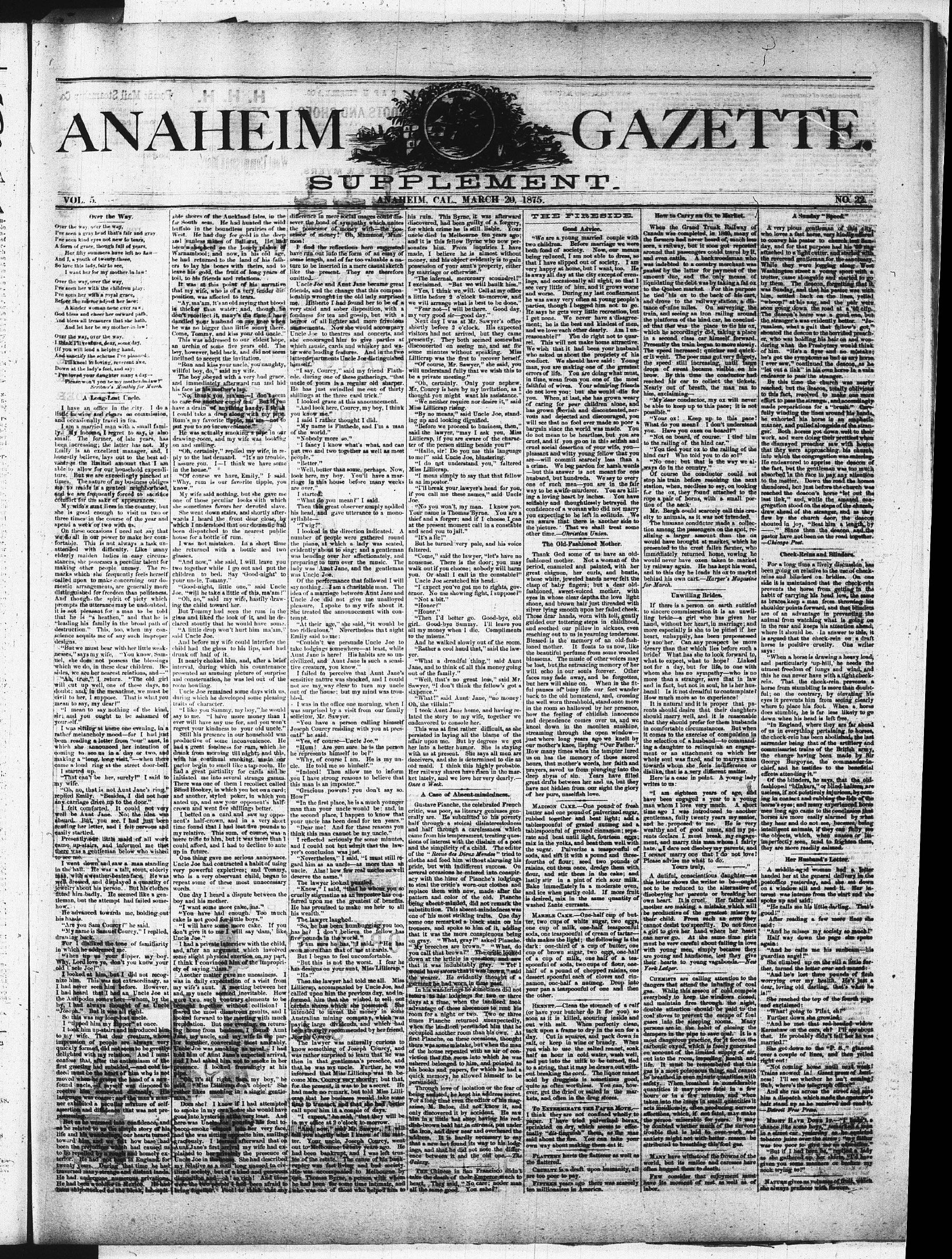
Searchable text
ANAHEIM
VOL. 5.
Over the Way.
Over the way, over the way,
I've seen a gray head that's fair and gray.
I've seen kind eyes not new to tears,
A form of grace, though full of years,
Her fifty summers have left no flaw—
And I, a youth of twenty-three,
So love this lady, fair to see,
I want her for my mother-in-law!
Over the way, over the way,
I've seen her with the children play;
I've seen her with a royal grace,
Before the mirror adjust her lace:
A kinder woman none ever saw;
God bless and cheer her outward path,
And bless all treasures that she hath,
And let her be my mother-in-law!
Over the way, over the way,
I think I'll venture, dear, some day,
(If you will lend a helping hand,
And sanctify the scheme I've planned),
I'll kneel in loving, reverent awe,
Down at the lady's feet, and say:
"I've loved your daughter many a day—
Please won't you be my mother-in-law?"
Scribner's Monthly for March.
A Long-Last Uncle.
I have an office in the city. I do a little in wine and cigars on commission,
and occasionally travel in tea.
I am a married man with a small family.
My income, I regret to say, is also small. The former, of late years, has been increasing; the latter has not. My Emily is an excellent manager, and, I honestly believe, lays out to the best advantage the limited amount that I am able to allow for our household expenditure.
able shores of the Auckland Isles, in the far South seas. He had hunted the wild buffalo in the boundless prairies of the West. He had dug for gold in the deep and sunless mines of Ballarat. He had been a shepherd on the lonely plains of Warnambool; and now, in his old age, he had returned to the land of his fathers to lay his bones with theirs, and to leave his gold, the fruit of long years of toil, to his friends and relations.
It was at this point of his narrative that my wife, who is of a very tender disposition, was affected to tears.
"Ay, ma'am. It's an old saying that blood is thicker than water; and, though he don't recollect it, many'a the time I have danced your husband on my knee when he was no bigger than little sonny there. Come, Tommy, and kiss your old uncle."
This was addressed to our eldest hope, an urchin of some five years old. The boy, however, held back, and did not seem inclined to accept the invitation.
"Run and kiss your uncle, you naughty, willful boy, do," said my wife.
The boy obeyed with a very bad grace, and immediately afterward ran and hid his face in his mother's lap.
"No, thank you, ma'am—I don't seem to care for another cup of tea. But if you have a drain of anything handy, I think I could take a drop along with my pipe. Rum's my favorite tipple, ma'am—not to put you to no inconvenience."
He was actually smoking a pipe in our drawing-room, and my wife was looking on and smiling.
"Oh, certainly," replied my wife, in reply to the last demand. "It's no trouble. I assure you. I—I think we have some difference in mere social severance the bond of sympathy the possessor of money! Oh, mon!
I find the reflection have run out into the forest some length, and of far nature to be inserted in a rock like the present. The omitted.
Uncle Joe and Aunt J friends, and the change in lionship wrought in the same time. Hitherto I had four very staid and sober fondness for tea and good horror of all lighter and amusements. Now she Uncle Joe to theatres as she encouraged him to which music, cards and ter were leading feature-latter departments Uncle himself.
"I say, Courcy," said edile, during one of these uncle of yours is a regal He has just swindled shillings at the three cafts I looked grave at this "And look here, Courcy you know me."
I said I rather thought "My name is Flathed of the world."
"Nobody more so." "I fancy I know what put two and two together people." "Better."
Well better than som
"I have an office in the country. I do a little in wine and cigars on commission, and occasionally travel in tea.
I am a married man with a small family. My income, I regret to say, is also small. The former, of late years, has been increasing; the latter has not. My Emily is an excellent manager, and, I honestly believe, lays out to the best advantage the limited amount that I am able to allow for our household expenditure. But we are exceedingly pinched at times. The nature of my business obliges me to reside in a genteel neighborhood, and we are frequently forced to sacrifice comfort for the sake of appearances.
My wife's nunt lives in the country, but she is good enough to visit us two or three times in the course of the year and spend a week or two with us.
On these occasions I need not say that we do all in our power to make her comfortable. This is not always a task unattended with difficulty. Like many elderly maiden ladies in easy circumstances, she possesses a peculiar talent for making other people uneasy. The remarks which she frequently feels herself called upon to make concerning our domestic arrangements, are generally more distinguished for freedom than politeness. And though the spirit of piety which prompts the utterance may be undoubted, it is not pleasant for a man to be told that he is "a heathen," and that he is "leading his family in the broad path of destruction." This, too, when my conscience acquits me of any such improper designs.
"But we must bear with her little weaknesses," says my wife, "You know, Samuel, she does not possess the blessings which we do, in these dear children. Besides, we are her nearest relations, and—"
"Ah, trun," I return. "The old girl will cut up well, one of these days, no doubt; and, in the meantime, we must be civil to her, I suppose. That is what you mean to say, my dear?"
"I mean to say nothing of the kind, sir; and you ought to be ashamed of your self."
I was sitting at home one evening, in a rather melancholy mood—for I had just been reading a letter from "our" aunt, in which she announced her intention of coming to see us in a day or two, and making a "long, long visit"—when there came a loud ring at the street door-bell.
I started up.
"That can't be her, surely?" I said to my wife.
"Oh, no, that is not Aunt Jane's ring," replied Emily. "Besides, I did not hear any carriage drive up to the door."
I felt comforted. It could not very well be Aunt Jane. No; the idea was aboard. But, you see, I had just been reading her letter, and I felt nervous and easily startled.
Presently our little maid of all work came up-stairs, and informed me that there was a gentleman below who wished to see me.
I went down and saw a man standing in the hall. He was a tall, stout, elderly man, with a weather-beaten face. He was well dressed, and displayed a quantity of jewelry about his person. But his clothes
The boy obeyed with a very bad grace, and immediately afterward ran and hid his face in his mother's lap.
"No, thank you, ma'am—I don't seem to case for another cup of tea. But if you have a drain of anything handy, I think I could take a drop along with my pipe. Rum's my favorite tipple, ma'am—not to put you to no inconvenience."
He was actually smoking a pipe in our drawing-room, and my wife was looking on and smiling.
"Oh, certainly," replied my wife, in reply to the last demand. "It's no trouble. I assure you. I—I think we have some in the house."
"Of course we have, Emily," I said. "Why, rum is our favorite tipple, you know."
My wife said nothing, but she gave me one of those peculiar looks with which she sometimes favors her devoted slave.
She went down stairs, and shortly afterwards I heard the front door close, by which I understood that our domestic had been dispatched to the nearest public house for a bottle of rum.
I was not mistaken. In a short time she returned with a bottle and two glasses.
"And now," she said, I will leave you two together while I go out and put the children to bed. Say 'Good-night' to your uncle, Tommy."
"Good-night, little one," said Uncle Joe, "will he take a little of this, ma'am?"
"Oh, no," said my wife, hastily drawing the child toward her.
But Tommy had seen the rum in the glass and liked the look of it, and he declared stoutly that he would have some.
"A little drop won't hurt him ma'am," said Uncle Joe.
And before my wife could interfere the child had the glass to his lips, and had drunk off half of it.
It nearly choked him, and after a brief interval, during which his countenance presented an amusing picture of surprise and consternation, he was led out of the room howling.
Uncle Joe remained some days with us during which he developed some pleasing traits of character.
"I like you Sammy, my boy," he would say to me. "I have more money than I ever will have any use for, and you won't regret your kindness to your old uncle."
Still his presence in our household was productive of some inconvenience. He had a great fondness for rum, which he drank from morning till night; and this, with his continual smoking, made our parlor begin to smell like a tap-room. He had a great partiality for cards and he initiated me into several strange games. There was one of them I recollect called Blind Hookey, in which you bet on a card; and another, styled poker, in which you anted up, and saw your opponent's half-crown and went five shillings better.
I betted on a card and saw my opponent's half-crown, and in a very short time found that I had lost five pounds to my relative. This sum, of course, was a mere trifle to him, but it was more than I could afford, and I had to decline to ante up in future.
One thing gave me serious annoyance. Uncle Joe had contracted a habit of using very powerful expletives; and Tommy, who is a very observant child, began to repeat some of these most unnecessary words.
"I say, Courcy," said ede. during one of these uncle of yours is a regal He has just swindled his shillings at the three earl.
I looked grave at this.
"And look here, Courcy you know me."
I said I rather thought "My name is Flathed of the world."
"Nobody more so."
"I fancy I know what put two and two together people."
"Better."
Well, better than some look here, my boy. Yriage in this house be are over."
I started.
What do you mean?
Then this great observer his head, and gave utter syllable—
"Twig!"
I looked in the direct number of people were the piano at which a evidently about to sing was bending over her preparing to turn over lady was Aunt Jane, and was Uncle Joe.
Of the performance they say nothing. I am a charade of a marrige between Uncle Joe did not give pleasure. I spoke to me She treated the announcement tempt.
At their age," she said too ridiculous." Never Emily said to me:
"Couldn't we persuase take lodgings somewhere Aunt Jane is here? His civilized, and Aunt Jane creature, you know I failed to perceive a sensitive nature was shown not see my way clear to out of the house; but mired.
I was in the office once was surprised by a visitor solicitor. Mr. Sawyer.
"You have a person Joseph Courcy residing ent!" he said.
"Yes, of course—Uncle Hum! Are you sure he represents himself to Why; of course I am alce. He told me so hin Indeed! Then allow you I have strong reason this man is an impostor." Gracious powers! How?
In the first place, he man than your uncle wihe second place, he hap your uncle has been deser Dear me! And for think this man cannot B reflected seriously iand I could not but sad year's conclusion was jus nevertheless," I said gard him as an uncle—uncle. Alas! how few deserve the name."
The lawyer looked poised "Know." I said "thus."
I felt comforted. It could not very well be Aunt Jane. No; the idea was absurd. But, you see, I had just been reading her letter, and I felt nervous and easily startled.
Presently our little maid of all work came up-stairs, and informed me that there was a gentleman below who wished to see me.
I went down and saw a man standing in the hall. He was a tall, stout, elderly man, with a weather-beaten face. He was well dressed, and displayed a quantity of jewelry about his person. But his clothes fitted him badly. He seemed like a gentleman, but the attempt had failed somehow.
He advanced towards me, holding out his hands.
"Are you Sam Courcy?" he said.
"My name is Samuel Courcy," I replied, drawing back.
For I disliked the tone of familiarity in which he addressed me.
"Then tip us your flipper, my boy. Why, Lord love ye, don't you know your old Uncle Joe?"
I looked at him, but I did not recognize him. This was not extraordinary, as I had never seen him before. However, I had heard that I had an Uncle Joe at the Antipodes somewhere—whom, by the by, I had always thought of as Uncle "Joseph." But it was all right.
So this was my long-lost uncle.
"I tipped him my flipper" at once.
I took him up-stairs and introduced him to my wife. That dear creature, whose impression of people are always very quickly formed, did not seem to be greatly delighted with my relation. And I must confess that, after the enthusiasm of the first greeting had subsided—and cold indeed must be the heart of him who is not moved when he grasps the hand of a new-found uncle—I myself was disposed to receive him somewhat distantly. His language was courteous; and the man's manner exhibited a peculiar mixture of self-assertion and diffidence that was not prepossessing.
But as he warmed into confidence, and as he related to us the simple story of his life and his wisdom, our hearts turned toward him, and we but how base had been the prejudices which had caused us to be repelled by a rough and homely exterior. He had not been in England for twenty years. During that time he had traversed many strange and distant lands. He had undergone numerous privations. He had been soldier in Mexico. He had been shipboarded on the bleak; inhospitable rooftop, in which you bet on a card; and another, styled poker, in which you anted up, and saw your opponent's half-crown and went five shillings better.
I betted on a card and saw my opponent's half-crown, and in a very short time found that I had lost five pounds to my relative. This sum, of course, was a mere trifle to him, but it was more than I could afford, and I had to decline to ante up in future.
One thing gave me serious annoyance. Uncle Joe had contracted a habit of using very powerful expletives; and Tommy, who is a very observant child, began to repeat some of these most unnecessary words.
One day I heard a dispute between the boy and his mother.
"I want some more cake, ma."
"You have had enough. Too much cake is not good for little boys."
"I will have some more cake. If you don't give it to me I will say 'dam,' like Uncle Joe."
I had a private interview with the child, and after an argument which involved some slight physical exertion on my part, I think I convinced him of the impropriety of saying "dam."
Another matter gave me uneasiness. I was in daily expedition of a visit from my wife's aunt. A meeting between her and my uncle seemed inevitable. How worry two such contrary elements to be brought together without collision? I feared the most disastrous results, and I looked forward to the meeting with much trepidation. But one evening, on returning home from business, I found Aunt Jane, my uncle, and my wife in the parlor together, conversing most amicably. Uncle Joe was smoking as usual. I had told him of Aunt Jane's expected arrival, and I had asked him not to smoke in her presence. I looked frighteningly at his pipe.
"Oh it's all right, Sam, my boy," he said.
"Miss Lilliecap don't object. She rather likes smoking in a single gentleman."
Does she? I know if I had attempted to smoke in my own house she would have gone into hysteria at the very least. And here was Uncle Joe pouring his foul tobacco-smoke into her very face, and she was sitting opposite him, smiling graciously. I learned afterward that on Aunt Jane's first arrival my wife had explained to her privately the presence of Uncle Joe in the room. She had described my relative as a man long unused to civilized society, but of a kind and generous disposition—and oh! so rich! And those were the two people I had been afraid to bring together." Fool! to think that any
"Gracious powers: y'r How?"
"In the first place, he man than your uncle w the second place, I happy your uncle has been dear
Dear me! And for think this man cannot b
I reflected seriously b
and I could not but sad yer's conclusion was just
Nevertheless," I said
gard him as an uncle—uncle. Alas! how few deserve the name."
The lawyer looked put.
"Know," I said,
"that cruelly stigmatize as an ferred upon me the great He has promised to make his wealth."
The lawyer laughed.
"So, he has been humilhas he? I don't believe five pounds in the world
I am sure he has," won more than that of
But I began to feel unBut this is not the has designs on your sum!
Ha!"
Then the lawyer had Lilliecap accompanied called upon him the pro-formed him that she w certain shares which she intended to invest ther Australian mining company paying large dividends been strongly recommend Joseph Courcy.
The lawyer was nat know something of Joa was rather surprised to then in that gentlama that he was my uncle informed that Miss Lillie come Mrs Courcy very for the present; it was had made no remark; but can that has business time to transact; and ther call upon him in a comp
"I expect," he said,
in my office at 2 o'clock and now," said Miss Jouse out to Melbourne town had been bankrupt,and kee of the estate.The ruptoy was fast living He was accompanied quo Thomas Byrne,a phe he had been for some who was one of those
IM GAZ
SUPPLEMENT.
ANAHEIM, CAL., MARCH 20, 1875.
difference in mere social usages could dissever the bond of sympathy which unites the possessor of money with—the possessor of money! Oh, Mammon, Mammon!
I find the reflections here suggested have run out into the form of an essay of some length, and of far too valuable a nature to be inserted in a mere casual sketch like the present. They are therefore omitted.
Uncle Joe and Aunt Jane became great friends, and the change that this companionship wrought in the old lady surprised me. Hitherto I had found her to be of a very staid and sober disposition, with a fondness for tea and gossip, but with a horror of all lighter and more frivolous amusements. Now she would accompany Uncle Joe to theatres and concerts, and she encouraged him to give parties at which music, cards and whiskey and water were leading features. And in the two latter departments Uncle Joe distinguished himself."
"I say, Courcy," said my friend Flathede, during one of these gatherings, "that uncle of yours is a regular old sharper. He has just swindled me out of thirty shillings at the three card trick."
I looked grave at this announcement.
"And look here, Courcy, my boy, I think you know me."
I said I rather thought I did.
"My name is Flathede, and I'm a man of the world."
"Nobody more so."
"I fancy I know what's what, and can put two and two together as well as most people."
"Better."
his ruin. This Byrne, it was afterward discovered, had been guilty of a forgery, for which crime he is still liable. Your uncle died in Melbourne ten years ago; and it is this fellow Byrne who now personates him. From inquiries I have made, I believe he is almost without money, and his object evidently is to gain possession of your aunt's property, either by marriage or otherwise."
"The infernal mercenary scoundrel!" I exclaimed. "But we will baulk him."
"Yes, I think we will. Call at my office a little before 2 o'clock to-morrow, and we will arrange what is best to be done." "Fear not—I will bethere. Good day, my very good sir—good day."
Next day I was at Mr. Sawyer's office shortly before 2 o'clock. His expected visitors had not arrived, but they came presently. They both seemed somewhat disconcerted on seeing me, and sat for some minutes without speaking. Miss Lillicrap was the first to recover herself.
"Of course, Mr. Sawyer," she said, you will understand fully that we wish this to be a private meeting."
"Oh, certainly. Only your nephew. Mr. Courcy is here by my invitation, as I thought you might want his assistance." "We neither require nor desire it," said Miss Lillicrap rising.
"By no means," said Uncle Joe, standing up and looking dignified.
"Before we proceed to business, then," said the lawyer, "may I ask you, Miss Lillicrap, if you are aware of the character of the person sitting beside you?"
"Hallo, sir! Do you use this language to me?" said Uncle Joe, blustering.
"I do not understand you," faltered Miss Lillicrap.
THE FIRESIDE.
Good Advice.
"We are a young married couple with two children. Before marriage we were both fond of society. Now, our means being reduced, I am not able to dress, so that I have slipped out of society. I am very happy at home, but I want, too. He is away all day at the city except of evenings, and occasionally all night, so that I see very little of him, and it grows worse and worse. During my last confinement he was away very often at young people's parties, though I begged him not to go. He says he gets very little recreation, but I get none. We never have a disagreement; he is the best and kindest of men, and we love each other dearly. Am I unreasonable?" You do right not to quarrel. This will not make home attractive. We wish that it had been your husband who asked us about the propriety of his conduct. We should have said: Young man, you are making one of the greatest errors of life. You are doing what must, in time, wean from you one of the most faithful of wives. Your admiring friends do not love you; but she would die for you. When, at last, she has grown weary of caring for your children alone, and has grown peevish and discontented, nervous and dejected and discouraged, you will see that no fool ever made so poor a bargain since the world was made. You do not mean to be heartless, but you are cruel, and if you go on in this selfish and cruel social desertion of your wife, you—pleasant and witty young fellow that you are—will commit scarcely less than a crime. We beg pardon for harsh words.
How to
When the Canada was the farmer seen, a rail around that and even capped pushed by amount due liquidating to the Quebec he tied "hit and drove tance of mi train, and the platform ed that tha in a second Presently The speed er it went.
My dear be able to possible."
Your o What do yo you. Have
Not on to the railil
You the hind car?
No one ways do in
"I say, Courcy," said my friend Flathede, during one of these gatherings, "that uncle of yours is a regular old sharper. He has just swindled me out of thirty shillings at the three card trick."
I looked grave at this announcement.
"And look here, Courcy, my boy, I think you know me."
I said I rather thought I did.
"My name is Flathede, and I'm a man of the world."
"Nobody more so."
"I fancy I know what's what, and can put two and two together as well as most people."
"Better."
"Well, better than some, perhaps. Now, look here, my boy. You'll have a marriage in this house before many weeks are over."
I started.
"What do you mean?" I said.
Then this great observer simply nodded his head, and gave utterance to a monosyllable—
"Twig!"
I looked in the direction indicated. A number of people were gathered round the piano, at which a lady was seated, evidently about to sing; and a gentleman was bending over her affectionately, and preparing to turn over the music. The lady was Aunt Jane, and the gentleman was Uncle Joe.
Of the performance that followed I will say nothing. I am a charitable man. The idea of a marriage between Aunt Jane and Uncle Joe did not give me unalloyed pleasure. I spoke to my wife about it. She treated the announcement with contempt.
"At their age," she said, "it would be too ridiculous." Nevertheless that night Emily said to me:
"Couldn't we persuade Uncle Joe to take lodgings somewhere—at least, while Aunt Jane is here? His habits are so uncivilized, and Aunt Jane is such a sensitive creature, you know."
I failed to perceive that Aunt Jane's sensitive nature was shocked, and I could not see my way clear to turn my uncle out of the house; but my mind was troubled.
I was in the office one morning, when I was surprised by a visit from our family solicitor, Mr. Sawyer.
"You have a person calling himself Joseph Courcy residing with you at present!" he said.
"Yes, of course—Uncle Joe."
"Hum! Are you sure he is the person he represents himself to be?"
"Why, of course I am. He is my uncle. He told me so himself."
"Indeed! Then allow me to inform you I have strong reasons to believe that this man is an impostor."
"Gracious powers! you don't say so. How?"
"In the first place, he is a much younger man than your uncle would be; and, in the second place, I happen to know that your uncle has been dead for ten years."
Dear me! And for these reasons you think this man cannot be my uncle.
I reflected seriously for some minutes, and I could not but admit that the lawyer's conclusion was just.
Nevertheless," I said, "I must still regard him as an uncle—as more than an uncle. Alas! how few real uncles so well deserve the name."
The lawyer looked puzzled.
Know." I said, "that he whom you so will understand fully that we wish this to be a private meeting."
"Oh, certainly. Only your nephew. Mr. Courcy is here by my invitation, as I thought you might want his assistance."
"We neither require nor desire it," said Miss Lillicrap rising.
"By no means," said Uncle Joe, standing up and looking dignified.
"Before we proceed to business, then," said the lawyer, "may I ask you, Miss Lillicrap, if you are aware of the character of the person sitting beside you?"
"Hallo, sir! Do you use this language to me?" said Uncle Joe, blustering.
"I do not understand you," faltered Miss Lillicrap.
"I mean simply to say that fellow is an impostor."
"I'll break your lawyer's head for you, if you call me these names," said Uncle Joe.
"No you won't, my man. I know you. Your name is Thomas Byrne. You are a thief and a forger; and if I choose I can at the present moment call in a constable and send you to jail."
"It's a lie!"
But he turned very pale, and his voice faltered.
"Come," said the lawyer, "let's have no nonsense. There is the door; you may walk out if you choose; nobody will harm you. Or shall I call in the constable?"
Uncle Joe scratched his head.
"I expect you've got me to rights, governor. No use showing fight, I suppose?"
"Not a bit."
Honor?
Honor."
Then I'd better go. Good-bye, old girl. Good-bye Sammy. I'll leave you all my money when I die. Compliments to the missus."
And he walked slowly out of the room.
Rather a cool hand that," said the lawyer.
“What a dreadful thing,” said Aunt Jane, and to think of all this money going out of the family."
Well, that's no great loss," said Mr. Sawyer, "I don't think the fellow's got sixpence."
“What!” said Aunt Jane, "no money! Oh, the villain!
I took Aunt Jane home, and having related the story to my wife, together we endeavored to console her.
This was at first rather difficult, as she persisted in laying all the blame of the affair upon me. But by degrees we got her into a better humor. She is staying with us at present. She says all men are deceivers, and she is determined to die an old maid. I think this highly probable. Her railway shares have risen in the market lately, and we love her very dearly—Once a Week.
A Case of Absent-mindedness
Gustave Pianche, the celebrated French critic, was poor, as literary geniuses generally are. He submitted to his poverty half through a stoical disinterestedness and half through a carelessness which came from his temperament, treating questions of interest with the disdain of a poet and the simplicity of a child. The editor of the "Revue des Dieux Mendes" tried to clothe and feed him without alarming his pride, but with indifferent success. On several occasions he entered into conspiracy with the hireer of Planche's lodgings to steal the critic's worn-out clothes and errors of life. You are doing what must in time, wean from you one of the most faithful of wives. Your admiring friends do not love you; but she would die for you. When at last, she has grown weary of caring for your children alone, and has grown peevish and discontented, nervous and dejected and discouraged, you will see that no fool ever made so poor a bargain since the world was made. You do not mean to be heartless, but you are cruel, and if you go on in this civil and cruel social desertion of your wife, you—pleasant and witty young fellow that you are—will commit scarcely less than a crime. We beg pardon for harsh words—but this answer is not meant for one husband, but hundreds. We say to every one of such men—you are in the fair way to be a wife-murderer. You are killing a loving heart by inches. You have selfishly and thoughtlessly betrayed the confidence of a woman who did not marry you expecting to be left in solitude. We are aware that there is another side to the picture. That we shall treat some other time.
Christian Union.
The Old-Fashioned Mother.
Thank God some of us have an old-fashioned mother. Not a woman of the period, enameled and painted, with her great chignon, her curls, and bustle whose white, jeweled hands never felt the clasp of baby fingers; but a dear old-fashioned, sweet-voiced mother, with eyes in whose clear depths the love light shone, and brown hair just threaded with silver lying smooth upon her faded cheek. Those dear hands, worn with toll, gently guided our totering steps in childhood, and soothed our pillow in sicknese even reaching out to us in yearning tenderness. Blessed is the memory of an old-fashioned mother. It floats to us now like beautiful perfume from some wooded blossoms. The music of other voices may be lost, but the entrancing memory of her will echo in our souls forever. Other faces may fade away, and be forgotten, but hers will shine on. When in the fitful pauses of busy life our feet wander back to the old homestead, and crossing the well worn threshold, stand once more in the room so hallowed by her presence, how the feeling of childish innocence and dependence comes over us, and we kneel down in the moulten sunshine, streaming through the open window—just where long years ago we knelt by our mother's knee, lisping "Our Father." How many times when the tempter lured us on has the memory of those sacred hours, that mother's words, her faith and prayers, saved us from plunging into the deep abyss of sin. Years have filled great drifts between her and us, but they have not hidden from our sight the glory of her pure, unselfish love.
Madison Cake—One pound of fresh butter and one pound of pulverized sugar, rubbed together and beat light; add a tablespoonful of grated nutmeg and a tablespoonful of ground cinnamon; separate and beat until light; fourteen eggs; mix in the yolks; and heat them well with the sugar. Pulverize a teaspoonful of soda, and sift it with a pound and three-fourths of flour; seed two pounds of raisins; cut them once; dredge them with flour; and stir them in the cake; and lastly stir in a pint of rich sour milk. Bake immediately in a moderate oven.
If there is sincere citing a ling bridge hand with more espoused heart, unlike by any other dreary thrush bride? What not for for a whom she more than in fact band! Is How much It is naught rents should should that they sit in comfort it comes to the selective ingagement or as whole soul towards dialysis. Here is it writes to me.
"I am have been been man whom time ago gentleman,and he paid wealthy rentals declamation,and hate.I do not m Please adv
"Gracious powers! you don't say so. How?"
"In the first place, he is a much younger man than your uncle would be; and, in the second place, I happen to know that your uncle has been dead for ten years."
"Dear me! And for these reasons you think this man cannot be my uncle."
I reflected seriously for some minutes, and I could not but admit that the lawyer's conclusion was just.
"Nevertheless," I said, "I must still regard him as an uncle—as more than an uncle. Alas! how few real uncles so well deserve the name."
The lawyer looked puzzled.
"Know," I said, "that he whom you so cruelly stigmatize as an impostor has conferred upon me the greatest of benefits. He has promised to make me heir to all his wealth."
The lawyer laughed.
"So, he has been humbugging you too, has he? I don't believe the fellow has five pounds in the world."
"I am sure he has," I said. "He has won more than that of me at cards."
But I began to feel uncomfortable.
"But this is not the worst. I fear he has designs on your sunt, Miss Lillicrap."
"Ha!"
Then the lawyer had told me all. Miss Lillicrap, accompanied by Uncle Joe, had called upon him the previous day, and informed him that she wished to sell out certain shares which she possessed. She intended to invest the money in some Australian mining company, which was paying large dividends, and which had been strongly recommended by her friend, Joseph Courcy.
The lawyer was naturally curious to know something of Joseph Courcy, and was rather surprised to learn that he was then in that gentleman's presence, and that he was my uncle. Further, he was informed that Miss Lillicrap was to become Mrs. Courcy very shortly; but that, for the present, it was to be a secret. He had made no remark, but told Miss Lillicrap that his business would take some time to transact, and that she had better call upon him in a couple of days.
"I expect," he said, "that they will be in my office at 9 o'clock to morrow."
And now, said Mr. Sawyer, "I will tell you shortly what I know of the matter. Your uncle, Joseph Courcy, went out to Melbourne twenty years ago. He had been bankrupt, and I was left trustee of the estate." The cause of his bankruptcy was fast living and bad society. He was accompanied to Melbourne by one Thomas Byrne, a person with whom he had been for some time intimate, and who was one of those who helped him to
A Case of Absent-mindedness.
Gustave Pianche, the celebrated French critic, was poor, as literary geniuses generally are. He submitted to his poverty half through a stoical disinterestedness and half through a carelessness which came from his temperament, treating questions of interest with the disdain of a poet and the simplicity of a child. The editor of the "Revue des Dieux Mendes" tried to clothe and feed him without alarming his pride, but with indifferent success. On several occasions he entered into conspiracy with the hiker of Planche's lodgings to steal the critic's worn-out clothes and replace them with new, made after the pattern and color of the old. Planche being absent-minded, did not remark the substitution. This absent-mindedness was one of his most striking traits. One day some one remarked a black stain on his trousers, and spoke to him of it, adding that it was the more conspicuous being on gray. "What, gray?" asked Planche. "My breeches are brown." "What do you call that brown?" The critic looked down at the article in question, and said that it was indubitably gray. "Yet I would have sworn that it was brown," said the wearer. He evidently thought of a garment he had worn in time past.
In his wanderings he sometimes did not return to his lodgings for two or three days at a time, when the landlord took advantage of these absences to rent his room for a night or two. Two or three times Planche returned unexpectedly, when the landlord persuaded him that he occupied another room than his own. At first Planche, on these occasions, thought there was some mistake, but when the man of the house repeated with an air of conviction that the room into which he was ushered belonged to him, and pointed to his books and papers, for which he had a quick memory, he allowed himself to be persuaded.
Through love of isolation or the fear of being assisted, he kept his address secret. For a long time even the editor of his magazine, M. Baloz, did not know it, and only discovered it by accident. He saw him in a little hat stop having his red-dish-brown bald hat in extremis put under the iron, and drew near and overheard the address. It is hardly necessary to say that a new hat found its way to his lodgings, and that he did not note the difference between it and the old one—The Galaxy.
The Chinese in San Francisco didn't take the death of their Emperor much to heart. They said: "No care; noder man all the same good. You sahai!"
MADISON CAKE.—One pound of fresh butter and one pound of pulverized sugar, rubbed together and beat light; add a tablespoonful of grated nutmeg and a tablespoonful of ground cinnamon; separate and beat until light, fourteen eggs; mix in the yolks, and beat them well with the sugar. Pulverize a teaspoonful of soda, and sift it with a pound and three-fourths of flour; seed two pounds of raisins, cut them once, dredge them with flour, and stir them in the cake; and lastly stir in a pint of rich sour milk. Bake immediately in a moderate oven, and ice when partly cold. If more fruit is desired, mix in the same quantity of washed Zante currants.
MARBLE CAKE.—One-half cup of butter, two cups of white sugar, two eggs, one cup of milk, one-half teaspoonful soda, one teaspoonful of cream of tartar—this makes the light; the following is the dark: one-third of a cup of butter, one cup of brown sugar, two eggs, one-half of a cup of milk, one half of a tea-spoonful of soda, two cups of flour, one-half of a pound of chopped raisins, one dessert spoonful each of cloves and cinnamon, one-half a nutmeg. Drop into your pan a teapooful of one and then the other.
RENNET.—Clean the stomach of a calf (or have your butcher do it for you) so soon as it is killed, scouring inside and out with salt. When perfectly clean, tack upon a frame to dry in the sun for a day. Cut in squares, and pack down in salt, or keep in wine or brandy. When you wish to use the salted rennet, soak half an hour in cold water, wash well, and put into the milk to be turned; tied to a string; that it may be drawn out without breaking the cord. The liquor rennet sold by druggists is sometimes good; quite as often worthless. You can however get the dried or salted in the markets, and often in the drug stores.
TO EXTREMATE THE PAPER MOTH—I think they are not confined wholly to paper. I have tried pulverized borax, sprinkled on dry, which seems to effectually "dis-tinguish" them; as the man said about the fire. You can take your own way about making them eat it.
FLATTERY harms the flattened as well as the flattered.
CROUZLY is a draft upon humanity; all are too poor to pay.
FIVEEEN years ago there was scarcely ten millionaires in America.
A dutiful letter this letter does not to be disobeying own heart; mother are be productive their children cannot design a girl to go can never be with young are young their heart York Lady.
CHEMIST DANGERS THE gas. Whatever everybody double attests coal stoves gases into persons dampers in most dangerous carbonic acid on account out into life. It may gas is a mole breathe safety. No quantities hours or taken into acts inside affections; the person be doubled trouble this anxiety their attributed many hours world; but often hugger.
Few co have its labor.
GAZETTE.
NO. 22
INSIDE.
How to Carry an Ox to Market.
When the Grand Trunk Railway of Canada was completed, in 1890, many of the farmers had never heard of; much less seen, a railway, but it soon got reported around that passengers could travel by it, and even cattle. A backwoodsman who was indebted to a country merchant was pushed by the latter for payment of the amount due, and the only means of liquidating the debt was by taking a fat ox to the Quebec market. For this purpose he tied his ox to the back of his cart, and drove to the railway station, a distance of nine miles. On surveying the train, and seeing an iron railing around the platform of the hind car, he concluded that that was the place to tie his ox, which he accordingly did, taking a place in a second class car himself forward. Presently the train began to move slowly. The speed increased; quicker and quicker it went. The poor man got very fidgety, the speed still increasing, until large drops of sweat became visible on his brow. By this time the conductor had reached his car to collect the tickets. Nearly out of breath, the man ran to him, exclaiming—
"My dear conductor, my ox will never be able to keep up to this pace; it is not possible."
"Your ox! Keep up to this pace! What do you mean? I don't understand you. Have you oxen on board?"
"Not on board, of course. I tied him to the railing of the hind car."
"You tied your ox to the railing of the hind car? Who told you to do so!"
"No one; but that is the way we always do in the country."
A Sunday "Speed."
A very pious gentleman of this city, who loves a fast horse, very kindly offered to convey his pastor to church last Sunday, and for that purpose had his dog attached to a light cutter, and started with the reverend gentleman for the sanctuary. While they were jogging along West Washington street a young sport with a trotter, came alongside and started to go by them. The deacon, forgetting that it was Sunday, and that his pastor was with him, settled back on the lime, yelled "whoop!" at his nag, and the pair were soon going down the road at a 60 clip. The deacon's horse was a good one, but the stranger's was evidently better. Jerusalem, what a gait that fellow's got," shouted the deacon to the horrified preacher, who was holding his hair on and wondering what the Presbytery would think of him. "He's a flyer and no mistake; he's got the symptoms as bad as any horse I ever saw," continued the deacon, as he "let out a link" in his own horse in a vain endeavor to pass the stranger.
By this time the church was nearly reached, but the deacon, totally oblivious to this fact, resolved to make one more effort to pass the stranger, and accordingly made preparations for a "brush." Carefully winding the lines around his hands, he exhorted his horse in an emphatic manner, and pulled alongside of the stranger. Both horses got down well to their work, and were doing their prettiest when the dismayed preacher saw with horror that they were approaching; his church, into which the congregation was entering. He endeavored to apprise the deacon of the fact, but the gentleman was too much
Mother.
has have an old-woman of the painted, with her hips, and bustle, never felt the touch of a dear old-mother, with the love light threaded with other faded cheek. With toil, gently in childhood, sickness, even tending tenderness. Of an old-fashioned us now, like some wooded other voices may be memory of her forever. Other be forgotten. When in the fit-tour feet wander, and crossing stand once more by her presence, English innocence over us, and we halten sunshine, open window—go we knelt by "Our Father." The tempter lured of those sacred hearts, her faith and anguaging into the years have filled us, but they sight the glory.
compound of fresh sulverized sugar, that light; add a nutmeg and a cinnamon; separate fourteen eggs; them well with teaspoonful of ground and three-two pounds ofodge them with the cake; and rich sour milk-moderate oven,
compound of fresh sulverized sugar, that light; add a nutmeg and a cinnamon; separate fourteen eggs; them well with teaspoonful of ground and three-two pounds ofodge them with the cake; and rich sour milk-moderate oven,
compound of fresh sulverized sugar, that light; add a nutmeg and a cinnamon; separate fourteen eggs; them well with teaspoonful of ground and three-two pounds ofodge them with the cake; and rich sour milk-moderate oven,
compound of fresh sulverized sugar, that light; add a nutmeg and a cinnamon; separate fourteen eggs; them well with teaspoonful of ground and three-two pounds ofodge them with the cake; and rich sour milk-moderate oven,
compound of fresh sulverized sugar, that light; add a nutmeg and a cinnamon; separate fourteen eggs; them well with teaspoonful of ground and three-two pounds ofodge them with the cake; and rich sour milk-moderate oven,
compound of fresh sulverized sugar, that light; add a nutmeg and a cinnamon; separate fourteen eggs; them well with teaspoonful of ground and three-two pounds ofodge them with the cake; and rich sour milk-moderate oven,
compound of fresh sulverized sugar, that light; add a nutmeg and a cinnamon; separate fourteen eggs; them well with teaspoonful of ground and three-two pounds ofodge them with the cake; and rich sour milk-moderate oven,
compound of fresh sulverized sugar, that light; add a nutmeg and a cinnamon; separate fourteen eggs; them well with teaspoonful of ground and three-two pounds ofodge them with the cake; and rich sour milk-moderate oven,
compound of fresh sulverized sugar, that light; add a nutmeg and a cinnamon; separate fourteen eggs; them well with teaspoonful of ground and three-two pounds ofodge them with the cake; and rich sour milk-moderate oven,
compound of fresh sulverized sugar, that light; add a nutmeg and a cinnamon; separate fourteen eggs; them well with teaspoonful of ground and three-two pounds ofodge them with the cake; and rich sour milk-moderate oven,
compound of fresh sulverized sugar, that light; add a nutmeg and a cinnamon; separate fourteen eggs; them well with teaspoonful of ground and three-two pounds ofodge them with the cake; and rich sour milk-moderate oven,
compound of fresh sulverized sugar, that light; add a nutmeg and a cinnamon; separate fourteen eggs; them well with teaspoonful of ground and three-two pounds ofodge them with the cake; and rich sour milk-moderate oven,
compound of fresh sulverized sugar, that light; add a nutmeg and a cinnamon; separate fourteen eggs; them well with teaspoonful of ground and three-two pounds ofodge them with the cake; and rich sour milk-moderate oven,
compound of fresh sulverized sugar, that light; add a nutmeg and a cinnamon; separate fourteen eggs; them well with teaspoonful of ground and three-two pounds ofodge them with the cake; and rich sour milk-moderate oven,
compound of fresh sulverized sugar, that light; add a nutmeg and a cinnamon; separate fourteen eggs; them well with teaspoonful of ground and three-two pounds ofodge them with the cake; and rich sour milk-moderate oven,
compound of fresh sulverized sugar, that light; add a nutmeg and a cinnamon; separate fourteen eggs; them well with teaspoonful of ground and three-two pounds ofodge them with the cake; and rich sour milk-moderate oven,
compound of fresh sulverized sugar, that light; add a nutmeg and a cinnamon; separate fourteen eggs; then told you to do so!
Your ox! Keep up to this pace! What do you mean? I don't understand you. Have you oxen on board?
Not on board, of course. I tied him to the railing of the hind car? Who told you to do so?
No one; but that is the way we always do in the country.
Of course the conductor could not stop his train before reaching the next station, when, needless to say, on looking for the ox, they found attached to the rope a pair of horns, with a small portion of the neck.
Mr. Bergh could scarcely call this cruelty to animals, as it was not intended.
The humane conductor made a collection among the passengers on the spot, realizing a larger amount than the ox would have brought at market, which he presented to the crest fallen farmer, who immediately returned home, vowing he would never have oxen taken to market by railway again. He has kept his word, and to this day he leads his ox to market behind his own cart.—Harper's Magazine for March.
Unwilling Brides.
If there is a person on earth entitled to sincere commiseration it is an unwilling bride—a girl who has given her hand, without her heart, in marriage; and more especially is she to be pitied if her heart, unhappily, has been prepossessed by an 'hor' Can any prospect be more dreary than that which lies before such a bride? What has she to look forward to, what to expect, what to hope? Linked not for a day, but for life, to one with whom she has no sympathy—who is no more than a stranger, save that in law and in fact, but not in soul, he is her husband! Is it not dreadful to contemplate? How much more so to experience!
It is natural and it is proper that parents should desire that their daughters should marry well, and it is reasonable that they should prefer for them husbands in comfortable circumstances. But when it comes to the exercise of compulsion in the selection of a husband—to commanding a daughter to relinquish an engagement or an attachment on which her whole soul was fixed, and to marry a man towards whom she feels indifference or dislike, that is a very different matter.
Here is a case in point. A young lady writes to us:
"I am eighteen years of age, and have been engaged a year to a young man whom I love very much. A short time ago I was introduced to another gentleman, fully twenty years my senior, and he proposed to me. He is very wealthy and of good name, and my parents declare I must break my engagement, and marry this man whom I fairly hate. I dare not disobey my parents, and I cannot marry one that I do not love! Please advise me what to do.
Yours truly,"
A dutiful, conscientious daughter—as this letter shows the writer to be—noted not to be reduced to the alternative of
By this time the church was nearly reached, but the deacon, totally oblivious to this fact, resolved to make one more effort to pass the stranger, and accordingly made preparations for a "brush."
Carefully winding the lines around his hands, he exhorted his horse in an emphatic manner, and pulled alongside of the stranger. Both horses got down well to their work, and were doing their pretended when the dismayed preacher saw with horror that they were approaching his church into which the congregation was entering. He endeavored to apprise the deacon of the fact, but the gentleman was too much absorbed In the face to pay any attention to the matter. Down the road the homes thundered, but just before the church was reached the deacon's horse "let out the last link," and while the amazed congregation stood on the steps of the chench, draw ahead of the stranger, and as they flew by the church door, the deacon shouted in joy, "Beat him a length," by — Since then the deacon and the pastor have not been on the road together.
Chuck-Reins and Blinders.
For a long time a lively discussion has been going on relative to the use of check-reins and blinders on bridles. On one side it is maintained that the check-rein prevents the horse from getting in the habit of carrying his head low, the same as braces keep a man from throwing his shoulder points forward, and that blinders are of an advantage in preventing the animal from watching what is going on in the rear and keeps his attention ahead where it should be. In answer to this it is argued that the check-rein on a draft horse is positive cruelty. One writer says:
"When a horse is drawing a heavy load, and particularly 'up-hill,' he needs the utmost freedom of lungs and wind, and this he can never have with a tight check-rein. That the check-rein prevents a horse from stumbling is more than doubtful; on the contrary, by elevating his eyes it prevents him from seeing clearly where to place his foot. When a horse does stumble, he is far less likely to go down when his head is left free.
In England, where they are far ahead of us in everything pertaining to horses, the check-rein has been abolished, the last surrender being that of the artistry and commissariat trains of the British army, the change having been made by Sir George Burgoyne, the commander-in-chief, and he testifies to the beneficial effects attending it."
Of the blinders, he says, that the old-fashioned "blinkers," or blind-hearts are useless if not politively injurious by coming in contact and rubbing the lids of the horse's eyes; and many experienced horses men long ago came to the conclusion that horses are more easily alarmed by what they hear and do not see, because being intelligent animals if they can fully see the objects which, when unseen or im imperfectly seen, tend to frighten them they are more readily calmed.
Her Husband's Letter.
A middle-aged woman had a letter handed her at the general delivery in the postoffice yesterday,and she as down on a window sill read it.Harla
"I am eighteen years of age, and have been engaged a year to a young man whom I love very much. A short time ago I was introduced to another gentleman, fully twenty years my senior, and he proposed to me. He is very wealthy and of good name, and my parents declare I must break my engagement, and marry this man whom I fairly hate. I dare not disobey my parents, and I cannot marry one that I do not love! Please advise me what to do.
Yours truly,
A dutiful, conscientious daughter—as this letter shows the writer to be—ought not to be reduced to the alternative of disobeying her parents or breaking her own heart. It is cruel. Her father and mother are making a mistake which will be productive of the greatest misery to their child. From such an error they cannot destist too speedily. Do not force a girl to give her hand where her heart can never go. At the same time girls must be very careful about falling in love with young men, simply because they are young and handsome, lost they give their hearts to young vagabonds.—New York Ledger.
Chemists are calling attention to the dangers that attend the inhalation of coal gas. While this season of cold compels everybody to keep the windows closed, and maintain fires through the night, double attention should be paid to the coal stoves to prevent the escape of foul gases into the sleeping rooms. Many persons are in the habit of closing the dampers in the pipe to save coal. It is a most dangerous practice, for it forces the carbonic oxyed, which is freely generated on account of the limited supply of air, out into the room, impaling health and life. It must be remembered that this gas is a most poisonous thing, and cannot be breathed in even minute quantities with safety. When breathed in considerable quantities it may prove fatal in a few hours or in a few minutes, and when taken into the lungs in small quantities it acts insidiously, often producing nervous affectations, which, if not fatal, may make the person miserable for years. It may be doubted whether much of the nervous trouble that is laid in over work, and anxiety might not with better reason be attributed to breathing this foul gas.
Many have withstood the frowns of the world, but its smiles and carasses have often hung them to death.
Few consider that enjoyment must have its moment of rest as well as of labor."
Her Husband's Letter.
A middle-aged woman had a letter handed her at the general delivery in the postoffice yesterday, and she sat down on a window sill and read it. Her interest was intense from the start and she spoke up and said:
"He calls me his little darling. That's good!"
After reading a few more lines she said:
"And he misses my society so much!"
Half way down the page she spoke again:
"And he calls me his sunbeam—his guardian angel!"
She climbed up on the sill a little further, turned the letter over and mused:
"And he's lost three pounds of flesh worrying over my health. He's just a dear, loving old darling, that's what he is!"
She reached the top of the fourth page and exclaimed:
"What! going to Pilnt, eh?"
Further down she growled:
"And he met that red-headed widow Kernshaw on the cars, eh! I'll see about that. He probably didn't tell her he was married!"
She got down to the "P. S." glanced over a couple of lines, and then yelled right out:
"Not coming home until next week! Trains snowed in! Great press of business! I'll see whether he isn't coming! Bub, where's the telegraph office?"
And she ran across the street and sent him a dispatch which made the dispatcher's hair stand up as he answered and read it.
Detroit Free Press.
MORT HAVE DOWN IN—"I haven't a chance like some boys," something a teen in a street car yesterday said; he questioned tobacco juice over the street; "my father was too poor to give me an education."
"But if I had been hit," replied a lady as she gathered up her shirts. "I'd have given you some manners or habits my neck trying to!"
Nature gives us volumes of fruit, which she always prefers with flowers.