anaheim-gazette 1875-03-13
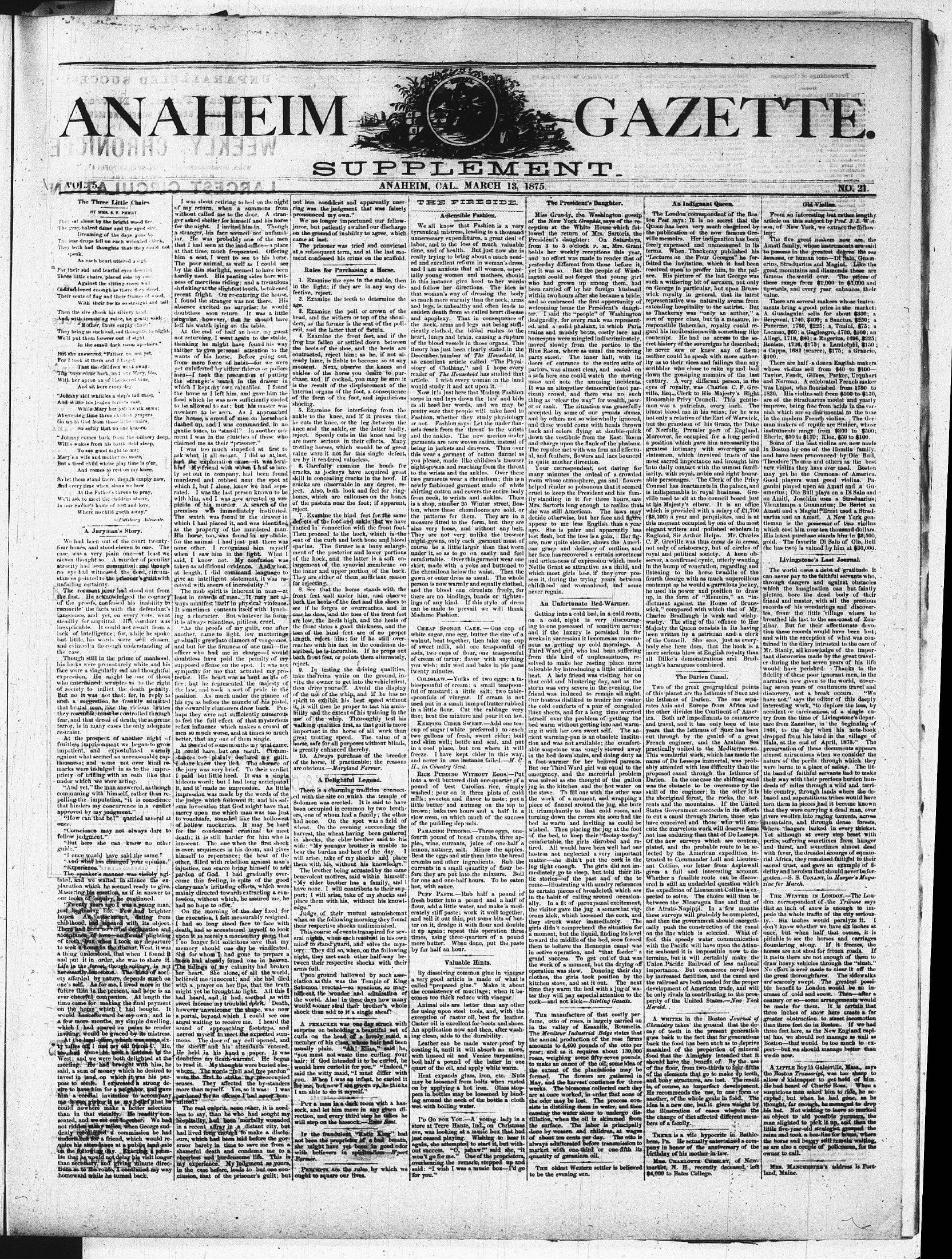
Scanned page
Searchable text
The Three Little Chairs.
BY MRS. S. T. PERRY
They sat alone by the bright wood fire.
The gray, haired dame and the aged sire.
Dreaming of the days gone by.
The tear-drops fell on each wrinkled cheek.
They both had thoughts that they could not speak.
As each heart uttered a sigh.
For their sad and tearful eyes described
Three little chairs, placed side by side.
Against the sitting room wall.
Old-fashioned enough as there they stood.
Their seats of flag and their frames of wood,
With their backs so straight and tall.
Then the sire shook his silvery head.
And, with trembling voice, he gently said:
"Mother, those empty chairs!"
They bring us such sad, sad thoughts to night.
We'll put them forever out of sight.
In the small dark room up-stairs."
But she answered: "Pather, no not yet,
For I look at them and I forget!
That the children went away;
The boys come back, and our Mary, too,
With her apron on of checkered blue,
And sit here every day.
"Johnny still whittles a ship's tail mast,
And Willie his leaden bullets cast,
While Mary her patch work saws;
At evening time three childish prayers
Go up to God from those little chairs,
So softly that no one knows.
"Johnny comes back from the billowy deep,
Willie wakes from his battlefield sleep,
To say good night to me;
Mary's a wife and mother no more,
But a tired child whose playtime is o'er,
And comes to rest on my knee."
I was about retiring to bed on the night
of my return, when a summons from
without called me to the door. A stranger asked shelter for himself and his horse
for the night. I invited him in. Though a stranger, his face seemed not unfamiliar. He was probably one of the men
that I had seen at the land-office—a place at that time; much frequented. Offering him a seat, I went to see to his horse.
The poor animal, as well as I could see by the dim starlight, seemed to have been hardly used. His panting sides bore witness of merciless riding; and a tremulous shrinking at the slightest touch, betokened recent fright. On re-entering the house,
I found the stranger was not there. His absence excited no surprise; he would doubtless soon return. It was a little singular, however, that he should have left his watch lying on the table.
At the end of half an hour, my guest not returning, I went again to the stable, thinking he might have found his way thither to give personal attention to the wants of his horse. Before going out, from mere force of habit—for we were yet uninfested by either thieves or policemen—I took the precaution of putting the stranger's watch in the drawer in which I kept my own valuables. I found the horse as I left him, and gave him the food which he was now sufficiently cooled to be allowed to eat; but his master was nowhere to be seen. As I approached the house, a crowd of men on horseback dashed up, and I was commanded, in no gentle tones, to "stand!" In another moment I was in the clutches of those who claimed me as their "prisoner."
I was too much stupefied at first to ask what it all meant. I did so at last, and the explanation came—it was terrible! My friend with whom I had so late not less confident and ring was the judgment pronounced my own."
1. Examine the eyes in the light; if they are effective, reject.
2. Examine the teeth age.
3. Examine the police head, and the withers of ders, as the former is the evil, and the latter that.
4. Examine the frogs has fallen or settled the heels of the shoe, contracted, reject him ready lame, is liable to moment. Next, observe ankles of the horse yaw chase, and if cocked, is the result of the di internal organs of the f of the form of the foot shooting.
5. Examine for intankle to the knee, and he cuts the knee, or the knee and the ankle, or reject. Speedy cuts in are more serious in the trotting horses, which value were it not for are by it rendered valuable.
6. Carefully examine
The boys come back, and our Mary, too,
With her apron on of the cheekered blue,
And sit here every day.
"Johnny still whittles a ship's tail mast,
And Willie his leader buits' cast,
While Mary her path work sews;
At evening time three children prayers
Go up to God from those little hairs,
So softly that no one knows.
"Johnny comes back from the shillowy deep,
Willie wakes from his battlefield sleep,
To say good night to me;
Mary's a wife and mother no more,
But a tired child whose play time is o'er,
And comes to rest on my knee.
So let them stand there, though empty now,
And every time when alone we bow.
At the Father's throne to pray,
We'll ask to meet the children above,
In our Sawlor's home of rest and love,
Where no child goeth away."
—Pittsburg Advocate.
A Juryman's Story.
We had been out of the court twenty-four hours, and stood eleven to one. The case was a very pain one—at least we eleven thought so. A murder of peculiar atrocity had been committed; and though no eye had witnessed the deed, circumstances pointed to the prisoner's guilt with unfailing certainty.
The recusant juror had stood out from the first. He acknowledged the cogency of the proofs, confessed his inability to reconcile the facts with the defendant's innocence, and yet, on every vote, went steadily for acquittal. His conduct was inexplicable. It could not result from a lack of intelligence; for, while he spoke but little, his words were well chosen, and evinced a thorough understanding of the case.
Though still in the prime of manhood, his locks were prematurely white and his face wore a singularly sad and thoughtful expression. He might be one of those who entertained scruples as to the right of society to inflict the death penalty. But no it was not that: for, in reply to such a suggestion, he frankly admitted that brutal men, like the vicious brutes they resemble, must be controlled through fear, and that dread of death, the supreme terror, is in many cases the only adequate restraint.
At the prospect of another night of fruitless imprisonment we began to grow impatient, and expostulated warmly against what seemed an unreasonable captiousness; and some not over kind remarks were indulged in as to the impropriety of trifling with an oath like that under which we were acting.
"And yet," the man answered, as though communing with himself, rather than repelling the imputation, "it is conscience that hinders my concurrence in a verdict approved by my judgment."
"How can that belt" queried several at once.
"Conscience may not always dare to follow judgment."
"But here she can know no other guide."
"I once would have said the same."
"And what has changed your opinion."
"Experience."
The speaker's manner was visibly agitated, and we waited in silence the explanation which he seemed ready to give.
I took the precaution of putting the stranger's watch in the drawer in which I kept my own valuables. I found the horse as I left him, and gave him the food which he was now sufficiently cooled to be allowed to eat; but his master was nowhere to be seen. As I approached the house, a crowd of men on horseback dashed up, and I was commanded, in no gentle tones, to "stand!" In another moment I was in the clutches of those who claimed me as their "prisoner."
I was too much stupified at first to ask what it all meant. I did so at last, and the explanation came—it was terrible. My friend with whom I had so lately set out in company, had been found murdered and robbed near the spot at which I, but I alone, knew we had separated. I was the last person known to be with him, and I was now arrested on suspicion of his murder. A search of the premises was immediately instituted. The watch was found in the drawer in which I had placed it, and was identified as the property of the murdered man. His horse, too, was found in my stable, for the animal I had just put there was none other. I recognized him myself when I saw him in the light. What I said, I know not. My confusion was taken as additional evidence. And when, at length, I did command language to give an intelligent statement, it was received with sneers of incredulity."
The mob spirit is inherent in man—at least in crowds of men. It may not always manifest itself in physical violence. It sometimes contents itself with lynching a character. But whatever its form, it is always relentless, pitiless, cruel.
As the proofs of my guilt, one after another, came to light, low mutterings gradually grew into clamors of vengeance, and but for the firmness of one man—the officer who had me in charge—I would doubtless have paid the penalty of my supposed offense on the spot. It was not sympathy for me that actuated my protector. His heart was as hard as his office; but he represented the majesty of the law, and took a sort of pride in the position. As much under the glance of his eye as before the muzzle of his pistol, the cowardly clamors drew back. Perhaps they were not sufficiently numerous to feel the full effect of that mysterious reflex influence which makes a crowd of men so much worse, and at times so much better, that any one of them single.
At the end of some months my trial came. It could have but one result. Circumstances too plainly declared my guilt. I alone knew they lived. The absence of the jury was very brief. To their verdict I paid but little heed. It was a single hideous word; but I had long anticipated it, and it made no impression. As little impression was made by the words of the judge which followed it; and his solen invocation that God might have that mercy upon me which man was too just to vouchsafe, sounded like the hollowest of hollow mockeries. It may be hard for the condemned criminal to meet death; it is still harder for him who is innocent. The one when the first shock is over, acquiesces in his doom, and gives himself to repentance; the heat of the other, filled with rebellion against man's injustice, can scarce bring himself to ask pardon of God. I had gradually overcome this feeling, in spite of the good clergyman's irritating efforts, which were
5. Examine for intractable to the knee, and he cuts the knee, or the knee and ankle, or reject. Speedy cuts are more serious in this trotting horses, which value were it not for them are by it rendered valuable.
6. Carefully examine cracks, as jockeys have skill in concealing cracks are observable ifject. Also both look bones, which are called of the pastern near their reject.
7. Examine the hind legs defects of the foot and named in connection with Then proceed to the head seat of the curb and bed spavins. The former moment of the posterior suture of the hook, and the latter largement of the synovial inner upper pores They are either of them for rejecting.
8. See that the front feet wall under both the heels of the feet see if he forges or owes case he does, and the toe are low, the heels high—the front shoes a good toe of the hind feet length, reject him; for reaches with his feet in scribbled, he is incurable both front feet, or point reject.
9. In testing these take their reins while owing vite the owner to get in then drive yourself. A of use of the whip, spirit to exhibit his b lie it will then be prop ability and the extent of use of the whip. The walking qualities first important in the horse great trotting speed. Horse safe for all purpose is greatly enhanced thou
10. Always purchase of the horse, if practice are obvious.
A Delightful
There is a charming edged with the site on which Solomon was erected been occupied in commens one of whom had a had none. On the s wheat. On the evenin harvest,the wheat have in shocks,the elder b wife: "My younger broth bear the burden and ho will arise,take of my them with his without The brother being ac benevolent motives,said "My elder brother have none.I will cont
communing with himself, rather than repelling the imputation, "it is conscience that hinders my concurrence in a verilict approval by my judgment."
"How can that be?" queried several at once.
"Conscience may not always dare to follow judgment."
"But here she can know no other guide."
"I once would have said the same."
"And what has changed your opinion."
"Experience."
The speaker's manner was visibly agitated, and we waited in silence the explanation which he seemed ready to give. Mastering his emotion, as if in answer to our looks of inquiry, he continued.
Twenty years ago I was a young man, just beginning life. Pew had brighter hopes. An attachment, dating from childhood, had opened with its object. There had been no verbal declaration and acceptance of love—no formal plighting of truth; but when I took my departure to seek a home in the distant West, it was a thing understood that when I found it and put it in order, she was to share it. Life in the forest, though solitary, is not necessarily lonely. The kind of society afforded by nature, depends much on one's self. As for me, I lived more in the future than in the present, and hope is an ever cheerful companion. At length the time came for making the final payment on the home which I had bought. It would henceforward be my own; and in a few more months, my simple dwelling, which I had spared no pains to render inviting, would be graced by its mistress.
At the land-office, which was some sixty miles off, I met my old friend C. He, too, had come to look a fortune in the West; and we were both delighted at the meeting. He had brought with him, he said, a sum of money which he desired to invest in land, on which it was his purpose to settle. I expressed a strong desire to have him for a neighbor, and gave him a cordial invitation to accompany me home giving it as my belief that he could nowhere make a better selection than in that vicinity. He readily consented, and we set out together. We had not ridden many miles when George suddenly recollected a commission he had undertaken for a friend, which would require his attendance at a public land sale on the following day. Exactly a promise that he would not delay his visit longer than necessary, and giving minute directions as to the route, I continued my way homeward while he turned back.
impression was made by the words of the judge which followed it; and his solemn invocation that God might have that mercy upon me which man was too just to vouchsafe, sounded like the hollowest of hollow mockeries. It may be hard for the condemned criminal to meet death; it is still harder for him who is innocent. The one when the first shock is over, acquiesces in his doom, and gives himself to repentance; the heat of the other, filled with rebellion against man's injustice, can scarce bring himself to ask pardon of God. I had gradually overcome this feeling, in spite of the good clergyman's irritating efforts, which were mainly directed towards extracting a confession without which he assured me, he had no hope to offer.
On the morning of the day fixed for the execution, I felt measurably resigned. I had so long stood face to face with death, had so accustomed myself to look upon it as merely a momentary pang, that I no longer felt solicitous save that my memory should one day be vindicated. She for whom I had gone to prepare a home had already found one in heaven. The tidings of my calamity had broken her heart. She alone, of all the world, believed me innocent; and she had died with a prayer on her lips, that the truth might yet be brought to light. All this I had heard, and it had soothed as with sweet incense my troubled spirit. Death, however unwelcome the shape, was now a portal beyond which I could see one angel waiting to receive me. I heard the sound of approaching footsteps, and nerved myself to meet the expected summons. The door of my cell opened, and the sheriff and his attendants entered. He held in his hand a paper. It was doubtless my death-warrant. He began to read it. My thoughts were busied elsewhere. The words "full and free pardon" were the first to strike my preoccupied senses. They affected the by-standers more than myself. Yes, so it was: I was pardoned for an offence I had never committed?
The real culprit, none other, it is needless to say, than he who had sought my hospitality, had been mortally wounded in a recent affray in a distant city, but had lived long enough to make a disclosure, which had been laid before the governor barely in time to save me from a shameful death and condemn me to a cheerless and burdensome life. This is my experience. My judgment as yours, in the case before, leads to but one conclusion, that of the prisoner's guilt; but
IM GAZ
SUPPLEMENT.
ANAHEIM, CAL., MARCH 13, 1875.
not less conscient and apparently unnering was the judgment that was falsely pronounced my own."
We no longer importuned our fellow-juror, but patiently awaited our discharge on the ground of inability to agree, which came at last.
The prisoner was tried and convicted at a subsequent term, and at the last moment confessed his crime on the scaffold.
Rules for Purchasing a Horse.
1. Examine the eyes in the stable, then in the light; if they are in any way defective, reject.
2. Examine the teeth to determine the age.
3. Examine the poll or crown of the head, and the withers or top of the shoulders, as the former is the seat of the polliev, and the latter that of fistula.
4. Examine the front feet, and if the frog has fallen or settled down between the heels of the shoe, and the heels are contracted, reject him; as he, if not already lame, is liable to become so at any moment.
Next, observe the knees and ankles of the horse you desire to purchase, and if cooked, you may be sure it is the result of the displacement of the internal organs of the foot, a consequence of the form of the foot, and injudicious shoeing.
5. Examine for interfering from the ankle to the knee, and if it proves that he cuts the knee, or the leg between the knee and the ankle, or the latter badly, reject. Speedy cuts in the knee and leg are more serious in their effects. Many trotting horses, which would be of great value were it not for this single defect, are by it rendered valueless.
6. Carefully examine the hoofs for
THE FIRESIDE.
A Sensible Fashion.
We all know that Fashion is a very tyrannical mistress, leading to a thousand unnecessary expenditures, a great deal of labor, and to the loss of much valuable time, and of health. But just now she is really trying to bring about a much needed and excellent reform in woman's dress, and I am anxious that all women, especially young women and mothers, should in this instance give heed to her words and follow her directions. The idea is that women's way of dressing the body so much more warmly than the neck, arms and legs, is unhealthy and often leads to sudden death from so called heart disease and apoplexy. That in consequence of the neck, arms and legs not being sufficiently clothed, the blood rushes to the heart, lungs and brain, causing a rupture of the blood vessels in those organs. This theory has just been clearly stated in the December number of The Household, in an excellent article called "The Physiology of Clothing," and I hope every reader of The Household has studied that article. I wish every woman in the land would study it and act upon it.
Now it is just here that Madam Fashion steps in and lays down the law and bids us all heed her words, and we may be pretty sure that people will take heed to Fashion, whether they study physiology or not. Fashion says: Let the under flannels reach from the throat to the wrists and the ankles. The new merino under garments are now woven entire, instead of being in jackets and drawers. Then over this wear a garment of cotton flannel as you please, made like children's trowser night-gowns and reaching from the throat.
The President's Daughter.
Miss Grundy, the Washington gossip of the New York Graphic, says of the reception at the White House which followed the return of Mrs. Sartoris, the President's daughter: On Saturdays, from 3 to 5 o'clock P.M. Mrs. Grant holds her weekly receptions this year, and no effort was made to render that of yesterday different from those before it, yet it was so. But the people of Washington could not forget that young girl who had grown up among them, had been carried off by her foreign husband within two hours after she became a bride, and so embraced the first opportunity of welcoming home the President's daughter. I said the "people" of Washington designedly, for every rank was represented, and a solid phalanx, in which Paris trains and muddy boots, costly lace and homespun were mingled indiscriminately, moved slowly from the portico to the Blue Room, where as usual the receiving party stood. The inner hall, with its doors of entrance to the entire suite of parlors, was almost clear, and seated on a sofa here one could watch the moving mass and note the amusing incidents. It was an altogether democratic (not partizan) crowd, and there was no such thing as "clear the way" for wealth, power or rank. The situation was gracefully accepted by some of our granda dames, and by others not so wise wholly ignored, and these would come with heads thrown back and colors flying at double-quick down the vestibule from the East Room and charge upon the flank of the phalanx. The repulse met with was firm and effectual, and feathers, flowers and lace bounced in quite another direction.
Your correspondent, not daring for
A Delightful Legend.
There is a charming tradition connected with the site on which the temple of Solomon was erected. It is said to have been occupied in common by two brothers, one of whom had a family; the other had none. On the spot was a field of wheat. On the evening succeeding the harvest, the wheat having been gathered in shocks, the elder brother said to his wife: "My younger brother is unable to bear the burden and heat of the day. I will arise, take of my shocks and place them with his, without his knowledge."
The brother being actuated by the same benevolent motives, said within himself: "My elder brother has a family, and I have none. I will contribute to their sun-reader of The Household has studied that article. I wish every woman in the land would study it and act upon it.
Now it is just here that Madam Fashion steps in and lays down the law and bids all heed her words, and we may be pretty sure that people will take heed to Fashion, whether they study physiology or not. Fashion says: Let the under flannels reach from the throat to the wrists and the ankles. The new merino under garments are now woven entire, instead of being in jackets and drawers. Then over this wear a garment of cotton flannel as you please, made like children's trowser night-gowns and reaching from the throat to the wrists and the ankles. Over these two garments wear a chemiloon; this is a newly fashioned garment made of white shirting cotton and covers the entire body from neck, to wrists and ankles. There is a shop, number 25 Winter street, Boston, where these chemiloons are sold, or the patterns for them. They are in a measure fitted to the form, but they are also very loose, and without any belt. They are not very unlike the trowser night-gowns, only each garment must of course be a little larger than worn under it, so as to go on easily and feel comfortable. Over this garment wear one skirt, made with a yoke and buttoned to the chemiloon below the waist. Then the gown or outer dress as usual. The whole person is now warmly and equally clothed, and the blood can circulate freely, for there are no bindings, bands or tightening of any kind. If this style of dress can be made to prevail we will thank Madame Fashion.
CHEAP SPONGE CAKE.—One cup of white sugar, one egg, butter the size of a walnut, beat together, then take one cup of sweet milk, add one teaspoonful of soda, two cups of flour, one teaspoonful of cream of tartar; flavor with anything you wish; mix well and bake in pie pans twenty minutes.
COLDSLAW.—Yolks of two eggs; a tablespoonful of cream; a small teaspoonful of mustard; a little salt; two tablespoonfuls of vinegar. If cream is not used put in a small lump of butter rubbed in a little flour. Cut the cabbage very fine; heat the mixture and pour it on hot.
KEEPING CIDER SWEET.—Add one teacup of sugar (white preferred) to reach two gallons of fresh, sweet cider; boil and skim well; bottle and seal, and put in a cool place, but not where it will freeze. I have kept cider in this way, and never in one instance failed.—M.C.H., in Country Gent.
RICE PUDDING WITHOUT Eggs.—Put into a well buttered dish one-quarter of a pound of best Carolina rice, simply washed; pour on it three pints of cold milk; sweeten and flavor to taste; put a little butter and nutmeg on the top to brown; bake two hours and a half in slow oven, on which much of the success of the pudding depends.
PARADISE PUDDING.—Three eggs, one-fourth pound of bread crumbs, three apples, wine, currants, juice of one-half a lemon, nutmeg, salt. Mince the apples. Beat the eggs and stir them into the bread crumbs and other ingredients. Rub the currants in a small quantity of flour before they are put into the mixture. Boil for one and one-half hours. To be eaten hot, with sauce.
An Unfortunate Bed-Warmer.
Getting into a cold bed, in a cold room, on a cold, night is very discouraging to one possessed of sensitive nerves; and if the luxury is persisted in for weeks in succession it becomes as monotonous as getting up cold mornings. A Third Ward girl who had been suffering from this kind of unpleasantness, resolved to make her resting place more tolerable by introducing a little artificial heat. A lady friend was visiting her on that cold and blustering day, and as the storm was very severe in the evening, the friend was induced to remain all night. Our hostess disliked to tender her visitor the cold comforts of a pair of congealed linen sheets, and for a long time worried herself over the problem of getting the bed warm without getting into and warming it with her own sweet self. The ancient warming-pan is an obsolete institution and was not available; the comfortable soapstone was snugly stowed away in the bed down stairs, and doing duty as a foot-warmer for her beloved parents. But our Third Ward girl was equal to the emergency, and the mercurial problem was solved as she thought of the gallon jug in the kitchen and the hot water on the stove. To fill one with the other was the work of a moment, and wrapping a piece of flannel around the jug, she bore it triumphantly to that cold room, and turning down the covers she soon had the bed as warm and inviting as could be wished. Then placing the jug at the foot of the bed, to keep their "footsy-tootsy" comfortable, the girls disobedied and retired. All would have been well had our hostess not neglected a very important matter—the she didn't put the cork in the jug tight enough. The girls did not immediately go to sleep, but told their little stories-of the past and of the come—illustrating with sundry references most sacred into daily irity, with able person Counsel him is indispensable ville used at his Majesty been written of The Court body else more serious all Dilkine laugh's haunt.
Two of this playthe Isthmian rates Asia,the otherrica.Bothand travel years that cut through French practically This woname of Dilkineattempted Darien.I was the old skill of the aborigines rents and States Goo-tcut a cara have concecute me not less ear Of the new plated,and lectited by trusted to ant Collis gives a creed is insisted in whether
There is a charming tradition connected with the site on which the temple of Solomon was erected. It is said to have been occupied in common by two brothers, one of whom had a family; the other had none. On the spot was a field of wheat. On the evening succeeding the harvest, the wheat having been gathered in shocks, the elder brother said to his wife: "My younger brother is unable to bear the burden and heat of the day. I will arise, take of my shocks and place them with his, without his knowledge."
The brother being actuated by the same benevolent motives, said within himself: "My elder brother has a family, and I have none. I will contribute to their support; I will arise, take of my shocks and place them with his, without his knowledge."
Judge of their mutual astonishment when on the following morning they found their respective shocks undiminished.
This course of events transpired for several nights, when each resolved in his own mind to stand guard, and solve the mystery. They did so, when on the following night, they met each other half-way between their respective shocks with their arms full.
Upon ground hallowed by such association as this was the Temple of King Solomon erected—so spacious, so magnificent, the wonder and admiration of the world. Alas! in these days how many would sooner steal their brother's whole shock than add to it a single sheaf?
A PREacher was one day struck with surprise on beholding a beautiful set of curls on the head of a lonely maid, a member of his class, whose hair had been usually plain. "Ah! Eliza," said he, "you must not waste time curling your hair; if God intended it to be curled, he would have curled it for you." "Indeed," said the witty maid, "I must differ with you. When I was an infant, he carved it for me, but now I am grown up, he thinks I am able to do it myself."
Put a man in a dark room with a hassock, and let him move in any given direction, and every third step he takes he will step on the hassock—Rome Sent.
In the fraudulent, "Katie King" had not been the proprietor of a bad breath, she might have yet been in good odor with believers in spiritualism—Eport Farmer.
Preachers are the rules by which we ought to square our lives.
PARADISE PUDDING.—Three eggs, one-fourth pound of bread crumbs, three apples, wine, currants, juice of one-half a lemon, nutmeg, salt. Mince the apples. Beat the eggs and stir them into the bread crumbs and other ingredients. Rub the currants in a small quantity of flour before they are put into the mixture. Boil for one and one-half hours. To be caten hot, with sauce.
Puff PASTE.—Rub half a pound of fresh butter into a pound and a half of flour, add a little water, and make a moderately stiff paste; work it well together, and roll it out thin, put some bits of butter on it, dredge it with flour and double it up again; repeat this operation three times, using three-quarters of a pound more butter. When done, put the paste by for half an hour.
Valuable Hints.
By dissolving common glue in vinegar a very good article is made of what is called "prepared glue." Make it about the consistency of mucilage; when it becomes too thick reduce with vinegar.
Animal oils are better than any other for using upon steel tools, and with the exception of castor oil, best for leather. Castor oil is excellent for boots and shoes. An application now and then, after washing clean, adds to the durability.
Leather can be made water-proof by coating it, until it will absorb no more, with linseed oil and Venice turpentine; boil half a pound of the latter in one quart of the oil, and apply while warm.
Heat expands glass, iron, etc. Nuts may be loosened from bolts when rusted on by applying a hot iron. Glass stoppers in bottles may be loosened by binding around the neck of the bottle a cloth wet with boiling water.
I'D GO FOR YOU.—A young lady in a store at Terre Hante, Ind., on Christmas eve, was looking at a music box that had just ceased playing. Wishing to hear it again, she attempted to start it, but without success. "O, pshaw!" said she, "it won't go for me." One of the proprietors, overhearing the remark, stepped up and said: "I wish I was a music box—I'd go for you."
The manufacture of that costly perfume, otto of roses, is largely carried on in the valley of Kesanlik, Houmelia. The Moniteur Industriel Belge states that the annual production of the rose farms amounts to 4,400 pounds of the otto per year; and as it requires about 130,000 roses, weighing some fifty-seven pounds, to make an ounce of the oil, some idea of the extent of the plantations may be formed. The flowers are gathered in May, and the harvest continues for three weeks. The blossoms collected each day are at once worked, in order that none of the odor may be lost. The process consists in distilling them in water, and then causing the water alone to undergo distillation, when the oil is skimmed from the surface. The labor is principally done by women and children, at wages of about ten cents per day. The otto is always adulterated before transmission to market with one-third or one-fifth its quantity of geranium oil.
The oldest Western settler is believed to be the evening sun.
GAZETTE.
NO. 21.
Daughter.
Washington gossip says of the re-house which follows. Sartoris, the On Saturdays, M., Mrs. Grant notions this year, to render that of those before it, people of Washington that young girl among them, had foreign husband became a bride, at opportunity of resident's daughter in which Paris costly lace and discriminately, portico to the actual receiving hall, with its entire suite of and seated on which the moving incidents,ocratic (not parable) was no such for wealth, power was gracefully grands dames, wholly ignored, with heads thrown at double-quick the East Room of the phalanx. Firm and effectuated lace bounced not daring for
An Indignant Queen.
The London correspondent of the Boston Post says: It is no secret that the Queen has been very much chagrined by the publication of the now famous Greville memoirs. Her indignation has been freely expressed and unmeasured in its terms. When Thackeray published his "Lectures on the Four Georges" he forfeited the invitation, which it had been resolved upon to proffer him, to the palace. His picture of the last George was such a withering bit of sarcasm, not only on George in particular, but upon Brunswick royalty in general, that its latest representative was naturally averse from extending hospitality to the satirist. But as Thackeray was "only an author," a sort of upper class, but in a measure, responsible Bohemian, royalty could regard his lucidations with something like contempt. He had no access to the secret history of the sovereigns he described; he never saw or knew any of them; neither could he speak with more authority as to their vices and failings than any scribbler who chose to rake up and boil down the gossiping memoirs of the last century. A very different person, in the eyes of royalty, was Charles C. F. Greville, Esq.; Clerk to His Majesty's Right Honorable Privy Council. This gentleman was a patrician, every inch. The bluest blood ran in his veins; for he was not only a relative of the Earl of Warwick, but the grandson of his Grace, the Duke of Norfolk, Premier peer of England. Moreover, he occupied for a long period a position which gave him necessarily the greatest intimacy with sovereigns and statesmen, which involved trusts of the most sacred importance and brought him into daily contact with the utmost familial violence.
From an interesting but rather lengthy article on this subject by Prof. J. J. Watson, of New York, we extract the following:
The five great makers now are the Amati family, whose instruments are said to possess in the greatest degree the so humane, or human tone—Df Salo, Guamerius, Straduarius and Magini. Like the great mountains and diamonds these are famous the world over. The prices of those range from $1,000 to $5,000 and upwards, and every year enhances their value.
There are several makers whose instruments bring a good price in the market: A Guadagnini sells for about $800; a Bergonzi, 1740; $400; a Sanctus, $250; a Panermo, 1760; $225; a Tonini, $75; a Lacasso, $60; a Gaglengro, 1780; $100; an Allegi, 1718; $80; a Rugerius, 1096; $225; Renisto, 1736; $175; a Landolphi, $150; a Cappa, 1689 (scarce), $175; a Grancio, $100.
There are half-a dozen English makers whose violins sell from $40 to $100—Taylor, Fendt, Gilkes, Parker, Urquhart and Norman. A celebrated French maker was Lupot, who flourished from 1790 to 1820. His violins sell from $100 to $150, are of the Straduarius model and yearly improve, being free from acids in the vanish which are so detrimental to the tone in the modern French violina. The German makers of repute are Steiner, whose instruments range from $800 to $500; Eberle, $50 to $150; Kloz, $50 to $100.
Some of the best violins are now made in Boston by one of the Humila family, and have been pronounced by Old Bull, Theodore Thomas and others as the best new violins they have ever used. Boston
not daring for
total of a crowded
gas and flowers
that it seemed
and his famthree hours, saw
to realize that
The laws may
her face and figure
english than a year
apparently has
a gain. Her figshows the American of outline, and
certain sweetness
which made
as a child, and
they ever posyears between
good, and some
in a cold room,
every discouragsensitive nerves;
persisted in for
homes as monotod mornings. A
had been suffering
pleasantness, realizing place more
a little artificial
visiting her on
day, and as the
remain all night.
Sender her visitor
air of congealed
time worried
of getting the
ing into and warmself. The anobsolete institutute; the comfortly stowed away
and doing duty as
beloved parents.
was equal to the
curricular problem
out of the gallon
the hot water on
the other was
and wrapping a
jug, she bore
cold room, and
she soon had the
ing as could be
jug at the foot
"footsy-tootsy"
disrobed and reenwell had our
very important
in the cork in the
girls did not imported told their little and of the toundry references
Two of the great geographical points of this planet are the Isthmus of Suez and the Isthmus of Darien. The one separates Asia and Europe from Africa and the other divides the Continent of America. Both are impediments to commerce and travel, and it has only been of late years that the Isthmus of Suez has been cut through by the genius of a great French engineer, and the Arabian Sea practically united to the Mediterranean. This wonderful work, which has made the name of De Lesseps immortal, was probably attended with less difficulty than the proposed canal through the Isthmus of Darien. In the one case the shifting sand was the obstacle to be overcome by the skill of the engineer; in the other it is the aboriginal forest, the rocks, the torrents and the mountains. If the United States Government succeeds in its efforts to cut a canal through Darien, those who have conceived and those who will execute the marvelous work will deserve fame not less enduring than that of De Lesseps. Of the new surveys which are contemplated, and the probable route to be selected by the American expedition intrusted to Commander Lull and Lieutenant Collins, our letter from Aspinwall gives a full and interesting account. Whether a feasible route can be discovered is still an undecided question which
Taylor, Fendt, Gilkes, Parker, Urquhart
and Norman. A celebrated French maker was Lupot, who flourished from 1790 to 1820. His violins sell from $100 to $150, are of the Straduarius model and yearly improve, being free from acids in the varnish which are so detrimental to the tone in the modern French violina. The German makers of repute are Steiner, whose instruments range from $800 to $500; Eberle; $50 to $150; Kloz, $50 to $100.
Some of the best violins are now made in Boston by one of the Humlin family, and have been pronounced by Ole Bull, Theodore Thomas and others as the best new violins they have ever used. Boston may yet be the Cremona of America. Good players want good violins. Paganini played upon an Amati and a Guamerius; Ole Bull plays on a Di Salo and an Amiti, Joachim uses a Straduarius; Vieuxtemps a Guamerius; De Beriot an Amati and a Magnii; Ernst used a Straduarius and an Amati. A New York gentleman is the possessor of two violins which cost him over ten thousand dollars. His latest purchase stands him in $8,500, gold. The favorite Di Salo Bull (he has two) is valued by him at $30,000.
Livingstone's Last Journal.
The world owes a debt of gratitude it can never pay to the faithful servants who, through dangers and against obstacles which the imagination can but faintly picture, bore the dead body of their friend and master, with all the precious records of his wonderings and discoveries, from the little village where he breathed his last to the sea-coast of Zanzibar. But for their affectionate devotion these records would have been lost; and with the exception of what was contained in the diary intrusted to the care of Mr. Stanley, all knowledge of the important discoveries made by the great traveler during the last seven years of his life would have perished. Thanks to the fidelity of these poor ignorant men, in the narrative now given to the world, covering seven years of continuous travel and discovery, not a break occurs. "We have not," says the editor of this deeply interesting work, "to deplore the loss, by accident or carelessness, of a single entry from the time of Livingstone's departure from Zanzibar, in the beginning of 1866, to the day when his note-book dropped from his hand in the village of Hala, at the end of April, 1873." The preservation of these documents appears almost miraculous when we consider the nature of the perils through which they were borne to a place of safety. The little band of faithful servants had to make their way with their precious burden hundreds of miles through a wild and terrible country, through lands where the debased and superstitious tribes would have torn them in pieces had it become known that they were carrying a dead man, over rivers swollen into raging torrents across mountains, and through dense forests, where dangers lurked in every thicket. Yet although at every step beset with perils, suffering sometimes from hunger and thirst, and sometimes almost dead with fever, the dreaded scourge of equatorial Africa, they remained faithful to their sacred trust, and gave an example of fidelity and heroism that should never be forgotten.—S. S. CONANT, in Harper's Magazine for March.
with the other was and wrapping a the jug, she bore in cold room, and she soon had the ing as could be the jug at the foot of "footsy-tootsy" disrobed and reseen well had our very important the cork in the girls did not imit told their litter and of the to laundry references cloth which are ground occasional excitement, a somewhat vigored the cork, and immediately. The situation for finding its level bed, soon forced nepin canal was "that feeder" a out of that was out of the drying off onning their day position by the out. The next with a jug of wafer attention to the marling Gazette.
that costly per- largely carried onnik, Roumelia. Belge states that of the rose farms of the otto per about 130,000 thirty-seven pounds oil, some idea of operations may be gathered in stations for three collected each day order that none of the process con- water, and then to undergo diskmed from is principally children, at wages away. The otto is the transmission to or one-fifth its settler is believed skill of the engineer; in the other it is the aboriginal forest, the rocks, the torrents and the mountains. If the United States Government succeeds in its efforts to cut a canal through Darlen, those who have conceived and those who will execute the marvelous work will deserve fame not less enduring than that of De Lemosa. Of the new surveys which are contem- plated, and the probable route to be selected by the American expedition intrusted to Commander Lull and Lieutenant Collins, our letter from Aspinwall gives a full and interesting account. Whether a feasible route can be discovered is still an undecided question which the expedition of Lieutenant Collins is expected to solve. The choice will then be between the Nicaragua line and that of the Atrato-Napippi. In a few months these surveys will probably be completed, and then the government should energetically push the construction of the canal on the line which is selected. What effect this speedy water communication with the Pacific will have upon the Atlantic seaboard it is impossible now to determine, but it will certainly make the Union Pacific Railroad of less national importance. But commerce never loses by increased facilities, and the canal and the railroad are both needed for the proper development of American trade, and will be only rivals in contributing to the prosperity of the United States.—New York Herald.
A WRITER in the Boston Journal of Chemistry takes the ground that the decay of teeth in the present generation goes back to the fact that for generations back the food has been such as to deprive mankind of the proportion of mineral food that the Almighty intended that it should have the benefit of. By the use of fine floor, from two-thirds to four-fifths of the elements that go to make up teeth, and bony structures, are lost. The result is, of course, an imperfect development. He recommends the use, in one form or another, of the whole grain in food. The idea is a new one, but it gives weight by the illustration of cases wherein the change of diet affected different members of a family.
There is a vile hypocrite in Bathhems, Pa. He actually entertained a company in honor of the anniversary of the birthday of his mother-in-law.
Mrs. CHARLOTTE CHESLY, of Newmarket, N. H., recently deceased, left $4,000 to Rates College.
THE WINTER IN LONDON.—The London correspondent of the Tribune says that an inch of snow is enough to impede the whole traffic of the city seriously. Six inches would paralyze it. I don't know whether we have six inches at once, but when half that comes, it is pitiable to see the horses and carriages floundering along. If it freezes, the horses are not shod for frozen roads. If it melts there are not enough of them to draw heavy vehicles through the "slush." No effort is ever made to clear it off the great thoroughfares. The sidewalks are scarcely swept. The greatest possible benefit to London would be an increase of cold and snow. Then—aafter a centary or so—some arrangements would be made for them. It is certain that three inches of snow here create a far greater obstruction to street locomotion than three feet do in Boston. If we had three feet here, as the New England capital has, we should not manage as well as Boston—that would be too much to expect—but we should manage better than we do now.
A LITTLE boy in Galesville, Mass., says the Boston Transcript, was too sharp to allow a kidnapper to get hold of him. He had heard of Charlie Ross. When a suspicious man asked him to ride, he accepted; but when he had gone, as he thought, far enough, he managed to drop his hat. Not wishing to leave so marked an object to aid possible pursuers, the man alighted to pick it up, and then the little five-year-old strategist grouped the rains and took a bee-line for home, where the horse and buggy still remain waiting, as are also a couple of policemen, for the owner to call.
Mrs. MANCHETER's address is Portland, Maine.