anaheim-gazette 1875-03-06
Scanned page
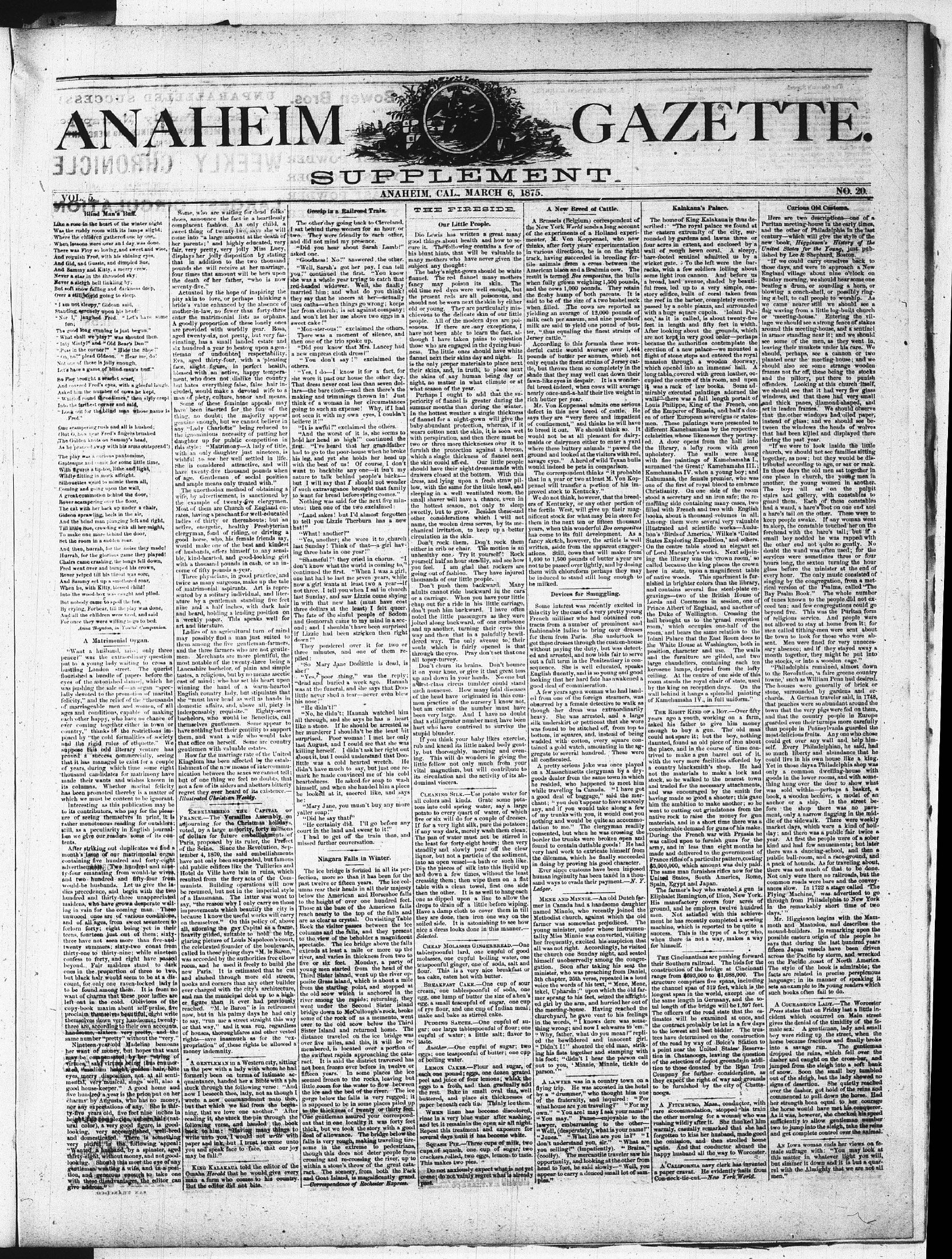
Searchable text
ANAHEIM
CHRONICLE
VOL. 5
Blind Man's Buff.
Like a rose in the heart of the winter night.
Was the ruddy room with its lamps alight;
Where the children gathered one by one.
When lessons were over and I day, was done.
There was Floy so loving, and sweet and wise,
And roguish Fred, with his shining eyes,
And Gid, and Guasie, and dimpled Sue,
And Sammy and Kitty, a merry crew.
Never a star in the shrouded sky;
Never a sleigh bell tinkling by;
But soft snow falling and darkness deep,
Over a still world going to sleep.
"I am not sleepy," Gideon said,
Standing serenely upon his head:
"Nor I," laughed Fred. "Let's have some fun;
The good long evening is just begun."
"What shall we play?" was shouted then.
"Inty Minty!" and "Old Bear's Den!"
"Pass in the corner!" "Hide the Shoe!"
"Oh, no!" plead Gideon. "Hear me, do!
Not one of these is jolly enough,
Let's have a game of blind-man's buff."
So Floy brought a scarlet scarf,
And covered Fred's eyes, with a gleeful laugh.
Asked him the number of cows he kept,
"Whirled round three times," then slyly crept into the farthest corner and said,
"Look out for the blind man whose name is Fred."
One scampering rush and all is hushed;
(But O, how near Fred's fingers brushed
The Golden knots on Sammy's head,
As he pranced away with his arms outspread!)
The play was a curious pantomime,
Grotesque and comic for some little time,
With gestures a timeless and light.
Some, who are waiting for dead folks' shoes, announce the fact in a heartlessly complacent fashion. An only child, a sweet thing of twenty two, says she will come into "a large amount at the death of her parents;" and highly educated, very fair, very pretty, very jolly Miss Lucy, displays her jolly disposition by stating that in addition to the two thousand pounds she will receive at her marriage, four times that amount will be hers upon the death of her father, "who is now seventy-five."
Actuated by the hope of inspiring the pity akin to love, or perhaps thinking a bride's value enhanced by the absence of mother-in-law, no fewer than forty-three enter the matrimonial lists as orphans. A goodly proportion of these lonely ones are provided with worldly gear. Rosa, aged twenty-six, not pretty, but very fascinating, has a small landed estate and six hundred a year to bestow upon a gentleman of undoubted respectability. Eva, aged thirty-four, with a pleasing face, slight figure, in perfect health, blessed with an active, happy temperament, who does not dislike the country but hates everything false, false hair included, would make a devoted wife to a man of piety, culture, honor and means.
Some of these feminine appeals may have been inserted for the fun of the thing; no doubt; the majority appear genuine enough, but we cannot believe in any "Lady Charlotte" being reduced to the ignominious necessity of putting her daughter up for public competition in this style: "Matrimony—A lady of title, with an only daughter just nineteen, is wishful to see her well settled in life. She is considered attractive, and will guess in a Railway.
The other day going back I sat behind three women two. They were friends and did not mind my pain. "Did you hear about asked one.
"Goodness! No!" and "Well, Sarah's got her you!" continued the fiesta she was a whole year trampled widower. married him; and what they say that he sneers uses oaths—when things her from church; is set and won't let her use all sweet cake!"
"Mon-ster-ous!" excels. There was a moment then one of the trio spoiled. "Did you know that a new empress cloth dress? You don't say it! others.
"Yes, I do—I know she wore it past our hour. That dress never cost lears—the bare cloth—and making and trimming think of a woman in going to such an expense not seen it with my own believe it!"
"It is awful!" exclaims. "And the worst of hold her head so high first. I've heard that had to go to the poor-hole his leg, and yet she hires the best of us!
So Floy brought a scarlet scarf,
And covered Fred's eyes, with a gleeful laugh.
Asked him the number of cows he kept,
"Whirled round three times," then stily crept
Into the farthest corner and said,
"Look out for the blind man whose name is Fred."
One scampering rush and all is hushed;
(But O, how near Fred's fingers brushed
The Golden knots on Sammy's head,
As he pranced away with his arms outspread!)
The play was a curious pantomime,
Groteque and comic for some little time,
With figures a tip-toe, lithe and light,
Wildly fitting in mock affright.
Silhouettes weird to mimic them all,
Coming and going upon the wall,
A great commotion behind the door,
Rover scampering over the floor,
The cat with her back up under a chair,
Gideon sprawling, heels in the air,
And the blind man plunging left and right,
Till little Sue, crowding with all her might,
To make one more behind the door,
Set the room in a sudden roar.
And then, hurrah, for the noise they made!
Hurrah, for the glorious game they played!
Chalra came crashing, the tongs fell down,
Fred went over and bumped his crown,
Rover yelped till his throat was sore,
And Sammy set up a smothered roar,
When he, with Kitty, blessed child!
Into the wood-box was caught and piled.
But nobody came to spoil the fun,
By crying, Forbear, till the play was done,
And all the children were tired, and said
For once they were willing to go to bed.
Anna Bogninton, in Youth' Companion.
A Matrimonial Organ.
"Want a husband, miss; only three pence!" was the extraordinary question put to a young lady waiting to cross a bustling London street. The flourished a bundle of papers before the eyes of the astonished damsel, which he was pushing the sale of—an organ "specially devoted to the promotion of marital felicity," and the relief of the "thousands of marriageable men and women, of all ages and conditions, capable of making each other happy, who have no chance of ever coming together either in town or country," thanks to the restrictions imposed by "the cold formalities of society and the rigid rules of etiquette." We suppose this odd literary venture has proved a success commercially, seeing that it has managed to exist for a couple of years, during which time some eight thousand candidates for matrimony have made their wants and wishes known in its columns. Whether marital felicity has been promoted thereby is a matter of which we must be content to be ignorant.
Interesting as this publication may be to its contributors, who pay for the pleasure of seeing themselves in print, it is rather monotonous reading for outsiders; still, as a peculiarity in English journalism we give our readers some of its contents.
After striking out duplicates we find a month's issue of our matrimonial organ containing five hundred and forty-eight advertisements. Two hundred and ninety-four emanating from would-be wives, and two hundred and fifty-four from would-be husbands. Let us give the lablessed with an active, happy temperament, who does not dislike the country but hates everything false, false hair included, would make a devoted wife to a man of piety, culture, honor and means.
Some of these feminine appeals may have been inserted for the fun of the thing; no doubt; the majority appear genuine enough, but we cannot believe in any "Lady Charlotte" being reduced to the ignominious necessity of putting her daughter up for public competition in this style: "Matrimony—A lady of title, with an only daughter just nineteen, is wishful to see her well settled in life. She is considered attractive, and will have twenty-five thousand pounds when of age. Gentlemen of social position and ample means only treated with."
The unorthodox method of obtaining a wife, by advertisement, is sanctioned by the example of twenty-five clergymen. Most of them are Church of England curates, having a penchant for well-educated ladies of thirty or thereabouts; but an active, energetic, healthy Presbyterian clergyman, fond of riding, or driving a good horse, who, his female friends say, would make one of the best and kindest of husbands, offers himself to any sensible, kind-hearted, and good-looking girl with a thousand pounds in cash, or an income of fifty pounds a year.
Three physicians in good practice; and twice as many surgeons, make up the tale of matrimonial aspirants. Art is represented by a solitary individual, and literature by a gentleman standing five feet nine and a half inches, with dark hair and beard, holding a leading position on a weekly paper. This speaks well for art and literature.
Ladies of an agricultural turn of mind may possibly find a man just suited to them among the five gentleman-farmers, and the three farmers who are not gentlemen. Merchants are more plentiful, the most notable of the twenty-three being a Lancashire bachelor, of plain and simple tastes, a religious, but by no means ascetic cast of mind; who has set his heart upon winning the hand of a warm-hearted English country lady, but stipulates that she "must have head as well as hands in domestic affairs, and above all, piety is indespensably requisite." Eighty-seven bachelors, who would be Benedicts, call themselves gentlemen. Some appear to have nothing but their gentility to support them, and want a wife who would take that office on herself. Some are country gentlemen with valuable estates.
How far the marriage rate of the United Kingdom has been affected by the establishment of the new means of intercommunication between the sexes we cannot tell; but of one thing we feel no doubts, that not a few of its aides and abettors bitterly regret they ever heard of its existence. — Illustrated Christian Weekly.
EMBELLISHING THE CAPITAL OF FRANCE.—The Versailles Assembly, on adjourning for the Christmas holidays, voted by a large majority, forty millions of dollars for future embellishments of Paris, proposed by its ruler, the Prefect of Seine. Since the Revolution, September 4, 1870, the said embellishments have not only been suspended, but famous old public edifices like the Tuilleries and Hotel de Ville have lain in ruins, which resulted from the fiery acts of the Communists. Building operations will now
"Yes, I do—I know she wore it past our hour. That dress never coat lears—the bare cloth—and making and trimmingings think of a woman in her going to such an expense not seen it with my own belief it!"
"It is awful!" exclaims "And the worst of it hold her head so high first. I've heard that had to go to the poor-hole his leg, and yet she hie with the best of us! I want to backbite any nature to talk behind but I will say that I if such extravagance be want for bread before Nothing was said for utes; then one of the t hat!
"Land sakes! but I to tell you Lizzie The hat!"
"What! another?"
"Yes, another; she last Sunday! Think off ing three hats in one yea"
"Shameful!" they don't know what the wont continued the first. "One hat had to last me now a girl wants at least not three. I tell you whilast Sunday, and saw I in with that new hat three dollars at the Lea The fate of the sinful L and Gomorrah came to end; and I shouldn't if Lizzie had been sown down."
They pondered ove three minutes, and plied:
"So Mary Jane Do she?"
"Yes; poor thing," "dead and buried a w was at the funeral, and little never shed a tear his nose!"
"He didn't?"
"No, he didn't; Hail all through, and she sa like a stone. If he shi her murderer I should surprised. Poor wom last August, and I cou killining herself. I did about it, but I could un little was a cold he didn't have much to mark he made convin heartedness. He ask himself, and when she he looked at it, sneez he:
"Mary Jane, you m yaller soap."
"Did he say that?"
"He certainly did court in the land and I had to get off missed further conver
After striking out duplicates we find a month's issue of our matrimonial organ containing five hundred and forty-eight advertisements. Two hundred and ninety-four emanating from would-be wives, and two hundred and fifty-four from would-be husbands. Let us give the ladies precedence, and begin with the two hundred and thirty-three unappreciated maidens, who have grown desperate waiting in vain for the coming man. These unwooded ones are of various conditions, and of all ages, from sweet seventeen to forlorn forty; eight being yet in their teens, fourteen just out of them; sixty-three have not seen more than five-and-twenty summers; sixty-two const from thirty-one to thirty-nine; while nineteen confess to forty, and eight have passed beyond. Fair maidens stand to dark ones in the proportion of three to two, but black hair would seem to be at a discount, for only one raven-locked lady is to be found among them. It is from no want of charms that these poor ladies are left out in the cold. Oblivious of the copy-book maxim about self-praise, five proclaim themselves beautiful, eight write themselves down very handsome; twenty-three are, according to their own accounts, handsome, sixteen very pretty, and the same number "pretty" without the "very."
Nineteen-year-old Madeline bemoans her want of money, but hopes that want may be compensated by her "string of virtues," said virtues being thus enumerated: medium height, golden hair, blue eyes, merry disposition, not at all sentimental, very musical, sings well, also a good house-keeper." A good home and five hundred a year is the price put on her charms by Augusta, who has no money, nor any expectations of any. She is thirty-five years old, five feet nine inches in height, fair complexion, subburn hair (natural color), a very good figure, is good-looking, very accomplished, well-bred and domesticated. There is something very pitiful in the following appeal:
"Wanted a husband, by a spinster, aged thirty-eight, without money, and not good-looking. Should this meet the eye of any gentleman wanting a wife, and in a position, and generous enough to take one with these disadvantages, the editor can give address."
EMBELLISHING THE CAPITAL OF FRANCE—The Versailles Assembly, on adjourning for the Christmas holidays, voted, by a large majority, forty millions of dollars for future embellishments of Paris, proposed by its ruler, the Prefect of the Seine. Since the Revolution, September 4, 1870, the said embellishments have not only been suspended, but famous old public edifices like the Tuilleries and Hotel de Ville have lain in ruins, which resulted from the fiery acts of the Communists. Building operations will now be resumed, but not in the imperial style of a Hausmann. The latter was wont to say, "the reason why I only carry on those improvements which beautify the city is because I know the useful works will carry on themselves." On this policy of above all, adorning the gay Capital as a frame, heavily gilded, suitable to hold the big, glaring picture of Louis Napoleon's court, the celebrated founder of the boulevards called in those piping days "M. le Baron," was accorded by the authorities free elbow room, and he used it freely to build the new Paris. It is estimated that he cut and slashed through more old streets, nooks and corners than any other builder ever charged with the city's architecture, and ran the municipal debt up to a higher figure than it ever had previously reached. "M. le Baron" is in retirement now, but in his palmy days he had only to say, "run me a street straight this way or that way," and it was run, regardless of houses, thoroughfares and other vested rights—save inasmuch as for the "expropriation" of these rights be allowed a money indemnity.
A GENTLEMAN in a Western city, sitting in the pew with a lady with whom he had formerly been on terms of intimate acquaintance, handed her a Bible with a pin stuck through the following verse: "And now I beseech thee, lady, not as though I wrote a new commandment unto thee, but that which we had from the beginning, that we love one another." After reading it, she stuck the pin through the following verse, and handed the book back to him: "Having many things to write unto you, I would not write with paper and ink, but I trust to come unto you and speak face to face, that our joy may be full."
KING KALAKAUA told the editor of the Omaha Herald that he would give every man a farm who comes to his country. But the editor did not bite.
The ice bridge is forfection, more so than past twelve or fifteen minutes rear their head below the American to the height of over Those at the base of reach nearly to the rear are as clear as crystalline Rock the visitor passes columns and the falls to the view of the best spectacle. The ice bridge extends at least a mile river, and varies in size or six feet. Young men started in Third Sister island, posite Grass island, from the starting point the old scow which river among the rapids went under the Sister bridge down to McCoy some of the rock off over to the old scow Sister Island and runs distance traveled over five miles, and membered is located the swiftest rapids across it. It is said that they not been frozen over fifteen years. In seemed frozen to the little room for the ice and the bed gorge below the fall is supposed to be in touch with the thickness of One gentleman assent that in one local deal of allowance. Falls is very rough some in the extra though this does not crossing and re-cross within a stone's thick rack. The scenery and Goat Island is—Correspondence of
Gossip is a Railroad Train.
The other day going back to Cleveland, I sat behind three women for an hour or two. They were friendly to each other, and did not mind my presence.
"Did you hear about Sarah Lamb?" asked one.
"Goodness! No!" answered the other.
Well, Sarah's got her pay, I can tell you!" continued the first. "You know she was a whole year trying to catch that red-headed widower. Well, she finally married him; and what do you think? they say that he sneers at her—actually uses oaths—when things go wrong; keeps her from church; is set against company; and won't let her use above two eggs in a sweet cake!"
"Mon-ster-ous!" exclaimed the others.
There was a moment of silence, and then one of the trio spoke up.
"Did you know that Mrs. Lancey had a new empress cloth dress?"
"You don't say!" exclaimed the others.
"Yes, I do—I know it for a fact, for she wore it past our house the other day. That dress never cost less than seven dollars—the bare cloth—and then there's the making and trimmings thrown in! Just think of a woman in her circumstances going to such an expense! Why, if I had not seen it with my own eyes, I couldn't believe it!"
"It is awful!" exclaimed the others.
And the worst of it is, she seems to hold her head so high!" continued the first.
"I've heard that her grandfather had to go to the poor-house when he broke his leg, and yet she holds her head up with the best of us! Of course, I don't
THE FIRESIDE.
Our Little People.
Dio Lewis has written a great many good things about health and how to secure it. The following contains a few of his blunt hints, that will be valuable to many mothers who have never given the subject any thought:
The baby's night-gown should be white flannel. The red flannel many mothers fancy may poison its skin. The old time red dyes were well enough, but the present reeds are all poisonous, and should not be worn next the skin by either old or young. They are particularly mischievous to the delicate skin of our little people. All of the modern dyes are poisonous. If there are any exceptions, I have not been able to learn the fact, although I have taken pains to question those who are engaged in the dyeing business. The little ones should have white flannel next their skins day and night. It is the only proper materials to place next their skins, and, in truth, to place next the skins of any human being day or night, no matter in what climate or at what season of the year.
Perhaps I ought to add that the superiority of flannel is greater during the summer months than during the winter. In the hottest weather a single thickness of flannel for a night-gown will give the baby-abundant protection, whereas, if it wears cotton next the skin, it is soon wet with perspiration, and then there must be two or three more thicknesses over it to furnish the protection against a breeze, which a single thickness of flannel next the skin could afford. Our little people should have their night dresses made with
A New Breed of Cattle.
A Brussels (Belgium) correspondent of the New York World sends a long account of the experiments of a Holland experimenter, M. Von Koppenael, who now thinks, after forty years' experimentation in various directions, he is on the right track, having succeeded in breeding fertile animals from a cross between the American bison and a Brahmin cow. The result is termed Bos compositus, the bulls when fully grown weighing 1,500 pounds, and the cows 1,000 pounds. They retain the fleshy hump of both parents. It is said to be of the size of a two bushel sack when filled. The cows are reported as yielding an average of 12,000 pounds of milk each per annum, and nine pounds of milk are said to yield one pound of butter, "thus equaling the finest strains of Jersey cattle."
According to this formula these wonderful cattle would average over 1,444 pounds of butter per annum, which not only equals the finest strains of Jersey cattle, but throws them so completely in the shade that they may well cast down their fawn-like eyes in despair. It is a wonderful breed indeed, when cows will average nearly once-and-a-half their live weight in rich butter per year.
Mr. Von Koppenael admits one serious defect in this new breed of cattle. He says they are "very fierce and impatient of confinement," and thinks he will have to breed it out. We should think so. It would not be at all pleasant for dairy-mails or dairymen either to enter a yard where these buttery animals "pawed the ground and looked at the visitors with red, savage eyes." A herd of wild Texan bulls would indeed be pets in comparison.
The home scribed: the eastern rounded by four acres wall of re-bare-footed wicket gate racks, with some lights; a broad, hu-l story edified the reef in; passed by with a hug ace; as it feet in lea After looks are not key because ther erection of flight of st mansion t which oper e long tabla; cupied th e it was a r mirably ab y walls—the Louis Philh of the Em ule en o f other men. The different E celebrities ed. A de dhe library upholstery with fine surnamed
"Yes, I do—I know it for a fact, for she wore it past our house the other day. That dress never cost less than seven dollars—the bare cloth—and then there's the making and trimmings thrown in! Just think of a woman in her circumstances going to such an expense! Why, if I had not seen it with my own eyes, I couldn't believe it!"
"It is awful!" exclaimed the others.
"And the worst of it is, she seems to hold her head so high!" continued the first. "I've heard that her grandfather had to go to the poor-house when he broke his leg, and yet she holds her head up with the best of us! Of course, I don't want to backbite any one—it isn't my nature to talk behind people's backs—but I will say that I should not wonder if such extravagance brought that family to want for bread before spring comes."
Nothing was said for the next five minutes; then one of the two exclaimed:
"Land sakes! but I'd almost forgotten to tell you Lizzie Therburn has a new hat!"
"What another?"
"Yes, another; she wore it to church last Sunday! Think of that—a girl having three hats in one year!"
"Shameful!" they cried in chorus. "I don't know what the world is coming to," continued the first. "When I was a girl, one hat had to last me seven years, while now a girl wants at least two a year—if not three. I tell you when I sat in church last Sunday, and saw Lizzie come shying in with that new hat (must have cost three dollars at the least) I felt queer. The fate of the sinful people of Sodom and Gomorrah came to my mind in a second; and I shouldn't have been surprised if Lizzie had been stricken then right down!"
They pondered over it for two or three minutes, and one of them replied:
"So Mary Jane Doolittle is dead, is she?"
"Yes, poor thing," was the reply: "dead and buried a week ago. Hannah was at the funeral, and she says that Doo-little never shed a tear—never even blew his nose!"
"He didn't?"
No, he didn't; Hannah watched him all through, and she says he has a heart like a stone. If he should be arrested as her murderer I shouldn't be the least bit surprised. Poor woman! I met her only last August, and I could see that she was killing herself. I didn't ask her right out about it, but I could understand that Doo-little was a cold hearted wretch. He didn't have much to say, but just one remark he made convinced me of his cold heartedness. He asked for soap to wash himself, and when she handed him a piece he looked at it, sneered like, and says he:
"Mary Jane, you mustn't buy any more yaller soap!"
"Did he say that?"
"He certainly did. I'll go before any court in the land and swear to it!"
I had to get off the train then, and missed further conversation.
Niagara Falls in Winter.
The ice bridge is formed in all its perfection, more so than it has been for the past twelve or fifteen years. The ice columns tear their heads in all their majesty
Perhaps I ought to add that the superiority of flannel is greater during the summer months than during the winter. In the hottest weather a single thickness of flannel for a night-gown will give the baby-abundant protection, whereas, if it wears cotton next the skin, it is soon wet with perspiration, and then there must be two or three more thicknesses over it to furnish the protection against a breeze, which a single thickness of flannel next the skin could afford. Our little people should have their night dresses made with drawers closed at the bottom. With this dress, and lying upon a fresh straw pillow, with the same for the little head, and sleeping in a well ventilated room, the small shaver will have a chance, even in the hottest season, not only to sleep sweetly, but to grow. Besides these and other considerations which I will not name, the woolen dress serves, by its mechanical irritation, to keep up a better circulation in the skin.
Don't rock them. Don't rock them either in crib or chair. The motion is an unhealthy one. Try it yourself! Rock yourself half an hour steadily, and see how you feel. I am glad that rockers are going out of fashion. They have injured thousands of our little people.
Don't push them backward. Many adults cannot ride backward in the cars or a carriage. When you have your little chap out for a ride in his little carriage, don't push him backward. I have often noted the little passengers as they were jolted along backward, off one curbstone and up another, turning their eyes this way and then that in a painfully bewildered way. The only avenue to their souls which is fairly opened is that through the eyes. Pray don't set that one all topsy-turvey.
Don't churn its brains. Don't bounce it on your knee, or give it that great toss up and down in your hands. No one but a first-class circus tumbler could stand such nonsense. How many fatal diseases of the head have originated in this common practice of the nursery I know not, but am certain the number must have been very large. And I have no doubt that a still greater number must have been hurt who have contrived to survive the stupid blunder.
If you think your baby likes exercise, rub and kneel its little naked body gently, but thoroughly, morning and evening. This will do wonders in giving the little fellow not only much from your vital magnetism, but will contribute to its circulation and the activity of its abdominal viscera.
Cleaning Silk.—Use potato water for all colors and kinds. Grate some potatoes into cold spring water, say a large potato to every quart of water, of which five or six will for a couple of dresses. If for a very light silk, pare the potatoes; if any way dark, merely wash them clean. The pan of water must not be stirred in the least for forty-eight hours; then very steadily and slowly pour off the clear liquor, but not a particle of the sediment, into an open vessel—a bath or such like. Dip the pieces of silk into this liquid up and down a few times, without the least creasing them; then wipe them on a flat table with a clean towel, first one side
Mr. Von Koppensal admits one serious defect in this new breed of cattle. He says they are “very fierce and impatient of confinement,” and thinks he will have to breed it out. We should think so. It would not be at all pleasant for dairy maids or dairymen either to enter a yard where these buttery animals “pawed the ground and looked at the visitors with red savage eyes.” A herd of wild Texan bulls would indeed be pets in comparison.
The correspondent thinks “it probable that in a year or two at least M. Von Koppensal will transfer a portion of his improved stock to Kentucky.”
We do not think, however, that the breeders of Kentucky, or any other portion of the fertile West, will give up their magnificent stock for what may be in store for them in the next ten or fifteen thousand years, when this wonderful Bos composita has come to its full development. As a fancy sketch, however, the article is well written, aside from the apparent exaggerations. Still, cows that will make from 1,400 to 1,500 pounds of butter a year are not to be passed over lightly, and by dosing them with chloroform perhaps they may be induced to stand still long enough to be milked.
Devices for Smuggling.
Some interest was recently excited in this city by the case of a very pretty young French milliner who had obtained contracts from a number of prominent and fashionable ladies to bring over dresses for them from Paris. She undertook to get these dresses through the custom-house without paying the duty, but was detected and arrested, and now bids fair to serve out a full term in the Penitentiary in consequence. She is well educated, speaks English fluently, and is so young and good looking that her hard fate has awakened a good deal of commiseration.
A few years ago a woman who had landed from one of the foreign steamers, was observed by a female detective to walk as though her dress was extraordinarily heavy. She was arrested, and a large silk underskiirt or petticoat that she wore was found to be stitched off, from top to bottom, in squares, and instead of being wadded with cotton, every square contained a gold watch, amounting in the aggregate to several hundred. These were all confiscated.
A pretty serious joke was once played on a Massachusetts clergyman by a dry goods dealer from the same town in which he resided, who happened to meet him while traveling in Canada. “I have got a good deal of baggage,” said the merchant; “you don’t appear to have scarcely any, and if you would take along a few of my trunks with you, it would cost you nothing and would be quite an accommodation to me.” The clergyman readily consented, but when he was crossing the border trunks were broken open and found to contain dutiable goods! He had very hard work to extricate himself from the dilemma, which he finally succeeded in doing by proving his good character.
Ever since customs have been imposed human ingenuity has been taxed in a thousand ways to evade their payment.—N.Y.
Leder
Niagara Falls in Winter.
The ice bridge is formed in all its perfection, more so than it has been for the past twelve or fifteen years. The ice columns rear their heads in all their majesty below the American and Horseshoe falls to the height of over one hundred feet. Those at the base of the American falls reach nearly to the top of the falls and are as clear as crystal. On visiting Table Rock the visitor passes between the ice columns and the falls, and they present to the view of the beholder a magnificent spectacle. The ice bridge above the falls extends at least a mile or more up the river, and varies in thickness from two to five or six feet. Monday, a party of young men started from the head of the Third Sister Island, went up the river opposite Grass island, which is about a mile from the starting point, and stopped at the old scow which is anchored in the river among the rapids; returning, they went under the Second Sister island bridge down to McCullough's rock, broke some of the rock off as a memento, went over to the old scow below the Third Sister Island and returned home. The distance traveled on the ice bridge was over five miles, and this, it will be remembered, is located over a portion of the swiftest rapids approaching the catact. It is said the district traversed has not been frozen over before in twelve or fifteen years. In some places the ice seemed frozen to the rocks, leaving but little room for the water to flow between the ice and the bed of the river. The ice gorge below the falls is very rugged; it is supposed to be in some places piled up to the thickness of twenty or thirty feet. One gentleman assured your correspondent that in one locality it was forty feet thick, but we took the story with a good deal of allowance. The bridge below the falls is very rough, making traveling tiresome in the extreme to pedestrians, though this does not deter people from crossing and re-crossing the river, up to within a stone's throw of the great catacract. The scenery, from both the Park and Goat Island, is magnificently grand.
Correspondence of Rochester Express.
CLEANING SILK.—Use potato water for all colors and kinds. Grate some potatoes into cold spring water, say a large potato to every quart of water, of which five or six will do for a couple of dresses. If for a very light silk, pare the potatoes; if any way dark, merely wash them clean. The pan of water must not be stirred in the least for forty-eight hours; then very steadily and slowly pour off the clear liquor, but not a particle of the sediment, into an open vessel—a bath or such like. Dip the pieces of silk into this liquid up and down a few times, without the least creasing them; then wipe them on a flat table with a clean towel, first one side then the other. It is as well to hang each one as dipped upon a line to allow the drops to drain off a little before wiping. Have a damp cloth to cover them in till they are done, then iron one way on the soiled side. It is astonishing to see how nice a dress looks done in this manner.
Selected.
CHEAP MOLASSES GINGERBREAD.—One tablespoonful lard, one cupful of good molasses, one cupful boiling water, one teaspoonful ginger, one of soda, salt and flour. This is a very nice breakfast or tea cake, eaten hot with butter.
BREAKFAST CAKE.—One cup of sour cream, one tablespoonful of soda, one egg, one lump of butter the size of a hen's egg, a small teacupful of sugar, one cup of rye flour, and one cup of Indian meal; make and bake as stirred cake.
PUDDING SAUCE.—One cupful of sugar; one large tablespoonful of flour; one cupful of water; a little salt; flavor to taste.
Another.—One cupful of sugar; two eggs; one teaspoonful of butter; one cup of boiling water.
LEMON CAKES.—Flour and sugar, of each one pound; eggs, one dozen grated peel and juice of four lemons; whisk the eggs to a froth, and then gradually add the rest. Bake in small oval tins, well buttered, and place six thicknesses of paper beneath each tin. Thinly ice them.
When linen has become discolored, rinse in a very blue water after washing, and let it remain in the open air all night. Repeat this treatment and exposure for several days until it has become white.
SQUASH PIE.—Three cups of milk, two cups of squash, one cup of sugar; two crackers rolled, two eggs, lemon to taste. This makes two pies.
Do not anxiously expect what is not yet come; do not vainly regret what is already past.
MENE AND MINNIE.—An old Dutch farmer in Canada had a handsome daughter named Minnie, who recently joined the Methodist church against which the old farmer was somewhat prejudiced. The young minister, under whose instrumentality Miss Minnie was converted, visiting her frequently, excited his suspicion that all was not right. Accordingly, he visited the church one Sunday night, and seated himself unobservedly among the congregation. Soon after taking his seat the minister, who was preaching from Daniel, 5th chapter, 25th verse, repeated in a loud voice the words of his text," Mene, Mene, tekel, Upharsin;" upon which the old farmer sprang to his feet, seized the affrighted girl by the arm, and hurried her out of the meeting-house. Having reached the churchyard, he gave vent to his feelings in the words," I knows dere was something wrong; and now I schwares to 'em." Why, father, what do you mean?" replied the bewildered and innocent girl." Didn't I!" shouted the old man, striking his fists together and stamping with his foot; "didn't I hear the parson call out to you,' Minnie, Minnie, tickle de parson."
A LAWYER was in a country town on a flying trip. He was accosted in the hotel by a "drummer," who thought him one of the fraternity, and inquired: "For what house are you traveling?" "For my own." "You are! may I ask your name?" "You may." Pause—enjoyable to the lawyer, embarrassing to the other—"Well,(desperately),what is your name?" "Jones." "What line are you in?" "I don't understand you, air." "What are you selling?" (impatiently). "Braina," (coolly). The mercantile traveler saw his opportunity,and looking at the other from head to foot,他 said slowly—"Well,你 appear to carry a denced small lot of samples."
GAZETTE.
NO. 20.
Cattle.
Correspondent of the Holland experiment on the right in breeding ferrets between the minin cow. The mutus, the bulls weighing 1,500 pounds, they retain parents. It is two bushel sack reported as 2,000 pounds of nine pounds of the pound of buttiness strains of muta these wonrage over 1,444 pounds, which notions of Jersey cat-completely in the east down their coast will average their live weight in permits one serious lot of cattle. He and impatientanks he will have could think so. Itasant for dairy-r to enter a yard calls "pawed the visitors with red, wild Texan bulls comparison.
Kalakana's Palace.
The home of King Kalakana is thus described: "The royal palace we found at the eastern extremity of the city, surrounded by gardens and lawns three or four acres in extent, and enclosed by a wall of rough hewn coral. A sleepy, bare-footed sentinel admitted us by a wicket gate. To the left were the barracks, with a few soldiers lolling about some light iron cannon. And before us a broad, hard avenue, shaded by beautiful trees, led up to a very simple, one-story edifice, built of coral taken from the reef in the harbor, completely encompassed by a noble piazza, and surrounded with a huge square cupola. 'Iolani Palace,' as it is called, is about twenty-five feet in length and fifty feet in width. After looking about the grounds, which are not kept in very good order—perhaps because the authorities contemplate the erection of a new palace—we mounted a flight of stone steps and entered the royal mansion through a wooden doorway, which opened into an immense hall. A long table covered with green leather, occupied the centre of this room, and upon it was a rack of law books. Some admirably executed paintings adorned the walls—there was a full length portait of Louis Philippe, King of the French, one of the Emperor of Russia, and half a dozen of other European sovereigns or statesmen. These paintings were presented to different Kamehamahas by the respective celebrities whose likenesses they portrayed. A door opens from the hall into the library, a lofty room with green upholstery. The walls were hung with fine paintings of Kamehamaha I., surnamed 'the Great;' Kamehamaha III.;
Curious Old Customs.
Here are two descriptions—one of a Puritan meeting-house in the early times, and the other of Philadelphia In the last century—which will give the style of the new book, Higginson's History of the United States for the Young, just published by Lee & Shephard, Boston.
"If we could carry ourselves back to those days, and were to approach a New England village about nine o'clock on Sunday morning, we should hear some one beating a drum, or sounding a horn, or blowing a conch-shell, or possibly ringing a bell, to call people to worship. As we came nearer still we should see a flag waving from a little log-built church or 'meeting-house.' Entering the village we should see a strong fence of stakes around this meeting-house, and a sentinel in armor standing near it; and we should see some of the men, as they went in, leaving their muskets under his care. We should perhaps see a cannon or two planted near the meeting-house; and we should also see some strange wooden frames not far off, these being the stocks and the pillory, put there to punish offenders. Looking at this church itself, we should see that it had very few glass windows, and that these had very small and thick panes, diamond-shaped, and set in leaden frames. We should observe that the other windows had oiled paper; instead of glass; and we should see between the windows the heads of wolves that had been killed and displayed there during the past year.
"If we were to look inside the little church, we should not see families sitting together, as now; but they would be distributed according to age, or sex or rank."
It is a wonder how will average live weight in permits one serious of cattle. He and impatient knives he will have could think so. Itasant for dairy-enter to enter a yardmals "pawed the visitors with red, wild Texan bulls comparison. Kicks it probable M. Von Kopfstort of his immy."
But that the breed-mother portion of me up their maggay be in store for fifteen thousand Bos compositus development. As a one article is well apparent exaggeration will make from butter a year are fully, and by dosing marshaps they may long enough to smuggling.
Centently excited in every pretty young had obtained con-firmed prominent and being over dresses the undertook to the custom-house, but was detect-bids fair to serve ministriary in con-educated, speaks to young and good life has awakened a nation.
Man who had land-gn steamers, was detective to walk as extraordinarily used, and a large coat that she wore off, from top to instead of being every square counting in the agreed. These were was once played gymman by a dryame town in which needed to meet himoda. "I have got," said the mermar to have scarcely take along a few it would cost you quite an accommodation readily was crossing the broken open and the goods! He had locate himself from finally succeeded in good character. Have been imposed ten taxed in a thou-spec payment.—N.Y.
The Right Kind of A Boy. Over fifty years ago a youth, working on a farm, asked his father to give him money enough to buy a gun. The old man could not spare it; but the boy, nothing daunted, found an old piece of iron about the place, and in the course of time contrived to make a gun barrel out of it with the very mere facilities afforded by a country blacksmith's shop. He had not the materials to make a lock and stock, so he walked to the nearest town and traded for the necessary attachments, and was encouraged by the smith for having made so good a shooter; this gave him the ambition to make another; so he went to cutting out grindstones from the native rock to raise the money for gun materials, and in a short time there was a considerable demand for guns of his make. During the French war with Prussia he was called upon to furnish guns for the army, and in less than eight months he made and delivered to the government of France rifles of a particular pattern, costing $5,000,000, which amount was duly paid. The same man furnishes rifles now for the United States, South America, Rome, Spain, Egypt and Japan.
The farmer's boy wanted a gun is long table covered with green leather, occupied the centre of this room, and upon it was a rack of law books. Some admirably executed paintings adorned the walls—there was a full length portrait of Louis Philippe, King of the French, one of the Emperor of Russia, and half a dozen of other European sovereigns or statesmen. These paintings were presented to different Kamechamahas by the respective celebrities whose likenesses they portrayed. A door opens from the hall into the library, a lofty room with green upholstery. The walls were hung with fine paintings of Kamechamaha I., surnamed 'the Great,' Kamechamaha III.; Kamechamaha IV. when a young boy; and Kahumana, the female premier, who was one of the first of royal blood to embrace Christianity. On one side of the room stood a secretary and an iron safe; the remaining side containing many cases, two filled with French and two with English books, about a thousand volumes in all. Among them were several very valuable illustrated and scientific works—Audubon's 'Birds of America,' Wilke's 'United States Exploring Expedition,' and others. On the centre table stood an elegant set of Lord Macaulay's works. Next adjoinning the library was the crown room,' so called because the king places the crown here in state, upon a magnificent table of native woods. This apartment is furnished in brighter colors than the library, and contains several fine steel-plate engravings—two of the British House of Lords and Commons in session, one of Prince Albert of England, and another of the Duke of Wellington. Crossing the hall brought us to the 'grand reception room,' which occupies one-half of the room, and bears the same relation to the Iolani Palace that the East Room does to the White House at Washington, both in position, character and use. The walls and the furniture are gilded, and two large chandeliers, containing each ten kerosene lamps, depend from the loft ceiling. At the centre of one side of this room stands the royal chair of state, used by the king on reception days. On the wall behind it hangs a splendid painting of Kamechamaha IV., in full uniform."
The Right Kind of A Boy. Over fifty years ago a youth, working on a farm, asked his father to give him money enough to buy a gun. The old man could not spare it; but the boy, nothing daunted, found an old piece of iron about the place, and in the course of time contrived to make a gun barrel out of it with the very mere facilities afforded by a country blacksmith's shop. He had not the materials to make a lock and stock, so he walked to the nearest town and traded for the necessary attachments, and was encouraged by the smith for having made so good a shooter; this gave him the ambition to make another; so he went to cutting out grindstones from the native rock to raise the money for gun materials, and in a short time there was a considerable demand for guns of his make. During the French war with Prussia he was called upon to furnish guns for the army, and in less than eight months he made and delivered to the government of France rifles of a particular pattern, costing $5,000,000, which amount was duly paid. The same man furnishes rifles now for the United States, South America, Rome, Spain, Egypt and Japan.
The whole number of tunes known to people did not exceed ten; and few congregations could go beyond five. This was the Puritan form of religious service. And people were not allowed to stay at home from it; for men called tithing-men were sent about the town to look for those who were absent. Men were fined for very unnecessary absence; and if they stayed away a month together, they might be put into the stocks, or into a wooden cage."
"Philadelphia remained, almost down to the Revolution,' a faire grecene country towne,' such as William Penn had desired. The houses were generally of brick or stone, surrounded by gardens and orchards. A German traveler said, in 1748, that peaches were so abundant around the town that the very pigs were fed on them, and that the country people in Europe guarded even their turnips more carefully than people in Pennsylvania guarded the most delicious fruits. Any one who chose could get over any wall and help himself. Every Philadelphiaian, he said, had so much liberty and abundance that he could live in his own house like a king. Yet in those days a Philadelphia shop was only a common dwelling-house with goods in the lower rooms, and with something hung over the door to show what was sold within—perhaps a basket, a book, a wooden beehive, a model of an anchor or a ship. In the street before the shop there was no pavement, only a narrow flagging in the middle of the sidewalk. There were weekly market days, which were a kind of holiday; and there was a public fair twice a year. At first people were of a sober kind and had few amusements; but later there was a dancing-school, and then a public ball-room, and a race-ground, and a pack of hounds. As for traveling about there was not much of that to be done. Not only were there no railroads, but the common roads were bare and the conveyances slow. In 1722 a stage called 'The
An old Dutch farmland some daughter recently joined the coast which the old prejudiced. The whose instrument converted, visiting his suspicion thatordingly, he visited on night, and seated among the congregating his seat the chasing from Daniel, repeated in a loud next. "Mene, Mene, in which the old far-scized the affright-hurried her out of having reached the extent to his feelings dere was some schwares to 'em." Do you mean?" replied innocent girl. The old man, strik- and stamping with near the parson call Minnie, tickle de country town on a costed in the hotel who thought him one indiqued: "For traveling!" "For my day I ask your name!"—enjoyable to the ear to the other—what is your name! He are you in?" "I air." "What are evidently)." "Brains," little traveler saw his ing at the other from slowly—"Well, you need small lot of sam-
The Cincinnatians are pushing forward their Southern railroad. The bids for the construction of the bridge at Cincinnati range from $693,000 to $1,088,000. The structure comprises five spans, including the channel span of 519 feet, which is the longest span in the world, except one of the same length in Germany, and the total length of the bridge will be 1,597 feet. The officers of the road state that the estimates will be examined at once, and the contract probably be let in a few days to the lowest and best bidder. The trustees have determined on the construction of the road by way of Boice's Station to a point near the United States' Reservation in Chatanoga, leaving the question of the selection of depot grounds in ad-dition to those donated by the Rean Iron Company for further consideration, as they expect the right of way and grounds to be furnished by the city of Chattanoga.
A Fitchburg, Mass., conductor, with rare accommodation, stopped his train the other morning for a woman who was rushing wildly after it. She thanked him warmly, casually remarked that she had forgotten to kiss her husband, made good the omission, and then strolled home again. And that conductor abused the happy husband all the way to Worcester.
A California navy clerk has invented a paper cravat. He evidently hails from Con-neck-tie-cut—New York World.
was sold within—perhaps a book, a wooden beehive, a model of an anchor or a ship. In the street before the shop there was no pavement, only a narrow flagging in the middle of the sidewalk. There were weekly market days, which were a kind of holiday; and there was a public fair twice a year. At first the people were of a sober kind and had few amusements; but later there was a dancing-school, and then a public ball-room, and a race-ground, and a pack of hounds. As for travelling about, there was not much of that to be done. Not only were there no railroads, but the common roads were bare and the conveyances slow. In 1722 a stage called 'The Flying-Machine,' was advertised to go through from Philadelphia to New York in the remarkably short time of two days.'"
Mr. Higginson begins with the Mammoth and Mastodon, and describes the mound-builders. In remarking upon the possible eastern origin of this people he says that during the last hundred years fifteen Japan vessels have been driven across the Pacific by storm, and wrecked on the Pacific coast of North America. The style of the book is admirable; the facts are related in precise perspicuous language; in its manner of speaking it sets an example to its young readers which such books often fail to do.
A Courageous Lady.—The Worcester Press states that on Friday last a little incident which occurred on Main street gives the denial of the timidity of the female sex: A gentleman, lady and small boy were riding up the street, when the horse became fractious and finally broke into a savage run. The gentleman dropped the reins, which fell over the dasher and caught on the cross-bar, and jumped from the sleigh into a soft bank of snow. Soon the small boy tumbled out of the sleigh, but the lady showed no signs of desertion. She quietly reached over the dasher, got hold of the reins and commenced to pull down the horse. Had her strength been equal to her courage the horse would have met his conqueror. As it was, however, she checked his speed sufficiently to allow gentleman number two to jump into the sleigh, take the reins and get complete control over the animal.
An Iowa woman ends her views on female suffrage with: "You may look at this matter in whatever light you will, but simmer it down and it is but a quarrel with the Almighty that we are not all men."