anaheim-gazette 1875-02-20
Scanned page
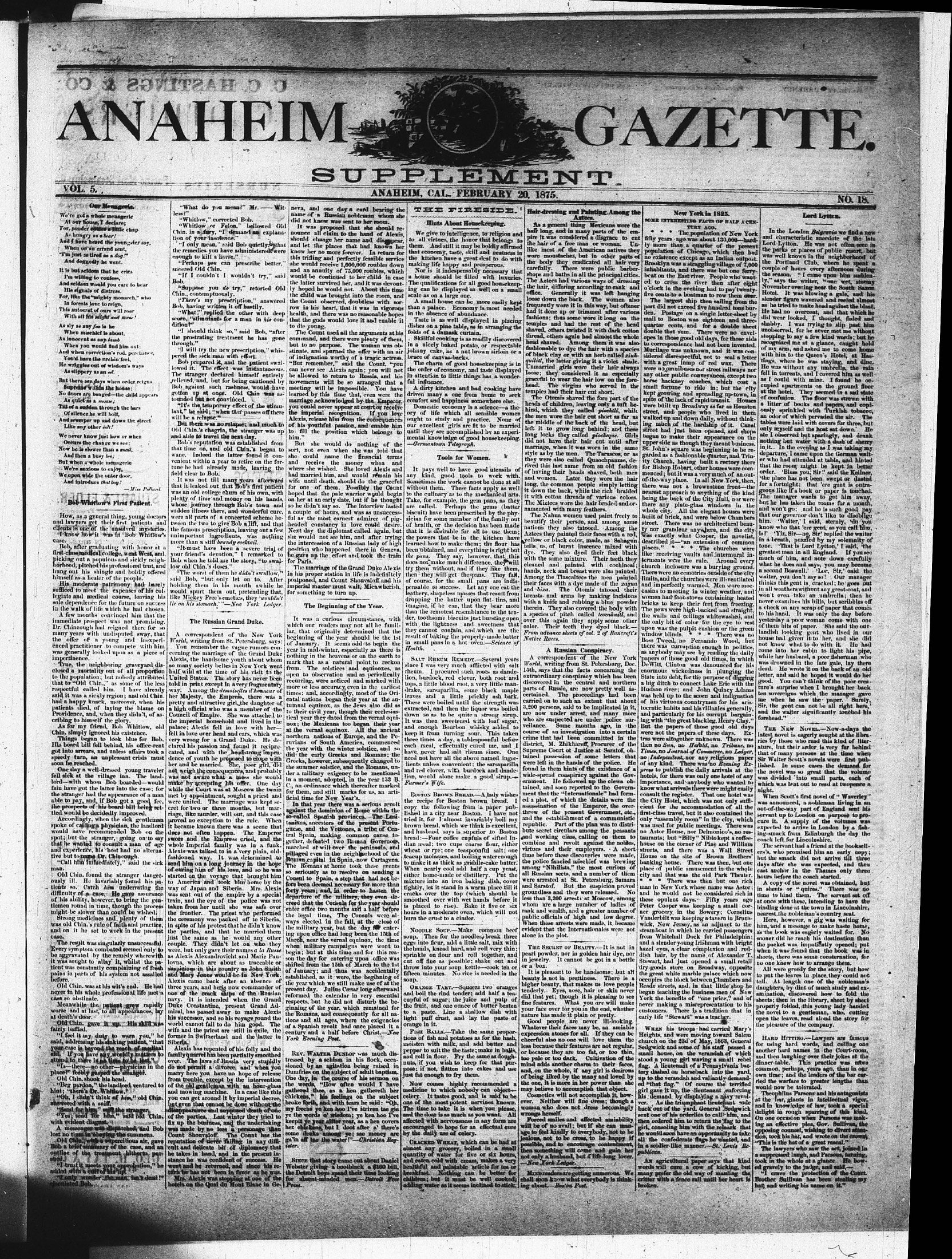
Searchable text
ANAHEIM
VOL. 5.
Our Manageria.
We've got a whole menagerie
At our house, I declare;
For, youder comes a little chap
As hungry as a bear!
And I have heard the youngster say,
When on an errand sent,
"I'm just as tired as a dog!"
And doggedly he went.
It is but seldom that he cries
I'm willing to confess,
And seldom would you care to hear
His signals of distress.
For, like the "mighty monarch," who
In forests love to reign,
This autocrat of ours will roar
With all his might and move!
As sly as any fox is he
When mischief is about,
As innocent as any knob
When you would find him out:
And when correction's rod, perchance,
You'd have the urchin feel,
He wriggles out of wisdom's ways
As slippery as an od.
But there are days when order reigns
Supreme within the house;
No doors are banged—the child appears
As quiet as a mouse;
Till of a sudden through the bars
Of silence he will bolt,
And swumper up and down the street
Like any other colt!
We never know just how or when
Occurs the change we see;
Now he is slower than a mail,
And then a busy bee;
But when a whole managerie
We're anxious to enjoy
"What do you mean?" Mr. — Witless?
"Whitlow," corrected Bob.
"Whitlow or Felon," bellowed Old Chin in a fury, "I demand an explanation of your insolence."
"I only mean," said Bob quietly, "that the remedies you have administered were enough to kill a horse."
"Perhaps you can prescribe better," sneered Old Chin.
“If I couldn't I wouldn't try,” said Bob.
“Suppose you do try,” retorted Old Chin, contemptuously.
“There's my prescription,” answered Bob, having written it off hastily.
“What!” replied the other with deep scorn, “stimulants for a man in his condition?”
“I should think so,” said Bob, “after the prostrating treatment he has gone through.”
“I will try the new prescription,” whispered the sick man with effort.
Bob prepared it, and the patient swallowed it. The effect was instantaneous. The stranger declared himself entirely relieved, and, but for being cautioned by Bob against such rashness, would have gotten up at once. Old Chin was astounded but not convinced.
“It’s the temporary effect of the stimulant,” he said; “when that passes off there will be a relapse.”
But there was no relapse; and much to Old Chin's chagrin, the stranger was up and able to travel the next day.
Bob's reputation was established from that time on, and old Chin's began to wane. Indeed the latter found it convenient within a year to retire on the fortune he had already made, leaving the neva, and one day a name of a Russian novice did not know was sent.
It was proposed that nounce all claim to the should change her name and let the places that know her no more forever this trifling and perfect she would receive 1,000, and an annuity of 75,000 would be continued to the latter survived her, ally hoped he would not; the child was brought in the Count observed, door row in his heart, that in health, and there was no that the gods would love to die young.
The Count used all the command, and there were but to no purpose. The stinate, and spurred the indignation worthy of "But remember," said can never see Alexis agree be allowed to return to movements will be so meeting will be impossessed by this time that marriage acknowledged you could never appear at the imperial recognition Alexis, release him from of his youthful passion, to fill the position with him.”
But she would do sort, not even when she could name the name and receive the most where she wished. She
Bob Whitlow's First Patient.
How, as a general thing, young doctors and lawyers get their first patients and clients is one of the unsolved mysteries. I know how it was in Bob Whitlow's case.
Bob, after graduating with honor at a first-class medical college, went West, and picking out a populous and sickly neighborhood, pitched his professional tent, and hung out his shingle and boldly offered himself as a healer of the people.
His moderate patrimony had barely sufficed to meet the expenses of his collegiate and medical course, leaving his sole dependence for the future on success in the walk of life which he had chosen.
A few months convinced him that the immediate prospect was not promising. Dr. Chincough had reigned there for so many years with undisputed sway, that the offer of a young and inexperienced practitioner to compete with him was generally looked upon as a piece of impertinence.
True, the neighboring graveyard disclosed a mortality out of all proportion to the population; but nobody attributed that to "Old Chin..." as some of the less respectful called him. I have already said it was a sickly region; and old Chin. had a happy knack, moreover, when his patients died, of laying the blame on Providence, and, when they didn't, of ascribing to himself the glory.
As for my friend, Bob Whitlow, old Chin, simply ignored his existence.
Things began to look blue for Bob. His board bill fell behind, his office-reent got into arrears, and unless affairs took a speedy turn, an unpleasant crisis must soon be reached.
One day a well-dressed young traveler fell sick at the village inn. The landlord—with whom Bob boarded—would fain have got the latter into the case; for the stranger had the appearance of a man able to pay, and, if Bob got a good fee, the prospects of his board bill being settled would be decidedly improved.
Accordingly, when the sick gentleman spoke of calling a physician, the landlord would have recommended Bob on the spot; but the stranger, going on to say that he wanted to consult a man of age and experience, his "host had no alternative but to name Dr. Chincough."
"Call him infrequently," said the sick man.
Old Chin found the stranger dangerously ill. He invariably found his patients so. Catch him underrating the street like any other colt!
We never know just how or when Occurs the change we see;
Now he is slower than an email,
And then a busy bee;
But when a whole menagerie We're anxious to enjoy,
We open wide the outer door,
And introduce that boy!
—Miss Pollard.
Bob Whitlow's chagrin, the stranger was up and able to travel the next day.
Bob's reputation was established from that time on, and old Chin's began to wane. Indeed the latter found it convenient within a year to retire on the fortune he had already made, leaving the field clear to Bob.
It was not till many years afterward that it leaked out that Bob's first patient was an old college chum of his own, with plenty of time and money on his hands, whose journey through Bob's town and sudden illness there, and wonderful cure, were all parts of a concerted scheme between the two to give Bob a lift, and that the famous prescription, leaving out a few unimportant ingredients, was nothing more than a stiff brandy cocktail.
"It-must have been a severe trial of your friend's devotion," I remarked to Bob when he told me the story, "to swallow old Chin.'s doses."
"The worst of them he didn't swallow," said Bob, "but only let on to. After holding them in his mouth awhile he would spurt them out, pretending that, like Mickey Free's emetics, they wouldn't lie on his stomach." —New York Ledger.
The Russian Grand Duke.
A correspondent of the New York World, writing from St. Petersburg, says: You remember the vague rumors concerning the marriage of the Grand Duke Alexis, the handsome youth about whom so many society belles in New York went half wild at the time of his visit to the United States. The story has never been told in print except in a very fragmentary way. Among the demoiselles d'honneur of her Majesty, the Empress, there was a pretty and attractive girl, the daughter of a high official who was a member of the Council of Empire. She was attached to the imperial household and lived in the palace; Alexis fell in love with her—fell in love over head and ears, which was very wrong for a Grand Duke. He declared his passion and found it reciprocated, and with the head-strong imprudence of youth he proposed to close with her and be married. She, poor girl, did not weigh the consequences, and probably was not aware what a mess she would make by accepting his offer. One day while the Court was at Moscow the twain met by appointment, sought a priest and were united. The marriage was kept secret for two or three months, but marriage, like murder, will out, and this case proved no exception to the rule. When it became known there was a scene that does not often happen. The Emperor swore and the Empress cried, and the whole Imperial family was in a funk. Alexis was talked to in a very plain, old-fashioned way. It was determined to send him on a long journey in the hope of curring him of his love, and so he was started on the voyage that brought him to America and took him home by the way of Japan and Silberia. Mrs. Alexis can never see Alexis again because he allowed to return to movements will be so meeting will be impossible learned by this time that marriage acknowledged you could never appear at the imperial recognition Alexis release him from of his youthful passion, to fill the position wilt him."
But she would do sort, not even when she could name the man and receive the most where she wished. She had married him, and wife until death should for one of them. Possessed that the pale warrior on her at an early date, but so he didn't say so. There a couple of hours, and full as the most earnest headed constancy in loom Next day the diplomat she would not see him; after the intercession of a Russian position who happened to have up the effort and for Paris.
The marriage of the Grass in his proper station in life postponed, and Count Shapiro imperial master must wait for something to turn up.
The Beginning of
It was a curious circle which our readers may notice that originally detected beginning of the year since January. It seems once a year in mid-winter, especially nothing in the heavens or mark that as a natural from. The solstices and open to observation and recurring were noticed as more or less accuracy every times; and accordingly, entail nations began their tumal equinox, as the Jupiter to their civil year, though tical year they dated from nox; the Mexicans too bad at the vernal equinox. northern nations of Europe ruvians of South America the year with the winter did the early Greeks and Greeks, however subsequent summer solstice, and der a military exigency thru in a moment, adopted, in C., an ordinance which thru for them, and still marks final time for New Year.
In that year there was against the dominion of Homo so-called Spanish provinces tanians, ancestors of the guese, and the Vettones, tra Spain, making cometgather defeated two Boar marched at will over the pillaged even in the neigh Roman capital in Spain. The Romans at home took so seriously as to resolve Consul to Spain, a step forebeen deemed necessary
the stranger had the appearance of a man able to pay, and if Bob got a good fee, the prospects of his board bill being settled would be decidedly improved.
Accordingly, when the sick gentleman spoke of calling a physician, the landlord would have recommended Bob on the spot; but the stranger, going on to say that he wanted to consult a man of age and experience, his host had no alternative but to name Dr. Chincough.
"Call him infrequently," said the sick man.
Old Chin found the stranger dangerously ill. He invariably found his patients so. Catch Him underrating the difficulty of a case. He gave assurance of his ability, however, to bring the gentlemen round in time, though the process might be slower than could be wished.
Strong medicines and plenty of them was old Chin's rule of faith and practice, and on it he set to work in the present case.
The result was singularly unsuccessful. Every symptom combated seemed only to be aggravated by the remedy wherewith it was sought to allay it, whilst the patient was constantly complaining of fresh pains in parts of his system not assailed before.
Old Chin was at his wit's end. He had never in his whole professional life met a case so obstinate.
Meanwhile the patient grew rapidly worse and at last, to all appearances, lay at death's door.
Old Chin gave it up. His skill was fairly hailed.
"I feel it my duty to warn you," he said, addressing his sinking patient, "that your case is beyond the reach of medical aid. If you have any worldly matters to attend to there is no time to be laid."
"It—there—no other—physician in the place!" feebly gasped the stranger.
Old Chin shook his head.
"Beg pardon," the landlord ventured to hint; "there's Dr. Whiflow."
"Oh, I didn't think of him," old Chin answered with a sniff.
"Send for him," said the stranger.
"Yes; send for him," said old Chin, with evident disgust.
A messenger was dispatched, and Bob lost no time in allying the summons.
Old Chin, with a supercilious air, gave Bob a brief summary of the case, and an outline of the treatment hitherto pursued.
"I trust it meets your approbation," he added with a cuff of his lip.
"I only wonder the man isn't dead!" circulated Bob.
IM GAZ
SUPPLEMENT.
ANAHEIM, CAL., FEBRUARY 20, 1875.
neva, and one day a card bearing the name of a Russian nobleman whom she did not know was sent to her room.
It was proposed that she should renounce all claim to the hand of Alexis, should change her name and disappear, and let the places that had known her know her no more forever. In return for this trifling and perfectly feasible service she would receive 1,000,000 roubles down and an annuity of 75,000 roubles, which would be continued to her child in case the latter survived her, and it was devoutly hoped he would not. About this time the child was brought into the room, and the Count observed, doubtless with sorrow in his heart, that it was in vigorous health, and there was no reasonable hopes that the gods would love it and enable it to die young.
The Count used all the arguments at his command, and there were plenty of them, but to no purpose. The woman was obstinate, and spurned the offer with an air of indignation worthy of a tragic actress. "But remember," said the Count, "you can never see Alexis again; you will not be allowed to return to Russia, and his movements will be so arranged that a meeting will be impossible. You have learned by this time that, even were the marriage acknowledged by the Emperor, you could never appear at court or receive the imperial recognition. If you love Alexis, release him from the consequences of his youthful passion, and enable him to fill the position which belongs to him."
But she would do nothing of the sort, not even when she was told that she could name the financial terms and receive the money when and where she wished. She loved Alexis and neva, and one day a card bearing the name of a Russian nobleman whom she did not know was sent to her room.
It was proposed that she should renounce all claim to the hand of Alexis, should change her name and disappear, and let the places that had known her know her no more forever. In return for this trifling and perfectly feasible service she would receive 1,000,000 roubles down and an annuity of 75,000 roubles, which would be continued to her child in case the latter survived her, and it was devoutly hoped he would not. About this time the child was brought into the room, and the Count observed, doubtless with sorrow in his heart, that it was in vigorous health, and there was no reasonable hopes that the gods would love it and enable it to die young.
The Count used all the arguments at his command, and there were plenty of them, but to no purpose. The woman was obstinate, and spurned the offer with an air of indignation worthy of a tragic actress. "But remember," said the Count, "you can never see Alexis again; you will not be allowed to return to Russia, and his movements will be so arranged that a meeting will be impossible. You have learned by this time that, even were the marriage acknowledged by the Emperor, you could never appear at court or receive the imperial recognition. If you love Alexis, release him from the consequences of his youthful passion, and enable him to fill the position which belongs to him."
But she would do nothing of the sort, not even when she was told that she could name the financial terms and receive the money when and where she wished. She loved Alexis and neva, and one day a card bearing the name of a Russian nobleman whom she did not know was sent to her room.
It was proposed that she should renounce all claim to the hand of Alexis, should change her name and disappear, and let the places that had known her know her no more forever. In return for this trifling and perfectly feasible service she would receive 1,000,000 roubles down and an annuity of 75,000 roubles, which would be continued to her child in case the latter survived her, and it was devoutly hoped he would not. About this time the child was brought into the room, and the Count observed, doubtless with sorrow in his heart, that it was in vigorous health, and there was no reasonable hopes that the gods would love it and enable it to die young.
The Count used all the arguments at his command, and there were plenty of them, but to no purpose. The woman was obstinate, and spurned the offer with an air of indignation worthy of a tragic actress. "But remember," said the Count, "you can never see Alexis again; you will not be allowed to return to Russia, and his movements will be so arranged that a meeting will be impossible. You have learned by this time that, even were the marriage acknowledged by the Emperor, you could never appear at court or receive the imperial recognition. If you love Alexis, release him from the consequences of his youthful passion, and enable him to fill the position which belongs to him."
But she would do nothing of the sort, not even when she was told that she could name the financial terms and receive the money when and where she wished. She loved Alexis and neva, and one day a card bearing the name of a Russian nobleman whom she did not know was sent to her room.
It was proposed that she should renounce all claim to the hand of Alexis, should change her name and disappear, and let the places that had known her know her no more forever. In return for this trifling and perfectly feasible service she would receive 1,000,000 roubles down and an annuity of 75,000 roubles, which would be continued to her child in case the latter survived her, and it was devoutly hoped he would not. About this time the child was brought into the room, and the Count observed, doubtless with sorrow in his heart, that it was in vigorous health, and there was no reasonable hopes that the gods would love it and enable it to die young.
The Count used all the arguments at his command, and there were plenty of them, but to no purpose. The woman was obstinate, and spurned the offer with an air of indignation worthy of a tragic actress. "But remember," said the Count, "you can never see Alexis again; you will not be allowed to return to Russia, and his movements will be so arranged that a meeting will be impossible. You have learned by this time that, even were the marriage acknowledged by the Emperor, you could never appear at court or receive the imperial recognition. If you love Alexis, release him from the consequences of his youthful passion, and enable him to fill the position which belongs to him."
But she would do nothing of the sort, not even when she was told that she could name the financial terms and receive the money when and where she wished. She loved Alexis and neva, and one day a card bearing the name of a Russian nobleman whom she did not know was sent to her room.
It is proposed that she should renounce all claim to the hand of Alexis, should change her name and disappear, and let the places that had known her know her no more forever. In return for this trifling and perfectly feasible service she would receive 1,000,000 roubles down and an annuity of 75,000 roubles, which would be continued to her child in case the latter survived her, and it was devoutly hoped he would not. About this time the child was brought into the room, and the Count observed, doubtless with sorrow in his heart, that it was in vigorous health, and there was no reasonable hopes that the gods would love it and enable it to die young.
The Count used all the arguments at his command, and there were plenty of them, but to no purpose. The woman was obstinate, and spurned the offer with an air of indignation worthy of a tragic actress. "But remember," said the Count, "you can never see Alexis again; you will not be allowed to return to Russia, and his movements will be so arranged that a meeting will be impossible. You have learned by this time that, even were the marriage acknowledged by the Emperor, you could never appear at court or receive the imperial recognition. If you love Alexis, release him from the consequences of his youthful passion, and enable him to fill the position which belongs to him."
But she would do nothing of the sort, not even when she was told that she could name the financial terms and receive the money when和where she wished.She loved Alexisand neva,and one day a card bearingthenameofaRussiannoblemanwhomshedidnotknowwassenttoherroom.
We give to intelligence,tothe honorthatbelongstohem.Andstillitmaybeboldlyaffirmedthateconomy,taste,skillandneatnessinthekitchenhavemeadalecaseofthelittlescaleasonaflargeone.
A small house can be more easily kept thana palace.Economyistmostneededintheabsenceofabundance.Tasteisaswelldisplayedinplacingdishesonapinetable.asinarrangingthefoldsofadamaskcurtain.
Skillfulcookingisasreadily discoveredinannicelybakedpotato,rorspectablejohnnycake,a nutbrown sirloinorbraceofcanvas-backs.
The charmofgoodhousekeepingisintheorderofeconomy,andtasteisplayedintentiontolittlethingshasawonderfulinfluence.
A dirtykitchenandbadcookinghavemadeentrmanyaonefromhometoseekcomfortandhappinesssomewhereelse.
Domesticeconomyisascience—atheoryoflifewhichallseniablewomenoughtstudytandpractice.Nomeofourexcellentgirlsfcitbfotebe marrieduntiltheyareaccomplishedbyanexperimentalknowledgeofgoodhousekeeping.-GermantownTelegraph.
ToolsforWomen.
Itparswelltohavegoodutensilsof
Hair-dressingandPaintingAmongtheAstere.
Asa general thingMexicansworethehairlong,andinmanypartsoftheempireitwasconsidereddisgracetocutthehairofafreemanorwoman.UnlikemostoftheAmericannatives theyworemountaches,bbutinotherpartsofthebodytheyeradicatedallhairverycarefullyTherewerepublicbarbershopsandbathsinalltheprincipalcities.TheAztecshadvariouswaysofdressingthehair,differingaccordingtrankandoffice.Generallyitwaslefthangingdowntheback.Thewomenalsofrequentlyworeitinthisway,但offenerhaditdoneuportrimmedaftervariousfashions;thussomeworeitlongonthetemplesandhadtherestoftheheadshaved,theotherstwisteditwithdarkcottonthread,theothersagainhadalmostthewholeheadshaved.Amongthemenitwasalsofashionabletodyehairwithaspeciesofblackclayorwithan herbcalledxiuhuquilitt,the lattergivingitavioletshade.Unmarriedgirlsworetheirhairalwaysloose;theyconsidereditasespeciallygraffeltowearthehairlowontheforehead.Thevirginswhoservedinthetempleshad theirhaircutshort.
TheOtomnisshavedtheforepartoftheheadsofchildrenleavingonlytauftbehind,theymenworethehaircutshortasfarasmiddleofthebackofthehead,但leftittocrowlong behind;andtheselonglockstheycalledpiocheque.Girlsdidnothave theirhaircutuntilarriagewhenitwasworninthesamestyleasbythemen.TheTarascos.orastheywerealsocalledQuaochpanme,drivedthislastnamefromanoldfashion
SOMEINTENTIONS
fiftyyearslatelymorethiopershipnoexistenceBrooklynweinhabitatbeatonthedcdclockinfivecententsThelargestportdidnotden.PostmailtoBccquerodeoincorpurposeMucilagewiserelieddispaiswithagreewerenoonyanyotherhorsehacksmallfortunekeptgrowingspiteofthewerebuiltstreath,andwalkedupimuchstreahadbegantomuppiersideSt.John'sgaragedasanityChurchforBishop
But she would do nothing of the sort, not even when she was told that she could name the financial terms and receive the money when and where she wished. She loved Alexis and had married him, and would remain his wife until death, should do the graceful for one of them. Possibly the Count hoped that the pale warrior would begin on her at an early date, but if he thought so he didn't say so. The interview lasted a couple of hours, and was as unsuccessful as the most earnest admirer of pig-headed constancy in love could desire. Next day the diplomat called again, but she would not see him, and after trying the intercession of a Russian lady of high position who happened there in Geneva, he gave up the effort and took the train for Paris.
The marriage of the Grand Duke Alexis in his proper station in life is indefinitely postponed, and Count Shouvaloff and his imperial master must wait. Micawberish, for something to turn up.
The Beginning of the Year.
It was a curious circumstance, with which our readers may not all be familiar, that originally determined that the beginning of the year should be the 1st of January. It seems odd to begin the year in mid-winter, especially as there is nothing in the heavens or on the earth to mark that as a natural point to reckon from. The solstices and equinoxes, as open to observation and as periodically recurring, were noticed and marked with more or less accuracy, even in the earliest times; and, accordingly, most of the Oriental nations began their year at the autumnal equinox, as the Jews also did as to their civil year, though their ecclesiastical year they dated from the vernal equinox; the Mexicans too began their year at the vernal equinox. All the ancient northern nations of Europe, and the Peruvians of South America, commenced the year with the winter solstice, and so did the early Greeks and Romans; the Greeks, however, subsequently changed to the summer solstice, and the Romans, under a military exigency to be mentioned in a moment, adopted, in the year 153 B.C., an ordinance which thereafter marked for them, and still marks for us, an artificial time for New Year's.
In that year there was a serious revolt against the dominion of Rome within the so-called Spanish provinces. The Lusitanians, ancestors of the present Portuguese, and the Vettones, a tribe of Central Spain, making common cause together, defeated two Roman Governors, marched at will over the peninsula, and pillaged even in the neighborhood of the Roman capital in Spain, now Cartagena. The Romans at home took these events so seriously as to resolve on sending a Consul to Spain, a step that had not before been deemed necessary for more than
Tools for Women.
It pays well to have good utensils of any kind, good tools to work with. Sometimes the work cannot be done at all without them. These facts apply as well to the culinary as to the mechanical arts. Take, for example, the gem pans, as they are called. Perhaps the gems (batter biscuit) have been prescribed by the physician for some member of the family out of health, or the decision has been made that it is desirable for all to use them; the powers that be in the kitchen have learned how to make them; the flour has been obtained, and everything is right but the pans. They say, however, that this does not make much difference, they will try them without, and if they like them, then they will get the pans. They fail of course, for the small pans are indispensable to success. Let any one eat the leathery, shapeless masses that result from dropping the batter upon flat tins, and imagine, if he can, that they bear more than the remotest resemblance to the tender, toothsome biscuits just bursting open with the lightness and sweetness that they cannot contain, and which are the result of baking the properly-made batter in small pans in a hot oven.—Science of Health.
SALT RHEUM REMEDY.—Several years since I was very much afflictied with salt rheum. I procured such roots as dandelion, burdock, red clover, both root and tops a little blood root, a very little mandrake, sarsaparilla, some black maple leaves and a little prickly ash bark. These were boiled until the strength was extracted, and then the liquor was boiled down so as to be quite a strong sirup. It was then sweetened with loaf sugar, and enough Bourbon whisky added to keep it from turning sour. This taken three times a day, a tablespoonful before each meal, effectually cured me, and I have never had salt rheum since. One need not have all the above named ingredients unless convenient; the sarsaparilla and red clover, with burdock and dandelion, would alone make a good sirup.
BOSTON BROWN BREAD.—A lady wishes the recipe for Boston brown bread. I copy the following from a paper published in a city near Boston. I have not tried it, for I almost invariably boil my brown bread, which we think is excellent, and husband says is superior to Boston bread:—Four coffee cupfuls of sifted Indian meal; two cups coarse flour, either wheat or rye; one teaspoonful salt; one teacup molasses, and boiling water enough to make it as thick as griddle-cake batter. When nearly cool add half a cup yeast, either home-made or distillery. Put the mixture into an iron baking dish, cover tightly, let it stand in a warm place till it loose; they considered it as especially graceful to wear the hair low on the forehead. The virgins who served in the temples had their hair cut short.
The Otomis shaved the fore part of the heads of children, leaving only a tuft behind, which they called piechlii, while the men wore the hair cut short as far as the middle of the back of the head, but left it to grow long behind; and these long locks they called piocheque. Girls did not have their hair cut until after marriage, when it was worn in the same style as by men. The Tarascos; or as they were also called Quaochpanme, derived this last name from an old fashion of having their heads shaved, both men and women. Later they wore the hair long, the common people simply letting it down back, while the rich braided it with cotton threads of various colors. The Miztecs wore the hair braded and ornamented with many feathers.
The Nahua women used paint freely to beautify their person,and among some nations they also tattooed. Among the Aztecs they painted their faces with a red,yellow or black color,made,sasahagun tells us,of burnt inscence mixed with dye. They also dyed their feet black with the same mixture. Their teeth cleaned and painted with cochineal; hands,n neck and breast were also painted. Among the Thascaleats they men painted their faces with a dye made of the xagua and bixa. The Otomis tattooed their breasts and arms by making incisions with a knife and rubbing a blue powder therein. They also covered body with a species of pitch called teocahuilt,and over this again they apply some other color. Their teeth they dyed black.-From advance sheets of vol. 2 of Bancroft's Native Races.
A Russian Conspiracy.
A correspondent of the New York World, writing from St.Petersburg, Dec. 15th,says thatthe facts concerningthe extraordinary conspiracywhich has been discovered inthe centralandnorthernparts ofRussia,thearenowprettywellascertained.Theproceedingshadbeencarriedontosuchanextthatabout3200persons,saidbe implicatedinit,aarenowunder arrest,andmanymorewhoaresuspectedareunderpolicesurveillance.Somemonthsago,inthecourseofan investigationintoa certaincrimethathadbeencommittedinthedistrict,M.Zhikhairef.ProcureroftheSupreme CourtofJusticeatSaratog obtained possessionofsomelettersthatwereleftinthehandsofthepolice.Hefoundinthehmindsoftheexistenceofawide-spreadconspiracyagaintheGovernment.Helfollowuptheclewsobtained,andsoreportedtotheGovernmentthatthe“Internationale”hadformedaplot.ofwhichthedetailsweretheassassinationoftheEmperor,theoverthrowofthepresentGovernment,eet,andtheestablishmentofacommunicisticpublic.Apartoftheplanwastocindributesecretcircularsamongthepeasantsandworkingclass,callingon themtocombineandrevoltagainthenotables,virtuesandtheemployers.Ashorttimebeforethediscoveriesweremade,thepolicefanciedmischiefwearingamong“Nihiliasts,”themostcuriousofallRussiansects,andanumberofthemenwerearrestedAtSt.Petersburg,SamaraandSaratof.Butthesuspicionproved
Any other cityHousetientforfirst-classtrafficonly“assessmentwasusedfornoAstorHousetientsbuthouseonthestreets,andHouseonthet bankinghoupleaceofpurecityandthere.”
In that year there was a serious revolt against the dominion of Rome within the so-called Spanish provinces. The Lusitanians, ancestors of the present Portuguese, and the Vettones, a tribe of Central Spain, making common cause together, defeated two Roman Governors, marched at will over the peninsula, and pillaged even in the neighborhood of the Roman capital In Spain, now Cartagena. The Romans at home took these events so seriously as to resolve on sending a Consul to Spain, a step that had not before been deemed necessary for more than forty years; and, in order to hasten the departure of the military, they even decreed that the Consuls for the year should enter office two months and a half before the legal time. The Consuls were always elected in the fall, at the close of the military year, but the day entering upon office had long been the 15th of March, near the vernal equinox, the time when military campaigns were wont to begin; but at this time and for this reason the day for entering upon office was shifted from the 15th of March to the 1st of January; and thus was accidentally established, as it were, the beginning of the year which we still make use of at the present day. Julius Caesar long afterward reformed the calendar in very essential respects, but he did not disturb the beginning of the year, which remained for the Romans, and consequently for all nations and all ages, where the exigencies of a Spanish revolt had once placed it a century and a half before Christ.
New York Evening Post.
Rev. Walter Dunlop was much distressed by a schism in his flock, occasioned by an agitation being raised in Dumfries on the subject of adult baptism. One day, in the course of his sermon on the words, "How often would I have gathered thue, as a hen gathereth her chickens," his feelings on the subject broke forth, and with tears he said: "Oh, my freens ye ken hoo I've striven tae gie ye the words o' wisdom; ye ken hoo I've keepit ye year after year, as a hen covers her chickens, but I doot after a there's some deks among ye; sae money are gain af tae the water!" — Christian Register.
Since that story came out about Daniel Webster giving a bootblack a $100 bill, the Detroit boys spend their time looking for absent-minded men. — Detroit Free Press.
Boston Brown Bread.—A lady wishes the recipe for Boston brown bread. I copy the following from a paper published in a city near Boston. I have not tried it, for Valmost invariably boil my brown bread, which we think is excellent, and husband says is superior to Boston bread: Four coffee cupfuls of sifted Indian meal; two cups coarse flour, either wheat or rye; one teaspoonful salt; one teacup molasses, and boiling water enough to make it as thick as griddle-cake batter. When nearly cool add half a cup yeast, either home-made or distillery. Put the mixture into an iron baking dish, cover tightly, let it stand in a warm place till it cracks over the top (which should be smoothed over with wet hands before it is placed to rise). Bake it five or six hours in a moderate oven, which will not burn the crust to a cinder.
Noodle Soup.—Make common beef soup. Then for the noodles break three eggs into flour, add a little salt, mix with the hands, knead hard, and roll very thin; sprinkle on flour and roll together, and cut off fine as possible; shake out and throw into your soup kettle—cook ten or fifteen minutes. No rice is needed in the soup.
Orange Tart.—Squeeze two oranges and boil the rind tender; add half a tea cupful of sugar; the juice and pulp of the fruit, and one ounce of butter beaten to a paste. Line a shallow dish with light puff crust, and lay the paste of orange in it.
Fish Balls.—Take the same proportions of fish and potatoes as for the hash, moisten with milk, and add butter and pepper to suit the taste; make in balls, and roll in flour. Fry the same as doughnuts, if you wish to keep for that purpose; if not, flatten into cakes and use just fat enough to fry them.
Now comes highly recommended a medicine to which nobody can object—celery. It tastes good, and is said to be one of the most potent nervines known. The time to take it is when you please, and the dose is as much as you want. All affected with nervousness in any form are encouraged to hope for an effectual cure by the daily use of celery.
Cracked Wheat, which can be had at almost any grocery, boiled in a small quantity of water for five or six hours, and eaten cold with cream, makes a very healthful and palatable article for tea or breakfast. Nothing can be better for children; but it must be well cooked) adding water as it seems inclined to stick.
ment that the "Internationale" had formed a plot, of which the details were the assassination of the Emperor, the throw of the present Government, etc., and the establishment of a communistic republic. Part of the plan was to distribute secret circulars among the peasants and working class, calling on them to combine and revolt against the nobles, virtues and their employers. A short time before these discoveries were made, the police fancied mischief was brewing among "Nihillists," the most curious of all Russian sects, and a number of them were arrested at St. Petersburg, Samara and Saratof. But the suspicion proved groundless and they were released. No less than 3,200 arrests at Moscow, among whom are a large number of ladies of rank and wealth, and a greater number of public officials of high and low degree. When these arrests were made, it became evident that the Internationales were not alone in the plot.
The Secret Of Beauty.—It is not in pearl powder, nor in golden hair dye, nor in jewelry. It cannot be got in a bottle or a box.
It is pleasant to be handsome; but all beauty is not in prettiness. There is a higher beauty that makes us love people tenderly. Eyes, nose, hair or skin never did that yet; though it is pleasing to see fine features. What you are will make your face over for you in the end, whether nature has made it plain or pretty.
Good people are never ill-looking. Whatever their faces may be, an amiable expression atones for all. If they can be cheerful also no one will love them less because their features are not regular, or because they are too fat, or too thin, too pale or too dark. Cultivation of the mind adds another charm to their faces, and on the whole, if any girl is desirous of being liked by the many and loved by the one, it is more in her power than she may believe to accomplish that object.
Cosmetics will not accomplish it however. Neither will fine dress; though a woman who does not dress becoming wrongs herself.
Forced smiles and affected amiability will be of no avail; but if she can manage to feel kindly to everybody, not to be jealous, not to be cross, to be happy if possible, and to encourage contentment, then something will come and gain her not only a husband, but & life-long lover.
—New York Leider.
Mixed readers are getting numerous. We shall soon know what everybody is thinking about. — Boston Post.
GAZETTE.
NO. 18.
Among the Mexicans wore the parts of the emblisgrace to cut her woman. Unican natives they had other parts of and all hair very public barber-principal cities. Days of dressing long to rank and was left hanging the women also way, but oftener after various it long on the front of the head with dark cotton almost the whole them it was also with a species herb called xiuh-a violet shade. Their hair always at as especially now on the fore-served in the short. Before part of the only a tuft be-piechli, while short as far as the head, but mind; and these biocheque. Girls cut until after them in the same Tarascos, or as moochanne, dean old fashion
New York in 1825. SOME INTERESTING FACTS OF HALF A CENTURY AGO.
The population of New York fifty years ago was about 130,000—hardly more than a quarter of the present population of Chicago, which then had no existence except as an Indian outpost. Brooklyn was a straggling village of 7,000 inhabitants, and there was but one ferry-boat on the East river. People who wanted to cross the river then after eight o'clock in the evening had to pay twenty-five cents to a boatman to row them over.
The largest ship then sailing from the port did not exceed five hundred tons burden. Postage on a single letter-sheet by mail to Boston was eighteen and three-quarter cents, and for a double sheet double that sum. There were no envelopes in those good old days, for those aids to correspondence had not been invented. Mucilage was unknown, and it was considered disrespectful, not to seal a letter with a great limp of red wax. There were no omnibuses nor street railways nor any other public conveyances, except two horse hackney coaches, which cost a small fortune to ride in; but the city kept growing and spreading up-town, in spite of the lack of rapid transit. Houses were built up Broadway as far as Houston street, and people who lived in them walked up and down daily, without thinking much of the hardship of it. Canal street had just been opened, and shops began to make their appearance on the upper side as though they meant business. St. John's square was beginning to be regarded as a fashionable quarter, and Trinity Church, having built a rectory there for Bishop Hobart, other houses were com-
Lord Lytton.
In the London Belgrivia we find a new and characteristic anecdote of the late Lord Lytton. He was not often seen in the parks or places of public resort, but was well known in the neighborhood of the Portland Club, where he spent a couple of hours every afternoon during the season. "I came upon him suddenly," says the writer, "one wet, stormy November evening near the South Saxon Hotel. It was blowing a gale, and his slender figure wavered and reeled almost as he tried to make head against the blast. He had no overcoat, and that which he did wear looked, I thought, faded and shabby. I was trying to slip past him unobserved, for he never met me without stopping to say a few kind words; but he recognized me at a glance, caught hold of my arm, and asked me to come home with him to the Queen's Hotel, at Hastings, where he was staying, and dine. He was without any umbrella, the rain fell in torrents, and I covered him as well as I could with mine. I found he occupied apartments on the ground floor at the hotel. They seemed in a sad state of confusion. The floor was strewn with a litter of books and papers, and copiously sprinkled with Turkish tobacco, an odor of which pervaded the air. The tables were laid with covers for three, but only myself and the host sat down. He ate I observed but sparingly, and drank nothing but water with a dash of sherry in it. In the evening as I was taking my departure, I came upon the German waiter who had attended at table, and hinted that the room might be kept in better
at as especially know on the fore-served in the short.
before part of the only a tuft be-piochli, while short as far as the head, but mind; and these boocheque. Girls went until after them in the same Tarascon, or as Boochpanme, dean an old fashioned, both men wore the hair simply letting the rich braided various colors. Braded and ordered.
The paint freely to deal among some. Among the places with a red, teoachuill, as Sahagun face mixed with their feet black their teeth they with cochineal; were also painted. Men painted tattooed their taking incisions a blue powder the body with teoachuill, and only some other dyed black.—2 of Bancroft's
Respiracy.
In New York Petersburg, Dec. concerning the which has been and northern pretty well as auges had been sent that about duplicated in it, and many more ever police sur-
ago, in the into a certain admitted in the procurer of the Great Saratof, oblige letters that the police. He existence of a against the Gov-
the clews ob-jo the Governale" had form-tails were the error, the over-government, etc., communistic was to distr-
the peasants on them to hast the nolies,ers. A short lines were made, was brewing most curious of number of them Isburg, Samara apiction proved
any other public conveyances, except two horse hackney coaches, which cost a small fortune to ride in; but the city kept growing and spreading up-town, in spite of the lack of rapid transit. Houses were built up Broadway as far as Houston street, and people who lived in them walked up and down daily, without thinking much of the hardship of it. Canal street had just been opened, and shops began to make their appearance on the upper side as though they meant business. St. John's square was beginning to be regarded as a fashionable quarter, and Trinity Church, having built a rectory there for Bishop Hobart, other houses were commenced; but it was a very much of an out-of-the-way place. In all New York, then, there was not a brownstone front—the nearest approach to anything of the kind being the back of City Hall, nor were there any plate-glass windows in the whole city. All the elegant houses were built of brick, and were below Chambers street. There was no architectural beauty nor grandeur anywhere, and the city was exactly what Cooper, the novelist, described it—an extension of common places." * * * The churches were like receiving vaults and intermural interments were the rule. Around every church enclosure was a burying ground. There were no cemetries outside of the city limits, and the churches were ill-ventilated and imperfectly warmed. Men wore moccasins to meeting in winter weather, and women had foot-stoves containing heated bricks to keep their feet from freezing. The pews were high-backed and straight, the walls and ceilings whitewashed, and the only bit of color for the eye to rest upon was the pulpit cushion or the green window blinds. * * * There was no Boss Tweed, no Fernando Wood, but there was corruption enough in politics, as anybody may see by reading the daily papers of those good old times, in which DeWitt, Clinton was denounced for his enormous wickedness in plunging the State into debt, for the purpose of digging a big ditch to connect Lake Erie with the Hudson river; and John Quincy Adams was held up to the scorn and indignation of his virtuous countrymen for his aristocratic habits and his villanies generally, and particularly for his corrupt bargaining with "the great blackleg, Henry Clay." But the papers of those good old days were not the papers of these days. Extras were altogether unknown. There was then no Sun, no Herald, no Tribune, no Times, no Journal of Commerce, no Ledger, no Independent, nor any religious paper of any kind. There was no Evening Express to publish the daily arrivals at the hotels, for there was only one hotel of any importance, and anybody who wanted to know what arrivals there might easily consult the register. That one hotel was the City Hotel, which was not only sufficient for the accommodation of all the first-class travel, but it also contained the only "assembly room" in the city, which was used for public meetings. There was no Astor House, nor Delmonico's, no restaurants; but "Billy" Niblo kept a coffee-house on the corner of Pine and William streets, and there was a Wall Street House on the site of Brown Brothers' banking house. There was then, but one place of public amusement in the whole city and that was the old Park Theater.* * * * There was then but one rich man in New York whose name was Astor; fell in torrents, and I covered him as well as I could with mine. I found he occupied apartments on the ground floor at the hotel. They seemed in a sad state of confusion. The floor was strewn with a litter of books and papers, and copiously sprinkled with Turkish tobacco, an odor of which pervaded the air. The tables were laid with covers for three, but only myself and the host sat down. He ate I observed but sparingly, and drank nothing but water with a dash of sherry in it.. In the evening as I was taking my departure, I came upon the German waiter who had attended at table, and hinted that the room might be kept in better order. 'Bless you,' Sir," said the Kellner, 'the place has not been swept or dusted for a fortnight; that 'ere gant is outrageous like if a book or paper is touched. The manager wants to get him away, but he has taken the rooms for a month,and won't go; and he is such good pay that our governor don't like to disoblige him. 'Waiter,' I said, sternly,' do you know who that 'ere gent, as you call him, is?' 'Yiz, Sir—no Sir,' replied the waiter in a breath, puzzled by my solemnity of tone. 'That is Lord Lytton,' I said, 'the greatest man in all England. If you see much of him, and note down carefully what he does and says, you may become a second Boswell.' 'Lor, Sir,' said the waiter, you don't say so! Our manager thinks this gent is cracked; he goes out in all weathers without any great-coat,and won't even take an umbrella; then he never examines his bills, but scribbles off a check on any scrap of paper that comes to his hand. It was only the day before yesterday a poor woman come with one of them bits of paper. She said the outlandish looking gent who lived in our house had given it to her,and she did not know what to do with it. He had come into her cabin to light his pipe, while her husband,a poor fisherman who was drowned in the late gale, lay there dead. He wrote it on the back of an old letter,and said he hoped it would do her good. You can't think of the poor creature's surprise when I brought her back ten sovereigns which the manager gave me when he saw the paper. Surely,Sir,the gent can not be all right here,'and the waiter significantly touched his forehead."
The New Novel—Now-a-days the latest novel is eagerly sought at the libraries by those who read this kind of literature,但 their ardor is very far behind that of many persons at the time when Sir Walter Scott's novels were first published.In some cases the demand for the novel was so great that the volume was divided into small parts,c each of which was lent out to read at twopence a night.
When Scott's first novel of "Waverley" was announced,a nobleman living in an out-of-the-way part of England sent his servant up to London on purpose to procure it.A supply of the volumes was expected to arrive in London by a fishing-smack from Edinburgh the day the coach left for Lincolnshire.
The servant had a friend at the booksellers',who promised him an early copy;but the smack did not arrive till three days after she was expected,and then east anchor in the Thames only three hours before the coach started.
A copy of the novel was obtained,but in sheets or "quires."There was no
It is not in hair dye, nor got in a bottle some; but all there is a love people or skin never deceasing to see the end, whether pretty.
Ill-looking, an amiable if they can be move them the are not regular, or too thin,ivation of the face, girl is desirous and loved by lower than she that object. Applish it, howcess; though a body, not to be happy if contentment, and gain her life-long lover.
Amiability able can man-body, not to be be happy if contentment, and gain her life-long lover.
An agricultural paper says: that kind words will cure a cow of kicking, but many prefer the old way of manling the critter with a fence rail until her heart is broken.
When his troops had carried Mary's Heights, and were moving toward Salem church on the 23d of May, 1863, General Sedgwick and some of his staff passed a small house, on the verandah of which stood a young girl waving a small rebel flag. A lieutenant of a Pennsylvania battery dashed on horseback into the yard, up to the verandah and valiantly demanded "that flag." Of course the terrified girl gave it up, the lieutenant enforcing his demand by displaying a navy revolver. As the triumphant heuteman rode back out of the yard, General Sedgwick sent one of his orderlies to call him, and then ordered him to return the flag to the girl, consoling him with the remark that he would soon have an opportunity to take all the confederate flags he wanted, and in a soldier-like manner—St. Louis Republican.
An agricultural paper says: that kind words will cure a cow of kicking, but many prefer the old way of manling the critter with a fence rail until her heart is broken.
When Scott's first novel of "Waverley" was announced, a nobleman living in an out-of-the-way part of England sent his servant up to London on purpose to procure it. A supply of the volumes was expected to arrive in London by a fishing-smack from Edinburgh the day the coach left for Lincolnshire.
The servant had a friend at the booksellers' who promised him an early copy; but the smack did not arrive till three days after she was expected, and then cast anchor in the Thames only three hours before the coach started.
A copy of the novel was obtained, but in sheets or "quires." There was no time to bind them. The servant set off at once with these, intending to have the binding done at the town in Lincolnshire, nearest the nobleman's country seat.
Here, however, a gig was waiting for him, and a message to make haste home, as the book was eagerly waited for. No sooner did he reach his destination than the packet was impatiently opened; put when it was found that the book was in sheets, there was some consternation, for no one knew how to arrange them.
All were greedy for the story, but how to put the leaves in place they could not tell. At length one of the nobleman's daughters, by dint of much study and examination, discovered how to fold the sheets; then in the library, sheet by sheet properly folded, this young lady handed the novel to a gentleman, who, cutting open the leaves, read aloud the story for the pleasure of the company.
Hard Hitting. Lawyers are famous for using hard words, and calling one another hard names in the Court-room, and then laughing over their jokes at the dinner-table. This practice was more common, perhaps, years ago, than in our own time; and the leaders of the bar carried the warfare to greater lengths than would now be tolerated.
Theophilus Parsons and his antagonists at the bar, giants in intellectual vigor, and in knowledge of law, took a special delight in rough sparring of this kind. On one occasion when Parsons was making an effective plea, Gov. Sullivan, the opposing counsel, wishing to divert attention, took his hat, and wrote on the crown: "This is the hat of a great rascal."
The lawyers who saw the act, joined in a suppressed laugh, and Parsons turning, took in the whole at a glance. He bowed gravely to the judge, and said,
"I crave the protection of the Court. Brother Sullivan has been stealing my hat; and writing his name on it."