anaheim-gazette 1875-02-13
Scanned page
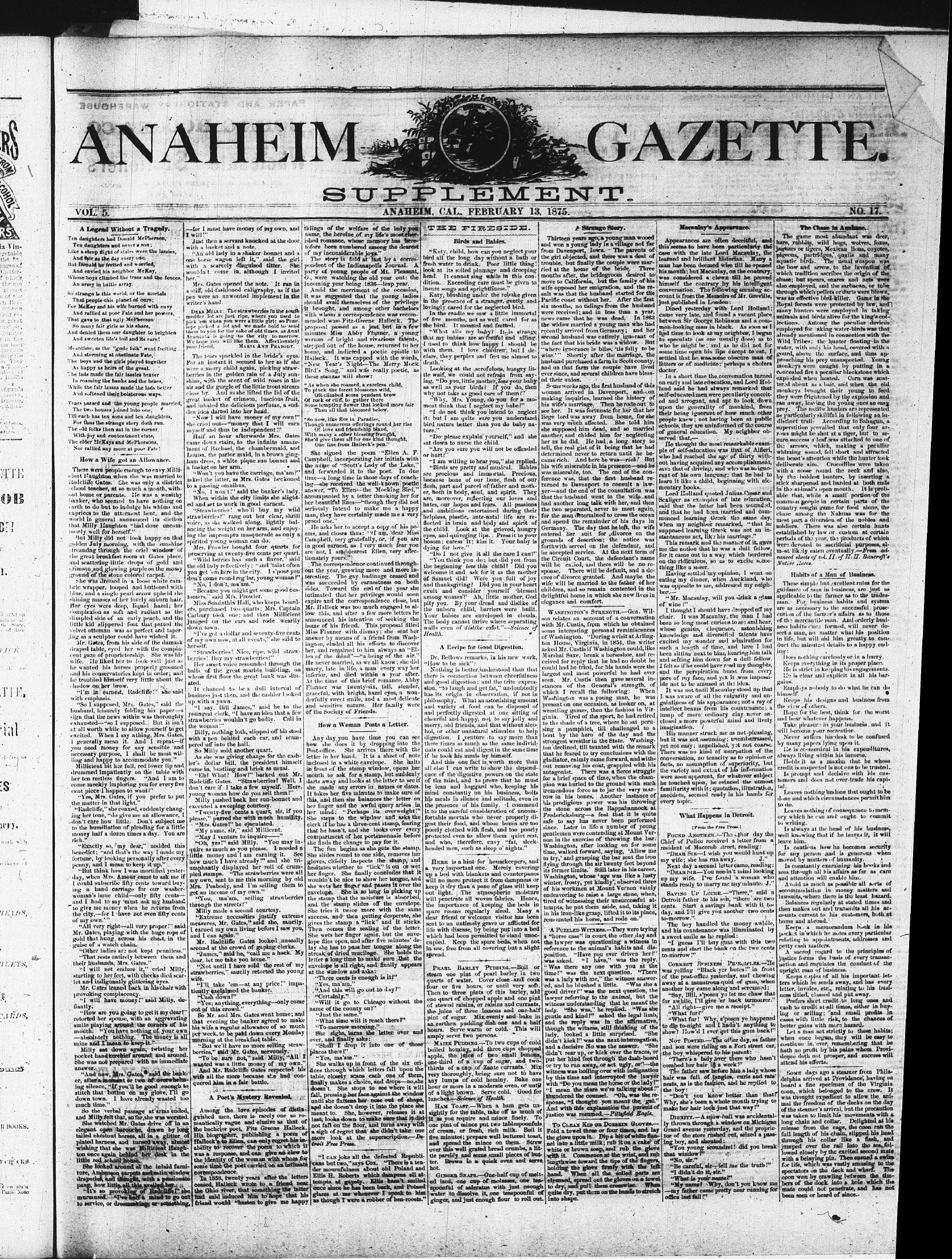
Searchable text
A Legend Without a Tragedy.
Ten daughters had Donald McPherson,
Ten daughters and never a son;
Like a steep flight of stairs were the lassies,
And fair as the day every one.
But Donald he fretted and worried,
And envied his neighbor McKay,
Whose boys climbed the trees and the fences,
An army in battle array.
So strango is this world, or the mortals
That people this planet of ours;
For McKay and his wife burned with envy
And rallied at poor Fate and her powers,
That gave to that ugly McPherson
So many fair girls as his share,
And denied them one daughter to brighten
And sweeten life's toil and its care!
Meantime, as the "gude folk" went fretting
And storming at obstinate Fate,
The boys and the girls played together
As happy as heirs of the great.
The lads made the fair lassies braver
In roaming the banks and the braces,
While the fair lasses made the lads better
And softened their bolsterous ways.
Years passed and the young people married,
The two houses joined into one,
Till each has ten sons and ten daughters,
For thus the strange story doth run.
The old folks then sat in the corner.
With joy and contentment elate,
The elder McKays and McPhersons,
Nor rallied any more at poor Fate!
How a Wife got an Allowance.
—for I must have money of my own, and
I will!"
Just then a servant knocked at the door
with a basket and a note.
"An old lady in a shaker bonnet and a
one horse wagon left it," said the girl
with a scarcely disguised titter. She
wouldn't come in, although I invited
her."
Mrs. Gates opened the note. It ran in
a stiff, old-fashioned caligraphy, as if the
pen were an unwonted implement in the
writer's hand.
DEAR MILLY: The strawberries in the south
medder lot are just ripe, where you used to
pick 'em when you were a little girl; so Penelope picked a lot and we made bold to send
them to you for the sake of old times, as Annt
Araminta is going to the city to-morrow.
We hope you will like them. Affectionately
your friend,
MARIA ANN PEABODY.
The tears sparkled in the bride's eyes.
For an instant it seemed to her as if she
were a merry child again, picking strawberries in the golden rain of a July sunshine,
with the scent of wild roses in the air and the gurgle of the little trout stream close by. And as she lifted the lid of the great basket of crimson, luscious fruit,
and inhaled the delicious perfume, a sudden idea darted into her head.
"Now I will have money of my own!"
she cried out—"money that I will earn
myself and thus be independent!"
Half an hour afterwards Mrs. Gates came down stairs, to the infinite amazement of Rachael, the chambermaid, and
Louisa, the parlor maid, in a brown gingham dress, a white pique sun bonnet and
a basket on her arm.
tidings of the week
name, the heroine
ished romance, whi
tofore been numb
of my inconsideral
The story is topondent of the Inoparty of young peaO., were watching
incoming year beinAmid the merrie
it was suggested t
should avail them
it brought, and a
with whom a corremended was Fitzproposal passed a
minutes Miss Abwoman of bright
stepped out of therhome, and indicteHaileck. It was c
"New Year's NighBird's Song," and
these stanzas will
"As when she roamed
To pluck the forest t
Of rock or cliff, to go
Some tempting floweThan all that bloc
"So now, like Eve in
Though numerous o'
Of love and frienWith many a sober b
She'd give them all f\
One line from H
She signed the Campbell, incorpothe name of "Scot-
The lads made the fair lashes braver
In roaming the banks and the braes,
While the fair lashes made the lads better
And softened their bolsterous ways.
Years passed and the young people married,
The two houses joined into one,
Till each has ten sons and ten daughters,
For thus the strange story doth run.
The old folks then sat in the corner.
With joy and contentment elate,
The elder McKays and McPhersons,
Nor rallied any more at poor Fate!
How a Wife got an Allowance.
There were people enough to envy Millicent Haughton when she was married to Radcliffe Gates. She was only a district school teacher, at so much a month, without home or parents. He was a wealthy banker, who seemed to have nothing on earth to do but to indulge his whims and caprices to the uttermost bent, and the world in general announced its diction that Milly Haughton "had done uncommonly well for herself."
But Milly did not look happy on that golden July morning, with the sunshine streaming through the oriel window of the great breakfast room at Gates place, and scattering little drops of gold and crimson and glowing purple on the mossy ground of the stone colored carpet.
She was dressed in a loose white cambrie wrapper, looped and buttoned with blue, and a single pearl arrow upheld the shining masses of her lovely auburn hair. Her eyes were deep, liquid hazel; her complexion as soft and radiant as the dimpled side of an early peach, and the little kid slippered foot that patted the velvet ottoman was as perfect and tapering as a sculptor could have wished it.
Mr. Gates, from his side of the damask draped table, eyed her with the complacent gaze of proprietorship. She was his wife. He liked her to look well just as he wanted his horses properly groomed and his conservatories kept in order; and he troubled himself very little about the shadow on her brow.
"I'm in earnest, Radcliffe!" she said with emphasis.
"So I supposed, Mrs. Gates," said the husband, leisurely folding his paper—a sign that the news within was thoroughly exhausted—"so I supposed. But it isn't at all worth while to allow yourself to get excited. When I say athing, Mrs. Gates, I generally mean it. And I repeat—if you need money for any sensible and necessary purpose, I shall be most willing and happy to accommodate you."
Millicent bit her full, red lower lip and drummed impatiently on the table with her ten restless fingers. "And I am to come weekly imploring you for every five cent piece I happen to want?"
"Yes, Mrs. Gates, if you prefer to put the matter in that light."
"Radcliffe," she coaxed, suddenly changing her tone, "do give me an allowance, I don't care how little. Don't subject me to the humiliation of pleading for a little money half a dozen times a day. You are rich."
"Exactly so, my dear," nodded this benedict; "and that's the way I made my fortune, by looking personally after every penny, and I mean to keep it up."
"But think how I was mortified yesterday, when Mrs. Amour came to ask me if I could subscribe fifty cents toward buying a hand carriage for our washerberries in the golden rain of a July sunshine, with the scent of wild roses in the air and the gurgle of the little trout stream close by. And as she lifted the lid of the great basket of crimson, luscious fruit, and inhaled the delicious perfume, a sudden idea darted into her head.
"Now I will have money of my own!" she cried out—"money that I will earn myself and thus be independent!"
Half an hour afterwards Mrs. Gates came down stairs, to the infinite amazement of Rachael, the chambermaid, and Lonisa, the parlor maid, in a brown gingham dress, a white pique sun bonnet and a basket on her arm.
"Won't you have the carriage, ma'am?" asked the latter, as Mrs. Gates beckoned to a passing omnibus.
"No, I won't!" said the banker's lady.
When within the city limits she alighted and set to work in good earnest.
"Strawberries! who'll buy my wild strawberries!" rang out her clear, shrill voice, as she walked along, lightly balancing the weight on her arm, and enjoying the impromptu masquerade as only a spirited young woman can do.
Mrs. Prowler bought four quarts for preserving at twenty-five cents per quart.
"Wild berries such as a flavor," said the old lady reflectively; "and 'taint often you get 'em here in the city. I'm pose you don't come round reg'lar, young woman?"
"No, I don't, ma-am."
"Because you might get some good customers," said Mrs. Prowler.
Miss Seminthia Hall, who keeps boarders, purchased two quarts; Mrs. Captain Carbury took one; and then Millicent jumped on the cars and rode wearily down town.
"I've got a dollar and seventy-five cents of my own now, at all events," she said to herself.
"Strawberries! Nice, ripe, wild strawberries! Buy my strawberries!"
Her sweet voice resounded through the halls of the great marble building, on whose first floor the great bank was situated.
It chanced to be a dull interval of business just then, and the cashier looked up with a yawn.
"I say, Bill James," said he to the youngest clerk; "I have an idea that a few strawberries wouldn't go badly. Call in the woman."
Billy, nothing loth, slipped off his stool with a pen behind each car, and scampered off into the hall.
So Milly sold another quart.
As she was giving change for the cashier's dollar bill, the president himself came in, bustling and brisk as usual.
"Eh? What? How?" barked out Mr. Radcliffe Gates. "Strawberries? Well, I don't care if I take a few myself. Here, young woman how do you sell them?"
Milly pushed back her sun-bonnet and executed a sweeping courtesy.
Twenty-five cents a quart, sir, if you please," purred she with much humility.
"Mrs. Gates!" he ejaculated.
"My name, sir," said Millicent.
"May I venture to inquire——"
"Oh, yes!" said Milly. "You may inquire as much as you please. I needed a little money and I am earning it. See how much I have already!" and she triumphantly displayed her roll of crumpled stamps. "The strawberries were all my own, sent to me this morning by old Mrs. Peabody, and I'm selling them to birds a song, and these stanzas will." As when she roamed To pluck the forest for Oft climbed some Of rock or cliff; to go Some tempting flowers Than all that blues
So now, like Ere in Though numerous owl Of love and friend With many a sober bob She'd give them all f One line from H
She signed the Campbell, incorporation of the name of "Scott and forwarded it time—a long time in time—she received an answer." To Ellen accompanied by an other beautiful lines seriously intend to man they have cew proud one."
He asks her to admire and closes the Campbell, very grace in good earnestness; as are not, I am derionately yours.
The correspondence out the year grows terrestering. The girl was succeeded by sides. Toward this intimated that her expire and the comforter Mr. Halleck was too low this, and after announced his intime home of his friend Miss Flanner with answer by means ofington, eluded all her,and remained len of the mind." He never married,marry late in life inferior,and died At the time of tha Flanner was two graceful,with bridderfully sweet smile and sensitive nature of the Society of L
How a Woman
Any day you hear how she does it Post-office. She letter in her hands inclosed in a white front of the stair mouth to ask for darts away and look she made any art It takes her five r this,and then she her finger and her mind: "Per She steps to the clerk if he has a t that he hasn't,and compartment of L she finds the chang
The fun begin She slides round gloves,c closely hesitates whether her finger.She wiouldn't be nice she wets her finge
"Yes, Mrs. Gates, if you prefer to put the matter in that light."
"Radcliffe," she coaxed, suddenly changing her tone, "do give me an allowance, I don't care how little. Don't subject me to the humiliation of pleading for a little money half a dozen times a day. You are rich."
"Exactly so, my dear," nodded this benedict; "and that's the way I made my fortune, by looking personally after every penny, and I mean to keep it up."
"But think how I was mortified yesterday, when Mrs. Amour came to ask me if I could subscribe fifty cents toward buying a hand carriage for our washerwoman's lame child—only fifty cents—and I had to say 'must ask my husband to give me money when he returns from the city,'—for I have not even fifty cents of my own."
"All very right—all very proper!" said Mr. Gates, playing with the huge rope of gold that hung across his chest, in the guise of a watch chain.
"Other ladies are not kept penniless."
"That rests entirely between them and their husbands, Mrs. Gates."
"I will not endure it," cried Milly, starting to her feet, with cheeks died scarlet and indignantly glittering eyes.
Mr. Gates leaned back in his chair with provoking complacency.
"I will have money!" said Milly, defiantly.
"How are you going to get it my dear?" retorted her spouse, with an aggravating smile playing around the corners of his mouth. "You have nothing of your own—absolutely nothing. The money is all mine and I mean to keep it."
Milly sat down again, twisting her pocket handkerchief around and around. She was not prepared with an immediate answer.
"And now, Mrs. Gates," said the banker, after a moment or two of overwhelming silence, "If you'll be good enough to stitch that button on my glove, I'll go down town. I have already wasted too much time."
So the verbal passage at arms ended, and Milly felt that, so far, she was worsted.
She watched Mr. Gates drive off in an elegant open barouche, drawn by long tailed chestnut horses, all in a glitter of plated harness, and turned away, almost wishing that she was Millicent Haughton once again behind her desk in the little red school house.
She looked around at the inlaid furniture, Ambusson carpets and satin window draperies, and thought, with a passionate pang, how little all this availed her.
"It's so provoking of Radcliffe!" she murmured. "I've half a mind to go out to service, or dreammaking; or something,
young woman how do you sell them?"
Milly pushed back her sun-bonnet and executed a sweeping courtesy.
"Twenty-five cents a quart, sir, if you please," purred she with much humility.
"Mrs. Gates!" he ejaculated.
"My name, sir," said Millicent.
"May I venture to inquire——"
"Oh, yes!" said Milly. "You may inquire as much as you please. I needed a little money and I am earning it. See how much I have already!" and she triumphantly displayed her roll of crumpled stamps. "The strawberries were all my own, sent to me this morning by old Mrs. Peabody, and I'm selling them to get an income of my own."
"You, ma'am, selling strawberries through the streets?"
Milly made a second courtesy.
"Extreme necessities justify extreme measures, Mr. Gates," said she, saucily. I earned my own living before I saw you, and I can again."
Mr. Radcliffe Gates looked uneasily around at the crowd of gaping clerks.
"James," said he, "call me a hack. My dear, let me take you home."
"Not until I have sold the rest of my strawberries," saucily retorted the young wife.
"I'll take 'em—at any price!" impatiently exclaimed the banker.
"Cash down?"
"Yes; anything everything—only come out of this crowd."
So Mr. and Mrs. Gates went home; and that evening the banker agreed to make his wife a regular allowance of so much per week, to be paid down every Monday morning at the breakfast table.
"But we'll have no more selling strawberries," said Mr. Gates, nervously.
"To be sure not," said Milly, "All I wanted was a little money of my own."
And Mr. Radcliffe Gates respected his wife all the more because she had conquered him in a fair battle.
A Poet's Mystery Revealed
Among the love episodes of distinguished men, there is rarely one so romantically vague and elusive as that of the bachelor poet, Fitz Greene Halleck. His biographer, publishing a poem of Halleck's to Ellen, can only regret his inability to recover the poem to which it was a response, and can give no clew to the identity of the woman with whom for some time the poet carried on an intimate correspondence.
In 1858, twenty years after the letters ceased, Halleck wrote to a friend near the Ohio river, that something the latter had induced him to hope that his friend would "hasten to give me happy
It takes her five rushes this, and then she her finger and then her mind: "Pen She steps to the clerk if he has a tie that he hasn't, and compartment of Lily she finds the change.
The fun begins. She slides round gloves, closely insists whether her finger. She wouldn't be nice if she wets her finger envelope. She is the stamp that thrashes and the stamp sinks.
She tries it twice successes, and then gives the stamp. Then comes the clerk. She wets her finger loops open and lay she has to pass streak of dried milk letter a long time envelope is all right at the window and three cents is three cents.
Yes, ma'am." And this will certainly.
Will it go to name of the count?
Just the same.
What time will she sighs turn over, and finally she shall drop places there?
Yes, ma'am."
She walks up fifes through whirl table, closely so finally makes a call doesn't. She still falls, pressing hard until she flattens and she doesn't meant to. She last looks down not fall on the floor a sigh of regret more look at fruit Free Press."
CIM GA
SUPPLEMENT.
ANAHEIM, CAL., FEBRUARY 13, 1875.
tidings of the welfare of the lady you name, the heroine of my life's most cherished romance, whose memory has herefore been numbered among the dearest of my inconsiderable joys."
The story is told at last by a correspondent of the Indianapolis Journal. A party of young people of Mt. Pleasant, O., were watching the old year out; the incoming year being 1836—leap year.
Amid the merriment of the occasion, it was suggested that the young ladies should avail themselves of the privilege it brought, and among other bachelors with whom a correspondence was recommended was Fitz-Greene Halleck. The proposal passed as a jest, but in a few minutes Miss Abby Flanner, a young woman of bright and vivacious talents, stepped out of the house, returned to her home, and indicted a poetic epistle to Halleck. It was capped with the words, "New Year's Night—The Merry Mock Bird's Song," and was really poetic, as these stanzas will show:
"As when she roamed, a careless child,
To pluck the forest blossoms wild,
Oft climbed some pendent brow
Of rock or cliff, to gather there
Some tempting flower that looked more fair
Than all that bloomed below.
So now, like Eve in Paradise,
Though numerous offerings round her rise
Of love and friendship bland,
With many a sober blessing fraught,
She'd give them all for one kind thought,
One line from Halleck's pen."
She signed the poem "Ellen A. F. Campbell, incorporating her initials with the name of 'Scott's Lady of the Lake,'"
THE FIRESIDE.
Birds and Babies.
"Katy, child, how can you neglect your bird all the long day without a bath or fresh water to drink. Poor little thing! look at its soiled plumage and drooping head. It cannot sing while in this condition. Exceeding care must be given to insure songs and sprightliness."
Katy, blushing under the rebuke given in the presence of a stranger, gently and lovingly cared for the neglected bird.
In the cradle we saw a little immortal of five months, not as well cared for as the bird. It moaned and fretted.
"What ails my baby? It is strange that my babies are so fretful and alluring. I used to think how happy I should be with them. I love children; but I declare, they perplex and frust me almost to death."
Looking at the scrofulous, hungry little waif, we could not refrain from saying, "Do you, little mother, lose your baby as well as your birds? If you do, then why not take as good care of them?"
"Why, Mrs. Young, do you for a moment think that I neglect my babe?"
"I do not think you intend to neglect it; but I am quite sure you understand bird nature better than you do baby nature."
"Do please explain yourself," and she sat down to nurse the child.
"Are you sure you will not be offended or hurt?"
"I am willing to hear you," she replied.
"Birds are pretty and musical. Babies"
A Strange Story.
Thirteen years ago, a young man wooed and won a young lady in a village not far from Davenport, Iowa. The parents of the girl objected, and there was a deal of trouble, but finally the couple were married at the home of the bride. Three months after, the bridegroom desired to move to California, but the family of his wife opposed her emigration, and the result was that the husband started for the Pacific coast without her. After the first six months, no tidings from the husband were received; and in less than a year, news came that he was dead. In 1863 the widow married a young man who had recently arrived from Germany; and her second husband was entirely ignorant of the fact that his bride was a widow. But where ignorance is bliss, 'tis folly to be wise." Shortly after the marriage, the husband purchased a farm in Scott county, and on that farm the couple have lived ever since, and several children have blessed their union.
Some weeks ago, the first husband of this woman arrived in Davenport, and on making inquiries, learned the history of his wife's marriage. Then he rode out to see her. It was fortunate for her that her liege lord was away from home, for she was very much affected. She told him she supposed him dead, and so married another, and chided him for neglecting her as he did. He had a long story to tell, the real gist of it being that he had determined never to return until he became rich. And here he was—rich! But his wife miserable in his presence—and he
How a Woman Posts a Letter.
Any day you have time you can see how she does it by dropping into the Post-office. She arrives there with the letter in her hand. It is a sheet of note inclosed in a white envelope. She halts in front of the stamp window, opens her mouth to ask for a stamp, but suddenly darts away and looks at the letter to see if she made any errors in names or dates. It takes her five minutes to make sure of this, and then she balances the letter on her finger and the awful query arises in her mind: "Perhaps its overweight!" She steps to the window and asks the clerk if he has a three-cent stamp, fearing that he hasn't, and she looks over every compartment of her portemonnaie before she finds the change to pay for it.
The fun begins as she gets the stamp. She slides round to one side, removes her gloves, closely inspects the stamp, and hesitates whether to "lick" it on or wet her finger. She finally concludes that it wouldn't be nice to show her tongue, and she wets her finger and passes it over the bird's song, and was really poetic, as these stanzas will show:
"As when she roamed, a careless child,
To pluck the forest blossoms wild,
Oft climbed some pendent brow
Of rock or cliff, to gather there
Some tempting flower that locked more fair
Than all that bloomed below.
"So now, like Ere in Paradise,
Though numerous offerings round her rise
Of love and friendship bland,
With many a sober blessing fraught,
She'd give them all for one kind thought,
One line from Halleck's pen."
She signed the poem "Ellen A. F. Campbell, incorporating her initials with the name of 'Scott's Lady of the Lake,' and forwarded it to the poet. In due time—a long time in those days of coaching—she received the well-known poetic answer, "To Ellen—the Mocking Bird," accompanied by a letter thanking her for her beautiful lines—"though they did not seriously intend to make me a happy man, they have certainly made me a very proud one."
He asks her to accept a copy of his poems, and closes thus: "I am, dear Miss Campbell, very gratefully, or, if you are in good earnest, as I very much fear you are not, I am dearest Ellen, very affectionately yours.
The correspondence continued throughout the year, growing more and more interesting. The gay badinage ceased and was succeeded by carnestness on both sides. Toward the end of the year she intimated that her privilege would soon expire and the correspondence close, but Mr. Halleck was too much engaged to allow this, and after a few more letters he announced his intention of seeking the home of his friend. This proposal filled Miss Flanner with dismay; she sent her answer by means of a friend from Washington, eluded all his efforts to discover her, and remained to him always an "Elen of the mind"—"a being of the air." He never married, as we all know; she did marry, late in life, a man every way her inferior, and died within a year after. At the time of this brief romance, Abby Flanner was twenty-six, tall, slender, graceful, with bright, hazel eyes, a wonderfully sweet smile, and a most delicate and sensitive nature. Her family were of the Society of Friends.
A Recipe for Good Digestion.
Dr. Bellows remarks, in his new work, "How to be sick":
Nothing is better understood than that there is connection between cheerfulness and good digestion; and the tite expression, "to laugh and get fat," undoubtedly has its origin in observation, if not in philosophy. What an astonishing amount and variety of food can be disposed of and perfectly digested at one sitting of cheerful and happy, not to say jolly and merry, old friends, and that without alcohol, or other unnatural stimulus to help digestion. I venture to say more than three times as much as the same individuals could eat and digest in the same time if he took his meals by himself.
And this one faec is worth more than all else I can write to show the dependence of the digestive powers on the state of the mind, and to prove that he must be lean and haggard who, keeping his mind constantly on his business, bolts his meals in silence and solitude, even in the presence of his family. I commend it to the careful consideration of uncomfortable mortals who never properly digest their food, and whose bones are too poorly clothed with flesh, and too poorly protected even to allow quiet rest, and who, therefore, envy "fat, sleek-headed men, such as sleep o' nights."
Here is a hint for housekeepers, and a very important one. Merely covering up a bed with blankets and counterpanes will no longer protect it from dampness or keep it dry than a pane of glass will keep it cool under the waistline, we could not refrain from saying, "Do you, little mother, love your baby as well as your birds? If you do, then why not take as good care of them?"
Why, Mrs. Young, do you for a moment think that I neglect my babe?
"I do not think you intend to neglect it; but I am quite sure you understand bird nature better than you do baby nature."
"Do please explain yourself," and she sat down to nurse the child.
Are you sure you will not be offended or hurt?
"I am willing to hear you," she replied.
Birds are pretty and musical. Babies are precious and immortal. Precious because bone of our bone, flesh of our flesh, part and parcel of father and mother, both in body, soul, and spirit. They are moreover, reflecting our loves and hates, our hopes and fears. All passions and ambitions entertained during their helpless, plastic, ante-natal life are reflected in brain and body and spirit of the child. Look at the grieved, hungry eyes, and quivering lips. Press it to your bosom: caress it; kiss it. Your baby is dying for love."
"Do I not give it all the care I can?" "You think you do; but did you from the beginning love this child? Did you welcome it and ask for it as the mother of Samuel did? Were your full joy and thanksgiving? Did you in your heart exult and consider yourself 'blessed among women?' Ah, little mother, God pity you. By your dread and dislike of the unborn child, barriers were built. Your babies are enveloped in clouds. The body cannot thrive where separating walls even of distike exist." — Science of Health.
A Recipe for Good Digestion.
Dr. Bellows remarks, in his new work,
"How to be sick":
Nothing is better understood than that there is connection between cheerfulness and good digestion; and the tite expression, "to laugh and get fat," undoubtedly has its origin in observation, if not in philosophy. What an astonishing amount and variety of food can be disposed of and perfectly digested at one sitting of cheerful and happy, not to say jolly and merry, old friends, and that without alcohol, or other unnatural stimulus to help digestion. I venture to say more than three times as much as the same individuals could eat and digest in the same time if he took his meals by himself.
And this one faec is worth more than all else I can write to show the dependence of the digestive powers on the state of the mind, and to prove that he must be lean and haggard who, keeping his mind constantly on his business, bolts his meals in silence and solitude, even in the presence of his family. I commend it to the careful consideration of uncomfortable mortals who never properly digest their food, and whose bones are too poorly clothed with flesh, and too poorly protected even to allow quiet rest, and who, therefore, envy "fat, sleek-headed men, such as sleep o' nights."
Here is a hint for housekeepers, and a very important one. Merely covering up a bed with blankets and counterpanes will no longer protect it from dampness or keep it dry than a pane of glass will keep it cool under the waistline, we could not refrain from saying, "Do you, little mother, love your baby as well as your birds? If you do, then why not take as good care of them?"
Why, Mrs. Young, do you for a moment think that I neglect my babe?
"I do not think you intend to neglect it; but I am quite sure you understand bird nature better than you do baby nature."
"Do please explain yourself," and she sat down to nurse the child.
Are you sure you will not be offended or hurt?
"I am willing to hear you," she replied.
Birds are pretty and musical. Babies are precious and immortal. Precious because bone of our bone, flesh of our flesh, part and parcel of father and mother, both in body, soul, and spirit. They are moreover,reflecting our loves和hates,our hopes和 fears.All passionsandambitionsentertainedduringtheirhelpless,plastic,ante-natallifeare reflectedinbrainandbodyandspiritofthechild.Lookatthegrieved,hungryeyes,andquiveringlips.Pressittoyourbosm:caressit;kissit.Yourbabyisdyingforlove."
"Do I not give it all the care I can?" "You think you do;but did you fromthebeginninglovethischild?DidyouwelcomeitandaskforitasmethemotherofSamueldid?Wereyoufulljoyandthanksgiving?Didyouinyourheartexultandconsideryourself'blessedamongwomen?'Ah,Littlemother,Godpityyou.Byyourdreadanddislikeoftheunbornchild,barrierswerebuilt.MrCustisthengaveseverthelessinthedelightfulhomeinwhichshenowlivestineleganceandcomfort.
Washington's Strength.-Gen.Wilson relates an account of a conversation with Mr.Custis,从whichheobtainsomeinterestingpersonalreminiscencesofWashington.“DuringavisitatArlingtonHouse,Virginia,在1854,thewriteraskedMr.CustisifWashingtoncouldlikemarshalSaxe,breakahorseshoe,andreceivedforreplythathehadno doubthecouldhadhe tried,forkihandswerethelargestandmostpowerfulhehadeverseen.MrCustisthengaveseverthelessinthedelightfulhomeinwhichshenowlivestineleganceandcomfort.
Washington's Strength.-Gen.Wilson relates an account of a conversation with Mr.Custis,从whichheobtainsomeinterestingpersonalreminiscencesofWashington.“DuringavisitatArlingtonHouse,Virginia,在1854,thewriteraskedMr.CustisifWashingtoncouldlikemarshalSaxe,breakahorseshoe,andreceivedforreplythathehadno doubthecouldhadhe tried,forkihandswerethelargestandmostpowerfulhehadeverseen.MrCustisthengaveseverthelessinthedelightfulhomeinwhichshenowlivestineleganceandcomfort.
Washington's Strength.-Gen.Wilson relates an account of a conversation with Mr.Custis,从 whichheobtainsomeinterestingpersonalreminiscencesofWashington.“DuringavisitatArlingtonHouse,Virginia,在1854,thewriteraskedMr.CustisifWashingtoncouldlikemarshalSaxe,breakahorseshoe,andreceivedforreplythathehadno doubthecouldhadhe tried,forkihandswerethelargestandmostpowerfulhehadeverseen.MrCustisthengaveseverthelessinthedelightfulhomeinwhichshenowlivestineleganceandcomfort.
Washington's Strength.-Gen.Wilson relates an account of a conversation with Mr.Custis,从 whichheobtainsomeinterestingpersonalreminiscencesofWashington.“DuringavisitatArlingtonHouse,Virginia,在1854,thewriteraskedMr.CustisifWashingtoncouldlikemmarshalSaxe,breakahorseshoe,andreceivedforreplythathehadno doubthecouldhadhe tried,forkihandswerethelargestandmostpowerfulhehadeverseen.MrCustisthengaveseverthelessinthedelightfulhomeinwhichshenowlivestineleganceandcomfort.
Washington's Strength.-Gen.Wilson relates an account of a conversation with Mr.Custis,从 whichheobtainsomeinterestingpersonalreminiscencesofWashington.“DuringavisitatArlingtonHouse,Virginia,在1854,thewriteraskedMr.CustisifWashingtonouldlikemmarshalSaxe,breakahorseshoe,andreceivedforreplythathehadno doubthecouldhadhe tried,forkihandswerethelargestandmostpowerfulhehadeverseen.MrCustisthengaveseverthelessinthedelightfulhomeinwhichshenowlivestineleganceandcomfort.
Washington's Strength.-Gen.Wilson relates an account of a conversation with Mr.Custis,从 whichheobtainsomeinterestingpersonalreminiscencesofWashington.“DuringavisitatArlingtonHouse,Virginia,在1854,thewriteraskedMr.CustisifWashingtonouldlikemmarshalSaxe,breakahorseshoe,andreceivedforreplythathehadno doubthecouldhadhe tried,forkihandswerethelargestandmostpowerfulhehadeverseen.MrCustisthengaveseverthelessinthedelightfulhomeinwhichshenowlivestineleganceandcomfort.
Washington's Strength.-Gen.Wilson relates an account of a conversation with Mr.Custis,从 whichheobtainsomeinterestingpersonalreminiscencesofWashington.“DuringavisitatArlingtonHouse,Virginia,在1854,thewriteraskedMr.CustisifWashingtonouldlikemmarshalSaxe,breakahorseshoe,andreceivedforreplythathehadno doubthecouldhadhe tried,forkihandswerethelargestandmostpowerfulhehadeverseen.MrCustisthengave severeshouldhavebeenperformedsince.LaterinlifeanumberofgentlemenwerecontendingatMountVernonintheexerciseofthrowingthebar.Washington,afterlookingonforsometimewalkedforward,saying‘Allowmeトtry,’andgraspingthebarsentherirownflythroughtheairtwentyfeetbeyonditsformerlimits.Sill laterinhiscarement.Washingtonwhose‘agewaslikealustywinter,frosty,yetkindly,'observedthreeofhisworkmenatMountVernon vainly
It takes her five minutes to make sure of this, and then she balances the letter on her finger and the awful query arises in her mind: "Perhaps its overweight!" She steps to the window and asks the clerk if he has a three-cent stamp, fearing that he hasn't, and she looks over every compartment of her portemonnaie before she finds the change to pay for it.
The fun begins as she gets the stamp. She slides round to one side, removes her gloves, closely inspects the stamp, and hesitates whether to "lick" it on or wet her finger. She finally concludes that it wouldn't be nice to show her tongue, and she wets her finger and passes it over the envelope. She is so long in picking up the stamp that the moisture is absorbed, and the stamp slides off the envelope. She tries it twice more with the same success, and then getting desperate, she gives the stamp a "lick" and it sticks. Then comes the sealing of the letter. She wets her finger again, but the envelope flies open, and after five minutes' delay she has to pass her tongue along the streak of dried mucilage. She holds the letter a long time to make sure that the envelope is all right, and finally appears at the window and asks:
"Three cents is enough is it?"
"Yes, ma'am."
"And this will go out to day?"
"Certainly."
"Will it go to Chicago without the name of the county on?"
"Just the same."
"What time will it reach there?"
"To-morrow morning."
She sighs, turns the letter over and over, and finally asks:
"Shall I drop it into one of those places there?"
"Yes, ma'am."
She walks up in front of the six orifices through which letters fall upon the table, closely scans each one of them, finally makes a choice, and drops—no, she doesn't. She stops to see where it will fall, pressing her face against the window until she flattens her nose out of shape, and she doesn't drop it into the place she meant to. She, however, releases it at last, looks down to make sure that it did not fall on the floor, and turns away with a sigh of regret that she didn't take one more look at the superscription.—Detroit Free Press.
"I can joke all the defeated Republicans but two," says Cox. "There is a tender mournfulness about old Poland and Ellis H. Roberts which dampens all attempts at gayety. Ellis hasn't smiled once since he has been back, and Poland glares at me whenever I speak to him as though I were a robber of hen-roosts."
Here is a hint for housekeepers, and a very important one. Merely covering up a bed with blankets and counterpanes will no more protect it from dampness or keep it dry than a pane of glass will keep out light. The atmospheric moisture will penetrate all woven fabrics. Hence, the importance of keeping the beds in spare rooms regularly aired. Many a dear friend or welcome visitor has been sent to an untimely grave or afflicted for life with disease, by being put into a bed which had been permitted to stand unoccupied. Keep the spare beds, when not in use, free from all covering but a slight spread.
PEARL BARLEY PUDDING.—Boil or steam one pint of pearl barley in two quarts of water. Cover close and cook four or five hours, or until very soft. Then to three pints of this barley, add one quart of chopped apple and one pint of stewed raisins, or raisins and currants, the juice of three lemons and one-half pint of sugar. Mix evenly and bake in an earthen pudding dish one and a half hours. Serve warm or cold. This will amply serve two persons.
MAIZE PUDDING.—To two cups of cold boiled hominy, add three cups chopped apple, the juice of two small lemons, one-third of a cup of sugar, and two-thirds of a cup of Zante currants. Mix very thoroughly, being sure not to have any lumps of cold hominy. Bake one hour or more in a moderate oven, or until of a light brown. Serve cold. Good for lunches—Science of Health.
HAM TOAST.—When a ham gets unsightly for the table, take off as much of it as you require and mince finely. To one pint of mince put two tablespoonfuls of cream, or fresh, rich milk. Boil five minutes; prepare well buttered toast, and spread the mince on them. Strew over this well grated bread crumbs, a little parsley and some small pieces of butter. Brown in a quick oven and serve hot.
GINGER SNAPS.—One-half cup of melted hard, one cup of molasses, one teaspoonful of saleratus with just enough water to dissolve it, one teaspoonful of ginger, and just enough flour to roll out.
mind constantly on his business, bolts his meals in silence and solitude, even in the presence of his family. I commend it to the careful consideration of uncomfortable mortals who never properly digest their food, and whose bones are too poorly clothed with flesh, and too poorly protected even to allow them quiet rest, and who, therefore, envy "fat, sleek-headed men, such as sleep o' nights."
HERE is a hint for housekeepers, and a very important one. Merely covering up a bed with blankets and counterpanes will no more protect it from dampness or keep it dry than a pane of glass will keep out light. The atmospheric moisture will penetrate all woven fabrics. Hence, the importance of keeping the beds in spare rooms regularly aired. Many a dear friend or welcome visitor has been sent to an untimely grave or afflicted for life with disease, by being put into a bed which had been permitted to stand unoccupied. Keep the spare beds, when not in use, free from all covering but a slight spread.
A PUZZLED WITNESS.—They were trying a "horse case" in court the other day and the lawyer was questioning a witness in reference to the animal's habits and disposition. "Have you ever driven her?" was asked. "I have," was the reply. "Was there any one with you at the time?" was the next question. "There was a lady with me," the witness answered, and he blushed a little. "Was she a good driver?" was the next question, the lawyer referring to the animal, but the witness understanding that he meant the lady." "She was," he replied. "Was she gentle and kind?" asked the legal limb, and the reply was in the affirmative, though the witness still thinking of the lady, looked a little surprised. "She didn't kick?" was the next interrogation, and a decisive No was the answer. "She didn't rear up, or kick over the traces, or put her hind feet through the dash-board or try to run away, or act ugly, or"—the witness was boiling over with indignation by this time and interrupted the lawyer with "Do you mean the horse or the lady?" "I mean the mare we're talking about!" thundered the counsel. "Oh, was the response," "I thought you meant the gal." And with this explanation the pursuit of justice was resumed.—Pittafield Eagle.
TO CLEAN KID OR DOESKIN GLOVES.—Fold a towel three or four times, and lay the glove upon it. Dip a bit of white flannel into a little milk; rub it on a cake'of white or brown soap; and rub the glove with it. Commence at the wrist; and rub lengthwise toward the tips of the fingers, holding the glove firmly with the left hand. When all the soiled parts are cleansed, spread out the gloves on a towel to dry; and pull them crosswise. When quite dry, put them on the hands to stretch into shape.
GAZETTE.
NO. 17.
Mage Story.
A young man wooed
himself in a village not far
away. The parents of
him there was a deal of
the couple were married the bride. Three
didgroom desired to
but the family of his
migration, and the rehaband started for the
first her. After the first
legs from the husband
in less than a year,
was dead. In 1863
a young man who had
been entirely ignorant of
he was a widow. But
his bliss, 'tis folly to be
after the marriage, the
farm in Scott county,
the couple have lived
all children have blessing.
The first husband of this
Davenport, and on
earned the history of
Then he rode out to
punate for her that her
from home, for she
stated. She told him
head, and so married
him for neglecting
had, a long story to
it being that he had
return until he become he was—rich! But
in his presence—and he
Macaulay's Appearance.
Appearances are often decoitful, and
this seems to have been particularly the case with the late Lord Macaulay, the learned and brilliant historian. Many a man has been deemed wise till he opened his mouth; but Macaulay, on the contrary, was considered a clown till he proved himself the contrary by his intelligent conversation. The following amusing account is from the Memoirs of Mr. Greville, just published in London:
Dined yesterday with Lord Holland;
came very late, and found a vacant place between Sir George Robinson and a common-looking man in black. As soon as I had time to look at my neighbor, I began to speculate (as one usually does) as to who he might be; and as he did not for some time open his lips except to cat, I settled that he was some obscure man of letters or of medicine; perhaps a cholera doctor.
In a short time the conversation turned on early and late education, and Lord Holland said he had always remarked that self-educated men were peculiarly conceited and arrogant, and apt to look down upon the generality of mankind, from their being ignorant of how much other people knew; not having been at public schools, they are uninformed of the course of general education. My neighbor observed that,
He thought the most remarkable example of self-education was that of Alfieri, who had reached the age of thirty without having acquired any accomplishment, says that of driving, and who was so igno-
The Chase in Anahune.
The game most abundant was deer,
hare, rabbit, wild hogs, wolves, foxes,
jagars or tigers, Mexican lions, coyotes,
pigeons, partridges, quails and many aquatic birds. The usual weapon was the bow and arrow, to the invention of which tradition ascribes the origin of the chase; but spears, snares and nets were also employed, and the sarbacan, or tule through which pellets or darts were blown, was an effective bird-killer. Game in the Royal forests were protected by law, and many hunters were employed in taking animals and birds alive for the king's collections. Among the peculiar devices employed for sking water-birds was that already mentioned in connection with the Wild Tribes; the hunter floating in the water, with only his head, covered with a gourd, above the surface, and thus approaching his prey unsuspected. Young monkeys were caught by putting in a concealed fire a peculiar blackstone which exploded when heated. Corn was scattered about as a bait, and when the old monkeys brought their young to feed they were frightened by the explosion and ran away leaving the young ones an easy prey. The native hunters are represented as particularly skillful in following an indistinct trail. According to Sahagun, a superstition prevailed that only four arrows might be shot at a tiger, but to secure success a leaf was attached to one of the arrows, which, making a peculiar whizzing sound, fell short and attracted the beast's attention while the hunter took deliberate aim. Crocodiles were taken with it and the peaks and also
In a short time the conversation turned on early and late education, and Lord Holland said he had always remarked that self-educated men were peculiarly conceited and arrogant, and apt to look down upon the generality of mankind, from their being ignorant of how much other people knew; not having been at public schools, they are uninformed of the course of general education. My neighbor observed that,
He thought the most remarkable example of self-education was that of Alfieri, who had reached the age of thirty without having acquired any accomplishment, save that of driving, and who was so ignorant of his own language that he had to learn it like a child, beginning with elementary books.
Lord Holland quoted Julius Caesar and Scaliger as examples of late education, said that the latter had been wounded, and that he had been married and commenced learning Greek the same day, when my neighbor remarked, "that he supposed learning Greek was not an instantaneous act, like his marriage."
This remark and the manner of it, gave me the notion that he was a dull fellow, for it came out in a way which bordered on the ridiculous, so as to excite something like a sneer.
Having settled my opinion, I went on eating my dinner, when Auckland, who was opposite to me, addressed my neighbor,
"Mr. Macaulay, will you drink a glass of wine?"
I thought I should have dropped off my chair. It was Macaulay, the man I had been so long most curious to see and hear, whose genius, cloquence, astonishing knowledge and diversified talents have excited my wonder and admiration for such a length of time, and here I had been sitting next to him, hearing him talk and setting him down for a dull fellow. I felt as if he could have read my thoughts, and the perspiration burst from every pore of my face, and yet it was impossible not to be amused at the idea.
It was not until Macaulay stood up that I was aware of all the vulgarity and ungainliness of his appearance; not a ray of intellect beams from his countenance; a lump of more ordinary clay never enclosed a more powerful mind and lively imagination.
His manner struck me as not pleasing, but it was not assuming; unembarrassed, yet not easy; unpolished, yet not coarse. There was no kind of usurpation of the conversation, no tenacity as to opinion or facts, no assumption of superiority, but the variety and extent of his information were soon apparent, for whatever subject he touched upon, he evinced the utmost familiarity with it; quotation, illustration, anecdote, seemed ready in his hands for every topic.
What Happens in Detroit.
From the Free Press.
Found Another: The other day the Chief of Police received a letter from a resident of Macomb street, reading:
"DEAR SIR—I wish you would hunt up my wife; she has run away."
Next day a second letter came, reading:
"DEAR SIR—You needn't mind looking up my wife. I've found a woman who stands ready to marry me any minute."
What Happens in Detroit.
From the Free Press.
Found Another.—The other day the Chief of Police received a letter from a resident of Macomb street, reading:
"DEAR SIR—I wish you would hunt up my wife; she has run away."
Next day a second letter came, reading:
"DEAR SIR—You see isn't mind looking up my wife. I've found a woman who stands ready to marry me any minute." J."
Saving Up Lucerne.—"There," said a Detroit father to his son, "there are two cents. Start a savings bank with it today, and I'll give you another two cents to-morrow."
The boy handled the money awhile, and his countenance was illuminated by a sweet smile as he replied:
"I guess I'll buy gum with this two cents and start the bank on the two cents to-morrow!"
Correct Business Principles.—He was yelling "Black yer butes!" in front of the post-office yesterday, and chewing away at a monstrous quid of gun, when another boy came along and screamed:
"Say, Bill, s'posen ye let me chaw that for awhile, I'll give 'er back termoirer."
"All right—give me a receipt."
"What fur?"
"What fur? Why, s'posen ye happened to die to-night and I hadn't anything to show? How'd I ever get this gum back?"
Not Posted.—The other day, as father and son were riding on a Fort street car, the boy whispered to his parent:
"There's a lady over there who hasn't combed her hair in a week!"
The father saw before him a lady whose hair was full of tangles, curls and rats' nests, as is the fashion, and he replied to the boy:
"Don't you know better than that? Why, she's been a whole month trying to make her hair look just that way!"
Dignity.—A snow-ball was accidentally thrown through a window on Michigan Grand avenue yesterday, and the proprietor of the store rushed out, seized a passing boy, and shouted:
"You young scoundrel! did you break that window?"
"No, sir."
"Be careful, sir—tell me the truth!"
"I didn't do it, sir."
"What is your name?"
"My name! Why, don't you know me—my father came pretty near running for office last fall!"
Leaves nothing indonec that ought to be done and which circumstances permit him to do.
Leaves nothing of consequence to memory which he can and ought to commit to writing.
Is always at the head of his business, well knowing that if he leaves it, it will leave him.
Is cautious how he becomes security for any person and is generous when moved by matters of humanity.
Is constantly examining his books and sees through all his affairs as far as care and attention will enable him.
Avoid as much as possible all sorts of accommodation in money matters and lawsuits, where there is the least hazard.
Balances regularly at stated times and then makes out and transmits all his accounts current to his customers, both at home and abroad.
Keeps a memorandum book in his pocket in which he notes every particular relating to appointments, addresses and petty cash matters.
A sacred regard to the principles of justice forms the basis of every transaction and regulates the conduct of the upright man of business.
Keeps copies of all his important letters which he sends away, and has every letter, invoice, etc., relating to his business titled, classed and put away.
Prefers short credit to long ones and cash to credit at all times, either in buying or selling; and small profits in cases with little risk, to the chances of better gains with more hazard.
Let a man act strictly to these habits; when once begun, they will be easy to continue in, ever remembering that he hath no profit by his pains whom Providence doth not prosper, and success will attend his efforts.
Some days ago a steamer from Philadelphia arrived at Providence, having on board a fine specimen of the Virginia coon, which belonged to the crew. It was thought expedient to allow the animal the freedom of the decks on the day of the steamer's arrival, but the precaution was taken to limit his movements with a long chain and collar. Delighted at his release from the cage, the coon ran the full length of his chain, slipped his head through his collar like a flash, and jumped over the rail into the sea, followed closely by the excited second mate with a belaying pln. Then ensued a swim for life, which was vastly amusing to the spectators on the deck and wharf. The coon won by crawling between the timbers of the dock into a hole which the mate could not penetrate, and has not been seen or heard of since.