anaheim-gazette 1875-01-30
Scanned page
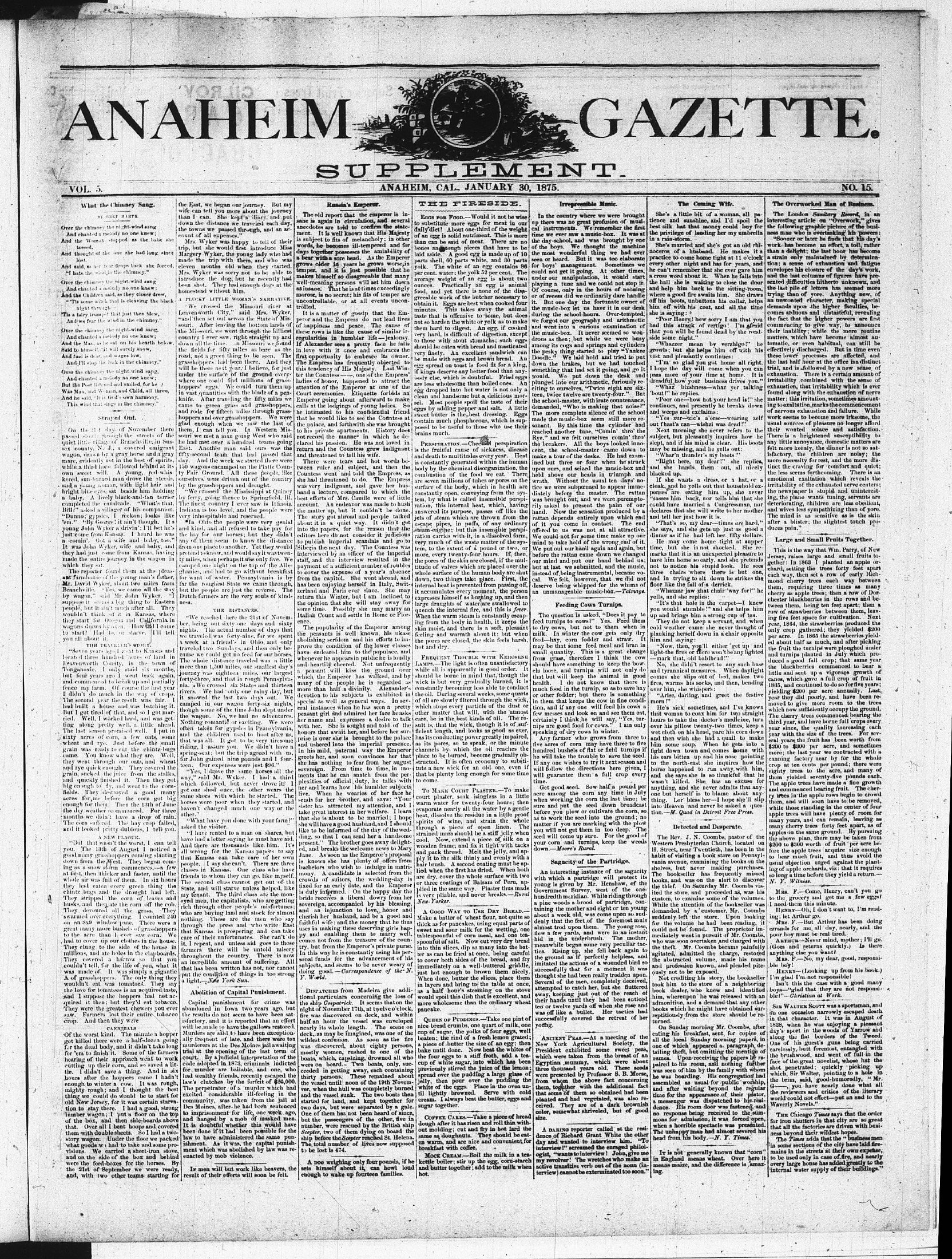
Searchable text
What the Chimney Sang.
By Derek Harte
Over the chimney the night-wind sang
And chanted a melody no one knew;
And the Woman stopped as the babe she tossed,
And thought of the one she had long since lost,
And said, as her tear drops back she forced,
"I hate the wind in the chimney."
Over the chimney the night-wind sang
And chanted a melody no one knew;
And the Children said, as they closer drew,
"Tis some witch that is cleaving the black night through—
This a fairy trumpet that just then blew,
And we fear the wind in the chimney."
Over the chimney the night-wind sang,
And chanted a melody no one knew;
And the Man, as he sat on his hearth below,
Said to himself, "It will surely snow,
And fuel is dear, and wages low,
And I'll stop the leak in the chimney."
Over the chimney the night-wind sang,
And chanted a melody no one knew;
But the Post listened and smiled, for he Was Man, and Woman, and Child, all three,
And he said, "It is God's own harmony,
This wind that sings in the chimney."
Strayed Out.
On the 21st day of November there passed slowly through the streets of the quiet little village of Branchville, in Sussex county, N. J., a covered emigrant wagon, drawn by a gray horse and a gray mare, evidently not in the best of spirits, while a third horse followed behind at its the East, we began our journey. But my wife can tell you more about the journey than I can. She kept a diary, and put down the distance we traveled each day, the towns we passed through, and an account of all expenses."
Mrs. Wyker was happy to tell of their trip, but she would first introduce Miss Margery Wyker, the young lady who had made the trip with them, and who was eleven months old when they started. Mrs. Wyker was sorry not to be able to introduce the dog, but he recently had been shot. They had enough dogs at the homestead without him.
A PLUCKY LITTLE WOMAN'S NARRATIVE.
"We crossed the Missouri river at Leavenworth City," said Mrs. Wyker, "and then set out across the State of Missouri. After leaving the bottom lands of the Missouri, we went through the fullest country I ever saw, right straight up and down all the time. In Missouri we found the fields for fifty miles as bare as the road, not a green thing to be seen. The grasshoppers had been there. And they will be there next year; I believe, for just under the surface of the ground everywhere one could find millions of grasshoppers' eggs. We could turn them up in vast quantities with the blade of a penknife. After traveling the fifty miles we came to green grass and grasshoppers, and rode for fifteen miles through grasshoppers and over grasshoppers. We were glad enough when we saw the last of them, I can tell you. In Western Missouri we met a man going West who said he had met over a hundred teams going East. Another man said ours was the fifty-second team that had passed that day. And the week we started there were 150 wagons encamped on the Platte Coun-
Russia's History.
The old report that same is again in circulation anecdotes are told to me. It is well known is subject to fits of words, he becomes ill days together possesses a bear with a sore head grows older in years temper, and it is just makes himself so disgraceful well-meaning persons as insane. That he is morose, is no secret; he uncontrollable, or at trottled.
It is a matter of good peror and the Empress of happiness and peace these rows is like the regularities in humility. If Alexander sees a pity in love with it once first opportunity to see The Empress has freed this tendency of His Mother the Countess — ladies of honor, happy attention of the Empress Court ceremonies. E Emperor going about calls at the lodgings on he intimated to his that he would like to be the palace, and forthwith to his private apartment not record the manner clared his passion. Return and the County and threatened to tell There were tears twice ruler and sub
Over the chimney the night wind sags,
And chanted a melody no one knew;
But the Post listened and smiled, for he
Was Man, and Woman, and Child, all three,
And he said, "It is God's own harmony,
This wind that sings in the chimney."
Strayed Out.
On the 21st day of November there passed slowly through the streets of the quiet little village of Branchville, in Sussex county, N.J., a covered emigrant wagon, drawn by a gray horse and a gray mare, evidently not in the best of spirits, while a third horse followed behind at its own sweet will. A young, red-whiskered, sun-burned man drove the steels, and a young woman, with light hair and bright blue eyes, sat beside him holding a baby. A lively black-and-tan terrier completed the cavalcade. "What's that, Bill?" asked a villager of his companion. "Dunno; gypsies, I reckon; looks like 'em." "By George! it ain't though. It is young John Wyker a drivin'; I'll bet he's just come from Kansas. I heard he was a comin', Got a wife and baby, too." It was John Wyker, wife and baby, and they had just come from Kansas, having made the entire journey in the wagon in which they sat.
The reporter found them at the pleasant farmhouse of the young man's father, Mr. David Wyker, about two miles from Branchville. "Yes, we came all the way by wagon," said Mr. John Wyker. "I suppose it seems a big thing to Eastern people, but it isn't much after all. They wouldn't think of it in Kansas, where they start for Oregon and California in wagons drawn by oxen. How did I come to start? Had to, or starve. I'll tell you all about it."
THE TRAVELER'S STORY.
"Seven years ago I went to Kansas and located three hundred acres of land in Leavenworth County, in the town of Tonganoxie. I only staid six months, but four years ago I went back again, and commenced to break up and partially fence my farm. Of course the first year I didn't do much in the way of crops. The second year the result was fair. I had built a house and was batching it. But I got tired of that, and so I got married. Well, I worked hard, and was getting along pretty well, a little ahead. The last season promised well. I put in sixty acres of corn, a few oats, some wheat and rye. Just before the small grain was ready to cut the chintz-bugs came. You know what they are. Well, they went through our oats, and wheat and rye quick enough. They covered the grain, sucked the juice from the stalks, and quickly finished it. Then they got big enough to fly, and went to the cornfields. They destroyed a good many acres for before the corn got big enough for them. Then the 13th of June the dry weather commenced. For three months we didn't have a drop of rain: The corn suffered. The hay crop failed, and it looked pretty dubious, I tell you.
A NEW FLAGUE.
"But that wasn't the worst, I can tell you. The 13th of August I noticed a good many grasshoppers coming slanting down from the West. They began coming as a snow storm commences—a few at first, then thicker and faster, until the whole air was full of them. In six hours they had eaten every green thing the under the surface of the ground everywhere one could find millions of grasshoppers' eggs. We could turn them up in vast quantities with the blade of a penknife. After traveling the fifty miles we came to green grass and grasshoppers, and rode for fifteen miles through grasshoppers and over grasshoppers. We were glad enough when we saw the last of them, I can tell you. In Western Missouri we met a man going West who said he had met over a hundred teams going East. Another man said ours was the fifty-second team that had passed that day. And the week we started there were 150 wagons encamped on the Platte County Fair Ground. All these people, like ourselves, were driven out of the country by the grasshoppers and drought.
"We crossed the Mississippi at Quincy by ferry, going thence to Springfield, Hli. The finest country I ever saw is Illinois. Indiana is too level, and the people were very inhospitable and reserved.
In Ohio the people were very genial and kind, and all refused to take pay for the hay for our horses; but they didn't any of them seem to know the distance from one place to another. Yet they would pretend to know, and would say it was twenty miles, when perhaps it was only five. We camped one night on the top of the Alleghanies, and had to go without breakfast for want of water. Peansylvania is by far the roughest State we came through, but the people are just the reverse. The Dutch farmers are the very souls of kindness."
THE DISTANCES.
"We reached here the 21st of November, being out sixty-one days and sixty nights. The actual number of days that we traveled was forty-nine, for we spent a week at a friend's in Ohio, and only traveled two Sundays, and then only because we could get no feed for our horses. The whole distance traveled was a little more than 1,500 miles, our smallest day's journey was eighteen miles, our largest forty-three, and that in rough Pennsylvania. We crossed six States and thirteen rivers. We had only one rainy day, but it snowed on the last two days out. We camped in our wagon forty-six nights, though some of the time John slept under the wagon. No, we had no adventures. Nothing romantic or exciting. We were often taken for gypsies in Pennsylvania, and the children used to hoot after us that was all. It got to be very tiresome riding, I assure you. We didn't have a spring-seat; but the trip agreed with us for John gained nine pounds and I fourteen. Our expenses were just $96."
"Yes, I drove the same horses all the way," said Mr. Wyker. I had a third which followed, but never drove it! I got one shod once, the other wears the same shoes with which he started. The horses were poor when they started, and haven't changed much one way or the other."
"What have you done with your farm?" asked the visitor.
"I have rented to a man on shares, but have had a letter saying he must have aid. And there are thousands like him. It's all wrong for the Kansas papers to say that Kansas can take care of her own people. I say she can't. There are three classes in Kansas. One class who have friends to whom they can go, like myself. The second class cannot get out of the State, and will starve unless helped, like
There were tears to tween ruler and sulk Countess went, and she had threatened to stay as very indignant, band a lecture, compel best efforts of Mrs.C account. An endearable matter up, but it is The story got abroad about it in a quiet voice into the papers; for editors here do not cease to publish imperial Siberia the next day; interviewed by an official staff; and the interview payment of a sufficient cover the expense from the capitol. She has been enjoying her zerland and Paris even return this Winter; be she opinion that she some time Possibly Italian Count and set ence.
The popularity of tthe peasants is well abolishing serfdom as prove the condition have endeared him whenever he appears in heartily cheered a peasant will kiss which the Emperor many of the people more than half a div devotion to his subject special as well as general instances when he peasant girl and admire her name and express with her. She is souls honors that await her pride is over she is bred ushered into her In his mild greets her, and soon she has nothing to ffo sovereign. From times that he can plexities of official her and learns how live When he we sends for her brother sister has attracted take great interest in that she is about to she will have a good life to be informed oding, so that I can see present." The brothed ed,and breaks the w Jane.As soon as thie is known she has p bacheloros who wish mony.A candidate crowds of suitors fixed for an early dat
They destroyed a good many acres for me before the corn got big enough for them. Then the 13th of June the dry weather commenced. For three months we didn't have a drop of rain: The corn suffered. The hay crop failed, and it looked pretty dubious, I tell you.
A NEW FLAGUE.
"But that wasn't the worst, I can tell you. The 13th of August I noticed a good many grasshoppers coming slanting down from the West. They began coming as a snow storm commences—a few at first, then thicker and faster, until the whole air was full of them. In six hours they had eaten every green thing the chintz bugs and the drought had left. They stripped the corn of leaves and husks, and they ate the corn off the cob. They devoured all the grass. They swarmed over everything. I counted 240 on an 8x9 window pane. There were a great many more bushels of grasshoppers to the acre than I ever saw corn. We had to cover up our clothes in the house. They clung to the side of the house in millions, and ate holes in the clapboards. They covered a harrow so that you couldn't tell, for the life of you, what it was made of. It was simply a gigantic A of grasshoppers. The only thing they wouldn't eat was tomatoes. They say the love for tomatoes is an acquired taste, and I suppose the hoppers had not acquired it then; but they'd eat tobacco. They were the greatest chewers you ever saw. Farmers lost their entire tobacco crop. And then they were
CANNIBALS
Of the worst kind. The minute a hopper got killed there were a half-dozen going for the dead body, and it didn't take long for 'em to finish it. Some of the farmers hearing of their approach went to work cutting up their corn, and so saved a little. I didn't save a thing. And in six hours after the hoppers came I hadn't enough to winter a cow. It was rough, mighty rough; and I thought the best thing we could do would be to start for old New Jersey, for it was certain starvation to stay there. I had a good, strong lumber wagon; I put a floor on the top of the box, and then side-boards above that. Over all I bent hoops and covered them with double sheets. So I had a two-story wagon. Under the floor we packed what goods we had to take and some provisions. We carried a sheet-iron stove, and on the side of the box and behind were the feed-boxes for the horses. By the 21st of September we were ready, and, with two other teams starting for
Abolition of Capital Punishment.
Capital punishment for crime was abandoned in Iowa two years ago, but the results do not seem to have been satisfactory, and it is reported that an effort will be made to have the gallows restored. Murders are said to have been exceptionally frequent of late, and there were ten murderers at the Des Moines jail awaiting trial at the opening of the last term of court. By a judicial interpretation of the code adopted in 1873, criminals indicted for murder are bailable, and one who had wealthy friends, recently escaped the law's clutches by the forfeit of $20,000. The perpetrator of a murder which had excited considerable ill-feeling in the community, was taken from the jail at Des Moines, after he had been sentenced to imprisonment for life, one week ago, and hanged by a mob of masked men. It is doubtful whether this would have been done if it had been possible for the law to have administered the same punishment. As it was, the capital punishment which was abolished by law was re-enacted by mob violence.
In men will but work like beavers, the result of their efforts will soon be felt.
When he wears sends for her brother's sister has attracted him that she is about to go she will have a good hair like to be informed or ding, so that I can present." The brother ed, and breaks the w Jane. As soon as this is known she has bachelor who wish mony. A candidate crowds of suitors, fixed for an early date is duly informed. On bride receives a librarian, accompany and an injunction cherish her husband faithful wife; and these uses in making these py and enabling them comes not from the try, but from the Emily In this way he is conscientious funds for the subjects, and seems doing good.—Correction Y. World.
Dispatches from national particulars concerning the ship Cospatrick: night of November 17 fire was discovered half an hour the very nearly its whole length deck, as may be ima wildest confusion was discovered, ab mostly women, rus boats, which, capsizes were on board. Treced in getting a thirty persons. That the vessel until noon ver, when the hull was and the vessel sunk started for land, and two days, but were One of them has not but the passengers number, were rescued Scepter, two of them ship before the Scepter The total number o to be lost is 474.
A too weighing o sets himself about enough to wake up
IM GAZ
SUPPLEMENT.
ANAHEIM, CAL. JANUARY 30, 1875.
Russia's Emperor.
The old report that the emperor is insane is again in circulation, and several anecdotes are told to confirm the statement. It is well known that His Majesty is subject to fits of melancholy; in other words, he becomes ill-tempered and for days together possesses the amiability of a bear with a sore head. As the Emperor grows older in years he grows worse in temper, and it is just possible that he makes himself so disagreeable that many well-meaning persons will set him down as insane. That he is at times exceedingly morose, is no secret; his fits of temper are uncontrollable, or at all events uncontrolled.
It is a matter of gossip that the Emperor and the Empress do not lead lives of happiness and peace. The cause of these rows is like the cause of similar irregularities in humbler life—jealousy. If Alexander sees a pretty face he falls in love with it once and embraces the first opportunity to embrace its owner. The Empress has frequently objected to this tendency of His Majesty. Last Winter the Countess——one of the Empress' ladies of honor, happened to attract the attention of the Emperor at one of the Court ceremonies. Etiquette forbids an Emperor going about afterward to make calls at the lodgings of young ladies. So he intimated to his confidential friend that he would like to see the Countess at the palace, and forthwith she was brought to his private apartments. History does not record the manne* in which he declared his passion. He was not loved in return and the Countess grew indignant and threatened to tell his wife.
There were tears and hot words between ruler and subject, and then the
THE FIRESIDE.
Eggs for Food — Would it not be wise to substitute more eggs for meat in our daily diet? About one-third of the weight of an egg is solid nutriment. This is more than can be said of meat. There are no bones and tough pieces that have to be laid aside. A good egg is made up of 10 parts shell, 60 parts white, and 30 parts yolk. The white of an egg contains 86 per cent. water; the yolk 52 per cent. The average weight of an egg is about two ounces. Practically an egg is animal food, and yet there is none of the disagreeable work of the butcher necessary to obtain it. Eggs are best when cooked four minutes. This takes away the animal taste that is offensive to some, but does not so harden the white or yolk as to make them hard to digest. An egg, if cooked very hard, is difficult of digestion, except to those with stout stomachs; such eggs should be eaten with bread and masticated very finely. An excellent sandwich can be made with eggs and brown bread. An egg spread on toast is food fit for a king, if kings deserve any better food than anybody else, which is doubtful. Fried eggs are less wholesome than boiled ones. An egg dropped into hot water is not only a clean and handsome but a delicious morsel. Most people spoil the taste of their eggs by adding pepper and salt. A little sweet butter is the best dressing. Eggs contain much phosphorous, which is supposed to be useful to those who use their brains much.
PERSPIRATION. — Checked perspiration is the fruitful cause of sickness, disease and death to multitudes every year. Heat is constantly generated within the human body by the chemical disorganization, the Irrepressible Music.
In the country where we were brought up there was no great profusion of musical instruments. We remember the first time we ever saw a music-box. It was at the day-school, and was brought by one of the boys. We thought the machine the most wonderful thing we had ever seen or heard. But it was too elaborate for boys' management. Sometimes we could not get it going. At other times, under our manipulation, it would start playing a tune and we could not stop it. Of course, only in the hours of nooning or of recess did we ordinarily dare handle it. But one day the fortunate owner of the music-box let us have it in our desk during the school-hours. Over-tempted, we forgot our geography and arithmetic and went into a curious examination of the music-box. It never seemed so wondrous as then; but while we were busy among its cogs and springs and cylinders the pesky thing started to play "Yankee Doodle." We laid hold and tried to put down the brakes, but we had touched something that had set it going, and go it would. We put down the desk and plunged into our arithmetic, furiously reciting to ourselves, "Twice eight are sixteen, twice twelve are twenty-four." But the school-master, with irate countenance, demanded, "Who is making that noise?" The more complete silence of the school made the music-box seem still more resonant. By this time the cylinder had reached another tune, "Comin' thro' the Rye," and we felt ourselves comin' thro' the breakers. All the boys looked innocent, the school-master came down to make a tour of the desks. He had examined but three or four when he struck ours, and seized the music-box and She's tainted her best silk in the privacy in a rain.
She's no noceros practice often he can't a cross wilt the hall and help where a off his bib she is said "Poor had this that you side some" "Whaz growls; vest and I'm I hope tha pass me dreadful" "Whaz bout?" "Poor continue and wee Yes out fhas Next subject, slept, may be "Whaz Right and she
The popularity of the Emperor among the peasants is well known, his ukase abolishing serfdom and his efforts to improve the condition of the lower classes have endeared him to the populace, and whenever he appears in public he is loudly and heartily cheered. Not unfrequently a peasant will kiss the ground over which the Emperor has walked, and by many of the people he is regarded as more than half a divinity. Alexander's devotion to his subjects is exhibited in special as well as general ways. In several instances when he has seen a pretty peasant girl and admired her face he asks her name and expresses a desire to talk with her. She is sought and told of the honors that await her, and before her surprise is over she is brought to the palace and ushered into the imperial presence.
In his mild, paternal way the Emperor greets her, and soon convinces her that she has nothing to fear from her august sovereign. From time to time, in moments that he can snatch from the perplexities of official duty, he talks with her and learns how his humbler subjects live. When he wearies of her face he sends for her brother, and says: "Your sister has attracted my attention, and I take great interest in her welfare. I learn that she is about to be married; I hope she will have a good husband, and I should like to be informed of the day of the wedding, so that I can send her a handsome present." The brother goes away delighted, and breaks the welcome news to Mary Jane. As soon as the Emperor's proposal is known she has plenty of offers from bachelors who wish to indulge in matrimony. A candidate is selected from the crowds of suitors, the wedding-day is fixed for an early date, and the Emperor
PERSPIRATION.—Cheeked perspiration is the fruitful cause of sickness, disease and death to multitudes every year. Heat is constantly generated within the human body by the chemical disorganization, the combustion of the food we eat. There are seven millions of tubes or pores on the surface of the body, which in health are constantly open, conveying from the system, by what is called insensible perspiration, this internal heat, which, having answered its purpose, passes off like the jets of steam which are thrown from the escape pipes, in puffs, of any ordinary steam-engine; but this insensible perspiration carries with it, in a dissolved form, very much of the waste matter of the system, to the extent of a pound or two, or more, every twenty-four hours. If, then, the pores of the skin are closed, if the multitude of valves which are placed over the whole surface of the human body are shut down, two things take place. First, the internal heat is prevented from passing off, it accumulates every moment, the person expresses himself as burning up, and then large draughts of water are swallowed to quench the internal fire, and this is fever. When the warm steam is constantly escaping from the body in health, it keeps the skin moist, and there is a soft, pleasant feeling and warmth about it; but when the pores are closed, the skin feels harsh, hot and dry.
FREQUENT TROUBLE WITH KEROSENE LAMPS.—The light is often unsatisfactory all at once in good order. It should be borne in mind that, though the wick is but very gradually burned, it is constantly becoming less able to conduct the oil. During several weeks, some quartz of oil are slowly filtered through the wick, which stops every particle of the dust or other matter that will, with the utmost care, be in the best kinds of oil. The result is, that the wick, though it is of sufficient length, and looks as good as ever, has its conducting power greatly impaired, as its pores, so to speak, or the minute channels by which the oil reaches the place to be burned, become gradually obstructed. It is often economy to substitute a new wick for an old one, even if that be plenty long enough for some time to come.
TO MAKE COURT PLASTER.—To make court plaster, soak isinglass in a little warm water for twenty-four hours; then evaporate nearly all the water by a gentle heat, dissolve the residue in a little proof spirits of wine, and strain the whole through a piece of open linen. The strained mass should be a stiff jelly when cool. Now, extend a piece of silk on a wooden frame, and fix it tight with tacks and pack thread. Melt the jelly, and apply it to the silk thinly and evenly with a hair brush. A second coating must be applied when the first has dried. When both are dry, cover the whole surface with two or three coatings of Balsam of Peru, applied in the same way. Plaster thus made
Feeding Cows Turnips.
The question is asked. "Does it pay to feed turnips to cows?" Yes. Feed them to dry cows, but not to them when in milk. In winter the cow gets only dry feed—hay, corn fodder and straw. It may be that some feed meal and bran in small quantity. This is a great change from grass; therefore I think the cow should have something to keep the bowels loose, will not only do that but will keep the animal in good health. I do not know that there is much food in the turnip; so as to save hay or other fodder; but there is something in them that keeps the cow in fine condition, and if any one will feed his cows a few messes and look on and see them eat certainly I think he will say, "Yes, turpins are good food for cows." I am only speaking of dry cows in winter.
Any farmer who grows from three to five acres of corn may have three to five hundred bushels of flat or field turnips if he will take the trouble to save the seed. If any one wishes to try it next season and will follow the directions here given, I will guarantee them a full crop every time.
Get good seed. Sow half a pound per acre among the corn any time in July when working the corn last time; be sure and put the seed down broadcast before you plow or cultivate the corn, so as to work the seed into the ground; no matter if you are marking with the plow you will not get them in too deep. The seed will come up sure. For the good of your corn and turnips, keep the weeds down.
Sagacity of the Partridge.
An interesting instance of the sagacity with which a partridge will protect its young is given by Mr. Henshaw, of the Yorkshire Sparrow Farm near Westminster.
Next subject: sleep; may be subject: dreadful.
Whatever else they look at going and go it would. We put down the desk and plunged into our arithmetic furiously reciting to ourselves. "Twice eight are sixteen, twice twelve are twenty-four." But the school-master, with irate countenance, demanded. "Who is making that noise?" The more complete silence of the school made the music-box seem still more resonant. By this time the cylinder had reached another tune. "Comin' thro'the Rye," and we felt ourselves comin' thro'the breakers. All the boys looked innocent, the school-master came down to make a tour of the desks. He had examined but three or four when he struck upon ours, and seized the music-box and held above our heads in triumph and wrath. Without usual ten days' notice we were subservenced to appear immediately before the master. The rattan was brought out, and we were peremptory asked to present the palm of our hand. Now the sensation produced by a rattan depends entirely upon which end of it you come in contact. The end offered to us was not at all attractive. We could not for some time make up our mind to take hold of the wrong end of it. We put out our hand again and again, but before the rattan came down we changed our mind and put our hand behind us; but at last we submitted, and the music instead of being instrumental, became vocal. We felt, however that we did not deserve being whipped for the whims of an unmanageable music-box.
Talmaga.
What yells, and
It's't you wouw up and b
They're cold well plankning him and
He mime time; but marks tha
marks tha have him not to n
three c o
and in floor like
What yells,
"It's't you wouw up and b
They're cold well plankning him and
He mime time; but marks tha
marks tha have him not to n
three c o
and in floor like
What yells,
"It's't you wouw up and b
They're cold well plankning him and
He mime time; but marks tha
marks tha have him not to n
three c o
and in floor like
What yells,
"It'sn't you wouw up and b
They're cold well plankning him and
He mime time; but marks tha
marks tha have him not to n
three c o
and in floor like
What yells,
"It'sn't you wouw up and b
They're cold well plankning him and
He mime time; but marks tha
marks tha have him not to n
three c o
and in floor like
What yells,
"It'sn't you wouw up and b
They're cold well plankning him and
He mime time; but marks tha
marks tha have him not to n
three c o
and in floor like
What yells,
"It'sn't you wouw up and b
They're cold well plankning him and
He mime time; but marks tha
marks tha have him not to n
three c o
and in floor like
What yells,
"It'sn't you wouw up and b
They're cold well plankning him and
He mime time; but marks tha
marks tha have him not to n
three c o
and in floor like
What yells,
"It'sn't you wouw up and b
They're cold well plankning him and
He mime time; but marks tha
marks tha have him not to n
three c o
and in floor like
What yells,
"It'sn't you wouw up and b
They're cold well plankning him and
He mime time; but marks tha
marks tha have him not to n
three c o
and in floor like
What yells,
"It'sn't you wouw up and b
They're cold well plankning him and
He mime time; but marks tha
marks tha have him not to n
three c o
and in floor like
What yells,
"It'sn't you wouw up and b
They're cold well plankning him and
He mime time; but marks tha
marks tha have him not to n
three c o
and in floor like
What yells,
"It'sn't you wouw up和b
They're cold well plankning him和b他mime时间;但mime时间;但mime时间;但mime时间;但mime时间;但mime时间;但mime时间;但mime时间;但mime时间;但mime时间;但mime时间;但mime时间;但mime时间;但mime时间;但mime时间;但mime时间;但mime时间;但mime时间;但mime时间;但mime时间;但mime时间;但mime时间;但mime时间;但mime时间;但mime时间;但mime时间;但mime时间;但mime时间;但mime时间;但mime时间;但mime时间;但mime时间;但mime时间;但mime时间;但mime时间;但mime时间;但mime时间;但mIME时间;但MIME时间;但MIME时间;但MIME时间;但MIME时间;但MIME时间;但MIME时间;但MIME时间;但MIME时间;但MIME时间;但MIME时间;但MIME时间;但MIME时间;但MIME时间;但MIME时间;但MIME时间;但MIME时间;但MIME时间;但MIME时间;但MIME时间;但MIME时间;但MIME时间;但MIME时间;但MME时间;但MME时间;但MME时间;但MME时间;但MME时间;但MME时间;但MME时间;但MME时间;但MME时间;但MME时间;但MME时间;但MME时间;但MMEtime;但MMEtime;但MMEtime;但MMEtime;但MMEtime;但MMEtime;但MMEtime;但MMEtime;但MMEtime;但MMEtime;但MMEtime;但MMEtime;但MMEtime;但MMEtime;但MMEtime;但MMEtime;但MMEtime;但MMEtime;但MMEtime;但MMEtime;但MMEtime;但MMEtime;但MMEtime;但MMEtime;但MMEtime;但MMEtime;但МЕтimes.但МЕтimes.但МЕтimes.但МЕтimes.但МЕтimes.但МЕтimes.但МЕтimes.但МЕтimes.但МЕтimes.但МЕтimes.但МЕтimes.但МЕтimes.她她她她她她她她她她她她她她她她她她她她她她她她她她她她她她她她她她她她她她她她她她她她她她她她她她她她她她她她她她她她她她她她她她她她她她她她她她她她她她她她她她她她她她她她地地地地地地地地地地地地地地地地地地地地地地地地地地地地地地地地地地地地地地地地地地地地地地地地地地地地地地地地地地地地地地地地地地地地地地地地地地地地地地地地,地、地、地、地、地、地、地、地、地、地、地、地、地、地、地、地、地、地、地、地、地、地、地、地、地、地、地、地、地、地、地、地、地、地、地、地、地、地、地、地、地、地、地、地、地、地、地、地、地、地、地、地、地、地、地、地、地、地、地、地、地、地、地、地、地、地、地、地、地、在地、在地、在地、在地、在地、在地、在地、在地、在地、在地、在地、在地、在地、在地、在地、在地、在地、在地、在地、在地、在地、在地、在地、在地、所在地、所在地、所在地、所在地、所在地、所在地、所在地、所在地、所在地、所在地、所在地、所在地、所在地、所在地、所在地、所在地、所在地、所在地、所在地、所在地、所在地、所在地、所在地、所在地、所在地,所在地,所在地,所在地,所在地,所在地,所在地,所在地,所在地,所在地,所在地,所在地,所在地,所在地,所在地,所在地,所在地,所在地,所在地,所在地,所在地,所在地,所在地,所在地,所在地,所在地,所在地,所在地,所在地,所在地,所在地,所在地,所在地,土地,土地,土地,土地,土地,土地,土地,土地,土地,土地,土地,土地,土地,土地,土地,土地,土地,土地,土地,土地,土地,土地,土地,土地,土地,土地,土地,土地,土地,土地,土地,土地,土地,土地,土地,土地,土地,土地。土地。土地。土地。土地。土地。土地。土地。土地。土地。土地。土地。土地。土地。土地。土地。土地。土地。土地。土地。土地。土地。土地。土地。土地。土地。土地。土地。土地。土地。土地。土地。土地。土地。土地。土地。土地。土地。的土地。土地。土地。土地。土地。土地。土地。土地。土地。土地。土地。土地。土地。的土地。土地。的土地。的土地。的土地。的土地。的土地。的土地。的土地。的土地。的土地。的土地。的土地。的土地。的土地。的土地。的土地。的土地。的土地。的土地。
The M.Eastern H Street habit of vanity shelves.
The book books are thick.
The horse hooves are thick.
The floor like wood.
The wallpaper.
The paper.
The paint.
The glue.
The rubber.
The leather.
The fabric.
The yarn.
The string.
The cord.
The rope.
The cable.
The wire.
The insulation.
The insulation material.
The insulation fiber.
The insulation material.
The insulation fiber.
The insulation material.
The insulation fiber.
The insulation material.
The insulation fiber.
The insulation material.
The insulation fiber.
The insulation material.
The insulation fiber.
The insulation material.
The insulation fiber.
The insulation material.
The insulation fiber.
The insulation material.
The insulation fiber.
The insulation material.
The insulation fiber.
The insulation material.
The insulation fiber.
The insulation material.
The insulation fiber.
The insulation material.
The insulation fiber.
The insulation material.
The insulation fiber.
The insulation material.
The insulation fiber.
The insulation material.
The insulation fiber."
Wait, let me re-read line 10: "She cloak; an penses can hide herself from rough weather."
Line 11: "She cloak; an penses can hide herself from rough weather."
Line 12: "She cloak; an penses can hide herself from rough weather."
Line 13: "She cloak; an penses can hide herself from rough weather."
Line 14: "She cloak; an penses can hide herself from rough weather."
Line 15: "She cloak; an penses can hide herself from rough weather."
Line 16: "She cloak; an penses can hide herself from rough weather."
Line 17: "She cloak; an penses can hide herself from rough weather."
Line 18: "She cloak; an penses can hide herself from rough weather."
Line 19: "She cloak; an penses can hide herself from rough weather."
Line 20: "She cloak; an penses can hide herself from rough weather."
Line 21: "She cloak; an penses can hide herself from rough weather."
Line 22: "She cloak; an penses can hide herself from rough weather."
Line 23: "She cloak; an penses can hide herself from rough weather."
Line 24: "She cloak; an penses can hide herself from rough weather."
Line 25: "She cloak; an penses can hide herself from rough weather."
Line 26: "She cloak; an penses can hide herself from rough weather."
Line 27: "She cloak; an penses can hide herself from rough weather."
Line 28: "She cloak; an penses can hide herself from rough weather."
Line 29: "She cloak; an penses can hide herself from rough weather."
Line 30: "She cloak; an penses can hide herself from rough weather."
Line 31: "She cloak; an penses can hide herself from rough weather."
Line 32: "She cloak; an penses can hide herself from rough weather."
Line 33: "She cloak; an penses can hide herself from rough weather."
Line 34: "She cloak; an penses can hide herself from rough weather."
Line 35: "She cloak; an penses can hide herself from rough weather."
Line 36: "She cloak; an penses can hide herself from rough weather."
Line 37: "She cloak; an penses can hide herself from rough weather."
Line 38: "She cloak; an penses can hide herself from rough weather."
Line 39: "She cloak; an penses can hide herself from rough weather."
Line 40: "She cloak; an penses can hide herself from rough weather."
Line 41: "She cloak; an penses can hide herself from rough weather."
Line 42: "She cloak; an penses can hide herself from rough weather."
Line 43: "She cloak; an penses can hide herself from rough weather."
Line 44: "She cloak; an penses can hide herself from rough weather."
Line 45: "She cloak; an penses can hide herself from rough weather."
Line 46: "She cloak; an penses can hide yourself from rough weather."
Line 47: "She cloak; an penses can hide yourself from rough weather."
Line 48: "She cloak; an penses can hide yourself from rough weather."
Line 49: "She cloak; an penses can hide yourself from rough weather."
Line 50: "She cloak; an penses can hide yourself from rough weather."
Line 51: "She cloak; an penses can hide yourself from rough weather."
Line 52: "She cloak; an penses can hide yourself from rough天气"
Line 53: "She cloak; an penses can hide yourself from rough天气"
Line 54: "She cloak; an penses can hide yourself from rough天气"
Line 55: "She cloak; an penses can hide yourself从rough天气"
Line 56: "She cloak; an penses可hide yourself从rough天气"
Line 57: "She cloak; an penis可hide yourself从rough天气"
Line 58: "She cloak; an penis可hide yourself从rough天气"
Line 59: "She cloak; an penis可hide yourself从rough天气"
Line 60: "She cloak; an penis可hide yourself从rough天气"
Line 61: "She cloak; an penis可hide yourself从rough天气"
Line 62: "She cloak; an penis可hide yourself从rough天气"
Line 63: "She cloak; an penis可hide yourself从rough天气"
Line 64: "She cloak; an penis可hide yourself从rough天气"
Line 65: "She cloak; an penis可hide yourself从rough天气"
Line 66: "She cloak; an penis可hide yourself从rough天气"
Line 67: "She cloak; an penis可hide yourself从rough天气"
Line 68: "She cloak; an penis可hide yourself从rough天气"
Line 69: "She cloak; an penis可hide yourself从rough天气"
LINE:
This pattern repeats until it reaches its maximum number (one hundred twos), then continues until it reaches its maximum number (two hundred twos), then continues until it reaches its maximum number (three hundred twos), then continues until it reaches its maximum number (five hundred twos), then continues until it reaches its maximum number (seven hundred twos), then continues until it reaches its maximum number (eight hundred twos), then continues until it reaches its maximum number (nine hundred twos), then continues until it reaches its maximum number (eleven hundred twos), then continues until it reaches its maximum number (twelve hundred twos), then continues until it reaches its maximum number (thirteen hundred twos), then continues until it reaches its maximum number (fifteen hundred twos), then continues until it reaches its maximum number (seventeen hundred twos), then continues until it reaches its maximum number (eighteen hundred twos), then continues until it reaches its maximum number (nineteen hundred twos), then continues until it reaches its maximum number (twenty hundred twos), then continues until it reaches its maximum number (thirty hundred twos), then continues until it reaches its maximum number (fifty hundred twos), then continues until it reaches its maximum number (seventy hundred twos), then continues until it reaches its maximum number (eighth hundred twos), then continues until it reaches its maximum number (ninth hundred twos), then continues until it reaches its maximum number (tenth hundred twos), then continues until it reaches its maximum number (eleventhundred twos), then continues until it reaches its maximum number (twelf Hundred twos), then continues until it reaches its maximum number (thirte Hundred twos), then continues until it reaches its maximum number (fourte Hundred twos), then continues until it reaches its maximum number (sixte Hundred twos), then continues until it reaches its maximum number (eighte Hundred twos), then continues until it reaches its maximum number (ninete Hundred twos), then continues until it reaches its maximum number (twenty Hundred twos), then continues until it reaches its maximum number (thirtel Hundred twos), then continues until it reaches its maximum number (fourtl Hundred twos), then continues until it reaches its maximum number (sixtl Hundred twos), then continues until it reaches its maximum number (eighte Hundred twos), then continues until it reaches its maximum number (ninete Hundred twos), then continues until it reaches its maximum number (twenty Hundred twos), then continues until it reaches its maximum number (thirtel Hundred twos), then continues until it reaches its maximum number (fourtl Hundred twos), then continues until it reaches its maximum number (sixtl Hundred twos), then continues until it reaches its maximum number (eighte Hundred twos), then continues until it reaches its maximum number (ninete Hundred twos), then continues until it reaches its maximum number (twenty Hundred twos).
When he wearies of her face he sends for her brother, and says: "Your sister has attracted my attention, and I take great interest in her welfare. I learn that she is about to be married; I hope she will have a good husband, and I should like to be informed of the day of the wedding, so that I can send her a handsome present." The brother goes away delighted, and breaks the welcome news to Mary Jane. As soon as the Emperor's proposal is known she has plenty of offers from bachelors who wish to indulge in matrimony. A candidate is selected from the crowds of suitors, the wedding-day is fixed for an early date, and the Emperor is duly informed. On the happy day the bride receives a liberal dowry from her sovereign, accompanied by his blessing, and an injunction to love, honor and cherish her husband, and be a good and faithful wife; and the money that he thus uses in making these deserving girls happy and enabling them to marry well, comes not from the treasure of the country, but from the Emperor's private purse. In this way he is constantly using his personal funds for the advancement of his subjects, and seems to be never weary of doing good.—Correspondence of the N.Y.World.
DISPATCHES FROM MADEIRA GIVE ADDITIONAL PARTICULARS CONCERNING THE LOSS OF THE Ship Cospatrick. It seems that on the night of November 17th, at twelve o'clock, fire was discovered on deck, and within half an hour the vessel was enveloped nearly its whole length. The scene on deck, as may be imagined, was one of the wildest confusion. As soon as the fire was discovered, about eighty persons, mostly women, rushed to one of the boats, which, capsizing, drowned all who were on board. Two boats, only, succeeded in getting away, each containing thirty persons. These remained about the vessel until noon of the 19th November, when the hull was completely burned and the vessel sunk. The two boats then started for land, and kept together for two days, but were separated by a gale. One of them has not been heard of since, but the passengers of the other, five in number, were rescued by the British ship Scepter, two of them dying on board the ship before the Scepter reached St. Helena. The total number of lives now supposed to be lost is 474.
A dog weighing only four pounds, if he sets himself about it, can howl loud enough to wake up fourteen families.
TO MAKE COURT PLASTER—To make court plaster, soak isinglass in a little warm water for twenty-four hours; then evaporate nearly all the water by a gentle heat, dissolve the residue in a little proof spirits of wine, and strain the whole through a piece of open linen. The strained mass should be a stiff jelly when cool. Now, extend a piece of silk on a wooden frame; and fix it tight with tacks and pack thread. Melt the jelly, and apply it to the silk thinly and evenly with a hair brush. A second coating must be applied when the first has dried. When both are dry, cover the whole surface with two or three coatings of Balsam of Peru, applied in the same way. Plaster thus made is very pliable, and never breaks.—Rural New-Yorker.
A GOOD WAY TO USE DRY BREAD. Make a batter of wheat flour, not quite so thick as for pancakes, using equal parts of sweet and sour milk for the wetting, one tablespoonful of corn meal, and one teaspoonful of salt. Now cut very dry bread into thin slices, dip as many into the batter as can be fried at once, being careful to cover both sides of the bread, and fry immediately on a well-buttered griddle, just hot enough to brown them nicely. When done, butter the slices, place them in layers and bring to the table at once, as a half hour's steaming on the stove would spoil this dish that is excellent, and more wholesome than the ordinary wheat pancake.
QUEEN OF PUDDINGS. Take one pint of nice bread crumbs, one quart of milk, one cup of sugar, the yolks of four eggs, well beaten; the rind of a fresh lemon grated; a piece of butter the size of an egg; then bake until done. Now beat the whites of the four eggs to a stiff froth, add a teacup of white sugar, into which has been previously stirred the juice of the lemon; spread over the pudding a large glass of jelly, then pour over the pudding the white of the eggs. Place in the oven until lightly browned. Serve with cold cream. I always beat the butter, eggs and sugar together.
COFFEE CAKES. Take a piece of bread dough after it has risen and roll thin without molding; cut and fry in hot lard the same as doughnuts. They should be eaten warm, and are nice and convenient for breakfast with coffee.
MOCK CREAM. Boil the milk in a tea kettle boiler; stir up the egg, corn-starch and butter together; add to the milk when hot.
SAGACITY OF THE PARTridge.
An interesting instance of the sagacity with which a partridge will protect its young is given by Mr. Henshaw, of the Government Survey, west of the one-hundredth meridian. While riding through a pine woods a brood of partridge, containing the mother and eight or ten young about a week old, was come upon so suddenly that the feet of the foremost mule almost trod upon them. The young rose, flew a few yards, and were in an instant hid in the underbrush. The mother, meanwhile began some very peculiar tactics. Rising up, she fell back again to the ground as if perfectly helpless, and imitated the actions of a wounded bird so successfully that for a moment it was thought she had been really trodden upon. Several of the men, completely deceived, attempted to catch her, but she fluttered away, keeping just out of the reach of their hands until they had been enticed ten or twelve yards off when she rose and was off like a bullet. Her tactics had successfully covered the retreat of her young.
ANCIENT PEAS. At a meeting of the New York Agricultural Society, the President exhibited some sweet peas, which were taken from the breast of an Egyptian mummy, which were about three thousand years old. These seeds were presented by Professor S.B.Morse, from whom the above fact concerning them, together with the additional fact that some of them so obtained had been planted and had vegetated, was also received. They are of a dark brownish color, somewhat shriveled, but of good size.
A DARING reporter called at the residence of Richard Grant White the other day and wanted to interview him. "To interview!" screamed the enraged philologist, "wants to interview! John give me my revolver! The wretches who make an active transitive verb out of the noun (interview) cannot be exterminated too soon."
GAZETTE.
NO. 15.
Music.
we were brought profusion of music remember the first pic-box. It was at night the machine we had ever was too elaborate Sometimes we At other times, it would start could not stop it. hours of nooning marily dare handle fortunate owner of leave it in our desk. Over-tempted, joy and arithmetic is examination of her seemed so wontle we were busy things and cylinders to play "Yankee I and tried to put we had touched it going, and go it on the desk and metic, furiously re-ice eight are six-eventy-four." But private countenance, taking that noise!"ence of the school them still more re-the cylinder had 'Comin' thro' the slaves comin' thro' boys looked innov- came down to us. He had exam- when he struck the music-box and
The Coming Wife.
She's a little bit of a woman, all patience and sunshine, and I'd spoil the best silk hat that money could buy for the privilege of landing her my umbrella in a rain-storm.
She's married and she's got an old rhinoceros of a husband. He makes it a practice to come home tight at 11 o'clock every other night and has for years, and he can't remember that she ever gave him a cross word about it. When he falls into the hall she is waiting to close the door and help him back to the sitting-room, where a good fire awaits him. She draws off his boots, unbuttons his collar, helps him off with his coat, and all the time she is saying:
"Poor Henry! how sorry I am that you had this attack of vertigo! I'm afraid that you will be found dead by the roalside some night."
"Whazzer mean by verzhigo!" he growls; but she helps him off with his vest and pleasantly continues:
"I'm so glad you got home all right. I hope the day will come when you can pass more of your time at home. It is dreadful how your business drives you."
"Whaz bizshness—whaz yer talking 'bout?" he replies.
"Poor one—how hot your head is!" she continues, and presently he breaks down and weeps and exclaims:
"Yes zur—zie's a'orse—wearing zelf out fhast's can—wishzi was dead!"
Next morning she never refers to the subject, but pleasantly inquires how he slept, and if his mind is clear. His boots may be missing, and he yells out:
"What'n thunder's my boots!"
Right here, my dear!" she replies, and she hands them out, all nicely
The Overworked Man of Business.
The London Sanitary Record, in an interesting article on "Overwork," gives the following graphic picture of the business man who is overtasking his powers:
"Sooner or later he finds that his day's work has become an effort, a toll, rather than a delight; the last hour has become a strain only maintained by determination; a sense of exhaustion and fatigue envelopes his closure of the day's work, and the last columns of figures have presented difficulties hitherto unknown, and the last pile of letters has seemed more trying than of yore. Anything new, of an unwonted character, making special demands upon the higher faculties, becomes arduous and distasteful, revealing the fact that the higher powers are first commencing to give way, to announce their inability; while the more routine matters, which have become almost automatic, or even habitual, can still be effectively discharged. But in time even these lower processes are affected, and the last half hour at the office is a distinct trial, and is followed by a new sense of exhaustion. There is a certain amount of irritability combined with the sense of exhaustion, that irritability which is ever found along with the exhaustion of nerve matter; this irritation, sometimes amounting to exaltation, marks the commencement of nervous exhaustion and failure. While work seems to become more lrksome, the usual sources of pleasure no longer afford their wonted solace and satisfaction. There is a heightened susceptibility to any little annoyance, domestic matters are felt more keenly, the dinner is not so satisfactory, the children are noisy; the more necessity for rest, and the more distinct the craving for comfort and quiet;
Turnips.
Does it pay to be a Yes. Feed them to them when in snow gets only dry and straw. It meal and bran in snow is a great change. I think the cow will not only do animal in good snow that there is snow, so as to save hay there is something cow in fine condition will feed his cows a and see them eat, will say, "Yes, turkeys." I am only winter. Rows from three to four field turnips if to save the seed. It next season and bones here given, I am full crop every half a pound per many time in July in the last time; be down broadcast activate the corn, so the ground; nozing with the plow too deep. The good of, keep the weeds
Partridge.
Sagacity of the sagacity will protect its Henshaw, of the sense of the one
Detected and Desperate.
The Rev. J. N. Coombs, pastor of the Western Presbyterian Church, located on H. Street, near Twentieth, has been in the habit of visiting a book store on Pennsylvania avenue, examining the books on the shelves, but never making purchases. The bookseller has frequently missed books, and was on the alert to discover the thief. On Saturday Mr. Coombs vis-exhaustion. There is a certain amount of irritability combined with the sense of exhaustion, that irritability which is ever found along with the exhaustion of nerve matter; this irritation, sometimes amounting to exaltation, marks the commencement of nervous exhaustion and failure. While work seems to become more irksome, the usual sources of pleasure no longer afford their wonted solace and satisfaction. There is a heightened susceptibility to any little annoyance, domestic matters are felt more keenly, the dinner is not so satisfactory, the children are noisy; the more necessity for rest, and the more distinct the craving for comfort and quiet; the less seems forthcoming. There is an emotional exaltation which reveals the irritability of the exhausted nerve centers; the newspaper is stupid and uninteresting, the piano wants tuning, servants are deteriorating, children are less obedient, and wives less sympathizing than of yore. The mind is as sensitive as is the skin after a blister; the slightest touch produces pain."
Large and Small Fruits Together.
This is the way that Wm. Parry, of New Jersey, raises large and small fruits together: In 1863 I planted an apple orchard, setting the trees forty feet apart each way, then set a row of early Richmond cherry trees each way between them, requiring three times as many cherry as apple trees; then a row of Dorchester blackberries in the rows and between them, being ten feet apart; then a row of strawberries between them, leaving five feet space for cultivation. Next year, 1864, the strawberries produced the only crop gathered; they yielded $200 per acre. In 1865 the strawberries yielded about half as much, and after picking the fruit the turnips were ploughed under and turnips planted in July which produced a good fall crop; that same year the blackberries commenced to bear a little and sent up a vigorous growth of canes, which gave a full crop of fruit in 1865, and continued to do so for five years; yielding $200 per acre annually. Last year they did poorly, and have been removed to give more room to the trees which now sufficiently occupy the ground. The cherry trees commenced bearing the third year, and have borne full crops every year since, the quality increasing each year with the size of the trees. For several years the fruit has been worth from $200 to $300 per acre, and sometimes more; the last year we contracted with a canning factory near by for the whole crop at ten cents per pound; there were eighty trees to the acre, and many of them yielded seventy-five pounds each. The apple trees have made a fine growth and commenced bearing fruit. The cherry trees in the apple rows begin to crowd them, and will soon have to be removed, while those standing in the center of four apple trees will have plenty of room for many years, and can remain, leaving as many cherry trees forty feet apart, as of apples on the same ground. By pursuing the above plan, there may be taken from $200 to $300 worth of fruit per acre before the apple trees acquire size enough to bear much fruit, and thus avoid the usual objection urged against the planting of apple orchards, viz: that it requires so long a time before they yield a return.
N. Y. Witness.
Detected and Desperate.
The Rev. J. N. Coombs, pastor of the Western Presbyterian Church, located on H. Street, near Twentieth, has been in the habit of visiting a book store on Pennsylvania avenue, examining the books on the shelves, but never making purchases. The bookseller has frequently missed books, and was on the alert to discover the thief. On Saturday Mr. Coombs visited the store, and proceeded as was his custom, to examine some of the volumes. While the attention of the bookseller was demanded by a customer, Mr. Coombs suddenly left the store. Upon looking for the volume he had been reading, it could not be found. The proprietor immediately went in pursuit of Mr. Coombs, who was soon overtaken and charged with the theft. Mr. Coombs became painfully agitated, admitted the charge, restored the abstracted volume, made his name and profession known, and pleaded piteously not to be exposed.
Not crediting his story, the bookseller took him to the store of a neighboring book dealer, who knew and identified him, whereupon he was released with an admonition, and a demand that any other books which he might have obtained surreptitiously from the store should be returned.
On Sunday morning Mr. Coombs, after eating his breakfast, sent for copies of all the local Sunday morning papers, in one of which appeared a paragraph detailing theft, but omitting the mention of names. Upon receiving the papers he repaired to his room, and nothing further was seen of him by the family with whom he was boarding. His congregation had assembled as usual for public worship, and after waiting beyond the regular time for the appearance of their pastor, a messenger was dispatched to his residence. His room door was fastened, and no response being received to the summons for admission, it was forced open, when a horrible spectacle was presented. The unhappy man had almost severed his head from his body.—N. Y. Times.
It is not generally known that "corn" in England means wheat. Over here it means maize, and the difference is amazing.
Mrs. F.—Come, Henry, can't you go to the grocery and get me a few eggs! I need them this minute.
Henry—Oh, I don't want to, I'm reading; let Arthur go.
Mrs. F.—But Arthur has been doing errands for me all day, nearly, and the poor boy must be real tired.
Arthur—Never mind, mother; I'll go. (Goes and returns quickly.) Is there anything else you want!
Mrs. F.—No, my dear, good, responsible boy!
Henry—(Looking up from his book.) I'm glad I'm not responsible!
Isn't this the case with a good many boys—"glad that they are not responsible!"—Christian at Work.
Sir Walter Scott was a sportsman, and on one occasion narrowly escaped death in that character. It was in August of 1828, when he was enjoying a pleasant day's sport in the woods of Yarrow and along the flat borders of the Tweed. One of his guest's guns being carried carelessly, butt foremost, entangled with the brushwood, and went off full in the face of the great novelist, whose hat the shot penetrated; quickly picking up which Sir Walter pointing to a hole in the brim, said, good-humoredly, "Mr. G——you have nearly done what all the reviewers and critics of the literary world could not effect—put an end to the Waverly Novels."
The Chicago Times says that the order for iron shutters in that city are so great that all the factories are driven with business beyond their wildest hopes.
The Times adds that the "business men in some sections of the city have laid firemains in the streets at their own expense, to be used only in case of fire, and nearly every large house has added greatly to the internal water supply of their buildings."