anaheim-gazette 1875-01-09
Scanned page
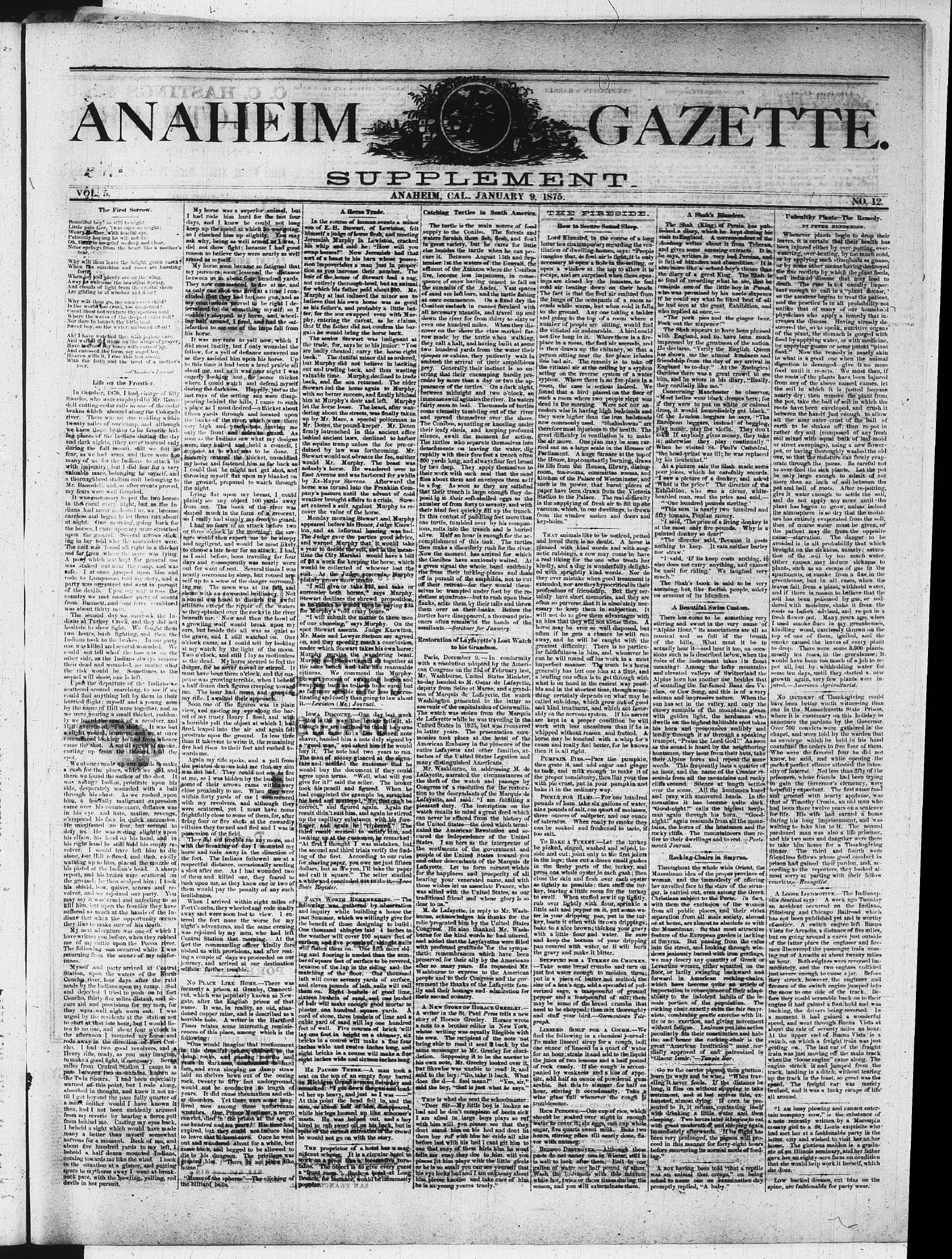
Searchable text
The First Sorrow.
Beautiful boy! so still to night!
Little pale face, 'twas once so bright;
Weary mother, with tearful eye,
Patiently hoping he will not die.
Oh, there is no grief so deep and clear,
None springs from the heart like a mother's tear.
Why wilt thou leave the bright green earth?
When the sunshine and roses are bursting forth:
When joy and plenty are on the wing,
Away for welcome the beautiful Spring,
And clouds of light from the crystal shore
Are gliding in at window and door?
Why wilt thou go, my own sweet child?
Is the world too cruel, too sinned?
Canst thour not venture thy spotless soul
Where the waves of the deepest color roll?
Nor dare to lame it thy little boat,
Sweet boy, on the water unbound allot?
Ah! I have watched these with jealous care,
And waited the name on the wings of prayer;
Have witnessed thy tones with earnest joy,
And caressed thy form, my angel boy,
Heaven wills it, I rise this test above.
With the faith and the trust of a mother's love.
—Chandler’s Journal
Life on the Frontier.
In October, 1870, I had charge of fifty Swedes, who were employed by Mr. Ramdell cutting cedar rails in one of the cedar brakes which abound along the Colorado river. There was no one residing within twenty miles of our camp, and although we knew these brakes to be favorite hiding places of the Indians during the day and dark nights, (they never maraud only during the full moon), still we felt no fear, as we had arms, and there were too many of us for the Indians to attack us with impunity; but I did fear for a very
My horse was a superior animal, but I had rode him hard for the last four days, and I knew he could not long keep up the speed as which he was going, so I checked him up slightly. You may ask why, being as well armed as I was, I did not show fight; because I had good reason to believe they were nearly as well armed as myself.
My horse soon became so fatigued that my pursuers soon lessened the distance between us to about four hundred yards. They now commenced to fire at me, and as only one shot was fired at a time I concluded that they had but one gun, and as my conclusions proved to be right I determined to do something myself; so I suddenly stopped my horse, and wheelling half around, I fired, and had the satisfaction to see one of the imps fall from his horse.
It was my turn to yell now, which I did most lustily, but I only wounded the fellow, for a yell of defiance answered me as they assisted him upon his horse. Up to this time it had been a level prairie all about me, and as it was near night I was eagerly looking out for some thicket where I could watch and defend myself during the darkness. Happily, just as the last rays of the setting sun were disappearing behind the hills, I came to such a place as I most desired—a thicket about fifteen yards through and located upon the banks of the river, which were there very high and precipitous, leaving me only the front and sides to guard. As soon as the Indians saw what my designs were, they halted and held a council, I suppose, as to what was to be done. I leisurely entered the thicket, unsaddled my horse and fastened him as far back as I could that he might not get shot and
A Horse.
In the course of son of E. H. Stewart himself a judge of Jeremiah Murphy his whip and same swap horned? No sort of a beast in his vision impoverishes situation as you increase heir of the house or not entirely thorough for which his father Murphy at last indulves that his own as his father's, and ter, for the son swags phy, entering the court that if the father did gain he would bring The senior Stewart the trade, for says are badly cheated; back." The dutiful but Murphy did not out and trading back valuable time. Mur back, and the son Stewart led the horse with no better success than at Murphy's do let the horse loose. dering about the struggle up by Mr. Mace, a Mr. Doten, the pound firmly intrenched behind ancient law in the equine tramp un-dained by law war Stewart would not accept would Mr. Murphy nobody's horse.
Life on the Frontier.
In October, 1870, I had charge of fifty Swedes who were employed by Mr. Ramsdell cutting cedar rails in one of the cedar brakes which abound along the Colorado river. There was no one residing within twenty miles of our camp, and although we knew these brakes to be favorite hiding places of the Indians during the day and dark nights, they never marauded only during the full moon). still we felt no fear, as we had arms, and there were too many of us for the Indians to attack us with injunty; but I did fear for a very valuable mare, belonging to myself, and a thoroughbred stallion colt belonging to Mr. Ramsdell, and as after events proved, my fears were well founded.
It was customary to put the two horses in the coral every night, but as the Indians had never molested us, we became careless and began to let them run about at night. One morning going back for the horses, I came upon my mare stretched upon the ground. Several arrows sticking in her told who the maudlers were. The colt was found all right in a thicket not far from where the mare was lying. A porry which was kept for general use was staked out near the camp, and was safe. I at once jumped upon him and rode to Lamppassas, told my story, and a party was organized and went in pursuit of the dexils. Upon our way across the country we met another party of scouts from Bunnett, and our force combined was about thirty men.
The second day we overtook the Indians at Turkey Creek, and they did not hesitate to show fight. We fought them two hours, bush fighting, and then the Indians took to the brakes. In our party one was killed and several wounded. We could not tell what the loss was on the other side, as the Indians always remove their dead and wounded, no matter what the risk would be. Sometimes, as the sequel will show, one is left.
Upon the departure of the Indians we scattered around searching, to see if we could find anything left by them in their hurried flight: myself and a young man by the name of Hill were together, and as we were hearing a small thicket, suddenly we heard the crack of a revolver, and Hill exclaimed, "I'm shot." It was but a slight wound, however, and we at once commenced looking to find from whence came the shot. A small speck of smoke, curling up from the thicket, told the spot.
We at once made up our minds to make a rush for the place, which we did, and there we found the author of the shot. It was a huge Indian, prostrate upon his side, desperately wounded with a ball through his chest. As we rushed upon him, a fearfully malignant expression came over his countenance, defiance was in his eye, and hate, malice, revenge, o'erspread his face in quick succession. He manifested no fear, but seemed to defy us. He was resting slightly upon his elbow, his head on his hand, and in his right hand he still held his empty revolver. I would have left him to die alone, but Hill refused, and then coolly walking up to him, placed the muzzle of his pistol at the Indian's head. A sharp report, and his brains were scattered on the ground; he then scalped him; I took his shield, low, quiver, arrows and re-about me, and as it was near night I was eagerly looking out for some thicket where I could watch and defend myself during the darkness. Happily just as the last rays of the setting sun were disappearing behind the hills, I came to such a place as I most desired—a thicket about fifteen yards located upon the banks of the river, which were very high and precipitous, leaving me only the front and sides to guard. As soon as the Indians saw what my designs were, they halted and held a council. I suppose as to what was to be done. I leisurely entered the thicket, unsaddled my horse and fastened him as far back as I could that he might not get shot, and throwing myself flat upon my blanket on the ground, prepared to watch through the night.
Lying flat upon my breast, I could plainly see any object 100 yards away from me. The bank of the river was shaped much in the form of a crescent, so I really had simply my front to guard.
I had no fears of an attack before two or three o'clock in the morning; the savages would then expect me to be sleepy and negligent, and would be most likely to choose a late hour for an attack. I had, as I said before, been traveling for four days and consequently was nearly worn out for want of rest. Several times I was nearly overcome by sleep, but roused myself up to a sense of the danger surrounding me. The moon was at its full, and shone with an unwonted brilliancy. Not a sound was heard to disturb the awful stillness except the ripple of the waters as they splashed over the rocks in the river beneath me. Now and then the howl of a growling wolf would break upon my ears, but beside this all was as quiet as the grave, and I still watched on. One o'clock came, as I could tell by looking at my watch by the light of the moon. Two o'clock, and still I lay as motionless as the dead. My horse seemed to feel the danger, for he never moved or stirred. It must have been three o'clock, and the suspense was growing terrible when I beheld a half dozen dark figures creeping toward me. The hour had come, and grasping my rifle, I awaited their approach.
Soon one of the figures was in plain view, and casting my eye along the barrel of my trusty Henry I fired, and with a horrible yell the object at which I had fired leaped into the air and again fell prostrate upon the ground. In less time than it takes me to write it, the remaining five had risen to their feet and rushed towards me.
Again my rifle spoke, and a yell from the painted demons told me that my aim was not bad. They could not see to fire at me, as I was hidden by the bushes, but some of their arrows came within very close proximity to me. When they were within forty yards of me I commenced with my revolvers, and although they were scattered, yet I must have come frightfully close to some of them, for after firing four or five shots at the cowardly villains they turned and fled and I was in possession of the field.
They did not trouble me any more, and with the breaking of day I mounted my horse and rode away in the direction of the fort. The Indians followed me at a respectful distance, occasionally sending a shot after me. As I had wounded two of them and killed one, they feared to rush upon me, as they knew one or two of them would pay the penalty of any such about me, and as it was near night I was eagerly looking out for some thicket where I could watch and defend myself during the darkness. Happily just as the last rays of the setting sun were disappearing behind the hills, I came to such a place as I most desired—a thicket about fifteen yards located upon the banks of the river, which were very high and precipitous, leaving me only the front and sides to guard. As soon as the Indians saw what my designs were, they halted and held a council. I suppose as to what was to be done. I leisurely entered the thicket, unaddled my horse and fastened him as far back as I could that he might not get shot, and throwing myself flat upon my blanket on the ground, prepared to watch through the night.
Lying flat upon my breast, I could plainly see any object 100 yards away from me. The bank of the river was shaped much in the form of a crescent, so I really had simply my front to guard.
I had no fears of an attack before two or three o'clock in the morning; the savages would then expect me to be sleepy and negligent, and would be most likely to choose a late hour for an attack. I had, as I said before, been traveling for four days and consequently was nearly worn out for want of rest. Several times I was nearly overcome by sleep, but roused myself up to a sense of the danger surrounding me. The moon was at its full, and shone with an unwonted brilliancy. Not a sound was heard to disturb the awful stillness except the ripple of the waters as they splashed over the rocks in the river beneath me. Now and then the howl of a growling wolf would break upon my ears but beside this all was as quiet as the grave, and I still watched on. One o'clock came, as I could tell by looking at my watch by the light of the moon. Two o'clock, and still I lay as motionless as the dead. My horse seemed to feel the danger for he never moved or stirred. It must have been three o'clock, and the suspense was growing terrible when I beheld a half dozen dark figures creeping toward me. The hour had come, and grasping my rifle, I awaited their approach.
Soon one of the figures was in plain view, and casting my eye along the barrel of my trusty Henry I fired, and with a horrible yell the object at which I had fired leaped into the air and again fell prostrate upon the ground. In less time than it takes me to write it, the remaining five had risen to their feet and rushed towards me.
Again my rifle spoke, and a yell from the painted demons told me that my aim was not bad. They could not see to fire at me, as I was hidden by the bushes, but some of their arrows came within very close proximity to me. When they were within forty yards of me I commenced with my revolvers, and although they were scattered yet I must have come frightfully close to some of them for after firing four or five shots at the cowardly villains they turned and fled and I was in possession of the field.
They did not trouble me any more, and with the breaking of day I mounted my horse and rode away in the direction of the fort. The Indians followed me at a respectful distance,occasionally sending a shot after我。As I had wounded two of them和 killed one,they feared to rush upon我,as they knew one or两of them would paythe penaltyofanysuchaboutme,andasitwasnearnightIwasengeredlookuptatthecureoutandtrainingbehindoutandtradingbehindoutandtradingbehindoutthedarkness.Happilyjustasthelastraysofthesettingsunweredisappearingbehindthehills.I cametosuchaplaceasImostdesired—athicketaboutfifteenyardslocateduponthebankoftheriverwhichwereveryhighandprecipitiousleavingmeonlythefrontandsidestoguard.AssoonastheIndianssawwhatmydesignswere,theyhaltedandheldastupbyMr.Mace,aMr.Doten,thepoun FirmintrenchedibehindancientlawstheequinetrampundainedbylawwStewartwouldnotswearMr.Murphynobody.HestAvenueandwasbyEx-MayorStewartdeclinestheartenteredaunitcoverthevalueoftheMondaymorningappearedbeforehiston,andaninform.TheJudgegavetheseandwarnedMurphyayeartocidetimetheCityMarshof$8aweekforkeewouldbecollectedasuit.AstheJudgeplainlygrowsmore"IwillgiveortaurrenderbothhorsemartendothewinterbroughtaffairartenteredaunitcoverthevalueoftheMondaymorningappearedbeforehiston,andaninform.TheJudgegavetheseandwarnedMurphyayeartocidetimetheCityMarshof$8aweekforkeewouldbecollectedasuit.AstheJudgeplainlygrowsmore"
As we rushed upon him, a fearfully malignant expression came over his countenance, defiance was in his eye, and hate, malice, revenge, o'erspread his face in quick succession. He manifested no fear, but seemed to defy us. He was resting slightly upon his elbow, his head on his hand, and in his right hand he still held his empty revolver. I would have left him to die alone, but Hill refused, and then, coolly walking up to him, placed the muzzle of his pistol at the Indian's head. A sharp report, and his brains were scattered on the ground; he then scaled him; I took his shield, bow, quiver, arrows and revolver, and we rejoined our party. You may say it was cruel and unfeeling to so kill him, but upon the frontier they have suffered so much at the hands of the Indians that when the opportunity occurs they like to make sure of his death.
My next adventure was one of which I have written you before, when they robbed me of my cattle upon the Pecos river. The following one occurred while I was returning from the scenes of my misfortunes.
Myself and party arrived at Central Station, upon the waters of the North Concho river, four days after the raid made by the Indians upon my camp. Sad and dejected I tried to push on to fort Concho, thirty-five miles distant, and secure aid and provisions for my men, for they were well nigh worn out. I was urged by the residents at the station not to start at that late hour, but I would listen to no one, and about four o'clock in the afternoon I mounted my horse and rode away in the direction of Fort Concho. I had two good revolvers, and a Henry rifle, ready, as you may imagine, to make a good fight, if necessary. Seven miles from Central Station I came to a pass between two mountains, known as the Twin Sisters. I had been especially warned of this point, but I rode along, absorbed in thought, and knew it not until I got beyond the pass fully quarter of a mile neither would I have known it then, had I not been suddenly aroused from my reverie by hearing a fierce yell from behind me. Casting my eyes back, I beheld a sight which would have made many a better than myself somewhat nervous for a moment. Back of me, and about five hundred yards to my left, I beheld a half dozen mounted Indians, coming towards me like the wind. I took in the situation at a glance, and putting spurs to my horse away I went at break-nock pace, with the howling, yelling, red devils in hot pursuit.
They did not trouble me any more, and with the breaking of day I mounted my horse and rode away in the direction of the fort. The Indians followed me at a respectful distance, occasionally sending a shot after me. As I had wounded two of them and killed one, they feared to rush upon me, as they knew one or two of them would pay the penalty of any such foolishness.
When I arrived within eight miles of Fort Concha, they wheeled and rode madly away and were soon lost to view. I entered the fort none the worse for my night's adventures, and the same evening was rejoined by my men, who had left Central Station that morning. At the fort the commanding officer kindly furnished us with provisions, and after resting a couple of days we proceeded on our journey, and arrived at our destination without further trouble.
No Place Like Home—There was formerly a prison at Granby, Connecticut, which was popularly known as Newgate, after the English prison of that name. It was, in reality, an old abandoned copper mine, and is described as a horrible hole. A writer in the Hartford Times relates some interesting reminiscences of this place, among which is the following:
"One would imagine that confinement in this dreadful prison, chained to the damp rocks, and passing months and years in darkness, condemned to hard fare, and even sleeping on damp straw laid on shelves hewn out of the oozing rock, twenty to fifty feet underground, would not be conducive to length of years. It did cause rheumatism and other disorders. Yet there were some long-lived men among these unfortunate witches. One Prince Mortimer, a negro convict, died in the prison at the age of one hundred and ten years! His time had expired, but they could not induce him to leave that hideous cave. Once he went out and wandered about for a while, but came back, and begged to be allowed to die in his dungeon. The privilege was granted him. 'There is no place like home!'
"Murdo of the spheres"—The clicking of the billiard balls."
CIM GA
SUPPLEMENT.
ANAHEIM, CAL., JANUARY 9, 1875.
A Horse Trade.
In the course of human events a minor son of E.H. Stewart, of Lewiston, felt himself a judge of horse flesh, and meeting Jeremiah Murphy in Lewiston, cracked his whip and said he: "How will you swap horses?" Now Jeremiah had that sort of a beast in his barn whose possession impoverishes a man just in proportion as you increase their number. The heir of the house of Stewart had a nag, not entirely thorough-breal, but an animal for which his father paid about $80. Mr. Murphy at last induced the minor son to believe that his own horse was as good as his father's, and probably a little better, for the son swapped even with Murphy, entering the caveat, as he claims, that if the father did not confirm the bargain he would bring the horse back.
The senior Stewart was indignant at the trade, for, says he to his junior: "You are badly cheated; carry the horse right back." The dutiful minor did as ordered, but Murphy did not believe in backing out and trading back, and thus wasting valuable time. Murphy declined to trade back, and the son returned. The elder Stewart led the horse again to Murphy, with no better success, and finally hitched him at Murphy’s door and left. Murphy let the horse loose. The beast, after wandering about the streets, was finally taken up by Mr. Mace, a special policeman to Mr. Doten, the pound-keeper. Mr. Doten firmly intrenched in this ancient office behind ancient laws, declined to harbor the equine tramp unless the fee pre-ordained by law was forthcoming. Mr. Stewart would not advance the fee, neither would Mr. Murphy. The beast was nobody’s horse. He wandered over to
Catching Turtles in South America.
The turtle is the main source of food supply to the Conibo. The forests and waters furnish them fish, flesh, and fowl in great variety, but he cares for little else besides the turtle when he can procure it. Between August 15th and September 1st the waters of the Ucayali, the affluent of the Amazon where the Conibos live, become less impetuous, in consequence of snow having ceased to fall on the summits of the Andes. Vast spaces of sand are left bare, and the turtle fishing at once commences. On a fixed day the Conibos embark in canoes furnished with all necessary utensils, and travel up and down the river for from thirty to sixty or even one hundred miles. When they discover on the shore the claw-marked furrow made by the turtle when walking, they call a halt, and having built at some two hundred yards from the water their oofups or cabins, they patiently wait in ambush the arrival of their amphibious prey. Generally their instinct is so unerring that their encamping hardly precedes by more than a day or two the appearance of the turtles. On a dark night, between midnight and two o’clock, an immense seawall agitates the river. Its waters fairly seem to boil. Thousands of turtles come clumsily tumbling out of the river and spread themselves over the shore. The Conibos, squatting or kneeling under their leafy sheds, and keeping profound silence, await the moment for action. The turtles who separate themselves into detachments on leaving the water, dig rapidly with their fore feet a trench often 200 yards long, and always four feet broad by two deep. They apply themselves to
THE FIRESIDE.
How to Secure Sound Sleep.
Lord Kinnaird, in the course of a long letter to a contemporary regarding the ventilation of dwelling-houses, says: "People imagine that, as foul air is light, it is only necessary to open a hole in the ceiling, or open a window at the top to allow it to escape, and are surprised when these openings are closed by the inmates, to feel cold air beating down on their heads. The fact is that the foul air emitted from the lungs of occupants of a room ascends while warm, but when cold it falls to the ground. Any one taking a ladder and going to the top of a room where a number of people are sitting would find the vitiated air unbearable. A bird could not live long in it. Where there is a fireplace in a room, the foul air ascends, and is then drawn up the chimney, so that a person sitting near the fire-place inhales this bad air. The remedy is to take off the vitiated air at the ceiling by a syphon acting on the reverse system of a water syphon. Where there is no fire-place in a room, the case is serious indeed. We found that a bird placed on the floor of such a room where two people slept was dead in the morning. Were not our ancestors wise in having high bedsteads and they were higher than the iron bedsteads now commonly used. "Shakedowns" are therefore most injurious to the health. The great difficulty in ventilation is to make the air move. One plan may be scan carried out on a large scale in the Houses of Parliament. A huge furnace at the top of the House, kept constantly burning, draws its life from the Houses library, dining-
Monday morning Stewart and Murphy appeared before his Honor, Judge Knowlton, and an informal hearing was had. The Judge gave the parties good advice, and warned Murphy that it would take a year to decide the suit, in the meantime the City Marshal would have a bill of $3 a week for keeping the horse, which would be collected of whoever lost the suit. As the Judge proceeds, Murphy plainly grows more tender.
"I will give or take $25, and take or surrender both horses," says Murphy. Stewart declines the shrewd proposition, as he thinks he would then be paying $25 for Murphy's "old crazy bones."
"I will submit the matter to three men of our choosing," says Murphy. On the spot Stewart assents. Judge Knowlton, Mr. Mace and Lawyer Stetson are agreed on, and they speedily reach a conclusion, under which Stewart takes his own horse; Murphy regains the wandering beast. Murphy and Stewart again sit together at the same bench and talk like reasonable citizens. We commend the Murphy-Stewart process of swapping horses and swapping back as tedious to be sure, but as far more sensible and far less precrastinating and costly than going to law about it.
Iowa Discount. One day last week—this is the way the broker tells it, although we are inclined to think he yarns—a man came to a Des Moines note shaver, handed him a note duly signed by a "good man," and asked him if he would buy it. The note had two years to run.
The man of money glanced at the signature and notified the customer that he would buy the document if they could agree upon terms. "Well, what will you give for it?" said the seller. The broker took his pencil and figured. When he had completed the example he scratched his head and muttered, "No, that can't be correct," and figured again. Again the result didn't suit him, and again he stirred up the capillary substance with his forefinger, and again he "ciphered." The third result seemed to satisfy him, and looking up at the customer, he remarked: "At first I thought I was mistaken, but the second and third trials verify the finding of the first. According to our rules for shaving paper, you owe me just fifteen dollars, but as it's you, I'll take the paper and call it square." The seller studied a while and concluded not to do it.
Iowa State Register.
Restoration of Layfayette's Lost Watch to his Grandson.
Paris, December 9.—In conformity with a resolution adopted by the American Congress on the 23d of February last, Mr. Washburne, United States Minister, to-day handed to M. Oscar de Lafayette, deputy from Seine et Marne, and a grandson of Marquis de Lafayette, the watch Washington presented to the latter as souvenir of the capitulation of Cornwallis. The watch was stolen from the Marquis de Lafayette while he was traveling in the United States in 1825, but was recovered in latter years. The presentation ceremonies took place at the hotel of the American Embassy in the presence of the entire Lafayette and other families, attaches of the United States Legation and many distinguished Americans.
Mr. Washburne, in addressing M. de Lafayette, narrated the circumstances of the theft of the watch and passage by Congress of a resolution for the restoration to the descendants of the Marquis de Lafayette, and said: "I am fulfilling a pleasant duty. The inscription on the watch recalls to mind a great deed which can never be effaced from the history of the United States—the deed which terminated the American Revolution and secured the independence of the United States. I am here as the interpreter of the sentiments of the government and people of the United States toward you and other descendants of the Marquis de Lafayette. Let us form earnest wishes for the happiness and prosperity of all bearing your venerated name, and with those wishes let us associate France, who acting on the reverse system of a water syphon. Where there is no fire-place in a room, the case is serious indeed. We found that a bird placed on the floor of such a room where two people slept was dead in the morning. Were not our ancestors wise in having high bedsteads and they were higher than the iron bedsteads now commonly used. "Shakedown" are therefore most injurious to the health. The great difficulty in ventilation is to make the air move. One plan may be seen carried out on a large scale in the Houses of Parliament. A huge furnace at the top of the House, kept constantly burning, draws its life from the Houses library, dining-room, tea rooms, committee rooms, and kitchen of the Palace of Westminster, and such is its power, that burnt pieces of paper have been drawn from the Victoria Station to the Palace. The real difficulty is the supplying of fresh air to fill up the vacuum, which, in our dwellings, is drawn from the window sashes and doors and key-holes.
That animals like to be noticed, petted and loved there is no doubt. A horse is pleased with kind words and with magnetic rubbings, a cow may come to have a real liking for the one who treats her kindly, and a dog is wonderfully delightful with sprightly kind words. Nor do they ever mistake when good treatment is extended, nor are they hypocritical in their professions of friendship. But they certainly have short memories, and they are often so perverse that it is absolutely necessary to keep them in subjection. It will not do to give them advantages with an idea that they will not abuse them. A horse may be ever so well disposed, but often if he gets a chance he will run away, and he will be caught with the greatest difficulty. There is no particular faithfulness in him, and whenever he can will round off his work in a most imperfect manner. The truth is a horse generally has but one idea at a time, and a leading one often is to get through with what is on hand in the easiest way possible and in the shortest time, though something certainly depends on what may be called sub-ideas, which grow out of good and kind treatment, and which act favorably on the nervous system. If his nerves are kept in a proper condition he will work with less uneasiness than if he is whipped without reason and fretted. A horse may be touched with a whip for a cause and really feel better, for he knows then it is all right.
Pumpkin Pie.—Pare the pumpkin, then grate it, and add sugar and ginger to taste, and milk enough to make it of proper consistency; then line your tins with pie crust, put in your pumpkin and bake it in the ordinary way.
Pickle for Ham's.—For one hundred pounds of ham take six gallons of water, nine pounds of salt, one quart of molasses, three ounces of saltpeter, and one ounce of saleratus. When ready to smoke they can be soaked and freshened to taste, if too salt.
To Bake a Turkey.—Let the turkey be picked, singed, washed and wiped, inside and out; joint only to the first joints in the legs; then cut a dozen small gashes in the fleshy parts of the turkey, and press one whole oyster in each gash; then close the skin and flesh over each oyster as tightly as possible; then stuff the turkey himself.
Through Musselwoman her universe
had completed the example he scrambled his head and muttered, "No, that can't be correct," and figured again. Again the result didn't suit him, and again he stirred up the capillary substance with his fore-finger, and again he "tiphared." The third result seemed to satisfy him, and looking up at the customer, he remarked: "At first I thought I was mistaken, but, the second and third trials verify the finding of the first. According to our rules for shaving paper, you owe me just fifteen dollars, but as it's you, I'll take the paper and call it square." The seller studied a while and concluded not to do it—Iowa State Register.
FACTS WORTH REMEMBERING. — The following was gathered by observation and inquiry while building a house the past Summer, which we willingly give for the benefit of those designing to build: One thousand shingles laid 4 inches to the weather will cover 100 square feet of surface and five pounds of shingle nails will fasten them on. One fifth more siding and flooring is needed than the number of square feet of surface to be covered, because of the lap in the siding and the matching of the floor. One thousand lath will cover seventy yards of surface, and eleven pounds of lath nails will nail them on. Eight bushels of good lime, sixteen bushels of sand, and one bushel of hair will make enough good mortar to plaster one hundred square yards. A cord of stone, three bushels of lime and a cubic yard of sand will lay one hundred feet of wall. Five courses of brick will lay one foot in height on a chimney, six bricks in a course will make a flue four inches wide and twelve inches long, and eight bricks in a course will make a flue eight inches wide and sixteen inches long.
HE PAUSED THERE. —A man took a seat on the top of an empty flour barrel on Michigan Grand avenue Saturday and remarked: "I get down the gun and loaded her up heavy, and just as I was —" At this point the head fell in, and the man, on about half of him, disappeared, while his legs loomed up like schooner's masts. He was helped out, and a boy hired to rub sweet oil on his back, but in spite of the earnest entreaties of the crowd he would not go on with the story.
THE proprietor of a hotel has a magnificent scheme. It is a circular hotel to work on a pivot like a locomotive turntable. The object is to give every guest a "front room." Such a hotel at Long Branch, for instance, would be immensely popular.
M. de Lafayette, in reply to Mr. Washburne, acknowledges his thanks for the relief presented him by the United States Congress. He also thanked Mr. Washburne for the kind words he had uttered, and added that the Lafayettes were filled with profound gratitude for the sympathetic remembrances which have been preserved for their ally by the Americans after so many years. He requested Mr. Washburne to express to the American people and to their Congress and the government the thanks of the Lafayette family and their homage and admiration for their second country.
A NEW STORY OF HORACE GREELEY. —A writer in the St. Paul Press tells a new story of Horace Greeley. Horace wrote a note to a brother editor in New York, whose writing was equally illegible with his own. The recipient of the note not being able to read it sent it back by the same messenger to Mr. Greeley for elucidation. Supposing it to be the answer to his own note, Mr. Greeley looked over it but likewise was unable to read it, and said to the boy: "Go, take it back. What does the d—d fool mean?" "Yes, sir," said the boy, "that is just what he says."
This is what she sent the schoolmaster: "Deer Sir—My little boy is looken so bad and he don't complain of been sick I am afraid to large boys plays so ruf with him will you please see that they dont stand him on his hed and dont lift them bee ruf with him he cride all nite before last with his hed I cant git him to one that any of them hirts him he wont toll me easy they do to him will you please lit him playe with the little girels as he is so small you can see yourself that his eye looks bad and I am onknessy about him please knoise and take caer of him he is so young youres truely."
PICKLE FOR HAMS. —For one hundred pounds of ham take six gallons of water, nine pounds of salt, one quart of molasses, three ounces of saltpeter, and one ounce of saleratus. When ready to smoke they can be soaked and freshened to taste, if too salt.
To BAKE A TURKEY. —Let the turkey be picked, singed, washed and wiped, inside and out; joint only to the first joints in the legs; then cut a dozen small gashes in the fleshy parts of the turkey, and press one whole oyster in each gash; then close the skin and flesh over each oyster as tightly as possible; then stuff the turkey, leaving a little room for the turkey to swell. When stuffed sew it up tightly, rub over lightly with flour, sprinkle a little salt and pepper on it, put some water in your dripping pan, put in the turkey, baste it often with its own drippings; bake to a nice brown; thicken your gravy with a little flour and water. Be sure and keep the bottom of your dripping pan covered with water or it will burn the gravy and make it bitter.
STUFFING FOR A TURKEY OR CHICKEN. —Take some bread crumbs and turn on just hot water enough to moisten them; put in a piece of butter not melted, the size of a hen's egg, add a spoonful of pulverized sage, a teaspoonful of salt; there may be some of the bread crumbs that need to be chopped; then mix thoroughly and stuff your bird—Germantown Telegraph.
LINSEED SIRUP FOR A COUGH. —We find the following in a chemical journal: To make linseed sirup for a cough, boil one ounce of linseed in a quart of water for an hour; strain it and add to the liquid the juice of two lemons and a half pound of rock candy. If the cough is accompanied by weakness and a loss of appetite, add half an ounce of powdered gum arabiic. Set this to simmer for half an hour, stirring it occasionally. Take a wine glass full whenever the cough is troublesome.
RICE PUDDING. —One cup of rice, which should be soaked over night in enough water to cover it; six eggs, one cup white sugar, five quarts sweet milk. Bake two hours, stirring often till nearly done, flavor with nutmeg.
BEDBUG DestroyER. —Although these pests do not annoy one in Winter, still it is well to look after them. Boil in one gallon of water one half pound of alum. Wash the bedbugs with this mixture while hot, twice or three times during the season, and you will exterminate them.
GAZETTE.
NO. 12
RESIDE.
The course of a long
dury regarding the venhouses, says: "People
air is light, it is only
hole in the ceiling, or
the top to allow it to
land when these openthe innats, to feel
down on their heads,
soul air emitted from
pants of a room asout when cold it falls
one taking a ladder
of a room where a
sitting, would find
harrable. A bird could
Where there is a firefoul air ascends, and
the chimney, so that a
fire-place inhales
remedy is to take off
ceiling by a syphon
system of a water
ne is no fire-place in a
serious indeed. We
placed on the floor of
two people slept was
Were not our anhigh bedsteads and
in the iron bedsteads
"Shakedowns" are
used to the health. The
tiliation is to make
man may be seen carlage in the Houses of
furnace at the top of
intently burning, draws
uses, library, dining-
A Shah's Blunders.
The Shah (King) of Persia has published a diary, which he kept during his visit to England. A correspondent of the Academy writes about it from Teheran, and gives some amazing extracts. It is, he says, written in very bad Persian, and is full of blunders and absurdities. It is also more like a school-boy's theme than the diary of a great King. The Shah is so fond of recording what he ate, that he reminds one of the little boy in Punjab, who was promised by his uncle sixpence if he could say what he liked best of all he had seen at the great Exhibition, and who replied at once,
"The pork pies and the ginger beer. Fork out the sixpence!"
The Shah appears to have been pleased with England, and to have been much impressed by the greatness of the nation. He declares, "Verily the English Queen has shown me the utmost kindness and friendship from the day of my arrival in England to-day." At the Zoological Gardens there was a great crowd to see him, and he wrote in his diary, "Really, they cordially like me."
Concerning Manchester he observes,
"Most ladies wear black dresses here; for if they were to put on white or colored dress, it would immediately get black."
Of the London boggars he says, "The European beggars instead of begging, play music, play the violin. They don't ask. If anybody gives money, they take it; otherwise they play continually."
When he visited St. Paul's Cathedral, "the head-priest was ill; he was replaced by his lieutenant."
At a picture sale the Shah made some
Unhealthy Plants—The Remedy.
BY PETER HENDERSON.
Whenever plants begin to drop their leaves, it is certain that their health has been injured either by over-potting, over-watering, over-heating, by too much cold, or by applying such stimulants as guano, or by some other means having destroyed the fine rootlets by which the plant feeds, and induced disease that may lead to death. The case is not usually important enough to call in a "plant doctor," so the amateur begins to treat the patient, and the practice is in all probability not unlike that of many of our household physicians who apply a remedy that increases the disease. Having already destroyed the soil, so to speak, nutritive organs of the plant, the stomach is gorged with food by applying water, or with medicine, by applying guano or some patent "plant food." Now the remedy is nearly akin to what is a good one when the animal digestion is deranged—give it no more food until it reacts. We must then, if the roots of the plants have been injured from any of the above named causes, let the soil in which it is potted become nearly dry; then remove the plant from the pot, take the ball of soil in which the roots have been enveloped, and crush it between the hands just enough to allow all the sour outer crust of the ball of earth to be shaken off; then re-pot in rather dry soil (composed of any fresh soil mixed with equal bulk of leaf-mold or street sweepings), using a new flowerpot, or having thoroughly washed the old one, so that the moisture can freely evaporate through the pores. Be careful not to over-feed the sick plants. Let the pot
Gardens there was a great crowd to see him, and he wrote in his diary, "Really, they cordially like me."
Concerning Manchester he observes,
"Most ladies wear black dresses here; for if they were to put on white or colored dress, it would immediately get black."
Of the London beggars he says, "The European beggars instead of begging, play music, play the violin. They don't ask. If anybody gives money, they take it; otherwise they play continually."
When he visited St. Paul's Cathedral, "the head-priest was ill; he was replaced by his lieutenant."
At a picture sale the Shah made some poor jokes, which he carefully records.
"I saw a picture of a donkey, and asked 'What is the price?' The director of the Exhibition, who was a clever, white-bearded man, read the price and said,—'One hundred pounds sterling.'
"This sum is nearly two hundred and fifty tomsans, Persian money."
"I said, 'The price of a living donkey is at the most only five pounds. Why is a painted donkey so dear?'
"The director said, 'Because it costs nothing to keep. It eats neither barley nor straw.'"
"I said, 'If its keep costs nothing, it also does not carry anything, and cannot be used for rilling.' We laughed very much.'
The Shah's book is said to be very amusing, but like foolish people, solely on account of its blunders.
A Beautiful Swiss Custom.
There has come to be something very stirring and sweet in the very name of "Alpine Hour," its associations are all so musical and so full of the breath of the hills. What must it be to actually hear it—and hear it too, on occasions such as is described below, when the voice of the instrument takes its finest meaning! Among the lofty mountains and elevated valleys of Switzerland the Alpine horn has another use besides that of sounding the far-famed Banz des Vaches, or Cow Song, and this is of a very solemn and impressive nature. When the sun has set in the valley, and only the snowy summits of the mountains gleam with golden light, the herdsman who dwells on the highest habitable spot takes his horn and pronounces audibly and loudly through it as through a speaking trumpet, "Praise the Lord God!" As soon as the sound is heard by the neighboring huntsmen, they issue from their huts, take their Alpine horns and repeat the same words. This frequently lasts a quarter of an hour, and the name of the Creator reounds from all the mountains and rocky cliffs around. Silence at length settles over the scene. All the huntsmen kneel and pray with uncovered heads. In the meantime it has become quite dark. "Good-night!" calls the highest herdsman again through his horn. "Good-night!" again resounds from all the mountains, the horns of the huntsmen and the rocky cliffs. The mountaineers then refire to their dwellings and to rest. — Portsmouth Journal.
Rocking-Chairs in Smyrna.
Throughout the whole wide Orient, the Mussulman idea of the proper province of woman, and the immodesty of offering her unveiled face to the stare of the stran-
food until it reacts. We must then, if the roots of the plants have been injured from any of the above named causes, let the soil in which it is potted become nearly dry; then remove the plant from the pot, take the ball of soil in which the roots have been enveloped, and crush it between the hands just enough to allow all the sour outer crust of the ball of earth to be shaken off; then re-pot in rather dry soil (composed of any fresh soil mixed with equal bulk of leaf-mold or street sweepings), using a new flowerpot, or having thoroughly washed the old one, so that the moisture can freely evaporate through the pores. Be careful not to over-feed the sick plants. Let the pot be only large enough to admit of not more than an inch of soil between the pot and ball of roots. After re-potting, give it water enough to settle the soil, and do not apply any more until the plant has begun to grow, unless indeed the atmosphere is so dry that the moisture has entirely evaporated from the soil, then of course water must be given, of the patient may die from the opposite cause—starvation. The danger to be avoided is in all probability that which brought on the sickness, namely: saturation of the soil by too much water. Other causes may induce sickness to plants, such as an escape of gas in the apartments, or smoke from a flue in the greenhouse, but in all cases, when the leaves fall from a plant, withhold water, and if there is reason to believe that the soil has been poisoned by gas, or soddered with moisture, shake it from the roots as before advised, and re-pot in a fresh flower-pot. Many years ago, when I used smoke flues in my greenhouses, kindling wood, carelessly thrown on the top of one of them, ignited, and the smoke caused the leaves of every plant to drop. There were some 3,000 plants, mostly tea roses in the greenhouse; it would have been too much of a job to repot all, but by withholding water for some ten days, until they started a new growth again, very few plants were injured. — American Agriculturist.
No incident of Thanksgiving could have been better worth witnessing than one in the Massachusetts State Prison, where it is customary on this holiday to announce the pardons by the Governor. Over 700 convicts were gathered in the chapel, and were told by the warden that an envelope which he held in his hand contained the orders to free four of them. Who were the favored four he did not know, he said, and while opening the packet perfect silence attested the intensity of interest. Not less than fifty of the prisoners whose friends had been trying to gain the Governor's clemency were hopefully expectant. The first name read and greeted with hearty applause was that of Timothy Cronin, an old man who had been there twelve years on a sentence for Life. His wife had earned a home during his long imprisonment, and was waiting to take him to it. The second pardoned man was also a life prisoner, and his two sons and daughter were there to take him home for a Thanksgiving dinner. The third and fourth were friendless fellows whose good conduct in prison had gained their pardon, and according to the reporters they looked almost sorry at parting with their fellow convicts. — Evangetist.
For one hundred gallons of water, quart of molasses, water, and one ounce ready to smoke they shenhed to taste, if Let the turkey hated and wiped, inky to the first joints frozen small gashes of the turkey, and in each gash; then over each oyster then stuff the turkey and sew it up tightly, flour, sprinkle a bit, put some waistpan, put in the turkey's own drippings; chicken your gravy and water. Be sure of your dripping or it will burn bitter.
KKEY OR CHICKEN. Crumbs and turn into moisten them; never melted; the spoonful of pulmonal of groundful of salt; there bread crumbs that even mix thoroughly Germantown Tele-
A COUGH. We chemical journal: for a cough, boil a quart of water and add to the liquid and a half pound cough is accompanied by a loss of appea- of powdered gum summer for half an seasonally. Take a fever the cough is cup of rice, which night in enough eggs, one cup white milk. Bake two well nearly done, fla-
Although these in Winter, still it them. Boil in one half pound of alum, with this mixture three times during the terminate them.
ROCKING-CHAIRS in Smyrna.
Throughout the whole wide Orient, the Mussulman idea of the proper province of woman, and the immodesty of offering her unveiled face to the stare of the stranger, is carried out, even among the Greek Christians subject to the Porte. In fact, with them the exclusion of the women from all public places, and their strict separation from all male society, abroad or at home, are almost as absolute as with the Mussulman. So that most attractive feature of the European garden is lacking at Smyrna. But passing from the cafes into the street, and looking through windows jealously barred with iron gratings, we may desry any quantity of Greek or Levantine women, either squatted on the floor, or lazily swinging backward and forward in American rocking-chairs, which have become quite an article of importation in consequence of their adaptability to the indolent habits of the female portion of the population. The rocking chair exactly suits the fair Smyrniote, combining gentle exercise with little or no exertion, and giving movement without fatigue. Laziness put into action peculiarly fits their constitution and habits; and hence the rocking-chair is the great "American Institution" most cordially approved of and patronized in "Glaour famir."—Temple Bar.
Go to the carrier pigeon thon glutton; learn its ways and be wise. "When travelling it never feeds. If the distance be long, it flies on without stopping to take nutriment, and at last arrives thin, exhausted, almost dying. If corn be presented to it, it refuses, contenting itself with drinking a little water and then sleeping. Two hours later it begins to eat with great moderation, and sleeping again immediately afterwards. If its flight has been very prolonged, the pigeon will proceed in this manner for forty-eight hours before recovering its normal mode of feeding."
A box having been told "that a reptile was an animal that creeps," on being asked to name one on examination day promptly replied, "A baby."
A LOOSE LOCOMOTIVE. The Indianapolis Bendinel says: A week ago Tuesday an accident occurred on the Indiana, Pittsburg and Chicago Railroad which has not been published yet and is worthy of notice. A switch engine left Buena Vista for Arcadia, a distance of five miles, but on going around a curve just outside of the latter place the engineer and firemen discovered the passenger train coming out of Arcadia at about twenty miles an hour. Both engines were reversed immediately, and the two engines collided just severe enough to cause a jar. Before they struck, however, the engineer and firemen of the switch engine jumped into the snow to one side of the track. Before they could scramble back on to their engine it had gained a foot-hold and was backing, the drivers being reversed. In a moment it had gained a wonderful speed, and went through Buena Vista at about the rate of seventy miles an hour. At the upper end of Buena Vista is a switch, on which a freight train was just getting on. The last car of the freight train was just moving off the main track when the "loose engine" came along. The engine struck it and jumped from the track, landing in a ditch, without tearing up the track in the least, so great was the speed. The freight car was merely bruised, and it was a lucky escape of life all around.
"I am busy plowing and cannot entertain company now," is the substance of a note recently written by a Macoupin county girl to a St. Louis exquisite who had met her at a fashionable party in the latter city and wished to visit her at her home. The glorious maiden is a graduate of an Illinois seminary, and her father gave her an eighty-acre farm on condition that she would help work it herself, which she does.
Low backed dresses, cut bias on the spine, are fashionable for party wear.