anaheim-gazette 1874-10-03
Scanned page
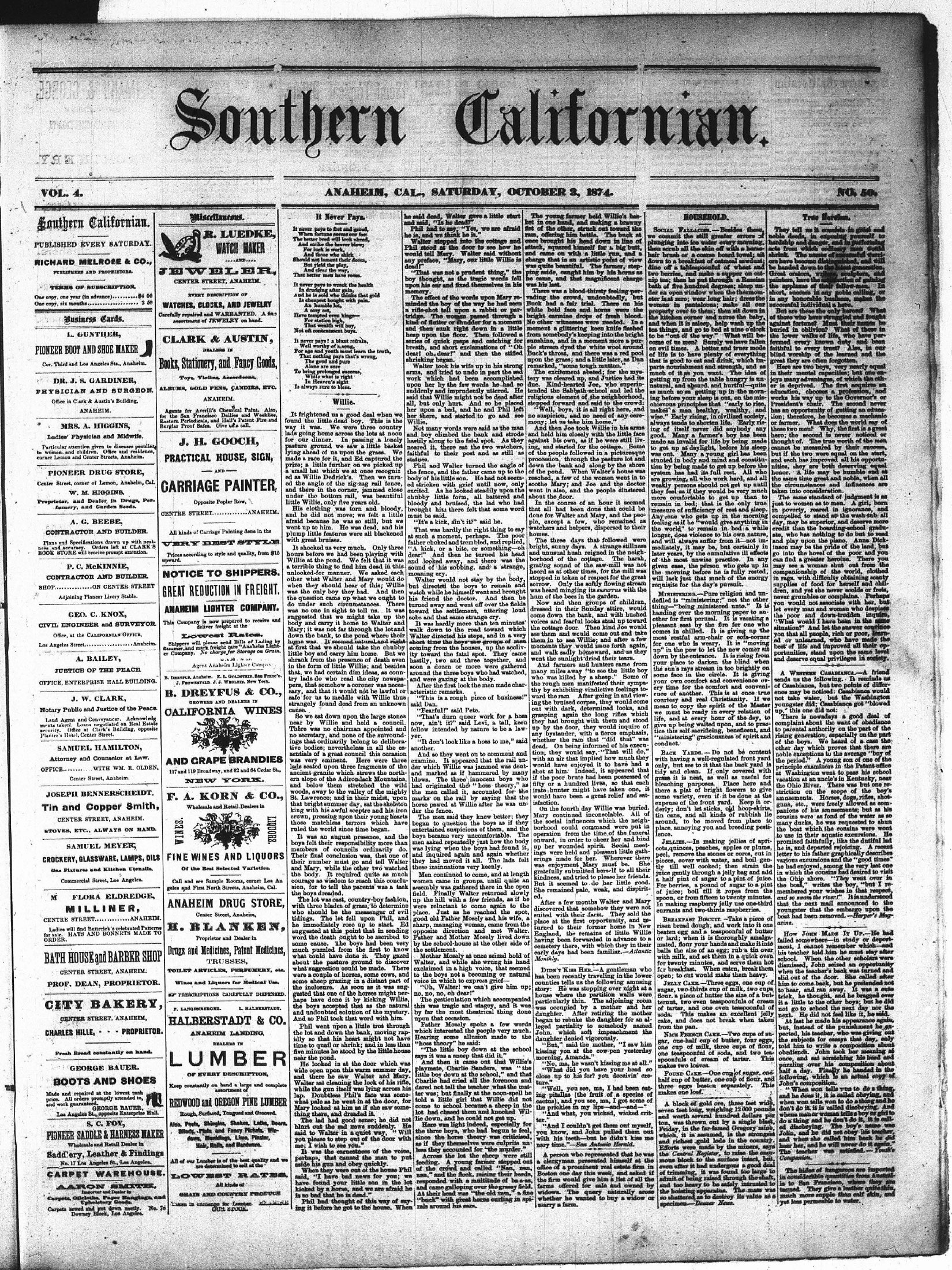
Searchable text
VOL. 4.
Southern Californian.
PUBLISHED EVERY SATURDAY.
RICHARD MELROSE & CO., PUBLISHERS AND PROFRIETORS.
TERMS OF SUBSCRIPTION.
One copy, one year (in advance) $4 00
One copy, six months 2 50
Business Cards.
L. GUNTHER,
PIONEER BOOT AND SHOE MAKER
Cor. Third and Los Angeles Sts., Anaheim.
DR. J. S. GARDINER,
PHYSICIAN AND SURGEON.
Office in Clark & Austin's Building,
ANAHEIM.
MRS. A. HIGGINS,
Ladies' Physician and Midwife.
Particular attention given to diseases peculiar to women and children. Office and residence, corner Lemon and Center Streets, Anaheim.
Miscellaneous.
R. LUEDKE,
WATCH MAKER
AND
JEWELER,
CENTER STREET, ANAHEIM.
EVERY DESCRIPTION OF
WATCHES, CLOCKS, AND JEWELRY
Carefully repaired and WARRANTYed. A fine assortment of JEWELRY on hand.
CLARK & AUSTIN,
DEALERS IN
Books, Stationery, and Fancy Goods,
Toys, Violin, Accordions,
ALBUMS, GOLD PENS, CANDIES, ETC.
ANAHEIM.
Agents for Averill's Chemical Paint. Also, for the San Francisco Dailies and Weeklies, Eastern Periodicals, and Hall's Patent Fire and Burglar Proof Safes. Give us a call.
J. H. GOOCH,
PRACTICAL HOUSE, SIGN,
ANAH
It Never Pares!
It never pays to first and giver When fortune seems oure The better bird will look at And strike the hawker b For lack is work,
And those who shirk Should not lament their de But yield the play,
And clear the way,
That better men have room It never pays to wreck the In drudging after gain,
And he is sold who thinks Is cheapest bought with An humble lot,
A cow cot,
Have tempted even kingdoms For station high,
That wealth will buy,
Not oft contentment buys It never pays! a blunt rea Well worthy of a sage For age and youth must be That nothing pays that The good and pure Alone are sure To bring prolonged success While what is right In Heaven's sight Is always sure to bless.
Willie:
It frightened us a good found the little dead by way it was. We were lads going home across for our dinner. In pasture ground we saw lying ahead of us upon made a race for it, and prize; a little further o a small hat which we a
DR. J. S. GARDINER,
PHYSICIAN AND SURGEON.
Office in Clark & Austin's Building,
ANAHEIM.
MRS. A. HIGGINS,
Ladies' Physician and Midwife.
Particular attention given to diseases peculiar to women and children. Office and residence, corner Lemon and Center Streets, Anaheim.
PIONEER DRUG STORE,
Center Street, corner of Lemon, Anaheim, Cal.
W. M. HIGGINS.
Preprieter, and Dealer in Drugs, Perfumery, and Garden Seeds.
A. G. BEEBE,
CONTRACTOR AND BUILDER.
Plans and Specifications drawn up with neatness and accuracy. Orders left at CLARK'S BOOK STORE will receive prompt attention.
P. C. McKINNIE,
CONTRACTOR AND BUILDER.
SHOP...ON CENTER STREET
Adjoining Pioneer Livery Stable.
GEO. C. KNOX,
CIVIL ENGINEER and SURVEYOR.
Office, at the CALIFORNIAN OFFICE,
Los Angeles Street...Anaheim.
A. BAILEY,
JUSTICE OF THE PEACE.
OFFICE, ENTERPRISE HALL BUILDING.
J. W. CLARK,
Notary Public and Justice of the Peace.
Land Agent and Conveyancer. Acknowledgments taken. Loans negotiated on Real Estate security. Office at Clark's Building, opposite Planter's Hotel, Center Street.
SAMUEL HAMILTON,
Attorney and Counselor at Law.
OFFICE...WITH WM. R. OLDEN,
Center Street, Anaheim.
JOSEPH BENNERSCHEIDT,
Tin and Copper Smith,
CENTER STREET, ANAHEIM.
STOVES, ETC., ALWAYS ON HAND.
SAMUEL MEYER,
CROCKERY, GLASSWARE, LAMPS, OILS
Gas Fixtures and Kitchen Utensils,
Commercial Street, Los Angeles.
TOYS, VIOLINS, ACCORDIONS,
ALBUMS, GOLD PENS, CANDIES, ETC.
ANAHEIM.
Agents for Averill's Chemical Paint. Also, for the San Francisco Dailies and Weeklies, Eastern Periodicals, and Hall's Patent Fire and Burglar Proof Safes. Give us a call.
J. H. GOOCH,
PRACTICAL HOUSE, SIGN,
AND
CARRIAGE PAINTER,
Opposite Poplar Row,
CENTRE STREET...ANAHEIM.
All kinds of Carriage Painting done in the VERY BEST STYLE
Prices according to style and quality, from $15 upward.
NOTICE TO SHIPPERS.
GREAT REDUCTION IN FREIGHT.
ANAHEIM LIGHTER COMPANY.
This Company is now prepared to receive and deliver freight at the Lowest Rates.
Shippers will please send Bills of Lading by Steamer, and mark freight care "Anaheim Lighter Company." No charge for Storage on Grain.
Agent Anaheim Lighter Company.
B. DREYFUS, Anaheim.
E. L. GOLDSTEIN, San Francisco.
J. PROWENFIELD, J. J. WEOLIN, New York.
B. DREYFUS & CO., GROWERS AND DEALERS IN CALIFORNIA WINES
AND GRAPE BRANDIES
117 and 119 Broadway, and 62 and 64 Cedar St.
NEW YORK.
F. A. KORN & CO., Wholesale and Retail Dealers in
WINES.
FINE WINES AND LIQUORS
Of the Best Selected Varieties.
Call and see Sample Rooms, corner Los Angeles and First North Streets, Anaheim, Cal.
Willie.
It frightened us a good found the little dead be way it was. We were lads going home across for our dinner. In pasture ground we saw lying ahead of us upon made a race for it, and prize; a little further o a small hat which we ad as Willie Dedrick's. Ed the angle of the zigzag and there in the corner under the bottom rail little Willie, only five yrs His clothing was too and he did not move; afraid because he was went up to him. He wilt plump little features we with great bruises.
It shocked us very much hours before we had been Willie at the pond. We a terrible thing to find unlooked-for manner other what Walter and when they should hear was the only boy they were the question came up we do under such circumstances was no one in sight to suggest that we might body and carry it home Mary; it was not far tha down the bank, to the p home was. It seemed at first that we should little boy and carry him shrank from the present in the form of little Willie that, we had certain diary lads do who read pers, that somehow a co sary, and that it would safe for us to meddle strangely found dead f cause.
So we sat down upon near by Willie and There was no chairma no secretary, and noneings that ordinarily be tive bodies; nevertheless essentials of a great count was very eminent. lads seated upon three ancient-granite which cern slope of the Adirondack and below them str woods, away to the val St. Lawrence; and in that bright summer day king with his awful sc crown, pressing upon those matchless terru ruled the world since it was an august p boys felt their response members of councils Their final conclusion their number must go and Mary, while the o the body. It required courage as wisdom to con sion, for to tell the p the boys dreaded.
Tin and Copper Smith,
CENTER STREET, ANAHEIM.
STOVES, ETC., ALWAYS ON HAND.
SAMUEL MEYER,
CROCKERY, GLASSWARE, LAMPS, OILS
Gas Fixtures and Kitchen Utensils,
Commercial Street, Los Angeles.
M FLORA ELDREDGE,
MILLINER,
CENTRE STREET...ANAHEIM.
Ladies will find Butterick's celebrated Patterns for sale. HATS AND BONNETS MADE TO ORDER.
BATH HOUSE and BARBER SHOP
CENTER STREET, ANAHEIM.
PROF. DEAN, PROPRIETOR.
CITY BAKERY,
CENTER STREET, ANAHEIM.
CHARLES MILLE, ... PROPRIETOR.
Fresh Bread constantly on hand.
GEORGE BAUER.
BOOTS AND SHOES
Made and repaired at the lowest cash price. All orders promptly attended to, and work guaranteed.
GEORGE BAUER.
Los Angeles St., opposite Enterprise Hall.
S. C. FOY,
PIONEER SADDLE & HARNESS MAKER
Wholesale and Retail Dealer in Saddery, Leather & Findings
No. 17 Los Angeles St., Los Angeles.
CARPET WAREHOUSE.
AARON SMITH,
Importer and Dealer in Carpets, Oilcloths, Paper Banglegs, and Upholstery Goods.
Carpets swned and put down neatly. No. 70 Downey Block, Los Angeles.
F. A. KORN & CO.
Wholesale and Retail Dealers in
FINE WINES AND LIQUORS
Of the Best Selected Varieties.
Call and see Sample Rooms, corner Los Angeles and First North Streets, Anaheim, Cal.
ANAHEIM DRUG STORE,
Center Street, Anaheim,
H. BLANKEN,
Proprietor and Dealer in Drugs and Medicines, Patent Medicines, TRUSSES,
TOILET ARTICLES, PERFUMERY, etc.
Wines and Liquors for Medical Use.
EP PRESCRIPTIONS CAREFULLY DISPENSED.
F. LANGENBERGER.
L. HALBERSTADT.
HALBERSTADT & CO.
ANAHEIM LANDING,
DEALERS IN
LUMBER
OF EVERY DESCRIPTION,
Keep constantly on hand a large and complete assortment of REDWOOD and OREGON PINE LUMBER
Rough, Surfaced, Tongued and Grooved.
Also, Posts, Shingles, Shakes, Lathes, Doors, Blinds, Plains and Fancy Planks, Windows, Meadows, Lime, Plaster, Hair, Nails, and Hardware.
All of our Lumber is of the best quality and we are determined to sell at the LOWEST RATE.
All kinds of GRAIN AND COUNTRY PRODUCE taken in exchange for Lumber.
It was an august p
boys felt their respon
members of councili
Their final conclusion
their number must g
and Mary, while the o
the body. It require
courage as wisdom to
sion, for to tell the p
the boys dreaded.
The lot was cast, co
with three blades of g
who should be the
tidings. The lot fell
he immediately rose e
suggested at this poi
word the death ought
some cause. The boo
much puzzled from
what could have done
about the pasture g
what suggestion could
were a couple of horse
some sheep grazing i
the inclosure. As so
gested that one of the
haps have done it b
the boys accepted th
and undoubted solutio
And so Phil took tha
Phil went upon a
the lot and down the
illy so that his hea
time to quail or shrimp
five minutes he stood
near the pond.
He looked in at th
wide open upon this
and there he saw V.
Walter sat cleaning t
while the gun itself w
lap. Doubtless Phil
what pale as he wenth
Mary looked at him a
you please to step out
me; I wish to see you
It was the earnest
perhaps, that canne
aside his gun and obe
When they were owe
aid," I have bad h
have found your likicked by a home, a
is so bad that he in d
Phil had thought it before he got
It Never Pays.
It never pays to first and growl,
When fortune seems our foe:
The better bird will look ahead,
And strike the haver blow;
For luck is work,
And those who shirk
Should not lament their doors,
But yield the play,
And clear the way,
That better man have room.
It never pays to wreck the health
In drudging after pain,
And he is sold who thinks that gold
Is cheapest bought with pain.
An humble lot,
A cow cot,
Have tempted even kings—
For station high,
That wealth will buy,
Not oft contentment buys.
It never pays! a blunt refrain,
Well worthy of a song.
For age and youth must learn the truth,
That nothing pays that's wrong.
The good and pure
Alone are sure
To bring prolonged success,
While what is right
In Heaven's sight
Is always sure to bless.
Willie.
It frightened us a good deal when we found the little dead boy. This is the way it was. We were three country lads going home across the lots at noon for our dinner. In passing a lonely pasture ground we saw a little basket lying ahead of us upon the grass. We made a race for it, and Ed captured the prize; a little further on we picked up a small hat which we at once recogniz
he said dead, Walter gave a little start and said, "Is he dead?"
Phil had to say, "Yes, we are afraid he is, and we think he is."
Walter stepped into the cottage and Phil stood at the door to see how he would tell Mary. Walter said without any preface, "Mary, our little Willie is dead!"
"That was not a prudent thing," the boy thought, as the tragic words fell upon his ear and fixed themselves in his memory.
The effect of the words upon Mary reminded the boy of the way he had seen a rifle-shot tell upon a rabbit or partridge. The woman passed through a kind of flutter or shudder for a moment and then sunk right down in a little heap upon the floor. Then followed a series of quick gasps and catching for breath, and short exclamations of "Oh dear! oh, dear!" and then the stifled shrinking began.
Walter took his wife up in his strong arms, and tried to undo in part the work which had been accomplished upon her by the few words he had so suddenly and imprudently uttered. He said that Willie might not be dead after all, but only hurt. And so he placed her upon a bed, and he and Phil left her there, and started to go and see Willie.
Not many words were said as the man and boy climbed the bank and strode hastily along to the fatal spot. As they neared it, there sat the two watchers, faithful to their post and as still as statues.
Phil and Walter turned the angle of the fence, and the father came up to the young farmer held Willie's basket in one hand, and making a brawny fast of the other, struck out toward the ram, offering him battle. The buck at once brought his head down in line of attack, squared himself for a big bait, and came on with a little run, and a charge that in an artistic point of view was quite beautiful. The farmer, stepping aside, caught him by his horns as he came, and that magnificent charge was his last.
There was a blood-thirsty feeling pervading the crowd, undoubtedly, but Buck had a fair trial. There on his white bold face and horns were the bright carmine drops of fresh blood. No other witnames were needed. In a moment a glittering keen knife flashed from somebody's keeping into the bright sunshine, and in a moment more a purple stream dyed the white wool around Buck's throat, and there was a red pool upon the grass; and a little later, as Dan remarked, "some tough mutton."
The excitement abated; for the mystery was cleared up, and Justice had its due. Kind-hearted Joe, who superintended the Sabbath-school and led the religious element of the neighborhood, stepped forward and said to the crowd: "Well, boys, it is all right here, and no suspicion, and no need of any ceremony; let us take him home."
And then Joe took Willie in his arms and held him closely with the little face against his own, as if he were still living, and started for the cottage. Some of the people followed in a picturesque procession, through the pasture lot and down the bank and along by the shore of the pond. When Walter's house was
Willie.
It frightened us a good deal when we found the little dead boy. This is the way it was. We were three country lads going home across the lots at noon for our dinner. In passing a lonely pasture ground we saw a little basket lying ahead of us upon the grass. We made a race for it, and Ed captured the prize; a little further on we picked up a small hat which we at once recognized as Willie Dedrick's. Then we turned the angle of the zig-zag rail fence, and there in the corner, jammed close under the bottom rail, was beautiful little Willie, only five years old.
His clothing was torn and bloody, and he did not move; we felt a little afraid because he was so still, but we went up to him. He was dead, and his plump little features were all blackened with great bruises.
It shocked us very much. Only three hours before we had been playing with Willie at the pond. We felt that it was a terrible thing to find him dead in this unlocked-for manner. We asked each other what Walter and Mary would do when they should hear of this; Willie was the only boy they had. And then the question came up what we ought to do under such circumstances. There was no one in sight to tell us. It was suggested that we might take up the body and carry it home to Walter and Mary; it was not far through the lotand down the bank, to the pond where their home was. It seemed natural and right at first that we should take the chubby little boy and carry him home. But we shrank from the presence of death even in the form of little Willie; and besides that, we had certain dim ideas, as country lads do who read the city newspapers, that somehow a coroner was necessary, and that it would not be lawful or safe for us to meddle with Willie thus strangely found dead from an unknown cause.
So we sat down upon the large stones near by Willie and held a council. There was no chairman appointed and no secretary, and none of the surroundings that ordinarily belong to deliberative bodies; nevertheless in all the essentials of a great council this occasion was very eminent. Here were three lads seated upon three fragments of the ancient granite which strews the northern slope of the Adirondack Mountains, and below them stretched the wild woods, away to the valley of the mighty St. Lawrence; and in their midst, upon that bright summer day, sat the skeleton king with his awful sceptre and his iron crown, pressing upon their young hearts those matchless terrors which have ruled the world since time began.
It was an august presence, and the boys felt their responsibility more than members of councils ordinarily do. Their final conclusion was, that one of their number must go and tell Walter and Mary, while the other two watched the body. It required quite as much courage as wisdom to reach this conclusion, for to tell the parents was a task the boys dreaded.
Not many words were said as the man and boy climbed the bank and strode hastily along to the fatal spot. As they neared it, there sat the two watchers, faithful to their post and as still as statues.
Phil and Walter turned the angle of the fence, and the father came up to the body of his little son. He had not seemed stricken with grief until now, only excited. As he looked steadily upon the chubby little form, all battered and bloody and bruised, the lad who had brought him there felt that some word must be said.
"It's a kick, isn't it?" said he.
That was hardly the right thing to say at such a moment, perhaps. The poor father choked and trembled, and replied, "A kick, or a bite, or something—oh dear!" And then he turned his head and looked away, and there was the sound of his sobbing, and a strange, moaning cry.
Walter would not stay by the body, but directed the boys to remain and watch while he himself went and brought his friend the doctor. And then he turned away and went off over the fields toward the settlement, uttering loud sobs and that same strange cry.
It was hardly more than ten minutes' walk down to the road toward which Walter directed his steps, and in a very short time the boys saw groups of men coming from the houses, up the acclivity toward the fatal spot. They came hastily, two and three together, and soon a dozen or more were gathered around the three boys who had watched, and were gazing at the body.
After the first look the men made characteristic remarks.
"This is a rough piece of business!" said Dan.
"Fearful!" said Pete.
"That's durn queer work for a boss now, ain't it?" said Levi, a tall, keen fellow intended by nature to be a lawyer.
"It don't look like a boss to me," said another.
And so they went on to comment and examine. It appeared that the rail under which Willie was jammed was dented and marked as if hammered by many blows. The three innocent boys who had originated the "hoss theory," as the men called it, accounted for the marks on the rail by saying that the horse pawed at Willie after he was under the fence.
The men said they knew better; they began to question the boys as if they entertained suspicions of them, and the boys became very uncomfortable. The men asked repeatedly just how the body was lying when the boys had found it, and inquired again and again whether they had moved it all. The lads felt these insinuations very keenly.
Men continued to come, and at length women came in groups, until quite an assembly was gathered there in the open field. Finally Walter returned slowly
The tery was cleared up, and Justice had its due. Kind-hearted Joe, who superintended the Sabbath school and led the religious element of the neighborhood, stepped forward and said to the crowd:
"Well, boys, it is all right here, and no suspicion, and no need of any ceremony; let us take him home."
And then Joe took Willie in his arms and held him closely with the little face against his own, as if he were still living, and started for the cottage. Some of the people followed in a picturesque procession, through the pasture lot and down the bank and along by the shore of the pond. When Walter's house was reached, a few of the women went in to soothe Mary; and Joe and the doctor went in also, and the people clustered about the door.
In the course of an hour it seemed that all had been done that could be done for Walter and Mary, and the people, except a few, who remained as watchers and helpers, dispersed to their homes.
The three days that followed were bright, sunny days. A strange stillness and unusual hush reigned in the neighborhood of the cottage. The harsh, grating sound of the saw-mill was not heard as at other times, for the mill was stopped in token of respect for the great sorrow. Only the softly flowing stream was heard mingling its sunrus with the hum of bees in the garden.
Now and then groups of children, dressed in their Sunday attire, would come down the bank, and with hushed voices and fearful looks steal up toward the cottage door. Then kind Joe would see them and would come out and take them in to see Willie; and after a few moments they would issue forth again, and walk sadly homeward, and as they went the sunlight dried their tears.
And farmers and hunters came from many miles away "to see the little boy who was killed by a sheep." Some of the rough men manifested their sympathy by exhibiting vindictive feelings toward the ram. After going in and viewing the bruised corpse, they would come out with dark, determined looks, and grasping again the long rifles which they had brought with them and stood up by the door; they would inquire of any bystander, with a fierce emphasis, whether the ram that "did that" was dead. On being informed of his execution, they would say: "That will do," with an air that implied how much they would have enjoyed it to have had a shot at him. Indeed, it appeared that if the poor brute had been possessed of fifty or a hundred lives, so that each irate hunter might have taken one, it would have been a great relief and satisfaction.
On the fourth day Willie was buried. Mary continued inconsolable. All of the social influences which the neighborhood could command were put in operation from time of the funeral onward, in order to cheer her and bind up her wounded spirit. Social meetings were held and pleasant little gatherings made for her. Wherever there was enjoyment Mary must be. She gratefully submitted hers-If to all their kindness,and tried to please her friends.But it seemed to do her little good.She remained pale,weak,and dispirit-ed.*
St. Lawrence; and in their midst, upon that bright summer day, sat the skeleton king with his awful sceptre and his iron crown, pressing upon their young hearts those matchless terrors which have ruled the world since time began.
It was an august presence, and the boys felt their responsibility more than members of councils ordinarily do. Their final conclusion was, that one of their number must go and tell Walter and Mary, while the other two watched the body. It required quite as much courage as wisdom to reach this conclusion, for to tell the parents was a task the boys dreaded.
The lot was cast, country-boy fashion, with three blades of grass, to determine who should be the messenger of evil tidings. The let fell upon Phil, and he immediately rose up to start. Ed suggested at this point that in sending word the death ought to be ascribed to some cause. The boys had been very much puzzled from the first to know what could have done it. They gazed about the pasture ground to discover what suggestion could be made. There were a couple of horses, some cows, and some sheep grazing in a distant part of the enclosure. As soon as it was suggested that one of the horses might perhaps have done it by kicking Willie, the boys accepted that as the natural and undoubted solution of the mystery. And so Phil took that word with him.
Phil went upon a little trot through the lot and down the bank, moving rapidly so that his heart might not have time to quail or shrink; and in less than five minutes he stood by the little house near the pond.
He looked in at the door which was wide open upon this warm summer day, and there he saw Walter and Mary. Walter sat cleaning the lock of his rifle, while the gun itself was lying across his lap. Doubtless Phil's face was somewhat pale as he went in at the door, for Mary looked at him as if she saw something there, and dreaded it.
The lad had good sense; he did not blurt out the sad news suddenly. He said to Walter in a quiet way, "Will you please to step out of the door with me; I wish to see you."
It was the earnestness of the voice, perhaps, that canned the man to put aside his gun and obey quickly.
When they were out of the house Phil said, "I have bad news for you; we have found your little son in the lot kicked by a horse, and we are afraid he is so bad that he is dead."
Phil had thought of this way of saying it before he got to the house. When
The men said they knew better; they began to question the boys as if they entertained suspicions of them, and the boys became very uncomfortable. The men asked repeatedly just how the body was lying when the boys had found it, and inquired again and again whether they had moved it all. The lads felt these insinuations very keenly.
Men continued to come, and at length women came in groups, until quite an assembly was gathered there in the open field. Finally Walter returned slowly up the hill with a few friends, as if he were reluctant to come again to the place. Just as he reached the spot, good old Father Mosely and his wife, a sharp, managing woman, came from the opposite direction and met Walter. Father and Mother Mosely lived down by the school-house at the other side of the settlement.
Mother Mosely at once seized hold of Walter, and while she wrung his hand exclaimed in a high voice, that seemed to the boys not a becoming or natural voice in which to express grief—
"Oh, Walter! we can't give him up; no, no, no, oh dear!"
The gesticulation which accompanied this was tragic and stagey, and it was by far the most theatrical thing done upon that occasion.
Father Mosely spoke a few words which interested the people very much. Hearing some allusion made to the "hoax theory" he said:
"The little boy down at the school says it was a sneep that did it."
And then it came out that Willie's playmate, Charlie Sanders, was "the little boy down at the school," and that Charlie had cried all the forenoon and dared not tell the teacher what the matter was; but finally at the noon-spell he told a little girl that Willie did not come to school because a sheep in the lot had chased them and knocked Willie down, and he could not get up.
Here was light indeed, especially for the three boys, who had begun to feel since the horse theory was criticised, as if they themselves were culprits unless they accounted for "the murder."
Across the lot the sheep were still feeding. A young farmer stepped out of the crowd and called "Nan, nan," and the flock, raising their heads, responded with a multitude of ha-ha-ha-ha-ha-ha-ha-ha-ha-ha-ha-ha-ha-ha-ha-ha-ha-ha-ha-ha-ha-ha-ha-ha-ha-ha-ha-ha-ha-ha-ha-ha-ha-ha-ha-ha-ha-ha-ha-ha-ha-ha-ha-ha-ha-ha-ha-ha-ha-ha-ha-ha
On the fourth day Willie was buried. Mary continued inconsolable. All of the social influences which the neighborhood could command were put in operation from time of the funeral onward, in order to cheer her and bind up her wounded spirit. Social meetings were held and pleasant little gatherings made for her. Wherever there was enjoyment Mary must be. She gratefully submitted hers-if to all their kindness, and tried to please her friends. But it seemed to do her little good. She remained pale, weak, and dispirited.
After a few months Walter and Mary discovered that somehow they were not suited with their farm. They sold the place at the first opportunity, and turned to their former home in New England, the remains of little Willie having been forwarded in advance to a cemetery there, with which they in their early days had been familiar.
"But," said the mother, "I saw him kissing you at the cow-pen yesterday morning, Amanda."
"No, ma, he wasn't kissing me at all." "What did you have your head so close up to his for? you deceivin' creature."
"Well, you see, ma, I had been eating pitallas (the fruit of a species of cactus), and you see, ma, I got some of the prickles in my lips—and—and—and"
"And what, you wicked, wicked critter."
"And I couldn't get them out myself, you know, and John pulled them out with his teeth—but he didn't kiss me nary time." —Sam Antonio Herald.
A person who represented that he was a clergyman presented himself at the office of a prominent real estate firm in Boston one day this week, and asked if the firm would give him a list of all the farms offered for sale and owned by widows. The query naturally arose whether he wanted to buy a widow or marry a farm.
Willie's bravery outwardly, but
he was down in line of
for a big butt,
bite run, and a
point of view
the farmer, stepby his horns as
nificent charge
Social Wallace.—Besides these,
we commit the still greater errors of
planging into ice water every morning,
than scrub all the skin off with a horsehair brush or a course board towel; sit
down to a breakfast of oatmeal newdust;
dine off a tablepoonful of wheat and
two berries, and make a supper on cuttip tea; then be put through a Russian
bath of five hundred degrees; sleep under
an open window when the thermometer is at zero; wear long hair; dress the woman in pantaloons; make all our property over to them; then sit down in the kitchen corner and nurse the baby,
and when it is sleepy, help wash up the tea things, and go to bed at nine o'clock to be "out of the way." What will become of us men? Surely we have fallen on evil times. A better and truer mode of life is to have plenty of everything that is good to eat and drink, which imparts nourishment and strength, and as much of it as you want. The idea of getting up from the table hungry is unnatural, and absurd, and hurtful—quite as much so as getting up in the morning before your sleep is out, on the mischievous principles that "early to rise, makes a man healthy, wealthy, and wise." Early rising, in civilized society, always tends to shorten life. Early rising of itself never did anybody any good. Many a farmer's boy has been made an invalid for life by being made to get up at daylight, before his sleep was out. Many a young girl has been stunted in body and mind and constitution by being made to get up before the system has had its full rest. All who
True Herein.
They tell us it consists in grief and noble deeds, in exposing yourself to hardship and danger, and in performing acts from which ordinary men would shrink. The names of successful warriors have become distinguished; and will be handed down to the latest generation. Great orators, writers, sculptors, and painters have the satisfaction of gaining the applause of their fellow-men. In short, success in any public calling, or in any honorable business, means the successful individual a hero.
But are these the only harms? What of those who have struggled and fought against fortune? Must their names be buried in oblivion? What of those in the lower walks of life, who have performed every known duty and been faithful to every trust? Also, in our blind worship of the learned and the great they are often forgotten.
Here are two boys, very nearly equal in their mental capacities; but one enjoys many advantages, of which the other is deprived. The first acquires an education, chooses a profession, and works his way up to the Governor's or President's chair. The second never has an opportunity of getting an education; therefore, he becomes a mechanic or farmer. What does the world say of these two men? Why, the first is a great hero; the second is never noticed or thought of. The true worth of the man cannot be measured by their success, but if the two were equal on the start, and each has improved all his opportunities, they are both deserving equal honor. A life may be humble and at
Justice had its duty, who superintendent and led the neighborhood, did to the crowd: right here, and of any cemetery."
Willie in his arms with the little face were still living in a picturesque pasture lot and long by the shore where women went in to and the doctor people clustered.
Hour it seemed that could be easy, and the people remained as dispersed to their followered strange stillness in the neigh-gear. The harsh saw-mill was not, for the mill was aspect for the great flowering stream with the garden.
Ups of children, day attire, would stand with hushed stalk up toward kind Joe would come out and take and after a few measure forth again, ward, and as they did their tears.
Munters came from see the little boy sheep." Some of usted their sympa-thetic feelings to going in and view they would come examined looks, and long rifles which them and stood would inquire of a fierce emphasis, that "did that" was named of his execu-
That will do," and how much they sit to have had it appeared that been possessed of lives, so that each have taken one, it great relief and sat.
Willie was buried. Consolable. All of which the neigh-ground were put in time of the funeral cheer her and bind spirit. Social meet-pleasant little gath-Wherever there must be. She others-lf to all their please her friends. So her little good. Weak, and dispirit-
Ministering.—Pure religion and undefiled is "ministering;" not the other thing—"being ministered unto." It is handing over the morning paper to another for first perusal. It is vacating a pleasant seat by the fire for one who comes in chilled. It is giving up the most restful arm-chair or sofa-corner for one who is weary. It is "moving up" in the pew to let the new comer sit down by the entrance. It is rising from your place to darken the blind when the sun's rays stream in too brightly on some face in the circle. It is giving your own comfort and convenience every time for the comfort and convenience of another. This is at once true courtesy and real Christianity. If we mean to copy the spirit of the Master we must be ready in every relation of life, and at every hour of the day, to give up being waited upon, and to practice this self-sacrificing, beneficent, and "ministering" graciousness of spirit and conduct.
Back Yards.—Do not be content with having a well-regulated front yard only, but see to it that the back yard is tidy and clean. If only covered with grass it is neat, as well as useful for bleaching purposes. Place here and there a plat of bright flowers to give some variety, even if it be done at the expense of the front yard. Keep it orderly; don't let sticks, old hoop-skirts, tin cans, and all kinds of rubbish lie around, to be moved from place. annoying you and breeding pestilence.
Jellies.—In making jellies of apricots, quinces, peaches, apples or plums, peel, remove the stones or cores, cut in pieces, cover with water, and boil gently till well cooked; then strain the juice gently through a jelly bag and add a half pint of sugar to a pint of juice. For berries, a pound of sugar to a pint of juice; boil till it ropes from the moon or from fifteen to twenty minutes.
The less we get up from the table hungry is unnatural, and aburd, and hurtful—quite as much so as getting up in the morning before your sleep is out, on the mischievous principles that "early to rise, makes a man healthy, wealthy, and wise." Early rising, in civilized society, always tends to shorten life. Early rising of itself never did anybody any good. Many a farmer's boy has been made an invalid for life by being made to get up at daylight, before his sleep was out. Many a young girl has been stunted in body and mind and constitution by being made to get up before the system has had its full rest. All who are growing, all who work hard, and all weakly persons should not get up until they feel as if they would be very much comfortable to get up than to remain in bed; that is the only true measure of sufficiency of rest and sleep. Anyone who gets up in the morning feeling as if he "would give anything in the world" to remain in bed a while longer, does violence to his nature, and will always suffer from it—not immediately, it may be, but certainly in later years, by the cumulative ill effects of the most unwise practice. In any given case, the person who gets up in the morning before he is fully rested, will lack just that much of the energy requisite for the day's pursuit.
A Western Casabianca.—A friend sends us the following. It reminds us of Casabianca, but two points of difference may be noticed: Casabianca would not take water, but the Washington youngster did; Casabianca got "blowed up," this one did not:
There is nowadays a good deal of complaint about the want of obedience to parental authority on the part of the rising generation, especially on the part of the boys. We heard of a case the other day which proves that there are noble exceptions to the average "boy of the period." A young son of one of the principle examiners in the Patent-office at Washington went to pass his school vacation at an uncle's in Kentucky, near Ohio River. There was but one restriction on the scope of the boy's amusements. Horses, dogs, rifles, shot-guns, etc., were freely allowed as companions of his amusements; but as his cousins were as fond of the water as so many ducks, he was requested to shun the boat which the cousins were wont to use in their aquatic excursions. He promised faithfully, like the dutiful lad he is, and departed rejoicing. A recent letter to his father graphically describes various excursions and the "good times" he had enjoyed among the very last one in which the cousins had desired to visit Ohio shore. "They went over in the boat," writes the boy, "but I remembered your wishes in that respect, it is understood
Willie was buried.
Consolable. All of which the neighand were put in time of the funeral cheer her and bind it.
Social meetpleasant little gathWherever there must be. She hers-If to all their please her friends,
to her little good, weak, and dispiritWalter and Mary show they were not him. They sold the opportunity, and near home in New Jersey in advance to a familiar—Atlantic
A gentleman who welling in the lower following amusing over night at a station walls were the adjoining room mother and her tiring the mother daughter for an alsomebody named impachment the seriously.
Mother, "I saw him cow-pen yesterday kissing me at all." Have your head so you deceivin' creama, I had been eatit of a species of ma, I got some of cups—and—and"
Tired, wicked critset them out myself, pulled them out he didn't kiss me Hamilton Herald.
Remanted that he was tested himself at the real estate firm in weak, and asked if him a list of all the calls and owned by naturally areas to buy a widow or some variety, even if it is done as the expense of the front yard. Keep it orderly; don't let sticks, old hoop-skirts, tin cans, and all kinds of rubbish lie around, to be moved from place to place, annoying you and breeding pestilence.
JELLIES.—In making jellies of apricots, quinces, peaches, apples or plums, peel, remove the stones or cores, cut in pieces, cover with water, and boil gently till well cooked; then strain the juice gently through a jelly bag and add a half pint of sugar to a pint of juice. For berries, a pound of sugar to a pint of juice; boil till it ropes from the spoon, or from fifteen to twenty minutes. In making raspberry jelly use one-third currants and two-thirds raspberries.
BREAKFAST BISCUIT.—Take a piece of risen bread dough, and work into it one beaten egg and a teaspoonful of butter or lard; when it is thoroughly amalgamated, flour your hands and make it into balls the size of an egg; rub a tin over with milk, and set them in a quick oven for twenty minutes, and serve them hot for breakfast. When eaten, break them open; to cut would make them heavy.
JELLY Cake.—Three eggs, one cup of sugar, two-thirds cup of milk, two cups flour, a piece of butter the size of a butternut, two even teaspoonfuls of cream of tartar, and one oven teaspoonful of soda. This makes an excellent jelly cake, and does not break when taken from the pan.
NICE FRENCH CAKE.—Two cups of sugar, one-half cup of butter, four eggs, one cup of milk, three cups of flour, one teaspoonful of soda, and two teaspoonfuls of cream of tartar. This makes two loaves.
FOUND CAKE.—One cup of sugar, one-half cup of butter, one cup of flour, and three eggs beaten separately. This makes one loaf.
A block of gold ore, three feet wide, seven feet long, weighing 12 000 pounds and worth several hundred dollars per ton, was thrown out by a single blast Friday, in the far-famed Gregory mine, which it is assumed, is the strongest and richest gold lode in the country. Efforts were made by the miners, says the Central Register, to raise the enormous block to the surface intact, but even after it had undergone a good deal of trimming, it was found too large to admit of being raised through the shaft, and too heavy to be safely intrusted to the hoisting apparatus. The mass was so shattered as to destroy its value as a specimen.—Denver News.
How John Made It Up.—He had failed somewhere—in study or deportment, I cannot remember which—and his teacher told him he must stay after school. When the other scholars were dismissed, John seized an opportunity when the teacher's back was turned and slid out of the door. She called after him to come back, but he prelanded not to hear, and ran away. It was aute trick, he thought, and he bragged over it a little to the other boys; but he did not go to school the next day nor the next. He did not feel like it, he said.
At last he made his appearance again, but instead of the punishment hepected, his teacher, who was giving out the subjects for essays that day, only told him to write a composition about obedience. John took her meaning at once, and sat scratching his head and puzzling over his composition about half a day. Finally he handed in the following, which is an actual copy of John's composition.
"When won tells won to do a thing, and he does it, it is called obeying, and when won tells won to do a thing and he don't do it; it is called obeying. And whens man or woman tells a boy or girl to do a thing and he doesn't do it; it is called disobeying. The boy's name was John, and he did not obey his teacher, and when she called him back he did hear her, and he will never do it again."
The teacher was satisfied. — Youth's Companion.
The hides of hangroos are imported in considerable quantities from Australia to San Francisco, where they are tanned. They give a leather quite thin, much more supple than calf skin, and yet less permeable to water.