anaheim-gazette 1874-07-25
Scanned page
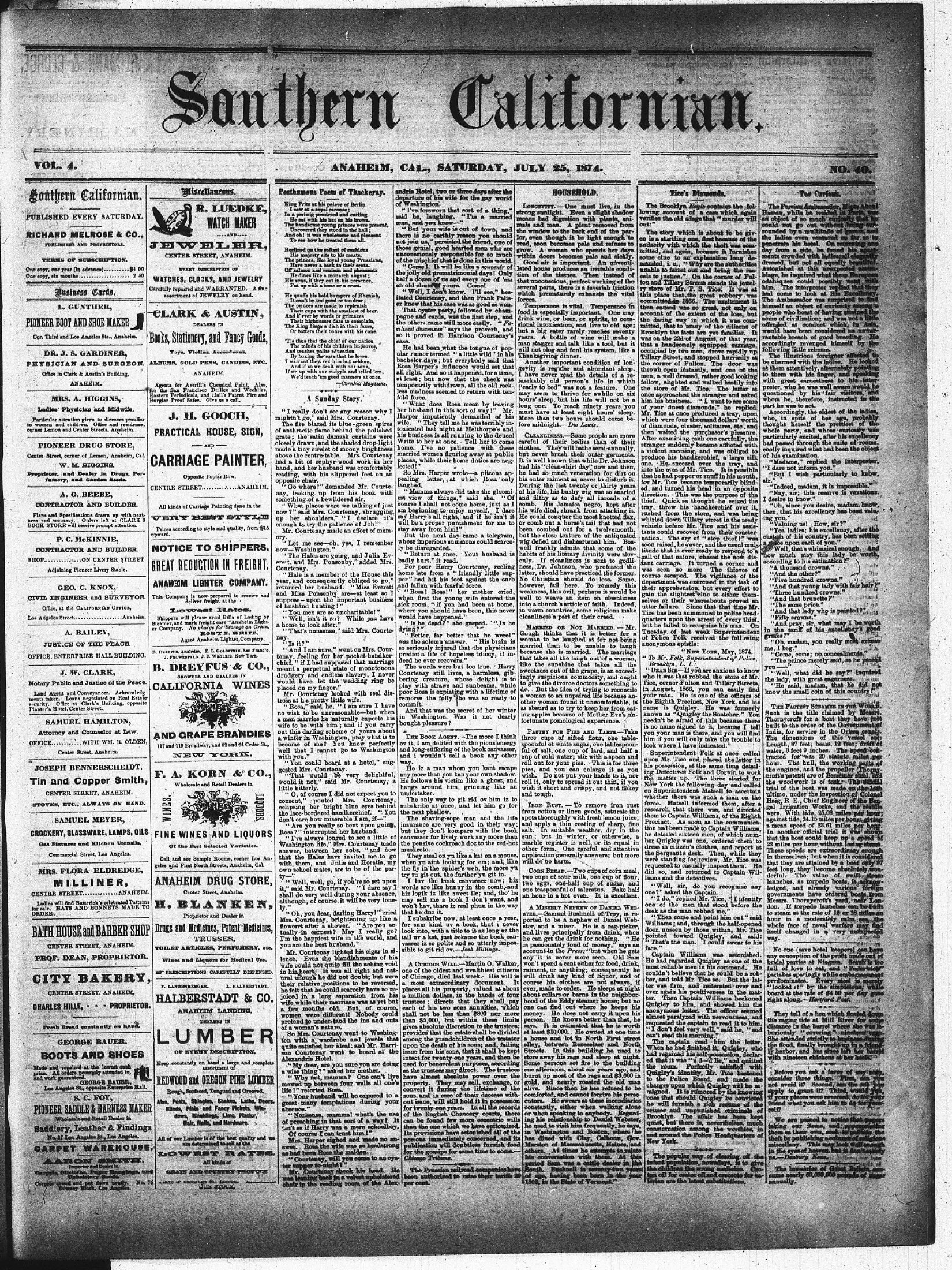
Searchable text
Southern Californian.
PUBLISHED EVERY SATURDAY.
RICHARD MELROSE & CO.,
PUBLISHERS AND PROPRIETORS.
TERMS OF SUBSCRIPTION.
One copy, one year (in advance).....$4 00
One copy, six months.....2 50
Business Cards.
L. GUNTHER,
PIONEER BOOT AND SHOE MAKER
Cor. Third and Los Angeles Sts., Anaheim.
DR. J. S. GARDINER,
PHYSICIAN AND SURGEON.
Office in Clark & Austin’s Building,
ANAHEIM.
MRS. A. HIGGINS,
Ladies’ Physician and Midwife.
Particular attention given to diseases peculiar to women and children. Office and residence, corner Lemon and Center Streets, Anaheim.
PIONEER DRUG STORE,
Center Street, corner of Lemon, Anaheim, Cal.
W. M. HIGGINS.
Miscellaneous.
R. LUEDKE,
WATCH MAKER
AND...
JEWELER,
CENTER STREET, ANAHEIM.
EVERY DESCRIPTION OF
WATCHES, CLOCKS, AND JEWELRY
Carefully repaired and WARRANTY. A fine assortment of JEWELRY on hand.
CLARK & AUSTIN,
DEALERS IN
Books, Stationery, and Fancy Goods,
Toys, Viellas, Accordions,
ALBUMS, GOLD PENN, CANDIES, ETC.
ANAHEIM.
Agents for Averill’s Chemical Paint. Also, for the San Francisco Deiles and Weeklies, Eastern Periodicals, and Hall’s Patent Fire and Burglar Proof Safes. Give us a call.
J. H. GOOCH,
PRACTICAL HOUSE, SIGN,
AND
CARRIAGE PAINTER,
Poetamous Poem of The King Fritz at his palace of Bellevue.
I saw at a royal coronation;
In a periwig powdered and cuckooed;
He sat with his hat on his head;
The handsome young princess Uncovered they stood in the And oh! it was wholesome and To see how he treated them
Redlined on the softest of cushions His majesty sits to his meadow The princes, like loyal young girls Have never a back to their Off salmon and venison and pheasant He dines like a monarch as His sons, if they eat in his prince Put up with a bone or a crucifix He quaffs his bold bumpers o' It can't be too good or too bad The princes are made to replace Their cups with the smaller And if ever by words or grimness They highnesses dare to co-The King things a dish in their Or batters their bones with Tis thus that the chief of our minds of his children And teaches polite education By boxing the ears that he I warrant they vex him but as And if so we dealt with ourself If we up with our cudgels and We'd teach 'em good manners
A Sunday Story
"I really don't see any mightn't go," said Mrs. Co.
The fire blazed its blue-of anthracite flame behind grate; the satin damask closely drawn, and the shade made a tiny circle of moon above the centre-table. Mr had a bit of zephyr-wood hand, and her husband was reading with his slippers."
MRS. A. HIGGINS,
Ladies' Physician and Midwife.
Particular attention given to diseases peculiar to women and children. Office and residence, corner Lemon and Center Streets, Anaheim.
PIONEER DRUG STORE,
Center Street, corner of Lemon, Anaheim, Cal.
W. M. HIGGINS.
Proprietor, and Dealer in Drugs, Perfumery, and Garden Seeds.
A. G. BEEBE,
CONTRACTOR AND BUILDER.
Plans and Specifications drawn up with neatness and accuracy. Orders left at CLARK'S BOOK STORE will receive prompt attention.
P. C. McKINNIE,
CONTRACTOR AND BUILDER.
SHOP...ON CENTER STREET
Adjoining Pioneer Livery Stable.
GEO. C. KNOX,
CIVIL ENGINEER and SURVEYOR.
Office, at the CALIFORNIAN OFFICE, Los Angeles Street...Anaheim.
A. BAILEY,
JUSTICE OF THE PEACE.
OFFICE, ENTERPRISE HALL BUILDING.
J. W. CLARK,
Notary Public and Justice of the Peace.
Land Agent and Conveyancer. Acknowledgments taken. Loans negotiated on Real Estate security. Office at Clark's Building, opposite Planter's Hotel, Center Street.
SAMUEL HAMILTON,
Attorney and Counselor at Law.
OFFICE...WITH WM. R. OLDEN, Center Street, Anaheim.
JOSEPH BENNERSCHEIDT,
Tin and Copper Smith,
CENTER STREET, ANAHEIM.
STOVES, ETC., ALWAYS ON HAND.
SAMUEL MEYER,
CROCKERY, GLASSWARE, LAMPS, OILS
Gas Fixtures and Kitchen Utensils,
Commercial Street, Los Angeles.
MRS. FLORA ELDREDGE,
MILLINER,
CENTRE STREET...ANAHEIM.
Agents for Averill's Chemical Paint. Also, for the San Francisco Deilles and Weeklies, Eastern Periodicals, and Hall's Patent Fire and Burglar Proof Safes. Give us a call.
J. H. GOOCH,
PRACTICAL HOUSE, SIGN,
AND
CARRIAGE PAINTER,
Opposite Poplar Row,
CENTRE STREET...ANAHEIM.
All kinds of Carriage Painting done in the VERY BEST STYLE.
Prices according to style and quality, from $15 upward.
NOTICE TO SHIPERS.
GREAT REDUCTION IN FREIGHT.
ANAHEIM LIGHTER COMPANY.
This Company is now prepared to receive and deliver freight at the Lowest Rates.
Shippers will please send Bills of Lading by Steamer, and mark freight care "Anaheim Lighter Company." No charge for Storage on Grain.
ROBT N. WHITE.
Agent Anaheim Lighter, Company.
B. DREYFUS & CO., GROWERS AND DEALERS IN CALIFORNIA WINES
AND CRAPE BRANDIES
117 and 119 Broadway, and 62 and 64 Cedar St., NEW YORK.
F. A. KORN & CO., Wholesale and Retail Dealers in WINES.
FINE WINES AND LIQUORS
Of the Best Selected Varieties.
Call and see Sample Rooms, corner Los Angeles and First North Streets, Anaheim, Cal.
ANAHEIM DRUG STORE,
Center Street, Anaheim,
"A Sunday Story"
"I really don't see any mightn't go," said Mrs. Co.
The fire blazed its blue of anthracite flame behind grate; the satin damask co closely drawn, and the shade made a tiny circle of moon above the centre-table. Mr had a bit of zephyr-wood hand, and her husband was reading, with his slippered opposite chair.
"Go where?" demanded he nay, looking up from his something of a bewildered now?" said Mrs. Courtenay up her shoulders. "I enough to try the patience Mr. Courtenay made an eory.
"Let me see—oh, yes, now—Washington."
"The Hales are going, aren't it? Mrs. Ponsonby, Courtenay."
Hale is a member of the year, and consequently obeyed her husband. "And Miss Ponsonby are—suppose—upon the import of husband hunting!"
"You men are so uncharming." Well, isn't it so? What a home to look after."
"That's nonsense," said he nay.
"Is it?"
And I am sure," went o tenay, feeling for her poo chief. "If I had supposed to meant a perpetual state of drudgery and endless slaves would have let the wedding placed on my finger."
Mr. Courtenay looked w tress at his pretty little wife.
"Rosa," said he, "I am no wish to be unreasonably a man marries he naturally wife to be with him; and out this darling scheme of a winter in Washington, p become of me? You kn well that I cannot go to with you."
"You could board at a gested Mrs. Courtenay."
That would be very would it not," said Mr. little bitterly.
"O, of course I did not consent," pouted Mrs. eclipsing her bright blue lace-bordered handkerchief not care how miserable I were you really so ben Rosa?" interrupted her h
"I've always longed to Washington life," Mrs. Co answer, between her sob that the Hales have invited them, and Julia an own school mates, are to b ty—"
"Wall, well, go, if you it," said Mr. Courtenay shall do very well during
SAMUEL MEYER,
CROCKERY, GLASSWARE, LAMPS, OILS
Gas Fixtures and Kitchen Utensils,
Commercial Street, Los Angeles.
MRS. FLORA ELDREDGE,
MILLINER,
CENTRE STREET...ANAHEIM.
Ladies will find Butterick's celebrated Patterns for sale. HATS AND BONNETS MADE TO ORDER.
BATH HOUSE and BARBER SHOP
CENTER STREET, ANAHEIM.
PROF. DEAN, PROPRIETOR.
CITY BAKERY,
CENTER STREET, ANAHEIM,
CHARLES HILLE, --- PROPRIETOR.
Fresh Broad constantly on hand.
GEORGE BAUER.
BOOTS AND SHOES
Made and repaired at the lowest cash price. All orders promptly attended to, and work guaranteed.
GEORGE BAUER,
Los Angeles St., opposite Enterprise Hall.
S. C. FOY,
PIONEER SADDLE & HARNESS MAKER
Wholesale and Retail Dealer in Saddiery, Leather & Findings
No. 17 Los Angeles St., Los Angeles.
CARPET WAREHOUSE,
AARON SMITH,
Importer and Dealer in Carpets, Offalettes, Pupete Hangings, and Upholstery Goods.
Carpets arranged and put down neatly. No. 76 Downey Block, Los Angeles.
WINES
FINE WINES AND LIQUORS
Of the Best Selected Varieties.
Call and see Sample Rooms, corner Los Angeles and First North Streets, Anaheim, Cal.
ANAHEIM DRUG STORE,
Center Street, Anabeim.
Proprietor and Dealer in Drugs and Medicines, Patent Medicines, TRUSSES,
TOILET ARTICLES, PERFUMERY, etc.
Wines and Liquors for Medical Use.
EP PRESCRIPTIONS CAREFULLY DISPENSED.
P. LANGENBERGER.
L. HALBERSTADT.
HALBERSTADT & CO.
ANAHEIM LANDING,
DEALERS IN
LUMBER
OF EVERY DESCRIPTION,
Keep constantly on hand a large and complete assortment of REDWOOD and OREGON PINE LUMBER
Rough, Surfaced, Tongued and Grooved.
Also, Posts, Shingles, Shakes, Laths, Doors, Blinds, Plain and Fancy Pickets, Windows, Mouldings, Lime, Plaster, Hair, Mallis, and Hardware.
All of our Lumber is of the best quality and we are determined to sell at the LOWEST RATES.
All kinds of GRAIN AND COUNTRY PRODUCE
consent," pouted Mrs. eclipsing her bright blue the lace-bordered handkerchief don't care how miserable it "Are you really so benign Rosa?" interrupted her hush "I've always longed to Washington life," Mrs. Co answer, between her subject that the Hales have invited with them, and Julia an own schoolmates, are to buy "Well, well, go, if you're it," said Mr. Courtenay shall do very well during although, of course, it willily."
Oh, you dear, darling Mrs. Courtenay brighten floweret after a shower. totally in earnest? May I'm the happiest wife in this you are the best husband.
Mr. Courtenay lighted lence. Even the blandish wife could not quite fill in his heart. It was all their relative positions to he felt that he could scarce joiced in a long separate wife while their marriage a few months old. But women were different! pretend to under-tand the of a woman's nature.
So Mrs. Courtenay went ton with a wardrobe and quite satisfied her ideal; a son Courtenay went to Alexandria Hotel.
"My dear, are you sure a wise thing?" asked her "Why not, mamma? meowed up between four life!" retorted Rosa.
"Your husband will be great many temptations absence."
"Nonsense, mammal of preaching in that sort isn't as if Harry was a man Of course I can trust h Mrs. Harper sighed and swear. Ross the wife was as had been Ross the maid "Courtney, will you eat her supper to night?"
Mr. Courtenay shank was leaning back in a vel chair in the reading room
Pesthamous Poem of Thackeray.
King Fritz at his palace of Berlin
I saw at a royal coronse;
In a periwig powdered and curling
He sat with his hat on his brows.
The handsome young princes were present,
Uncovered they stood in the hall;
And oh! it was wholesome and pleasant
To see how he treated them all.
Reclined on the softest of cushions
His majesty sits to his meats,
The princess, like loyal young Prussians,
Have never a back to their seats.
Off salmon and venison and pheasants
He dines like a monarch august;
His sons, if they eat in his presence,
Put up with a bone or a crust.
He quaffs his bold bumpers of Rhenish,
It can't be too good or too dear.
The princes are made to replenish
Their cups with the smallest of beer.
And if ever by words or grimaces
Their highness dare to complain.
The King flings a dish in their faces,
Or batters their bones with his cane.
Tis thus that the chief of our nation
The minda of his children improves,
And teaches polite education
By boxing the ears that he loves,
I warrant they vex him but seldom,
And if so we dealt with our sons,
If we up with our cudgels and told 'em,
We'd teach 'em good manners at once.
—Cornhill Magazine.
A Sunday Story.
"I really don't see any reason why I mightn't go," said Mrs. Courtenay.
The fire blazed its blue-green spires of anthracite flame behind the polished rate; the satin damask curtains were loosely drawn, and the shaded drop-light made a tiny circlet of moony brightness above the centre-table. Mrs. Courtenay and a bit of zephyr-wood work in her hand, and her husband was comfortably reading, and his slipper was on an andria Hotel, two or three days after the departure of his wife for the gay world of Washington.
"I've foreworn that sort of a thing," said he, laughing. "I'm a married man, and you know—"
"But your wife is out of town, and there is no earthly reason you should not join us," persisted the friend, one of those genial, good hearted men who are unconscionally responsible for so much of the mischief that is done in this world.
"Come! It will be like a souvenir of the jolly old prematrimonial days! Only half a dozen of us and every one of 'eta an old chummy yours. Come!
"Well, I don't know. I'll see," hesitated Courtenay, and then Frank Paliser knew that his case was as good as won.
That oyster party, followed by champagne and cards, was the first step, and the others came still more easily. "Facilise descensus" says the proverb, and so it proved in Harrison Courtenay's case.
He had been what the tongue of popular rumor termed "a little wild" in his bachelor days; but everybody said that Rosa Harper's influence would set that all right. And so it happened, for a time, at least; but now that the check was temporarily withdrawn, all the old reckless madness seemed to return with tenfold force.
"What does Rosa mean by leaving her husband in this sort of way!" Mr. Harper impatiently demanded of his wife. "They tell me he was terribly intoxicated last night at Melthorpe's and his business is all running to the deuce! Write to her at once. Tell her to come home. I've no patience with these married women figuring away at public places, while their home duties are neglected!"
So Mrs. Harper wrote—a pitiful anndria Hotel, two or three days after the departure of his wife for the gay world of Washington.
"I've foreworn that sort of a thing," said he, laughing. "I'm a married man, and you know—"
"But your wife is out of town, and there is no earthly reason you should not join us," persisted the friend, one of those genial, good hearted men who are unconscionaly responsible for so much of the mischief that is done in this world.
"Come! It will be like a souvenir of the jolly old prematrimonial days! Only half a dozen of us and every one of 'eta an old chummy yours. Come!
"Well, I don't know. I'll see," hesitated Courtenay, and then Frank Paliser knew that his case was as good as won.
That oyster party, followed by champagne and cards, was the first step, and the others came still more easily. "Facilise descensus" says the proverb, and so it proved in Harrison Courtenay's case.
He had been what the tongue of popular rumor termed "a little wild" in his bachelor days; but everybody said that Rosa Harper's influence would set that all right. And so it happened, for a time, at least; but now that the check was temporarily withdrawn, all the old reckless madness seemed to return with tenfold force.
"What does Rosa mean by leaving her husband in this sort of way!" Mr. Harper impatiently demanded of his wife. "They tell me he was terribly intoxicated last night at Melthorpe's and his business is all running to the deuce! Write to her at once. Tell her to come home. I've no patience with these married women figuring away at public places, while their home duties are neglected!"
So Mrs. Harper wrote—a pitiful anndria Hotel, two or three days after the departure of his wife for the gay world of Washington.
"I've foreworn that sort of a thing," said he, laughing. "I'm a married man, and you know—"
"But your wife is out of town, and there is no earthly reason you should not join us," persisted the friend, one of those genial, good hearted men who are unconscionaly responsible for so much of the mischief that is done in this world.
"Come! It will be like a souvenir of the jolly old prematrimonial days! Only half a dozen of us and every one of 'eta an old chummy yours. Come!
"Well, I don't know. I'll see," hesitated Courtenay, and then Frank Paliser knew that his case was as good as won.
That oyster party, followed by champagne and cards, was the first step, and the others came still more easily. "Facilise descensus" says the proverb, and so it proved in Harrison Courtenay's case.
He had been what the tongue of popular rumor termed "a little wild" in his bachelor days; but everybody said that Rosa Harper's influence would set that all right. And so it happened, for a time, at least; but now that the check was temporarily withdrawn, all the old reckless madness seemed to return with tenfold force.
"What does Rosa mean by leaving her husband in this sort of way!" Mr. Harper impatiently demanded of his wife. "They tell me he was terribly intoxicated last night at Melthorpe's and his business is all running to the deuce! Write to her at once. Tell her to come home. I've no patience with these married women figuring away at public places, while their home duties are neglected!"
So Mrs. Harper wrote—a pitiful anndria Hotel, two or three days after the departure of his wife for the gay world of Washington.
"I've foreworn that sort of a thing," said he, laughing. "I'm a married man, and you know—"
"But your wife is out of town, and there is no earthly reason you should not join us," persisted the friend, one of those genial, good hearted men who are unconscionaly responsible for so much of the mischief that is done in this world.
"Come! It will be like a souvenir of the jolly old prematrimonial days! Only half a dozen of us and every one of 'eta an old chummy yours. Come!
"Well, I don't know. I'll see," hesitated Courtenay, and then Frank Paliser knew that his case was as good as won.
That oyster party, followed by champagne and cards, was the first step, and the others came still more easily. "Facilise descensus" says the proverb, and so it proved in Harrison Courtenay's case.
He had been what the tongue of popular rumor termed "a little wild" in his bachelor days; but everybody said that Rosa Harper's influence would set that all right. And so it happened, for a time, at least; but now that the check was temporarily withdrawn, all the old reckless madness seemed to return with tenfold force.
"What does Rosa mean by leaving her husband in this sort of way!" Mr. Harper impatiently demanded of his wife. "They tell me he was terribly intoxicated last night at Melthorpe's and his business is all running to the deuce! Write to her at once. Tell her to come home. I've no patience with these married women figuring away at public places, while their home duties are neglected!"
So Mrs. Harper wrote—a pitiful anndria Hotel, two or three days after the departure of his wife for the gay world of Washington.
"I've foreworn that sort of a thing," said he, laughing. "I'm a married man, and you know—"
"But your wife is out of town, and there is no earthly reason you should not join us," persisted the friend, one of those genial, good hearted men who are unconscionaly responsible for so much of the mischief that is done in this world.
"Come! It will be like a souvenir of the jolly old prematrimonial days! Only half a dozen of us and every one of 'eta an old chummy yours. Come!
"Well, I don't know. I'll see," hesitated Courtenay, and then Frank Paliser knew that his case was as good as won.
That oyster party, followed by champagne and cards, was the first step, and the others came still more easily. "Facilise descensus" says the proverb, and so it proved in Harrison Courtenay's case.
He had been what the tongue of popular rumor termed "a little wild" in his bachelor days; but everybody said that Rosa Harper's influence would set that all right. And so it happened, for a time, at least; but now that the check was temporarily withdrawn, all the old reckless madness seemed to return with tenfold force.
"What does Rosa mean by leaving her husband in this sort of way!" Mr. Harper impatiently demanded of his wife. "They tell me he was terribly intoxicated last night at Melthorpe's and his business is all running to the deuce! Write to her at once. Tell her to come home. I've no patience with these married women figuring away at public places, while their home duties are neglected!"
So Mrs. Harper wrote—a pitiful anndria Hotel, two or three days after the departure of his wife for the gay world of Washington.
"I've foreworn that sort of a thing," said he, laughing. "I'm a married man, and you know—"
"But your wife is out of town, and there is no earthly reason you should not join us," persisted the friend, one of those genial, good hearted men who are unconscionaly responsible for so much of the mischief that is done in this world.
"Come! It will be like a souvenir of the jolly old prematrimonial days! Only half a dozen of us and every one of 'eta an old chummy yours. Come!
"Well, I don't know. I'll see," hesitated Courtenay, and then Frank Paliser knew that his case was as good as won.
That oyster party, followed by champagne and cards, was the first step, and the others came still more easily. "Facilise descensus" says the proverb, and so it proved in Harrison Courtenay's case.
He had been what the tongue of popular rumor termed "a little wild" in his bachelor days; but everybody said that Rosa Harper's influence would set that all right. And so it happened, for a time, at least; but now that the check was temporarily withdrawn, all the old reckless madness seemed to return with tenfold force.
"What does Rosa mean by leaving her husband in this sort of way!" Mr. Harper impatiently demanded of his wife. "They tell me he was terribly intoxicated last night at Melthorpe's and his business is all running to the deuce! Write to her at once. Tell her to come home. I've no patience with these married women figuring away at public places, while their home duties are neglected!"
So Mrs. Harper wrote—a pitiful anndria Hotel, two or three days after the departure of his wife for the gay world of Washington.
"I've foreworn that sort of a thing," said he, laughing. "I'm a married man, and you know—"
"But your wife is out of town, and there is no earthly reason you should not join us," persisted the friend, one of those genial, good hearted men who are unconscionaly responsible for so much of the mischief that is done in this world.
"Come! It will be like a souvenir of the jolly old prematrimonial days! Only half a dozen of us and every one of 'eta an old chummy yours. Come!
"Well, I don't know. I'll see," hesitated Courtenay, and then Frank Paliser knew that his case was as good as won.
That oyster party,followed by champagne和cards,was the first step,andthe others came still more easily." Facilise descensus" says the proverb,and so it proved in Harrison Courtenay's case.
He had been what the tongue of popular rumor termed "a little wild" in his bachelor days; but everybody said that Rosa Harper's influence would set that all right. And so it happened,for a time,at least;but now that the check was temporarily withdrawn,all the old reckless madness seemed to return with tenfold force."
"What does Rosa mean by leaving her husband in this sort of way!" Mr. Harper impatiently demanded of his wife. "They tell me he was terribly intoxicated last night at Melthorpe's and his business is all running to the deuce! Write to her at once. Tell her to come home. I've no patience with these married women figuring away at public places,while their home duties are neglected!" So Mrs. Harper wrote—a pitiful anndria Hotel,two or three days after the departure of his wife for the gay world of Washington.
"I've foreworn that sort of a thing," said he,laughing。 "I'm a married man,and you know—"
"But your wife is out of town,and there is no earthly reason you should not join us," persisted the friend,one of those genial,good hearted men,well,align,the store,once accounted for,the daring,mitted,that Brooklyn threw on himself,a well fellow,alike,the store once approved him his busiiness on him first Mr.Tice as which wereOf diamond then waited After exam stranger sues a violent act produce him one He...into the eye
A Sunday Story.
"I really don't see any reason why I mightn't go," said Mrs. Courtenay.
"The fire blazed its blue-green spires of anthracite flame behind the polished rate; the satin damask curtains were closely drawn, and the shaded drop-light made a tiny cirelet of moony brightness above the centre-table. Mrs. Courtenay had a bit of zephyr-wood work in her hand, and her husband was comfortably reading, with his slippered feet on an opposite chair.
"Go where?" demanded Mr. Courtenay, looking up from his book with something of a bewildered air.
"What places were we talking of just now?" said Mrs. Courtenay, shrugging up her shoulders. "I declare it's enough to try the patience of Job!"
Mr. Courtenay made an effort of memory.
"Let me see—oh, yes, I remember how—Washington."
"The Hales are going, and Julia Everett, and Mrs. Ponsonby," added Mrs. Courtenay.
"Hale is a member of the House this year, and consequently obliged to go," returned her husband. "Miss Everett and Miss Ponsonby are—at least so I suppose—upon the important business of husband hunting!"
"You men are so uncharitable!"
"Well, isn't it so? While you have home to look after."
"That's nonsense," said Mrs. Courtenay.
"Is it?"
"And I am sure," went on Mrs. Courtenay, feeling for her pocket-handler chief. "if I had supposed that marriage meant a perpetual state of monotonous wrudgery and endless slavery, I never would have let the wedding ring be placed on my finger."
Mr. Courtenay looked with real distress at his pretty little wife.
"Rosa," said he, "I am sure I have no wish to be unreasonable—but when a man marries he naturally expects his wife to be with him; and if you carry out this darling scheme of yours about winter in Washington, pray what is to become of me? You know perfectly well that I cannot go to Washington with you."
"You could board at a hotel," suggested Mrs. Courtenay.
"That would be very delightful, would it not," said Mr. Courtenay, a little bitterly.
"O, of course I did not expect you to consent," pointed Mrs. Courtenay, eclipsing her bright blue eyes behind the lace-bordered handkerchief. "You don't care how miserable I am, if—"
"Are you really so bent upon going, Rosa?" interrupted her husband.
"I've always longed to see a little of Washington life," Mrs. Courtenay made answer, between her sobs, "and now that the Hales have invited me to go with them, and Julia and Horatia, my own school mates, are to be of the party—"
"Wall, well, go, if you're so set upon it," said Mr. Courtenay.
"I dare say I shall do very well during your absence,
We'd teach 'em good manners at once.
Cornhill Magazine.
A Sunday Story.
"I really don't see any reason why I mightn't go," said Mrs. Courtenay.
"The fire blazed its blue-green spires of anthracite flame behind the polished rate; the satin damask curtains were closely drawn, and the shaded drop-light made a tiny cirelet of moony brightness above the centre-table. Mrs. Courtenay had a bit of zephyr-wood work in her hand, and her husband was comfortably reading, with his slippered feet on an opposite chair.
"Go where?" demanded Mr. Courteenay, looking up from his book with something of a bewildered air.
"What places were we talking of just now?" said Mrs. Courtenay, shrugging up her shoulders. "I declare it's enough to try the patience of Job!"
Mr. Courteenay made an effort of memory.
"Let me see—oh, yes, I remember how—Washington."
"The Hales are going, and Julia Everett, and Mrs. Ponsonby," added Mrs. Courtenay.
"Hale is a member of the House this year, and consequently obliged to go," returned her husband. "Miss Everett and Miss Ponsonby are—at least so I suppose—upon the important business of husband hunting!"
"You men are so uncharitable!"
"Well, isn't it so? While you have home to look after."
"That's nonsense," said Mrs. Courtenay.
"Is it?"
"And I am sure," went on Mrs. Courtenay, feeling for her pocket-handkerchief. "if I had supposed that marriage meant a perpetual state of monotonous wrudgery and endless slavery, I never would have let the wedding ring be placed on my finger."
Mr. Courteenay looked with real distress at his pretty little wife.
"Rosa," said he, "I am sure I have no wish to be unreasonable—but when a man marries he naturally expects his wife to be with him; and if you carry out this darling scheme of yours about winter in Washington, pray what is to become of me? You know perfectly well that I cannot go to Washington with you."
"You could board at a hotel," suggested Mrs. Courtenay.
"That would be very delightful, would it not," said Mr. Courtenay, a little bitterly.
"O, of course I did not expect you to consent," pointed Mrs. Courtenay, eclipsing her bright blue eyes behind the lace-bordered handkerchief. "You don't care how miserable I am, if—"
"Are you really so bent upon going, Rosa?" interrupted her husband.
"I've always longed to see a little of Washington life," Mrs. Courtenay made answer, between her sobs, "and now that the Hales have invited me to go with them, and Julia and Horatia, my own school mates, are to be of the party—"
"Wall, well, go, if you're so set upon it," said Mr. Courtenay.
"I dare say I shall do very well during your absence,
We'd teach 'em good manners at once.
Cornhill Magazine.
A Sunday Story.
"I really don't see any reason why I mightn't go," said Mrs. Courtenay.
"The fire blazed its blue-green spires of anthracite flame behind the polished rate; the satin damask curtains were closely drawn, and the shaded drop-light made a tiny cirelet of moony brightness above the centre-table. Mrs. Courtenay had a bit of zephyr-wood work in her hand, and her husband was comfortably reading, with his slippered feet on an opposite chair.
"Go where?" demanded Mr. Courteenay, looking up from his book with something of a bewildered air.
"What places were we talking of just now?" said she. "Of course I shall not come home, just as I beginning to enjoy myself." I dare say Harry's all right, and if he isn't it will be a proper punishment for me to stay away from him!
But the next day came a telegram, whose imperious summons could scarcely be disregarded.
"Return at once." Your husband is badly hurt," it read.
For poor Harry Courtney, reeling home late from a "friendly little supper" had hit his foot against the curb and fallen with fearful force.
"Rosa! Rosa!" her mother cried, when first the young wife entered the sick room, "if you had been at home, where you should have been, this never would have happened."
"It is he dead?" she gasped. "'Is he dying?'"
"Better, far better that he were!" was the solemn answer. "His brain is so seriously injured that the physicians predict a life of hopeless idiocy, if indeed he ever recovers."
The words were but too true. Harry Courtney still lives, a harmless, gibbing creature, whose delight is to play with straws and sunbeams, while poor Rosa is expiating with a lifetime of remorse the folly she was so ready to commit.
And that was the secret of her winter in Washington. Was it not dearly bought pleasure?
The Book Agent. — The more I think ov it. I am delited with the pious energy and long-suffering of the book canvasser, and i wouldn't sell a book any other way.
He iz a man whom kant escape any more than you kan your own shadow. He follows his victim like a ghost, and hangs around him, grinning like an undertaker.
The only way to git rid ov him iz to subskribe at once, and let him go for the next phool.
The shaving-sope man and the life insurance are very good in their way; but they don't kompare with the book canvasser for lively work any more than the pensive cockroach doz to the red-hot muskeeto.
They steal on yu like a kat on a mouse, when yuaint looking for em; and like fly in the spider's web, the more yu try tu git out, the further yu git in.
I law the book canvasser now; hiz worms are like hunny in the comb,and hiz logik iz like sweet ile; and , tho' he
I have never read the details of a remarkably old person's life in which "early to bed" was not a feature. One may seem to thrive for awhile on six hours' sleep; but his life will not be a long one. To reach ninety years you must have at least eight hours' sleep. More than two hours should come before midnight.-Dio Lewis.
CLEANLINESS.-Some people are more careful of their bodies than of their clothes. They will bathe semi-annually but never brush their outer garments. It is well known that while Dr Johnson had his "clean-shirt day" now and then, he had so much veneration for dirt on his outer raiment as never to disturb it. During the last twenty or thirty years of his life, his bushy wig was so snarled and filthy as to defy all inroads of a comb. His Jamaica negro, kept after his wife died, shrank from attacking it. He could conquer the most knotted flax, or comb out a horse's tail that had not been combed out for a twelvemonth, but the close texture of the antiquated wig defied and disheartened him. Boswell frankly admits that some of the habits of his literary divinity were slowly. If cleanliness is next to godliness., Dr Johnson, who professed the latter should have practiced the former. No Christian should do less. Some however, fail here. To remedy this weakness, this evil perhaps it would be well to weave an item on cleanliness into a church's article of faith. Indeed, in warm countries some religions make cleanliness a part of their creed.
MARRIED OR NOT MARRIED.-Mr. Gough thinks that it is better for a woman to be langhed at for not being married than to be unable to laugh because she is married. The marriage that takes all the laughness out of the grape is an exceedingly suspicious commodity, and ought to give the divorce doctors something to do. But the idea of trying to reconcile a woman to an unpaired life because another woman found it uncomfortable, is as absurd as to try to keep her from eating apples because of Mother Eve's unfortunate pomological experience.
PASTRY FOR PIES AND TARTS—Take three cups of sifted flour, one table-spoonful of white sugar, one tablespoonful of salt, one cup of lard, and half a cup of cold water; stir with a spoon and roll out for your pies. This is for three pies, and you can enlarge it as you wish. Do not put your hands to it, nor roll it only to spread it out thin; if you wish it short and crispy, and not flakey and tough.
IRON RUST.-To remove iron rust from cotton or linen goods, saturate the spots thoroughly with fresh lemon juice, and apply a thin coating of sharp, fine salt. In suitable weather dry in the sun; but in winter, or otherwise,a marble register is well,或 its equal in other form. One careful and attentive application generally answers; but more will do no harm.
CORN BREAD.-Two cups of corn meal,two cups of sour milk,一杯of flour,two eggs,一半 half cup of sugar,and one teaspoonful of saleratus.Bake half an hour in a hot oven. It is excellent.
```
consent," pouted Mrs. Courtenay, eclipsing her bright blue eyes behind the lace-bordered handkerchief. "You don't care how miserable I am, if—"
"Are you really so bent upon going, Rosa?" interrupted her husband.
"I've always longed to see a little of Washington life," Mrs. Courtenay made answer, between her sobs, "and now that the Hales have invited me to go with them, and Julia and Horatia, my own schoolmates, are to be of the party—"
"Wall, well, go, if you're so set upon it," said Mr. Courtenay. "I dare say I shall do very well during your absence, although, of course, it will be very lonely."
"Oh, you dear, darling Harry!" cried Mrs. Courtenay, brightening up like a floweret after a shower. "Are you actually in earnest? May I really go? I'm the happiest wife in the world, and you are the best hrband."
Mr. Courtenay lighted his cigar in silence. Even the blandishments of his wife could not quite fill the aching void in his heart. It was all right and natural enough he did not doubt; but were their relative positions to be reversed, he felt that he could scarcely have so rejoiced in a long separation from his wife while their marriage was as yet but a few months old. But, of course, women were different! Nobody could pretend to understand the ins and outs of a woman's nature.
So Mrs. Courtenay went to Washington with a wardrobe and jewels that quite satisfied her ideal; and Mr. Harrison Courtney went to board at the Alexandria Hotel.
"My dear, are you sure you are doing a wise thing?" asked her mother.
"Why not, mamma? One can't live mewed up between four walls all one's life!" retorted Rosa.
"Your husband will be exposed to a great many temptations during your absence."
"Nonsense, mammal what's the use of preaching in that sort of a way? It isn't as if Harry was a mere schoolboy. Of course I can trust him!"
Mrs. Harper sighed and made no answer. Rosa the wife was as headstrong as had been Rosa the maiden.
"Courtney, will you come to an oyster supper to night?"
Mr. Courtenay shook his head. He was leaning back in a velvet upholstered chair in the reading room of the Alex-
The only way to git rid ov him iz to subskribe at once, and let him go for the next phello.
The shaving-sope man and the life insurance are very good in their way; but they don't kompare with the book canvasser for lively work any more than the pensive cockroach doz to the red-hot muskeeto.
They steal on yu like a kat on a mouse. when yuaint looking for em; and, like the fly in the spider's web, the more yu try tu git out, the further yu git in.
I lav the book canvasser now; hiz words are like hunny in the comb,and hiz logik iz like sweet ile; and, tho' he sell me a book I don't want, and won't hav, thare iz real phun in the way that he duz it.
I subskribe now, at least once a year, for sum kind uv a book, that i never look into, with a title to it az long az the tail uv a kat, just bekanse the book canvasser iz so polite and so utterly impossible to git rid ov.-Josh Billings.
A Curious Will.—Martin O. Walker, one of the oldest and wealthiest citizens of Chicago, died last week. His will is a most extraordinary document. It places all his property, valued at about a million dollars, in the hands of four trustees; directs that they shall pay each of his two sons annuities, which shall not be less than $800 nor more than $5,000, but within these limits gives absolute discretion to the trustees; provides that the estate shall be divided among the grandchildren of the testator upon the death of his sons; and failing issue from his sons, that it shall be kept intact for twenty-one years, and then be used for benevolent purposes, according as the trustees may direct. The trustees have almost absolute power over the property. They may sell, exchange, or convert it during the lifetime of the sons, and in case of their decease without issue, will still hold it in possession for twenty-one years. In all the records of the English Chancery courts, there can be found few more eccentric wills than the one which we have epitomized. Its provisions have astonished all of the persons immediately concerned, and its publication will doubtless furnish food for the gossip for some time to come—Chicago Tribune.
The Prussian railroad companies have been authorized to raise their tariffs 20 per cent.
Iron Rust. — To remove iron rust from cotton or linen goods, saturate the spots thoroughly with fresh lemon juice, and apply a thin coating of sharp, fine salt. In suitable weather, dry in the sun; but in winter, or otherwise, a marble register is well, or its equal in other form. One careful and attentive application generally answers; but more will do no harm.
Corn Bread. — Two cups of corn meal, two eggs, one-half cup of sugar, and one teaspoonful of saleratus. Bake half an hour in a hot oven. It is excellent.
A Miserelly Nephew of Daniel Webster.—Samuel Bushnell. of Troy, is reported to be a nephew of Daniel Webster, and a miser. He is a rag-picker, and lives principally from drink, when he can get the drink for nothing.
He is passionately fond of money," says an account in the Press,"but when he gets any it is never more seen. Old Sam won't spend a cent either for food, drink, raiment, or anything; consequently he will drink any kind of liquor, and of course his clothes are not always, if ever, made to order. He sleeps at night about cellars or barns in the neighborhood of Eddy Steamer house; but no one can find where he keeps his money. He does not carry it upon his person. He knows better than that, he says. It is estimated that he is worth at least $10,000. He owned at one time a house and lot in North First street alley, between Rensselaer and North Streets. In this building he used to store away his rags and sleep at night. Some persons set fire to the building one afternoon, about six years ago, and burn up most of the rags and $3,000 in gold, and nearly roasted the old man alive. Since then he has refused to be comforted, and cannot forgive his persuaders. He swears at these incendiaries constantly; either when walking alone or when speaking to anybody. Regarding his relationship to Daniel Webster, he used to visit him frequently; he says, in Washington and Boston, where he has dined with Clay Calhoun, Gov.Marshall of Massachusetts,Haines,and others. At times he attempts to relate his conversation with them. At this period Sam was a cattle dealer in the South. Bushnell is seventy-two years of age, having been born in the year 1802,在the State of Vermont."
Tice's Diamonds.
The Brooklyn Hale contains the following account of a case which again verifies the old age that "murder will out."
The story which is about to be given is a startling one, first because of the androicity with which the theft was committed, and again, because it furnishes some clue to an explanation long demanded, i.e., "Why are the authorities unable to ferret out and bring the rails to justice." On the corner of Fulton and Tillary Streets stands the jewelery store of Mr. T. S. Tice. It was at this place that the great robbery was committed in 1866. The excitement it then canad was so great, not only on account of the extent of the loss, but the daring way in which it was committed, that to many of the citizens of Brooklyn the facts are yet familiar. It was on the 22d of August, of that year, that a handsomely equipped carriage, occupied by two men, drove rapidly up Tillary Street, and stopped hurriedly at the corner of Fulton. The door was thrown open instantly, and one of the men, a well dressed, rather good looking fellow, alighted and walked hastily into the store of Mr. Tice. The latter at once approached the stranger and asked him his business. "I want to see some of your finest diamonds," he replied. Mr. Tice at once produced a tray, upon which were four thousand dollars worth of diamonds, cluster, solitaires, etc., and then waited the purchaser's pleasure. After examining each one carefully, the stranger suddenly became afflicted with a violent sneezing, and was obliged to produce his handkerchief, a large silk one. He sneezed over the tray, and into the eyes of Mr. Tice. It is possible
Tee Carriens.
The Persian Ambassador, Migna Aboul Hassan, while he resided in Paris, was an object of so much curiosity that he could not go out without being surrounded by a multitude of guests, and the ladies even ventured so far as to penetrate his hotel. On returning one day from a ride, he found his apartments crowded with ladies; all elegantly dressed, but not all equally beautiful. Astoniished at this unexpected ambulance, he inquired what these European odalisques could possibly want with him. The interpreter replied that they had come to look at His Excellency. The Ambassador was surprised to find himself an object of curiosity among people who boast of having attained the some civilization; and was not a little offended at conduct which, in Asia, would have been considered an unwarrantable breach of good breeding. He accordingly revenged himself by the following little scheme.
The illustrious foreigner affected to be charmed with the ladies. He looked at them attentively, alternately pointing to them with his finger, and speaking with great earnestness to his interpreter, who he was well aware would be questioned by his fair visitors, and whom he, therefore, instructed in the part he was to act.
Accordingly, the eldest of the ladies, who, in spite of her age, probably thought herself the prettiest of the whole party, and whose curiosity was particularly excited, after his excellency had passed through the suite of rooms, coolly inquired what had been the object of his examination.
"Madame," replied the interpreter, "I dare not inform you."
men, a well dressed, rather good looking fellow, alighted and walked hastily into the store of Mr. Tice. The latter at once approached the stranger and asked him his business. "I want to see some of your finest diamonds," he replied. Mr. Tice at once produced a tray, upon which were four thousand dollars' worth of diamonds, cluster, solitaire, etc., and then waited the purchaser's pleasure. After examining each one carefully, the stranger suddenly became afflicted with a violent sneezing, and was obliged to produce his handkerchief, a large silk one. He sneezed over the tray, and into the eyes of Mr. Tice. It is possible that he had pepper or snuff in his mouth, for Mr. Tice became temporarily blinded, and turned his head in an opposite direction. This was the purpose of the thief. Quick as thought he seized the tray, throw his handkerchief over it, rushed from the store, and was being whirled down Tillary street in the ready vehicle before Mr. Tice and his assistants could recover from their consternation. The cry of "stop thief!" was soon raised, however, and the usual multitude that is ever ready to respond to a call of that nature, chased the now distant carriage. It turned a corner and was seen no more. The thieves of course escaped. The vigilance of the department was exercised in the task of their apprehension, but every effort to gain the slightest clue to either themselves or their whereabouts proved an utter failure. Since that time Mr. Tice has been summoned to police headquarters upon the arrest of every thief, but he failed to recognize his man. On Tuesday of last week Superintendent of Police Folk received the following anonymous epistle:
"New York, May, 1874.
To Mr. Folk, Superintendent of Police, Brooklyn, L. I.
DEAR SIR—If you are anxious to know who it was that robbed the store of Mr. Tice, corner Fulton and Tillary Streets, in August, 1866, you can easily find your man. He is one of the officers of the Eighth Precinct, New York, and his name is Quigley. He was formerly known as "Quigley the Snatcher." You needn't be afraid of this because there is no name signed to it, because I tell you your man is there, and you will find him if you will only take the trouble to look where I have indicated."
Superintendent Folk at once called upon Mr. Tice and placed the letter in his possession, at the same time detailing Detectives Folk and Corwin to work the matter up. The three started for New York the following day and called on Superintendent Matsell to ascertain whether there was such a man on the force. Matsell informed them, after a research, that there was, and directed them to Captain Williams, of the Eighth Precinct. As soon as the communication had been made to Captain Williams, he detailed sixteen men, of which number Quigley was one, ordered them to dress in citizen's clothes, and report at the Sergeant's desk. Then, while they were standing for review, Mr. Tice was requested to casually inspect them. He did so, and returned to Captain Williams and the detectives.
Well, sir, do you recognize any one?" asked the Captain.
to them with his finger, and spanning with great earnestness to his interpreter, who he was well aware would be questioned by his fair visitors, and whom he, therefore, instructed in the part he was to act.
Accordingly, the eldest of the ladies who, in spite of her age, probably thought herself the prettiest of the whole party, and whose curiosity was particularly excited, after his excellency had passed through the suite of rooms, cooily inquired what had been the object of his examination.
"Madame," replied the interpreter,
"I dare not inform you."
But I wish particularly to know, sir.
Indeed, madam, it is impossible.
Nay, sir; this reserve is vexatious. I desire to know.
Oh, since you desire, madam know then, that his excellency has been valuing you.
Valuing us! How, sir?
Yes, ladies; his excellency, after the custom of his country, has been setting a price upon each of you.
Well, that a whimsical enough. And how much may this lady be worth according to his estimation?
"A thousand crowns."
And the other?
Five hundred crowns.
And that young lady with fair hair?
Three hundred crowns.
And that brunette?
The same price.
And that lady who is painted?
Fifty crowns.
And pray, sir, what may I be worth in the tariff of his excellency's good grades?
Oh. madam, you really must examine me, I beg.
Come, come; no concealments.
The prince merely said, as he passed you——
Well, what did he say? Inquired the lady with great engerness.
He said, madam, that he did not know the small coin of this country!
THE FASTEST STRAMER IN THE WORLD.
Such is the title claimed by Messrs Thornycroft for a boat they have just built to the order of the Government of India; for service in the Oriental canal. The dimensions of this vessel are: Length, 87 feet; beam. 13 feet; draft of water; 3 feet 9 inches. The speed contracted for was 20 statute miles per hour. The hull, the working parts of the engines, and the propeller (Thornycroft's patent) are of Bessamer steel, and the woodwork is of teak. This official trial of the boat was made on the lath ultimo under the inspection of Colonel Haig, R.E., Chief Engineer of the Hangal Irrigation Works, and the results were: With tide, 25.08 miles per hour; against tide, 24.15 miles per hour; giving a mean speed of 23.61 miles per hour. In another official trial it was shown that the boat could keep up a speed of 22 miles per hour without losing steam. These speeds are extraordinary enough in themselves; but when it is considered that they are attained by a boat only 87 feet long, they become absolutely wonderful. The value of swift steam launches as torpedo boats is unknown governments have ordered boats from
of iron rust, saturate the lemon juice, of sharp, fine dry in the otherwise, equal in and attentive to it is excellent.
Daniel Webb of Troy, is re- of Daniel Webb a rag-picker, drink, when nothing. "He honey," says an at when he gets seen. Old Sam for food, drink, consequently he liquor, and of not always, if sleeps at night the neighbor-house; but no he keeps his carry it upon his arm than that, he that he is worth at one time First street and North he used to sleep at night. To the building years ago, and and $3,000 in old the old man is refused to be arrive his persa- incendiaries walking alone body. Regard- Daniel Webb, namely, he says, where he Calhoun, Gov. Haines, Haimes, and attempts to relate them. At this dealer in the twenty-two years in the year most of corn meal, cup of flour, sugar, and bake half It is excellent.
Matsell informed them, after a research, that there was, and directed them to Captain Williams, of the Eighth Precinct. As soon as the communication had been made to Captain Williams, he detailed sixteen men, of which number Quigley was one, ordered them to dress in citizen's clothes, and report at the Sergeant's desk. Then, while they were standing for review, Mr. Tice was requested to casually inspect them. He did so, and returned to Captain Williams and the detectives.
"Well, sir, do you recognize any one?" asked the Captain.
"I do," replied Mr. Tice, "I identify one of the men that stood before the desk as the man robbed me."
Then come and point him out." said Williams; and, through the half-opened door, unseen by those within, Mr. Tice pointed toward Quigley, and said: "That's the man. I could swear to his face."
Captain Williams was astonished. He had regarded Quigley as one of the most reliable men in his command. He couldn't believe that he could be a robber, and told Mr. Tice so. But the latter was firm, and raterated over and over again his positiveness in the matter. Then Captain Williams beckoned Quigley to him, and showed him the anonymous letter. The officer seemed almost paralyzed with nervousness, and requested the captain to read it to him. "I don't feel very well," said he, "and can't read this morning."
The captain read him the letter. When he had finished it, Quigley, who had regained his self-possession, declared that it was "a d—d lie," and quitted the room. Perfectly satisfied with Quigley's identity, Mr. Tice hastened to the Police Board, and made the charges upon which Quigley will be arraigned. It is removed by the knowing ones that should Quigley be convicted he will furnish a rich resume of the crimes and unpunished criminals of Brooklyn. The affair has been kept quiet, but there is, nevertheless, much consternation among the worthies, in and around the Police Headquarters of New York.
The popular way of clearing off the infant population, nowadays, is to give the children the wrong medicine. Cholera oil for easter oil and encephalitis are the latest substitutions.
Haig, R. E., Chief Engineer of the Hengal Irrigation Works, and the results were. With tide, 25.08 miles per hour; against tide, 24.15 miles per hour; giving a mean speed of 23.61 miles per hour.
In another official trial it was shown that the boat could keep up a speed of 22 miles per hour without losing steam. These speeds are extraordinary enough in themselves; but when it is considered that they are attained by a boat only 67 feet long, they become absolutely wonderful. The value of swift steam launches, as torpedo boats, is acknowledged, and already various foreign governments have ordered boats from Messrs. Thornycroft's yard, near London. If torpedo launches can be built to steam at the rate of 16 or 18 miles an hour in a moderately calm sea, the whole face of naval warfare may find itself changed in a very unexpected way.
No one (save hotel keepers) can have any conception of the profit made out of bridal parties at Niagara. Sariff is too full of love to eat, and "Fallowwich" partakes sparingly while embarrassment predominates. Every meal is merely "looked at" by the simpletons; while board at the rate of $4.50 per day goes right along.-Hartford Post.
They tell of a hen which floated down tile raging tide at Mill River for some distance in the harrel where she was haboriously "covering." nineteen ingress She attended strictly to business fishing the flood, finally brought up in a friendly harbor, and has since left her harrel with nineteen chickens at her health.
Before you ask a favor of any man consider three things. First, can you not avoid it? Second, can the child you apply to, grant it? Third would you if your places were reversed; do for your friend what you ask him to do for yourself?
We are pained to notice that papers taking our items, and apprehending them as their own, seek to publish a column of religious miscellany. This may look well enough in the eyes of heaven, but it isn't healthy no-Danbury News.
The breweries of Great Britain consume nearly 60,000,000 pounds of sugar annually.