anaheim-gazette 1874-07-18
Scanned page
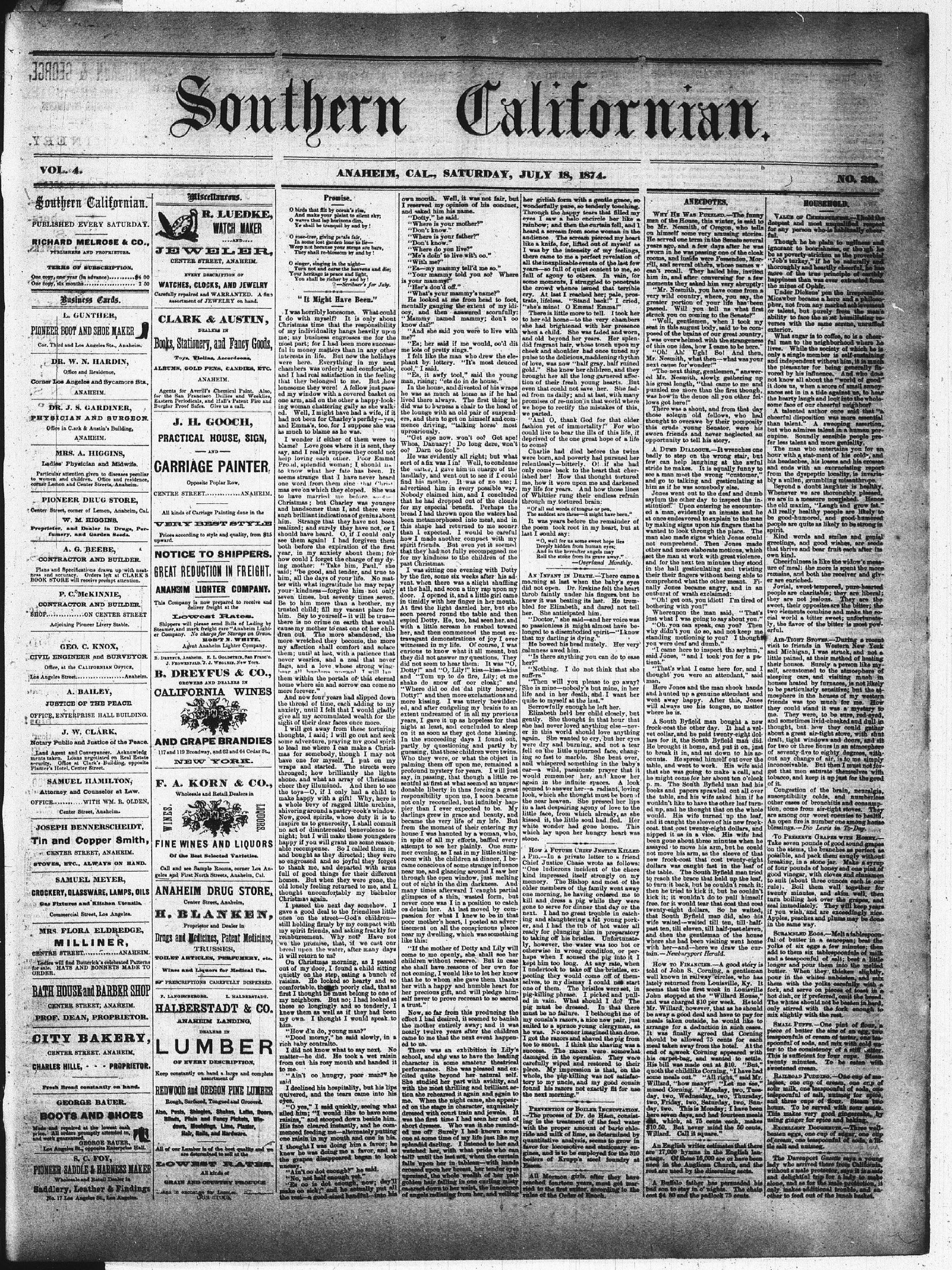
Searchable text
VOL. 4.
Southern Californian.
PUBLISHED EVERY SATURDAY.
RICHARD MELROSE & CO., PUBLISHERS AND PROFRIETORS.
TERMS OF SUBSCRIPTION.
One copy, one year (In advance)……$4 00
One copy, six months……2 50
Business Cards.
L. GUNTHER,
PIONEER BOOT AND SHOE MAKER
Cor. Third and Los Angeles Sts., Anaheim.
DR. W. N. HARDIN,
Office and Residence,
Corner Los Angeles and Sycamore Sts.,
ANAHEIM.
DR. J. S. GARDINER,
PHYSICIAN AND SURGEON.
Office in Clark & Austin's Building,
ANAHEIM.
MRS. A. HIGGINS,
Ladies' Physician and Midwife.
Miscellaneous.
R. LUEDKE,
WATCH MAKER
JEWELER,
CENTER STREET, ANAHEIM.
EVERY DESCRIPTION OF
WATCHES, CLOCKS, AND JEWELRY
Carefully repaired and WARRANTYed. A fine assortment of JEWELRY on hand.
CLARK & AUSTIN,
DEALERS IN
Books, Stationery, and Fancy Goods,
Toys, Violin, Accordeons,
ALBUMS, GOLD PENS, CANDIES, ETC.
ANAHEIM.
Agents for Averill's Chemical Paint. Also,
for the San Francisco Deilies and Weeklies,
Eastern Periodicals, and Hall's Patent Fire and
Burglar Proof Safes. Give us a call.
J. H. GOOCH,
PRACTICAL HOUSE, SIGN,
AND
CARRIAGE PAINTER.
Promise.
O birds that flit by ocean's And make your plaint to
O waves that lap horizons d Ye shall be tranquil by a
O rose-tree, giving petals fa In some lost garden lone Weep not because your sterr They shall re-blossom by
O singer, singing in the night Turn not and earse the h Your heritage is peace and You shall be richer by an —Scribbl
"It Might Have I was horribly lonesome. I do with myself? It Christmas time that the of my individuality hangs me; my business engross most part; for I had been ful in money matters than interests in life. But now were here. Everything chambers was orderly and I had real satisfaction that they belonged to m lonesome they were! A fe ed my window with a cover one arm, and on the other ing woman chattering gailed. Well, I might have had not been for Charley's and Emma's, too, for I su as much to blame as he wa I wonder if either of t blame? Love goes where say, and I really suppose to help loving each other. Proud, splendid woman; to know what her fate
Corner Los Angeles and Sycamore Sts., Anaheim.
DR. J. S. GARDINER,
PHYSICIAN AND SURGEON.
Office in Clark & Austin's Building, Anaheim.
MRS. A. HIGGINS,
Ladies' Physician and Midwife.
Particular attention given to diseases peculiar to women and children. Office and residence, corner Lemon and Center Streets, Anaheim.
PIONEER DRUG STORE,
Center Street, corner of Lemon, Anaheim, Cal.
W. M. HIGGINS.
Proprietor, and Dealer in Drugs, Perfumery, and Garden Seeds.
A. G. BEEBE,
CONTRACTOR AND BUILDER.
Plans and Specifications drawn up with neatness and accuracy. Orders left at CLARK'S BOOK STORE will receive prompt attention.
P. C. McKINNIE,
CONTRACTOR AND BUILDER.
SHOP...ON CENTER STREET
Adjoining Pioneer Livery Stable.
GEO. C. KNOX,
CIVIL ENGINEER and SURVEYOR.
Office, at the CALIFORNIAN OFFICE, Los Angeles Street...Anaheim.
A. BAILEY,
JUSTICE OF THE PEACE.
OFFICE, ENTERPRISE HALL BUILDING.
J. W. CLARK,
Notary Public and Justice of the Peace.
Land Agent and Conveyancer. Acknowledgments taken. Loans negotiated on Real Estate security. Office at Clark's Building, opposite Planter's Hotel, Center Street.
SAMUEL HAMILTON,
Attorney and Counselor at Law.
OFFICE...WITH WM. R. OLDEN, Center Street, Anaheim.
JOSEPH BENNERSCHEIDT,
Tin and Copper Smith,
CENTER STREET, ANAHEIM.
STOVES, ETC., ALWAYS ON HAND.
SAMUEL MEYER,
CROCKERY, GLASSWARE, LAMPS, OILS
ANAHEIM.
Agents for Averill's Chemical Paint. Also, for the San Francisco Dullies and Weeklies, Eastern Periodicals, and Hall's Patent Fire and Burglar Proof Safes. Give us a call.
J. H. GOOCH,
PRACTICAL HOUSE, SIGN,
AND
CARRIAGE PAINTER.
Opposite Poplar Row,
CENTRE STREET...ANAHEIM.
All kinds of Carriage Painting done in the VERY BEST STYLE.
Prices according to style and quality, from $15 upward.
NOTICE TO SHIPPERS.
GREAT REDUCTION IN FREIGHT.
ANAHEIM LIGHTER COMPANY.
This Company is now prepared to receive and deliver freight at the Lowest Rates.
Shippers will please send Bills of Lading by Steamer, and mark freight care "Anabeim Lighter Company." No charge for Storage on Grain.
BOST N. WHITE.
Agent Anabeim Lighter Company.
B. DREYFUS, Anaheim. E. L. GOLDERMIN, San Franco o.
J. FROWENFIELD, J. W. WEOLIN, New York.
B. DREYFUS & CO., GROWERS AND DEALERS IN CALIFORNIA WINES
AND GRAPE BRANDIES
117 and 119 Broadway, and 62 and 64 Cedar St., NEW YORK.
F. A. KORN & CO., Wholesale and Retail Dealers in
WINES.
FINE WINES AND LIQUORS
Of the Best Selected Varieties.
Call and see Sample Rooms, corner Los Angeles and First North Streets, Anaheim, Cal.
ANAHEIM DRUG STORE,
I wonder if either of the blame? Love goes where I say, and I really suppose that help loving each other.
Proud, splendid woman; to know what her fate seems strange that I have one word from them since mas eve on which they elope to have married me best Christmas; but Charley was handsomer than I am such brilliant indications of him. Strange that they be realized; and surely they should have heard. O, if I see them again! I had for both before the expiration year, in my anxiety about how could I forget the changing mother: "Take him said; 'be good, and tender him, all the days of your life with what ingratitude he your kindness—forgive his seven times, but seventy Be to him more than any trusted child; fill my vacant him. Say to yourself—it there is no crime on earth cause my mother to cast on dren out. The more abode more wretched they become my affection shall comfort them; until at last, with a never wearies, and a zeal flags, and a love whose hear all harbors nummed them within the portals of home where sin and sorrow more forever."
And now four years had passed the thread of time, each a anxiety, until I felt that I give all my accumulated sight of their dear faces once I will get away from the thoughts, I said; I will go some adventure, praying me to lead me where I can mas for somebody, though have one for myself. I wraps and started. They thronged; how brilliantly shone, and what an array cheer they illuminated. At the toys—O, if I only have make happy with a gift! a whole bevy of ragged shivering around a pastry-cook Now, good spirits, whose inspire us to generosity, I no act of disinterested night; but I will make the happy if you will grant me able recompense. So I can and bought as they direct so engrossed and so joyful to thank me, and depart full of good things for the homes. But when they were old lonely feeling returned thought uncomfortably
OFFICE... WITH WM. R. OLDEN,
Center Street, Anaheim.
JOSEPH BENNERSCHEIDT,
Tin and Copper Smith,
CENTER STREET, ANAHEIM.
STOVER, ETC., ALWAYS ON HAND.
SAMUEL MEYER,
CROCKERY, GLASSWARE, LAMPS, OILS
Gas Fixtures and Kitchen Utensils.
Commercial Street, Los Angeles.
MRS. FLORA ELDREDGE,
MILLINER,
CENTRE STREET... ANAHEIM.
Ladies will find Butterick's celebrated Patterns for sale. HATS AND BONNETS MADE TO ORDER.
BATH HOUSE and BARBER SHOP
CENTER STREET; ANAHEIM.
PROF. DEAN, PROPRIETOR.
CITY BAKERY,
CENTER STREET, ANAHEIM.
CHARLES HILLE, - - PROPRIETOR.
Fresh bread constantly on hand.
GEORGE BAUER.
BOOTS AND SHOES
Made and repaired at the lowest mash price. All orders promptly attended to, and work guaranteed.
GEORGE BAUER.
Los Angeles St., opposite Enterprise Hall.
S. C. POY,
PIONEER SADDLE & HARNESS MAKER
Wholesale and Retail Dealer in Saddlery, Leather & Findings
No. 17 Los Angeles St., Los Angeles.
WINES.
FINE WINES AND LIQUORS
Of the Best Selected Varieties.
Call and see Sample Rooms, corner Los Angeles and First North Streets, Anaheim, Cal.
ANAHEIM DRUG STORE,
Center Street, Anaheim,
H. BLANKEN,
Proprietor and Dealer in
Drugs and Medicines, Patent Medicines,
TRUSSES,
TOILET ARTICLES, PERFUMERY, etc.
Wines and Liquors for Medical Use.
PRESCRIPTIONS CAREFULLY DISPENSED.
P. LANGENBERGS.
L. HALBERSTADT.
HALBERSTADT & CO.
ANAHEIM LANDING,
DEALERS IN
LUMBER
OF EVERY DESCRIPTION,
Keep constantly on hand a large and complete assortment of
REDWOOD and OREGON PINE LUMBER
Rough, Surfaced, Tongued and Grooved.
Also, Posts, Shingles, Shakes, Laths, Boards,
Blinds, Plain and Fancy Pickets, Windows,
Mouldings, Lime, Plaster,
Hair, Halls, and Hardware.
All of our Lumber is of the best quality and we are determined to sell at the
LOWEST RATE.
All kinds of
GRAIN AND COUNTRY PRODUCE
In exchange for Lumber.
make happy with a gift
a whole bevy of ragged hair
shivering around a pastry-crust
Now, good spirits, whose inspire us to generosity, I no act of disinterested bed night; but I will make them happy if you will grant me able recompense. So I can and bought as they direct so engrossed and so joyful to thank me, and depart full of good things for the homes. But when they wore lonely feeling returned thought uncomfortably Christmas again.
I passed the next day gave a good deal to the fright ones on the street—God still holding firmly by my spirit friends, and asking reinbursement. Why not we the promise that, if bread upon the water, after it will return to us?
On Christmas morning out of my door, I found a quietly on the step, eating raisins. He looked so comfortable, though poorly first I thought he must be my neighbors. But no; these so longingly and knew them as well as if they own. I thought I was him.
"How d'u do, young man?
"Dood morny," he said rich baby contralto.
I did not know what to matter—he did. He took from out his rosy mouth to me.
"Ain't oo hungry, po said
I declined his hospitality quivered, and the tears of eyes.
"O yes," I said quickly ailed him; "I would like raising," and stooped down His face cleared instantly mened feeding me—alter one raisin in my mouth as I thought I was doing his know he was doing me a grape disappeared in messy."
"Ain't too dot enough!"
"No, not half enough yet."
"Es oo is dot enough make on sick," and he said the rest—a good sized haunt."
Southern California
ANAHEIM, CAL., SATURDAY, JULY 18, 1874.
Premise.
O birds that flit by ocean's rim,
And make your plaint to silent sky;
O waves that lap horizons dim,
Ye shall be tranquil by and by!
O rose-tree, giving petals fair,
In some lost garden lone to lie—
Weep not because your stems are bare,
They shall re-blossom by and by!
O singer, singing in the night—
Turn not and earse the heavens and die;
Your heritage is peace and light,
You shall be richer by and by!
—Scribner's for July.
"It Might Have Been."
I was horribly lonesome. What could I do with myself? It is only about Christmas time that the responsibility of my individuality hangs heavily upon me; my business engrosses me for the most part; for I had been more successful in money matters than in any other interests in life. But now the holidays were here. Everything in my neat chambers was orderly and comfortable, and I had real satisfaction in the feeling that they belonged to me. But show onesome they were! A fellow just passed my window with a covered basket on one arm, and on the other a happy-looking woman chattering gaily as she walked. Well, I might have had a wife, if it had not been for Charley's perfidy—yes, and Emma's, too, for I suppose she was as much to blame as he was.
I wonder if either of them were to blame? Love goes where it is sent, they say, and I really suppose they could not help loving each other. Poor Emma! Proud, splendid woman; I should no know what her fate has been. It own mouth. Well, it was not fair, but I reserved my opinion of his conduct, and saked him his name.
"Dotty," he said.
"Where is your mother?"
"Don't know."
"Where is your father?"
"Don't know."
"Where do you live?"
"Me's doin' to live with oo."
"With me?"
"Es—my mammy tell'd me so."
"Your mammy told you so? Where is your mammy?"
"Her's don'd off."
"What's your mammy's name?"
He looked at me from head to foot, mentally ganging the extent of my idiocy, and then answered scornfully:
"Mammy named mammy; don't oo know dat?"
"And she said you were to live with me?"
"Es; her said if我 would, oo'd dit me lots of pretty sings."
I felt like the man who drew the elephant by lottery. "It's most deuced cool." I said.
"Es, it awfy tool," said the young man, rising; "ets do in de house."
In the house, and divested of his wraps he was as much at home as if he had lived there always. The first thing he did was to harness a chair to the head of the lounge with an old pair of suspenders, and then to get on himself and commence driving, "talking horse" most uproariously.
"Get ape now, won't oo? Get ape! Whoa, Danuary! Do long dere, won't oo? Darn oo fool!"
He was evidently all right; but what sort of a fix was I in? Well, to condense the matter, I gave him in charge of her girliah form with a gentle grace, so wonderfully pure, so tenderly touching. Through the happy tears that filled my eyes I saw a halo encircle her like a rainbow; and then the curtain fell, and I heard a scream from some woman in the audience. The scream pierced my heart like a knife, for, lifted out of myself as I was by the intensity of my feelings, there came to me a perfect revelation of all the inexplicable events of the last few years—so full of quiet content to me, so full of agony to others. In vain, for some moments, I struggled to penetrate the crowd whence issued that terrible cry. At last I reached her; pale, prostrate, lifeless. "Stand back!" I cried, "she's mine! O Emma! Emma!"
There is little more to tell. I took her to her old home—to the very chambers she had brightened with her presence when a child. She was faded and worn, and old beyond her years. Her splendid fragrant hair, whose touch upon my cheek and shoulder had once tuned my pulse to the delicious,maddening rhythm of love, was now "half gray,half rinsed gold." She knew her children,and they brought her all the long garnered affection of their fresh young hearts. But even that could not save her. She faded from us daily; and at last, with many promises of re-union'in that world where we hope to rectify the mistakes of this, we parted.
"And O, thank God for that older fashion yet of immortality!" For who could live to bear the ills of this life, if deprived of the one great hope of a life to come?
Charlie had died before the twins were born, and poverty had pursued her relentlessly—bitterly. Oh! if she had only come back to the heart that cherished him of the Mr. Nessman next moment.
Why?
Man of the Mr. Nessman next moment.
Well, seat in tha posed of the Mr. Nessman next moment.
Oh! Mr. Nessman next moment.
The new Mr. Nessman next moment.
Was how low lows got there those souls thought t this sworn frie opportunities.
A Dum badly to few can stride he
and I had real satisfaction in the feeling that they belonged to me. But how onesome they were! A fellow just passed my window with a covered basket on one arm, and on the other a happy-looking woman chattering gaily as she walked. Well, I might have had a wife, if it had not been for Charley's perfidy—yes, and Emma's, too, for I suppose she was as much to blame as he was.
I wonder if either of them were to blame? Love goes where it is sent, they say, and I really suppose they could not help loving each other. Poor Emma! Proud, splendid woman; I should not know what her fate has been. It seems strange that I have never heard one word from them since that Christmas was eve on which they eloped. She was so have married me before another Christmas; but Charley was younger and handsome than I, and there were such brilliant indications of genius about him. Strange that they have not been realized; and surely they have not, or I should have heard. O, if I could only see them again! I had forgiven them both before the expiration of the first year, in my anxiety about them; for now could I forget the charge of my dying mother: "Take him, Paul," she said; "be good, and tender, and true to him, all the days of your life. No matter with what ingratitude he may repay your kindness—forgive him not only seven times, but seventy times seven. Be to him more than a brother, my trusted child; fill my vacant place for him. Say to yourself—it will be true—there is no crime on earth that would cause my mother to cast one of her children out. The more abandoned, the more wretched they become, the more my affection shall comfort and solace them; until at last, with a patience that never wearies, and a zeal that never flags, and a love whose strong wings are all hurdles forward. I will haunt them within the portals of that eternal home where sin and sorrow can come no more forever."
And now four years had slipped down the thread of time, each adding to my anxiety, until I felt that I would gladly give all my accumulated wealth for the night of their dear faces once more.
I will get away from these torturing thoughts, I said; I will go out and seek some adventure, praying my good spirit to lead me where I can make a Christmas for somebody, though I may not have one for myself. I put on my wraps and started. The streets were thronged; how brilliantly the lights shone, and what an array of Christmas cheer they illumined. And then to see the toys—O, if I only had a child to make happy with a gift! Why, here is a whole bevvy of ragged little urchins, shivering around a pastry-cook's window. Now, good spirits, whose duty it is to inspire us to generosity, I shall commit no act of disinterested benevolence tonight; but I will make these youngsters happy if you will grant me some reasonable recompense. So I called them in, and bought as they directed; they were so engrossed and so joyful they forgot to thank me, and departed with arms full of good things for their different homes. But when they were gone, the old lonely feeling returned to me, and I thought uncomfortably my bachelor
"Es, it awfy tool," said the young man, rising; "ets do in de house."
In the house, and divested of his wraps he was as much at home as if he had lived there always. The first thing he did was to harness a chair to the head of the lounge with an old pair of suspenders, and then to get on himself and commence driving, "talking horse" most uproariously.
"Get ape now, won't oo? Get ape! Whoa, Danuary! Do long ode, won't oo? Darn oo fool."
He was evidently all right; but what sort of a fix was I in? Well, to condense the matter, I gave him in charge of the landlady, and went out to see if I could find his mother. It was of no use; I advertised him in every possible way. Nobody claimed him, and I concluded that he had dropped out of the clouds for my especial benefit. Perhaps the bread I had thrown upon the waters had been metamorphosed into meat, and in this shape had returned to me sooner than I expected. I would be careful how I made another compact with my spirit friends. But even yet it seemed that they had not fully recompensed me for my kindness to the children of the past Christmas.
I was sitting one evening with Dotty by the fire, some six weeks after his advent. when there was a slight shuffling at the hall, and soon a tiny rap upon my door. I opened it, and a little girl came in timidly with her finger in her mouth. At first the light dazzled her, but she soon peered round the table and then espied Dotty. He, too, had seen her, and with a little scream he rushed toward her, and then commenced the most extravagant demonstrations of joy I ever witnessed in my life. Of course, I was curious to know what it all meant, but they did not answer my questions. They did not seem to hear them. It was "O, Dotty!" and "O; Lily!" kiss—kiss—and "Tum up to de fire, Lily; et me shake de snow off our cloak;" and "Where did oo det dat pitty horsey, Dotty?" and then more exclamations and more kissing. I was utterly bewildered, and after cudgeling my brains to an extent undreamed of in all my previous years, I gave it up as hopeless for that night at least, and concluded to sleep on it as soon as they got done kissing. In the succeeding days I found out, partly by questioning and partly by guessing, that these children were twins. Who they were, or what the object in palming them off upon me, remained a profound mystery for years. I will just say, in passing, that though a little resentful at first at what seemed an unparable liberty in thus forcing a great responsibility upon me, I soon became not only reconciled, but infinitely happier than I ever expected to be. My darlings grew in grace and beauty, and became the very life of my life. But from the moment of their entering my house I was haunted by a woman, who, in spite of all my efforts, baffled every attempt to see her plainly. One summer evening, as I sat in my little sitting-room with the children at dinner, I became conscious of some strange influence near me, and glancing around I saw her through the open window, just melting out of sight in the dim darkness. And many times afterward I caught partial glimpses of a thin-wasted form but brought her all the long garnered affection of their fresh young hearts. But even that could not save her. She faded from us daily; and at last, with many promises of re-union in that world where we hope to rectify the mistakes of this, we parted.
"And O, thank God for that older fashion yet of immortality!" For who could live to bear the ills of this life, if deprived of the one great hope of a life to come?
Charlie had died before the twins were born, and poverty had pursued her relentlessly—bitterly. O! if she had only come back to the heart that cherished her! How that thought tortured me, how it wore upon me and darkened my life for years. And how those lines of Whittier rung their endless refrain through my tortured brain:
"Of all sad words of tongue or pen. The saddest are these—them have been."
It was years before the remainder of the poem took root in my heart, but at last I could say:
"O well for us some sweet hope lies Deeply hidden from human eyes; And in the hereafter angels may Roll the stone from its grave away."
—Overland Monthly.
AN INFANT IN DEATH—There came a morning at last when the baby's eyes did not open. Dr. Erskine felt the heart throb faintly under his fingers; but he knew it was beating its last. He trembled for Elizabeth, and dared not tell her. She anticipated him.
"Doctor," she said—and her voice was so passionless it might almost have belonged to a disembodied spirit—"I know that my darling is dying." He bowed his head mutely. Her very calmness awed him.
"Is there anything you can do to ease her?"
"Nothing. I do not think that she suffers."
"Then will you please to go away? She is mine—nobody's but mine, in her life and in her death, and I want her quite to myself at the last."
Sorrowfully enough he left her.
Elizabeth held her child closely, but gently. She thought in that hour that she had never loved anything else—never in this world should love anything again. She wanted to cry; but her eyes were dry and burning, and not a tear fell on the little upturned face, changing so fast to marble. She bent over, and whispered something in the baby's ear—a wild, passionate prayer that it would remember her, and know her again in the infinite spaces. A look seemed to answer her—a radiant, loving look which she thought must be born of the near heaven. She pressed her lips in a last despairing agony of love to the little face, from which already, as she kissed it, the little soul had fled. Her white wonder had gone home. This which lay upon her hungry heart was stone.
HOW A FUTURE CHRIST JUSTICE KILLED A PICT.-In a private letter to a friend Chief Justice Chase wrote as follows: "One ludicrous incident of the chore kind impressed itself strongly on my memory. The Bishop and most of the older members of the family went away one morning, he having ordered me to bring her all the long garnered affection of their fresh young hearts. But even that could not save her. She faded from us daily; and at last, with many promises of re-union in that world where we hope to rectify the mistakes of this, we parted."
AND Mr. M.
his great niece this cruel sworn frie
opportunities.
A DUMMY badly to few
stride he see a man
and go to him as if
him as if
Jones wavs asylum stintation.
ed a man
at once en
by making
wanted to
man also
not comp
other and set
the mast
and for th
in the h
their their comprehe
nally Jon
outburst
Oh!
goth bothering
Where just what
Oh.ye
why didn' t stand
you were
I came said Jon
tient."
"That's thought'
man.
Here Jo
hunt went awa
will always
where he
A South frock-coat
vet collars lars for i
He brought
to break counts,
table,and
that she h
he might
p.m.
The books and
the table
wouldn't ed up,
and would.
It can coat.
that nipped it
been gone
assayed t
not moved new frocd dollars w
the table,
to reach it
then he t
kick it."
make happy with a gift! Why, here is a whole bevy of ragged little urchins, shivering around a pastry-cook's window. Now, good spirits, whose duty it is to inspire us to generosity, I shall commit no act of disinterested benevolence tonight; but I will make these youngsters happy if you will grant me some reasonable recompense. So I called them in, and bought as they directed; they were so engrossed and so joyful they forgot to thank me, and departed with arms full of good things for their different homes. But when they were gone, the old lonely feeling returned to me, and I thought uncomfortably my bachelor Christmas again.
I passed the next day somehow. I gave a good deal to the friendless little ones on the street—God's children—still holding firmly by my compact with any spirit friends, and asking frankly for reinbursement. Why not? Have not we the promise, that, if we cast our bread upon the water, after many days it will return to us?
On Christmas morning, as I passed out of my door, I found a child sitting quietly on the step, eating a bunch of raisins. He looked so hearty and so comfortable, though poorly clad, that at first I thought he must belong to one of my neighbors. But no; I had looked at these so longingly and so tenderly, I knew them as well as if they had been my own. I thought I would speak to him.
"How d'u do, young man?"
"Dood morny," he said slowly, in a rich baby contralto.
I did not know what to say next. No matter—he did. He took a wet raisin from out his rosy mouth and handed it to me.
"Ain't oo hungry, poor man?" he said.
I declined his hospitality, but his lips quivered, and the tears came into his eyes.
"O yes," I said quickly, seeing what killed him; "I would like to have some raisins," and stooped down beside him. His face cleared instantly, and he commenced feeding me—alternately putting one raisin in my mouth and one in his. I thought I was doing him a favor; he knew he was doing me a favor; and as the grapes disappeared began to look uneasy.
"Ain't oo dot enough!" he said.
"No, not half enough yet."
"He oo is dot enough, now; day'll make oo sick;" and he actually put all the rest—a good sized handful—into his responziomy upon me. I soon became not only reconciled, but infinitely happier than I ever expected to be. My darlings grew in grace and beauty, and became the very life of my life. But from the moment of their entering my house I was haunted by a woman, who, in spite of all my efforts, baffled every attempt to see her plainly. One summer evening, as I sat in my little sitting-room with the children at dinner, I became conscious of some strange influence near me, and glancing around I saw her through the open window, just melting out of sight in the dim darkness. And many times afterward I caught partial glimpses of a thin, wasted form, but never once was I in a position to catch on detain her. At last moved by compassion for what I knew to be in that poor mother's heart, I posted an advertisement on all the conscientious places near my dwelling, which was something like this:
"If the mother of Dotty and Lily will come to me openly, she shall see her children without reserve. But in case she shall have reasons of her own for not coming, I would like to let her know that he to whom she gave them thanks her with a happy and humble heart for her precious gift, and will pledge himself never to prove recreant to so sacred a trust."
Now, so far from this producing the effect I had desired, it seemed to banish the mother entirely away; and it was nearly twelve years after the children came to me that the next event happened to us.
There was an exhibition in Lily's school, and she was to have the leading character in some amateur theatrical performance. She was pleased and excited quite beyond her natural self. She studied her part with avidity, and with the most thrilling and brilliant action she rehearsed it again and again to me. When the night came, she appeared on the stage in character, exquisitely dressed with court train and jewels. It was the first time I had seen her out of short dresses. Who was it she reminded me off? Surely I had known some one as some time of my life just like my splendid darling. I listened to her and watched her, with what pride who can tell? until the last act, when the certain falls upon her in tableau—with hands crossed upon her breast, her tender eyes upraised, the whole wealth of her pale golden hair falling in one curling misty caress down to her waist, the innocence of angels radiating from her, and voiling the near heaven. She pressed her lips in a last despairing agony of love to the little face, from which already, as she kissed it, the little soul had fed. Her white wonder had gone home. This which lay upon her hungry heart was stone.
HOW A FUTURE CHIEF JUSTICE KILLED A PIG...In a private letter to a friend Chief Justice Chase wrote as follows: "One ludicrous incident of the chore kind impressed itself strongly on my memory. The Bishop and most of the older members of the family went away one morning, he having ordered me to kill and dress a pig while they were gone to serve for dinner that day or the next. I had no great trouble in catching and slaughtering a fat young porker, and I had the tub of hot water all ready for plunging him in preparatory to taking off his bristles. Unfortunately however, the water was too hot or otherwise in wrong condition, or perhaps when I sensed the pig into it I kept him too long. At any rate, when I undertook to take off the bristles, expecting they would come off of themselves, to my dismay I could not start one of them. The bristles were set, in pig-killing phrase. I picked and pulled in vain. What should I do? The pig must be dressed. In that there must be no failure. I bethought me of my cousin's razors, a nice new pair, just snited to a spruce young clergyman, as he was. No sooner imagined than done. I got the razors and shaved the pig from toe to snout. I think the shaving was a success. The razors were somewhat damaged in the operation. They were carefully wiped and restored to their place. My impression is that, on the whole, the pig-killing was not satisfactory to my uncle, and my good consin found his razors not exactly fit for use the next morning."
PREVENTION OF BOILER INCrustation...The process of Dr. de Haen, consisting in the treatment of the feed water with the proper amount of barric chloride and milk of lime, as determined by quantitative analysis, seems to grow in flavor for locomotive and stationary engines, and is to be employed for the $310 boilers of Krupp's steel foundation at Emsa.
All Mormon girls, after they have reached fourteen years, must get married to the first suitor, according to the rules of the Order of Emmos.
ANECDOTES.
Why He Was Puzzled.—The funny man of the House, this winter, is said to be Mr. Neasmith, of Oregon, who tells on himself some very amusing stories. He served one term in the Senate several years ago, and a few days after he was sworn in he was passing one of the cloak rooms, and inside were Fessenden, Morrill, and several others, whose names won't recall. They hailed him, invited him in, and after conversing for a few moments they asked him very abruptly:
"Mr. Neasmith, you have come from a very wild country, where, you say, the greater portion of your life has been passed. Will you tell us what first struck you on coming to the Senate?"
"Well, gentlemen, when I took my seat in this august body, said to be composed of the brains of our great country, I was overwhelmed with the strangeness of this one idea, how I came to be here."
"Oh! Ah! Ugh! So! And then, Mr. Neasmith, what then—what was your next cause for 'wonder?'
"The next thing, gentlemen," answered Mr. Neasmith, slowly gathering up his great length, "that came to me and puzzled me more than the first though, was how in the deuce all you other fellows got here!"
There was a shout, and from that day those solemn old fellows, who had thought to overweave by their pomposity this crude young Senator, were his sworn friends and never neglected an opportunity to tell his story.
A DUMB DIALOGUE.—It wrenches one badly to step on the wrong stair, but few can help laughing at the awful stride he makes. It is equally funny to
HOUSEHOLD.
VALUE OF CHAMPIONS.—I hold the deepest and most unqualified respect for any person who is habitually cheerful.
Though he be plain to ugliness and ignorant to boorishness, or though he be as poverty-stricken as the proverbial "Job's turkey," if he be naturally and thoroughly and heartily cheerful, he has more of the true principle of earthly happiness than was ever extruded from the mines of Ophir.
Under Dickens' pen the irresponsible Micawber became a hero and a philosopher, not from any marked achievement or talent, but purely from the man's ability to face the most humiliating reverses with the same serene, unruffled exterior.
What sugar is to coffee, so is a cheerful man to the neighborhood where he lives. While the society of which he is only a single member is self-sustaining and independent without him, it is much the pleasanter for being generally flavored by his influence. And who does not know all about the "world of good" it does us, when a score of small annoyances set in in a tide against us, to hear the hearty laugh and look into the wholesome face of our cheerful neighbor?
A talented author once said that "a cheerful disposition was more essential than talent." A sweeping assertion, but who admires talent in a human porcupine. Soundly sensible people prefer less talent and more geniality.
The man who entertains you for an hour with a statment of his cold-, and his headaches, his losses and his crosses and ends with an exorcising report from the dramatic locality in invariably
for that older boy!" For who of this life, if hope of a life
more the twins had pursued her! If she had heart that cherished tortured and darkened how those lines endless refrain:
pen. right have been."
remainder of heart, but at
hope lies eyes;
may have away."
and Monthly.
There came a baby's eyes felt the heart fingers, but he must have been spirit—"I know."
Her very can do to ease think that she to go away? at mine, in her hand. I want her left her. old closely, but that hour that thing else—never love anything, but her eyes and not a tear face, change the bent over, in the baby's prayer that it and know her faces. A look radiant, loving must be born of pressed her lips of love to the already, as she had fled. Her home. This angry heart was
INSTICE KILLED better to a friend note as follows: of the chore strongly on my mind most of the family went away ordered me to
ed Mr. Nesmith, slowly gathering up his great length, "that came to me and puzzled me more than the first though, was how in the deuce all you other fellows got here!"
There was a shout, and from that day those solemn old fellows, who had thought to overwee by their pomposity this crude young Senator, were his sworn friends and never neglected an opportunity to tell his story.
A Dumb Dialogue.—It wrenches one badly to step on the wrong stair, but few can help laughing at the awful stride he makes. It is equally funny to see a man meet the wrong "customer," and go to talking and gesticulating at him as if he was somebody else.
Jones went out to the deaf and dumb asylum the other day to inspect the institution. Upon entering he encountered a man, evidently an inmate, and he at once endeavored to explain to the man by making signs upon his fingers that he wanted to look through the place. The man also made signs which Jones could not comprehend. Then Jones made other and more elaborate motions, which set the man at work with great violence, and for the next ten minutes they stood in the hall gesticulating and twisting their their fingers without being able to comprehend what the other meant. Finally Jones became angry, and in an outburst of wrath exclaimed:
"Oh! get out, you idiot! I'm tired of bothering with you!"
Whereupon the man said, "That's just what I was going to say about you."
"Oh. you can speak, can you? Then why didn't you do so, and not keep me standing motioning to you? I thought you were deaf and dumb."
"I came here to inspect the asylum," said Jones, "and I took you for a patient."
"That’s what I came here for, and I thought you were an attendant," said man.
Here Jones and the man shook hands and hunted up a genuine attendant and went away happy. After this, Jones will always use his tongue, no matter where he is.
A South Byfield man bought a new frock-coat the other day. It had a velvet collar, and he paid twenty-eight dollars for it, the South Byfield man did. He brought it home, and put it on, just to break it in, and sat down to his accounts. He spread himself out over the table, and went to work. His wife said that she was going to make a call, and he might come for her about ten o'clock p.m. The South Byfield man had his books and papers sprawled out all over the table, and his wife asked him if he wouldn't like to have the other leaf turned up, and he thought that on the whole would. His wife turned up the leaf, and it caught the sleeve of his new frock-coat. that cost twenty-eight dollars, and nipped it as in a vice. His wife had been gone about three minutes when he assayed to move his arm, but he could not move his arm, as the sleeve of that new frock-coat that cost twenty-eight dollars was caught fast in the leaf of the table. The South Byfield man tried to reach the brace that held up the leaf, to turn it back, but he couldn't reach it; then he tried to kick it, but he couldn't kick it; it wouldn't do to pull himself word by word by word. And who does not know all about the "world of good" it does us, when a score of small annoyances set in in a tide against us, to hear the hearty laugh and lock into the wholesome face of our cheerful neighbor?
A talented author once said that "a cheerful disposition was more essential than talent." A sweeping assertion, but who admires talent in a human porcupine. Soundly sensible people prefer less talent and more geniality.
The man who entertains you for an hour with a stat-ment of his cold-, and his headaches, his losses and his crosses and ends with an exorcising report from the dyspeptic locality, is invariably a sullen, grumbling misanthrope.
Beyond a doubt laughter is healthy. Whenever we are thoroughly pleased, we are in a measure nourished. Hence the old maxim, "Laugh and grow fat." All really healthy people are likely to be good-humored, and good-humored people are quite as likely to be strong in spirit.
Kind words and smiles and genial greetings, and good wishes, are seeds that thrive and bear fruit each after its own kind.
Cheerfulness is like the widow's measure of meal: the more is spent the more remains, and both the receiver and giver are enriched.
Jovial, sweet-tempered, pure-hearted people are charitable; they are liberal; they are not jealous. They are the sweet, their opposites are the bitter; the two elements combine and make the social world a bitter sweet; unfortunately, the flavor of the bitter is most powerful.
Air-Tight Stoves.—During a recent visit to friends in Western New York and Michigan, I was struck, and not a little pained, at their method of heating their houses. Surely a person like myself, accustomed to the atmosphere of sleeping cars, and visiting much in houses heated by furnaces, is not likely to be particularly sensitive; but the atmosphere in the houses of my western friends was too much for me. How they could stand it was a mystery to me. They were, to be sure, red-eyed, and sometimes livid-cheeked and dull in thought, but how they could gather about a great air-tight stove, with shut draft, tight windows and doors, and sit for two or three hours in an atmosphere of seventy-five to eighty degrees, without any change of air, is to me simply inconceivable. But then I must not forget that men saturate themselves with tobacco, and keep it up just for the good of it.
Congestion of the brain, neuralgia, susceptibility colds, and numberless other cases of bronchitis and consumption, come from air-tight stoves. They are among our worst enemies to health. An open fire is number one among house blessings.—Dio Lewis in To-Day.
To Preserve Grapes with Honey.—Take seven pounds of good sound grapes on the stems, the branches as perfect as possible, and pack them singly without breaking, in a stone jar. Make a syrup of four pounds of honey and one pint of good vinegar, with cloves and almonds to suit (about three ounces each is our rule). Boil them well together for twenty minutes, and skim well, then
Unfortunate was too hot or cold, or peril pigs into it I many rate, when the bristles, exe- cee off of them would not start les were set, in locked and pull-Id I do? The In that there thought me of the new pair, just clergyman, as mined than done. The pig from shaving was a mere somewhat. They were stored to their that, on the was not satisfac- y good cousin actively fit for use
How to Financier.—A good story is told of John S. Corning, a gentleman well known in railway circles, who has lately returned from Louisville, Ky. It seems that the first week in Louisville John stopped at the "Willard House," and was charged $10 per week. He told Mr. Willard, however, that as he should be away a good deal and have to pay for meals taken outside, he would like to arrange for a deduction in such cases. It was finally agreed that Corning should be allowed 75 cents for each meal taken away from the hotel. At the end of a week Corning appeared with his carpet-bag, and wanted to settle. His bill was made out at $10. "But," quoth the childlike Corning, "I have had some meals out." "All right," said Mr. Willard, "how many!" "Let me see," mused Corning. "Monday, two, Tuesday, two, Wednesday, two, Thursday, two, Friday, two, Saturday, two, Sunday, two. This is Monday; I have been here seven days, and had fourteen meals this, at 75 cents each, makes $10.50. But never mind the 50 cents, Willard. Call it square."
An English writer estimates that there are 17,000 hymns in the English language. Of these 16,000 are or have been used in the Anglican Church, and the rest are used by the dissenting sects.
A Buffalo father has persuaded his bad son to stay in o'nights. The chain cost $480 and the padlock 75 cents.
To Preserve Grape with Honey.—Take seven pounds of good sound grapes on the stems, the branches as perfect as possible, and pack them snugly without breaking, in a stone jar. Make a syrup of four pounds of honey and one pint of good vinegar, with cloves and chinamen to suit (about three ounces each is our rule). Boil them well together for twenty minutes, and skim well, then turn boiling hot over the grape, and seal immediately. They will keep years if you wish, and are exceedingly nice. Apples, peaches and plums may be done in the same way.
Scrambled Eggs.—Melt a tablespoonful of butter in a sancpan; beat the yolks of six eggs a few minutes; then add to them six tablespoonfuls of milk and a teaspoonful of salt; beat a little longer and pour them into the melted butter. When they thicken slightly, pour in the whites unbeaten, and mix them with the yolks carefully with a fork, and serve on pieces of toast in a hot dish, or if preferred, omit the bread. The whites should not be beaten in hard, only stirred with the fork enough to mix slightly with the rest.
Small Puffs.—One pint of flour, a piece of butter the size of an egg, two teaspoonfuls of cream of turkey, one teaspoonful of soda, and mix with cold water to the consistency of a stiff batter. This is sufficient for four cups. Steam twenty minutes. To be eaten with sweetened cream.
Railroad Pudding.—One cup of maltages; one cup of cream, one cup of sour milk, one teaspoonful of soda, one teaspoonful of salt, nutmeg for spice, and three cups of flour. Steam two hours. To be served with sour maltages. This makes very good ginger-sake by using ginger for spice and baking.
Excellent Doughnut.—Three well-beaten eggs, one cup of sugar, one cup of cream, one teaspoonful of soda, a little salt and nutmeg.
The Davenport Gazette says a young lady who arrived there from California without a male protector says it is a safe and delightful trip for a lady to make alone, and as for the male production, it only makes additional trouble, and another to feed out of the lunch basket.