anaheim-gazette 1874-07-11
Scanned page
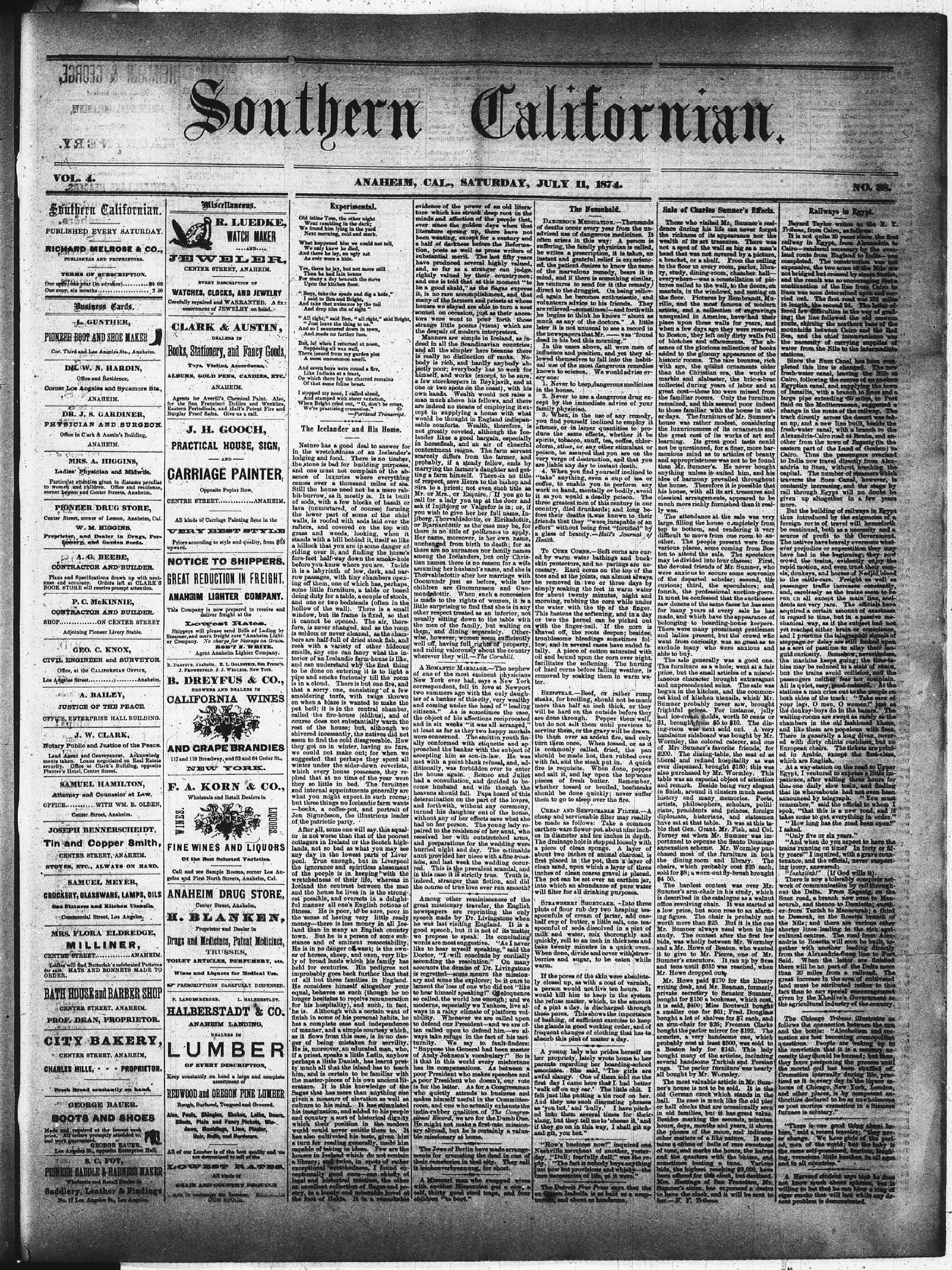
Searchable text
VOL. 4.
Southern Californian.
PUBLISHED EVERY SATURDAY.
RICHARD MELROSE & CO., PUBLISHERS AND PROFRIETORS.
TERMS OF SUBSCRIPTION.
One copy one year (in advance).....$4 00
One copy, six months.....2 50
Business Cards.
L. GUNTHER,
PIONEER BOOT AND SHOE MAKER
Cor. Third and Los Angeles Sts., Anaheim.
DR. W. N. HARDIN,
Office and Residence,
Corner Los Angeles and Sycamore Sts.,
ANAHEIM.
DR. J. S. GARDINER,
PHYSICIAN AND SURGEON.
Office in Clark & Austin's Building,
ANAHEIM.
MRS. A. HIGGINS,
Ladies' Physician and Midwife.
Miscellaneous.
R. LUEDKE,
WATCH MAKER
AND...
JEWELER,
CENTER STREET, ANAHEIM.
EVERY DESCRIPTION OF
WATCHES, CLOCKS, AND JEWELRY
Carefully repaired and WARRANTYed. A fine assortment of JEWELRY on hand.
CLARK & AUSTIN,
DEALERS IN
Books, Stationery, and Fancy Goods,
Toys, Violinas, Accordeons,
ALBUMS, GOLD PENS, CANDIES, etc.
ANAHEIM.
Agents for Averill's Chemical Paint. Also,
for the San Francisco Deilies and Weeklies,
Eastern Periodicals, and Hall's Patent Fire and
Burglar Proof Safes. Give us a call.
J. H. GOOCH,
PRACTICAL HOUSE, SIGN,
AND
CARRIAGE PAINTER
Experiencing:
Old feline Tom, the other
Went rambling in the
We found him lying in
Next morning, cold a
What happened him woke
We only knew he died
And there he lay, an ugly
As ever wore a hide.
Yes, there he lay, but not
Than he had lain before.
For many a day beneath
Upon the kitchen floor.
"Boys, take the spade at
I said to Ben and Brig
And take that nuisance
And drop him out of it."
"All right," said Ben,
"Just leave the thing
And so I sauntered down
And made no further
But, lo! when I returned
Supposing all was well
There issued from my gown
A most uncommon sigh
And seven boys were roaming
Like Indians at a feast
On which there lay the stone
Of that same feline beast.
I stopped my nose, I called
And stamped with shine
When Bright cried out,
We're practicing cremation.
The Icelander a
Office and Residence,
Corner Los Angeles and Sycamore Sts,
ANAHEIM.
DR. J. S. GARDINER,
PHYSICIAN AND SURGEON.
Office in Clark & Austin's Building,
ANAHEIM.
MRS. A. HIGGINS,
Ladies' Physician and Midwife.
Particular attention given to diseases peculiar to women and children. Office and residence, corner Lemon and Center Streets, Anaheim.
PIONEER DRUG STORE,
Center Street, corner of Lemon, Anaheim, Cal.
W. M. HIGGINS,
Proprietor, and Dealer in Drugs, Perfumery, and Garden Seeds.
A. G. BEEBE,
CONTRACTOR AND BUILDER.
Plans and Specifications drawn up with neatness and accuracy. Orders left at CLARK'S BOOK STORE will receive prompt attention.
P. C. McKINNIE,
CONTRACTOR AND BUILDER.
SHOP...ON CENTER STREET
Adjoining Pioneer Livery Stable.
GEO. C. KNOX,
CIVIL ENGINEER and SURVEYOR.
Office, at the CALIFORNIAN OFFICE,
Los Angeles Street...Anaheim.
A. BAILEY,
JUSTICE OF THE PEACE.
OFFICE, ENTERPRISE HALL BUILDING.
J. W. CLARK,
Notary Public and Justice of the Peace.
Land Agent and Conveyancer. Acknowledgments taken. Loans negotiated on Real Estate security. Office at Clark's Building, opposite Planter's Hotel, Center Street.
SAMUEL HAMILTON,
Attorney and Counselor at Law.
OFFICE...WITH WM. R. OLDEN,
Center Street, Anaheim.
JOSEPH BENNERSCHEIDT,
Tin and Copper Smith,
CENTER STREET, ANAHEIM.
STOVERS, ETC., ALWAYS ON HAND.
SAMUEL MEYER,
CROCKERY, GLASSWARE, LAMPS, DILS
ALBUMS, GOLD PENS, CANDIES, ETC.
ANAHEIM.
Agents for Averill's Chemical Paint. Also, for the San Francisco Drillies and Weeklies, Eastern Periodicals, and Hall's Patent Fire and Burglar Proof Safes. Give us a call.
J. H. GOOCH,
PRACTICAL HOUSE, SIGN,
AND
CARRIAGE PAINTER,
Opposite Poplar Row,
CENTRE STREET...ANAHEIM.
All kinds of Carriage Painting done in the VERY BEST STYLE
Prices according to style and quality, from $15 upward.
NOTICE TO SHIPPERS.
GREAT REDUCTION IN FREIGHT.
ANAHEIM LIGHTER COMPANY.
This Company is now prepared to receive and deliver freight at the Lowest Rates.
Shippers will please send Bills of Lading by Steamer, and mark freight care "Anaheim Lighter Company." No charge for Storage on Grain.
HOST X. WHITE.
Agent Anaheim Lighter Company.
B. DREYFUS & CO., GROWERS AND DEALERS IN
CALIFORNIA WINES
AND CRAPE BRANDIES
117 and 119 Broadway, and 62 and 64 Cedar St., NEW YORK.
F. A. KORN & CO., Wholesale and Retail Dealers in
WINES.
FINE WINES AND LIQUORS
Of the Best Selected Varieties.
Call and see Sample Rooms, corner Los Angeles and First North Streets, Anaheim, Cal.
ANAHEIM DRUG STORE.
JOSEPH BENNERSCHEIDT,
Tin and Copper Smith,
CENTER STREET, ANAHEIM.
STOVES, ETC., ALWAYS ON HAND.
SAMUEL MEYER,
CROCKERY, GLASSWARE, LAMPS, OILS
Gas Fixtures and Kitchen Utensils.
Commercial Street, Los Angeles.
MRS. FLORA ELDREDGE,
MILLINER,
CENTRE STREET...ANAHEIM.
Ladies will find Butterlok's celebrated Patterns for sale. HATS AND BONNETS MADE TO ORDER.
BATH HOUSE and BARBER SHOP
CENTER STREET, ANAHEIM.
PROF. DEAN, PROPRIETOR.
CITY BAKERY,
CENTER STREET, ANAHEIM.
CHARLES HILLE, ... PROPRIETOR.
Fresh Brand constantly on hand.
GEORGE BAUER.
BOOTS AND SHOES
Made and repaired at the lowest cash price. All orders promptly attended to, and work guaranteed.
GEORGE BAUER,
Los Angeles St., opposite Enterprise Hall.
S. C. FOY,
PIONNER SADDLE & HARNESS MAKER
Wholesale and Retail Dealer in Saddlery, Leather & Findings
No. 15 Los Angeles St., Los Angeles.
WINES.
FINE WINES AND LIQUORS
Of the Best Selected Varieties.
Call and see Sample Rooms, corner Los Angeles and First North Streets, Anaheim, Cal.
ANAHEIM DRUG STORE,
Center Street, Anaheim,
H. BLANKEN,
Proprietor and Dealer in Drugs and Medicines, Patent Medicines, TRUSSES,
TOILET ARTICLES, PERFUMERY, etc.
Wines and Liquors for Medical Use.
PRESCRIPTIONS CAREFULLY DISPENSED.
F. LANGENBERGER.
L. HALBERSTADT.
HALBERSTADT & CO.
ANAHEIM LANDING,
DEALERS IN LUMBER
OF EVERY DESCRIPTION.
Keep constantly on hand a large and complete assortment of REDWOOD and OREGON PINE LUMBER
Rough, Surfaced, Tongued and Grooved.
Also, Posts, Shingles, Shakes, Latha, Doars, Blinds, Plain and Fancy Pickets, Windows, Mouldings, Lime, Plaster, Hair, Nails, and Hardware.
All of our Lumber is of the best quality and we are determined to sell at the LOWEST RATES.
All kinds of GRAIN AND COUNTRY PRODUCTS
— sum in exchange for Lumber.
After all, some one wonders if there is not worse than cottagers in Ireland or lands, not so bad as any day in the lower pool. True enough, the ignorance and spite of the people is in wrethedness of their Iceland the contrast and the house he lives est possible, and over ful manner all one’s fitness. He is poor, the sense of having money—there is less land than in many an town. But he is a position and of eminent He is in no danger of horses, sheep, and of broad lands which hold for centuries. improbably goes back of all but three families. He considers himself equal, behaves as such longer hesitates to request for his hospitality), he is. Although with finish in some of his products has a complete case of manner, and a simple as it flows from this ger of being mistaken. He is, moreover, an officer if a priest speaks a life perhaps a little Danish; much all that the him, and is certain to the master-pieces of her erature. It is this Sagas that has more given a measure of culture to his mind. His imagination, and a country a sort of which their position world could never have also cultivated him a turn for reading give capable of taking in it houses in Iceland while a library; and twice exceptional wretched capably good one legal and historical to an excellent collection stray, in a lansy and the foot of Hokla.
ANAHEIM, CAL., SATURDAY, JULY 11, 1874.
Experimental.
Old feline Tom, the other night
Went rambling in the dark;
We found him lying in the yard
Next morning, cold and stark.
What happened him we could not tell,
We only knew he died,
And there he lay, an ugly eat
As ever wore a hide.
Yes, there he lay, but not more still
Than he had lain before
For many a day beneath the stove
Upon the kitchen floor.
"Boys, take the spade and dig a hole," I said to Ben and Bright,
And take that nuisance by the tail And drop him out of sight"
"All right;" said Ben, "all right;" said Bright,
"Just leave the thing to us."
And so I sauntered down in town,
And made no further fuss.
But, lo! when I returned at noon,
Supposing all was well,
There issued from my garden plot
A most uncommon smell.
And seven boys were round a fire,
Like Indians at a feast,
On which there lay the charred remains Of that same feline beast.
I stopped my nose, I called aloud,
And stamped with sheer vexation,
When Bright cried out, "O, don't be cross,
We're practicing cremation."
Portland Transcript.
The Icelander and His Home.
Nature has a good deal to answer for in the wretchedness of an Icelander's lodging and food. There is no timber, the stone is bad for building purposes, and one must not complain of the abevidence of the power of an old literature which has struck deep root in the minds and affection of the people that, ever since the golden days when that literature sprang up, there have not been wanting, except for a century and a half of darkness before the Reformation, poets as well as prose writers of substantial merit. The last fifty years have produced several highly valued, and, so far as a stranger can judge, rightly valued by their countrymen; and one is told that at this moment "to be a good skald," as the Sagas express it, is no rare accomplishment, and that many of the farmers and priests at whose houses we stayed are able to turn a neat sonnet on occasion, just as their ancestors were wont to pour forth those strange little poems (visus) which are the despair of modern interpreters.
Manners are simple in Iceland, as indeed in all the Scandinavian countries; and all the simpler here because there is really no distinction of ranks. Nobody is rich, and hardly anybody objectly poor; everybody has to work for himself, and works (except, to be sure, a few storekeepers in Reykjavik, and at one or two spots on the coast), with his own hands. Wealth would not raise a man much above his fellows, and there are indeed no means of employing it except in supplying a house with what would be thought in England indispensable comforts. Wealth, therefore, is not greatly coveted, although the Icelander likes a good bargain, especially in horseflesh, and an air of cheerful contentment reigns. The farm servant scarcely differs from the farmer, and probably, if a steady fellow, ends by marrying the farmer's daughter and getting evidence of the power of an old literature which has struck deep root in the minds and affection of the people that, ever since the golden days when that literature sprang up, there have not been wanting, except for a century and a half of darkness before the Reformation, poets as well as prose writers of substantial merit. The last fifty years have produced several highly valued, and so far as a stranger can judge, rightly valued by their countrymen; and one is told that at this moment "to be a good skald," as the Sagas express it, is no rare accomplishment, and that many of the farmers and priests at whose houses we stayed are able to turn a neat sonnet on occasion, just as their ancestors were wont to pour forth those strange little poems (visus) which are the despair of modern interpreters.
The Household.
DANGEROUS MEDICATION.—Thousands of deaths occur every year from the unadvised use of dangerous medicines. It often arises in this way: A person is suffering, the family physician is called, he writes a prescription, it is taken, an instant and grateful relief is experienced; the patient desires to know the name of the marvelous remedy, bears it in mind, and if there is something similar, he ventures to send for it (the remedy) direct to the druggist. On being relieved again he becomes enthnastic, and volunteers advice to his friends. They are relieved—sometimes!—and forthwith he begins to think he knows "about as much as any of the doctors." A little later it is not unusual to see a record in the newspapers that Mr. — was "found dead in his bed this morning."
In the cases above, all were men of influence and position, and yet they allowed themselves to fall into the habitual use of the most dangerous remedies known to science. We would advise every one:
1. Never to keep dangerous medicines in the house.
2. Never to use a dangerous drug except by the immediate advice of your family physician.
3. When, in the use of any remedy, you find yourself inclined to employ it oftener, or in larger quantities to produce the same effects, whether it be spirits, tobacco, annff, tea, coffee, chloroform, ether, or any other stimulant or poison, be assured that you are on the very verge of destruction, and that you are liable any day to instant death.
4. When you find yourself inclined to
The Icelander and His Home.
Nature has a good deal to answer for in the wretchedness of an Icelander's lodging and food. There is no timber, the stone is bad for building purposes, and one must not complain of the absence of luxuries where everything comes over a thousand miles of sea. Still the house need not be a mere rabbit-burrow, as it mostly is. It is built of sods, with a few blocks of basalt or lava (unmortared, of course) forming the lower part of some of the chief walls, is roofed with sods laid over the rafters, and covered on the top with grass and weeds, looking, when it stands with a hill behind it, itself so like a hillock that you are in some danger of riding over it, and finding the horse's fore-feet half-way down the smoke-hole before you know where you are. Inside it is a labyrinth of low, dark, and narrow passages, with tiny chambers opening off them, one of which has, perhaps, some little furniture, a table or board doing duty for a table, a couple of stools, and one or two bedsteads (often in the hollow of the wall). There is a small window, but its frame is fixed, so that it cannot be opened. The air, therefore, is never changed, and as the room is soldom or never cleaned, as the chambers are half-full of dried stock fish, and reek with a variety of other hideous smells, any one can fancy what the interior of an Icelandic farm-house is like, and can understand why the first thing to be done on entering it is to light a pipe and smoke furiously till the room is in a cloud. There is but one fire, and that a sorry one, consisting of a few smoldering turfs, with twigs thrown on when a blaze is wanted to make the pot boil; it is in the central chamber, called the fire-house (eldhus), and of course does not substantially warm the rest of the house; but, although we shivered incessantly, the natives did not seem to find the cold disagreeable. How they got on in winter, having no furs, we could not make out; for when we suggested that perhaps they spent all winter under the eider-down coverlets, which every house possesses, they replied that at no time of the year were they so little in bed. The furniture and internal appointments generally are what you might expect in such rooms; but three things no Icelandic farm wants—books, a coffee-pot, and portrait of Jon Sigurdsson, the illustrious leader of the patriotic party.
After all, some one will say this squalor is not worse than that of the poorest cottagers in Ireland or the Scotch highlands, not so bad as what you may see any day in the lowest parts of Liverpool. True enough, but in Liverpool the ignorance and spiritless abasement of the people is in keeping with the wretchedness of their life, whereas in Iceland the contrast between the man and the house he lives in is the strong-
himself, and works (except, to be sure, a few storekeepers in Reykjavik, and at one or two spots on the coast), with his own hands. Wealth would not raise a man much above his fellows, and there are indeed no means of employing it except in supplying a house with what would be thought in England indispensable comforts. Wealth, therefore, is not greatly coveted, although the Icelander likes a good bargain, especially in horseflesh, and an air of cheerful contentment reigns. The farm servant scarcely differs from the farmer, and probably, if a steady fellow, ends by marrying the farmer's daughter and getting a farm himself. There is no title of respect, save Herra to the bishop and Sira to a priest; not even such title as Mr. or Mrs., or Esquire. If you go to call for a lady you tap at the door and ask if Injiborg or Valgefor is in; or, if you wish to give her her full name, Injiborg Thorvaldsdottir, or Eiriksdottir, or Bjarnarddottir as the case may be, for there is no title of politeness to apply. Her name, moreover, is her own name, unchanged from birth to death; for as there are no surnames nor family names among the Icelanders, but only Christian names, there is no reason for a wife assuming her husband's name, and she is Thorvaldsdottir after her marriage with Goomundr just as before, while her children are Guomunsson and Guomndsddottir. When such a concession is made to the rights of women, it is a little surprising to find that she is in any other respect treated as an inferior, not usually sitting down to the table with the men of the family, but waiting on them, and dining separately. Otherwise, however women seem sufficiently well off, having full rights of property, and riding valorously about the country wherever they will.—The Cornhill.
A Romantic Marriage.—The nephew of one of the most eminent physicians New York ever had, says a New York correspondent, fell in love at Newport two summers ago with the only daughter of a banker of this city, very wealthy and coming under the head of "leading citizens." As is sometimes the case, the object of his affections reciprocated and in six weeks "it was all arranged," at least as far as they two happy mortals were concerned. The smitten youth finally conformed with etiquette and ap proached the banker with the subject of accepting him as son-in-law. He was met with a point blank refusal, and additionally, was forbidden ever to enter the house again. Romeo and Juliet had a consultation, and decided to become husband and wife though the heavens should fall. Papa heard of this determination on the part of the lovers,and forthwith without any ceremony turned his daughter out of the house without any of her effects save what she had on her person. The young lady repaired to the residence of her aunt, who received her with outstretched arms,and preparations for the wedding were hurried night and day. The estimable aunt provided her niece with a fine trousseau,and last week the wedding occurred. This is prevalent scandal,and in this case it is strictly true. Truth is Indeed,stranger than fiction,and did the course of true love ever run smooth?
very one:
1. Never to keep dangerous medicines in the house.
2. Never to use a dangerous drug except by the immediate advice of your family physician.
3. When,在the use of any remedy,you find yourself inclined to employ it oftener,或in larger quantities to produce the same effects,whether it be spirits,tobacco,snuff,tea,coffee,chloroform,ether,或any other stimulant or poison,be assured that you are on the very verge of destruction,and that you are liable any day to instant death.
4. When you find yourself inclined to "take" anything,even a cup of tea or coffee,to enable you to perform any work on hand,mentally or bodily,avoid it as you would a deadly poison.The three greatest men of this century in our country,died drunkards;and long before their deaths it was known to their friends that they "were incapable of an effort"without being first "fortified"by a glass of brandy.-Hall's Journal Of Health.
To Cure Corns.-Soft corn are curled by warm water bathings and buckskin protectors,and no parings are necessary.Hard corn on the top of the toes and at the joints,可 almost always be removed in two or three days by simply soaking the feet in warm water for about twenty minutes,night and morning,rubbing the corn while under the water with the tip of the finger.This hastens the softening,and in a day or two the kernel can be picked out with the finger-nail.If the corn is shaved off,the roots deepen;besides,troublesome bleedings sometimes follow,and in several cases have ended fatally.A piece of cotton saturated with oil and bound upon the corn over night,facilitates the softening.The hurting of hard corn before falling weather.is removed by soaking them in warm water.
Beefsteak.-Beef,或 rather rump steaks.for broiling Should not be much more than half an inch thick.or they will be hard on the outside before they are done through.Pepper them well,but do not salt them until previous to serving them,或the gravy will be drawn.Do them over an ardent fire,and only turn them once.When tossed,或as it is commonly called,fried,the pan should be made hot then rubbed over with fat,and the steak put in.A quick fire and salt it,and lay upon the top some pieces of fresh butter.Remember whether tossed or broiled,Beefsteaks should be done quickly;never suffer them to go to sleep over the fire.
Cheap and Serviceable Fillets.-A cheap and serviceable filter may readily be made as follows:Take a common earthen-ware flower-pot about nine inches in diameter and ten inches in depth.The drainage hole is stopped loosely with a piece of clean sponge.A layer of about two inches of animal charcoal is first placed in the pot,the next is layer of clean sand.upon which a layer of three inches of clean coarse gravel is placed.The pot can be set over an earthen jar,introducing an abundance of pure waterwill filter for all drinking purposes.
After all, some one will say, this equal or is not worse than that of the poorest cottagers in Ireland or the Scotch highlands, not so bad as what you may see any day in the lowest parts of Liverpool. True enough, but in Liverpool the ignorance and spiritless abasement of the people is in keeping with the wretchedness of their life, whereas in Iceland the contrast between the man and the house he lives in is the strongest possible, and oversets in a delightful manner all one's English notions of fitness. He is poor, to be sure, poor in the sense of having very little ready money—there is less money in all Iceland than in many an English country town. But he is a person of some substance and of eminent respectability. He is in no danger of want; is the owner of horses, sheep, and oxen, very likely of broad lands which his family has held for centuries. His pedigree not improbably goes back further than that of all but three families in England. He considers himself altogether your equal, behaves as such (though he no longer hesitates to receive remuneration for his hospitality), and such, in fact, he is. Although with a certain want of finish in some of his personal habits, he has a complete ease and independence of manner, and a simple courteous which, as it flows from this case, is in no danger of being mistaken for servility. He is, moreover, an educated man, who, if a priest speaks a little Latin, anyhow perhaps a little Danish, has learnt pretty much all that the island has to teach him, and is certain to be familiar with the master-pieces of his own ancient literature. It is this knowledge of the Sagas that has more than anything else given a measure of elevation as well as culture to his mind. It has stimulated his imagination, and added to his people and country a sort of historical dignity which their position in the modern world could never entitle them to. It has also cultivated his taste, given him a turn for reading generally, made him capable of taking in ideas. Few are the houses in Iceland which do not contain a library; and twice, in spots of rather exceptional wretchedness, I found exceptionally good ones—one chiefly of legal and historical treaties, the other an excellent collection of Sagas and poetry, in a lansy and miserable hotel at the foot of Hokla. It is a remarkable determination on the part of the lovers, and forthwith, without any ceremony, turned his daughter out of the house, without any of her effects save what she had on her person. The young lady repaired to the residence of her aunt, who received her with outstretched arms, and preparations for the wedding were hurried night and day. The estimable aunt provided her niece with a fine trousseau, and last week the wedding occurred. This is the prevalent scandal, and in this case it is strictly true. Truth is indeed, stranger than fiction, and did the course of true love ever run smooth?
Among other reminiscences of the great missionary traveler, the English newspapers are reprinting the only speech made by Dr. Livingstone when he was last visiting England. It is a good speech, but it is not of its matter we propose to speak. Its concluding words are most suggestive. "As I never like to hear myself speaking," said the Doctor, "I will conclude by cordially seconding the resolution." On many accounts the demise of Dr. Livingstone is regretted—some mourn the missionary and some the explorer; be it ours to lament the loss of one who did not "like to hear himself speaking!" Of eloquence so called the world has enough; and we moderns, especially we Yankees, live always in a rainy climate of platform volubility. Whenever we are called upon to defend our President—and we are often called upon to defend him—we always take refuge in the fact of his taciturnity. We say to fault-finders: "Suppose the General had been master of Andy Johnson's vocabulary!" So is it that in this world every misfortune has its compensations. As between a poor President who makes speeches and a poor President who doesn't, our vote is for the latter. As for a Congressman who quietly attends to business and makes himself useful in the Committee room, and one who actually exhausts the indis-rubber qualities of The Congressional Record, we are for the Dumb One. He might not make a first-rate missionary abroad, but he is certainly a valuable missionary at home.
The Jews of Berlin have made arrangements for cremating the dead in one of their cemeteries in that city. They call it leichnenverbrunnung, for short.
A Missouri man who swapped wives with another Missourian got a cow, calf, thirty good steel traps, and four children "to boot."
CHEAP AND SERVICEABLE FILTER. A cheap and serviceable filter may readily be made as follows: Take a common earthen-ware flower-pot about nine inches in diameter and ten inches in depth. The drainage hole is stopped loosely with a piece of clean sponge. A layer of about two inches of animal charcoal is first placed in the pot, then a layer of clean sand, upon which a layer of three inches of clean coarse gravel is placed. The pot can be set over an earthen jar, into which an abundance of pure water will filter for all drinking purposes.
STRAWBERRY SHORTCAKE. Into three pints of flour rub dry two heaping tea-spoonfuls of cream of tartar, add one-half cup of butter, a little salt, one teapooffel of soda dissolved in a pint of milk and water, mix thoroughly and quickly, roll to an inch in thickness and bake twenty minutes in a quick oven. When done, divide and cover with strawberries and sugar, to be eaten while warm.
If the pores of the skin were absolutely closed up, as with a coat of varnish, a person would not live ten hours. It would kill him to keep in the system the refuse matter, which, to the amount of a pint a day, is discharged through these pores. This shows the importance of bathing, of sufficient exercise to keep the glands in good working order, and of frequent changes of clothing that has to absorb this pint of matter a day.
A young lady who prides herself on her propriety, lately wrote home to her parents regarding her boarding-school associates. She said, "The girls are awful slangy. One of them told me the first day I came here that I had better 'walk off on my car.' The little chit. I felt just like putting a tin roof on her. And they use such disgusting phrases as 'you bet,' and 'bully.' I have pitched into them several times for their alang, but they tell me to 'cheese it,' and if they go on in this way, I shall git up and git you bet."
"How's business now?" inquired one Nashville merchant of another yesterday. "Dull; fearfully dull." was the reply. "The fact is nobody bays anything just now but provisions and whisky—the bare necessaries of life, as it were."
The Detroit Free Press says that the ex-Green Inkhella is as bold as a soup-ture; and about as handsome.
Corrian.
1874.
NO. 28.
Sale of Charles Sumner's Effects.
Those who visited Mr. Sumner's residence during his life can never forget the richness of its appearance nor the wealth of its art treasures. There was not a spot of the wall as big as a man's hand that was not covered by a picture, a bracket, or a shelf. From the ceiling to the floor in every room, parlor, library, study, dining-room, chamber. hall—everywhere—was a constellation of pictures nailed to the wall, to the doors, on mantels, in the windows, and resting on the floor. Pictures by Rembrandt, Murillo, and the most famous of modern artists, and a collection of engravings unequaled in America, have had their place upon these walls for years, and when a few days ago they were removed to Boston, they left only dirty walls full of blotches and effacements. The absence of the glorious collection of books added to the gloomy appearance of the historic rooms. The rare bronzes, rich with age, the quaint ornaments older than the Christian era, the works of marble and alabaster, the bric-a-brac collected during years of labor and at great cost—these too were missed from the familiar rooms. Only the furniture remained, and this seemed poor indeed to those familiar with the house in other days. The furniture of Mr. Sumner's house was rather modest, considering the luxuriousness of its ornaments and the great cost of its works of art and learning. Its great good taste could not be questioned, for a finer, more harmonious mind as articles of beauty and appropriateness was not to be found than Mr. Sumner's. He never bought anything unless it suited him and his
Railways in Egypt.
Bayard Taylor writes to the N. Y. Tribune from Cairo, as follows:
It is not quite 20 years since the first railway in Egypt, from Alexandria to Cairo—rendered necessary by the overland route from England to India—was completed. The construction was not bridged but crossed by steam locomotion, and the result was no encouraging that a continuation of the line from Cairo to Suez was soon determined upon and carried out. The first road was 181 miles in length, the second 94. The latter offered few difficulties in the way of grading; the line followed the old caravan route, skirting the northern base of the mountains between Cairo and the Red Sea, and the chief inconvenience was the necessity of carrying supplies of water from the Nile to the intermediate stations.
Since the Suez Canal has been completed this line is changed. The new fresh-water canal, leaving the Nile at Cairo, following the course of an ancient Egyptian canal, and supplying the town of Ismailia, with a branch to Suez and a large pipe extending 60 miles to Port Said on the Mediterranean, suggested a change in the route of the railway. The track directly across the desert was taken up, and a new line built beside the fresh-water canal, with a branch to the Alexandria-Cairo road at Benha, and another from the town of Zagazig (in the eastern part of the Land of Gozen) to Cairo. Thus the passengers overland to India now travel directly from Alexandria to Suez; without touching the capital. The number of steamers which
dangerous medicines
dangerous drug extensive advice of your
house of any remedy,
relieved to employ it
quantities to protects, whether it be
of tea, coffee, chlorother stimulant or
what you are on the
action, and that you
instant death.
yourself inclined to
open a cup of tea or
to perform any
rally or bodily, avoid
readly poison. The
this century in our
wards; and long bewas known to their
here, incapable of an
first "fortified" by
Hall's Journal of
Soft corns are curathings and buckno parings are neces on the top of the
can almost always
or three days by
feet in warm water
minutes, night and
the corn while under
tip of the finger.
mining, and in a day
can be picked out.
If the corn is
deepen; besides,
grows sometimes follages have ended faton saturated with
the corn over night,
ming. The hurting
falling weather, is
them in warm waor rather rump
should not be much
both thick, or they
outside before they
Pepper them well,
until previous to
ravy will be drawn.
ident fire, and only
then tossed, or as it
fried, the pan
then rubbed over
sk put in. A quick
when done, pepper
upon the top some
letter. Remember,
broiled, beefsteaks
okely; never suffer
over the fire.
EABLE FILTER.—A
e filter may readily
Take a common
not about nine inchten inches in depth.
stopped loosely with
range. A layer of
animal charcoal is
hot, then a layer of
such a layer of three
the gravel is placed.
over an earthen jar,
ance of pure water
liking purposes.
The attendance at the sale was very large, filling the house completely from top to bottom, and rendering it very difficult to move from one room to another. The people present were from various places, some coming from Boston to attend the sale. The spectators may be divided into four classes: First, the devoted friends of Mr. Sumner, who were anxious to secure some souvenirs of the departed scholar; second, the curious; third, the speculators; and fourth, the professional auction-goers. It must be confessed that the auctioneer saw dozens of the same faces he has seen for many years at every sale he has made, and which have the appearance of belonging to boarding-house keepers. There were many prominent gentlemen and ladies present, but the crowd who went from curiosity was so great as to exclude many who were anxious and able to buy.
The sale generally was a good one. The furniture as a whole; went at a fair price, but the small articles of a miscellaneous character brought extravagant and unprecedented sums. The sale was begun in the kitchen, and the commonest kind of kitchen utensils, which Mr. Sumner probably never saw, brought frightful prices. For instance, jelly and ice-cream molds, worth 50 cents or $1, brought from $5 to $10. The dining-room was next sold out. A very handsome sideboard was bought by Mr. Wormley, the colored caterer, and one of Mr. Sumner's favorite friends, for $200. The dining-table, the seat of as liberal and refined hospitality as was ever dispensed, brought $160; this was also purchased by Mr. Wormley. This table was an especial object of attention and remark. Beside being very elegant in finish, around it clusters much secret history and many memories. Poets, artists, philosophers, scholars, politicians, presidents and princes, foreign diplomats, historians, and statesmen have sat at that table. It was at this table that Gen. Grant. Mr. Fish, and Col. Forney sat when Mr. Sumner was importuned to espouse the Santo Domingo annexation scheme. Mr. Wormley purchased most of the furniture in both the dining room and library. The chairs, which probably cost $25 each, sold for $8; a worn-out fly-brush brought $4 50.
The hardest contest was over Mr. Sumner's arm-chair in his study, which is described in the catalogue as valuable.
fresh-water canal, leaving the Nile in Cairo, following the course of an ancient Egyptian canal, and supplying the town of Ismailia, with a branch to Suez and a large pipe extending 50 miles, to Port Said on the Mediterranean, suggested a change in the route of the railway. The track directly across the desert was taken up, and a new line built beside the fresh-water canal, with a branch to the Alexandria-Cairo road at Benha, and another from the town of Zagazig (in the eastern part of the Land of Goahen) to Cairo. Thus the passengers overland to India now travel directly from Alexandra to Suez; without touching the capital. The number of passengers which traverse the Suez Canal, however, is constantly increasing, and the stage by rail through Egypt will no doubt be given up altogether in a few years more.
But the building of railways in Egypt thus introduced by the exigencies of a foreign rorto of travel will henceforth be continued, both as a necessity and a source of profit to the Government. The natives have bravely overcome whatever prejudice or superstition they may have had in the beginning; they now crowd the trains, evidently enjoy the rapid motion, and even trust their camels, donkeys, and horses of Nadjdj blood to the cattle-cars. Freight as well as passenger traffic increases constantly, and carelessly as the train seems to be run on all except the main line, accidents are very rare. The officials have acquired a certain amount of excitement in regard to time, but in a passive mechanical way, as if the subject had not yet reached either brain or conscience, and I presume the telegraphic signals of stoppage or delay are still linked upon as a sort of pastime to allay their languid curiosity. Somehow nevertheless,the machine keeps going;the time-tables may be reduced to a state of chaos,but the trains avoid collision,and the passengers neither fear nor complain.All is quiet,easy,good-natural.At the stations a man cries out to the people on both sides of the track: "Take care of your legs.O men.O women!" just as the donkey-boy do in the bazaar.The waiting-rooms are swept as rapidly as the chambers in the old fashioned khans,and like them are populous with fleas.There is generally a long divan,coversed with dirty chintz cushions,但 no European chairs.The tickets are printed in Arabicexceptthe first-classwhich are English.
At a way-station on the road to Upper Egypt,I ventured to express a little impatience,after waiting three hours for-the one daily slow train,and finding that its whereabouts had not even been announced by telegraph."You must remember,"said the official to whom I spoke,"that this is a new road,and it takes some to get everything in order."
"How long has the road been open?" I asked.
"Only five or six years."
"And when do you expect to have the trains running on time? In forty or fifty years?" I inquired,with a grave countenance,and the official,never suspecting irony,s answered:
"Inshallah!" (If God wills it).
There is now a tolerably complete network of communication by rail throughout the Delta.From Zagazig.on the South Road,a branch now runs to Man
The hardest contest was over Mr. Sumner's arm-chair in his study, which is described in the catalogue as a walnut office revolving chair. It was started at a low price, but soon rose to an alarming figure. The chair is probably not worth more than $25. But it is the one Mr. Sumner always used when in his study. The contest after the first few bids, was wholly between Mr. Wormley and a Mr. Howe of Boston, who wanted it to give to Mr. Pierce, one of Mr. Sumner's executors. It ran up by fives and tens until $315 was reached, when Mr. Howe dropped out.
Mr. Howe paid $170 for the library writing desk, and Mr. Beaman, formerly private secretary to Senator Sumner, bought for $150 a bookcase, which cost it is said, $400; Miss Boutwell bought a smaller one for $61; Fred Donglais bought a lot of shelves for $7 each, and an arm-chair for $26; Freeman Clarke bought the parlor mirror for $192. The armoury, a very handsome one, which probably cost at least $500, was sold to a Boston lady for $145. This lady bought many of the articles, including several handsome Turkish and Persian rings. The parlor furniture was nearly all bought by Mr. Wormley.
The most valuable article in Mr. Sumner's house is not to be sold. It is the old German clock which stands in the hall. Its case is much like the old pier or hall clocks that are occasionally seen in old families, but it has great value. Besides marking the seconds, minutes, hours, days, months and years, it shows the phases of the moon, and indicates other matters of a like nature. It contains a chime of bells of rare sweetness of tone, and marks the hours, the halves and the quarters with the chime, and sometimes beating a tune. Various bids, the highest reaching $8,000, have been offered for this clock, but declined. Mrs. Hastings of San Francisco, Mr. Sumner's sister, has expressed a desire to have the clock, and it will be sent to her—N.Y.Tribune.
"There is one good thing about habies," said a recent traveler; "they never change. We have girls of the parlored, men of the world; but the baby in the same self-poseidon, funeless laughing, voracious little heathen in all ages and in all countries."
A Harvard student says that he does not know much about spheres, but in willing to bet that he can blow a ring of cigar smoke that will last while any decent problem is demonstrated.