anaheim-gazette 1874-07-04
Scanned page
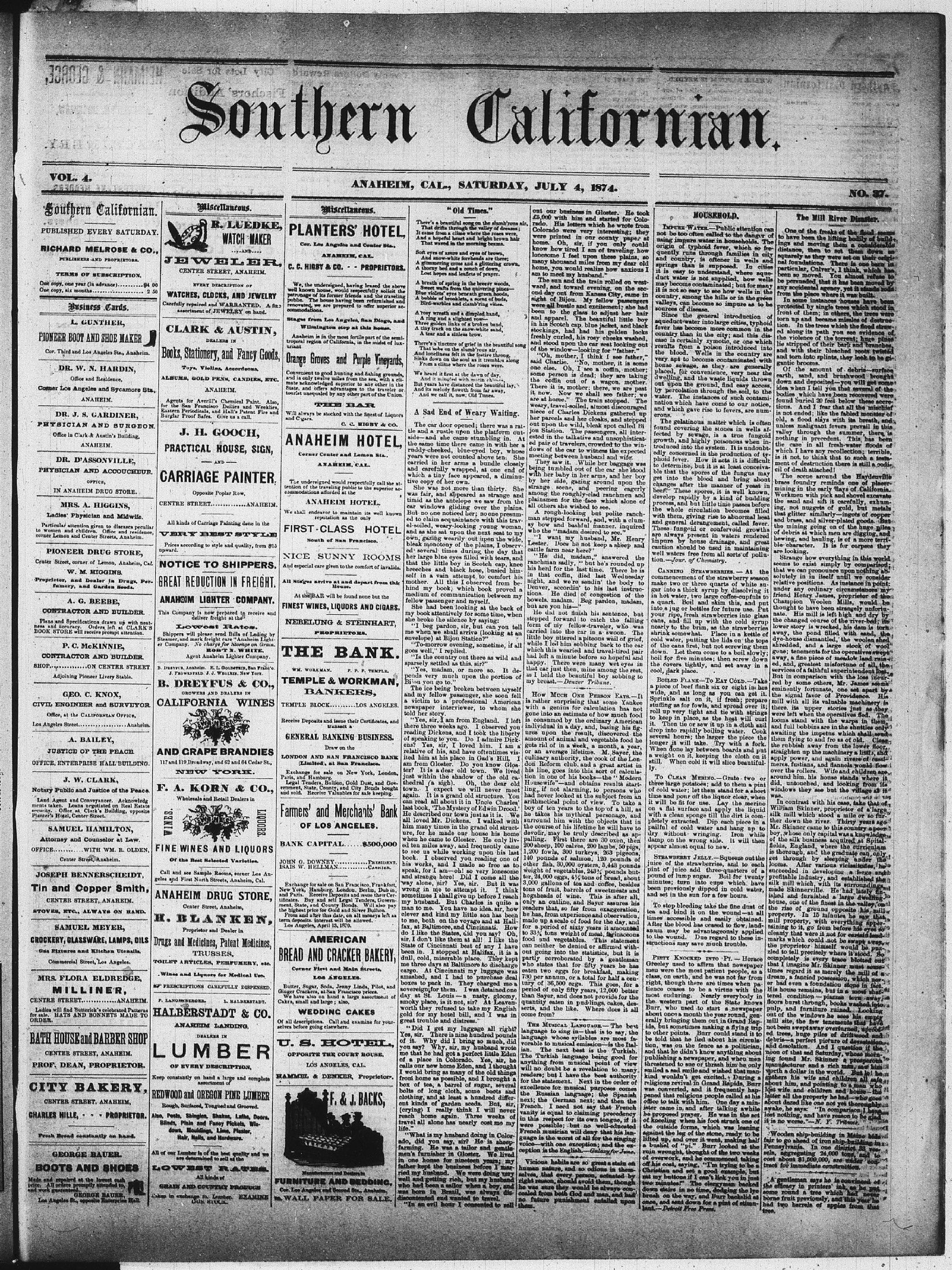
Searchable text
VOL. 4.
Southern Californian.
PUBLISHED EVERY SATURDAY.
RICHARD MELROSE & CO., PUBLISHERS AND PROFRIETORS.
TERMS OF SUBSCRIPTION.
One copy, one year (in advance).....84 00
One copy, six months.....2 50
Business Cards.
L. GUNTHER,
PIONEER BOOT AND SHOE MAKER
Cor. Third and Los Angeles Sts., Anaheim.
DR. W. N. HARDIN,
Office and Residence,
Corner Los Angeles and Sycamore Sts.
ANAHEIM.
DR. J. S. GARDINER,
PHYSICIAN AND SURGEON.
Office in Clark & Austin's Building,
ANAHEIM.
DR. D'ASSONVILLE,
PHYSICIAN AND ACCOUCHEUR.
Miscellaneous.
R. LUEDKE,
WATCH MAKER
JEWELER,
CENTER STREET, ANAHEIM.
EVERY DESCRIPTION OF
WATCHES, CLOCKS, AND JEWELRY
Carefully repaired and WARRANTYed. A first assortment of JEWELRY on hand.
CLARK & AUSTIN,
DEALERS IN
Books, Stationery, and Fancy Goods,
Toys, Viellas, Accordeons,
ALBUMS, GOLD PENS, CANDIES, etc.
ANAHEIM.
Agents for Averill's Chemical Paint. Also, for the San Francisco Deilies and Weeklies, Eastern Periodicals, and Hall's Patent Fire and Burglar Proof Safes. Give us a call.
J. H. GOOCH,
PRACTICAL HOUSE, SIGN,
AND CARDIAGE PAINTER
Office and Residence,
Corner Los Angeles and Sycamore Sta.
ANAHEIM.
DR. J. S. GARDINER,
PHYSICIAN AND SURGEON.
Office in Clark & Austin's Building,
ANAHEIM.
DR. D'ASSONVILLE,
PHYSICIAN AND ACCOUCHEUR.
OFFICE,
IN ANAHEIM DRUG STORE.
MRS. A. HIGGINS,
Ladies' Physician and Midwife.
Particular attention given to diseases peculiar to women and children. Office and residence, corner Lemon and Center Streets, Anaheim.
PIONEER DRUG STORE,
Center Street, corner of Lemon, Anaheim, Cal.
W. M. HIGGINS,
Proprietor, and Dealer in Drugs, Perfumery, and Garden Seeds.
A. G. BEEBE,
CONTRACTOR AND BUILDER.
Plans and Specifications drawn up with neatness and accuracy. Orders left at CLARK'S BOOK STORE will receive prompt attention.
P. C. McKINNIE,
CONTRACTOR AND BUILDER.
SHOP...ON CENTER STREET.
Adjoining Pioneer Livery Stable.
GEO. C. KNOX,
CIVIL ENGINEER and SURVEYOR.
Office, at the CALIFORNIAN OFFICE,
Los Angeles Street...Anaheim.
A. BAILEY,
JUSTICE OF THE PEACE.
OFFICE, ENTERPRISE HALL BUILDING.
J. W. CLARK,
Notary Pubilio and Justice of the Peace.
Land Agent and Conveyancer. Acknowledgments taken. Loans negotiated on Real Estate security. Office at Clark's Building, opposite Planter's Hotel, Center Street.
SAMUEL HAMILTON,
Attorney and Counselor at Law.
OFFICE...WITH WM. R. OLDEN,
Center Street, Anaheim.
JOSEPH BENNERSCHEIDT,
Tin and Copper Smith,
ALBUMS, GOLD PENS, CANDIES, ETC.
ANAHEIM.
Agents for Averill's Chemical Paint. Also, for the San Francisco Dailies and Weeklies, Eastern Periodicals, and Hall's Patent Fire and Burglar Proof Safes. Give us a call.
J. H. GOOCH,
PRACTICAL HOUSE, SIGN,
AND
CARRIAGE PAINTER,
Opposite Poplar Row,
CENTRE STREET...ANAHEIM.
All kinds of Carriage Painting done in the VERY BEST STYLE
Prices according to style and quality, from $15 upward.
NOTICE TO SHIPERS.
GREAT REDUCTION IN FREIGHT.
ANAHOMI LIGHTER COMPANY.
This Company is now prepared to receive and deliver freight at the Lowest Rates.
Shippers will please send Bills of Lading by Steamer, and mark freight care "Anaheim Lighter Company." No charge for Storage on Gran. ROST N. WHITE.
Agent Anaheim Lighter Company.
B. DREYFUS, Anaheim. E. L. GOLDESTRIN, San Franco 'o.
J. FROWSFIELD. J. J. WEGLIN, New York.
B. DREYFUS & CO., GROWERS AND DEALERS IN CALIFORNIA WINES
AND GRAPE BRANDIES
117 and 119 Broadway, and 62 and 64 Cedar St,
NEW YORK.
F. A. KORN & CO., Wholesale and Retail Dealers in
WINES.
FINE WINES AND LIQUORS
Of the Best Selected Varieties.
Call and see Sample Rooms, corner Los Angeles and First North Streets, Anaheim, Cal.
ANAHEIM DRUG STORE
Land Agent and Conveyancer. Acknowledgments taken. Loans negotiated on Real Estate security. Office at Clark's Building, opposite Planter's Hotel, Center Street.
SAMUEL HAMILTON,
Attorney and Counselor at Law.
OFFICE... WITH WM. R. OLDEN,
Center Street, Anaheim.
JOSEPH BENNERSCHEIDT,
Tin and Copper Smith,
CENTER STREET, ANAHEIM.
STOVES, ETC., ALWAYS ON HAND.
SAMUEL MEYER,
CROCKERY, GLASSWARE, LAMPS, OILS
Gas Fixtures and Kitchen Utensils,
Commercial Street, Los Angeles.
MRS. FLORA ELDREDGE,
MILLINER,
CENTRE STREET...ANAHEIM.
Ladies will find Butterick's celebrated Patterns for sale. HATS AND BONNETS MADE TO ORDER.
BATH HOUSE and BARBER SHOP
CENTER STREET, ANAHEIM.
PROF. DEAN, PROPRIETOR.
CITY BAKERY,
CENTER STREET, ANAHEIM.
CHARLES HILLE, - - PROPRIETOR.
Fresh Broad constantly on hand.
GEORGE BAUER.
BOOTS AND SHOES
Made and repaired at the lowest cash price. All orders promptly attended to, and work guaranteed.
GEORGE BAUER.
Los Angeles St., opposite Enterprise Hall.
WINES.
FINE WINES AND LIQUORS
Of the Best Selected Varieties.
Call and see Sample Rooms, corner Los Angeles and First North Streets, Anaheim, Cal.
ANAHEIM DRUG STORE,
Center Street, Anaheim,
H. BLANKEN,
Proprietor and Dealer in
Drugs and Medicines, Patent Medicines,
TRUSSES,
TOILET ARTICLES, PERFUMERY, etc.
Wines and Liquors for Medical Use.
PRESCRIPTIONS CAREFULLY DISPENSED.
P. LANGBERRGER.
L. MALBERSTADT.
HALBERSTADT & CO.
ANAHEIM LANDING,
DEALERS IN
LUMBER
OF EVERY DESCRIPTION,
Keep constantly on hand a large and complete assortment of
REDWOOD and OREGON PINE LUMBER
Rough, Surfaced, Tongued and Grooved.
Also, Peels, Shingles, Shakes, Lails, Doors,
Blinds, Plain and Fancy Pickets, Windows, Mouldings, Lime, Plaster,
Hair, Nails, and Hardware.
All of our Lumber is of the best quality and we are determined to sell at the
LOWEST RATES.
All kinds of
GRAIN AND COUNTERMY PRODUCTS
Known in exchange for: Lumber. EXAMINE DURABLE.
Farmers' and Merchants'
OF LOS ANGELES
BANK CAPITAL...
JOHN G. DOWNEY.... ISAIS W. HELLMAN....
Exchange for sale on San Francisco New York, Hamburg, London and Paris. Receive Deposits andificates. Buy and sell Legal documents, State, and County Bond the highest price for Gold and Silver.From and after this date, on a term deposits. Interest will be a Los Angeles, April 13, 1870.
AMERICA
BREAD AND CRACKED
Corner First and Main Los Angeles.
Butter, Sugar, Soda, Jenny Ginger Crackers, at San Francisco We have also on hand a large Cakra, small and large; also.
WEDDING CA
Of all descriptions. Call and exe selves before going elsewhere.
U.S. HOT
OPPOSITE THE COURT
LOS ANGELES,
HAMMEL & DENKER,
FURNITURE AND D
Cor. Los Angeles and Second B WALL PAPER FO
Southern California
ANAHEIM, CAL., SATURDAY, JULY 4, 1874.
Miscellaneous.
PLANTERS' HOTEL,
Cer. Los Angeles and Center Sts.
ANAHEIM, CAL.
C. C. HIGBY & CO. - PROPRIETORS.
We, the undersigned, having leased the above well known house, would respectfully solicit the patronage of its former friends and the traveling public. The house having been refurnished and renovated, we are prepared to offer superior accommodations.
Stages from Los Angeles, San Diego, and Wilmington stop at this house.
Anaheim is in the most fertile part of the semi-tropical region of California, in the midst of luxuriant Orange Groves and Purple Vineyards.
Convenient to good hunting and fishing grounds, and is only twelve miles from the sea, with a climate acknowledged superior to any other in the State, and offers advantages to the traveler or tourist unequaled by any other part of the Union.
THE BAR
Will always be stocked with the finest of Liquors and Cigars.
C. C. HIGBY & CO.
ANAHEIM HOTEL,
Corner Center and Lemon Sts.
ANAHEIM, CAL.
"Old Times."
There’s a beautiful song on the slumb’rous air,
That drifts through the valley of dreams;
It came from a clime where the roses were,
And a hopeful heart and bright brown hair
That waved in the morning beams.
Soft eyes of azure and eyes of brown,
And snow-white foreheads are there;
A glimmering cross and a glittering crown,
A thorny bed and a couch of down,
Lost hopes and leaflets of prayer.
A breath of spring in the breezy woods,
Sweet wafts from the quivering pines—
Blue violets’ eyes beneath green hoods,
A bubble of brooklets, a scent of buds,
Bird-warbles and clamb’ring vines.
A rosy wreath and a dimpled hand,
A ring and a slighted yow—
Three golden links of a broken band,
A tiny track on the snow-white sand,
A tear and a sinless brow.
There’s a tincture of grief in the beautiful song
That sobs on the slumb’rous air,
And loneliness felt in the festive throng.
Sinks down on the soul as it trembles along
From a clime where the roses were.
We heard it first at the dawn of day,
And it mingled with mornin chimes.
But years have distanced the beautiful lay,
And its melody floweth from far away,
And we call it, now, Old Times.
A Sad End of Weary Waiting.
The car door opened; there was a rattle and a rustle upon the platform outside—and she came stumbling in. At the same time there came in with her a ruddy-cheeked, blue-eyed boy, whose years were not counted above ten. She carried in her arms a bundle closely and carefully wrapped, at one end out our business in Gloster. He took £5,000 with him and started for Colorado. His letters which he wrote from Colorado were very interesting; they were printed in our county paper at home. Oh, air, if you only could know how tired I am of traveling: how lonesome I feel upon these plains, so many thousand miles from my dear old home, you would realize how anxious I am to meet my husband."
The sun and the train rolled on westward, and toward evening, on the second day out from Kansas City, came in sight of Bijou. My fellow passengers were all bustle and excitement; she had been to the glass to adjust her hair and apparel. The beautiful little boy in his Scotch cap, blue jacket, and black stockings, had had his golden locks freshly curled, his rosy cheeks washed, and stood upon the car seat looking out of the window—looking for "father."
"Oh, mother, I think I see father," said Charlie. "No, mother, it is some one else. Oh, I see a coffin, mother; some person is dead; they are taking the coffin out of a wagon, mother. There it is, mother; there, we are past it now. Now we shall see father; we are at home." The train stopped. The weary, travel-soiled, almost discouraged niece of Charles Dickens gathered up her parcels and her cloaks, and stepped out upon the wild, bleak spot called Bijou Station. The passengers, all interested in the talkative and unsophisticated pair of travelers, crowded to the windows of the car to witness the expected meeting between husband and wife.
They saw it. While her baggage was being tumbled out of the car she stood
A Sad End of Weary Waiting.
The car door opened; there was a rattle and a rustle upon the platform outside—and she came stumbling in. At the same time there came in with her a ruddy-cheeked, blue-eyed boy, whose years were not counted above ten. She carried in her arms a bundle closely and carefully wrapped, at one end of which a tiny face appeared, a diminutive copy of her own.
She was not more than thirty. She was fair, and appeared as strange and timid as the antelope we saw from the car windows gliding over the plains. But no one noticed her; no one presumed to claim acquaintance with this travel-soiled, weary-looking young woman, and as she sat upon the next seat to my own, gazing wearily out upon the wide, bleak monotony of the plains, I observed several times during the day that her large blue eyes filled with tears, and that the little boy in Scotch cap, knee breeches and black hose, busied himself in a vain attempt to comfort his mother. All this I observed from behind my book, which book proved a medium of communication between my fellow passenger and myself.
She had been looking at the back of my book attentively for some time, when she broke the silence by saying:
"I beg pardon, sir, but can you tell me when we shall arrive (looking at an envelope) at Bijou Station?"
"To-morrow evening, sometime, if all goes well," I replied.
"Is the country out there as wild and sparsely settled as this, sir?"
"Yes, madam, or more so. It depends very much upon the portion of Bijou you go to."
The ice being broken between myself and my fellow passenger, she soon fell a victim to a professional American newspaper interviewer, to whom she told her story.
"Yes, sir, I am from England. I left there three weeks ago. I observed you reading Dickens, and I took the liberty of speaking to you. Do I admire Dickens? Yes, sir, I loved him. I am a relative of his, and have oftentimes visited him at his place in Gad's Hill. I am from Gloster. Do you know Gloster? It is a dear old town. We lived just within the shadow of the old cathedral (a sigh). Oh, the dear old town. I expect we will never meet again. It is a grand old structure. You can read all about it in Uncle Charles' last book, 'The Mystery of Edwin Drood.' He described our town just as it is. We all loved Mr. Dickens. I walked with him many times in the grand old structure, for he made our house his home when he came to Gloster. He only lived ten miles away, and frequently came to see us while working upon his last book.
I observed you reading one of his works, and I made so free as to speak, for I am—oh! so very lonesome and strange here! Did I come all the way alone, sir? Yes, sir. But it was wrong in me to attempt it. I think sometimes I shall give up before I reach some person is dead; they are taking the coffin out of a wagon, mother. There it is, mother; there, we are past it now. Now we shall see father; we are at home." The train stopped. The weary, travel-soiled, almost discouraged niece of Charles Dickens gathered up her parcels and her cloaks, and stepped out upon the wild, bleak spot called Bijon Station. The passengers, all interested in the talkative and unsophisticated pair of travelers, crowded to the windows of the car to witness the expected meeting between husband and wife.
They saw it. While her baggage was being tumbled out of the car she stood with her baby in her arms, and her boy by her side, gazing around upon the strange scene, and peering eagerly among the roughly-clad ranchmen and plainsmen for the face which alone of all others she wished to see.
A rough-looking but polite ranchman stepped forward, and with a clumsy bow and bashful manner, inquired who the "madam desired to see."
"I want my husband, Mr. Henry Lester. Does he not keep a sheep and cattle farm near here?"
"He did, madam," answered the ranchman sadly, "but he's rounded up his herd for the last time. There he is in that coffin, died last Wednesday night, and we're sendin' the body to Denver, accordin' to his last instructions. He died of congestion of the bowels, madam. Beg pardon, madam, but are you his—"
He did not finish his sentence, but stepped forward to catch the falling form of my fellow-traveler, who was carried into the car in a swoo. The little boy uttered a piteous wail of grief, while I led him sobbing back to the car which this wearied and travel-tired pair had left a minute before so hopeful and happy. There were many wet eyes in that car just then, mine among the rest, as I held the beautiful boy sobbing to my breast.—Denver Tribune.
How Much One Person Eats—It is rather surprising that some Yankee with a genius for calculation has not gone into an estimate of how much food is consumed by the ordinary American individual in a day, and basing his figures upon the result, discovered the amount of animal and vegetable food he gets rid of in a week, a month, a year, or an average lifetime. M. Sayer, the culinary authority, the cook of the London Reform club, and a great artist in his line, goes into this sort of calculation in one of his books—the "Modern Housewife"—and obtains results starting if not alarming; to persons who had never looked at the subject from an arithmetical point of view. To take a boy of ten years to the top of a hill, as he takes his mythical personage, and surround him with the objects that in the course of his lifetime he will have to devoir may be truly described as appalling. First there are 30 oxen, then 200 sheep, 100 calves, 200 lambs, 50 pigs, 1,200 fowls, 300 turkeys, 263 pigeons, 140 pounds of salmon, 120 pounds of other fish, 30,000 oysters, 5,443 pounds weight of vegetables, 243% pounds butter, 24,000 eggs, 4% tons of bread, about 3,000 gallons of tea and coffee, besides tons of fruit, barrels of sweetmeats and hogsheads of wine. This is after all...
Farmers' and Merchants' Bank
OF LOS ANGELES.
BANK CAPITAL...$500,000
JOHN G. DOWNEY...PRESIDENT.
ISAIS W. HELLMAN...CASHIER.
Exchange for sale on San Francisco, Frankfort,
New York, Hamburg, London, Berlin, Dub in,
and Paris. Receive Deposits and issue their Certificates.
Buy and sell Legal Tenders, Government,
State, and County Bonds. Will also pay the highest price for Gold and Silver Bullion.
From and after this date, on all moneys left as term deposits, interest will be allowed.
Los Angeles, April 13, 1870.
AMERICAN
BREAD AND CRACKER BAKERY,
Corner First and Main Streets,
LOS ANGELES.
Butter, Sugar, Soda, Jenny Linds, Pilot, and Ginger Crackers, at San Francisco prices.
We have also on hand a large assortment of Cakes, small and large; also,
WEDDING CAKES
Of all descriptions. Call and examine yourselves before going elsewhere.
U. S. HOTEL,
OPPOSITE THE COURT HOUSE,
LOS ANGELES, CAL.
MAMMEL & DENKER, Proprietor.
F. & J. BACKS,
Manufacturers and Dealers in
URNITURE AND BEDDING.
Con. Los Angeles and Second Sea., Amahima.
A WALL PAPER FOR SALE.
You can read all about it in Uncle Charles' last book, 'The Mystery of Edwin Drood.' He described our town just as it is. We all loved Mr. Dickens. I walked with him many times in the grand old structure, for he made our house his home when he came to Gloster. He only lived ten miles away, and frequently came to see us while working upon his last book.
I observed you reading one of his works, and I made so free as to speak, for I am—oh! so very lonesome and strange here! Did I come all the way alone, sir? Yes, sir. But it was wrong in me to attempt it. I think sometimes I shall give up before I reach my husband. But Charles is quite a man to me. You have no idea, sir, how clever and kind my little son has been to me, both on the voyage and at Halifax, at Baltimore, and Cincinnati. How do I like the States, did you say? Oh, sir, I don't like them at all! I like the State of Cincinnati best of any I have been in. I stopped at Halifax, it is a dull, cold, miserable place. They kept me three days at Baltimore to discharge cargo. At Cincinnati my luggage was smashed, and I had to purchase deal boxes to pack in. They charged me a sovereign for them. I was detained one day at St. Louis—a nasty, gloomy, smoky place, is it not, sir? At Leavenworth they refused to take my English gold for my hotel bill, and I was in great trouble and distress."
"Did I get my luggage all right? Yes, sir. There is nine hundred pounds of it. Why did I bring so much, did you say? Why, sir, my husband wrote me that he had got a perfect little Eden of a place in Colorado. Yes, sir, he calls our new home Eden, and I thought I would bring as many of the old things front home as possible, and I brought a box of tea, a barrel of sugar, several bolts of long cloth, some boots and clothing, and at least a hundred different kinds of garden seeds. But, air, (crying) I really think I will never reach home again. Three weeks of travel all alone has nearly cost me my life."
"What is my husband doing in Colorado, did you say, sir? He is sheep-farming. He was a tailor and gentlemen's furnisher in Gloster. We lived in one house for nineteen years; my father kept the business before I married my husband. We were doing very well and getting rich, but my husband who had been a sailor when a boy, and was born in Brazil, was always discontented and wanted to travel." In an evil hour I consented to sell
THE MUSICAL LANGUAGE—The best language to sing in—that is to say, the language whose syllables are most favorable to musical emission—is the Italian. The next best is the Turkish. The Turkish language being good for anything from musical point of view will no doubt be a revelation to many readers; but I have the best authority for the statement. Next in the order of excellence for musical purposes comes the Russian language; the Spanish next; the German next; and then the French. I need not say that French vanity is equal to claiming precedency in this respect for its own tongue, if it were possible; but no well-educated French musician will deny that his language is the worst of all for the singing voice—with one exception: and the exception is the English—Galaxy for June.
Vicious habits are so great a stain on human nature, and so odious in them-selves, that every person admitted by right reason should avoid them; though he was sure they would be always concealed from both God and man; and had no future punishment entailed upon them.
Gloster. He took started for Colowhich he wrote from interesting; they county paper at you only could of traveling how these plains, so from my dear old size how anxious I had."
HOUSEHOLD.
IMPURE WATER.—Public attention can not be too often called to the dangur of using impure water in households. The origin of typhoid fever, which so frequently runs through families in city and country, is oftener in wells and springs than is supposed. In cities it is easy to understand, where aqueduct water is not supplied, how wells may become contaminated; but for many it is not so easy to see how wells in the country, among the hills or in the green valleys, can become so impure as to be sources of disease.
Since the general introduction of aqueduct water into large cities, typhoid fever has become more common in the country than in the city; and this disease is certainly zymotic, or one which results from a poison introduced into the blood. Wells in the country are very apt to become contaminated with house sewage, as they are generally placed, for convenience, very near the dwelling, and the waste liquids thrown out upon the ground, find easy access, by percolation through the soil, to the water. The instances of such contamination which have come to our notice, and which gave rise to fevers, are numerous.
The gelatinous matter which is often found covering the stones in wells affected by sewage, is a true fangoid growth, and highly poisonous when introduced into the system. It is undoubtedly concerned in the production of typhoid fever. How it acts it is difficult to determine; but it is at least conceivable that the spores of the fungus may
The Mill River Disaster.
One of the freaks of the flood seems to have been the lifting bodily of buildings and moving them a considerable distance, then to set them down as squarely as they were set on their original foundations. There is one here in particular, Culver's. I think, which has been so moved. You almost refuse to be persuaded that it has been moved by any accidental agency, yet it standsods from the place where it was built.
In some instances houses have been protected by single trees which stood in front of them; in others, the trees were torn up and became missiles of destruction. In the trees which the flood stressed along its path you see evidence of the violence of the torrent; huge pines lie stripped of their bark and branches, and with their bleached roots twisted and torn into splints, they look to be gigantic brooms.
Of the amount of debris—surface earth, sand, and brushwood brought down and deposited—you will get some idea when I tell you that several of the bodies which have been recovered were found buried 20 feet below these accretions. And I fear that all the mischief is not ended; like the fabled monster of old, a flood slays with its breath, and unless malignant fevers provail in this valley through the summer, there is nothing in precedent. This has been the case in all fresh-water floods of which I have any recollection; terrible, is it not, to think that to such a testament of destruction there is still a codicil of death attached!
they are taking wagon, mother,
there, we are past
see father; we
stopped. The
most discouraged
mens gathered up
laks, and stepped
spot called Biengers, all interand unsophisticatded to the winness the expected
and wife.
other baggage was
the car she stood
arms, and her boy
ground upon the
peering eagerly
ranchmen and
which alone of
see.
at polite ranchand, with a clummanner, inquired
to see."
and, Mr. Henry
keep a sheep and
answered the
she's rounded up
one. There he is
last Wednesday
the body to
his last instrucngestion of the
bardon, madam,
sentence, but
catch the falling
veler, who was
a swoon. The
ous wail of grief,
back to the car
travel-tired pair
so hopeful and
any wet eyes in
among the rest,
boy sobbing to
bune.
PERSON EATS.—It
some Yankee
relation has not
how much food
ninary American
basing his figdiscovered the
gettable food he
month, a year,
M. Sayer, the
book of the Longgreat artist in sort of calculathe "Modern results startto persons who subject from an awk. To take a hop of a hill, as personage, and objects that in the will have to described as apes 30 oxen, then lambs, 50 pigs, 263 pigeons,
120 pounds of fish, 5,443 pounds of pounds but of bread, about coffee, besides sweetmeats and biscuits is after all
CANNING STRAWBERRIES.—At the commencement of the strawberry season make two or three quarts of white sugar into a thick syrup by dissolving it in hot water, two large coffee-cupfuls to a quart. Boil and skim this, and put into a jug or bottles for future use. Put your ripe, fresh strawberries into glass cans, and fill up with the cold syrup nearly to the brim, as the strawberries shrink somewhat. Place in a kettle of cold water, putting the lids on the tops of the cans first, but not screwing them down. Let them come to a boil slowly; boil for five minutes; then screw down the covers tightly, and set away in a cool, dark place.
BOILED FLANK—To EAT COLD.—Take a piece of beef flank six or eight inches wide, and as long as you can get it. Sprinkle salt on it, if fresh; prepare stuffing as for fowls, and spread over it; roll up very tight and tie with strings to keep in place, as the heat will curl it. Then tie or sew it up in a cloth and drop into rapidly boiling water. Cook several hours; the larger the piece longer it will take. Try with a fork. When done lay between boards and put a weight on it, keeping the cloth on it still. When cold it will slice beautifully.
TO CLEAN MERino.—Grate two or three large potatoes; add to them a pint of cold water; let them stand for a short time and pour off the liquor clear, when it will be fit for use. Lay the merino on a flat surface and apply the liquid with a clean sponge till the dirt is completely extracted. Dip each piece in a painful of cold water and hang up to dry without wringing. Iron while damp on the wrong side. It will then appear almost equal to new.
STRAWBERRY JELLY.—Squeeze out the juice of the strawberries, and to each pint of juice add three-quarters of a pound of lump sugar. Boil for twenty minutes; turn into cups which have been previously dipped in cold water, and set in the sun for a few hours.
The gelatinous matter which is often found covering the stones in wells affected by sewage, is a true fungoid growth, and highly poisonous when introduced into the system. It is undoubtedly concerned in the production of typhoid fever. How it acts it is difficult to determine; but it is at least conceivable that the spores of the fungus may get into the blood and bring about changes after the manner of yeast in beer. These spores, it is well known, develop rapidly by a kind of budding process, and but little time passes before the whole circulation becomes filled with them, giving rise to abnormal heat and general derangement, called fever. These fungoid or confervoid growths are always present in waters rendered impure by house drainage, and great caution should be used in maintaining well waters free from all sorts of pollution.—Jour. of Chemistry.
Strange how everything in this world seems to exist simply by comparison; that we can pronounce upon nothing absolutely in in itself until we consider relative positions. As instance in point: under any ordinary circumstances my friend Henry James, proprietor of the Champion Woolen Mills, would be thought to have been strangely unfortunate. His mill is left high and dry by the changed course of the river-bed; its lower story is wrecked, his dam is torn away, the pond filled with sand, the dye-house dismantled, the woolen shed shredded, and a large stock of wool gone; tenements for the operatives swept away, a fine piece of meadow land ruined, and greatest misfortune of all, the services of a faithful superintendent lost. But in comparison with the loss incurred by some others, Mr. James seems eminently fortunate, one set apart by the signal favor of Providence. His mill with all its valuable machinery is there; its upper stories just as they were left when the operatives fled. The looms stand with the warps in them, and full bobbins are in the shuttles only awaiting the impetus which shall send them flying to and fro as of old. Clear the rubbish away from the lower floor, straighten up the machinery a little, and apply power, and again rivers of casières, fustians, and flannels would flow over the rollers. Wife and children are around him; his house stands where it did, untouched, and looking from its windows they see but the village all it was.
In contrast with his case, take that of William Skinner, proprietor of a large silk mill which stood a mile or so further down the river. Thirty years ago Mr. Skinner came to this country a poor boy, whose only capital was a knowledge of the silk business acquired at Spitalfields, England, where the curriculum is thorough, and the graduate can only get through by sleeping under the looms. After various vicissitudes he succeeded in developing a large and profitable industry, and established the silk mill which, with its surroundings made Skinnerville. He had lazily finished and furnished a large dressing room.
To take a hop of a hill, as personage, and objects in the will have to be described as apes 30 oxen, then lambs, 50 pigs, 263 pigeons, 120 pounds of milk, 5,443 pounds but of bread, about coffee, besides sweetmeats and bis is after all, ever assures his exaggeration, and observation, for the day, and does it amounted at faginaceous this statement affirmed with tics, but it is a gentleman years he has breakfast, making for half a centis goes, for a 12,000 better provide for the fruits, cakes, deserts does it all.
STRAWBERRY JELLY.—Squeeze out the juice of the strawberries, and to each pint of juice add three-quarters of a pound of lump sugar. Boil for twenty minutes; turn into cups which have been previously dipped in cold water, and set in the sun for a few hours.
To stop bleeding take the fine dust of tea and bind it on the wound—at all times accessible and easily obtained. After the blood has ceased to flow, land-anum may be advantageously applied to the wound. Due regard to these instructions may save much trouble.
PEETY KNOCKED INTO PT. — Horace Greeley used to affirm that newspaper men were the most patient people, as a class, on earth, and he was not far from right, though there are times when patience ceases to be a virtue with the most enduring. Nearly everybody in the western part of the State knows Burr, who used to start a newspaper about once a month the year round, generally bringing them out in Grand Rapids, but sometimes making a flying trip to other points. Burr could stand it to be told that he lied about his circulation, was on the fence as a politician, and that he didn't know anything about publishing a newspaper, and when men threatened to sue or thrash him he only smiled a sad smile and wished that mankind wouldn't get excited. During a religious revival in Grand Rapids, Burr was converted, and it frequently happened that religious people called at his office to talk with him. One day a minister came in, and after talking awhile he proposed prayer. He was in the act of kneeling when his foot struck one of the outside forms, which was leaning against the leg of the stone, ready to be lifted up, and over it went, making half a bushel of "pi." Burr looked at the ruin wrought, thought of the two weeks of overwork, and he commenced taking off his coat, saying, "I'm trying to be a Christian and set a good example, but my buttons if I can't link you in just two minutes!" The clerkman backed down stairs in no time, dodging the lye brush on the way, and Burr backslid at once, and sent down for a pint of stimulant.—Detroit Free Press.
In contrast with his case, take that of William Skinner, proprietor of a large silk mill which stood a mile or so further down the river. Thirty years ago Mr. Skinner came to this country a poor boy, whose only capital was a knowledge of the silk business acquired at Spitalfields, England, where the curriculum is thorough, and the graduate can only get through by sleeping under the looms. After various vicissitudes, he succeeded in developing a large and profitable industry, and established the silk mill which, with its surroundings made Skinnerville. He had lately finished and furnished a large dwelling house, one of the finest in the valley, on the rise of ground opposite his mill property. In 15 minutes he saw that mill property, with everything appertaining to it, go from before his eyes to cleanly that were it not for certain landmarks which could not be swept away, the proprietor himself would be puzzled to tell precisely where it stood. So completely is every trace blotted out that I imagine Mr. Skinner must sometimes regard it as merely the mill of a dream, a fancied possession, which never had even a foundation stone in fact. His house remains, but in a most characterized condition—piazzas torn away floors burst through books washed into pulp, and furniture ruined. Looking out of the windows he sees his empty mill site, the few tenements that have not been swept away overturned, uprooted trees, huge piles of driftwood and debris—a perfect picture of devastation and desolation. And I question if the noon of that sad Saturday, whose morning found Mr. Skinner a prosperous manufacturer and a rich man worth a dollar in the world. But he gathers his wife and children all safe about him, and pointing to a man who lost wife and children and houses—the latter all the property he had—who goes about dazed like one not yet thoroughly awake, he says: "In comparison I have lost nothing, and have reason to be glad it is no worse."—N. Y. Tribune.
Wooden ship-building in Maine hints fair to go ahead of iron ship-building in Pennsylvania. In one district $3 vessels, aggregating 24,000 tons, and to cost about $1,500,000 are under contract for immediate construction.
A gentleman says he is convinced of the efficacy in printers' ink, as he met some round a tree which had never borne fruit previously, and this year he had two barrels of apples from that tree.