anaheim-gazette 1874-06-20
Scanned page
Searchable text
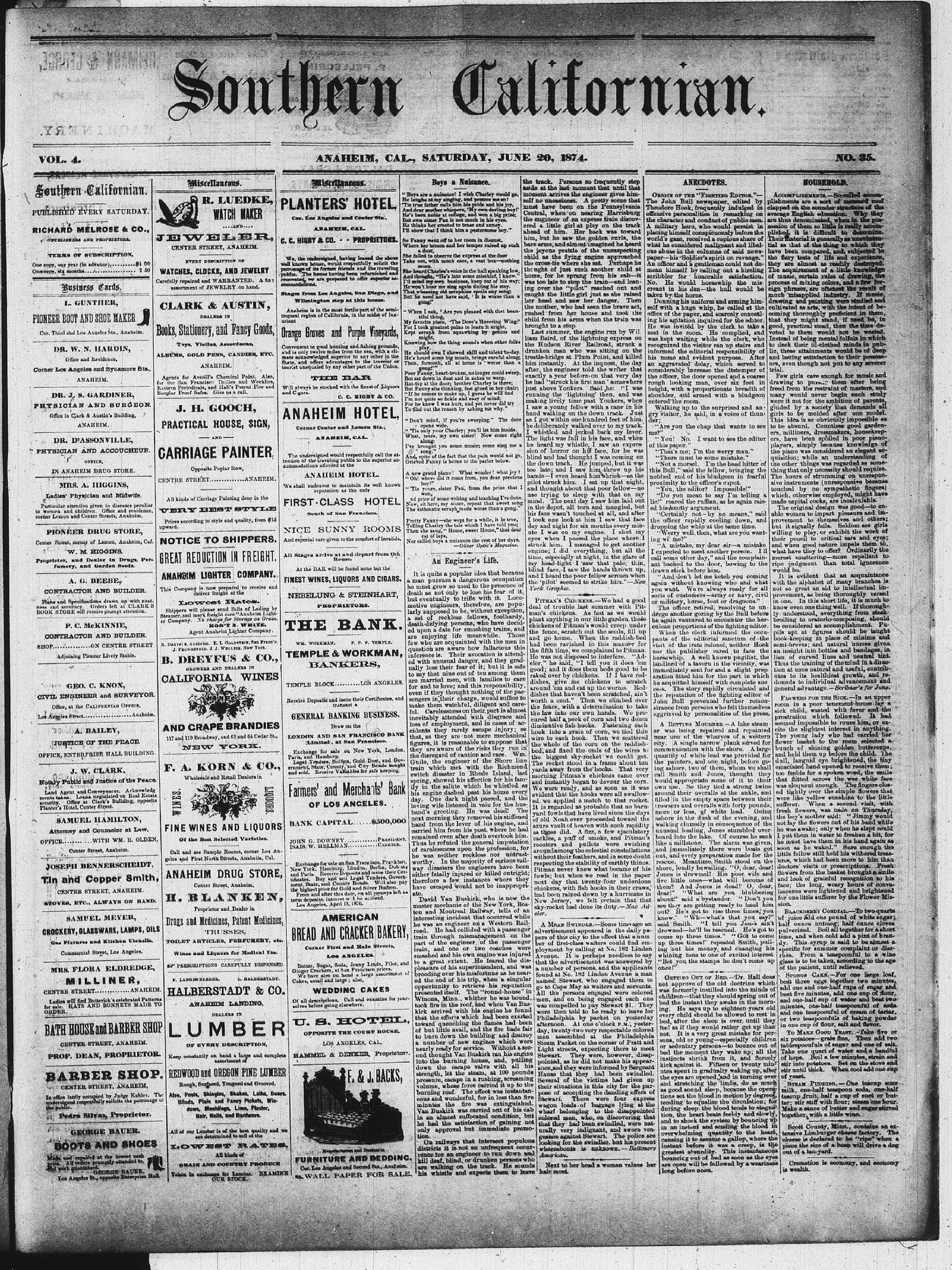
VOL. 4.
Southern Californian.
PUBLISHED EVERY SATURDAY.
RICHARD MELROSE & CO., PUBLISHERS AND PROPRIETORS.
TERMS OF SUBSCRIPTION.
One copy, one year (in advance)... $1 00
One copy, six months... $2 50
Business Cards.
L. GUNTHER,
PIONEER BOOT AND SHOE MAKER
Cor. Third and Los Angeles Sts., Anaheim.
DR. W. N. HARDIN,
Office and Residence,
Corner Los Angeles and Sycamore Sts.,
ANAHEIM.
DR. J. S. GARDINER,
PHYSICIAN AND SURGEON.
Office in Cjark & Austin's Building,
ANAHEIM.
DR. D'ASSONVILLE,
PHYSICIAN AND ACCOUCHEUR.
OFFICE,
IN ANAHEIM DRUG STORE.
Miscellaneous.
R. LUEDKE,
WATCH MAKER
AND...
JEWELER,
CENTER STREET, ANAHEIM.
EVERY DESCRIPTION OF
WATCHES, CLOCKS, AND JEWELRY
Carefully repaired and WARRANTED. A first assortment of JEWELRY on hand.
CLARK & AUSTIN,
DEALERS IN
Books, Stationery, and Fancy Goods,
Toys, Violins, Accordeons,
ALBUMS, GOLD PENS, CANDIES, ETC.
ANAHEIM.
Agents for Averill's Chemical Paint. Also,
for the San Francisco Deilies and Weeklies,
Eastern Periodicals, and Hall's Patent Fire and
Burglar Proof Safes. Give us a call.
J. H. GOOCH,
PRACTICAL HOUSE, SIGN,
AND
CARRIAGE PAINTER.
Opposite Poplar Row,
Miscellaneous.
PLANTERS'
Corr. Los Angeles and
ANAHEIM,
C. C. HIGBY & CO.
We, the undersigned, having well known house, would respect patronage of its former friend public. The house having been renovated, we are prepared to commodations.
Stages from Los Angeles,
Wilmington stop at Anaheim is in the most fertile tropical region of California, in urient Orange Groves and Pu Convenient to good hunting and is only twelve miles from state, and offers advantages tourat unequaled by any other.
THE BA
Will always be stocked with the and Cigars.
ANAHEIM
Corner Center and L.
ANAHEIM,
The undersigned would respet tion of the traveling public commodations afforded at the
ANAHEIM.
DR. J. S. GARDINER,
PHYSICIAN AND SURGEON.
Office in Clark & Austin's Building,
ANAHEIM.
DR. D'ASSONVILLE,
PHYSICIAN AND ACCOUCHEUR.
OFFICE,
IN ANAHEIM DRUG STORE.
MRS. A. HIGGINS,
Ladies' Physician and Midwife.
Particular attention given to diseases peculiar to women and children. Office and residence, corner Lemon and Center Streets, Anaheim.
PIONEER DRUG STORE,
Center Street, corner of Lemon, Anaheim, Cal.
W. M. HIGGINS.
Proprietor, and Dealer in Drugs, Perfumery, and Garden Seeds.
A. G. BEEBE,
CONTRACTOR AND BUILDER.
Plans and Specifications drawn up with neatness and accuracy. Orders left at CLARK'S BOOK STORE will receive prompt attention.
P. C. McKINNIE,
CONTRACTOR AND BUILDER.
SHOP...ON CENTER STREET
Adjoining Pioneer Livery Stable.
GEO. C. KNOX,
CIVIL ENGINEER and SURVEYOR.
Office, at the CALIFORNIAN OFFICE, Los Angeles Street...Anaheim.
A. BAILEY,
JUSTICE OF THE PEACE.
OFFICE, ENTERPRISE HALL BUILDING.
J. W. CLARK,
Notary Public and Justice of the Peace.
Land Agent and Conveyancer. Acknowledgments taken. Loana negotiated on Real Estate security. Office at Clark's Building, opposite Planter's Hotel, Center Street.
SAMUEL HAMILTON,
Attorney and Counselor at Law.
OFFICE...WITH WM. R. OLDEN, Center Street, Anaheim.
JOSEPH BENNERSCHEIDT,
Tin and Copper Smith,
CENTER STREET, ANAHEIM.
AGENTS FOR AVERILL'S CHEMICAL PAINT. Also, for the San Francisco Deilies and Weeklies, Eastern Periodicals, and Hall's Patent Fire and Burglar Proof Safes. Give us a call.
J. H. GOOCH,
PRACTICAL HOUSE, SIGN,
AND
CARRIAGE PAINTER.
Opposite Poplar Row,
CENTRE STREET...ANAHEIM.
All kinds of Carriage Painting done in the VERY BEST STYLE.
Prices according to style and quality, from $15 upward.
NOTICE TO SHIPERS.
GREAT REDUCTION IN FREIGHT.
ANAHEIM LIGHTER COMPANY.
This Company is now prepared to receive and deliver freight at the Lowest Rates.
Shippers will please send Bills of Lading by Steamer, and mark freight care "Anaheim Lighter Company." No charge for Storage on Grain.
HOST N. WHITE.
Agent Anaheim Lighter Company.
B. DREYFUS & CO., OROWERS AND DEALERS IN CALIFORNIA WINES
AND CRAPE BRANDIES
117 and 119 Broadway, and 62 and 64 Cedar St., NEW YORK.
F. A. KORN & CO., Wholesale and Retail Dealers in WINES.
FINE WINES AND LIQUORS
Of the Best Selected Varieties.
Call and see Sample Rooms, corner Los Angeles and First North Streets, Anaheim, Cal.
ANAHEIM DRUG STORE,
Center Street, Anaheim,
THE BA
Will always be stocked with the and Cigars.
ANAHEIM
Corner Center and L
ANAHEIM,
The undersigned would respond tention of the traveling public commodations afforded at the
ANAHEIM H
We shall endeavor to maintain reputation as the
FIRST-CLASS
South of San Fr
NICE SUNNY
And especial care given to the
All Stages arrive at and House.
At the BAR will be found
FINEST WINES, LIQUOR
NEBELUNG & ST
PROPRIETE
THE B
WM. WORKMAN.
TEMPLE & WO
BANK
TEMPLE BLOCK....Receive Deposites and issue the transact
GENERAL BANKING
Draw on the LONDON AND SAN FR
(Limited), at San
Exchange for sale on Paris, and Hamburg.
Legal Tenders, Bullion, Government, State, County, and sold. Receive Valuable
Farmers' and Meat OF LOS AN
BANK CAPITAL.
JOHN G. DOWNEY...
ISAIS W. HELLMAN...
Exchange for sale on New York, Hamburg, London and Paris. Receive Deposits tificates. Buy and sell Landment, State, and County B the highest price for Gold a From and after this date.
SAMUEL HAMILTON,
Attorney and Counselor at Law.
OFFICE... WITH WM. R. OLDEN,
Center Street, Anaheim.
JOSEPH BENNERSCHEIDT,
Tin and Copper Smith,
CENTER STREET, ANAHEIM.
STOVES, ETC., ALWAYS ON HAND.
SAMUEL MEYER,
CROCKERY, GLASSWARE, LAMPS, OILS
Gas Fixtures and Kitchen Utensils,
Commercial Street, Los Angeles.
MRS. FLORA ELDREDGE,
MILLINER,
CENTRE STREET...ANAHEIM.
Ladies will find Butterick's celebrated Patterns for sale. HATS AND BONNETS MADE TO ORDER.
BATH HOUSE and BARBER SHOP
CENTER STREET, ANAHEIM.
PROF. DEAN, PROPRIETOR.
BARBER SHOP.
CENTER STREET, ANAHEIM.
In office lately occupied by Judge Kohler. The undersigned respectfully solicits the patronage of the public.
Pedro Silvas, Proprietor.
GEORGE BAUER.
BOOTS AND SHOES
Made and repaired at the lowest cash price. All orders promptly attended to, and work guaranteed.
GEORGE BAUER,
Los Angeles St., opposite Enterprise Hall.
FINE WINES AND LIQUORS
Of the Best Selected Varieties.
Call and see Sample Rooms, corner Los Angeles and First North Streets, Anaheims, Cal.
ANAHEIM DRUG STORE,
Center Street, Anaheim,
H. BLANKEN,
Proprietor and Dealer in Drugs and Medicines, Patent Medicines, TRUSSES,
TOILET ARTICLES, PERFUMERY, etc.
Wines and Liquors for Medical Use.
PRESCRIPTIONS CAREFULLY DISPENSED.
P. LANGINBERGER.
L. HALBERSTADT.
HALBERSTADT & CO.
ANAHEIM LANDING,
DEALERS IN
LUMBER
OF EVERY DESCRIPTION,
Keep constantly on hand a large and complete assortment of REDWOOD and OREGON PINE LUMBER
Rough, Surfaced, Tongned and Grooved.
Also, Posts, Shingles, Shakes, Laths, Doors, Blinds, Plain and Fancy Pickets, Windows, Mouldings, Lime, Plaster, Hair, Nails, and Hardware.
All of our Lumber is of the best quality and we are determined to sell at the LOWEST RATES.
All kinds of GRAIN AND COUNTRY PRODUCE
Taken in exchange for Lumber. EXAMINE OUR STOCK.
NORTHCALIFORNIA
ANAHEIM, CAL., SATURDAY, JUNE 20, 1874.
Miscellaneous.
PLANTERS' HOTEL,
Cev. Los Angeles and Center Sts.
ANAHEIM, CAL.
C. C. HIGBY & CO. - PROPRIETORS.
We, the undersigned, having leased the above well known house, would respectfully solicit the patronage of its former friends and the traveling public. The house having been refurbished and renovated, we are prepared to offer superior accommodations.
Stages from Los Angeles, San Diego, and Wilmington stop at this house.
Anaheim is in the most fertile part of the semi-tropical region of California, in the midst of luxuriant Orange Groves and Purple Vineyards.
Convenient to good hunting and fishing grounds, and is only twelve miles from the sea, with a climate acknowledged superior to any other in the State, and offers advantages to the traveler or tourist unequaled by any other part of the Union.
THE BAR
Will always be stocked with the finest of Liquors and Cigars.
C. C. HIGBY & CO.
ANAHEIM HOTEL,
Corner Center and Lemon Sts.
ANAHEIM, CAL.
The undersigned would respectfully call the attention of the traveling public to the superior accommodations afforded at the Boys a Nuisance.
"Boys are a nuisance! I wish Charley would go. He laughs at my singing, and peers me so! This true father calls him his pride and his joy, And dear mother whispers, 'My own darling boy!' He's been noble at college, and won a big prize; But own sister Fan is not much in his eyes. He thinks her created to tease and annoy. I'll show that I think him a pearsonome boy."
So Fanny went off to her room in disguise. Where her broom and her temper raised up such a dust. She failed to observe the express at the door Take out, with much care, a vast box—nothing more.
She heard Charley's voice in the hall speaking low, And thought, "He's into some mischief, I know." I'll mind my own business, keep out of his way; He won't hear me sing again during his stay. That wheezing old seraphine spoils any song; But he need not have said, 'It is worse than a gong!'
"When I ask, 'Are you pleased with that beautiful thing,' My favorite piece, 'The Dove's Hovering Wing?' For I took greatest pains to learn it aight, Kept seraph from squawking by genius and might. Knowing how the thing sounds when other folks play, He should own I showed skill and talent to day. He heard some big music, brings careful along; Then, forsooth, all at home is 'worse than a gong!'" Poor Fanny, heart-broken, no longer could sweep, But sat down in dust and in ashes to weep. Hat-tap at the door; brother Charley is there; But Fanny sits thinking, fast glued to her chair; If he comes to make up, I guess he will find I'm not quite so sickle and easy of mind; For he knew I was hurt, and yet never did try To find out the reason by asking me why."
"Don't mind, if you're sweeping." The door opens wide.
"Tis only your Charley; you'll let him inside. What, tears, my own sister! Now come right along: I've brought you some music; come sing me a song!" And, spite of the fact that the pain would not go, Grieved Fanny is borne to the parlor below.
A new grand piano! What wonder! what joy!
the track. Persons so frequently step aside at the last moment that until that moment arrives the engineer gives himself no unseasiness. A pretty scene that must have been on the Pennsylvania Central, when on nearing Harrriburg the engineer of an express train discovered a little girl at play on the track ahead of him. Her back was toward him, but he saw the golden curls, the bare arms, and almost imagined he heard the joyous prattle of the unsuspecting child as the flying engine approached the cross-tie where she sat. Perhaps he thought of just such another child at home, for he sprang from his cab—it was too late to stop the train—and leaning over the "pilot" reached out and caught the little girl just as she raised her head and saw her danger. Then the mother, who had seen the brave act, rushed from her house and took the child from his arms when the train was brought to a stop.
Last summer, the engine run by William Baird, of the lightning express on the Hudson River Railroad, struck a drunken man who was sitting on the treatle-bridge at Plum Point, and killed him instantly. At the inquest, the day after, the engineer told the writer that exactly a year before on that very day he had "struck his first man" somewhere just above Yonkers. Said he: "I was running the 'lightning' then, and was making lively time past Yonkers, when I saw a young fellow with a cane in his hand walking on the down track. Just as I got within one hundred feet of him, he deliberately walked over to my track. I whistled and jerked back my lever. The light was full in his face, and when he heard my whistle, I saw an expression of horror on his face, for he was blind and had thought I was coming on the down track. He jumped, but it was too late; and I saw him throw up his origin.
The John Theodoreoffensive character A military placing his world's gun what he does abuse paper—having mean his scribblery No. He creaent in taken by Donnin self with office of taking his seat in was kept recognizinf informed his name considererlthe office rough height wshoulder entered Walking grry visit der;
"Are ye me?" You of this page "That"
"Theen"
Not this Bullet
THE BAR
Will always be stocked with the finest of Liquors and Cigars.
ANAHEIM HOTEL,
Corner Center and Lemon Sts.
ANAHEIM, CAL.
The undersigned would respectfully call the attention of the traveling public to the superior accommodations afforded at the
ANAHEIM HOTEL.
We shall endeavor to maintain its well known reputation as the only
FIRST-CLASS HOTEL
South of San Francisco.
NICE SUNNY ROOMS
And special care given to the comfort of invalids.
All Stages arrive at and depart from this House.
At the BAR will be found none but the FINEST WINES, LIQUORS AND CIGARS.
NEBELUNG & STEINHART,
PROPRIETORS.
THE BANK.
WM. WORKMAN. P. P. P. TEMPLE.
TEMPLE & WORKMAN, BANKERS,
TEMPLE BLOCK...LOS ANGELES.
Receive Deposits and issue their Certificates, and transact a
GENERAL BANKING BUSINESS.
Draw on the
LONDON AND SAN FRANCISCO BANK (Limited), at San Francisco.
Exchange for sale on New York, London, Paris, and Hamburg.
Legal Tenders, Bulldon, Gold Dust, and Government, State, County, and City Bonds bought and sold. Receive Valuables for safe keeping.
Farmers' and Merchants' Bank OF LOS ANCELES.
BANK CAPITAL...$500,000
JOHN G. DOWNEY...PRESIDENT.
ISAIS W. HELLMAN...CASHIER.
Exchange for sale on San Francisco, Frankfort, New York, Hamburg, London, Berlin, Dublin, and Paris. Receive Deposits and issue their Certificates. Buy and sell Legal Tenders, Government, State, and County Bonds. Will also pay the highest price for Gold and Silver Bullion.
From and after this date, on all money's left as poor fanny, heart-broken, no hunger could sweep, But sat down in dust and in ashes to weep.
Hat-tap at the door; brother Charley is there; But Fanny sits thinking, fast glued to her chair;
"If he comes to make up, I guess he will find I'm not quite so sickle and easy of mind;
For he knew I was hurt, and yet never did try To find out the reason by asking me why."
"Don't mind, if you're sweeping." The door opens wide.
"Tis only your Charley; you'll let him inside. What, tears, my own sister! Now come right along!
I've brought you some music; come sing me a song."
And, spite of the fact that the pain would not go, Grieved Fanny is borne to the parlor below.
A new grand piano! What wonder! what joy!
"Oh! where did it come from, you dear precious boy!"
"Tis yours, sister Pan, from the prize that I won,
and price of some writing and teaching I've done.
Now, sit here, my sister, repeat that sweet song
The asthmatic seraph made worse than a gong."
Pretty Fanny—she wept for a while, it is true,
Telling Charley the tale which I have told you;
Then she sang, "Home, sweet Home," that dear east of lays.
Nor called boys a nuisance the rest of her days.
—Oliver Optic's Magazine.
An Engineer's Life.
It is quite a popular idea that because a man pursues a dangerous occupation he must grow so used to the presence of death as not only to lose his fear of it but eventually to trifle with it. Locomotive engineers, therefore, are popularly supposed to be, without exception,
a set of reckless fellows, foolhardy, death-defying persons, who have decided upon a date for smashing trains, and are enjoying life meanwhile. Those few who are acquainted with the men in question are aware how fallacious this inference is. Their avocation is attended with unusual danger, and they gradually lose their fear of it; but it is safe to say that nine out of ten among them are married men, with families to care for and to love; and this responsibility, even if they thought nothing of the passengers in their charge, would suffice to make them watchful, diligent and careful.
Carelessness on their part is almost inevitably attended with disgrace and loss of employment, and in cases of accidents they rarely escape injury; so that, as they are not mere mechanical figures, it is reasonable to suppose that they are aware of the risks they run in the disregard of caution and care. Wm. Guile, the engineer of the Shore line train which met with the Richmond switch disaster in Rhode Island, last spring, showed his affection for his family in the salute which he whistled as his engine dashed past his home every day. One dark night passed, and the loving wife listened in vain for the husband's greeting. He was dead!
The next morning they removed his stiffened hand from the lever of his engine, and carried him from his post, where he had remained even after death overtook him.
Thus he refuted the general imputation of carelessness upon the profession, for he was neither reckless nor untrustworthy. In the majority of serious railway disasters the engineers have been either fatally injured or killed outright; therefore a few instances where they have escaped would not be inappropriate.
PITMAN'S CHICKENS.—We had a good deal of trouble last summer with Pitman's chickens. As fast as we would plant anything in our little garden, those chickens of Pitman's would creep under the fence, scratch out the seeds, fill up and go home. When the raddish-bed had been ravished in this manner for the fifth time, we complained to Pitman. He was not disposed to interfere.
"Adler," he said, "I tell you it does 'em good; and it does them beds good to be raked over by chickens. If I have redishes, give me chickens to scratch around 'em and eat up the worms. Red dishes that haven't been scratched, ain't worth a cent." Then we climbed over the fence, with a determination to take the law into our own hands. We procured half a peck of corn and two dozen diminutive fish-hooks. Fastening each hook into a grain of corn, we tied thin wire to each hook. Then we scattered the whole of the corn on the raddish-bed, and fixed the ends of the wires to the biggest sky-rocket we could get. The rocket stood in a frame about ten yards away from the hooks. That very morning Pitman's chickens came over and instantly began to devour the corn. We were ready, and as soon as it was evident that the hooks were all swallowed, we applied a match to that rocket. It is regarded as probable that no barnyard fowls that have lived since the days of old Noah ever proceeded toward the azure vault of heaven with such rapidity as those did. A flizz, a few ejaculatory cackles, a puff of smoke, and Pitman's roosters and pullets were swishing around among the celestial constellations without their feathers, and in some doubt respecting the stability of earthly things. Pitman never knew what became of his fowls; but when we read in the paper next day that twenty-four underdone chickens, with fish hooks in their caws, had been rained down by a hurricane in
OF LOS ANCELES.
BANK CAPITAL...$500,000
JOHN G. DOWNEY...PRESIDENT,
ISAIS W. HELLMAN...CASHIER.
Exchange for sale on San Francisco, Frankfort,
New York, Hamburg, London, Berlin, Dublin
and Paris. Receive Deposits and issue their Certificates.
Buy and sell Legal Tenders, Government,
State, and County Bonds. Will also pay the highest price for Gold and Silver Bullion.
From and after this date, on all money left as term deposits, interest will be allowed.
Los Angeles, April 13, 1870.
AMERICAN
BREAD AND CRACKER BAKERY,
Corner First and Main Streets,
LOS ANGELES.
Butter, Sugar, Soda, Jenny Linds, Pilot, and Ginger Crackers, at San Francisco prices.
We have also on hand large assortment of Cakes, small and large; also,
WEDDING CAKES
Of all descriptions. Call and examine for yourselves before going elsewhere.
U. S. HOTEL,
OPPOSITE THE COURT HOUSE,
LOS ANGELES, CAL.
HAMMEL & DENKER, Proprietor.
F. & J. BACKS,
Manufacturers and Designers in
FURNITURE AND BEDDING.
Cor. Los Angeles and Second St., Anaheim.
WALL PAPER FOR SALE.
One dark night passed, and the loving wife listened in vain for the husband's greeting. He was dead! The next morning they removed his stiffened hand from the lever of his engine, and carried him from his post, where he had remained even after death overtook him. Thus he refuted the general imputation of carelessness upon the profession, for he was neither reckless nor untrustworthy. In the majority of serious railway disasters the engineers have been either fatally injured or killed outright; therefore a few instances where they have escaped would not be inappropriate.
David Van Buskirk, who is now the master mechanic of the New York, Boston and Montreal Railway, tells of an interesting incident that occurred while he was an engineer on a Western Railroad. He had collided with a passenger train through mismanagement on the part of the engineer of the passenger train, and one or two coaches were smashed and his own engine was injured to a great extent. He feared the displeasure of his superintendent, and was brooding over his misfortune as he neared the end of his trip, when a singular opportunity to retrieve his reputation presented itself. The "round-house" in Winona, Minn., whither he was bound, took fire in the roof, and when Van Buskirk arrived with his engine he found that the efforts which had been exerted toward quenching the flames had been of but little avail, and the fire bade fair to burn down the building and destroy a number of new engines which were nearly ready for service. Without a second thought Van Buskirk ran his engine into the burning house, and, pulling down the escape valve with all his strength, let the steam, at 100 pounds pressure, escape in a rushing, screaming volume, whose force carried it up to the burning roof. The effect was instantaneous and wonderful, for in less than five minutes the fire was extinguished. Van Buskirk was carried out of his cab in an almost suffocated condition, but he had the satisfaction of gaining not only approval but immediate promotion.
On railways that intersect populous districts it is not an unfrequent occurrence for an engineer to run down and kill deaf, blind, or drunken persons who are walking on the track. He sounds his whistle and expects them to leave ed. we applied a match to that rocket. It is regarded as probable that no barnyard fowls that have lived since the days of old Noah ever proceeded toward the azure vault of heaven with such rapidity as those did. A fizz, a few ejaculatory cackles, a puff of smoke, and Pitman's roosters and pullets were swishing around among the celestial constellations without their feathers, and in some doubt respecting the stability of earthly things. Pitman never knew what became of his fowls; but when we read in the paper next day that twenty-four underdone chickens, with fish hooks in their caws, had been rained down by a hurricane in New Jersey, we felt certain that that sky-rocket had done its duty.—Max Adler.
A MEAN SWINDLE — Some time ago an advertisement appeared in the daily papers of this city to the effect that a number of first-class waiters could find employment by calling at No. 182 Linden Avenue. It is perhaps needless to say that the advertisement was answered by a number of persons, and the applicants found at No. 182 Linden Avenue a man named Stewart, who engaged them to go to Cape May as waiters and servants. All the persons engaged were colored men, and on being engaged each one was compelled to pay Stewart $1. They were then told to be ready to leave for Philadelphia by packet on yesterday afternoon. At one o'clock P.M., yesterday, twenty-two very respectable colored men assembled at the Philadelphia Steam Packet on the corner of Pratt and Light streets, expecting there to meet Stewart. They were, however, disappointed, as he did not make his appearance,and they were informed by Sergeant Hause that they had been swindled. Several of the victims had given up their situations in this city for the purpose of accepting the dazzling offers of Stewart. There were four express wagon loads of baggage lying at the wharf belonging to the disappointed colored men, who, on discovering that they had been swindled, were naturally very indignant, and swore vengeance against Stewart. The police are looking for the swindler, but his present whereabouts is unknown.—Baltimore American.
Next to her head a woman values her hair most.
ANECDOTES.
ORIGIN OF THE "FIGHTING EDITOR."—The John Bull newspaper, edited by Theodore Hook, frequently indulged in offensive personalities in remarking on the character and conduct of public men. A military hero, who would persist in placing himself conspicuously before the world's gaze, received a copious share of what he considered malignant and libelous abuse in the columns of said newspaper—his "Soldier's spirit on revenge." An officer and a gentleman could not demean himself by calling out a hireling scribbler for honorable satisfaction. No. He would horsewhip the miscreant in his den—the bull would be taken by the horns.
Donning his uniform and arming himself with a huge whip, he called at the office of the paper, and scarcely concealing his agitation inquired for the editor. He was invited by the clerk to take a seat in the room. He complied, and was kept waiting while the clerk, who recognized the visitor ran up stairs and informed the editorial responsibility of his name and evident purpose. After an aggravated delay, which served to considerably increase the dtemper of the officer, the door opened and a coarse rough looking man, over six feet in height, with a proportionate breadth of shoulder, and armed with a bludgeon entered the room.
Walking up to the surprised and angry visitor, he said, in a voice of thunder;
"Are you the chap that wants to see me?"
"You! No. I want to see the editor of this paper."
"That's me; I'm the werry man."
"There must be some mistake."
"Not a morsel. I'm the head hitter of this Bull," said the fellow, bringing the
HOUSEHOLD.
Accomplishments—So-called accomplishments are a sort of mistard roof clapped on the sounder structure of the average English education. Why they are thus denominated, when in the possession of them so little is really accomplished, it is difficult to determine. Their material is generally as unnatural as that of the thing to which they have been compared, and, subjected to the fiery tests of life and experience, they are almost as readily destroyed. The acquirement of a little knowledge of music, certain rules of drawing, the process of mixing colors, and a few foreign phrases, are oftenest the result of much misapplied industry. If music, drawing and painting were studied and cultivated as arts, with the intent of becoming thoroughly proficient in them, that they might stand, if need be, in good, practical stead, then the time devoted to them would not be wasted. Instead of being mental follofs in which to deck their ill-clothed minds in public, these attainments would be of deep and lasting satisfaction to their possessors, even though not put to any severer trial.
Few girls care enough for music and drawing to pursue them after being freed from the restraint of masters, and many would never begin such study were it not for the ambition of parents, guided by a society that demands all girls to be molded after one model. This idea is so obviously impossible as to be absurd. Countless good gardeners, milliners, dressmakers, housekeepers, have been spoiled in poor piano-players, simply because knowledge of the piano was considered an elegant acquisition; while an understanding of the other things was regarded as something that only necessity should require.
We had a good summer with Pitman as we would little garden, those would creep under the seeds, fill up the raddish-bed this manner forained to Pitman interfere. "Ad you it does 'em beds good to be. If I have redkens to scratch the worms. Redn scratched, ain't we climbed over elimination to take hands. We prown and two dozen Fastening each corn, we tied thin when we scattered on the raddish-beds of the wires to get we could get frame about ten hooks. That very thickcas came over devour the corn. As soon as it was were all swallowh to that rocket.able that no barnved since the days succeeded toward the with such rapidity a few ejaculatoryoke, and Pitman's bows were swishing stital constellations and in some doubt of earthly things. What became of his read in the paper my four underdone looks in their craws, by a hurricane in the officer, the door opened and a coarse rough looking man, over six feet in height, with a proportionate breadth of shoulder, and armed with a bludgeon entered the room.
Walking up to the surprised and angry visitor, he said, in a voice of thunder;
"Are you the chap that wants to see me?"
"You! No. I want to see the editor of this paper."
"That's me; I'm the werry man."
"There must be some mistake."
"Not a morsel. I'm the head hitter of this Bull," said the fellow, bringing the nobbed end of his bludgeon in fearful proximity to the officer's input.
"You, the editor? Impossible!"
"Do you mean to say I'm telling a lie?" roared the ruffian, as he again raised his notty argument.
"Certainly not—by no means," said the officer rapidly cooling down, and dropping the whip at the same time.
"Werry well, then, what are you wantingwi'me?"
"A mistake, my dear sir—a mistake I expected to meet another person. Ill call some other day," and the complainant backed to the door, bowing to the drawn stick before him.
"And don't let me ketch you coming again without knowing who and what you want. We're always ready for all sorts of customers—army or navy, civil or military, horse, foot or dragoons."
The officer retired, resolving to undergo another goring by the Bull before he again ventured to encounter the herculean proportions of the fighting editor.
When the clerk informed the occupants of the editorial sanctum of the visit of the irate colonel, neither Hook nor the publisher cared to face the horsewhip. A well known pugilist, the landlord of a tavern in the vicinity, was immediately sent for and a slight preparation fitted him for the part in which he acquitted himself with complete success. The story rapidly circulated and the reputation of the fighting editor of John Bull prevented further remonstrance from persons who felt themselves aggrieved by personalities of the press.
A Betting Mourner. —A lake steamer was being repaired and repainted near one of the wharves of a western city. A single narrow plank served for communication with the shore. A large quantity of white lead was provided for the painters, and one night, before going ashore, two of them, whom we shall call Smith and Jones, thought they would appropriate some of it to their own use. So they tied a strong twine around their overalls at the ankle, and filled in the empty space between their trowers and overalls with forty pounds, more or less, gf white lead. Going ashore in the dusk of the evening, and walking clumsily in consequence of the unusual loading, Jones stumbled overboard into the lake. Of course he sank like a millstone. The alarm was given, and immediately there were boats got out, and every preparation made for the rescue. Meantime, Smith stood on the shore, loudly bewailing. "O, dear, dear! Jones is drowned! His poor wife and five little ones—what will become of them? And Jones is dead! O, dear, dear!" "What are you blubbering
Few girls care enough for music and drawing to pursue them after being freed from the restraint of masters, and many would never begin such study were it not for the ambition of parents, guided by a society that demands all girls to be molded after one model. This idea is so obviously impossible as to be absurd. Countless good gardeners, milliners, dressmakers, housekeepers, have been spoiled in poor pianoplayers, simply because knowledge of the piano was considered an elegant acquisition; while an understanding of the other things was regarded as something that only necessity should require. The hours of strumming on unresponsive instruments (unresponsive because touched by no sympathetic fingers) which, otherwise employed, might have made capital cooks, are incalcillable.
The original design was good—to enable women to impart pleasure and improvement to themselves and others; but it signally fails. Soldom are girls willing to play, or exhibit the work of their pencil to critical ears and eyes; and when good nature impels them to, what have they to offer? Ordinarily the merest smattering—more repellant to ripe judgment than total ignorance would be.
It is evident that an acquaintance with the alphabet of many branches is not so great an aid to intellectual improvement, as being thoroughly versed in one. In this short life, it is much to know even one thing well. If thoroughly understood, everything from steak-broiling to oratorio-composing, should be considered an accomplishment. Pupils apt at figures should be taught book-keeping in place of minims and semi-breves; and natural nurses given an insight into bottles and bandages, in lieu of curved lines and neutral tint. Thus the training of the mind in a direction at once natural and useful contributes to its healthiest growth, and redoubles to individual advancement and general advantage. —Scribner's for June.
Flowers for the Sick. —In an upper room in a poor tenement-house lay a sick child, wasted with fever and the prostration which followed. It had seemed impossible to rouse him, or excite the slightest interest in anything. The young lady who had carried her flower basket to the room selected a bunch of shining golden buttercups, and held them up before the child. The dull, languid eye brightened, the tiny emaciated hand opened to receive them; too feeble for a spoken word, the smile that flitted across the wee white face was eloquent enough. The fingers closed tightly over the simple flowers that were like yellow sunshine to the little sufferer. When a second visit, with fresh flowers, was made on Thursday, the boy's mother said: "Jimmy would not lay the flowers out of his hand while he was awake; only when he slept could I put them in water to freshen a bit, for he must have them in his hand again as soon as he waked." Sure enough the little fellow still held his withered treasures, which had been more to him than doctors' visits or prescriptions. Fresh flowers from the basket brought a smile and look of grateful recognition to his face; the long, weary hours of convalescence were lightened and brightened for one little sufferer by the Flower Mi-
Some time ago an able that no barn-keived since the days succeeded toward the with such rapidity a few ejaculatory boke, and Pitman's was were swishing essential constellations and in some doubt any of earthly things. What became of his bread in the paper may four underdone looks in their craws; by a hurricane in certain that its duty.—Max Adc
In the Philadelphia corner of Pratt and getting there to meet here, however, disappointment on discovering that swindled, were natant, and swore venart. The police are dudder, but his present unknown.—Baltimore
A woman values her filled in the empty space between their browsers and overalls with forty pounds, more or less, of white lead. Going ashore in the dusk of the evening, and walking clumsily in consequence of the unusual loading, Jones stumbled overboard into the lake. Of course he sank like a millstone. The alarm was given, and immediately there were boats got out, and every preparation made for the rescue. Meantime, Smith stood on the shore, loudly bewailing. "O, dear, dear! Jones is drowned! His poor wife and five little ones—what will become of them? And Jones is dead! O, dear, dear!" "What are you blubbering about?" said a bystander. "Don't you see they are getting ready to haul him out? He's got to rise three times; you know." "Wh—what's that you say?" said Smith. "I tell you Jones isn't drowned—he'll be rescued. He's got to come up three times." "Got to come up three times!" repeated Smith, pulling out his money and changing his whining tone to one of excited interest "Bet you the stamps he don't come up once!"
GETTING OUT OF BED.—Dr. Hall does not approve of the old doctrine which was formerly instilled into the minds of children—that they should spring out of bed the instant they awake in the morning. He says up to eighteen years old every child should be allowed to rest in bed, after the sleep is over, until they feel as if they would rather get up than not. It is a very great mistake for persons, old or young—especially children or sedentary persons—to bounce out of bed the moment they wake up; all the instincts shrink from it, and fiercely kick against it. Fifteen or twenty minutes spent in gradually waking up, after the eyes are opened, and in turning over and stretching the limbs, do as much as good sound sleep, because the operations set the blood in motion by degrees, tending to equalize the circulation; for during sleep the blood tends to stagnation, the heart beats feebly and slowly, and to shock the system by bouncing up in an instant and sending the blood in overwhelming quantity to the heart, causing it to assume a gallop, where the instant before it was a creep, is the greatest absurdity. This instantaneous bouncing out of bed as soon as the eyes are open will be followed by a weariness long before noon.
BLACKBEER CONDIAL.—To two quartz of juice sold one pound of white sugar; half ounce nutmeg; half ounce cloves pulverized. Boil all together for a short time, and when cold add a pint of brandy. This syrup is said to be almost specific for summer complaint or diarrhea. From a teaspoonful to a wine glass is to be taken, according to the age of the patient, until relieved.
SPONGE CAKE.—For one large loaf, beat three eggs together two minutes, add one and one-half cups of sugar and beat five minutes, add one cup of flour, and one-half cup of water and beat two minutes, one-half teaspoonful of soda and one teaspoonful of cream of tartar, or two teaspoonfuls of baking powder in one cup of flour, salt and flavor.
TO MAKE GOOD YEAST.—Take five or six potatoes—grate fine. Then add two tablespoonfuls of sugar and one of salt. Take one quart of water and a handful of hops. Boil a few minutes, strain and stir into potatoes. Set on the stove and stir until thick. When cool add one cup of yeast.
STREAM PUDDING.—One teacup sour milk, one-half teaspoon soda, one-half teacup fruit, half a cup of sweet or butter; stir stiff with flour; steam one hour. Make a sauce of butter and sugar stirred together with a little wine.
Scott County, Minn., contains an extensive Limburger cheese factory. The cheese is declared to be "ripe" when a piece the size of a bean will drive a dog out of a tan-yard.
Cremation is economy, and economy is wealth.