anaheim-gazette 1873-10-11
Scanned page
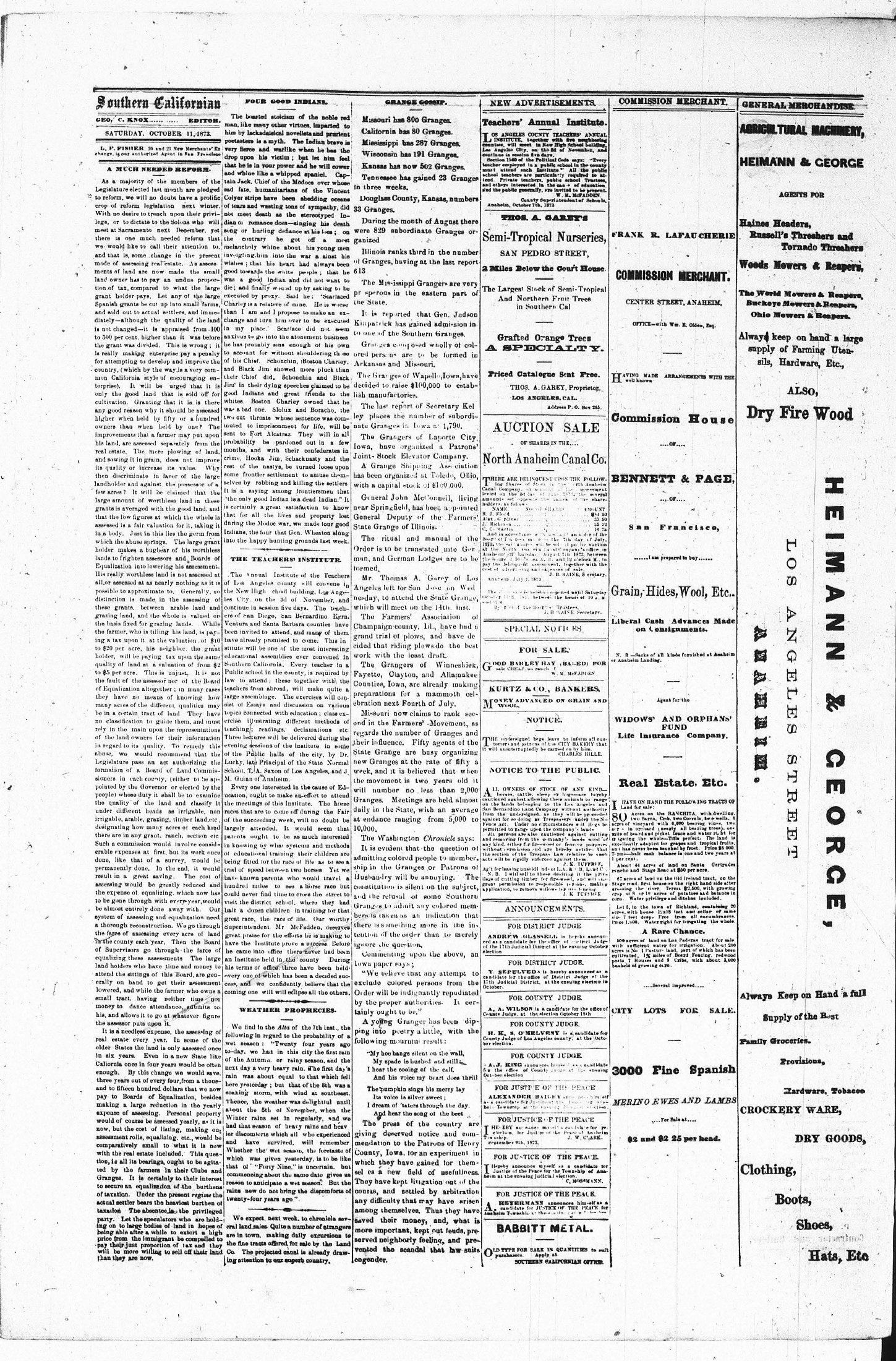
Searchable text
Southern Californian
GEO. C. KNOX... EDITOR.
SATURDAY. OCTOBER 11, 1873.
L. P. FISHER: 20 and 21 New Merchants' Exchange is our authorized Agent in San Francisco
A MUCH NEEDED REFORM.
As a majority of the members of the Legislature elected last month are pledged to reform, we will no doubt have a prolific crop of reform legislation next winter. With no desire to trench upon their privilege, or to dictate to the Solons who will meet at Sacramento next December, yet there is one much needed reform that we would like to call their attention to, and that is, some change in the present mode of assessing real estate. As assessments of land are now made the small land owner has to pay an undue proportion of tax, compared to what the large grant holder pays. Let any of the large Spanish grants be cut up into small farms, and sold out to actual settlers, and immediately—although the quality of the land is not changed—it is appraised from 100 to 500 per cent, higher than it was before the grant was divided. This is wrong; it is really making enterprise pay a penalty for attempting to develop and improve the country, (which by the way is a very common California style of encouraging enterprise). It will be urged that it is only the good land that is sold off for cultivation. Granting that it is, is there any good reason why it should be assessed higher when held by fifty or a hundred owners than when held by one? The improvements that a farmer may put upon his land, are assessed separately from the real estate. The mere plowing of land, and sowing it in grain, does not improve its quality or increase its value. Why then discriminate in favor of the large landholder and against the possessor of a few acres? It will be claimed that the large amount of worthless land in these grants is warranted with the good land.
The boasted stoicism of the noble man, like many other virtues, imparted him by lackadaisical novelists and poetasters is a myth. The Indian bravery fierce and warlike when he had drop upon his victim; but let him that he is in your power and he will cease and whine like a whipped spaniel.
tain Jack. Chief of the Modocs over wad fate, humanitarians of the Vita Colyer stripe have been shedding oo of tears and wasting tons of sympathy not meet death as the stereotyped dian or romance does—singing his song or hurling defiance at his loes on the contrary he got off a melancholy whine about his young inveigling him into the war a sinn wishes; that his heart had always good towards the white people; that was a good Indian and did not want die; and finally wound up by asking executed by proxy. Said he: 'Scar Charley is a relative of mine. He is w than I am and I propose to make an change and turn him over to be exe in my place.' Scarface did not anxious to go into the atonement busi he has probably sins enough of his to account for without shouldering of his Chief. Schonchin, Boston Char and Black Jim showed more pluck their Chief did. Schonchin and L Jim in their dying speeches claimed good Indians and great friends to whites. Boston Charley owned tha was a bad one. Slolux and Boracho two cut throats whose sentence was muted to imprisonment for life, went to Fort Alcatraz. They will have probability be pardoned out in a months, and with their confederate crime, Hooka Jim, Schacknasty and rest of the nastys, be turned loose some frontier settlement to amuse tha selves by robbing and killing the set. It is a saying among frontiersmen: 'the only good Indian is a dead Indian is certainly a great satisfaction to
Granting that it is there any good reason why it should be assessed higher when held by fifty or a hundred owners than when held by one? The improvements that a farmer may put upon his land, are assessed separately from the real estate. The mere plowing of land, and sowing it in grain, does not improve its quality or increase its value. Why then discriminate in favor of the large landholder and against the possessor of a few acres? It will be claimed that the large amount of worthless land in these grants is averaged with the good land, and that the low figures at which the whole is assessed is a fair valuation for it, taking it in a body. Just in this lies the germ from which the abuse springs. The large grant holder makes a bugbear of his worthless lands to frighten assessors and Boards of Equalization into lowering his assessment. His really worthless land is not assessed at all, or assessed at as nearly nothing as it is possible to approximate to. Generally, no distinction is made in the assessing of these grants, between arable land and grazing land, and the whole is valued on the basis fixed for grazing lands. While the farmer, who is tilling his land, is paying a tax upon it at the valuation of $10 to $20 per acre, his neighbor, the grant holder, will be paying tax upon the same quality of land at a valuation of from $2 to $5 per acre. This is unjust. It is not the fault of the assessor nor of the Board of Equalization altogether; in many cases they have no means of knowing how many acres of the different qualities may be in a certain tract of land. They have no classification to guide them, and must rely in the main upon the representations of the land owners for their information in regard to its quality. To remedy this abuse, we would recommend that the Legislature pass an act authorizing the formation of a Board of Land Commissioners in each county (either to be appointed by the Governor or elected by the people) whose duty it shall be to examine the quality of the land and classify it under different heads as irrigable, non irrigable, arable, grazing, timber land, etc., designating how many acres of each kind there are in any grant, ranch, section etc. Such a commission would involve considerable expenses at first, but its work once done, like that of a survey, would be permanently done. In the end, it would result in a great saving. The cost of assessing would be greatly reduced and the expense of equalizing, which now has to be gone through with every year, would be almost entirely done away with. Our system of assessing and equalization need a thorough reconstruction. We go through the farce of assessing every acre of land in the county each year. Then the Board of Supervisors go through the farce of equalizing these assessments. The large cultivation. Granting that it is there any good reason why it should be assessed higher when held by fifty or a hundred owners than when held by one? The improvements that a farmer may put upon his land, are assessed separately from the real estate. The mere plowing of land, and sowing it in grain, does not improve its quality or increase its value. Why then discriminate in favor of the large landholder and against the possessor of a few acres? It will be claimed that the large amount of worthless land in these grants is averaged with the good land, and that the low figures at which the whole is assessed is a fair valuation for it, taking it in a body. Just in this lies the germ from which the abuse springs. The large grant holder makes a bugbear of his worthless lands to frighten assessors and Boards of Equalization into lowering his assessment. His really worthless land is not assessed at all, or assessed at as nearly nothing as it is possible to approximate to. Generally, no distinction is made in the assessing of these grants, between arable land and grazing land, and the whole is valued on the basis fixed for grazing lands. While the farmer, who is tilling his land, is paying a tax upon it at the valuation of $10 to $20 per acre, his neighbor, the grant holder, will be paying tax upon the same quality of land at a valuation of from $2 to $5 per acre. This is unjust. It is not the fault of the assessor nor of the Board of Equalization altogether; in many cases they have no means of knowing how many acres of the different qualities may be in a certain tract of land. They have no classification to guide them, and must rely in the main upon the representations of the land owners for their information in regard to its quality. To remedy this abuse, we would recommend that the Legislature pass an act authorizing the formation of a Board of Land Commissioners in each county (either to be appointed by the Governor or elected by the people) whose duty it shall be to examine the quality of the land and classify it under different heads as irrigable, non irrigable, arable, grazing, timber land, etc., designating how many acres of each kind there are in any grant, ranch, section etc. Such a commission would involve considerable expenses at first, but its work once done, like that of a survey, would be permanently done. In the end, it would result in a great saving. The cost of assessing would be greatly reduced and the expense of equalizing, which now has to be gone through with every year, would be almost entirely done away with. Our system of assessing and equalization need a thorough reconstruction. We go through the farce of assessing every acre of land in the county each year. Then the Board of Supervisors go through the farce of equalizing these assessments. The large cultivation.
Granting that it is there any good reason why it should be assessed higher when held by fifty or a hundred owners than when held by one? The improvements that a farmer may put upon his land, are assessed separately from the real estate. The mere plowing of land, and sowing it in grain, does not improve its quality or increase its value. Why then discriminate in favor of the large landholder and against the possessor of a few acres? It will be claimed that the large amount of worthless land in these grants is averaged with the good land, and that the low figures at which the whole is assessed is a fair valuation for it, taking it in a body. Just in this lies the germ from which the abuse springs. The large grant holder makes a bugbear of his worthless lands to frighten assessors and Boards of Equalization into lowering his assessment. His really worthless land is not assessed at all, or assessed at as nearly nothing as it is possible to approximate to. Generally, no distinction is made in the assessing of these grants, between arable land and grazing land, and the whole is valued on the basis fixed for grazing lands. While the farmer, who is tilling his land, is paying a tax upon it at the valuation of $10 to $20 per acre, his neighbor, the grant holder, will be paying tax upon the same quality of land at a valuation of from $2 to $5 per acre. This is unjust. It is not the fault of the assessor nor of the Board of Equalization altogether; in many cases they have no means of knowing how many acres of the different qualities may be in a certain tract of land. They have no classification to guide them, and must rely in the main upon the representations of the land owners for their information in regard to its quality. To remedy this abuse, we would recommend that the Legislature pass an act authorizing the formation of a Board of Land Commissioners in each county (either to be appointed by the Governor or elected by the people) whose duty it shall be to examine the quality of the land and classify it under different heads as irrigable, non irrigable, arable, grazing, timber land, etc., designating how many acres of each kind there are in any grant, ranch, section etc. Such a commission would involve considerable expenses at first, but its work once done, like that of a survey, would be permanently done. In the end, it would result in a great saving. The cost of assessing would be greatly reduced and the expense of equalizing, which now has to be gone through with every year, would be almost entirely done away with. Our system of assessing and equalization need a thorough reconstruction. We go through the farce of assessing every acre of land in the county each year. Then the Board of Supervisors go through the farce of equalizing these assessments. The large cultivation.
The Annual Institute of the Teachers' Institution
The Annual Institute of the Teachers' Institution will convertthe New High school building.Los Angeles City.onthe 3dof November.continuesin session five days.The teachersof San Diego,San Bernardino VenturaandSanta Barbara countiesbeen invitedto attend,andmanyofthehavealreadypromisedtome.The institutewillbeoneofthemostinterestededucationalassemblieseverconvenedSouthernCalifornia.Every teacherPublic schoolinthecounty.isrequiredlawtoattend;these togetherwithteachersfromabroad.willmakequallargeassemblage.TheexerciseswilssistofEssaysanddiscussiononvarietiesconnectedwitheducation;classerciseillustratingdifferentmethodsteaching;readings.declamationsThreelectureswillbedeliveredduringeveningsessionsoftheInstitute.inofthePublichallsofthecity.byLucky,thelatePrincipaloftheStateNoSchool,T.A.SaxonofLosAngeles,aM.GuinnofAnaheim.
Every one interested in the causeofeducationoughttomakeanefforttoadthemeetingsoftheInstitute.Thetracesthataretocomeoffduringtheofthesucceedingweek.willno doubtlargelyattendedItwouldseemaparentsoughttobeas muchinterestinknowingbywhatsystemsandmetodeducationaltrainingtheirchildrenbeing fittedfortheraceoflifeastotrialofspeedbetweentwohorses.Yohaveknownparentswhowouldtrainhundredmilestoseeahorseracecouldneverfindtimetocrossthestrivevisitthedistrictschoolwheretheyhalta dozenchildrenin trainingtorigreatrace,theraceoflife.WurSuperintendentMrMcFadden,descargreatpraiseforyetheeffortsheismakinghavetheInstituteproveasuccess.Dothecomeintoofficethere neverhadanInstituteheldinthecountyD
We find in the Alta of the 7th inst
following in regard to the probability
wet season: "Twenty four years
to-day, we had in this city the first
of the Autumn, or rainy season, and
next day a very heavy rain. The firrain was about equal to that which
here yesterday; but that of the 8th
soaking storm, with wind at south
Thence, the weather was delightful
about the 5th of November, when
Winter rains set in regularly, and
had that season of heavy rains and
liter discomforts which all who experiand have survived, will rememWhether the wet season, the foresta
which was given yesterday, is to be
that of "Forty Nine," is uncertain.
commencing about the same date give
reason to anticipate a wet season. But
rains now do not bring the discomfort
twenty-four years ago."
We expect next week, to chronicle
eral land sales. Quite a number of straare in town, making daily excursion
the fine tracts offered for sale by the
Co. The projected canal is already oling attention to our superb country.
FOR GOOD INDIANS.
and stoicism of the noble red
my other virtues, imparted to
dialical novelists and prurient
a myth. The Indian brave is
and warlike when he has the
his victim; but let him feel
your power and he will cower
like a whipped spaniel. Capief of the Modocs over whose
manitarians of the Vincent
have been shedding oceans
wasting tons of sympathy, did
ath as the stereotyped Inance does—singing his death
ling defiance at his foes; on
he got off a most
whine about his young men
into the war against his
his heart had always been
the white people; that he
Indian and did not want to
fly wound up by asking to be
proxy. Said he: 'Scarface relative of mine. He is worse
and I propose to make an exern him over to be executed.'
Scarface did not seem
into the atonement business
only sins enough of his own
or without shouldering those
Schonchin, Boston Charley,
him showed more pluck than
Did. Schonchin and Black
dying speeches claimed to be
and great friends to the
Charley owned that he.
Slolux and Boracho, the
states whose sentence was comprisonment for life, will be
Alcatraz. They will in all
be pardoned out in a few
with their confederates in
Jim, Schacknasty and the
mastys, be turned loose upon
or settlement to amuse themobbing and killing the settlers
ag among frontiersmen that
Indian is a dead Indian." It
GRANGE GOSUP.
Missouri has 800 Granges.
California has 80 Granges.
Mississippi has 287 Granges.
Wisconsin has 191 Granges.
Kansas has now 502 Granges.
Tennessee has gained 23 Granges
in three weeks.
Douglass County, Kansas, numbers
33 Granges.
During the month of August there were 829 subordinate Granges organized.
Illinois ranks third in the number of Granges, having at the last report 613.
The Mississippi Grangers are very prosperous in the eastern part of the State.
It is reported that Gen. Jndson Kimpatrick has gained admission into one of the Southern Granges.
Granges composed wholly of colored persons are to be formed in Arkansas and Missouri.
The Granges of Wapello, Iowa, have decided to raise $100,000 to establish manufactories.
The last report of Secretary Kelley places the number of subordinate Granges in Iowa at 1,790.
The Grangers of Laporte City, Iowa, have organized a Patrons' Joint Stock Elevator Company.
A Grange Shipping Association has been organized at Toledo, Ohio, with a capital stock of $100,000.
General John McConneil, living near Springfield, has been appointed
NEW ADVERTISEMENTS.
Teachers' Annual Institute.
LOS ANGELES COUNTY TEACHERS' ANNUAL INSTITUTE, together with five neighboring counties, will meet in New High School building, Los Angeles City, on the M of November, and continue in session two days.
Section 1540 of the Political Code says: "Every teacher employed in a public school in the county must attend such Institute." All the public school teachers are particularly required to attend. Private teachers, public school Trustees, and others interested in the cause of education and the public generally, are invited to be present.
W. H. McFADDEN.
County Superintendent of Schools,
Anaheim, October 7th, 1873
THOS. A. GAREY'S Semi-Tropical Nurseries,
SAN PEDRO STREET,
2 Miles Below the Court House.
The Largest Stock of Semi-Tropical And Northern Fruit Trees in Southern Cal.
Grafted Orange Trees A SPECIALTY.
Priced Catalogue Sent Free.
THOS. A. GAREY, Proprietog,
LOS ANGELES, CAL.
Address P. O. Box 265.
AUCTION SALE OF SHARES IN THE...
North Anaheim Canal Co.
THERE ARE DELINQUENT UPON THE FOLLOWing Shares of Stock in North Anaheim Canal Company, accounted on the 31st day of June 1873, the several amounts set oppose the names of the share-holders as follow.
The last report of Secretary Kelley places the number of subordinate Granges in Iowa at 1,790.
The Grangers of Laporte City, Iowa, have organized a Patrons' Joint Stock Elevator Company.
A Grange Shipping Association has been organized at Toledo, Ohio, with a capital stock of $100,000.
General John McConneil, living near Springfield, has been appointed General Deputy of the Farmers' State Grange of Illinois.
The ritual and manual of the Order is to be translated into German, and German Lodges are to be formed.
Mr. Thomas A. Garey of Los Angeles left for San Jose on Wednesday, to attend the State Grange, which will meet on the 14th inst.
The Farmers' Association of Champaign county, Ill., have had a grand trial of plows, and have decided that riding plows do the best work with the least draft.
The Grangers of Winneshiek, Fayette, Clayton, and Allamakee Counties, Iowa, are already making preparations for a mammoth celebration next Fourth of July.
Missouri now claims to rank second in the Farmers' Movement, as regards the number of Granges and their influence. Fifty agents of the State Grange are busy organizing new Granges at the rate of fifty a week, and it is believed that when the movement is two years old it will number no less than 2,000 Granges. Meetings are held almost daily in the State, with an average attendance ranging from 5,000 to 10,000.
The Washington Chronicle says:
It is evident that the question of admitting colored people to membership in the Granges or Patrons of Husbandry will be annoying. The constitution is silent on the subject, and the refusal of some Southern Granges to admit any colored members is taken as an indication that there is something more in the intention of the order than to merely ignore the question.
Commenting upon the above, an
admitting colored people to membership in the Granges or Patrons of Husbandry will be annoying. The constitution is silent on the subject, and the refusal of some Southern Granges to admit any colored members is taken as an indication that there is something more in the intention of the order than merely ignore the question.
Commenting upon the above, an Iowa paper says;
"We believe that any attempt to exclude colored persons from the Order will be indignantly repudiated by the proper authorities. It certainly ought to be."
A young Granger has been dipping into poetry a little, with the following mournful result:
"My hoe hangs silent on the wall,
My spade is hushed and still;
I hear the cooing of the calf,
And his voice my heart does thrill
The pumpkin sings his merry lay
Its voice is silver sweet;
I dream of taters through the day.
And hear the song of the beet
The press of the country are giving deserved notice and commendation to the Patrons of Henry County, Iowa, for an experiment in which they have gained for themselves a new field of usefulness. They have kept litigation out of the courts, and settled by arbitration any difficulty that may have arisen among themselves. Thus they have saved their money, and, what is more important, kept out feuds, preserved neighborly feeling, and prevented the scandal that law suits engender."
EMENTS.
Institute.
Nurseries,
TREET,
Court House.
Semi-Tropical
nt Trees
Cal
Trees
ALTY.
Sent Free.
Y, Proprietor,
CAL.
SALE
HE...
Canal Co.
ON THE FOLLOW.
COMMISSION MERCHANT.
FRANK R. LAFAUCHERIE
COMMISSION MERCHANT.
CENTER STREET, ANAHEIM.
OFFICE—with Wm. R. Olden, Esq.
HAVING MADE ARRANGEMENTS WITH THE well known
Commission House
....OF...
BENNETT & PAGE,
....OF...
GENERAL MERCHANDISE
AGRICULTURAL MACHINERY,
HEIMANN & GEORGE
AGENTS FOR
Haines Headers,
Russell's Threshers and
Tornado Threshers
Weeds Mowers & Reapers,
The World Mowers & Reapers,
Buckeye Mowers & Reapers,
Ohio Mowers & Reapers.
Always keep on hand a large supply of Farming Utensils, Hardware, Etc.,
ALSO,
Dry Fire Wood
Commission House
...OF...
BENNETT & PAGE,
...OF...
San Francisco,
I am prepared to buy...
Grain, Hides, Wool, Etc..
Liberal Cash Advances Made on Consignments.
N. B—Sacks of all kinds furnished at Anaheim or Anaheim Landing.
Agent for the
WIDOWS' AND ORPHANS' FUND
Life Insurance Company.
Real Estate, Etc.
HAVE ON HAND THE FOLLOWING TRACTS OF Land for sale:
80 acres on the RANCHITA, with dwelling, two Barns, Crib, two Cornals, two wells, 8 acres of vineyard with 6,000 bearing vines, two acres in orchard (nearly all bearing trees), one mile of board and picket fence and water rijt for irrigation the whole—Title perfect. The land is excellently adapted for grapes and tropical fruits, and has never been touched by frost. Price $3,000.
Terms—half cash balance in one and two years at 1 per cent.
About 44 acres of land on Santa Gertrudes rancho and Stage Road at $50 per acre.
67 acres of land on the Old Ireland tract, on the Stage road first house on the right hand side after crossing the river. Terms $2,500, with growing crop of 8 or 10 acres of potatoes and balance in corn. Water privilege and ditches included.
Lot 5, in the town of Richland, containing 20 acres, with house 1x18 feet and cellar of same size-7 feet deep. Free from all encumbrances. Price 1,000. Water right for irrating the whole.
A Rare Chance.
500 acres of land on Los Padres tract for sale with sufficient water for irrigation. About 200 acres is No. 1 Pasture-land, part of which has been cultivated. 1½ miles of Board Fencing, redwood posts, 7 Houses and 9 Cribs, with about 2,000
CITY LOTS FOR SALE.
3000 Fine Spanish MERINO EWES AND LAMBS
For Sale at...
$2 and $2 25 per head.
Always Keep on Hand a full Supply of the Best Family Groceries.
Provisions,
Hardware, Tobacco CROCKERY WARE,
DRY GOODS,
Clothing,
Boots,
Shoes,
Hats, Etc.