anaheim-gazette 1873-10-04
Scanned page
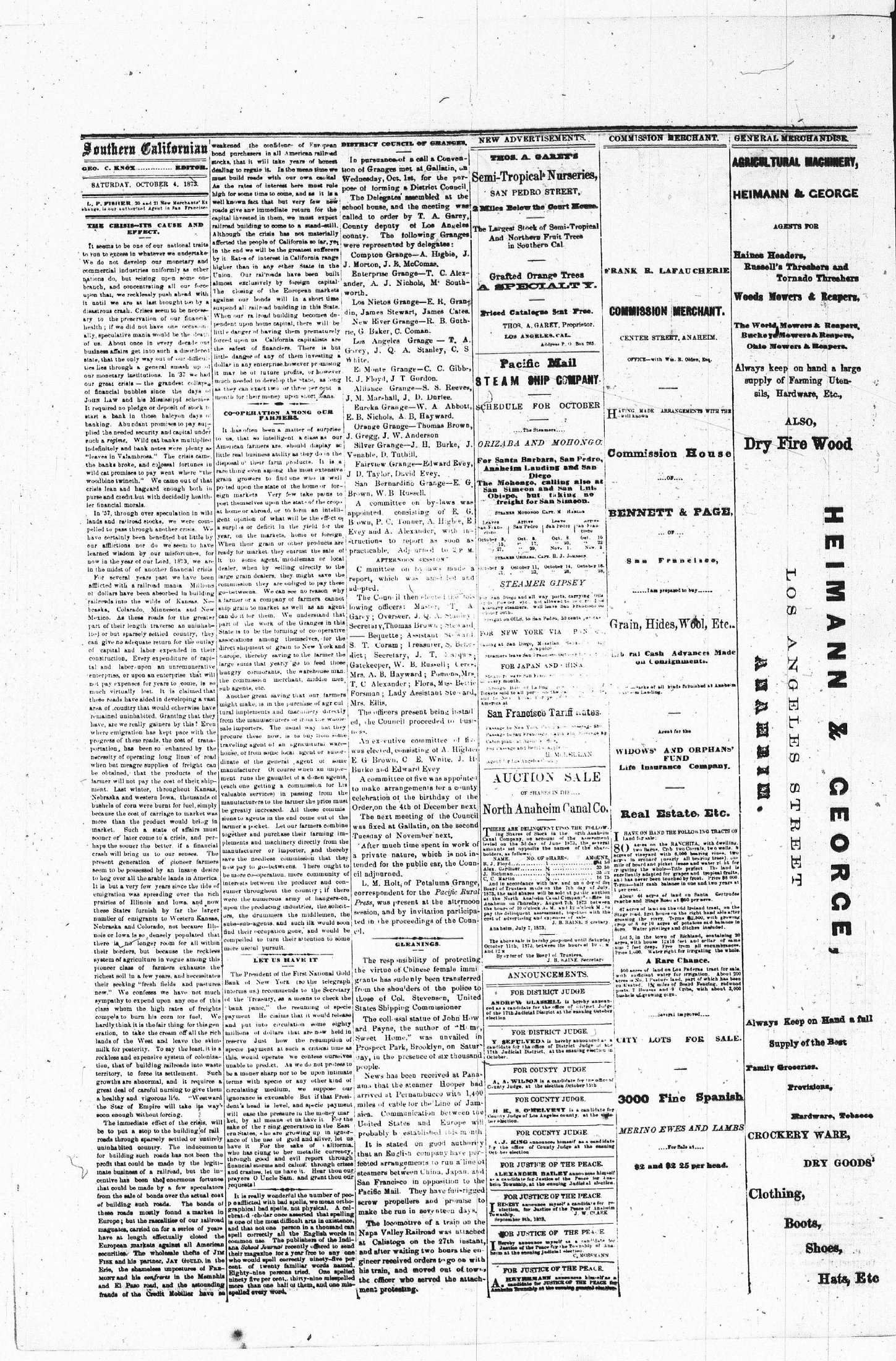
Searchable text
Southern Californian
GEO. C. KNOX... EDITOR.
SATURDAY, OCTOBER 4, 1873.
L. P. FISHER. 20 and 21 New Merchants' Exchange, is our authorized Agent in San Francisco.
THE CRISIS—ITS CAUSE AND EFFECT.
It seems to be one of our national traits to run to excess in whatever we undertake. We do not develop our monetary and commercial industries uniformly as other nations do, but seizing upon some one branch, and concentrating all our force upon that, we recklessly push ahead with it until we are at last brought too by a disastrous crash. Crises seem to be necessary to the preservation of our financial health; if we did not have one occasionally, speculative mania would be the death of us. About once in every decade our business affairs get into such a disordered state, that the only way out of our difficulties lies through a general smash up of our monetary institutions. In '37 we had our great crisis—the grandest collapse of financial bubbles since the days of John Law and his Mississippi schemes. It required no pledge or deposit of stock to start a bank in those halcyon days of banking. Abundant promises to pay supplied the needed security and capital under such a regime. Wild cat banks multiplied indefinitely and bank notes were plenty as "leaves in Valambrosa." The crisis came the banks broke, and colossal fortunes in wild cat promises to pay went where "the woodbine twineth." We came out of that crisis lean and haggard enough both in purse and credit, but with decidedly healthier financial morals.
weakened the confidence of European bond purchasers in all American railroad stocks, that it will take years of honest dealing to regain it. In the mean time we must build roads with our own capital. As the rates of interest here must rise high for some time to come, and as it is well known fact that but very few new roads give any immediate return for the capital invested in them, we must expect railroad building to come to a stand-still. Although the crisis has not materially affected the people of California so far, yet in the end we will be the greatest sufferer by it. Rates of interest in California range higher than in any ether State in the Union. Our railroads have been built almost exclusively by foreign capitals. The closing of the European market against our bonds will in a short time suspend all railroad building in this State. When our railroad building becomes dependent upon home capital, there will be little danger of having them prematurely forced upon us. California capitalists are the safest of financiers. There is little danger of any of them investing dollar in any enterprise however promising it may be of future profits, or howevem much needed to develop the State, as long as they can exact two or three per cent month for their money upon short loans.
CO-OPERATION AMONG OUR FARMERS.
It has often been a matter of surprise to us, that so intelligent a class as American farmers are, should display little real business ability as they do in the disposal of their farm products. It is rare thing even among the most extensive grain growers to find one who is well positioned upon the state of the home or foreign markets. Very few take paints post themselves upon the state of the crops.
It required no pledge or deposit of stock to start a bank in those halcyon days or banking. Abundant promises to pay supplied the needed security and capital under such a regime. Wild cat banks multiplied indefinitely and bank notes were plenty as "leaves in Valambrosa." The crisis came, the banks broke, and colossal fortunes in wild cat promises to pay went where "the woodbine twineth." We came out of that crisis lean and haggard enough both in purse and credit but with decidedly healthier financial morals.
In '57, through over speculation in wild lands and railroad stocks, we were compelled to pass through another crisis. We have certainly been benefited but little by our afflictions nor do we seem to have learned wisdom by our misfortunes, for now in the year of our Lord, 1873, we are in the midst of of another financial crisis.
For several years past we have been afflicted with a railroad mania. Millions of dollars have been absorbed in building railroads into the wilds of Kansas, Nebraska, Colorado, Minnesota and New Mexico. As these roads for the greater part of their length traverse an uninhabited or but sparsely settled country, they can give no adequate return for the outlay of capital and labor expended in their construction. Every expenditure of capital and labor upon an unremunerative enterprise, or upon an enterprise that will not pay expenses for years to come, is so much virtually lost. It is claimed that these roads have aided in developing a vast area of country that would otherwise have remained uninhabited. Granting that they have, are we really gainers by this? Even where emigration has kept pace with the progress of these roads, the cost of transportation has been so enhanced by the necessity of operating long lines of road when but meagre supplies of freight can be obtained, that the products of the farmer will not pay the cost of their shipment. Last winter, throughout Kansas, Nebraska and western Iowa, thousands of bushels of corn were burnt for fuel, simply because the cost of carriage to market was more than the product would bring in market. Such a state of affairs must sooner or later come to a crisis, and perhaps the sooner the better if a financial crash will bring us to our senses. The present generation of pioneer farmers seem to be possessed by an insane desire to hog over all the arable lands in America. It is but a very few years since the tide of emigration was spreading over the rich prairies of Illinois and Iowa, and now these States furnish by far the larger number of emigrants to Western Kansas, Nebraska and Colorado, not because Illinois or Iowa is so densely populated that there is no longer room for all within their borders, but because the reckless system of agriculture in vogue among this
CO-OPERATION AMONG OUR FARMERS.
It has often been a matter of surprise to us, that so intelligent a class as our American farmers are, should display little real business ability as they do in the disposal of their farm products. It is rare thing even among the most extensive grain growers to find one who is well poised upon the state of the home or for sign markets. Very few take pains post themselves upon the state of the crop at home or abroad, or to form an intelligent opinion of what will be the effect a surplus or deficit in the yield for year, on the markets, home or forest. When their grain or other products ready for market, they entrust the sale it to some agent, middleman or dealer, when by selling directly to large grain dealers, they might save commission they are obliged to pay the go-between. We can see no reason why a farmer or a company of farmers can ship grain to market as well as an agri-can do it for them. We understand that part of the work of the Granges in State is to be the forming of co-operative associations among themselves, for direct shipment or grain to New York Europe, thereby saving to the farmer large sums that yearly go to feed the hungry cormorants, the warehouse in the commission merchant, middle nub agents, etc.
Another great saving that our farm might make, is in the purchase of agricultural implements and machinery direct from the manufacturers or from the sale importers. The usual way that we procure these now is to buy from a traveling agent of an agricultural house, or from some local agent or subordinate of the general agent or manufacturer. Of course when an immeasure runs the gauntlet of a dozen agri(each one getting a commission for valuable services) in passing from manufacturers to the farmer the price will be greatly increased. All these commissions to agents in the end come out of our farmer's pocket. Let our farmers come together and purchase their farming plements and machinery directly from manufacturer or importer, and then save the needless commission that now pay to go-between. There ought be more co-operation; more communities between the producer and summer throughout the country; if were the numerous army of hanger upon the producing industries, the soils, the drummers the middlemen subs-sub-agents, and such ilk would find their occupation gone; and would compelled to turn their attention to more useful pursuit.
The present generation of pioneer farmers seem to be possessed by an insane desire to hog over all the arable lands in America. It is but a very few years since the tide of emigration was spreading over the rich prairies of Illinois and Iowa, and now these States furnish by far the larger number of emigrants to Western Kansas, Nebraska and Colorado, not because Illinois or Iowa is so densely populated that there is no longer room for all within their borders, but because the reckless system of agriculture in vogue among this pioneer class of farmers exhausts the richest soil in a few years, and necessitates their seeking "fresh fields and pastures new." We confess we have not much sympathy to expend upon any one of this class whom the high rates of freights compels to burn his corn tor fuel. We hardly think it is the fair thing for this generation, to take the cream off all the rich lands of the West and leave the skim milk for posterity. To say the least, it is a rockless and expensive system of colonization, that of building railroads into waste territory, to force its settlement. Such growths are abnormal, and it requires a great deal of careful nursing to give them a healthy and vigorous life. "Westward the Star of Empire will take its way soon enough without forcing.
The immediate effect of the crisis, will be to put a stop to the building of rail roads through sparsely settled or entirely uninhabited country. The inducements for building such roads has not been the profit that could be made by the legitimate business of a railroad, but the incentive has been the enormous fortunes that could be made by a few speculators from the sale of bonds over the actual cost of building such roads. The bonds of these roads mostly found a market in Europe; but the rascalities of our railroad magnates, carried on for a series of years have at length effectually closed the European markets against all American securities. The wholesale thefts of JIM FISK and his partner, JAY GOULD, in the Erie, the shameless unpostures of FREEMONT and his confreres in the Memphis and El Paso road, and the astounding frauds of the Credit Mobilier have so save the needless commission that they now pay to go-between. There ought be more co-operation, more communal interests between the producer and the summer throughout the country; if were the numerous army of hungers upon the producing industries, the soils, the drummers the middlemen subsub-agent, and such ilk would find their occupation gone, and would compelled to turn their attention to more useful pursuit.
LET US HAVE IT
The President of the First National Bank of New York (so the telegram informs us.) recommends to the Secretary of the Treasury, as a means to check bank panic," the resuming of payment. He claims that it would rise and put into circulation some millions of dollars that are nowhere reserve. Just how the resumption species payment at such a critical time would operate we contess our unable to predict. As we do not prey on a money sharp nor to be upon interms with specie or any other kind circulating medium, we suppose ignorance is excusable. But if that student's head is level, and specie pay will ease the pressure in the money market, by all means set us have it. For sake of the rising generation in the Western States, who are growing up in anance of the use of gold and silver, have it. For the sake of vali who has clung to her metallic currethough good and evil report tha financial storms and calms, through and crashes, let us have it. Hear thy prayers O Uncle Sam, and grant tha requesta!
It is really wonderful the number of afflicted with bad spells, we mean graphical bad spells, not physical, ebrated-cholar once asserted that spells is one of the most difficult arts in oxixand that not one person in a thousand spell correctly all the English wwommon use. The publishers of tha ana School Journal recently offered tha their magazine for a year free to ass who would spell correctly ninety-fifteenth of twenty familiar words in Eighty-nine persons tried. One ninety-five per cent., thirty-nine mismore than one half of them, and on spelled every word.
DISTRICT COUNCIL OF GRANGES.
In pursuance of a call a Convention of Granges met at Gallatin, on Wednesday, Oct. 1st, for the purpose of forming a District Council. The Delegates assembled at the school house, and the meeting was called to order by T. A. Garey, County deputy of Los Angeles county. The following Granges were represented by delegates:
Compton Grange—A. Higbie, J. J. Morton, J. K. McComas.
Enterprise Grange—T. C. Alexander, A. J. Nichols, M. Southworth.
Los Nietos Grange—E. R. Grandin, James Stewart, James Cates.
New River Grange—R. B. Guthrie, G. Baker, C. Coman.
Los Angeles Grange — T. A. Garey, J. Q. A. Stanley, C. S. White.
E. Monte Grange—C. C. Gibbs, R. J. Floyd, J. T. Gordon.
Alliance Grange—S. S. Reeves, J. M. Marshall, J. D. Durlee.
Eureka Grange—W. A Abbott, E. B. Nichols, A. B. Hayward.
Orange Grange—Thomas Brown, J. Gregg, J. W. Anderson
Silver Grange—J. H. Burke, J. Venable, D. Tuthill.
Fairview Grange—Edward Evey, J. D. Taylor, David Evey.
San Bernardino Grange—E. G. Brown, W. B Russell.
NEW ADVERTISEMENTS.
THOS. A GAREY'S Semi-Tropical Nurseries,
SAN PEDRO STREET,
2 Miles Below the Court House.
The Largest Stock of Semi-Tropical And Northern Fruit Trees in Southern Cal.
Grafted Orange Trees
A SPECIALTY.
Priced Catalogue Sent Free.
THOS. A, GAREY, Proprietor.
LOS ANGELES, CAL.
Address P.O Box 265.
Pacific Mail
STEAM SHIP COMPANY.
SCHEdule for October
ORIZABA AND MOHONGO.
For Santa Barbara, San Pedro, Anaheim Landing and San Diego.
The Mohenge, calling also at San Simeon and San Luis Obispo, but taking no freight for San Simeon.
BEEN A Matter of surprise intelligent a class as our
are should display no less ability as they do in the
farm products. It is a among the most extensive
to find one who is well
state of the home or forVery few take pains to
upon the state of the crops
and, or to form an intelliof what will be the effect of
efficit in the yield for the
markets, home or foreign
grain or other products are
set they entrust the sale of
agent, middleman or local
by selling directly to the
holders, they might save the
they are obliged to pay these
We can see no reason why
company of farmers cannot
market as well as an agent
them. We understand that
work of the Granges in this
the forming of co-operative
among themselves, for the
of grain to New York and
by saving to the farmer the
yearly go to feed those
grants, the warehouse man,
merchant, middle men,
at saving that our farmers
in the purchase of agricul
ents and machinery directly
facturers or from the whole.
The usual way that they now, is to buy from some
of an agricultural waresome local agent or suborgeneral agent of some
Of course when an impgauntlet of a dozen agents,
taking a commission for his
ceee) in passing from the
to the farmer the price must
reased. All these commissions in the end come out of the
et. Let our farmers combine
purchase their farming immachinery directly from the
or importer, and thereby
less commission that they
betweens. There ought to
operation more community of
even the producer and conchout the country; if there
numerous army of hangers-on,
ducing industries, the solicitminers the middlemen, the
nts. and such ilk would soon
capitation gone, and would be
turn their attention to some
pursuit.
Eureka Grange—W. A Abbott,
E. B. Nichols, A. B. Hayward.
Orange Grange—Thomas Brown,
J. Gregg, J. W. Anderson.
Silver Grange—J. H. Burke, J.
Venable, D. Tuthill.
Fairview Grange—Edward Evey,
J. D. Taylor, David Evey.
San Bernardino Grange—E. G.
Brown, W. B Russell.
A committee on by-laws was appointed consisting of E. G.
Brown, P. C. Tonner, A. Higbie, E.
Evey and A. Alexander, with instructions to report as soon as practicable. Adjuried to 2 P.M.
AFTERNOON SESSION
Committee on by-laws made a report, which was amended and adopted.
The Council then elected the following officers: Master, T. A.
Garey; Overseer, J. Q. A. Stanley.
Secretary, Thomas Brown; Stewart.
Bequette; Assistant Steward,
S. T. Coram; Treasurer, S. Benediet;
Secretary, J. T. Marquis;
Gatekeeper, W. B. Russell; Ceres.
Mrs. A. B. Hayward; Pomona, Mrs.
T. C Alexander; Flora, Miss Bettie.
Forsman; Lady Assistant Steward,
Mrs. Ellis.
The officers present being installed, the Council proceeded to business.
An executive committee of five was elected, consisting of A. Higbie,
E.G.Brown,C.E.White,J.H.Burke and Edward Evey.
A committee of five was appointed to make arrangements for a county celebration of the birthday of the Order, on the 4th of December next.
The next meeting of the Council was fixed at Gallatin, on the second Tuesday of November next.
After much time spent in work of a private nature, which is not intended for the public ear, the Council adjourned.
L. M. Holt, of Petaluma Grange,
correspondent for the Pacific Rural Press, was present at the afternoon session, and by invitation participated in the proceedings of the Council.
GLEANINGS.
The responsibility of protecting...
TUS HAVE IT
ment of the First National Gold New York (so the telegraph recommends to the Secretaryury, as a means to check the country; if there numerous army of hangers-on, reducing industries, the solicitors summers the middlemen, therants, and such ilk would soon occupation gone, and would be turn their attention to some pursuit.
L. M. Holt, of Petaluma Grange, correspondent for the Pacific Rural Press, was present at the afternoon session, and by invitation participated in the proceedings of the Council.
GLEANINGS.
The responsibility of protecting the virtue of Chinese female immigrants has suddenly been transferred from the shoulders of the police to those of Col. Stevenson, United States Shipping Commissioner.
The colossal statue of John Howard Payne, the author of "Home, Sweet Home," was unveiled in Prospect Park, Brooklyn, on Saturday, in the presence of six thousand people.
News has been received at Panama that the steamer Hooper had arrived at Pernambuco with 1,400 miles of cable for the Line of Jamaica. Communication between the United States and Europe will probably be established this month.
It is stated on good authority that an English company have perfected arrangements to run a line of steamers between China, Japan, and San Francisco in opposition to the Pacific Mail. They have full-rigged screw propellers and promise to make the run in seventeen days.
The locomotive of a train on the Napa Valley Railroad was attached at Calistoga on the 27th instant, and after waiting two hours the engineer received orders to go on with his train, and moved out of town, the officer who served the attachment protesting.
COMMISSION MERCHANT.
FRANK R. LAFAUCHERIE
COMMISSION MERCHANT.
CENTER STREET, ANAHEIM.
OFFICE—with Win. R. Olden, Esq.
HAVING MADE ARRANGEMENTS WITH THE WELL KNOWN
Commission House
GENERAL MERCHANDISE
AGRICULTURAL MACHINERY,
HEIMANN & GEORGE
AGENTS FOR
Haines Headers,
Russell's Threshers and Tornado Threshers
Woods Mowers & Reapers,
The World, Mowers & Reapers,
Buckeye Mowers & Reapers,
Ohio Mowers & Reapers.
Always keep on hand a large supply of Farming Utensils, Hardware, Etc.,
ALSO,
Dry Fire Wood
HAVING MADE ARRANGEMENTS WITH THE
well known
Commission House
....OF...
BENNETT & PAGE,
... OF...
San Francisco,
I am prepared to buy...
Grain, Hides, Wool, Etc.
General Cash Advances Made on Consignments.
Arent for the
WIDOWS' AND ORPHANS'
FUND
Life Insurance Company.
Real Estate, Etc.
I HAVE ON HAND THE FOLLOWING TRACTS OF
land for sale:
80 acres on the RANCHITA, with dwelling.
two barns, Crib two Corrals, two wells, a
acre of vineyard with 6,000 bearing vines, two
acres in orchard (nearly all bearing trees), one
mile of board and picket fence and water rill for
irrigating the whole—Title perfect. The land is
excellently adapted for grapes and tropical fruits,
and has never been touched by frost. Price $8,000.
Terms—half cash balance in one and two years at
1 per cent.
About 44 acres of land on Santa Gertrudes
rancho and Stage Road at $50 per mere.
67 acres of land on the Old Ireland tract, on the
Stage road, first house on the right hand able after
crossing the river. Terms $2,500, with growing
crop of 8 or 10 acres of potatoes and balances in
barn. Water privilege and ditches included.
Lot 5, in the town of Richland, containing 20
acres, with house 12x18 feet and cellar of same
size 7 feet deep. Free from all encumbrances.
Price 1,000. Water right for irrigating the whole.
ALSO,
Dry Fire Wood
HEIMANN &
GEORGE,
LOS ANGELES STREET
AMMUNITION.
CITY LOTS FOR SALE.
3000 Fine Spanish
MERINO EWES AND LAMBS
For Sale at...
$2 and $2 25 per head.
Always Keep on Hand a full Supply of the Best Family Groceries.
Provisions,
Hardware, Tobacco
CROCKERY WARE,
DRY GOODS¹
Clothing,
Boots,
Shoes,
Hats, Etc