anaheim-gazette 1872-08-17
Scanned page
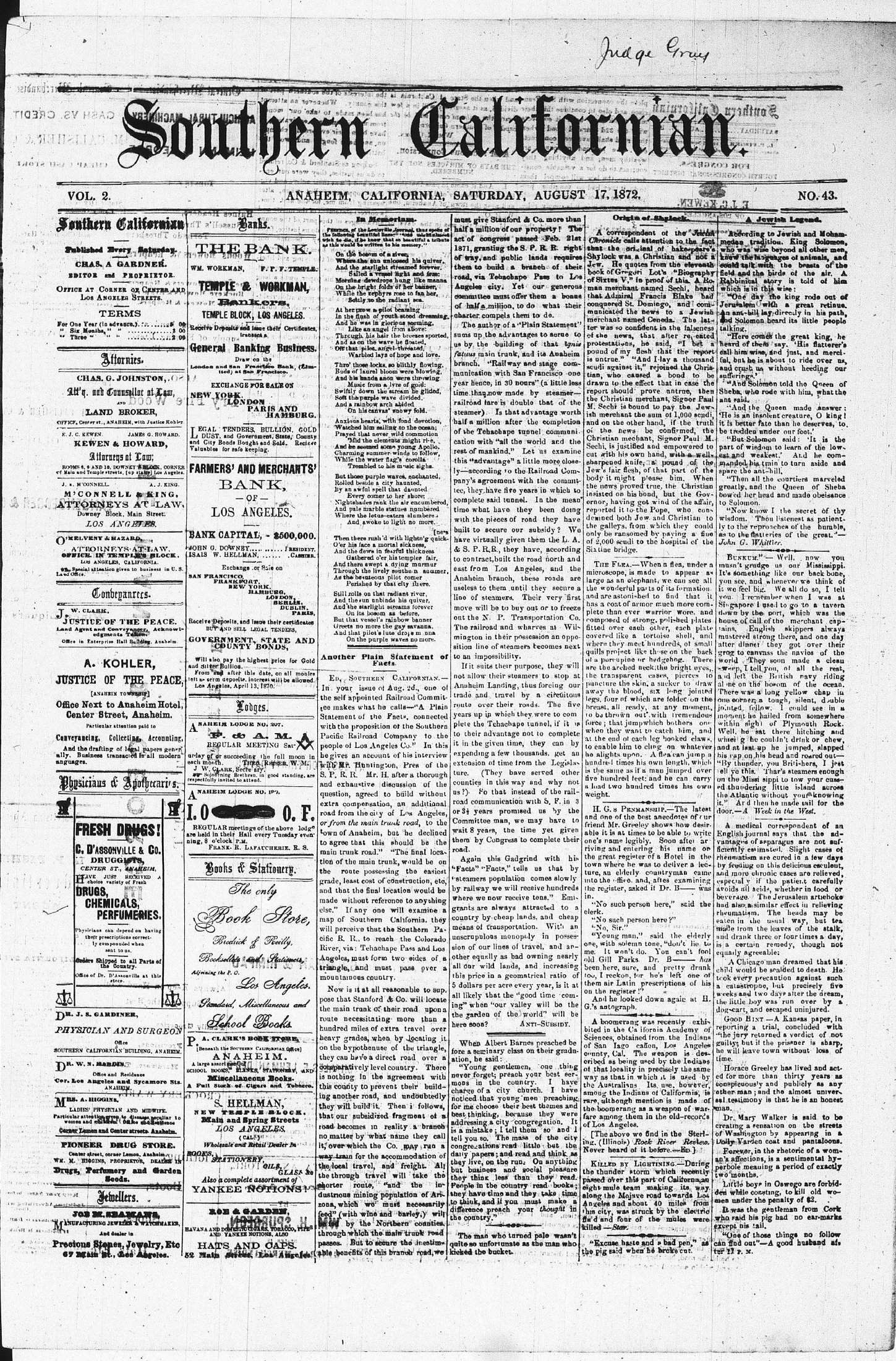
Searchable text
VOL. 2.
ANAHEIM
Southern California
Published Every Saturday.
CHAS. A GARDNER.
EDITOR and PROPRIETOR.
OFFICE at CORNER or CENTER AND
LOS ANGELES STREETS.
TERMS
For One Year (in advance.) ..... 5 00
" Six Months." ..... 3 00
" Three." ..... 2 00
Attornies.
CHAS. G. JOHNSTON,
Att'y. and Counselor at Law,
AND
LAND BROKER,
OFFICE, Center at., ANAHEIM, with Justice Kobler.
E. J. C. KEWEN. JAMES G. HOWARD.
KEWEN & HOWARD,
Attorneys at Law;
ROOMS 8, 9 AND 10. DOWNEY'S BLOCK, CORNER
of Main and Temple streets, [up stairs] Los Angeles.
J. R. M'CONNELL. A. J. KING.
M'CONNELL & KING,
ATTORNEYS AT LAW,
Banks.
THE BANK.
WM. WORKMAN, P.P.F. TEMPLE.
TEMPLE & WORKMAN,
Bankers,
TEMPLE BLOCK, LOS ANGELES.
Receive Deposits and issue their Certificates,
transactions.
General Banking Business.
Draw on the
London and San Francisco Bank (Limited) at San Francisco.
EXCHANGE FOR SALE ON
NEW YORK.
LONDON
PARIS AND
HAMBURG.
LEGAL TENDERS, BULLION, GOLD
DUST, and Government, State, County
and City Bonds Bought and Sold. Recieve
Valuables for safe keeping.
FARMERS' AND MERCHANTS'
BANK,
— OF —
AND
LAND BROKER,
OFFICE, Center st., ANAHEIM, with Justice Kohler.
E. J. C. KEWEN. JAMES G. HOWARD.
KEWEN & HOWARD,
Attorneys at Law;
ROOMS 8, 9 AND 10. DOWNEY'S BLOCK, CORNER
of Main and Temple streets. [up stairs] Los Angeles.
J. R. M'CONNELL. A. J. KING.
M'CONNELL & KING,
ATTORNEYS AT LAW,
Downey Block, Main Street:
LOS ANGELES.
O'MELVENY & HAZARD.
ATTORNEYS AT LAW.
OFFICE IN TEMPLE'S BLOCK,
LOS ANGELES, CALIFORNIA.
The Special attention given to business in U.S.
Laed Office.
Conbeyanrees.
J. W. CLARK.
JUSTICE OF THE PEACE.
Land Agent and Conveyancer, Acknowledgments Taken.
Office in Enterprise Hall Building, Anaheim.
A. KOHLER,
JUSTICE OF THE PEACE,
[ANAHEIM TOWNHIP]
Office Next to Anaheim Hotel,
Center Street, Anaheim.
Particular attention paid to
Conveyancing, Collecting, Accounting,
And the drafting of legal papers generally. Business transacted in all modern
languages.
Physicians & Apothecaries.
FRESH DRUGS!
C. D'ASSONVILLE & Co.
DRUGGISTS,
CENTER ST., ANAHEIM,
HAVE JUST RECIVED A
choice variety of Fresh
DRUGS,
CHEMICALS,
PERFUMERIES.
Physicians can depend on having
their prescriptions correctly compounded when
sent to us.
LONDON
PARIS AND
HAMBURG.
LEGAL TENDERS, BULLION, GOLD
DUST, and Government, State, County
and City Bonds Bought and Sold. Recieve
Valuables for safe keeping.
FARMERS' AND MERCHANTS'
BANK,
OF -
LOS ANGELES.
BANK CAPITAL, - $500,000.
JOHN G. DOWNEY..... PRESIDENT.
ISAIS W. HELLMAN..... CASHIER.
Exchange or Sale on
SAN FRANCISCO,
FRANKPORT,
NEW YORK,
HAMBURG,
LOFDON,
BERLIN,
DUBLIN,
PARIS,
Receive Deposits, and issue their certificates
BUY AND SELL LEGAL TENDERS,
GOVERNMENT, STATE AND
COUNTY BONDS,
Will also pay the highest price for Gold
and Silver Bullion.
From and after this date, on all monies
left as germ deposits, interest will be allowed.
Los Angeles, April 13, 1870.
Lodges.
ANAHEIM LODGE NO. 207.
F. & A. M.
REGULAR MEETING Sat
urday of or succeeding the full moon in
each month.
THE REISER, W. M.
J W. CLARK, Secretary.
Suojfrning Brethren, in good standing, are
respectfully invited to attend.
ANAHEIM LODGE NO. 197.
I.O. O.F.
REGULAR meetings of the above lodge
are held in their Hall every Tuesday evenning, 8 o'clock P.M.
FRANK. R. LAFAUCHERIE. R. S.
Books & Stationery.
The only
Book Store,
Biodick & Reilly,
Booksellers and Statisters.
DRUGGISTS,
CENTER ST., ANAHEIM,
HAVE JUST RECEIVED A
choice variety of Fresh
DRUGS,
CHEMICALS,
PERFUMERIES.
Physicians can depend on having
their prescriptions correctly
compounded when sent to us.
Orders shipped to all Parts of
the Country.
Office of Dr. D'Assonville at this
store.
DR. J. S. GARDINER,
PHYSICIAN AND SURGEON
Office
SOUTHERN CALIFORNIAN BUILDING, ANAHEIM.
DR. W. N. HARDIN,
Office and Residence
Cor. Los Angeles and Sycamore Sts.
ANAHEIM.
MRS. A. HIGGINS,
LADIES PHYSICIAN AND MIDWIFE.
Particular attention given to diseases peculiar to
women and children.
Office and Residence
Carner Lemon and Center streets, Anaheim.
PIONEER DRUG STORE.
Center street, corner Lemon, Anaheim.
WR. M. HIGGINS, PROPRIETOR, DEaler in
Drugs, Perfumery and Garden Seeds.
Jewellers.
JOB M. SHAMANS,
MANUFACTURING JEWELER & WATCHMAKER,
And dealer in
Precious Stones, Jewelry, Eto
67 Main St., Los Angeles.
Books & Stationery.
The only
Book Store,
Brodick & Poilly,
Bookseller and Stationery,
Adjoining the P.O.
Los Angeles.
Standard, Miscellaneous and
School Books.
P. A. CLARK'S BOOK STORE,
[Beneath the Southern Californian Office]
ANAHEIM.
A large assortment of
SCHOOL BOOKS, BLANKS, STATIONERY, AND
Miscellaneous Books.
A Full Stock of Cigars and Tobacco.
S. HELLMAN,
NEW TEMPLE BLOCK.
Main and Spring Streets
LOS ANGELES.
(CALL.)
Wholesale and Retail Dealer In
BOOKS,
STATIONERY,
OILS,
GLASS To
Also a complete assortment of
YANKEE NOTIONS!
ROB & GARDEN,
HAVANA AND DOMESTIC INGERS, TOBACCO, PIPES
AND YANKEE NOTIONS, ALSO
HATS AND CAPS.
52 Main Street, Los Angeles.
Shern California
ANAHEIM, CALIFORNIA, SATURDAY, AUGUST 17, 1872
In Memoriam.
Pamphlet of the Louisville Journal, thus apologizes of the following beautiful homage: "And much admiration wish so die, if he know that so beautiful a tribute as this would be written to his memory."
On the bosom of a given,
Whence the sun unloosed his quiver,
And the starlight streamed forever.
Sailed a vessel light and from:
Morning dawdrops hung like manna
On the bright folds of her banner,
While the kephyr rose to fan her,
Softly to the radiant sea.
At her prow a pilot beaming
In the flash of youth stood dreaming,
And he was in glorious seeming.
Like an angel from above:
Through his hair the breezes sported,
And as on the wave he floated,
Off that pilots angel-throated,
Warbled lays of hope and love.
Thro' those locks, so blithly flowing,
Buds of laurel bloom were blowing,
And his hands anon were throwing
Music from a lyre of gold:
Swiftly down the stream he glided,
Soft the purple wave divided,
And a rainbow arch abided.
On his canvas' snowy fold.
Anxious hearts, with fond devotion,
Watched him sailing to the ocean;
Prayed that never wild commotion
"Mid the elements might rise,
And he seemed some young Apollo,
Charming summer winds to follow,
While the water flag's corolla
Trembled to his music sighs.
But those purple waves, enchanted,
Rolled beside a city haunted,
By an awful spell that daunted.
Every comer to her shore;
Nightshades rank the air encumbered,
must give Stanford & Co. more than half a million of our property! The act of congress passed Feb. 21st 1871, granting the S. P. R. right of way, and public lands requires them to build a branch of their road, via Tehachape Pass to Los Angeles city. Yet our generous committee must offer them a bonus of half a million, to do what their charter compels them to do.
The author of a "Plain Statement" sums up the advantages to acrue to us by the building of that ignis fatius main trunk, and its Anaheim branch. "Railway and stage communication with San Francisco one year hence, in 30 nours" (a little less time than now made by steamer—railroad fare is double that of the steamer). Is that advantage worth half a million after the completion of the Tehachape tunnel communication with "all the world and the rest of mankind." Let us examine this "advantage" a little more closely—according to the Railroad Company's agreement with the committee, they have five years in which to complete said tunnel. In the mean
Origins
A correspondent called that the orphan Shylock was, Jew. He quoted book of Gregory of Sixtus V., man merchant that Admiral conquered St. maryicated ther merchant named ter was so coarse of the news, protestations pound of my is untrue." Scudi against tian, who can drawn to the report should the Christian M. Sechi is be isish merchant and on the otto of the news Christian med Sechi, is justi cut with his o sharpened kn Jew's fair fles body it might the news prov insisted on his error, having
Another Plain Statement of Facts.
ED, SOUTHERN CALIFORNIAN.—In your issue of Aug. 2d., one of the self appointed Railroad Committee makes what he calls—“A Plain Statement of the Facts, connected with the proposition of the Southern Pacific Railroad Company to the people of Los Angeles Co.” In this he gives an account of his interview with Mr. Huntington, Pres of the S. P. R. R. Mr. H. after a thorough and exhaustive discussion of the question, agreed to build without extra compensation, an additional road from the city of Los Angeles, or from the main trunk road, to the town of Anaheim, but he declined to agree that this should be the main trunk road.” “The final location of the main trunk, would be on the route possessing the easiest grade, least cost of construction, etc., and that the final location would be made without reference to anything else.” If any one will examine a map of Southern California, they will perceive that the Southern Pacific R. R., to reach the Colorado River, via: Tehachape Pass and Los Angeles, must form two sides of a railroad fare is double that of the steamer). Is that advantage worth half a million after the completion of the Tehachape tunnel communication with “all the world and the rest of mankind.” Let us examine this “advantage” a little more closely—according to the Railroad Company’s agreement with the committee, they have five years in which to complete said tunnel. In the mean time what have they been doing with the pieces of road they have built to secure our subsidy? We have virtually given them the L. A. & S. P. R. R., they have, according to contract, built the road north and east from Los Angeles, and the Anaheim branch, these roads are useless to them until they secure a line of steamers. Their very first move will be to buy out or to freeze out the N. P. Transportation Co. The railroad and wharves at Wilmington in their possession an opposition line of steamers becomes next to an impossibility.
If it suits their purpose, they will not allow their steamers to stop at Anaheim Landing, thus forcing our trade and travel by a circuitous route over their roads. The five years up in which they were to complete the Tehachape tunnel, if it is to their advantage not to complete it in the given time, they can by expending a few thousands, get an extension of time from the Legislature. (They have served other counties in this way and why not us?) So that instead of the railroad communication with S. F. in 3 or 34 years promised us by the Committee man, we may have to wait 8 years, the time yet given them by Congress to complete their road.
Again this Gadgrind with his “Facts”“Facts,” tells us that by steamers population comes slowly by railway we will receive hundreds where we now receive tons.” Emigrants are always attracted to a country by cheap lands, and cheap means of transportation. With an unscrupulous monopoly in possession of our lines of travel, and another equally as bad owning nearly
M. Sechi is best mish merchant and on the otto of the new Christian meet Sechi is justly cut with his own sharpened knot Jew’s fair flees body it might the news prov insisted on his error having reported it too demined both the galleys, fric only be ransom of 2,000 scudi Sixtine bridge.
THE FLEA microscope, is large as an elf the wonderful and are astonish has a coat of plete than ever composed of a fitted over es covered like a where they may quills project of a porcupine are the arched the transparent puncture the away the bloody legs, four of w breast, all rea to be thrown force; that jun when they wa at the end o t to enable him he alights upon hundred times is the same as five hundred for a load two bu weight.
H. G. s Pen and one of the friend Mr. Gre able it is at ti one’s name leg riving and ent the great regi town where he ture, an elderl into the office. the register, as in.
“No such per clerk.
“No such per No, Sir.”
“Young man one, with solen me. It won’t old Gill Park
tion of the main trunk, would be on the route possessing the easiest grade, least cost of construction, etc, and that the final location would be made without reference to anything else.” If any one will examine a map of Southern California, they will perceive that the Southern Pacific R. R., to reach the Colorado River, via: Tehachape Pass and Los Angeles, must form two sides of a triangle, and must pass over a mountainous country.
Now is it at all reasonable to suppose that Stanford & Co. will locate the main trunk of their road upon a route necessitating more than a hundred miles of extra travel over heavy grades, when by locating it on the hypothenuse of the triangle, they can have a direct road over a comparatively level country. There is nothing in the agreement with this county to prevent their building another road, and undoubtedly they will build it. Then I follows, that our subsidized fragment of a road becomes in reality a branch no matter by what name they call it, over which the Co. may run a way train for the accommodation of the local travel, and freight. All the through travel will take the shorter route, “and the industrious mining population of Arizona, which we must necessarily feed” (with wine and barley) will be by the Northern counties through which the main trunk road passes. But to secure the inestimable benefits of this branch road, we
Again this Gadgrind with his “Facts”“Facts,” tells us that by steamers population comes slowly by railway we will receive hundreds where we now receive tons.” Emigrants are always attracted to a country by cheap lands, and cheap means of transportation. With an unscrupulous monopoly in possession of our lines of travel, and another equally as bad owning nearly all our wild lands, and increasing this price in a geometrical ratio of 5 dollars per acre every year, is it at all likely that the “good time coming” when “our valley will be the garden of the world” will be here soon?
Anti-Subsidy.
When Albert Barnes preached before a seminary class on their graduation, he said:
“Young gentlemen, one thing never forget; preach your best sermons in the country. I have charge of a city church. I have noticed that young men preaching for me choose their best themes and best thinking, because they were addressing a city congregation. It is a mistake; I tell them so and I tell you so. The mass of the city congregations read little but the daily papers; and read and think as they live, on the run. On anything but business and social pleasure they think less than they read. People in the country read books; they have time and they take time to think, and if you must make a difference preach your thought in the country.”
The man who turned pale wasn’t quite so unfortunate as the man who kicked the bucket.
Judge Gray
AURT 17, 1872. NO. 43.
Origin of Shlock.
A correspondent of the Jewish Chronicle calls attention to the fact that the original of Shakespeare's Shylock was a Christian and not a Jew. He quotes from the eleventh book of Gregori Lot's "Biography of Sixtus V," in proof of this. A Roman merchant named Sechi, heard that Admiral Francis Blake had conquered St. Domingo, and communicated the news to a Jewish merchant named Ceneda. The latter was so confident in the falseness of the news, that after repeated protestations, he said, "I bet a pound of my flesh that the report is untrue." "And I lay a thousand scudi against it," rejoined the Christian, who caused a bond to be drawn to the effect that in case the report should prove untrue, then the Christian merchant, Signor Paul M. Sechi is bound to pay the Jewish merchant the sum of 1,000 scudi, and on the other hand, if the truth of the news be confirmed, the Christian merchant, Signor Paul M. Sechi, is justified and empowered to cut with his own hand, with a well-sharpened knife, a pound of the Jew's fair flesh, of that part of the body it might please him. When the news proved true, the Christian insisted on his bond, but the Governor, having got wind of the affair,
According to Jewish and Mohammedan tradition, King Solomon, who was wise beyond all other men, knew the languages of animals, and could talk with the beasts of the field and the birds of the air. A Rabbinical story is told of him which is in this wise:
"One day the king rode out of Jerusalem with a great retinue. An ant-bill lay directly in his path, and Solomon heard its little people talking.
"Here comes the great king, he heard of them say. 'His flatterer's call him wise, and just, and merciful, but he is about to ride over us, and crush us without heeding our sufferings.'"
"And Solomon told the Queen of Sheba, who rode with him, what the ant said."
"And the Queen made answer: 'He is an insolent creature. O king I it is better fate than he deserves, to be trodden under our feet.'"
"But Solomon said: 'It is the part of wisdom to learn of the lowest and weakest.' And he commanded his train to turn aside and spare the ant-bill."
"Then all the courtiers marveled greatly, and the Queen of Sheba bowed her head and made obeisance to Solomon."
M. Sechi is bound to pay the Jewish merchant the sum of 1,000 scudi, and on the other hand, if the truth of the news be confirmed, the Christian mechanist, Signor Paul M. Sechi, is justified and empowered to cut with his own hand, with a well-sharpened knife, a pound of the Jew's fair flesh, of that part of the body it might please him. When the news proved true, the Christian insisted on his bond, but the Governor, having got wind of the affair, reported it to the Pope, who condemned both Jew and Christian to the galleys, from which they could only be ransomed by paying a fine of 2,000 scudi to the hospital of the Sixtine bridge.
The Flea.—When a flea, under a microscope, is made to appear as large as an elephant, we can see all the wonderful parts of its formation and are astonished to find that it has a coat of armor much more complete than ever warrior wore, and composed of strong, polished plates fitted over each other, each plate covered like a tortoise shell, and where they meet hundreds, of small quills project like those on the back of a porcupine or hedgehog. There are the arched neck, the bright eyes, the transparent cases, pierces to puncture the skin, a sucker to draw away the blood, six long jointed legs, four of which are folded on the breast, all ready, at any moment, to be thrown out with tremendous force; that jumpwhich bothers one when they want to catch him, and at the end of each leg booked claws, to enable him to cling on whatever he alights upon. A flea can jump a hundred times his own length, which is the same as if a man jumped over five hundred feet; and he can carry a load two hundred times his own weight.
H. G. s Penmanship.—The latest and one of the best anecdotes of our friend Mr. Greeley shows how desirable it is at times to be able to write one's name legibly. Soon after arriving and entering his name on the great register of a Hotel in the town where he was to deliver a lecture, an elderly countryman came into the office, and antes examining the register, asked if Dr. B—was in.
"No such person here," said the clerk.
"No such person here?"
"No, Sir."
"Young man," said the elderly one, with solemn tone, "don't lie to me. It won't do. You can't fool old Gill Parks. Dr. B——has"
"And the Queen made answer: 'He is an insolent creature, O king I it is better fate than he deserves, to be trodden under our feet.'"
"But Solomon said: 'It is the part of wisdom to learn of the lowest and weakest.' And he commanded his train to turn aside and spare the ant-hill.
"Then all the courtiers marveled greatly, and the Queen of Sheba bowed her head and made obeisance to Solomon.
"Now know I the secret of thy wisdom. Thou listenest as patiently to the reproaches of the humble, as to the flatteries of the great."—John G. Whittier.
Bunkum." — Well, now you mustn't grudge us our Mississippi. It's something like our back bone, you see, and whenever we think of it we feel big. We all do so, I tell you. I remember when I was at Singapore I used to go to a tavern down by the port, which was the house of call of the merchant captains. English skippers always mustered strong there, and one day after dinner they got over their grog to canvass the navies of the world. They soon made a clean sweep, I tell you, of all the rest, and left the British navy riding alone on the bosom of the ocean. There was a long yellow chap in one corner; a tough, silent, double jointed fellow. I could see in a moment he hailed from somewhere within sight of Plymouth Rock. Well, he sat there hitching and wining he couldn't drink or chew, and at last up he jumped, slapped his cap on his head and roared out—"By thunder, you Britishers, I just tell ye this. Thar's steamers enough on the Missi sippi to tow your cussed thundering little island across the Atlantic without your knowing it." And then he made sail for the door.—A Week in the West.
A medical correspondent of an English journal says that the advantages of asparagus are not sufficiently estimated. Slight cases of rheumatism are cured in a few days by feeding on this delicious esculent, and more chronic cases are relieved especially if the patient carefully avoids all acids, whether in food or beverage. The Jerusalem artichoke had also a similar effect in relieving rheumatism. The heads may be eaten in the usual way, but tea made from the leaves of the stalk, and drank three or four times a day, is a certain remedy, though not equally agreeable:
the great register of a Hotel in the town where he was to deliver a lecture, an elderly countryman came into the office and, after examining the register, asked if Dr. B—was in.
"No such person here," said the clerk.
"No such person here?"
"No, Sir."
"Young man," said the elderly one, with solemn tone, "don't lie to me. It won't do. You can't fool old Gill Parks. Dr. B——has been here, sure, and pretty drunk too, I reckon, for he's left one of them air Latin prescriptions of his on the register!"
And he looked down again at H. G.'s antograph.
A boomerang was recently exhibited in the California Academy of Sciences, obtained from the Indians of San Iago canyon, Los Angeles county, Cal. The weapon is described as being used by the Indians of that locality in precisely the same way as that in which it is used by the Australians Its use, however, among the Indians of California, is rare, although mention is made of the boomerang as a weapon of warfare among them in the old-records of Los Angeles.
[The above we find in the Sterling. (Illinois) Rock River Review. Never heard of it before.—Ed.]
KILLED BY LIGHTNING.—During the thunder storm which recently passed over this part of California, an eight mile team making its way along the Mojave road towards Los Angeles and about 40 miles from this city, was struck by the electric flick and four of the mules were killed—Star.
"Excuse haste and a bad pen," as the pig said when he broke out.
rheumatism are cured in a few days by feeding on this delicious esculent, and more chronic cases are relieved, especially if the patient carefully avoids all acids, whether in food or beverage. The Jerusalem artichoke had also a similar effect in relieving rheumatism. The heads may be eaten in the usual way, but tea made from the leaves of the stalk, and drank three or four times a day, is a certain remedy, though not equally agreeable:
A Chicago man dreamed that his child would be scalded to death. He took every precaution against such a catastrophe, but precisely five weeks and two days after the dream, the little boy was run over by a dog-cart, and escaped uninjured.
GOOD HINT — A Kansas paper, in reporting a trial, concluded with "the jury returned a verdict of not guilty; but if the prisoner is sharp, he will leave town without loss of time.
Horace Greeley has lived and acted for more than thirty years as conspicuously and publicly as any other man; and the almost universal testimony is that he is an honest man.
Dr. Mary Walker is said to be creating a sensation on the streets of Washington by appearing in a Dolly Varden coat and pantaloons.
Forever, in the rhetoric of a woman's affections, is a sentimental hyperbole meaning a period of exactly two months.
Little boys in Oswego are forbidden while coasting, to kill old women under the penalty of $2.
It was the gentleman from Cork who said his pig had no ear-marks except his tail.
"One of those things no follow can find out"—A good husband after II p. x.