anaheim-gazette 1872-06-29
Scanned page
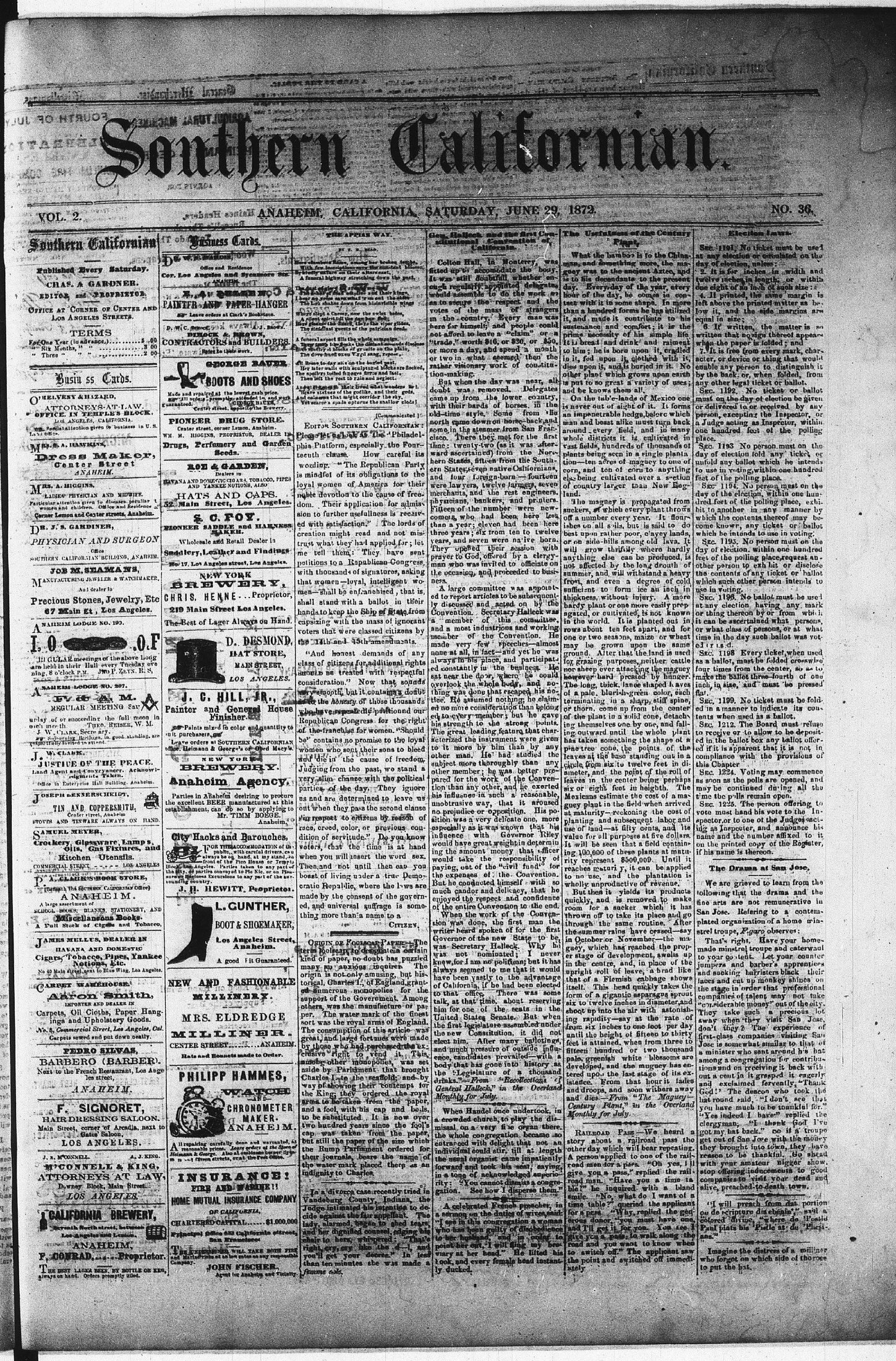
Searchable text
Southern California
Published Every Saturday.
CHAS. A GARDNER.
EDITOR and PROPRIETOR.
OFFICE AT CORNER OF CENTER AND
LOS ANGELES STREETS.
TERMS
For One Year (in advance.)...5 00
Six Months, " " ...3 00
Three " " ...2 00
Business Cards.
O'HELVENY & HAZARD,
ATTORNEYS-AT-LAW.
OFFICE IN TEMPLE'S BLOCK,
LOS ANGELES, CALIFORNIA.
Special attention given to business in U.S.
Law Office.
MRS. A. HAWKINS,
Dress Maker,
Center Street
ANAHEIM.
MRS. A. HIGGINS,
LADIES PHYSICIAN AND MIDWIFE.
Particular attention given to diseases peculiar to
children.
Business Cards.
DEW W. BARNES
Office and Residence
Cor. Los Angeles and Sycamore St.
ANAHEIM.
E. A. DULCER
PAINTER AND PAPER-HANGER
Leave orders at Clark's Bookstore.
D. W. C. PRINCE
DIOCK & BROWN,
CONTRACTORS and BUILDERS.
Please let phia Platform teenth cl
wording.
is mindful loyal wom
noble devo
dom. The
ATTORNEYS AT LAW.
OFFICE IN TEMPLE'S BLOCK,
LOS ANGELES, CALIFORNIA.
Special attention given to business in U.S. Law Office.
MR. S. A. HAWKINS,
Dress Maker,
Center Street
ANAHEIM.
MRS. A. HIGGINS,
LADIES PHYSICIAN AND MIDWIFE.
Particular attention given to diseases peculiar to women and children.
Office and Residence
Cerner Lemon and Center streets, Anaheim.
DR. J. S. GARDINER,
PHYSICIAN AND SURGEON
Office
SOUTHERN CALIFORNIAN BUILDING, ANAHEIM.
JOB M. SEAMANS,
MANUFACTURING JEWELER & WATCHMAKER,
And dealer in
Precious Stones, Jewelry, Etc.
67 Main St., Los Angeles.
ANAHEIM LODGE NO. 193.
I.O.F.
REGULAR meetings of the above lodges held in their Hull every Tuesday evening, 8 o'clock P.M.
J.W. P.ZEYN R.S.
ANAHEIM LODGE NO. 207.
F.Y. & A.M.
REGULAR MEETING Saturday of or succeeding the full moon in each month.
TUEO. REISER, W.M.
J.W. CLARK, Secreary.
Solvency Reichen, in good standing, are perpetually invited to attend.
J.W. CLARK.
Justice of the Peace.
Land Agent and Conveyancer. Acknowledgments taken.
Office in Enterprise Hall Building, Anaheim.
JOSEPH DENNERSCHEIDT,
TIN AND COPPERSMITH.
Center street, Anaheim
STOVES AND TINWARE ALWAYS ON HAND.
SAMUEL MEYER,
Crookery, Glassware, Lamps, Oils, Gns Fixtures, and Kitchen Utensils.
COMMERCIAL STREET - LOS ANGELES
P.A.CLAKE'S BOOK STORE,
[Below the Southern California Office]
ANAHEIM.
A large assortment of SCHOOL BOOKS: BLANKS, STATIONERY, AND Miscellaneous Books.
A Full Stock of Cigars and Tobacco.
JAMES MELLUS, DEALER IN HAVANA AND DOMESTIC Cigars, Tobacco, Pipes, Yankee
PIONEER DRUG STORE.
Center street, corner Lemon, Anaheim.
WM. M. HIGGINS, PROPRIETOR, DEALER IN Drugs, Perfumery and Garden Seeds.
ROB & GARDEN,
Dealers in HAVANA AND DOMESTIC CIGARS, TOBACCO, PIPES AND YANKEE NOTIONS, also HATS AND CAPS.
52 Main Street, Los Angeles.
E.C. POY.
PIONEER SADDLE and HARNESS MAKER.
Wholesale and Retail Dealer in Saddlery, Leather and Findings.
No. 17, Los Angeles street, Los Angeles.
NEW YORK BREWERY,
CHRIS. HENNE... Proprietor,
219 Main Street Los Angeles.
The Best of Lager Always on Hand.
D.. DESMOND,
HAT STORE,
MAIN STREET,
LOS ANGELES.
J.C. HILL, JR., Painter and General House Finisher.
Paints mixed in color and quantity to suit purchasers.
Leave orders at SOUTHERN CALIFORNIAN office. Heimann & George's or Old Macys.
NEW YORK BREWERY.
Anaheim Agency.
Parties in Anaheim desiring to procure the excellent BEER manufactured at this establishment, can do so by applying to Mr. TIMM BOEGE.
Anaheim.
City Hacks and Barouches,
FOR THE ACCOMMODATION OF THE PUBLIC, with careful drivers, can always be on hand, at my stand, in front of the Picco House or Temple Block, Los Angeles. Parties taken to any part of the city, or parties conveyed to Pic Nic, or on pleasure or Business Excursions to any part of the surrounding country.
J.H. HEWITT, Proprietor.
L.CUNTHER,
BOOT & SHOEMAKER,
Los Angeles Street, Anaheim.
A good fit Guaranteed.
Kitchen Utensils.
COMMERCIAL STREET - LOS ANGELES
P. A. CLAREY'S BOOK STORE,
[Below the Southern California Office]
ANAHEIM.
A large assortment of
SCHOOL BOOKS: BLANKS, STATIONERY, AND
Miscellaneous Books.
A Full Stock of Cigars and Tobacco.
JAMES MELLUS, DEALER IN
HAVANA, AND DOMESTIC
Cigars, Tobacco, Pipes, Yankee
Notions, Etc.
No 40 Main Street, next to Blue Wing, Los Angeles.
CARRET WAKEHOUSE.
Aaron Smith,
IMPORTER AND DEALER IN
Carpets, Oil Cloths, Paper Hangings and Upholstery Goods.
No. 5, Commercial Street, Los Angeles, Cal.
Carpets sewed and put down neatly.
PEDRO SILVAS,
BARBERO (BARBER).
Next to the French Restaurant, Los Angele
les street,
ANAHEIM.
F. SIGNORET,
HAIR DRESSING SALOON.
Main Street, corner of Arcadia, next to
Gates Saloon,
LOS ANGELES.
J. K. McCONNELL.
A. J. KING.
McCONNELL & KING,
ATTORNEYS AT LAW,
Downey Block, Main Street
LOS ANGELES.
CALIFORNIA BREWERY,
Beynath North street, between
Los Angeles and Leonia.
ANAHEIM.
F. CONRAD....Proprietor.
THE BEST LAGEN BEER, BY BOTTLE OR KEK,
always on hand. Orders promptly filled.
L. GUNTHER,
BOOT & SHOEMAKER,
Los Angeles Street,
ANAheim.
A good Fit Guaranteed.
NEW AND FASHIONABLE
MILLINERY.
MRS. ELDREDGE
MILLINER.
CENTER STREET.....ANAHEIM.
Hats and Bonnets made to Order.
PHILIPP HAMMES,
WATCH
AND CHRONOMETER
MAKER
ANAHEIM.
All repairing carefully done and warranted, at reasonable prices. Leamy orders of the Shire of Helmann & George. Also all real estate burger restaurants in Fifth streets, near the Park Office.
INSURANCE!
FIRE AND WARME!!
HOME MUTUAL INSURANCE COMPANY
OF CALIFORNIA,
CHARTERED CAPITAL...$1,000,000
Principal Office at California street,
San Brandon.
The insurance will take both fire and maritime at all hours as any responsible Company.
JOHN FISCHER,
Agent for Anaheim and Vininity.
Eastern California
NAHEIM, CALIFORNIA, SATURDAY, JUNE 29, 1872.
THE APPIAN WAY.
Here abstinence hides among her broken legs,
With four insignias over the national blouse,
By bishop milture on their altar seat,
A funeral highway stretching down the past.
The day of the battle in Monterrey was filled up to accommodate the body.
It was still doubtful whether enough regularly appointed delegates would assemble to do the work so as to secure the respect and the votes of the mass of strangers in the country. Every man was here for himself; and people could not afford to leave a "claim" or a "trade," worth $10, or $20, or $50, or more a day, and spend a month or two in what seemed then the rather visionary work of constitution-making.
But when the day was near, all doubt was removed. Delegates came up from the lower country, with their bands of horses, in the old-time style. Some from the north came down on horse-back, and some in the steamer from San Francisco. There they met for the first time: twenty-two (as it was afterward ascertained) from the Northern States, fifteen from the Southern States, seven native Californians, and four foreign-born—fourteen were lawyers, twelve farmers, seven merchants, and the rest engineers, physicians, bankers, and printers.
The Usefulness of Pigs
What the hamburger man, and something gray was to the man is to his decendant's day. Every day of hour of the day, he tastes with it in some than a hundred form it, and made it co-sustenance and coprime necessity of it. It is bread and drink to him; he is born in it, fed upon it, dies upon it, and is other plant which gives us put to so great a and be knows them.
On the tab'e-land is never out of sight an impenetrable hedge man and beast alike around every field whole districts it in vast fields, hundreds plants being seen in tion—ten acres of corn, and ten of corn else being cultivated of country larger land.
The magney is
EDITOR SOUTHERN CALIFORNIAN: Please let us look at the "Philadelphia Platform," especially the Fonrteenth clause. How careful its wording. "The Republican Party is mindful of its obligations to the loyal women of America for their noble devotion to the cause of freedom. Their application for admission to further usefulness is received with satisfaction." The lords of creation might read and not mistrust what they had applied for; let me tell them: They have sent petitions to a Republican Congress, with thousands of signatures, asking that women—loyal, intelligent women—shall be enfranchised, that is, shall stand with a ballot in their hands to keep the Ship of State from capsizing with the mass of ignorant voters that were classed citizens by the 14th and 15th amendments.
"And honest demands of any class of citizens for additional rights should be treated with respectful consideration." Now that sounds very smooth, but it contains a doubt to the honesty of those thousands who have repeatedly petitioned our Republican Congress for the right of the franchise for women. "Should be" contains no promise to the loyal women who sent their sons to bleed and die in the cause of freedom. Judging from the past, we stand a very slim chance with the political parties of the day. They ignore us and are determined to leave us out when they pass the second clause in respect to citizens by reason of race, creed, color, or previous condition of servitude." Do you know voters, that the time is at hand when you will insert the word sex? Then and not until then can you boast of living under a true Democratic Republic, where the laws are made by the consent of the governed, and universal suffrage is something more than a name to a Citizen.
ORIGIN OF FOOLING PAPER—The term foolishly to designate a certain kind of paper, no doubt has puzzled with their bards of horses, in the old-time style. Some from the north came down on horse-back and some in the steamer from San Francisco. There they met for the first time: twenty-two (as it was afterward ascertained) from the Northern States, fifteen from the Southern States, seven native Californians, and four foreign-born—fourteen were lawyers, twelve farmers, seven merchants, and the rest engineers, physicians, bankers, and printers. Fifteen of the number were newcomers who had been here less than a year; eleven had been here three years; six from ten to twelve years, and seven were native born. They opened their session with prayer to God, offered by a clergyman who was invited to officiate on the occasion, and proceeded to business.
A large committee was appointed to report articles to be subsequently discussed and acted on by the Convention. Secretary Halleck was a member of this committee, and a most industrious and working member of the Convention. He made very few speeches—almost none at all, in fact—and yet he was always in his place, and participated constantly in the business. He sat near the door, where he could overlook the whole body, and nothing was done that escaped his notice. He assumed nothing; he claimed no more consideration than holding to every member; but he gave his strength to the strong points. The great leading feature that characterized the instrument were given to it more by him than by any other man. He had studied the subject more thoroughly than any other member; he was better prepared for the work of the Convention than any other, and he exerted his influence in such a reasonable, unobtrusive way, that it aroused no prejudice or opposition. His position was a very delicate one, more especially as it was known that his influence with Governor Riley would have great weight in determining the amount money that officer would take the responsibility of paying, out of the "civil fund" for the expenses of the Convention. But he conducted himself with so much candor and delicacy, that he enjoyed the respect and confidence of the entire Convention to the end.
When the work of the Convention was done, the first man the writer heard spoken of for the first Governor of the new State to be, was Secretary Halleck. Why he was not nominated; I never knew for I am not politician; but it is never out of sight an impenetrable hedge man and boast alike around every field; whole districts it has vast fields; hundreds plants being seen in tion—ten acres of corn, and ten of corn else being cultivated of country larger than land.
The magney is suckers, which ever off a number everyishes on all soils, but best upon rather poor or on side-hills amid will grow thrifty anything else cannot affected by the summer, and will wilt frost, and even a sufficient to form thickness without hardy plant or one agated or cultivated in the world. It is rows about ten feet one or two seasons may be grown up ground. Alter that for grazing purpose nor sheep ever attach however hard press The long, thick land of a pale, blurish-green terminating in a s or thorn, come up f of the plant in a soling themselves once. Outward until has taken something pine tree cone, the leaves at the base s circle from six to tw ameter, and the pop leaves in the center six or eight feet in Mexicans estimate t guey plant in the field at maturity—reckon planting and subsume use of land—at fifty value for all purposes. It will be seen than ing 100,000 of these rity represent $50 reaches maturi y, it to no use, and th wholly unproductive.
But then it yield quickly, and is re room for a sucker thrown off to take through the same the summer rains h in October or Nova geary, which has re er stage of develop
Origin or Footnote Paper—The term foolscap to denote a certain kind of paper, no doubt has puzzled many anxious inquirers. The origin is not only amusing, but historical, Charles I., of England, granted numerous monopolies for the support of the Government. Among others, was the manufacture or paper. The water mark of the finest sort was the royal arms of England. The consumption of this article was great, and large fortunes were made by those who had purchased the exclusive right to vend it. This among other monopolies, was set aside by Parliament that brought Charles I. to the seafold; and by way of showing their contempt for the King; they ordered the royal arms to be taken from the paper, and a fool, with his cap and boots, to be substituted. It is now over two hundred years since the fool's cap was taken from the paper, but still the paper of the size which the Rump Parliament ordered for their journals, bears the name of the water mark placed there as an indignity to Charles.
In a divorce case recently tried in Vandeburg County, Indiana, the Judge intimated his intention to decide against the fair appellant. The lady, alarmed, began to shed tears, and her dignified counsel, edging his chair to horn, whispered: "That's right, cry, my like the d-1, and you'll get your deocr." In less than ten minutes she was made a femme sole.
When Handel once undertook in a crowded church, to play the dismissal on a very fine organ there, the whole congregation became so entranced with delight that not an individual could stir; till at length the usual organist came impatiently forward and took his seat, saying, in a tone of acknowledged superiority: "You cannot dismise a congregation. See how I dispense them."
A celebrated French preacher, in a sermon on the duties of wives said: "I see in this congregation a woman who has been guilty of disobedience to her husband, and is going to point her out, I will fling my heart at her head." He lifted his look, and every female head instantly ducked.
The Usefulness of the Century Fippi
What the lambos is to the Chinaman, and something more, the magney was to the ancient Aztec, and is to his descendants to the present day. Every day of the year, every hour of the day, he comes in contact with it in some shape. In more than a hundred forms he has utilized it, and made it contribute to his sustenance and comfort; it is the prime necessity of his simple life. It is bread and drink and raiment to him; he is born upon it, cradled in it, fed upon it, clothed with it, dies upon it, and is buried in it. No other plant which grows upon earth is put to so great a variety of uses; and be knows them all.
On the tab'e lands of Mexico one is never out of sight of it. It forms an impenetrable hedge, before which man and beast alike must turn back around every field, and in many whole districts it is cultivated in vast fields, hundreds of thousands of plants being seen in a single plantation—ten acres of magney to one of corn, and ten of corn to anything else being cultivated over a section of country larger than New England.
The magney is propagated from
is never out of sight of it. It forms an impenetrable hedge before which man and beast alike must turn back around every field, and in many whole districts it is cultivated in vast fields, hundreds of thousands of plants being seen in a single plantation—ten acres of magney to one of corn, and ten of corn to anything else being cultivated over a section of country larger than New England.
The magney is propagated from suckers, of which every plant throws off a number every year. It flourishes on all soils, but is said to do best upon rather poor clayey lands, or on side-bills among old lava. It will grow thrifty where hardly anything else can be produced, is not affected by the long drought of summer, and will withstand a heavy frost, and even a degree of cold sufficient to form ice an inch in thickness without injury. A more hardy plant or one more easily propagated, or cultivated, is not known in the world. It is planted out in rows about ten feet apart, and for one or two seasons, maize or wheat may be grown upon the same ground. After that the land is used for grazing purposes, neither cattle nor sheep ever attacking the magney however hard pressed by hunger. The long, thick, lance shaped leaves of a pale, bluish-green color, each terminating in a sharp, stiff spine, or thorn, come up from the center of the plant in a solid cone, detaching themselves one by one, and falling outward until the whole plant has taken something the shape of a pine tree cone, the points of the leaves at the base standing out in a circle from six to twelve feet in diameter, and the point of the roll of leaves in the center being perhaps six or eight feet in height. The Mexicans estimate the cost of a magney plant in the field when arrived at maturity—reckoning the cost of planting and subsequent labor and use of land—at fifty cents, and its value for all purposes at five dollars. It will be seen that a field containing 100,000 of these plants at maturity represent $500,000. Until it reaches maturity, it can be applied to no use, and the plantation is wholly unproductive of revenue.
But then it yields its products quickly, and is removed to make room for a sucker which it has thrown off to take its place and go through the same routine. After the summer rains have ceased—say in October or November—the magney, which has reached the proper stage of development, swells up or delivered to or received by any person, excepting the Inspector, or a Judge acting as Inspector, within one hundred feet of the polling place.
Sec. 1193 No person must on the day of election fold any ticket or unfold any ballot which he intends to use in voting within one hundred feet of the polling place.
Sec. 1194 No person must on the day of the election within one hundred feet of the polling place, exhibit to another in any manner by which the contents thereof may become known, any ticket or ballot which he intends to use in voting.
Sec. 1195 No person must on the day of election within one hundred feet of the polling place, request another person to exhit or disclose the contents of any ticket or ballot which such other person intends to use in voting.
Sec. 1196 No ballot must be used at any election having any mark or thing thereon by or from which it can be ascertained what persons, or what class of persons, or at what time in the day such ballot was voted or used.
Sec. 1198 Every ticket when used as a ballot must be folded crosswise four times from the center, so as to make the ballot three-fourth of one inch in size; and must be pressed flat.
Sec. 1199 No ticket must be folded in a manner to indicate its contents when used as a ballot.
Sec. 1212 The Board must refuse to receive or to allow to be deposited in the ballot box any ballot offered if it is apparent that it is not in compliance with the provisions of this Chapter.
Sec. 1224 Voting may commence as soon as the polls are opened, and may be continued during all the time the polls remain open.
Sec. 1225 The person offering to vote must hand his vote to the Inspector, or to one of the Judges acting as Inspector, and announce his name and the number affixed to it on the printed copy of the Register, if his name is thereon.
The Drama at Sam Jose,
We are grieved to learn from the following that the drama and the fine arts are not remunerative in San Jose. Referring to a contemplated organization of a home minstrel troupe, Figaro observes:
That right. Have your homemade minstrel troupe and caterwaulet your content. Let your counter
The Drama at San Jose.
We are grieved to learn from the following that the drama and fine arts are not remunerative in San Jose. Referring to a contemplated organization of a home minstrel troupe, Figaro observes:
That's right. Have your homemade minstrel troupe and caterwaulet your content. Let your counter jumper and barber's apprentices and sucking barristers black their faces and cut up monkey shines on the stage in order that professional companies of talent may not take considerable money out of the city. They take such a precious lot away when they visit San Jose, don't they? The experience of first-class companies visiting San Jose is somewhat similar to that of a minister who sent around his hat among a congregation for contributions and on receiving it back without a cent in it grasped it eagerly and exclaimed fervently, "Thank God!" The deacon who took the hat round said, "I don't see that you have much to be thankful for." "Yes indeed I have" replied the clergyman, "I thank God I've got my hat back." So if a troupe get out of San Jose with the money they brought into town, they have reason to be thankful. Go ahead with your amateur bigger show, stop offering inducements to good companies to visit your dead and alive, preached-to-death town.
"I will preach from dat portion on de scripture dischinie," said a colored divine, "where do Postlu Paul pints his 'Pistle at du 'Phisiana'."
Imagine the distress of a milliner who forgets on which side of the roce to put the hat.