anaheim-gazette 1872-04-20
Scanned page
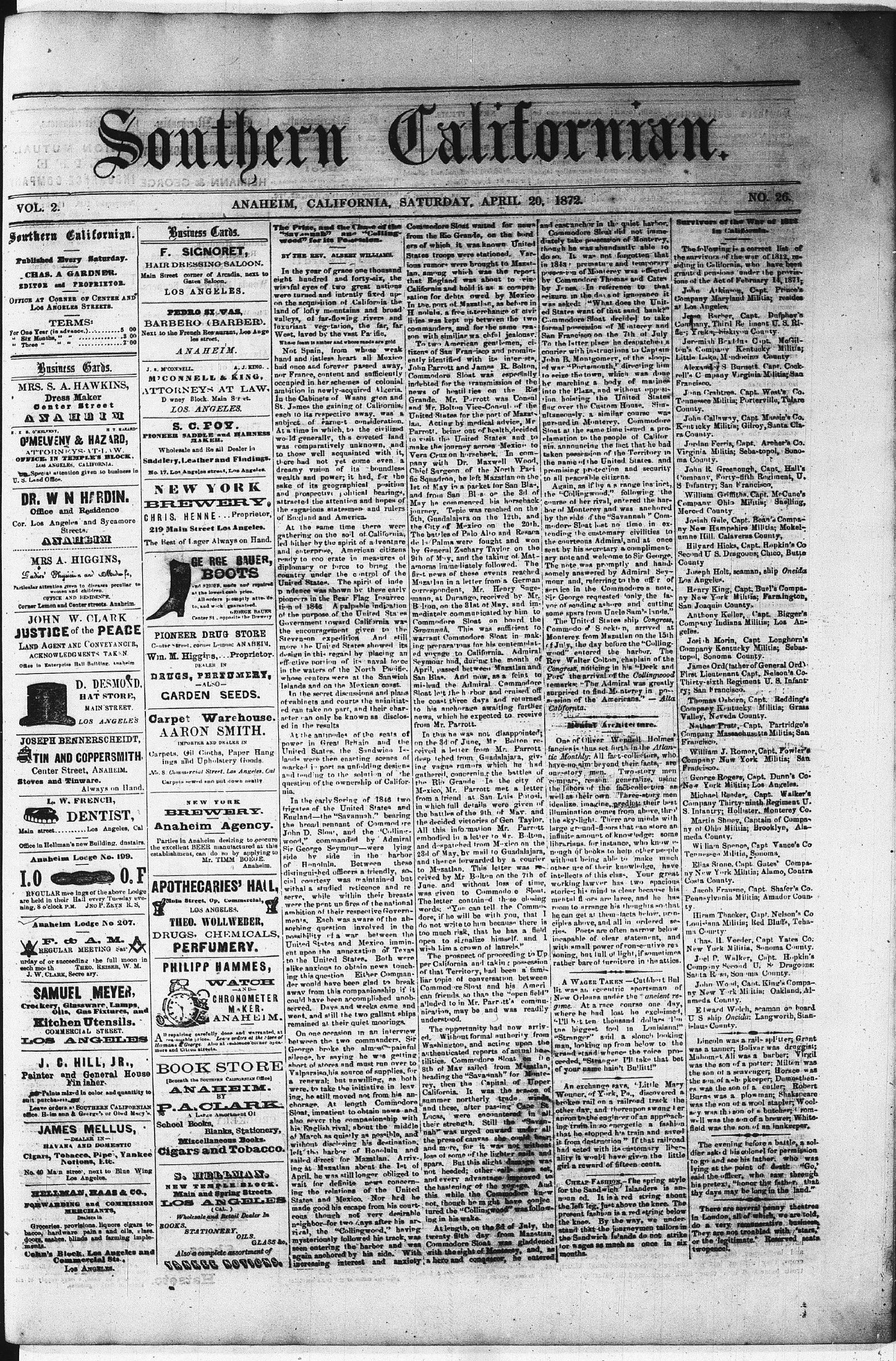
Searchable text
Southern California.
Published Every Saturday.
CHAS. A GARDNER.
EDITOR and PROPRIETOR.
OFFICE at CORNER of CENTER AND
LOS ANGELES STREETS.
TERMS:
For One Year (in advance.)...5 00
" Six Months," " " ...3 00
" Three " " " ...2 00
Business Cards.
MRS. S. A. HAWKINS,
Dress Maker
Center Street
ANAHEIM
R. X. R. O'MELVENY,
H. T. WARD'
O'MELVENY & HAZARD,
ATTORNEYS AT LAW.
OFFICE IN TEMPLE'S BLOCK,
LOS ANGELES, CALIFORNIA.
Special attention given to business in
U. S. Land Office.
DR. W N HARDIN.
Business Cards.
F. SIGNORET,
HAIR DRESSING SALOON.
Main Street corner of Arcadia, next to
Gates Saloon.
LOS ANGELES.
PEDRO SI VAS,
BARBERO (BARBER).
Next to the French Restaurant, Los Angele
les street,
ANAHEIM.
J. R. M'CONNELL.
A. J. KING.
M'CONNELL & KING,
ATTORNEYS AT LAW,
Downey Block. Main Street.
LOS ANGELES.
S. C. POY.
PIONEER SADDLE and HARNESS
MAKER.
Wholesale and Retail Dealer in
Saddlery, Leather and Findings.
No. 17, Los Angeles street, Los Angeles.
NEW YORK
BREWERY.
Center Street
ANAHEIM
R. X. R. O'MELVENY,
H. T. HARARDO'MELVENY & HAZARD,
ATTORNEYS AT LAW.
OFFICE IN TEMPLE'S BLOCK,
LOS ANGELES, CALIFORNIA.
Special attention given to business in
U.S. Land Office.
DR. W N HARDIN.
Office and Residence
Cor. Los Angeles and Sycamore
Streets.
ANAHEIM
MRS A. HIGGINS,
Ladies' Physician and Medicine,
Particular attention given to diseases peculiar to
women and children.
OFFICE AND RESIDENCE.
Corner Lemon and Center streets. Anaheim.
JOHN W. CLARK
JUSTICE of the PEACE
LAND AGENT AND CONVEYANCER,
ACKNOWLEDGMENTS TAKEN.
Office in Enterprise Hall Building. Anaheim
D. DESMOND,
HAT STORE,
MAIN STREET.
LOS ANGELES
JOSEPH BENNERSCHEIDT,
TIN AND COPPERSMITH.
Center Street, Anaheim.
Stoves and Tinware.
Always on Hand.
L. W. FRENCH,
DENTIST,
Main street...Los Angeles, Cal
Office in Hellman's new Building. dnstairs.
Anaheim Lodge No. 199.
I.O O.F
REGULAR meetings of the above Lodge
are held in their Hall every Tuesday evening; 8 o'clock P.M.
JNO P. ZEYN R.S.
Anaheim Lodge No 207.
F. & A. M.
REGULAR MEETING Sar
D.Whey Block. Main Street.
LOS. ANGELES.
S. C. POY.
PIONEER SADDLE and HARNESS
MAKER.
Wholesale and Real Dealer in
Saddlery, Leather and Findings.
No. 17. Los Angeles street, Los Angeles.
NEW YORK
BREWERY.
CHRIS. HENNE...Proprietor,
219 Main Street Los Angeles.
The Best of Lager Always on Hand.
GE RGE BAUER,
BOOTS
and PHONE, made and repaired
at the lowest cash price.
All orders promptly attende
to, and work guaranteed.
GEORGE BAUER
Center St., opposite the Brewery.
PIONEER DRUG STORE
Center Street, corner Lemon: Anaheim.
Win. M. Higgins,...Proprietor.
DEALER IN
DRUGS, PERFUMERY,
ALSO—
GARDEN SEEDS.
Carpet Warehouse.
AARON SMITH.
IMPORTER AND DEALER IN
Carpets, Oil Cloths, Paper Hang
ings and Upholstery Goods.
No. 8. Commercial Street, Los Angeles, Cal
Carpets sewed and put down neatly.
NEW YORK
BREWERY.
Anaheim Agency.
Parties in Anaheim desiring to procure
the excellent BEER manufactured at this
establishment, can do so by applying to
Mr. TIMM BOEGE.
Anaheim.
APOTHECARIES' HALL,
Main Street, Op. Commercial,
LOS ANGELES.
THEO. WOLLWEBER,
DRUGS, CHEMICALS,
PERFUMERY.
In the early frigates of the England—the
the broad penny John D. Slownood," comm
Sir George Seaside by side of Honolulu distinguished ocial courtesy withal a studi serve, while were the pent ambition of the ments, Enchoring quest possibility of United States ent upon the United States
Anaheim Lodge No. 109.
I.O. O.F.
RFGULAR meetings of the above Lodge are held in their Hall every Tuesday evening, 8 o'clock P.M. JNO P.ZEYN R.S.
Anaheim Lodge No 207.
F. & A. M.
REGULAR MEETING Sat.
urday of or succeeding the full moon in each month.
THEO. REISER, W. M.
J.W. CLARK, Secreary.
SAMUEL MEYER,
Crockery, Glassware, Lamps,
Oils, Gas Fixtures, and
Kitchen Utensils.
COMMERCIAL STREET.
LOS ANGELES
J. C. HILL, JR.,
Painter and General House Painter.
Paints mixed in color and quantity to suit purchaser.
Leave orders at SOUTHERN CALIFORNIAN office. Heim ann & George's or Obed Macy.
JAMES MELLUS,
—DEALER IN—
HAVANA AND DOMESTIC
Cigars, Tobacco, Pipe, Yankee Notions, etc.
No. 40 Main street, next to Blue Wing Los Angeles.
HELLMAN, BAAS & CO., FORWARDING and COMMISSION MERCHANTS,
Dealers in
Groceries, provisions, liquors cigars to bacco, hardware paints and oils, glass doors, saws, blinds and farming implements.
John's Block, Los Angeles and Commercial Sts., Los Angeles.
APOTHECARIES' HALL,
Main Street, Op. Commercial,
LOS ANGELES.
THEO. WOLLWEBER,
DRUGS, CHEMICALS,
PERFUMERY.
PHILIPP HAMMES,
WATCH
AND
CHRONOMETER
MAKER.
ANAHEIM.
All repairing carefully done and warranted, at reasonable prices. Leave orders at the store of Herman & George. Also at residence corner Sycamore and Citron streets.
BOOK STORE
[Beneath the Southern California Office]
ANAHEIM.
BY
P.A. CLARK.
A Large Assortment Of School Books,
Blanks, Stationery,
Miscellaneous Books.
Cigars and Tobacco.
S. HELLMAN,
NEW TEMPLE BLOCK.
Main and Spring Streets
LOS ANGELES
(CAL.)
Wholesale and Retail Dealer In BOOKS.
STATIONERY.
OILS.
GLASS & Co.
Also a complete assortment of VARIABLE NOVENUES.
The Prize, and the Chance of the "Savannah" and "Callingwood" for its Presentation.
BY THE REV. ALBERT WILLIAMS.
In the year of grace one thousand eight hundred and forty-six, the wiseful eyes of two great nations were turned and intently fixed upon the acquisition of California the land of lofty mountains and broad valleys, of far-flowing rivers and luxuriant vegetation, the far, far West, laved by the vast Pacific.
Not Spain, from whose weak hand and listless heart all Mexico had once and forever passed away, nor France, content and sufficiently occupied in her schemes of colonial ambition in newly-acquired Algeria, In the Cabinets of Washington and St. James the gaining of California, each to its respective away, was a subject of earnest consideration. At a time in which, to the civilized world generally, this coveted land was comparatively unknown, and to those well acquainted with it, there had not yet come even a dreamy vision of its boundless wealth and power; it had, for the sake of its geographical position and prospective political bearings, attracted the attention and hopes of
Commodore Sloot waited for news from the Rio Grande, on the borders of which it was known. United States troops were stationed. Various rumors were brought to Mazatlan, among which was the report that England was about to viz. California and hold it as a compensation for debts owed by Mexico. In the port of Mazatlan, a free interchange of civilities was kept up between the two commanders, and for the same reason with similar waitsful jealousy.
To two American gentlemen, citizens of San Francisco and prominently identified with its interests, John Parrott and James R. Bolton, Commodore Sloot was especially indebted for the transmission of the news of hostilities on the Rio Grande. Mr. Parrott was Consult and Mr. Bolton Vice-Consul of the United States for the port of Mazatlan. Acting by medical advice, Mr. Parrott, being out of health, decided to visit the United States and to make the journey across Mexico to Vera Cruz on horseback. In company with Dr. Maxwell Wood, Chief Surgeon of the North Pacific Squadron, he left Mazatlan on the 1st of May in a packet for San Blas, and from San Blas on the 3d of May he commenced his horseback and castanchor in the quiet Commodore Sloot did not distantly take possession of though he was abundantly done. It was not forgod in 1845: premature and the possession of Monterey was by Commodore Thomas by Jones. In reference to seizure in the days of ignition was asked: "What does red States want of that same Commodore Sloot decide formal possession of Montenary on the 7th To the latter place he deserier with instructions to John B. Montgomery, of war "Portsmouth," direct to seize the town, which by marching a body into the Plaza, and without hoisting the United flag over the Custom House ultimately, a similar compartment in Monterey. Commodore Sloot at the same time is elation to the people announcing the fact that taken possession of the T name of the United States promising protection and to all peaceable citizens.
Again, as if by a ransom the "Collingwood," follow course of her rival, enter
St. James the gaining of California, each to its respective away, was a subject of earnest consideration. At a time in which, to the civilized world generally, this coveted land was comparatively unknown, and to those well acquainted with it, there had not yet come even a dreamy vision of its boundless wealth and power; it had, for the sake of its geographical position and prospective political bearings, attracted the attention and hopes of the sagacious statesmen and rulers of England and America.
At the same time there were gathering on the soil of California, led hither by the spirit of adventure and enterprise, American citizens ready to coo erate in measures of diplomacy or force to bring the country under the control of the United States. The spirit of independence was shown by these early pioneers in the Bear Flag Insurrection of 1846. A palpable indication of the purpose of the United States Government toward California was the encouragement given to the Stevenson expedition. And still more the United States showed its design in this regard by placing an effective portion of its naval force in the waters of the North Pacific, whose centers were at the Sanwich Islands and on the Mexican coast.
In the secret discussions and plans of cabinets and courts the uninitiated can take no part, and their character can only be known as disclosed in the results.
At the antipodes of the seats of power in Great Britain and the United States, the Sandwich Islands were then enacting scenes of marked port as unfolding designs and tending to the solution of the question of the ownership of California.
In the early Spring of 1846 two frigates of the United States and England—the "Savannah," bearing the broad pennant of Commodore John D. Sloan, and the "Collinswood," commanded by Admiral Sir George Seymour—were lying side by side in the harbor of Honolulu. Between these distinguished officers a friendly, social courtesy was maintained but with a studied reticence and reserve, while within their breasts were the pent up fires of the national ambition of their respective Governments. Each was aware of the absorbing question involved in the possibility of a war between the United States and Mexico imminent upon the annexation of Texas to the United States. Both were
In this he was not disappointed; on the 3d of June, Mr Bolton received a letter from Mr. Parrott deep tailed from Guadalajara, giving vague rumors which he had gathered, concerning the battles of the Rio Grande. In the city of Mexico, Mr. Parrott met a letter from a friend at San Luis Potosí, in which full details were given of the battles of the 9th of May, and the decided victories of Gen Taylor. All this information Mr. Parrott embodied in a letter to Mr. Bolton, and despatched from Mexico on the 23d of May, by mail to Guadalajara, and thence forwarded by a courier to Mazatlan. This letter was received by Mr. Bolton on the 7th of June, and without loss of time, was given to Commodore Sloat. The letter contained these closing words: "You can tell the Commodore, if he will be with you, that I do not write to him because there is too much risk, that he has a field open to signalize himself, and I wish him a crown of laurels."
The prospect of proceeding to Upstate over the Custom House ultimately, a similar course of her rival entered Monterey and was by the side of the "Savannah" Sloat last no time tending the customary courteous Admiral, sent by his secretary a copy note and welcome to The note was promptly answered by Admiral Mourn and referring to service in the Commodore Sir George requested for voror of sending ashore some spars from Uncle Sam.
The United States ship Commodo e Stockton, Monterey from Mazatlan of July, the day before the wood entered the harbor Rev Walter Colton, chaplain Congress, noticing in his Port the arrival of the remarker: "The Admiral surprised to find Monterey session of the American California."
side by side in the harbor of Honolulu. Between these distinguished officers a friendly, social courtesy was maintained but withal a studied reticence and reserve, while within their breasts were the pent up fires of the national ambition of their respective Governments. Each was aware of the absorbing question involved in the possibility of a war between the United States and Mexico imminent upon the annexation of Texas to the United States. Both were alike anxious to obtain news touching this question. Either Commander would have been glad to break away from this companionship if it could have been accomplished unobserved. Days and weeks came and went, and still the two gallant ships remained at their quiet moorings.
On one occasion in an interview between the two commanders, Sir George broke the almost painful silence, by saying he was getting short of stores and must run over to Valparaiso, his source of supplies, for a renewal; but unwilling, as both were, to take the initiative in leaving, he still moved not from his anchorage. At length Commodore Sloat, impatient to obtain news and also sever the companionship with his English rival, about the middle of March as quietly as possible, and without disclosing his destination, left the harbor of Honolulu and sailed direct for Mazatlan. Arriving at Mazatlan about the 1st of April, he was still longer obliged to wait for definite news concerning the relations of the United States and Mexico. Nor hrd he made good his escape from his courteous though not very desirable neighbor-for two days after his arrival, the "Collingwood," having mysteriously followed his track, was seen entering the harbor and was again anchored by his side. With increasing interest and anxiety
25th of May, by Mr. Bolton on the 7th of June, and without loss of time, was given to Commodore Sloat. The letter contained these closing words: "You can tell the Commodore, if he will be with you, that I do not write to him because there is too much risk, that he has a field open to signalize himself, and I wish him a crown of laurels."
The prospect of proceeding to Upper California and taking possession of that Territory, had been a familiar topic of conversation between Commodore Sloat and his American friends, so than the "open field" alluded to in Mr. Parrott's communication, may be and was readily understood.
The opportunity had now arrived. Without formal authority from Washington, and acting upon the authenticated reports of actual hazards, Commodore Sloat on the 8th of May sailed from Mantanlan, heading the "Savannah" for Monterey, then the Capital of Upper California. It was the season of summer northerly trade winds and these, after passing Cape St. Lucas, were encountered in all their strength. Still the "Savannah" was urged onward under all the press of canvas she could bear, and more, for it was not without loss of some of the lighter sails and spares. But this slight damage was not heeded; other calls were set, and every advantage improved to the hastening of the voyage. And this while the Commodore knew not, though he might have conjectured the "Collingwood" was following in his wake.
At length, on the 2d of July, the twenty fifth day from Mazatlan, Commodore Sloat was gladdened with the sight of Monteny, and, as a hero and conqueror, he entered without being able to other use of their knowledge intellects of this class, working lawyer has stories; his mind is clear mental floors are large; room to arrange his thieves above, and all in ries. Poets are often incapable of clear stair with small power of consonance, but full of light rather bare of furniture.
A WAGER TAKEN — lit was an eccentric New Orleans under the gime. At a race course where he had lost lily but ten thousand the biggest fool in "Stranger" said a man, looking up from a grand stand whence he ceded, "Stranger Ill." Of your name hain't B
An exchange save Wouner, of York, Pa., broken rail on a railroad other day, and thereon apron to the engineer ing train in so emergent that he stopped his trit from destruction." He had acted with its curiosity it would have given girl a reward of fifteen.
CHEAP FASHION—for the Sandwich Island noun ed. It is a red left leg just above present fashion is a red knee. By the wedge that the journeys the Sandwich Island for wages as much as months.
Survivors of the War of 1812 in California.
The following is a correct list of the survivors of the war of 1812 residing in California, who have been granted pensions under the provisions of the Act of February 14, 1871:
John Atkinson, Capt. Prince's Company Maryland Militia; resides at Los Angeles.
Jose Barber, Capt. Dufphay's Company, Third Regiment U.S. Rifles; Yreka—Siskiyou County.
Jeremiah Bradley, Capt. McGillen's Company Kentucky Militia; Little Lake, Mendocino County.
Alexander S Burnett, Capt. Cookell's Company Virginia Militia; San Francisco.
John Crabtree, Capt. West's Co. Tennessee Militia; Porterville, Tulare County.
John Callaway, Capt. Massie's Co. Kentucky Militia; Gilroy, Santa Clara County.
Jordan Ferris, Capt. Archer's Co. Virginia Militia; Sebastopol, Sonoma County.
John R Greenough, Capt. Hall's Company, Forty-fifth Regiment U.S. Infantry; San Francisco.
William Griffiths, Capt. McCune's Company Ohio Militia; Shelling,
over the Custom House. Simmonously, a similar course was
used in Monterey. Commodore
at the same time issued a protion to the people of Californance announcing the fact that he had
a possession of the Territory in
name of the United States and
raising protection and security
of peaceable citizens.
Again, as if by a range instinct,
"Collingwood," following the
one of her rival, entered the harbor Monterey and was anchored
the side of the "Savannah." Commodore Sloat hast no time in existing the customary civilities to
mourteous Admiral, and at once
by his secretary a complimentnote and welcome to Sir George.
Note was promptly and handly answered by Admiral Seyler and, referring to the offer of
price in the Commodore's note,
George requested only the fasfolding ashore and cutting
spars from Uncle Sam's lands."
The United States ship Congress,
Mendoza & Stockton, arrived at
Monterey from Mazatlan on the 15th
July, the day before the "Collingwood" entered the harbor. The
Walter Coltan, chaplain of the
gress, noticing in his "Deck and
the arrival of the Collingwood"
marker, "The Admiral was greatly
arrived to find Monterey in position of the Americans." — Alta
California.
Minute Architecture.
Nine of Oliver Wendell Holmes'
life is thus set forth in the AllanMonthly: All fact-collectors who
no longer beyond their facts are
story men. Two-story men
separate, reason generalize, using
librors of the fact-collectors as
as their own. Three-story men
analyze, imagine, predict their best
imitation comes from above, thresky-light. There are minds with
large ground-floors that can store an
absolute amount of knowledge; some
warnings, for instance, who know eighh of books to help other people about being able to make much
use of their knowledge, have
collects of this class. Your great
parking lawyer has two spacious
series: his mind is clear because his
mental floors are large, and he has
to arrange his thoughts so that
can get at them facts below, prunes
above, and all in ordered seas.
Poets are often narrow below
capable of clear statement, and
with small power of consecutive rening, but full of light, if sometimes
the harm of furniture in the attics.
Tennessee Militia; Forterville, Tulare County.
John Callaway, Capt Massia's Co.
Kentucky Militia; Gilroy, Santa Clara County.
Jordan Ferris, Capt. Archer's Co.
Virginia Militia; Sebastopol, Sunoma County.
John K. Greenough, Capt. Hall's
Company, Forty-fifth Regiment, U.S.
Infantry; San Francisco.
William Griffiths, Capt. McCune's
Company Ohio Militia; Snelling,
Merced County.
Josiah Gale, Capt. Bean's Company New Hampshire Militia; Mokelamne Hill. Calaveras County.
Hilyard Hicks, Capt. Hopkin's Co.
Second U.S. Dragoons; Chico, Butte County.
Joseph Holt, seaman, ship Oneida
Los Angeles.
Henry King, Capt. Buel's Company New York Militia; Farmington,
San Joaquin County.
Anthony Keller, Capt. Bigger's
Company Indiana Militia; Los Angles.
Josiah Morin, Capt Longhorn's
Company Kentucky Militia; Sebastopol,
Sonoma County.
James Ord (father of General Ord)
First Lieutenant Capt. Nelson's Co.
Thirty-sixth Regiment U.S. Infantry;
San Francisco.
Thomas Osborn, Capt. Redding's
Company Kentucky Militia; Grass Valley,
Nevada County.
Nathan Pratt, Capt. Partridge's
Company Massachusetts Militia; San Francisco.
William J. Romor, Capt. Fowler's
Company New York Militia; San Francisco.
George Rogers, Capt. Dunn's Co.
New York Militia; Los Angeles.
Michael Reeder, Capt. Walker's
Company Thirty-ninth Regiment U.S.
Infantry; Hollister, Monterey Co.
Martin Shuey, Captain of Company
of Ohio Militia; Brooklyn, Alameda County.
William Spence, Capt Vance's Co.
Tennessee Militia; Sonoma.
Elias Stone, Capt Gates' Company New York Militia; Alamo, Contra Costa County.
Jacob Fransne, Capt. Shafer's Co.
Pennsylvania Militia; Amador County.
Hiram Thacker, Capt. Nelson's Co.
Louisiana Militia; Red Bluffs, Tehama County.
Chas. H. Veeder, Capt Yates Co:
New York Militia; Sonoma County.
Joel P. Walker, Capt. Hopkin's
A WAGER TAKEN — Cuthbert Bully was an eccentric sportsman of New Orleans under the ancient regime. At a race course one day, where he had lost his exclaimed, "I'll bet ten thousand dollars I'm the biggest fool in Louisiana!" Stranger said a slonch looking man, looking up from below to the stand whence the voice proceeded, "Stranger I'll take that bet by your name hain't Bullitt!"
An exchange saw, "Little Mary Tonner, of York, Pa., discovered a broken rail on a railroad track the other day, and thereupon swang her apron to the engineer of an approaching train in so energetic a fashion that he stopped his train and saved from destruction." If that railroad had acted with its customary liberty it would have given the little girl a reward of fifteen cents.
CHEAP FASHION—The spring style for the Sandwich Islanders is announced. It is a red string about the left leg, just above the knee. The present fashion is a red string below the knee. By the way, we understand that the journeymen tailors in the Sandwich Islands do not strike or wages as much as once in six months.
Elias Stone, Capt. Gates’ Company New York Militia; Alamo, Contra Costa County.
Jacob Fransne, Capt. Shafer’s Co. Pennsylvania Militia; Amador County.
Hiram Thacker, Capt. Nelson’s Co. Louisiana Militia; Red Bluffs, Tehama County.
Chas. H. Veeder, Capt Yates Co: New York Militia, Sonoma County.
Joel P. Walker, Capt. Hopkin's Company Second U., St. Dragoons: Santa Rosa, Sonoma County.
John Wood, Capt. King’s Company New York Militia: Oakland, Alameda County.
Edward Welch, seaman on board U.S ship Oncida: Langworth, Stanislaw County.
Lincoln was a rail-splitter; Grant was a tanner; Bolivar was druggist; Mahomet Ali was a barber; Virgil was the son of a porter; Milton was the son of a scavenger; Horace was the son of a shoepeeper; Demgathenes was the son of a cutler; Robert Burns was a plowman; Shakspeare was the son of a wool stapler; Woolsey was the son of a butcher;romwell was the son of a brewer; Whitefield was the son of an innkeeper.
The evening before a battle, a soldier asked his colonel for permission to go and see his father, who was lying at the point of death. "Go," said the officer, who saw through his pretext, "honor thy father, that thy days may be long in the land."
There are several penny theatre in London, all of which we are told, do a very remunerative business. They are not troubled with 'stars,' or the 'legitimate.' Reserved seats twopence!