anaheim-gazette 1872-04-13
Scanned page
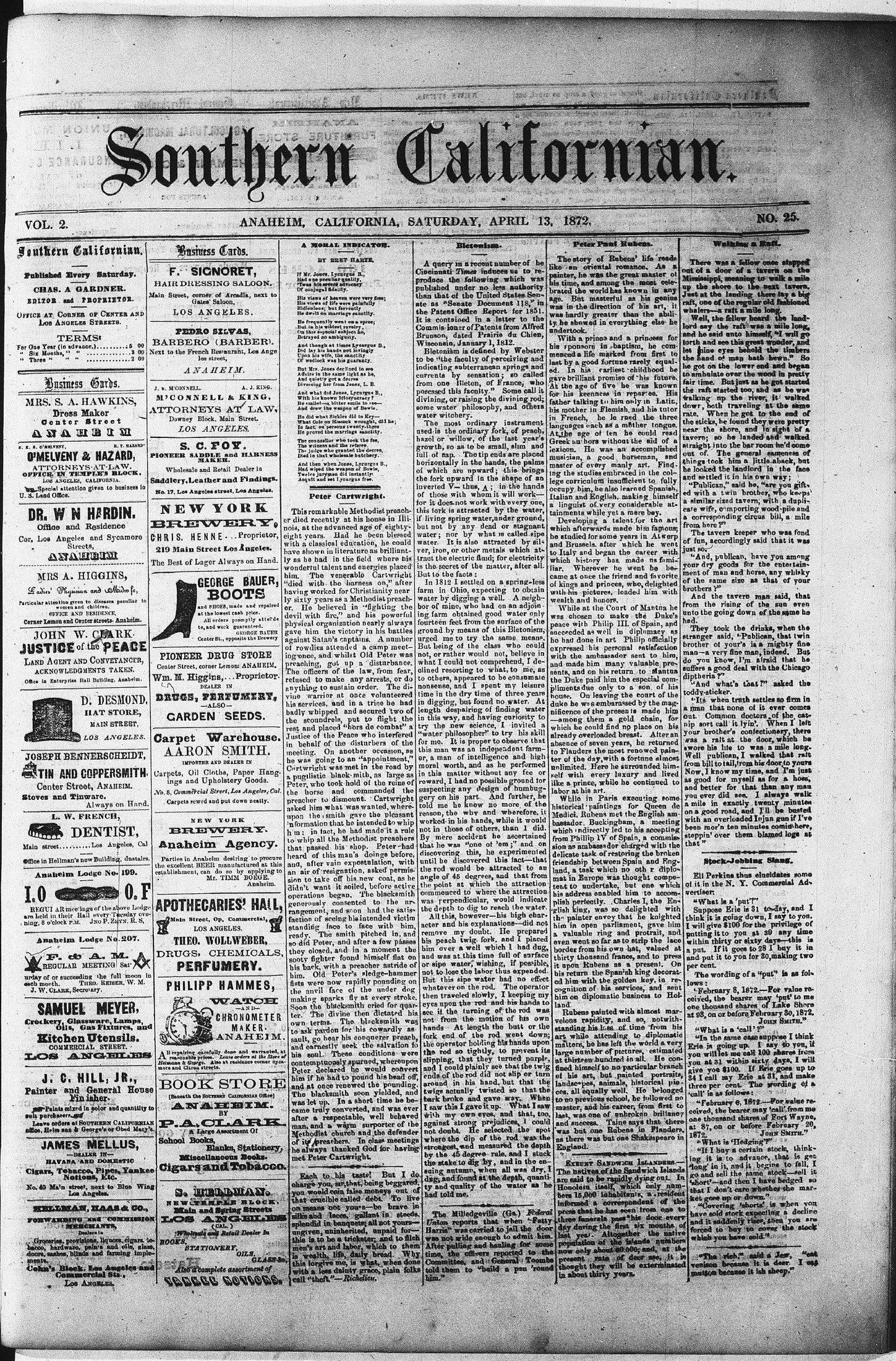
Searchable text
Southern California.
Published Every Saturday.
CHAS. A GARDNER.
EDITOR and PROPRIETOR.
OFFICE AT CORNER OF CENTER AND
LOS ANGELES STREETS.
TERMS:
For One Year (in advance.)...5 00
" Six Months," " " ...3 00
" Three " " " ...2 00
Business Cards.
F. SIGNORET,
HAIR DRESSING SALOON.
Main Street, corner of Arcadia, next to
Gates' Saloon,
LOS ANGELES.
PEDRO SILVAS,
BARBERO (BARBER).
Next to the French Restaurant, Los Angele
los street,
ANAHEIM.
MRS. S. A. HAWKINS,
Dress Maker
Center Street
ANAHEIM
H. K. S. O'MELVENY,
H. T. HAZARD*
O'MELVENY & HAZARD,
ATTORNEYS-AT-LAW.
OFFICE IN TEMPLE'S BLOCK,
LOS ANGELES, CALIFORNIA.
Special attention given to business in
U. S. Land Office.
Business Cards.
J. R. M'CONNELL.
A. J. KING.
M'CONNELL & KING,
ATTORNEYS AT LAW,
Downey Block, Main Street.
LOS ANGELES.
S. C. FOX.
PIONEER SADDLE and HARNESS
MAKER.
Wholesale and Retail Dealer in
Saddlery, Leather and Findings.
No. 17, Los Angeles street, Los Angeles.
A MORA
BY B
If Mr. Jones. L
Had one peculiar
Twas his seven
Of conjugal Bd
His views of he
His views of life
Ridiculous; but
He dwelt on ma
He frequently
But in his wild
On this special
Betrayed no am
And though at
Did lay his haw
Upon his wife,
Of wedlock war
But Mrs. Jones
Affairs in the s
And quietly go
Divorcing her t
And what did J
With his knowe
He smiled—a b
And drew the th
He did what Sh
What Cole on P
In fact; on pern
He proved tha
The counsellor
The witness an
The judge who
Died in that wi
And then whet
Had wiped the
Twelve jaryme
Acquit and set
Peter
MRS. S. A. HAWKINS,
Dress Maker
Center Street
ANAHEIM
M. K. S. O'MELVENY,
H. T. HAZARD
O'MELVENY & HAZARD,
ATTORNEYS AT LAW.
OFFICE, IN TEMPLE'S BLOCK,
LOS ANGELES, CALIFORNIA.
Special attention given to business in U. S. Land Office.
DR. W N HARDIN.
Office and Residence
Cor, Los Angeles and Sycamore Streets,
ANAHEIM
MRS A. HIGGINS,
Ladies' Physician and Midwife,
Particular attention given to diseases peculiar to women and children.
OFFICE AND RESIDENCE,
Corner Lemon and Center streets. Anaheim.
JOHN W. CLARK.
JUSTICE of the PEACE
LAND AGENT AND CONVEYANCER,
ACKNOWLEDGMENTS TAKEN.
Office in Enterprise Hall Building, Anaheim.
D. DESMOND,
HAT STORE,
MAIN STREET,
LOS ANGELES.
JOSEPH BENNERSCHEIDT,
TIN AND COPPERSMITH,
Center Street, Anaheim.
Stoves and Tinware.
Always on Hand.
L. W. FRENCH,
DENTIST,
Main street...Los Angeles, Cal
Office in Hellman's new Building, dnstairs.
Anaheim Lodge No. 199.
I.O. O.F.
REGUI AR meetings of the above Lodge are held in their Hail every Tuesday evening, 8 o'clock P.M.
JNO P. ZEYN. R. S,
Anaheim Lodge No. 207.
ATTORNEYS AT LAW,
Downey Block, Main Street.
LOS ANGELES.
S. C. FOY.
PIONEER SADDLE and HARNESS MAKER.
Wholesale and Retail Dealer in Saddlery, Leather and Findings.
No. 17, Los Angeles street, Los Angeles.
NEW YORK
BREWERY,
CHRIS. HENNE...Proprietor,
219 Main Street Los Angeles.
The Best of Lager Always on Hand.
GEORGE BAUER,
BOOTS
and RHOES, made and repaired at the lowest cash price.
All orders promptly attend to, and work guaranteed.
GEORGE BAUER
Center St., opposite the Drewery.
PIONEER DRUG STORE
Center Street, corner Lemon: ANAHEIM.
Wm. M. Higgins,...Proprietor.
DEALER IN
DRUGS, PERFUMERY,
—ALSO—
CARDEN SEEDS.
Carpet Warehouse.
AARON SMITH.
IMPORTER AND DEALER IN
Carpets, Oil Cloths, Paper Hangings and Upholstery Goods.
No. 8, Commercial Street, Los Angeles, Cal.
Carpets sewed and put down neatly.
NEW YORK
BREWERY.
Anaheim Agency.
Parties in Anaheim desiring to procure the excellent BEER manufactured at this establishment, can do so by applying to Mr. TIMM BOEGE.
Anaheim.
APOTHECARIES' HALL,
Main Street, Op. Commercial,
LOS ANGELES.
THEO. WOLLWEBER,
DRUGS, CHEMICALS,
This remarker died recently nois, at the adv eight years.
with a classical have shown in ly as he had i wonderful tale him. The v "died with th having worked ly sixty years or. He belie devil with fire physical organ gave him the against Satan" of rowdies att ing once, and preaching, go The officers o refused to ma anything to su vine warrior his services, a badly whipped the scoundre rest and place Justice of the in behalf of o meeting. On he was going Cartwright w a pugilistic b Peter, who to the horse s preacher to c asked him wh upon the sm 'information th him: in fact, to whip all th that passed heard of this and, after va an air of resi sion to take didn't want operations be generously o rangement, a faction of sec standing fac ready. The so did Peter they closed, sooty fighter
Anaheim Lodge No. 199.
I.O. O.F.
REGUI AR meetings of the above Lodge are held in their Hail every Tuesday evening, 8 o'clock P.M. JNO P. ZEYN. R.S.
Anaheim Lodge No. 207.
F. & A. M.
REGULAR MEETING Sat
urday of or succeeding the full moon in each month.
THEO. REISER, W. M.
J. W. CLARK, Secretary.
SAMUEL MEYER,
Crockery, Glassware, Lamps,
Oils, Gas Fixtures, and
Kitchen Utensils.
COMMERCIAL STREET.
LOS ANGELES
J. C. HILL, JR.,
Painter and General House Finisher.
Paints mixed in color and quantity to suit purchaser.
Leave orders at SOUTHERN CALIFORNIAN office, Helm ann & George's or Obed Macy's.
JAMES MELLUS,
—DEALER IN—
HAVANA AND DOMESTIC
Cigars, Tobacco, Pipes, Yankee Notions, Etc.
No. 40 Main street, next to Blue Wing Los Angeles.
KILLMAN, HAAS & CO.
FORWARDING AND COMMISSION MERCHANTS,
Dealers in
Groceries, provisions, liquors, cigars, tobacco, hardware, paints and oils, glass, doors, smashes, blinds and farming implements.
John's Block, Los Angeles and Commercial Sts.
Los Angeles.
APOTHECARIES’ HALL,
Main Street, Op. Commercial,
LOS ANGELES.
THEO. WOLLWEBER,
DRUGS, CHEMICALS,
PERFUMERY.
PHILIPP HAMMES,
WATCH
AND
CHRONOMETER
MAKER.
ANAHEIM.
All repairing carefully done and warranted, at reasonable prices. Leave orders at the Store of Heimann & George. Also at residence corner Sycamore and Citron streets.
BOOK STORE
[Beneath the Southern California Office]
ANAHEIM.
BY
P.A. CLARK
A Large Assortment Of School Books,
Blanks, Stationery,
Miscellaneous Books.
Cigars and Tobacco.
S. HELLMAN.
NEW TEMPLE BLOCK.
Main and Spring Streets
LOS ANGELES
(CAL.)
Wholesale and Retail Dealer In BOOKS.
STATIONERY,
OILS.
GLASS & In.
Also a complete assortment of VANESS NOTIONS.
A MORAL INDICATOR.
BY BEEP HARTE.
If Mr. Jones, Lycurgus B., Had one peculiar quality,
Twas his severe advocacy Of conjugal fidelity.
His views of heaven were very free;
His views of life were painfully Hidiculous; but fervently He dwelt on marriage sanctity.
He frequently went on a spree; But in his wildest revelry, On this especial subject he, Betrayed no ambiguity.
And though at times Lycurgus B., Did lay his hands not lovingly Upon his wife, the sanctity Of wedlock was his guaranty.
But Mrs. Jones declined to see Affairs in the same light as he, And quietly got a decree Divorcing her from Jones, L. B.
And what did Jones, Lycurgus B., With his known idiosyncracy? He smiled—bitter smile to ree—and drew the weapon of Bowle.
He did what Sickles did to Key—What Cole on Hiscock wrought, did he; In fact, on persons twenty-three He proved the marriage sanctity.
The counsellor who took the fee, The witness and the referee. The judge granted the decree, Died in that wholesale butchery.
And then when Jones, Lycurgus B., Had wiped the weapon of Bowle, Twelve jurymen did instantly Acquit and set Lycurgus free.
Peter Cartwright.
Bletonism.
A query in a recent number of he Cincinnati Times induces us to reproduce the following which was published under no less authority than that of the United States Senate as "Senate Document 118," in the Patent Office Report for 1851. It is contained in a letter to the Commissioner of Patents from Alfred Brunson, dated Prairie du Chien, Wisconsin, January 1, 1812.
Bletonism is defined by Webster to be "the faculty of perceiving and indicating subterranean springs and currents by sensation; so called from one lleton, of France, who possessed this faculty." Some call it divining, or raising the divining rod; some water philosophy, and others water witchery.
The most ordinary instrument used is the ordinary fork, of peach, hazel or willow, of the last year's growth, so as to be small, slim and full of sap. The tip ends are placed horizontally in the hands, the palms of which are upward; this brings the fork upward in the shape of an inverted V—thus, A; in the hands of those with whom it will work—for it does not work with every one,
Peter Paul Ruin
The story of Rubens like an oriental roman painter, he was the great his time, and among the brated the world has kno age. But masterful art was in the direction of was hardly greater than ty he showed in every undertook.
With a prince and a his sponsors in baptism monced a life marked last by a good fortune r ed. In his earliest gave brilliant promise of At the age of five he for his keenness in re father talking to him once his mother in Flemish, in French, he le rne languages each as a mbi At the age of ten he Greek authors without t lexicon. He was an musician, a good boro master of every manly ing the studies embraced lege curriculum insuffici occupy him, he also learn Italian and English, ma a linguist of very cons
Peter Cartwright.
This remarkable Methodist preacher died recently at his house in Illinois, at the advanced age of eighty-eight years. Had he been blessed with a classical education, he could have shown in literature as brilliantly as he had in the field where his wonderful talent and energies placed him. The venerable Cartwright "died with the harness on," after having worked for Christianity nearly sixty years as a Methodist preacher. He believed in "fighting the devil with fire," and his powerful physical organization nearly always gave him the victory in his battles against Satan's captains. A number of rowdies attended a camp meeting once, and whilst Old Peter was preaching, got up a disturbance. The officers of the law, from fear, refused to make any arrests, or do anything to sustain order. The divine warrior at once volunteered his services, and in a trice he had badly whipped and secured two of the scoundrels, put to flight the rest and placed "hors de combat" a Justice of the Peace who interfered in behalf of the disturbers of the meeting. On another occasion, as he was going to an "appointment," Cartwright was met in the road by a pugilistic black-mith, as large as Peter, who took hold of the reins of the horse and commanded the preacher to dismount. Cartwright asked him what was wanted, whereupon the smith gave the pleasant information that he intended to whip him: in fact, he had made it a rule to whip all the Methodist preachers that passed his shop. Peter had heard of this man's doings before, and, after vain expostulation, with an air of resignation, asked permission to take off his new coat, as he didn't want it soiled, before active operations began. The blacksmith generously consented to the arrangement, and soon had the satisfaction of seeing his intended victim standing face to face with him, ready. The smith pitched in, and so did Peter, and after a few passes they closed, and in a moment the sooty fighter found himself flat on divining, or raising the driving rod, some water philosophy, and others water witchery.
The most ordinary instrument used is the ordinary fork, of peach, hazel or willow, of the last year's growth, so as to be small, slim and full of sap. The tip ends are placed horizontally in the hands, the palms of which are upward; this brings the fork upward in the shape of an inverted V—thus, Λ; in the hands of those with whom it will work—for it does not work with every one, this fork is attracted by the water, if living spring water, under ground, but not by any dead or stagnant water; nor by what is called sipe water. It is also attracted by silver, iron, or other metals which attract the electric fluid; for electricity is the secret of the matter, after all. But to the facts:
In 1812 I settled on a spring-less farm in Ohio, expecting to obtain water by digging a well. A neighbor of mine, who had on an adjoining farm obtained good water only fourteen feet from the surface of the ground by means of this Bletonism; urged me to try the same means. But being of the class who could not, or rather would not, believe in what I could not comprehend, I declined resorting to what, to me, as to others, appeared to be consumate nonsense, and I spent my leisure time in the dry time of three years in digging, but found no water. At length despairing of finding water in this way, and having curiosity to try the new science, I invited a "water philosopher" to try his skill for me. It is proper to observe that this man was an independent farmer, a man of intelligence and high moral worth, and as he performed in this matter without any fee or reward, I had possible ground for suspecting any design of humbuggy on his part. And further, he told me he knew no more of the reason, the why and wherefore, it worked in his hands, while it would not in those of others, than I did.
By mere accident he ascertained that he was "one of 'em;" and on discovering this, he experimented until he discovered this fact—that the rod would be attracted to an angle of 45 degrees, and that from the point at which the attraction commenced to where the attraction was perpendicular, would indicate the depth to dig to reach the water.
All this, however—his high character and his explanations—did not remove my doubt. He prepared his peach twig-fork, and I placed him over a well which I had dug, and was at this time full of surface water witchery.
The most ordinary instrument used is the ordinary fork, of peach, hazel or willow, of the last year's growth, so as to be small, slim and full of sap. The tip ends are placed horizontally in the hands, the palms of which are upward; this brings the fork upward in the shape of an inverted V—thus, Λ; in the hands of those with whom it will work—for it does not work with every one, this fork is attracted by the water, if living spring water, under ground, but not by any dead or stagnant water; nor by what is called sipe water. It is also attracted by silver, iron, or other metals which attract the electric fluid; for electricity is the secret of the matter, after all. But to the facts:
In 1812 I settled on a spring-less farm in Ohio, expecting to obtain water by digging a well. A neighbor of mine, who had on an adjoining farm obtained good water only fourteen feet from the surface of the ground by means of this Bletonism; urged me to try the same means. But being of the class who could not, or rather would not, believe in what I could not comprehend, I declined resorting to what, to me, as to others, appeared to be consumate nonsense, and I spent my leisure time in the dry time of three years in digging, but found no water. At length despairing of finding water in this way, and having curiosity to try the new science, I invited a "water philosopher" to try his skill for me. It is proper to observe that this man was an independent farmer, a man of intelligence and high moral worth, and as he performed in this matter without any fee or reward, I had possible ground for suspecting any design of humbuggy on his part. And further, he told me he knew no more of the reason, the why and wherefore, it worked in his hands, while it would not in those of others than I did.
By mere accident he ascertained that he was "one of 'em;" and on discovering this, he experimented until he discovered this fact—that the rod would be attracted to an angle of 45 degrees, and that from the point at which the attraction commenced to where the attraction was perpendicular would indicate the depth to dig to reach the water.
All this, however—his high character and his explanations—did not remove my doubt. He prepared his peach twig-fork, and I placed him over a well which I had dug,and was at this time full of surface water witchery.
The most ordinary instrument used is the ordinary fork, of peach,hazel or willow,the last year's growth,sо as to be small,slim and full of sap.The tip ends are placed horizontally in the hands,the palms of which are upward;this bringsthe fork upwardintheshapeofan invertedV—thus,A;inthehandsofthosewithwhomitwillwork—foritdoesnotworkwitheveryonethisforkisattractedbythewateriflivingspringwaterundergroundbutnotbyanydeadorstagnantwaternorbywhatiscalledsipewaterItisalsoattractedbysilverironorothermetalswhichattracttheelectricfluid;forelectricityisthesecretofthematterafterallButtofthefaits:
In 1812 I settled on a spring-less farm in Ohio expecting to obtain water by digging a well.A neighborof minewhohadonanadjoinng FarmobtainedgoodwateronlyfourteenfeetfromthesurfaceofthegroundbymeansofthisBletonism;urgedmetocrytethesamemeans.Butbeingoftheclasswhocouldnot,ratherwouldnot,believeinwhatIcouldnotcomprehend.Ideclinedresortingtothe,tomeasys,andothersappearedtobeconsumatenonsense,andIspentmyleisuretimeinthedrytimeofthreeyearsindiggingbutfoundnowater.Antlengthdespairingoffindingswaterinthisway,andhavings curiositytotrythenewscience.Iinviteda"waterphilosopher"totryhisskillfordeme.itIspropertoobservethatthismanwasanindependentfarmer,amanofintelligenceandhighmoralworth,andasheperformedinthismatterwithoutanyfeerorroward.Ihadpossiblegroundtor Suspectinganydesignofhumbuggyonhispart.Andfurtherhe toldmeheknewnomoreofthereason,thewhyandwherefore.itworkedinhishandswhileitwouldnotinthoseofothersthanIdid.Bymereaccidentheascertainedthathewas"oneof'em;"andoncounseachingthis,theexperimentuntilbediscoveredthisfact—thattherodwouldbefac turedtoanangleof45degrees,andthatfromthepointatwhichtheattractioncommencedtowheretheattractionwasperpendicular.wouldindicatethedepthtodigtoreachthewater.
Allthishowever—hishighcharacterandhisexplanations—didnotremovemy doubt.Hewparedhispeachtwig-fork,andIplacedhimoverawellwhichIhaddug,andwasatthistimefullofsurfacewaterwitchery.
The most ordinary instrument used is the ordinary fork,of peach,hazel or willow,the last year's growth,sо as to be small,slim和fullofsap.The tip ends are placed horizontally in the hands,the palms of which are upward;this bringsthe fork upwardintheshapeofan invertedV—thus,A;inthehandsofthosewithwhomitwillwork—foritdoesnotworkwitheveryonethisforkisattractedbythewateriflivingspringwaterundergroundbutnotbyanydeadorstagnantwaternorbywhatiscalledsipewaterItisalsoattractedbysilverironorothermetalswhichattracttheelectricfluid;forelectricityisthesecretofthematterafterallButtofthefaits:
In 1812 I settled on a spring-less farm in Ohio expecting to obtain water by digging a well.A neighborof minewhohadonanadjoinng FarmobtainedgoodwateronlyfourteenfeetfromthesurfaceofthegroundbymeansofthisBletonism;urgedmetocrytethesamemeans.Butbeingoftheclasswhocouldnot,ratherwouldnot,believeinwhatIcouldnotcomprehend.Ideclinedresortingtothe,tomeasys,andothersappearedtobeconsumatenonsense,andIspentmyleisuretimeinthedrytimeofthreeyearsindiggingbutfoundnowater.Antlengthdespairingoffindingswaterinthisway,andhavings curiousitytotrythenewscience.Iinviteda"waterphilosopher"totryhisskillfordeme.itIspropertoobservethatthismanwasanindependentfarmer,amanofintelligenceandhighmoralworth,andasheperformedinthismatterwithoutanyfeerorroward.Ihadpossiblegroundtor Suspectinganydesignofhumbuggyonhispart.Andfurtherhe toldmeheknewnomoreofthereason,thewhyandwherefore.itworkedinhishandswhileitwouldnotinthoseofothersthanIdid.Bymereaccidentheascertainedthathewas"oneof'em;"andoncounseachingthis,theexperimentuntilbediscoveredthisfact—thattherodwouldbefac turedtoanangleof45degrees,andthatfromthepointatwhichtheattractioncommencedtowheretheattractionwasperpendicular.wouldindicatethedepthtodigtoreachthewater.
Allthishowever—hishighcharacterandhisexplanations—didnotremovemy doubt.Hewparedhispeachtwig-fork,andIplacedhimoverawellwhichIhaddug,andwasatthistimefullofsurfacewaterwitchery.
The most ordinary instrument used is the ordinary fork,of peach,hazel or willow,the last year's growth,sо as to be small,slim和fullofsap.The tip ends are placed horizontally in the hands,the palms of which are upward;this bringsthe fork upwardintheshapeofan invertedV—thus,A;inthehandsofthosewithwhomitwillwork—foritdoesnotworkwitheveryonethisforkisattractedbythewateriflivingspringwaterundergroundbutnotbyanydeadorstagnantwaternorbywhatiscalledsipewaterItisalsoattractedbysilverironorothermetalswhichattracttheelectricfluid;forelectricityisthesecretofthematterafterallButtofthefaits:
In 1812 I settled on a spring-less farm in Ohio expecting to obtain water by digging a well.A neighborof minewhohadonanadjoinng FarmobtainedgoodwateronlyfourteenfeetfromthesurfaceofthegroundbymeansofthisBletonism;urgedmetocrytethesamemeans.Butbeingoftheclasswhocouldnot,ratherwouldnot,believeinwhatIcouldnotcomprehend.Ideclinedresortingtothe,tomeasys,andothersappearedtobeconsumatenonsense,andIspentmyleisuretimeinthedrytimeofthreeyearsindiggingbutfoundno水.Antlengthdespairingoffindingswaterinthisway,andhavings curiousitytotrythenewscience.Iinviteda"waterphilosopher"totryhisskillfordeme.itIspropertoobservethatthismanwasanindependentfarmer,amanofintelligenceandhighmoralworth,andasheperformedinthismatterwithoutanyfeerorroward.Ihadpossiblegroundtor Suspectinganydesignofhumbuggyonhispart.Andfurtherhe toldmeheknewnomoreofthereason,thewhyandwherefore.itworkedinhishandswhileitwouldnotinthoseofothersthanIdid.Bymereaccidentheascertainedthathewas"oneof'em;"andoncounseachingthis,theexperimentuntilbediscoveredthisfact—thattherodwouldbefac turedtoanangleof45degrees,andthatfromthepointatwhichtheattractioncommencedtowheretheattractionwasperpendicular.wouldindicatethedepthtodigtoreachthewater.
Allthishowever—hishigh characterandhisexplanations—didnotremovemy doubt.Hewparedhispeachtwig-fork,andIplacedhimoverawellwhichIhaddug,andwasatthistimefullofsurfacewaterwitchery.
The most ordinary instrument used is the ordinary fork,of peach,hazel or willow,the last year's growth,sso as to be small,slim和fullofsap.The tip ends are placed horizontally in the hands,the palms of which are upward;this bringsthe fork upwardintheshapeofan invertedV—thus,A;in.thehands.ofthosewithwhomitwillwork—foritdoesnotworkwitheveryonethisforkisattractedbythewateriflivingspringwaterundergroundbutnotbyanydeadorstagnantwaternorbywhatiscalledsipewaterItisalsoattractedbysilverironorothermetalswhichattracttheelectricfluid;forelectricityisthesecretofthematterafterallButtofthefaits:
In 1812 I settled on a spring-less farm in Ohio expecting to obtain water by digging a well.A neighborof minewhohadonanadjoinng Farmobtainedgoodwateronlyfourteenfeetfromthesurfaceofthegroundbymeans-ofthisBletonism;urgedmetocrytethesamemeans.Butbeingoftheclasswhocouldnot,ratherwouldnot,believeinwhatIcouldnotcomprehend.Ideclinedresortingtothe,tomeasys,andothersappearedtobeconsumatenonsense,andIspentmyleisuretimeinthedrytimeofthreeyearsindiggingbutfoundno水.Antlengthdespairingoffindingswaterinthisway,andhavings curiousitytotrythenewscience.Iinviteda"waterphilosopher"totryhisskillfordeme.itIspropertoobserve thatthismanwasanindependentfarmer,amanofintelligenceandhighmoralworth,andasheperformedinthismatter withoutanyfeerorroward.Ihadpossiblegroundtor Suspectinganydesignofhumbuggyonhispart.Andfurtherhe toldmeheknewnomoreofthereason,thewhyandwherefore.itworkedinHishouseswhileitwouldnotinthoseofothersthanIdid.Bymereaccidentheascertained thathewas"oneof'em;"andoncounseachingthis,theexperimentuntilbediscoveredthisfact—thattherodwouldbefac turedtoanangleof45degrees,andthatfromthepointatwhichtheattractioncommencedtowheretheattractionwasperpendicular.wouldindicatethedepthtodigtoreachthewater.
Allthishowever—hishigh characterandhisexplanations—didnotremovemy doubt.Hewparedhispeachtwig-fork,andIplacedhimoverawellwhichIhaddug,andwasatthistimefullofsurfacewaterwitchery.
The most ordinary instrument used is the ordinary fork,of peach,hazel or willow,the last year's growth,sso as to be small,slim和fullofsap.The tip ends are placed horizontally in the hands,the palms of which are upward;this bringsthe fork upwardin-theshapeofan invertedV—thus,A;in.thehands.ofthosewithwhomitwillwork—foritdoesnotworkwitheveryonethisforkisattractedbythewateriflivingspringwaterundergroundbutnotbyanydeadorstagnantwaternorbywhatiscalledsipewaterItisalsoattractedbysilverironorothermetalswhichattracttheelectricfluid;forelectricityisthesecretofthematterafterallButtofthefaits:
In 1812 I settled on a spring-less farm in Ohio expecting to obtain water by digging a well.A neighborof minewhohadonanadjoinng Farmobtainedgoodwateronlyfourteenfeetfromthesurfaceofthegroundbymeans-ofthisBletonism;urgedmetocrytethesamemeans.Butbeingoftheclasswhocouldnot,ratherwouldnot,believeinwhatIcouldnotcomprehend.Ideclinedresortingtothe,tomeasys,andothersappearedtobeconsumatenonsense,andIspentmyleisuretimeinThematterwithoutanyfeerorroward.Ihadpossiblegroundtor Suspectinganydesignofhumbuggyonhispart.Andfurtherhe toldmeheknewnomoreofthereason,thewhyandwherefore.itworkedinHishouseswhileitwouldnotinthoseofothersthanIdid.Bymereaccidentheascertained thathewas"oneof-em;"andoncounseachingthis,theexperimentuntilbediscoveredthisfact—thattherodwouldbefac turedtoanangleof45degrees,andthatfromthepointatwhichtheattractioncommencedtowheretheattractionwasperpendicular.wouldindicatethedepthtodigtoreachthewater.
Allthishowever—hishigh characterandhisexplanations—didnotremovemy doubt.Hewparedhispeachtwig-fork,andIplacedhimoverawellwhichIhaddug,andwasatthistimefullOfSurfaceWaterwitchery.
The most ordinary instrument used is the ordinary fork,of peach,hazel or willow,the last year's growth,sso as to be small,slim和full OfSap.The tip ends are placed horizontally in the hands,the palms of which are upward;this bringsthe fork upwardin-theshapeofan invertedV—thus,A;in.thehands.ofthosewithwhomitwillwork—foritdoesnotworkwitheveryonethisforkisattractedbythewateriflivingspringwaterundergroundbutnotbyanydeadorstagnantwaternorbywhatiscalledsipewaterItisalsoattractedbysilverironorothermetalswhichattracttheelectricfluid;forelectricityisThesecretOfTheMuseumAndBuckensHambleWhichIndirectly Led To From Phillip IV Of Spain As ambassador charles delicate task of restoring friendship between Spa land,a task which no mat in Europe was thought to undertake,buy his address enabled him plish perfectly.Charles glish king was so dear tha painter envoy that him in open parliuma valuable ring and even went so far as to send border from his own ha pl thirty thousand francs.
heard of this man's doings before,
and, after vain expostulation, with
an air of resignation, asked permission
to take off his new coat, as he
didn't want it soiled, before active
operations began. The blacksmith
generously consented to the arrangement, and soon had the satisfaction of seeing his intended victim standing face to face with him,
ready. The smith pitched in, and
so did Peter, and after a few passes they closed, and in a moment the sooty fighter found himself flat on his back, with a preacher astride of him. Old Peter's sledge-hammer fists were now rapidly pounding on the anvil face of the under dog making sparks fly at every stroke. Soon the blacksmith cried for quarter. The divine then dictated his own terms. The blacksmith was to ask pardon for his cowardly assault, go hear his conquerer preach, and earnestly seek the salvation for his soul. These conditions were contemptuously spurned, whereupon Peter declared he would convert him if he had to pound his head off, and at once renewed the pounding. The blacksmith soon yielded, and was let up. In a short time he became truly converted, and was ever after a respectable, well behaved man, and a warm surporter of the Methodist church and the defender of its preachers. In class meetings he always thanked God for having met Peter Cartwright.
Each to his taste! But I do charge you, sir, that, being beggared, you would coin false monies out of that crucible called debt. To live on means not yours—be brave in silks and laces, gallant in steeds, splendid in banquets; all not yours—ungiven, uninhabited, unpaid for—this is to be a trickster, and to filch men's art and labor, which to them is wealth, life, daily bread. Why this forgive me, is what, when done with a less dainty grace, plain folks call "theft."—Richelieu.
The Milledgeville (Ga.) Federal Union reports that when "Fatty Harris" was carried to jail the door was not wide enough to admit him. After pulling and hanling for some time, the officers reported to the Committee, and General Toombs told them to "build a pen round him."
All this, however—his high character and his explanations—did not remove my doubt. He prepared his peach twig fork, and I placed him over a well which I had dug, and was at this time full of surface or sipe water, wishing, if possible, not to lose the labor thus expended. But this sipe water had no effect whatever on the rod. The operator then traveled slowly, I keeping my eyes upon the rod and his hands to see if the turning of the rod was not from the motion of his own hands. At length the butt or the fork end of the rod went down; the operator holding his hands upon the rod so tightly, to prevent its slipping, that they turned purple, and I could plainly see that the twig ends of the rod did not slip or turn around in his hand, but that the twigs actually twisted so that the bark broke and gave way. When I saw this I gave it up. What I saw with my own eyes, and that, too, against strong prejudices, I could not doubt. He selected the spot where the dip of the rod was the strongest, and measured the depth by the 45 degree rule, and I stuck the stake to dig by, and in the ensuing autumn, when all was dry, I dug, and found at the depth, quantity and quality of the water as he had told me.
The hatives of the Savars are said to be rapidly. Honolulu itself, which bears 15,000 inhabitants informed a correspondent press that he has seen three fanerals pass "half day during the first last year." Altogether population of the island now only about 60,000 present rate of thought they will be in about thirty years.
1872. NO. 25.
Peter Paul Rubens.
The story of Rubens' life reads an oriental romance. As a later, he was the great master of time, and among the most celebrated the world has known in any. But masterful as his genius is in the direction of his art, it is hardly greater than the ability showed in everything else heertook.
With a prince and a princess for sponsory in baptism, he commenced a life marked from first to by a good fortune rarely equal. In his earliest childhood he the brilliant promise of his future, the age of five he was known his keenness in repartee. His mother talking to him only in Latin, mother in Flemish, and his tutor French, he learned the three languages each as a mother tongue. The age of ten he could read seek authors without the aid of a con. He was an accomplished musician, a good horseman, and liter of every manly art. Find the studies embraced in the college curriculum insufficient to fully impy him, he also learned Spanish, Italian and English, making himself linguist of very considerable at-
Walking a Raft.
There was a fellow once stepped out of a door of a tavern on the Mississippi, meaning to walk a mile up the shore to the next tavern. Just at the landing there lay a big raft, one of the regular old fashioned whalers—a raft a mile long.
Well, the fellow heard the landlord say the raft was a mile long, and he said unto himself, "I will go forth and see this great wonder, and let mine eyes behold the timbers the hand of man hath hown." So he got on the lower end and began to ambulate over the wood in pretty fair time. But just as he got started the raft started too, and as he was walking up the river, it walked down, both traveling at the same rate. When he got to the end of the sticks, he found they were pretty near the shore, and in sight of a tavern; so he landed and walked straight into the bar room he'd come out of. The general sameness of things took him a little aback, but he looked the landlord in the face and settled it in his own way:
"Publican," said he, "are you gifted with a twin brother, who keeps a similar sized tavern; with a dupli-
other talking to him only in Latin,
mother in Flemish and his tutor
French, he le rued the three
languages each as a mother tongue.
The age of ten he could read
week authors without the aid of a
con. He was an accomplished
musician, a good horseman, and
master of every manly art. Finding the studies embraced in the college curriculum insufficient to fully
upy him, he also learned Spanish,
German and English, making himself
linguist of very considerable attaments while yet a mere boy.
Developing a talent for the art
which afterwards made him famous;
studied for some years in Atwerp
and Brussels after which he went
Italy and began the career with
which history has made us familiar.
Wherever he went he become at once the friend and favorite
kings and princes, who, delighted
with his pictures, loaded him with
health and honors.
While at the Court of Mantua he
was chosen to make the Duke's
race with Philip III. of Spain, and
acceeded as well in diplomacy as
had done in art. Philip officially
pressed his personal satisfaction
with the ambassador sent to him,
made him many valuable prets,
and on his return to Mantua.
Duke paid him the especial comments due only to a son of his use. On leaving the court of the
duke he was embarrassed by the magcence of the presents made him among them a gold chain, for
which he could find no place on his ready overloaded breast. After an ensance of seven years, he returned
Flanders the most renowed painof the day, with a fortune almost limited. Here he surrounded him
with every luxury and lived
as a prince, while he continued to
door at his art.
While in Paris executing some
historical paintings for Queen de
Madici, Rubens met the English ambassador. Buckingham, a meeting indirectly led to his accepting
from Phillip IV of Spain, a commission as ambassador charged with the delicate task of restoring the broken
friendship between Spain and Engladia, a task which no other diplomat in Europe was thought compresuitable to undertake, but one which is address enabled him to accomlish perfectly. Charles I, the Enlish king, was so delighted with
the painter envoy that he knighted
him in open parliament, gave him
valuable ring and protrait, and
then went so far as to strip the lace
order from his own hat, valued at thirty thousand francs, and to press
Stock-Jobbing Siang.
Eli Perkins thus elucidates some
of it in the N. Y. Commercial Advertiser.
"What is a 'put'?"
Suppose Erie is 31 today, and I think it is going down, I say to you.
I will give $100 for the privilege of putting it to you at 30 any time within thirty or sixty days—this is a put. If it goes to 28 I buy it in and put it to you for 30, making two
Ell Perkins thus elucidates some of it in the N.Y. Commercial Advertiser.
"What is a 'put'?"
Suppose Erie is 31 to-day, and I think it is going down, I say to you. I will give $100 for the privilege of putting it to you at 30 any time within thirty or sixty days—this is a put. If it goes to 28 I buy it in and put it to you for 30, making two per cent.
The wording of a "put" is as follows:
"February 8, 1872.—For value received, the bearer may 'put' to me one thousand shares of Lake Shore at 98, on or before February 30, 1872. John Smith."
"What is a 'call'?"
In the same case suppose I think Erie is going up. I say to you, if you will let me call 100 shares from you at 31 within sixty days, I will give you $100. If Erie goes up to 34 I call my Erie at 31, and make three per cent. The wording of a 'call' is as follows:
"February 6, 1872.—For value received, the bearer may 'call' from me one thousand shares of Fort Wayne, at 87, on or before February 20, 1872. John Smith."
"What is 'Hedging'?"
If I buy a certain stock, thinking it is to advance, that is get 'long' in it, and it begins to fall, I go and sell the same stock—sell it 'short'—and then I have hedged so that I don't care whether the market goes up or down.
"Covering 'shorts' is when you have sold stock expecting a decline and it suddenly rises, then you are forced to buy to cover the stock which you have sold."
"The rich," said a Jew, "out venison because it is deer. I can mutton because it is sheep."