anaheim-gazette 1872-04-06
Scanned page
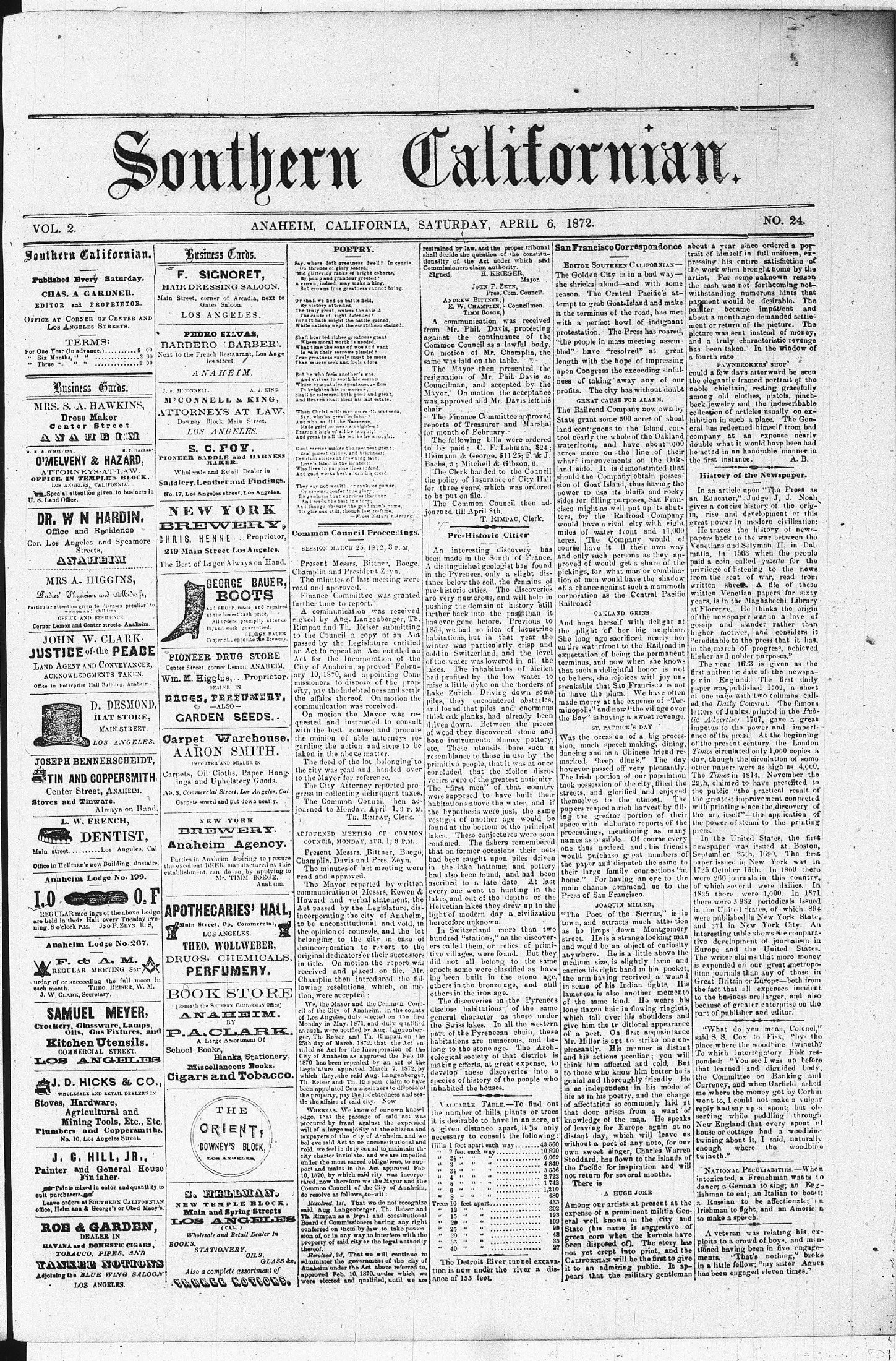
Searchable text
Southern Californian.
Published Every Saturday.
CHAS. A GARDNER.
EDITOR and PROPRIETOR.
OFFICE AT CORNER OF CENTER AND
LOS ANGELES STREETS.
TERMS:
For One Year (in advance.)... 5 00
" Six Months," " " ... 3 00
" Three "... 2 00
Business Cards.
MRS. S. A. HAWKINS,
Dress Maker
Center Street
ANAHEIM
M. K. B. O'MELVENY,
M. T. HAZARD
O'MELVENY & HAZARD,
ATTORNEYS-AT-LAW.
OFFICE. IN TEMPLE'S BLOCK,
LOS ANGELES, CALIFORNIA.
Special attention given to business in
U. S. Land Office.
Business Cards.
F. SIGNORET,
HAIR DRESSING SALOON.
Main Street, corner of Arcadia, next to
Gates' Saloon,
LOS ANGELES.
PEDRO SILVAS,
BARBERO (BARBER).
Next to the French Restaurant, Los Angele
les street,
ANAHEIM.
J. R. M'CONNELL.
A. J. KING.
M'CONNELL & KING,
ATTORNEYS AT LAW,
Downey Block, Main Street.
LOS ANGELES.
S. C. FOY.
PIONEER SADDLE and HARNESS
MAKER.
Wholesale and Retail Dealer in
Saddlery, Leather and Findings.
No. 17, Los Angeles street, Los Angeles.
MRS. S. A. HAWKINS,
Dress Maker
Center Street
ANAHEIM
M. K. B. O'MELVENY &
HAZARD,
ATTORNEYS AT LAW.
OFFICE, IN TEMPLE'S BLOCK,
LOS ANGELES, CALIFORNIA.
Special attention given to businesses in U.S. Land Office.
DR. W N HARDIN.
Office and Residence
Cor. Los Angeles and Sycamore Streets,
ANAHEIM
MRS A. HIGGINS,
Ladies' Physician and Midwife,
Particular attention given to diseases peculiar to women and children.
OFFICE AND RESIDENCE
Corner Lemon and Center streets. Anaheim.
JOHN W. CLARK.
JUSTICE of the PEACE
LAND AGENT AND CONVEYANCER,
ACKNOWLEDGMENTS TAKEN.
Office in Enterprise Hall Building, Anaheim.
D. DESMOND,
HAT STORE,
MAIN STREET,
LOS ANGELES.
JOSEPH BENNERSCHEIDT,
TIN AND COPPERSMITH
Center Street, Anaheim.
Stoves and Tinware.
Always on Hand.
L. W. FRENCH,
DENTIST,
Main street...Los Angeles, Cal.
Office in Hellman's new Building, dnstairs.
Anaheim Lodge No. 199.
I.O. O.F.
REGULAR meetings of the above Lodge are held in their Hall every Tuesday evening, 8 o'clock P.M.
JNO P. ZEYN, R. S.
Anaheim Lodge No. 207.
M'CONNELL & KING,
ATTORNEYS AT LAW,
Downey Block, Main Street.
LOS ANGELES.
S. C. FOY.
PIONEER SADDLE and HARNESS MAKER.
Wholesale and Retail Dealer in Saddlery, Leather and Findings.
No. 17, Los Angeles street, Los Angeles.
NEW YORK
BREWERY,
CHRIS. HENNE...Proprietor,
219 Main Street Los Angeles.
The Best of Lager Always on Hand.
GEORGE BAUER,
BOOTS
and SHOES, made and repaired at the lowest cash price.
All orders promptly attend to, and work guaranteed.
GEORGE BAUER
Center St., opposite the Brewery.
PIONEER DRUG STORE
Center Street, corner Lemon: ANAHEIM.
Wm. M. Higgins,...Proprietor.
DEALER IN
DRUGS, PERFUMERY,
-ALSOCARDEN SEEDS...
Carpet Warehouse.
AARON SMITH.
IMPORTER AND DEALER IN
Carpets, Oil Cloths, Paper Hangings and Upholstery Goods.
No. 5, Commercial Street, Los Angeles, Cal.
Carpets sewed and put down neatly.
NEW YORK
BREWERY.
Anaheim Agency.
Parties in Anaheim desiring to procure the excellent BEER manufactured at this establishment, can do so, by applying to Mr. TIMM BOEGE.
Anaheim.
APOTHECARIES' HALL,
Main Street, Op. Commercial,
LOS ANGELES.
THEO. WOLLWEBER,
DRUGS, CHEMICALS,
When Christ was Say, who so And who, as did Made grief so Example high o And great in all
Good service ma Zeal purest th Devotion amiles Love's labor Who lives to pu And good work They say not not Or crowns co The goodness th And reads th And though ob Tis glorious at
Common O
SESSION M
Present Champlin an The minute read and ap Finance further time A commin signed by Rimpau and to the Court passed by the Act to re Act for the City of Ana ary 10, 187 missioners city, pay th the affairs communica On motion quested am with the bo the opinion garding th taken in th The deed the city wa to the Maye The City gress in col The Con journed to
ADJOURNED COUNCIL,
Present Champlin an The minute read and a The Ma communication Howard a Act passed incorporati to be unce the opinion belonging disincorp or original de
Office in Hellman's new Building, dnstairs.
Anaheim Lodge No. 199.
I.O. O.F.
REGULAR meetings of the above Lodge are held in their Hall every Tuesday evening, 8 o'clock P.M. JNO P. ZEYN, R.S.
Anaheim Lodge No. 207.
F. & A. M.
REGULAR MEETING Saturday of or succeeding the full moon in each month. THEO. REISER, W. M.
J. W. CLARK, Secretary.
SAMUEL MEYER,
Crockery, Glassware, Lamps,
Oils, Gas Fixtures, and
Kitchen Utensils.
COMMERCIAL STREET.
LOS ANGELES
J. D. HICKS & CO., WHOLESALE AND RETAIL DEALERS IN Stoves, Hardware, Agricultural and Mining Tools, Etc., Etc.
Plumbers and Coppersmiths.
No. 10, Los Angeles Street.
J. C. HILL, JR., Painter and General House Finisher.
Paints mixed in color and quantity to suit purchaser.
Leave orders at SOUTHERN CALIFORNIAN office, Heim ann & George's or Obed Macy's.
ROE & GARDEN,
DEALER IN HAVANA and DOMESTIC CIGARS, TOBACCO, PIPES, AND YANKED NOTIONS
Adjoining the BLUE WING SALOON
LOS ANGELES.
APOTHECARIES' HALL,
Main Street, Op. Commercial,
LOS ANGELES.
THEO. WOLLWEBER,
DRUGS, CHEMICALS,
PERFUMERY.
BOOK STORE
[Beneath the SOUTHERN CALIFORNIAN Office]
ANAHEIM.
BY
P.A. CLARK.
A Large Assortment Of School Books,
Blanks, Stationery,
Miscellaneous Books.
Cigars and Tobacco.
THE ORIENT;
DOWNEY'S BLOCK,
LOS ANGELES.
S. HELLMAN,
NEW TEMPLE BLOCK,
Main and Spring Streets
LOS ANGELES
(CAL.)
Wholesale and Retail Dealer In BOOKS,
STATIONERY.
OILS.
GLASS &
Also a complete assortment of VARIABLE NOTIONS.
Yern California
NAHEIM, CALIFORNIA, SATURDAY, APRIL 6, 1872.
POETRY.
Say, where doth greatness dwell? In courts,
On thrones of glory seated.
Mid glittering ranks of bright cohorts,
By pomp and grandeur greeted?
A crown, indeed, may make a king.
But crowns true greatness cannot bring.
Or shall we find on battle field,
By victory attended.
The truly great, unless the shield
The cause of right defended?
Porous hath might the battle gained,
While nations wept the execution stained.
Shall hoarded riches greatness grant
Where moral worth is needed.
What time the sons of woe and want
In vain their sorrows pleaded?
True greatness surely must be more
Than misers seek and fools adore.
But he who feels another's woe,
And strives to soothe his sorrow
Whose sympathies spontaneous flow
To brighten his to-morrow,
Shall be esteemed both good and great,
And Heaven shall bless his last estate.
When Christ with men on earth was seen,
Say, who so great in labor?
And who, as did the Nazareene,
Made grief so near a neighbor?
Example high of all be taught;
And great in all the works he wrought.
Good service makes the meekest great;
Zeal purest shines, and brightest;
Devotion amiles at freewing fate;
Love's labor is the lightest;
Who lives to purpose lives indeed;
And good works best adorn his creed.
They say not wealth, or rank, or power,
Or crowns, confer true glory;
His goodness that survives the hour
And reads the beat in story;
And though obscure the good man's name,
restrained by law, and the proper tribunal shall decide the question of the constitutionality of the Act under which said Commissioners claim authority.
Signed, H. KROGER,
Mayor.
John P. ZEYN,
Pres. Com. Council.
ANDREW BITTNER,
E. W. CHAMPLIN,
Councilmen.
TIMM BOERG,
A communication was received from Mr. Phil Davis, protesting against the continuance of the Common Council as a lawful body.
On motion of Mr. Champlin, the same was laid on the table.
The Mayor then presented the resignation of Mr. Phil Davis as Councilman, and accepted by the Mayor. On motion the acceptance was approved and Mr. Davis left his chair.
The Finance Committee approved reports of Treasurer and Marshal for month of February.
The following bills were ordered to be paid: C. F. Lehman, $24; Heimann & George, $11 25; F. & J. Bachs, 5; Mitchell & Gibson, 6.
The Clerk handed to the Council the policy of insurance of City Hall for three years, which was ordered to be put on file.
The Common Council then ad-
San Francisco Corr
Editor Southern C
The Golden City is in she shrinks aloud—and reason. The Central tempt to grab Goat Island it the terminus of the with a perfect howl protestation. The Pre“the people in mass mended” have “resolved length with the hope upon Congress the exteness of taking away profits. The city has GREAT CAUSE FOR The Railroad Company State grant some 500 land contiguous to the trol nearly the whole waterfront, and have acres more on the wharf improvements land side. It is dem should the Company sion of Goat Island, the power to use its blides for filling purposes since might well
Common Council Proceedings.
SESSION MARCH 25, 1872, 3 P.M.
Present Messrs. Bittner, Boege, Champlin and President Zeyn.
The minutes of last meeting were read and approved.
Finance Committee was granted further time to report.
A communication was received signed by Aug. Langenberger, Th. Rimpau and Th. Reiser submitting to the Council a copy of an Act passed by the Legislature entitled an Act to repeal an Act entitled an Act for the Incorporation of the City of Anaheim, approved February 10, 1870, and appointing Commissioners to dispose of the property, pay the indebtedness and settle the affairs thereof. On motion the communication was received.
On motion the Mayor was requested and instructed to consult with the best counsel and procure the opinion of able attorneys regarding the action and steps to be taken in the above matter.
The deed of the lot belonging to the city was read and handed over to the Mayor for reference.
The City Attorney reported progress in collecting delinquent taxes.
The Common Council then adjourned to Monday, April 1, 3 P.M.
Th. Rimpau, Clerk.
ADJOURNED MEETING OF COMMON COUNCIL, MONDAY, APR. 1, 3 P.M.
Present Messrs. Bittner, Boege, Champlin, Davis and Pres. Zeyn.
The minutes of last meeting were read and approved.
The Mayor reported by written communication of Messrs. Kewen and Howard and verbal statement, the Act passed by the Legislature, disincorporating the city of Anaheim, to be unconstitutional and void, in the opinion of counsels, and the lot belonging to the city in case of disincorporation to revert to the original dedicators or their successors.
An interesting discovery has been made in the South of France. A distinguished geologist has found in the Pyrenees, only a slight distance below the soil, the remains of pre-historic cities. The discoveries are very numerous, and will help in pushing the domain of history still farther back into the past than it has ever gone before. Previous to 1854, we had no idea of lacustrine habitations, but in that year the winter was particularly crisp and cold in Switzerland, and the level of the water was lowered in all the lakes. The inhabitants of Meilen had profited by the low water to raise a little dyke on the borders of Lake Zurich. Driving down some piles, they encountered obstacles, and found that piles and enormous thick oak planks, had already been driven down. Between the pieces of wood they discovered stone and bone instruments, clumsy pottery, etc. These utensils bore such a resemblance to those in use by the primitive people, that it was at once concluded that the Meilen discoveries were of the greatest antiquity. The "first men" of that country were supposed to have built their habitations above the water, and if the hypothesis were just, the same vestiges of another age would be found at the bottom of the principal lakes. These conjectures were soon confirmed. The fishers remembered that on former occasions their nets had been caught upon piles driven in the lake bottoms; and pottery had also been found, and had been ascribed to a late date. At last every one went to hunting in the lakes, and out of the depths of the Helvetian lakes they drew up to the light of modern day a civilization heretofore unknown.
In Switzerland more than two hundred "stations," as the discoverers called them, or relies of primitive villages, were found. But they did not all belong to the same land contiguous to the trool nearly the whole waterfront, and have acres more on the wharf improvements on land side. It is demission should the Company vision of Goat Island, this power to use its blue sides for filling purpose cisco might as well patrons, for the Railroad would have a rival miles of water from acres. The Company course have it ll th and only such person proved of would get pickings, for what maction of men would have of a chance against su corporation as the C Railroad?
OAKLAND G
And hugs herself with the plight of her life. She long ago sacrificed entire waterfront to the expectation of being terminus, and now wished that such a delightful to be hers, she rejoiced speakable that San Fiori to have the plum made merry at the exminopolis" and now "the Bay" is having a change.
ST. PATRICK'
Was the occasion on sion, much speech made dancing and as a Chie marked, "heep durn however passed off with The Irish portion of took possession of the streets, and glorified themselves to the papers reaped arising the greater po space with elaborate proceedings, mention names as possible. One thus noticed a would purchase groat the paper and dispatch their large family home." For having main chance commissure Press of San Francisco.
JOAQUIN M
"The Poet of the town, and attracts as he limps down street. He is a strand and would be an object anywhere. He is a large size island."
The Mayor reported by written communication of Messrs. Kewen & Howard and verbal statement, the Act passed by the Legislature, disincorporating the city of Anaheim, to be unconstitutional and void, in the opinion of counsels, and the lot belonging to the city in case of disincorporation to revert to the original dedicators or their successors in title. On motion the report was received and placed on file. Mr. Champlin then introduced the following resolutions, which, on motion, were accepted:
We, the Mayor and the Common Council of the City of Anaheim, in the county of Los Angeles, duly elected on the first Monday in May, 1871, and duly qualified as such, were notified by Aug. Langenberger, Th. Reiser and Th. Rimpau, on the 25th day of March, 1872, that the Act entitled an Act for the Incorporation of the City of Anaheim as approved the Feb. 10, 1870 has been repealed by an act of the Legislature approved March 7, 1872, by which they, the said Aug. Langenberger, Th. Reiser and Th. Rimpau claim to have been appointed Commissioners to dispose of the property, pay the indebtedness and settle the affairs of said city. Now
Whereas We know of our own knowledge that the passage of said act was procured by fraud against the expressed will of a large majority of the citizens and taxpayers of the city of Anaheim, and we believe said Act to be unconstitutional and void, we feel in duty bound to maintain the city charter inviolate, and we are impelled under the most sacred obligations, to support and maintain the Act approved Feb. 10, 1870, by which said city was incorporated, now therefore we the Mayor and the Common Council of the City of Anaheim, do resolve as follows, to-wit:
Resolved, 1st That we do not recognize said Aug. Langenberger, Th. Reiser and Th. Rimpau as a legal and constitutional Board of Commissioners having any right conferred on them by law to take possession of, or in any way to interfere with the property of said city or the legal authority thereof.
Resolved, 2d That we will continue to administer the government of the city of Anaheim under the Act above referred to, approved Feb. 10, 1870. under which we were elected and qualified, until we are had been caught upon piles driven in the lake bottoms; and pottery had also been found, and had been ascribed to a late date. At last every one went to hunting in the lakes, and out of the depths of the Helvetian lakes they drew up to the light of modern day a civilization heretofore unknown.
In Switzerland more than two hundred "stations," as the discoverers called them, or relies of primitive villages, were found. But they did not all belong to the same epoch; some were classified as having been built in the stone age, others in the bronze age, and still others in the iron age.
The discoveries in the Pyrenees disclose habitations of the same general character as those under the Swiss lakes. In all the western part of the Pyrenean chain, these habitations are numerous, and belong to the stone age. The Archaeological society of that district is making efforts, at great expense, to develop these discoveries into a species of history of the people who inhabited the houses.
VALUEABLE TABLE.—To find out the number of hills, plants or trees it is desirable to have in an acre, at a given distance apart, it is only necessary to consult the following:
Hills 1 foot apart each way...43,560
2 feet each way...10,890
2½ feet each way...6,069
3 feet each way...4,840
3½ feet each way...3,556
4 feet each way...2,722
5 feet each way...1,742
6 feet each way...1,210
8 feet each way...680
Trees 10 feet apart...435
12 feet apart...202
15 feet apart...193
20 feet apart...109
25 feet apart...98
30 feet apart...48
35 feet apart...35
40 feet apart...27
The Detroit River tunnel excavation is now under the river a distance of 155 feet.
JOAQUIN M.
"The Poet of the town, and attracts me as he limps down street. He is a strange and would be an object anywhere. He is a medium size, is slightly carries his right hand; the arm having receded in some of his Indian lameness is also an odd of the same kind. Long flaxen hair in which fall over his give him the tr ditition of a poet. On first Mr. Miller is apt to pleasantly. His mind and his actions peculiar think him affected to those who know genial and thorough life as in his poetry, of affectation so conducive that door arises from knowledge of the nature of leaving for Europe distant day, which without a poet of a own sweet singer,
Stoddard, has flown the Pacific for inspiration not return for sovereign There is
A HUGE
Among our artists are expense of a prominent well known State (his name is green corn when it been disposed of). Not yet crept into California will be it to an admiring pears that the mi-
San Francisco Correspondence
EDITOR SOUTHERN CALIFORNIAN—
The Golden City is in a bad way—the shrieks aloud—and with some reason. The Central Pacific's attempt to grab Goat Island and make it the terminus of the road, has met with a perfect bowl of indignant protestation. The Press has roared, the people in mass meeting assembled" have "resolved" at great length with the hope of impressing upon Congress the exceeding sinfulness of taking away any of our profits. The city has without doubt GREAT CAUSE FOR ALARM.
The Railroad Company now own by state grant some 500 acres of shoal and contiguous to the Island, control nearly the whole of the Oakland waterfront, and have about 600 acres more on the line of their shaft improvements on the Oakland side. It is demonstrated that should the Company obtain possession of Goat Island, thus having the power to use its bluffs and rockyides for filling purposes, San Francisco might as well put up its shutabout a year since ordered a portrait of himself in full uniform, expressing his entire satisfaction of the work when brought home by the artist. For some unknown reason the cash was not forthcoming notwithstanding numerous hints that payment would be desirable. The painter became impatient and about a month ago demanded settlement or return of the picture. The picture was sent instead of money, and a truly characteristic revenge has been taken. In the window of a fourth rate PAWNBROKERS' SHOP could a few days afterward be seen the elegantly framed portrait of the noble chieftain, resting gracefully among old clothes, pistols, pinchbeck jewelry and the indescribable collection of articles usually on exhibition in such a place. The General has redeemed himself from bad company at an expense nearly double what it would have been had he acted in an honorable manner in the first instance.
A. B.
History of the Newspaper.
In an article upon "The Press as an Educator," Judge J. J. Noah gives a concise history of the orig-
The Railroad Company now own by state grant some 500 acres of shoal and contiguous to the Island, control nearly the whole of the Oakland waterfront, and have about 600 acres more on the line of their charf improvements on the Oakland side. It is demonstrated that should the Company obtain possession of Goat Island, thus having the power to use its bluffs and rocky sides for filling purposes, San Francisco might as well put up its shuters, for the Railroad Company would have a rival city with eight miles of water front and 11,000 acres. The Company would of course have it all their own way and only such persons as they approved of would get a share of the pickings, for what man or combination of men would have the shadow off a chance against such a mammoth corporation as the Central Pacific Railroad?
OAKLAND GRINS
And hugs herself with delight at the plight of her big neighbor. She long ago sacrificed nearly her entire waterfront to the Railroad in expectation of being the permanent terminus, and now when she knows that such a delightful honor is not to be hers, she rejoices with joy unpeakable that San Francisco is not to have the plum. We have often made merry at the expense of "Terminopolis" and now "the village over the Bay" is having a sweet revenge.
ST. PATRICK'S DAY
Was the occasion of a big procession, much speech making, dining, dancing and as a Chinese friend remarked, "heep dunk." The day however passed off very pleasantly. The Irish portion of our population took possession of the city, filled the streets, and glorified and enjoyed themselves to the utmost. The papers reaped a rich harvest by filling the greater portion of their space with elaborate reports of the proceedings, mentioning as many names as possible. Of course every one thus noticed and his friends would purchase great numbers of the paper and dispatch the same to their large family connections "at home." For having an eye to the main chance commend us to the Press of San Francisco.
JOAQUIN MILLER,
"The Poet of the Sierras," is in town, and attracts much attention as he limps down Montgomery street. He is a strange looking man and would be an object of curiosity anywhere. He is a little above the medium size is slightly lame and beck jewelry and the indescribable collection of articles usually on exhibition in such a place. The General has redeemed himself from bad company at an expense nearly double what it would have been had he acted in an honorable manner in the first instance.
History of the Newspaper.
In an article upon "The Press as an Educator," Judge J. J. Noah gives a concise history of the origin, rise and development of this great power in modern civilization:
He traces the history of newspapers back to the war between the Venetians and Solyman II, in Dalmatia, in 1563 when the people paid a coin called gazetta for the privilege of listening to the news from the seat of war, read from written sheets. A file of these written Venetian papers for sixty years, is in the Maghabechi Library at Florence. He thinks the origin of the newspaper was in a love of gossip and slander rather than higher motives, and considers it "creditable to the press that it has, in the march of progress, achieved higher and nobler purposes."
The year 1623 is given as the first authentic date of the newspaper in England. The first daily paper was published 1702, a sheet of one page with two columns called the Daily Courant. The famous letters of Junius, printed in the Public Advertiser 1767, gave a great impetus to the power and importance of the press. At the beginning of the present century the London Times circulated only 1,000 copies a day, though the circulation of some other papers were as high as 4,000. The Times in 1814, November the 29th, claimed to have presented to the public "the practical result of the greatest improvement connected with printing since the discovery of the art itself"—the application of the power of steam to the printing press.
In the United States, the first newspaper was issued at Boston, September 25th, 1690. The first paper issued in New York was in 1725 October 16th. In 1800 there were 266 journals in this country, of which several were dailies. In 1835 there were 1,000. In 1871 there were 5,982 periodicals issued in the United States, of which 894 were published in New York State, and 371 in New York City. An interesting table shows the comparative development of journalism in Europe and the United States. The writer claims that more money
JOAQUIN MILLER,
"The Poet of the Sierras," is in town, and attracts much attention as he limps down Montgomery street. He is a strange looking man and would be an object of curiosity anywhere. He is a little above the medium size, is slightly lame and carries his right hand in his pocket, the arm having received a wound in some of his Indian fights. His lameness is also another memento of the same kind. He wears his long flaxen hair in flowing ringlets, which fall over his shoulders and give him the traditional appearance of a poet. On first acquaintance Mr. Miller is apt to strike one unpleasantly. His manner is distant and his actions peculiar; you will think him affected and cold. But to those who know him better he is genial and thoroughly friendly. He is as independent in his mode of life as in his poetry, and the charge of affectation so commonly laid at that door arises from a want of knowledge of the man. He speaks of leaving for Europe again at no distant day, which will leave us without a poet of any note, for our own sweet singer, Charles Warren Stoddard, has flown to the Islands of the Pacific for inspiration and will not return for several months.
There is
A HUGE JOKE
Among our artists at present at the expense of a prominent militia General well known in the city and State (his name is suggestive of green corn when the kernels have been disposed of). The story has not yet crept into print, and the Californian will be the first to give it to an admiring public. It appears that the military gentleman
"What do you mean, Colonel," said S. S. Cox to Fisk, "by the place where the woodbine twineth? To which interrogatory Fisk responded: 'You see I was up before that learned and dignified body, the Committee on Banking and Currency, and when Garfield asked me where the money got by Corbin went to, I could not make a vulgar reply and say up a spout; but observing while peddling through New England that every spout of house or cottage had a woodbine twining about it, I said, naturally enough where the woodbine twineth."
NATIONAL PECULIARITIES.—When intoxicated, a Frenchman wants to dance; a German to sing; an Englishman to eat; an Italian to boast; a Russian to be affectionate; an Irishman to fight, and an American to make a speech.
A veteran was relating his exploits to a crowd of boys, and mentioned having been in five engagements. "That's nothing," broke in a little fellow; "my sister Agnes has been engaged eleven times."