anaheim-gazette 1872-03-23
Scanned page
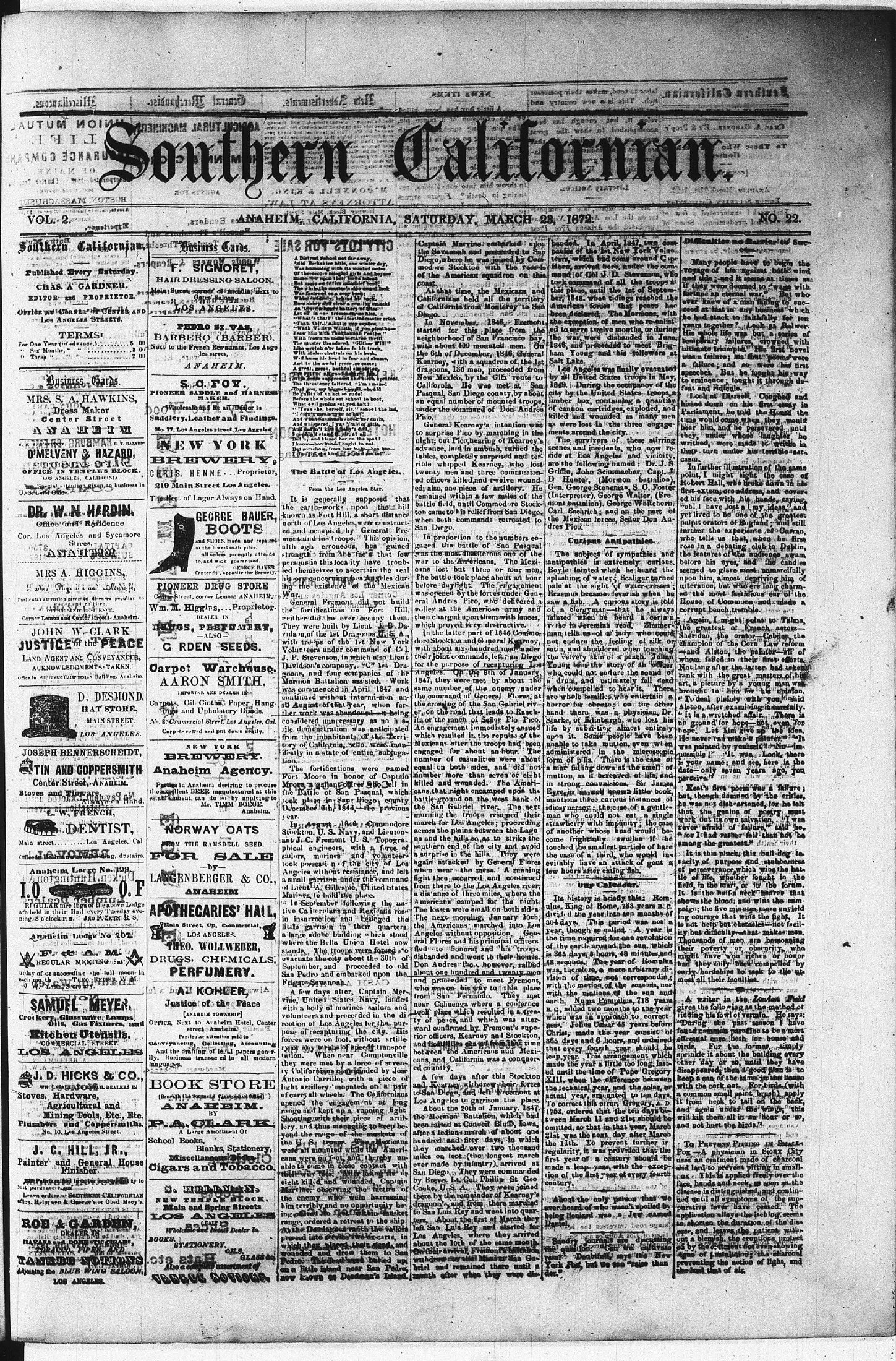
Searchable text
Southern California
VOL. 2.
Southern California Business Cards.
Published Every Saturday.
CHAS. A GARDNER.
EDITOR and PROPRIETOR.
Office at Corner of Center and Los Angeles Streets.
TERMS:
For One Year (limited sunday)...5 00
" Six Months," " ...3 00
" Threep."...2 00
Business Cards.
MRS. S. A. HAWKINS,
Dress Maker
Center Street
ANAHEIM
O'MELVENY & HAZARD,
STOCKENS CO. LAW
OFFICE IN TEMPLE'S BLOCK,
LOS ANGELES, CALIFORNIA.
Special attention given to business in U.S. Land Office.
F. SIGNORET,
HAIR DRESSING SALOON.
Main Street corner of Archdale next to Gates Saloon.
LOS ANGELES.
PEDRO SI VAS,
BARBERO (BARBER).
Next to the French Restaurant, Los Angeles street,
ANAHEIM.
S. C. FOY.
PIONEER SADDLE and HARNESS MAKER.
Wholesale and He all Dealer in Saddlery, Leather and Findings.
No. 17, Los Angeles street, Los Angeles.
NEW YORK BREWERY.
CHRIS HENNE...Proprietor,
219 Main Street Los Angeles.
The Best of Lager Always on Hand.
Dress Maker
Center Street
ANAHEIM
O'MELVENY & HAZARD,
STOCKING & LAW
OFFICE IN TEMPLE'S BLOCK,
LOS ANGELES, CALIFORNIA.
Special attention given to business in
U.S. Land Office.
DR. W. N. HARDIN.
Office and Residence
Cor. Los Angeles and Sycamore
Streets,
ANAHEIM.
MRS A. HIGGINS,
Ladies' Physician and Medici,
Particular attention given to diseases peculiar to
sanitary and children.
OFFICE AND RESIDENCE.
Cornor Lemon and Center streets. Anaheim.
JOHN W. CLARK
JUSTICE of the PEACE
LAND AGENT AND CONVEYANCER,
ACKNOWLEDGMENTS TAKEN.
Office in Southern California Building. Anaheim.
D. DESMOND,
HAT STORE,
MAIN STREET.
LOS ANGELES.
JOSEPH BENNERSCHEIDT,
TIN AND COPPERSMITH.
Center Street, Anaheim.
Stoves and Finware.
Always on Hand.
L. W. FRENCH,
DENTIST,
Main street...Los Angeles, Cal.
Office at Holloway Building, dnstairs.
Anaheim Lodge No. 199.
I.O. 0.F.
REGULAR meetings of the above Lodge are held in their Hall every Tuesday evening. 8 o'clock P.M.
Anaheim Lodge No 202.
Wholesale and Reall Dealer in Saddley, Leather and Findings.
No. 17. Los Angeles street, Los Angeles.
NEW YORK
BREWERY.
CHRIS. HENNE...Proprietor,
219 Main Street Los Angeles.
The Host of Lager Always on Hand.
GEORGE BAUER,
BOOTS
and SHOES, made and repaired at the lowest cash price.
All orders promptly attested to, and work guaranteed.
GEORGE BAUER
Center St., opposite the Brewery.
PIONEER DRUG STORE
Center Street, corner Lemon: Anaheim.
Wm. M. Higgins,...Proprietor.
DEALER IN
DRUGS, PREFUMERY,
- ALSO -
GARDEN SEEDS.
Carpet Warehouse.
AARON SMITH.
IMPORTER AND DEALER IN
Carpets, Oil Cloths, Paper Hangings and Upholstery Goods.
No. 8. Commercial Street, Los Angeles, Cal.
Carpets sewed and put down neatly.
NEW YORK
BREWERY.
Anaheim Agency.
Parties in Anaheim desiring to procure the excellent BEER manufactured at this establishment, can do so by applying to Mr. TIMM BOEGE.
Anaheim.
NORWAY OATS
FROM THE RAMSDELL SEED.
FOR SALE
-byLANGENBERGER & CO., Anaheim
APOTHECARIES' HALL,
Main Street, Op. Commercial,
LOS ANGELES.
THEO. WOLLWEBER,
DRUGS, CHEMICALS.
ANAHEIM LODGE No. 109.
I.O.F.
REGULAR meetings of the above Lodge are held in their Hall every Tuesday evening at 8 o'clock P.M. JNO P. ZEYN R.S.
ANAHEIM LODGE No. 202
F. & A. M.
REGULAR MEETING on Saturday of or succeeding the full moon in such month as TURGO, BERGEN W. M.
J.W. LAKE, Secrety.
SAMUEL MEYER,
Crockery, Glassware, Lamps, Oils, Gas Fixtures, and Kitchen Utensils.
COMMERCIAL STREET.
LOS ANGELES
J. D. HICKS & CO., who specializes in FALL DEALERS IN Stoves, Hardware, Agricultural and Mining Tools, Etc., Etc. Plumbers and Coppersmiths.
No. 10, Los Angeles Street.
J. C. HILL, JR., Painter and General House Finisher.
Lease orders in SOUTHERN CALIFORNIAN office. Relevant & General or Old Mary's.
ROE & GARDEN,
DEALER IN HAWKES AND SONOR OF GRAINS, TOBACCO, PIPES, AND TANNER NOTIONS
Adjoining the BLUE WING SALOON, LOS ANGELES.
FOR SALE
byLANGENBERGER & CO., ANAHEIM
APOTHECARIES' HALL,
Main Street, Op. Commercial,
LOS ANGELES.
THEO. WOLLWEDER,
DRUGS, CHEMICALS,
PERFUMERY.
A KOHLER,
Justice of the Peace
[ANAHEIM TOWNSHIP]
OFFICE, Next to Anaheim Hotel, Center street Anaheim.
Particular attention paid to Conveyancing, Collecting, Accounting
And the drafting of legal papers generally. Business transacted in all modern languages.
BOOK STORE
[Beneath the Sorcerary (California)] ANAHEIM.
BY
P.A. CLARK.
A Large Assortment Of School Books,
Blanks, Stationery,
Miscellaneous Cigars and Tobacco.
S. ERIEL MAN,
NEW TEMPLE STOCK.
Main and Spring Streets
LOS ANGELES
(CARED)
Wholesale and Install Dealer in BOOKS,
STATIONERY,
OILS,
GLASS DOE
Also a complete department of 700006 5071068.
EERN CALIFORNIA
HEIM, CALIFORNIA, SATURDAY, MARCH 23, 1872.
A District school not far away,
"Mid Berkshire hills, one winter day,
Was humming with its wonted noise
Of threecore migrated girls and boys,
Some few upon their births hast!
But more on fallen mischief here!
The whistle the master's new dream back
Was fastened on a copy book;
Which suddenly behind his head
Raised abeydant clear a revolving smash!
An 'tory' honey battery of time
Let off in one trembling him.
"What's that?" the startled master erased.
"That this?" a little app wept.
"Wath William Willitt. If you pleadhe—
I saw him kilt Thuthannah Feathe."
With frown to mind stern thrill.
The master thundered. "Hither Will!"
Like welch over taken in his track,
With stolen chatteels on his back.
Will hung his head in fear and shame,
And to the awful press came:
A great, green, baskful simplestion.
The butt of a groundward horn
Whitilde suppressed and bismil preplied.
The threatener faltered. "I'm amazed
That you, my biggest pugil, should
Be guilty of an act rude!
Before the whole set school to boot,
What will genius set you to?
""Twas she, herself, sir," sobbed the lad,
"I didn't mean it at all!
And when no one shook her curls,
And whispered, I was frald of girl,
And didn't kill nobody's doll,
And didn't kill anybody's dolls,
But up and kissed her on the spot!
I know—boo indeed! ought to not.
But somehow, from her book—boo boo—
I thought the kind of wildness to call."
The Battle of Los Angeles.
From the Los Angeles Star.
It is generally supposed that
the earth works upon the hill
Captain Marvine embarked upon
the Savannah and proceeded to San Diego, where he was joined by Commodore Stockton with the vessels
of the American squadron on this coast.
At that time, the Mexicans and
Californians held all the territory
of California from Monterey to San Diego.
In November, 1846, Fremont
started for this place from the
neighborhood of San Francisco bay,
with about 400 mounted men. On
the 6th of December, 1846, General
Kearney, with a squadron of the 1st
dragoons, 180 men, proceeded from
New Mexico, by the Gila route to
California. He was met at San
Pasqual, San Diego county, by about
an equal number of mounted troops,
under the command of Don Andres
Pico.
General Kearney's intention was to surprise Pico by marching in the night; but Pico hearing of Kearney's advance, laid in ambush, turned the tables, completely surprised and terrible whipped Kearney, who lost twenty men and three commissioned officers killed, and twelve wounded; also, one piece of artillery. He remained within a few miles of the battle field, until Commodore Stock-
banded. In April, 1846,
panies of the last New
tearn, which had come to Harnx arrived here, used
mand of Col J. D. Stuart took command of all this place, until the last ber, 1848, when tidings American forces that been declared. The Me
the exception of men wiled to serve twelve months the war were disbanded 1846, and proceeded to ham Young and his Salt Lake.
Los Angeles was finally by all United States troop 1849. During the occa-city by the United State limber box, containing of cannon cartridges, exkilled and wounded as were lost in the threements around the city.
The survivors of the scenes and incidents, we side at Los Angeles are the following named Griffin, John Schumachi D Hunter, (Mormon Gen. George Stoneman),
(Interpreter), George W mont battalion). George
The Battle of Los Angeles.
From the Los Angeles Star.
It is generally supposed that the earth works upon the hill known as Fort Hill, a short distance north of Los Angeles, were constructed and occupied by General Fremont and his troops. This opinion, although erroneous, has gained strength from the fact that few persons in this locality have troubled themselves to ascertain the real history concerning Los Angeles during the existence of the Mexican War.
General Fremont did not build the fortifications on Fort Hill; neither did he ever occupy them. They were built by Lieut B. Davidson, of the 1st Dragoons U.S.A., with troops of the 1st New York Volunteers under command of Col J. P. Stevenson, in which also Lieut Davidson's company, "C" 1st Dragoons, and four companies of the Mormon Battalion assisted. Work was commenced in April 1847 and continued without intermission until August of that year, when further work was abandoned—it being considered unnecessary as no hostile demonstration was anticipated from the inhabitants of the Territory of California, who were manifestly in a state of entire subjugation.
The fortifications were named Fort Moore in honor of Captain Moore, a gallant officer who fell in the Battle of San Pasqual, which took place in San Diego county December 6th, 1843—the previous year.
In August 1846, Commodore Stockton, U.S. Navy, and Lieutenant J.C. Fremont U.S. Topographical engineers, with a force of sailors, marines and volunteers took possession of the city of Los Angeles without resistance, and left a small garrison under the command of Lieut A. Gillespie, United States Marines, to hold the place.
In September following the native Californians and Mexicans rose in insurrection and besieged the little garrison in their quarters—a large adobe building which stood where the Bella Union Hotel now stands. The troops were formed so evacuate the city about the 30th of an equal number of mounted troops under the command of Don Andres Pico.
General Kearney's intention was to surprise Pico by marching in the night; but Pico hearing of Kearney's advance, laid in ambush, turned the tables, completely surprised and terrible whipped Kearney, who lost twenty men and three commissioned officers killed, and twelve wounded; also, one piece of artillery. He remained within a few miles of the battle field, until Commodore Stockton came to his relief from San Diego, when both commands retreated to San Diego.
In proportion to the numbers engaged, the battle of San Pasqual was the most disasterous one of the war to the Americans. The Mexicans lost but three or four men. The battle took place about an hour before daylight. The engagement was opened by the forces under General Andres Pico, who delivered a volley at the American army and then charged upon them with lances, which proved very destructive.
In the latter part of 1846 Commodore Stockton and General Kearney, with about six hundred men under their joint commands, left San Diego for the purpose of recapturing Los Angeles. On the 8th of January, 1847, they were met by about the same number of the enemy under the command of General Flores, at the crossing of the San Gabriel river, on the road that leads to Rancho or the ranch of Sesior Pio Pico. An engagement immediately ensued which resulted in the repulse of the Mexicans after the troops had been engaged for about an hour. The number of casualties were about equal on both sides, and did not number more than seven or eight killed and wounded. The Americans that night encamped upon the battle-ground on the west bank of the San Gabriel river. The next morning the troops resumed their march for Los Angeles; proceeding across the plains between the Laguna and the hills so as to strike the southern end of the city and avoid a surprise in the hills. They were again attacked by General Flores when near the messa. A running fight then occurred and continued from there to the Los Angeles river, a distance of three miles, where the Americans camped for the night. The losses were small on both sides. The next morning, January 10th, the Americans marched into Los Angeles without opposition. General Flores and his principal officers fled to Sonora; and his troops disbanded and went to their homes.
The survivors of the scenes and incidents we side at Los Angeles are the following named Griffin, John Schumachi D Hunter, (Mormon Gen. George Stoneman (Interpreter), George W. Mont battalion). George Carl Eschrich; and on the Mexican forces, Sendres Pico.
Curious Antipathies
The subject of sympanthesis is extremen Boyle fainted when he splashing of water; Scallopale at the sight of war Kreasmus became feverish saw a fish. A curious sigh of a clergyman—that fainted when he heard wise Jeremiah read man tells us not endure the feeling satin, and abuddered when the veilery skin of a per Young told the story of who could not endure tha drum, and ultimately when compelled to hear are whole families who will horror for choice: one hand there was a pharae Starke, of Edinburgh, who life by substituting almost upon it. Some people unable to take mutton administered in the form of pills. There is a mar falling down at tha mutton as if bereaved in strong convulsions. Eyes in his wet knappenments three curious in idiosyncrasy; the case oman who could not eat strawberry with impunity of another whose head come frightfully swollen touched the smallest partthe case of a thirdwho evitably have an attack few hours after eating firn.
Ung Calendar
Its history is briefly thus ulus, King of Rome, 283 divided the year into ten 304 days. This period year, though so called,the time required for one of the earth around tho is 365 days; 4 hours; 48 seconds.
In September following the native Californians and Mexicans rose in insurrection and besieged the little garrison in their quarters, a large adobe building which stood where the Bella Union Hotel now stands. The troops were formed to evacuate the city about the 30th of September, and proceeded to old San Pedro and embarked upon the Frigate Savannah.
A few days after, Captain Merville, United States Navy, landed with a body of marines sailors and volunteers and proceeded in the direction of Los Angeles for the purpose of recapturing the city. His forces were on foot, without artillery or any means of speedy transportation. When near Comptonville they were met by a force of seventy Californians commanded by Jose Antonio Carrillo, with a piece of light artillery mounted on a pair of carryall wheels. The Californians opened the engagement at long range and kept up a running fight. Shooting with their piece of artillery, and thus managing to keep beyond the range of the markets of the U.S. troops. The Mexicans were all mounted while the Americans were on foot, and thereby unable to come in close contact with their wily Tiles. After losing six or eight killed and wounded, Captain Marvine, observing the tactics of the enemy who were harrassing him terribly and no opportunity being offered to within musket range, ordered a retreat to the ship. As the Dominican naval the callos pressed into service two days in which then placed their land and wounded and drew them to San Pedro. The fleet was backed up on a little island near San Pedro, now known as Dundman's Island.
Again attacked by General Flores when near the mess. A running fight then occurred and continued from there to the Los Angeles river, a distance of three miles, where the Americans camped for the night. The losses were small on both sides. The next morning, January 10th, the Americans marched into Los Angeles without opposition. General Flores and his principal officers fled to Sonora, and his troops disbanded and went to their homes. Don Andres Pico, however, rallied about one hundred and twenty men and proceeded to meet Fremont, who was on his way to this place from San Fernando. They met near Cahuenga where a conference took place which resulted in a treaty of peace, and which was afterwards confirmed by Fremont's superior officers, Kearney and Stockton, and that millions of dollars from that time between the Americans and Mexicans, and California was a conquered country.
A few days after this Stockton and Kearney with drew their forces to San Diego, and left Freemont at Los Angeles to garrison the place.
About the 20th of January, 1847, the Mormon Battalion, which had been raised at Council Bluffs, Iowa, after a tedious march of about one hundred and fifty days, in which they marched over two thousand miles on foot (the longest march ever made by infantry), arrived at San Diego. They were commanded by Brevet Lt. Col. Phillip St Geo Cooke, U.S.A. They were joined there by the remainder of Kearney's dragoons, and from there marched to San Luis Rey and went into quarters. About the first of March they left San Luis Rey and started for Los Angeles, where they arrived about the 10th of the same month. On their arrival, Fremont's militia withdrew and Minnervin Gabriel and remained there until a month after when they were dis-
Its history is briefly titled "King of Rome," divided into ten 304 days. This period year, though so called, the time required for one of the earth around the earth is 365 days; 5 hours; 48 seconds. The year was therefore a mere vision of time, not corp with the motion of the earth. Numa Pompilius, n.c., added two months which was an approach to nature. Julius Caesar made the year 365 days and 6 hours, and that every fourth year leap year. This arrangement made the year a little too until the time of Populus XIII, when the difference in technical year, and actual year amounted to correct this error. Grettis 1752, ordered that the tenth between March 11 and 21st omitted, so that in that year 21st was the next day at the 11th. To prevent regularity, it was provided first year of a century made a leap year, with tion of the first year of eve century.
About the only person ever heard of who wasn't being lionized was a J Daniel.
Sandry journals on this question: Can we say York Post, but we can say Dent."
In April, 1847, two counties of the 1st New York Volunteer, which had come around Cape Cod, arrived here under the command of Col J. D. Stevenson, who took command of all the troops at its place until the 1st of September, 1848, when tidings reached the American forces that peace had been declared. The Mormons, with exception of men who re-enlisted to serve twelve months or during the war, were disbanded in June, 1848, and proceeded to meet Brigadier Young and his followers at St Lake.
Los Angeles was finally evacuated all United States troops in May, 1849. During the occupancy of the city by the United States troops, a bar box containing a quantity cannon cartridges exploded, and wounded as many men were lost in the three engagements around the city.
The survivors of these stirring times and incidents, who now reside at Los Angeles and vicinity, the following named: Dr. J. S. Finn, John Schumacher, Capt. J. Hunter, (Mormon battalion), George Stonenian, S. O. Foster (prepreter), George Walter, (Freeman battalion), George Whitehorn.
Difficulties no harder to succeed
Many people have to begin the voyage of life against both wind and tide; and it seems at times as if they were doomed to wage with fortune an eternal war. But who ever knew of a man failing to succeed at that in any business which he had stuck to faithfully for ten years together? Look at Relwer. His whole life was but a series of temporary failures, crowned with ultimate triumphs. His first novel was a failure; his first poems were a failure; and so were his first speeches. But he fought his way to eminence; fought it through defeat and miscalculation.
Look at Marcelli. Coughed and hissed down on his first essay in Parliament, he told the House the time would come when they would bear him, and he persevered until they, under whose laughter he writhed, were made to write in their turn under his terrible sarcasm.
In further illustration of the same point, I might sight the case of Robert Hall, who broke down in his first extempore address, and covered his face with his hands, saying, "oh! I have lost all my ideas."
over box, containing a quantity of cannon cartridges, exploded, and wounded as many men were lost in the three engagements around the city.
The survivors of these stirring tales and incidents, who now reside at Los Angeles and vicinity, are the following named: Dr. J. S. Finn, John Schumacher, Capt. J. Hunter, (Mormon battalion), George Stoneman, S. C. Foster (perpetrator), George Walter (freeman battalion). George Whitehorn, Eschrich; and on the part of the Mexican forces, Senor Don Antoy Pico.
Curious Antipathies.
The subjects of sympathies and pathies is extremely curious. He fainted when he heard the whining of water; Scaliger turned at the sight of water-cresses;ismus became feverish when he caught a fish. A curious story is told of a clergyman—that he always tried when he heard a certain noise in Jeremiah read. Zimmer tells us of a lady who could endure the feeling of silk or cotton, and abuddered when touching ivory skin of a peach. Julian tells the story of an officer who could not endure the sound of rum, and ultimately fell dead with compelled to hear it. There whole families who entertain a horror for choice; on the other there was a physician, Dr. Luke, of Edinburgh, who lost his by substituting almost entirely it. Some people have been able to take mutton, even when ministered in the microscopic study of pills. There is the case of her falling down at the smell of tonon, as if bereaved of life, and strong convulsions. Sir James Kinship in his well-known little book, mentions three curious instances of synergy; the case of a gentleman who could not eat a single orcherry with impunity; the case another whose head would be frightfully swollen if he touched the smallest particle of hard case of a third who would instantly have an attack of gout a hours after eating fish.
Our Calendar.
A history is briefly this: Romans King of Rome, 783 years old, died the year into ten months of days. This period was not a day though so called. A year is time required for one revolution on earth around the sun, which takes days, 4 hours, 40 minutes and seconds. The age of Romans is known.
In further illustration of the same point, I might sight the case of Robert Hall, who broke down in his first extempore address, and covered his face with his hands, saying "oh! I have lost all my ideas," and yet lived to be one of the greatest pulpit orators of England; and still further the experience of Curran, who tells us that, when he first rose in a debating club in Dublin, the features of the audience swam before his eyes, and the candles seemed to glare most unmercifully upon him, almost depriving him of utterance, but who are long charmed by the most fastidious ear of the House of Commons and made a corrupt bench tremble.
Again, I might point to Talma, the greatest of French actors—Sheridan, the orator—Cobden, the champion of the Corn Law reform—and Alston, the painter—all of whom failed in their first efforts. Not long after the latter had taken rank with the great masters of his art, a picture by a young man was brought to him for his opinion. To deal plainly with you, said Alston, after examining in carefully. It is a wretched affair. There is no ground for hope—not even for hope. Let him give up the idea. He never can make a painter. "It was painted by yourself." No—impossible!" "It was." Look, there is your name; and see here is the date—only seven years ago, you perceive."
Keats's first poem was a failure; but though damned by the critics, he was not disheartened; for he halt that the genius of poetry must work out its own salvation. "I was never afraid of failure," and he "for I had rather fall than not be among the greatest."
It is this pluck; this bull-dog tenacity of purpose and stubbornness of perseverance which wins the battle of life, whether fought in the field, in the marsh, or in the forum. It is the half-a-neck terrace that shows the blood; and wins the campaign; the five minutes more any yielding courage that wins the fight. It is not help but obstacles—not facility but difficulty—that makes men. Thousands of men are homoaning their poverty or obscurity, who might have won riches or honor
A writer in the London Field gives the following as the method of ridding his fowl of vermin. He says:
"During the past season I have found common parasite to be a most effectual one both for house and birds. For the former, simply sprinkle it about the building every other day or so, until they have disappeared; then a good plan is to keep a can of the same in this house with the cork out. For birds (with a common small paint brush), apply it from neck to tail on the back, and again under the wings; this will kill them all in no hour or so, and not hurt the birds."
To prevent pitting in Small-Pox—a physician in Sionx City uses an ointment made of charcoal and lard to prevent pitting in small-pox. This is applied freely over the face, hands and neck, as soon as the disease is distinguished, and continued until all symptoms of the suppurative fever have ceased. The application always the itching seems to shorten the duration of the disease, and leaves the patient without a blemish, the eruptions protected by the ointment for even showing signs of inflammation; the charcoal preventing the action of light, and the land that of air.