anaheim-gazette 1872-02-17
Scanned page
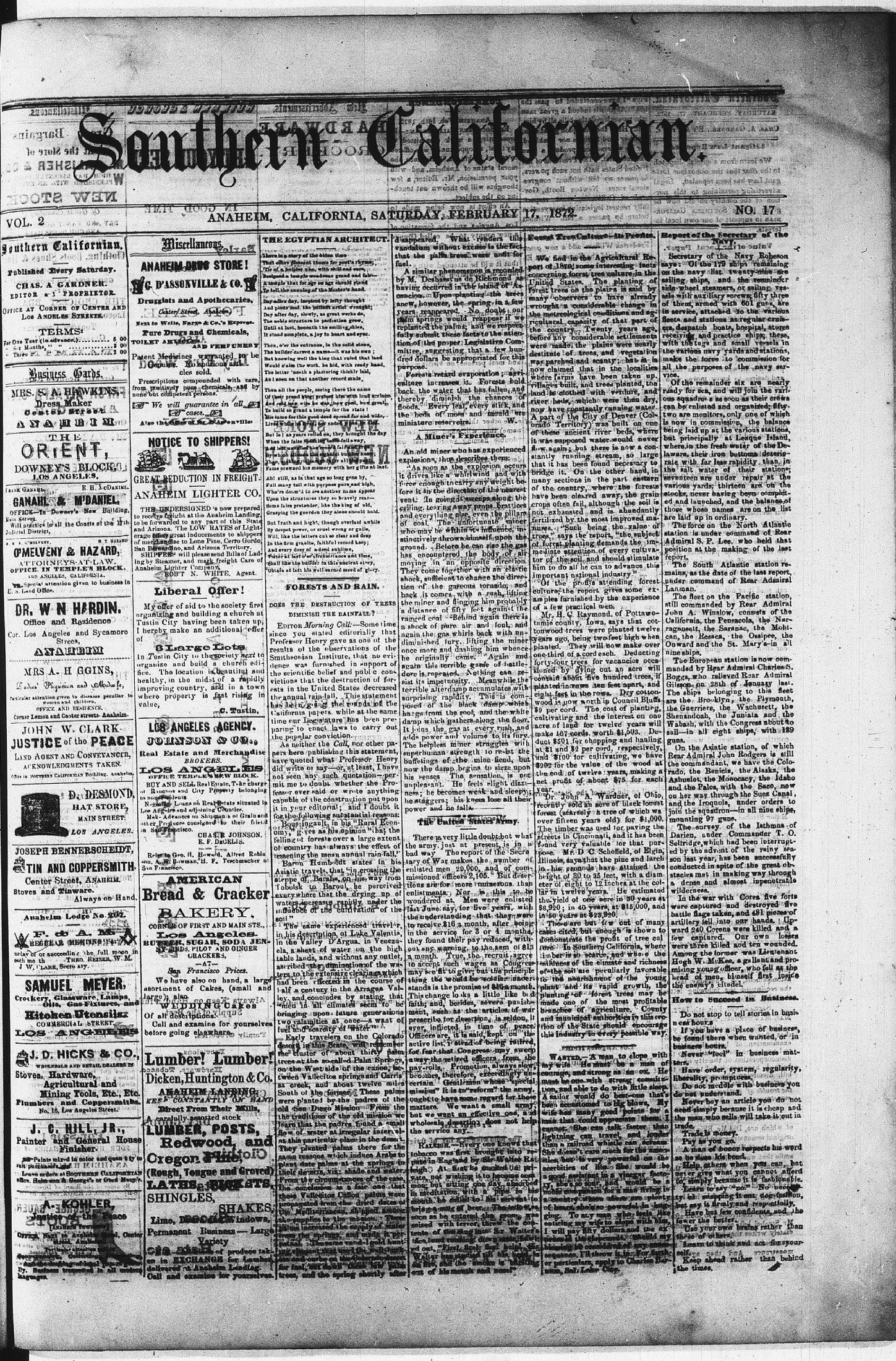
Searchable text
Southern Californian.
Published Every Saturday.
CHAS. A GARDNER.
EDITOR 1 PROPRIETOR.
OFFICE AT CORNER OF CENTER AND
LOS ANGELES STREET.
TERMS:
For One Year (in advance)... 5 00
Six Months... 2 00
Three Months... 2 00
Business Cards.
MRS. S. A. HAWKINS,
Dress Maker
Center Street
ANAHEIM
THE ORIENT,
DOWNEY'S BLOCK,
LOS ANGELES.
FRANK GANAH
E. H. McDaniel
GANAH & M'DANIEL
Miscellaneous.
ANAHEIM DRUG STORE!
C. D'ASSONVILLE & CO.
Druggists and Apothecaries,
Center Street, Anaheim
Next to Wells, Fargo & Co.'s Express.
Pure Drugs and Chemicals,
TOILET ARTIFIXAL
AND PERFUMERY
Patent Medicines warranted to be
Guarantee. No punious articles sold.
Prescriptions compounded with care
from positively pure chemicals, and by
none but competent persons."
We will guarantee in all cases.
Also the Offer of Anaheim:
NOTICE TO SHIPPERS!
GREAT REDUCTION IN FREIGHT.
ANAHEIM LIGHTER CO.
Dress Maker
Center Street
ANAHEIM
THE
ORIENT,
DOWNEY'S BLOCK,
LOS ANGELES.
FRANK GANAH.
E. H. McDaniel.
GANAHL & M'DANIEL
OFFICE—In Downer's New Building,
Main Street.
Will practice in all the Courts of the 17th Judicial District.
E. H. McDaniel.
O'MELVENY & HAZARD,
ATTORNEYS-AT-LAW.
OFFICE IN TEMPLE'S BLOCK,
LOS ANGELES, CALIFORNIA.
Special attention given to business in U.S. land Office.
DR. W N HARDIN.
Office and Residence
Cor. Los Angeles and Sycamore Strees,
ANAHEIM
MRS A. H GGINS,
Ladies' Physician and Medicine,
Particular attention given to diseases peculiar to women and children.
OFFICE AND RESIDENCE
Cornar Lemon and Center streets Anaheim.
JOHN W. CLARK.
JUSTICE of the PEACE
LAND AGENT AND CONVEYANCER,
ACKNOWLEDGMENTS TAKEN.
Office in Southern California Building Anaheim.
D. DESMOND.
HAT STORE,
MAIN STREET.
LOS ANGELES.
JOSEPH BENNERSCHEIDT,
TIN AND COPPERSMITH.
Center Street, Anaheim.
Stoves and Tinware.
Always on Hand.
Anaheim Lodge No. 207.
F. & A. M.
REGULAR MEHING SAY
day of or succeeding the full moon in
THROU REISER, W.M.
We will guarantee in all cases.
Also the Offer of Mr. Naerville
NOTICE TO SHIPPERS!
GREAT REDUCTION IN FREIGHT.
ANAHEIM LIGHTER CO.
THE UNDERSIGNED is now prepared to receive freight at the Anaheim Landing, to be forwarded to any part of this State and Arizona. The LOW RATES of Lighter equipment great inducements to shippers of merchandise to Lone Pine, Cerro Gordo, San Bernardino, and Arizona Territory.
SHIPPERS will please send Bills of Loading by Steamer, and mark freight Care of Anaheim Lighter Company.
BOB T N. WHITE, Agent.
Liberal Offer!
My offer of aid to the society first organizing and building a church at Tustin City having been taken up, I hereby make an additional offer of
8 Large Lots
In Tustin City to the society next to organize and build a church edifice. The location is beautiful and healthy, in the midst of a rapidly improving country, and in a town where property is fast rising in value,
C. Tustin,
LOS ANGELES AGENCY.
JOHNSON & CO.
Real Estate and Merchandise Brokers.
LOS ANGELES
OFFICE TEMPLE NEW BLOCK.
BUY AND SELL Real Estate, Take charge of Bauhaus and City Property belonging to home residents.
Negotiate Loans on Real Estate situated in Los Angeles and adjoining Counties.
Make Advances on Shipping of Grain and other Produces consigned to their friend in San Francisco.
CHAS R JOHNSON.
E. F. DEGELIS.
Refer to Geo. H. Howard, Alfred Robinson, A. W. Bowman, H. F. Teeschmacher of San Francisco.
AMERICAN
Bread & Cracker
BAKERY,
CORNER OF FIRST AND MAIN STS., Los Angeles.
BUTTER, SUGAR, SODA JENNY LANDS, PILOT AND GINGER CRACKERS,
DOES THE DESTRUCTION MINISTRY since you stated Professor Henry gave results of the objection Institution was furnished the scientific beliefs violations that the defects in the United States in the annual rainfall has been grungy California papers time our Legislature paring to enact law the popular convict As neither the persons here publish have quoted what did write or say—not seen any such mit me to doubt lessesser ever said or capable of the condit it in your editor for the following bussingault, itomy, gives as his felling of forests of country has a tessening the mess Baron Humble Asiatic travels, U steppe of Barabai Tobolsk to Baraxx where that waters increases influence of the soil."
The same ex in his description in the Valley Della, a sheet of w table lands, and
TIN AND COPPERSMITH,
Center Street, Anaheim.
Stoves and Tinware.
Always on Hand.
Anaheim Lodge No. 207.
F. & A. M.
REGULAR MERING N.Y.
today of or succeeding the full moon in each month.
THKO. REISER, W. M.
J. W. LARK, Secreary.
SAMUEL MEYER,
Crockery, Glassware, Lamps,
Oils, Gas Fixtures, and
Kitchen Utensilsz
COMMERCIAL STREET,
LOS ANGELES
J. D. HICKS & CO.,
WHOLESALE AND RETAIL DEALERS IN
Stoves, Hardware,
Agricultural and
Mining Tools, Etc., Etc.
Plumbers and Coppersmiths.
No. 16, Los Angeles Street.
J. C. HILL, JR.,
Painter and General House
Finisher.
A. KOHLER,
Justice of the Peace
(Anaheim Township)
Orting Next to Anaheim Landlift.
Center Block, Anaheim.
For further information call:
Business transmitted in all modern languages.
M, CALIFORNIA, SATURDAY, FEBRUARY 17, 1872.
THE EGYPTIAN ARCHITECT.
There is a story of the old time that offers pleasant themes for poet's rhyme;
His of a builder who, with skill and care,
Designed a temple worthless grand and fair.
A temple that for age on age should stand.
To tell the meaning of the Master's hand.
Day after day, inspired by heart thought
And pains real, the bittern artist wrought;
Day after day, slowly, as great works do,
The noble structure to perfection grew,
Until at last, beneath the smiling skies,
It stood complete, a joy to heart and eye.
Then, ever the entrance, in the solid stone,
The builder carved a name—it was his own;
But knowing well the king that ruled that land
Would claim the work he hid, with ready hand,
The letter 'neath a plastering thickly laid,
And soon on that another record made.
Then all the people, seeing there the name
Of their proud king, praised him with loud acclaim
And said hog, wife he was,hew good, how great,
To build so grand a temple for the state!
His fame for this good deed spread far and wide.
Lived while he lived; age and wisdom he told.
But let I as years rolled on; they brought the day
When the false spaking tailed fall away,
And left us called the second fall hardy
By which allude the grateful builder known;
Then, making them sound for all his praise
Fame crowned his memory with her gifts at last.
Ah! still, as in that age so long gone by,
Full many toll with purpose pure and high,
Who're doomed to see another name appear
Upon the structures they so bravely rear—
Some false pretender, like the king of old,
disappeared. What renders this vandalism without excuse is the fact
that the palm trees were unit for fuel.
A similar phenomenon is recorded by M. Desbassays de Richmond as
having occurred in the island of Assciconion.
Upon planting the trees anew, however, the spring in a few
years reappeared. No doubt, our palm springs would reappear if we
replanted the palms, and we respectfully submit these facts to the attention of the proper Legislative Committee, suggesting that a few hundred dollars be appropriated for this purpose.
Forests retard evaporation; agriculture increases it. Forests hold back the water that has fallen, and thereby diminish the chances of floods. Every leaf, every stick, and the beds of more and mound are miniature reservoirs.
A Miner's Experience.
An old miner who has experienced explosions thus describes them:
"As soon as the explosion occurs it drives like a whirlwind and with force enough to carry any weight before it in the direction of the nearest vent. In going it sweeps along the ceiling tearing away props brattlets"
Forest Tree Culture—its Principles
We find in the Agriculture part of 1819 some interesting concerning forest tree culture in United States. The plantain forest trees on the plains is so many observers to have wrought a considerable change in meteorological conditions in rural capacity of that country. Twenty years before any considerable settlement were made, the plains were destitute of trees, and vegetation was parched and scanty; but now claimed that in the low where farms have been taken villages built, and trees planted land is clothed with verdun river beds, which were then now have constantly running. A part of the City of Denver orado Territory) was built of these ancient river beds; it was supposed water would flow again; but there is now stantly running stream, so that it has been found necessary bridge it. On the other hand many sections in the part of the country, where the crops often fail, although the
FORESTS AND RAIN.
DOES THE DESTRUCTION OF TREES DIMINISH THE RAINFALL?
EDITOR Morning Call:—Some time since you stated editorially that Professor Henry gave as one of the results of the observations of the Smithsonian Institute, that no evidence was furnished in support of the scientific belief and public conventions that the destruction of forests in the United States decreased the annual rainfall. This statement has been going the rounds of the California papers while at the same time our Legislature has been preparing to enact laws to carry out the popular conviction.
As neither the Call, nor other papers here publishing this statement, have quoted what Professor Henry did write or say—or, at least, I have not seen any such quotation—permit me to doubt whether the Professor over said or wrote anything capable of the construction put upon it in your editorial; and I doubt it for the following substantial reasons:
Boussingault, in his "Rural Economy," gives as his opinion "that the felling of forests over a large extent of country has always the effect of lessening the mean annual rainfall."
Baron Humboldt states in his Asiatic travels that "in crossing the steppe of Baraba, on his way from Tobolsk to Baroul, he perceived everywhere that the drying up of waters increases rapidly under the influence of the cultivation of the soil"
The same experienced traveler, in his description of Lake Valentis, in the Valley D'Argua, in Venezuela, a sheet of water on the high table lands, and without any outlet,
Every leaf, every stick, and the beds of moss and mould are miniature reservoirs.
A Miner's Experience.
An old miner who has experienced explosions, thus describes them:
"As soon as the explosion occurs it drives like a whirlwind and with force enough to carry any weight before it in the direction of the nearest vent. In going it sweeps along the ceiling, tearing away props, bristles and everything else, even the pillars of coal. The unfortunate miner who may be within its influence, instinctively throws himself upon the ground. Before he can rise the gas has encountered the body of air moving in an opposite direction. They come together with an elastic shock, sufficient to change the direction of the gaseous tornado, and back it comes with a rush, lifting the miner and flinging him probably a distance of fifty feet against the ragged coal. Behind again there is a shock of pure air and fount, and again the gas whirls back with diminished fury, lifting the miner once more and dashing him whence he originally came. Again and again this terrible game of battle-dore is repeated. Nothing can resist its impetusity. Meanwhile the terrible alterdamp accumulates with surprising rapidity. This is composed of the black damp which hangs from the roof, and the white damp which gathers along the floor. It joins the gas at every rush, and adds power and volume to its furry. The helpless miner struggles with superhuman strength to resist the buffetings of the mine fiend, but now the damp begins to sieze upon his senses. The sensation is not unpleasant. He feels slight dizziness; he becomes weak and sleepy; he staggers; his knees lose all their power and he falls."
The United States Army.
There is very little doubt but what the army just at present is in a bad way. The report of the Secretary of War makes the number of enlisted men 29,000, and of commissioned officers 2,105. But desertions are for more numerous than enlistments. Nor is this to be wondered at. Men were enlisted last June say, for five years, with the understanding that they were to receive $16 a month, after being in the service for 3 or 4 months, they found their pay reduced without any warning to the sum of $13 a month. True, the recruit agrees
Mr. H. C. Raymond, of Potamie county, Iowa, says that tonwood trees were planted years ago, being two feet high planted. They will now make one-third of a cord each. De forty-four trees for vacancy signed by dying out an area contain about five hundred planted in rows ten feet apart eight feet in the rows. Dry wood is now worth in Councels $9 per cord. The cost of cultivating and the interest acre of land for twelve yeas make 167 cords, worth $1,500 duct $501 for chopping and at $1 and $2 per cord, respand $100 for cultivating,$902 for the value of the end of twelve years, net profit of about $75 per year.
Dr. John A. Wardner recently sold an acre of black forest (scarcely a tree of w over fifteen years old) for The timber was used for paving streets in Cincinnati, and it found very valuable for the pose. Mr. D. C. Schofield, Illinois says that the pine in his grounds have attained height of 30 to 35 feet with eter of eight to 12 inches at lar in twelve years. He owe the yield of one acre in 30 $8,920; in 40 years, at $15 in 50 years at $23,920.
There are but few cases cited, but enough is demonstrated the profit of nature. In Southern California timber is so scarce, and we
Baron Humboldt states in his Asiatic travels that "in crossing the steppe of Baraba, on his way from Tobolsk to Baroul he perceived everywhere that the drying up of waters increases rapidly under the influence of the cultivation of the soil."
The same experienced traveler, in his description of Lake Valentis, in the Valley D'Argua, in Venezuela, a sheet of water on the high table lands, and without any outlet, ascribed the diminution of the waters to the extensive clearings which had been effected in the course of half a century in the Arragua Valley and concludes by stating that men in all climates seem to be bringing upon future generations two calamities at once—a want of fuel and scarcity of water.
Early travelers on the Colorado desert in this State will remember the cluster of about thirty palm trees at the so-called Palm Springs, on the West side of the canyon, between Vallecitos springs and Carras as creek, and about twelve miles South of the former. These palms were planted by the padres of the old San Diego Mission. From the traditions of the old mission we learn that the padres found a small flow of water at irregular intervals at this particular place in the desert. They planted palms there for the same reasons which induce Arabs to plant date palms at the springs in their deserts, viz: shade and water. From the circumstances of the case, The conclusion is a fair one that these Vallecitos Cañon palms were propagated from the dried dates of the Mediterranean, shipped among the supplies to the mission. These palms increased the supply of water from the springs, and made it perennial. The same wandel gold hunting element used with the well-shucked and curved on the Colorado desert for fowl, but not those low palm trees, and the spring shortly after badway.
The report of the tary of War makes the number of enlisted men 29,000, and of commissioned officers 2,105. But descriptions are for more numerous than enlistments. Nor is this to be wondered at. Men were enlisted last June say, for five years, with understanding that they were to receive $16 a month, after being in the service for 3 or 4 months, they found their pay reduced, without any warning, to the sum of $13 a month. True, the recruit agree to accept such wages as Congress may see fit to give; but the principle thing would be soldier under stands is the promise of $16 a month. This change looks a little like bad faith; and besides severe punishment, such as the articles of war prescribe for desertion is seldom if ever inflicted in time of peace. Officers are, it is said, kept on the active list. I stand of being retired for fear that Congress may sweep away the retired officers from the pay-roll. Promotion always slow becomes, therefore, exceedingly uncertain. Gentilemen whose special mission it is to reform" the army ought to have some regard for these matters. We want a small army, but we want an effective one, and wholesale deportation does not help the service any.
RALKIRG—Everyone knows that tobacco was first brought into repiles in England by Sir Walter Ralke. At first he smoked in private, not wishing it to become common; but sitting one day absorbed in meditation, with a pipe in his mouth he called to his servant to bring a mug of beer. The following soon as he entered the room gas seized with terror, throw the contents of the lingering down dust behind out. "First! First! feel help," Sir Walter has replied till she begins on fire, and the smoke is building out of his mouth and nose."
Report of the Secretary of the Navy.
Secretary of the Navy Robeson says: Of the 179 ships remaining on the navy list twenty-nine are sailing ships, and the remainder side-wheel steamers, or sailing vessels with auxiliary screws; fifty three of them, armed with 601 guns, are in service, attached to the various fleets and stations as regular cruisers, despatch boats, hospital stores receiving and practice ships; these, with the tugs and small vessels in the various navy yards and stations, make the force to commission for all the purposes of the navy service.
Of the remainder six are nearly ready for sea, and will join the various squadrons as soon as their crews can be enlisted and organized; fifty-two are monitors, only one of which is now in commission, the balance being laid up at the various stations, but principally at Lesque Island, where in the fresh water of the Delaware, their iron bottoms deteriorate with far less rapidity than in the salt water of their stations; seventeen are under repair at the various yards; thirteen are on the stocks, never having been complitied and launched, and the balance of
the profits attending forest the report gives some ex-furnished by the experience of practical men.
M. C. Raymond, of Pottawtook county, Iowa, says that cotton trees were planted twelve years, being two-feet high when they will now make over all of a cord each. Deducting our trees for vacancies occasionally dying out an acre will about five hundred trees, if in rows ten feet apart, and set in the rows. Dry cotton-grow north in Council Bluffs record. The cost of planting, irrigating and the interest on one land for twelve years will be 127 cords, worth $1,503. De-001 for chopping and hauling and $2 per cord, respectively, 100 for cultivating, we have the value of the wood at half of twelve years, making a profit of about $75 for each John A. Wardner, of Ohio, sold an acre of black locust scarcely a tree of which was fifteen years old) for $1,000. Number was used for paving the in Cincinnati, and it has been very valuable for that purpose. Mr. D. C. Schofield, of Elgin, says that the pine and larch grounds have attained the depth of 30 to 35 feet, with a diameter eight to 12 inches at the col-twelve years. He estimated yield of one acre in 80 years at; in 40 years, at $15,000, and years at $23,920.
we are but few out of many listed, but enough is shown to illustrate the profit of tree cultivation in Southern California, where it is so scarce, and where the soil is constantly running water. Of the City of Denver (Colo-territory) was built on one ancient river bed, where supposed water would never run; but there is now a conrunning stream, so large has been found necessary to sit. On the other hand, in sections in the part eastern country, where the forests can be cleared away, the grain often fail, although the soil is unausted and is abundantly filled by the most improved man-made "Such being the value ofays the report, "the subject of planting demands the im-attention of every cultivator soil, and should stimulate to all he can to advance this important national industry."
The force on the North Atlantic station is under command of Rear Admiral S. P. Lee, who held that position at the making of the last report.
The South Atlantic station remains as the date of the last report, under command of Rear Admiral Lanman.
The fleet on the Pacific station, still commanded by Rear Admiral John A. Winslow, consists of the California, the Pensacola, the Narragansett, the Saranac, the Mohican, the Resaca, the Ossipee, the Onward and the St. Mary's-in all nine ships.
The European station is now commanded by Rear Admiral Charles S. Bogga, who relieved Rear Admiral Gilsson on 28th of January last. The ships belonging to this fleet are the Brooklyn, the Plymouth, the Guerrriere, the Wachneett, the Shenandoah, the Juniata and the Wabash, with the Congress about to sail—in all eight ships, with 189 guns.
On the Asiatic station, of which Rear Admiral John Rodgers is still the commandant, we have the Colorado, the Benicia, the Alaska, the Ashuelot, the Monocacy, the Idaho and the Palos, with the Saco, now on her way through the Suez Canal, and the Iroquois, under orders to join the squadron—in all nine ships, mounting 97 guns.
The survey of the Isthmus of Darien, under Commander T. O. Selfridge, which had been interrupted by the advent of the rainy season last year, has been successfully conducted in spite of the great obstacles met in making way through a dense and almost inpenetrable wilderness.
In the war with Corea five forts were captured and destroyed five battle flags taken, and 491 pieces of artillery fell into our hands. Upward 240 Corons were killed and a few captured. Our own losses were three killed and ten wounded. Among the former was Lieutenant Hugh W. M.Keea a gallant and pro-
says that the pine and larch grounds have attained the height of 30 to 35 feet, with a diameter eight to 12 inches at the collar twelve years. He estimated yield of one here in 60 years at $15,000, and years at $23,920.
We are but few out of many fortified, but enough is shown to illustrate the profit of tree cultivation in Southern California, where it is so scarce, and whose trees of the climate and richness soil are peculiarly favorable for nourishment of the young and its rapid growth, the long of forest trees may be one of the most profitable fields of agriculture. County municipal authorities in this area should encourage industry in every possible way.
A man to elope with life. He must be a man of dignity and strong as an ox. He has one with strong constituent ability to do with little sleep or would do best-one that's accustomed to big blows. My many good points for a man could appreciate them. I am. She can talk faster than living can travel, and loner on railroad whistle can scream. Doesn't care much for the amenities is very powerful on the cities of life. She would be bad assistant in a vinegar factory so sour, and would be a companion for a man living in city where there are plenty of shops and so powerful in huge To any man who feels like lying my wife to slopes with him, will pay fifty dollars and the extra all the discipline. Should my being considered any amenance I'll throw it in. For further information apply to Charles Barry, Salt Lake City.
son last year, has been successfully conducted in spite of the great obstacles met in making way through a dense and almost inpenetrable wilderness.
In the war with Corea five forts were captured and destroyed five battle flags taken, and 481 pieces of artillery fell into our hands. Upward 240 Corons were killed and a few captured. Our own losses were three killed and ten wounded. Among the former was Lieutenant Hugh W. McKee, a gallant and promising young officer, who fell at the head of men, himself first inside the enemy's citadel.
How to succeed in business.
Do not stop to tell stories in business hours.
If you have a place of business, be found there when wanted, or in business hours.
Never "fool" in business matters.
Have order, system, regularity, liberality, promptness.
Do not meddle with business you do not understand.
Never buy an article you do not need simply because it is cheap and the man who sells will take it out in trade.
Trade is money.
Pay as you go.
A man of honor respects his word as he does his bond.
Help others when you can, but never give what you cannot afford to, simply because it is fashionable.
Learn to say "no." No necessity of snapping it out dog fashion, but say it firmly and respectfully.
Have but few confidents, and the fewer the better.
Use your own brains rather than those of others.
Learn to think and act for yourself.
Keep ahead rather than behind the times.