anaheim-gazette 1871-02-11
Scanned page
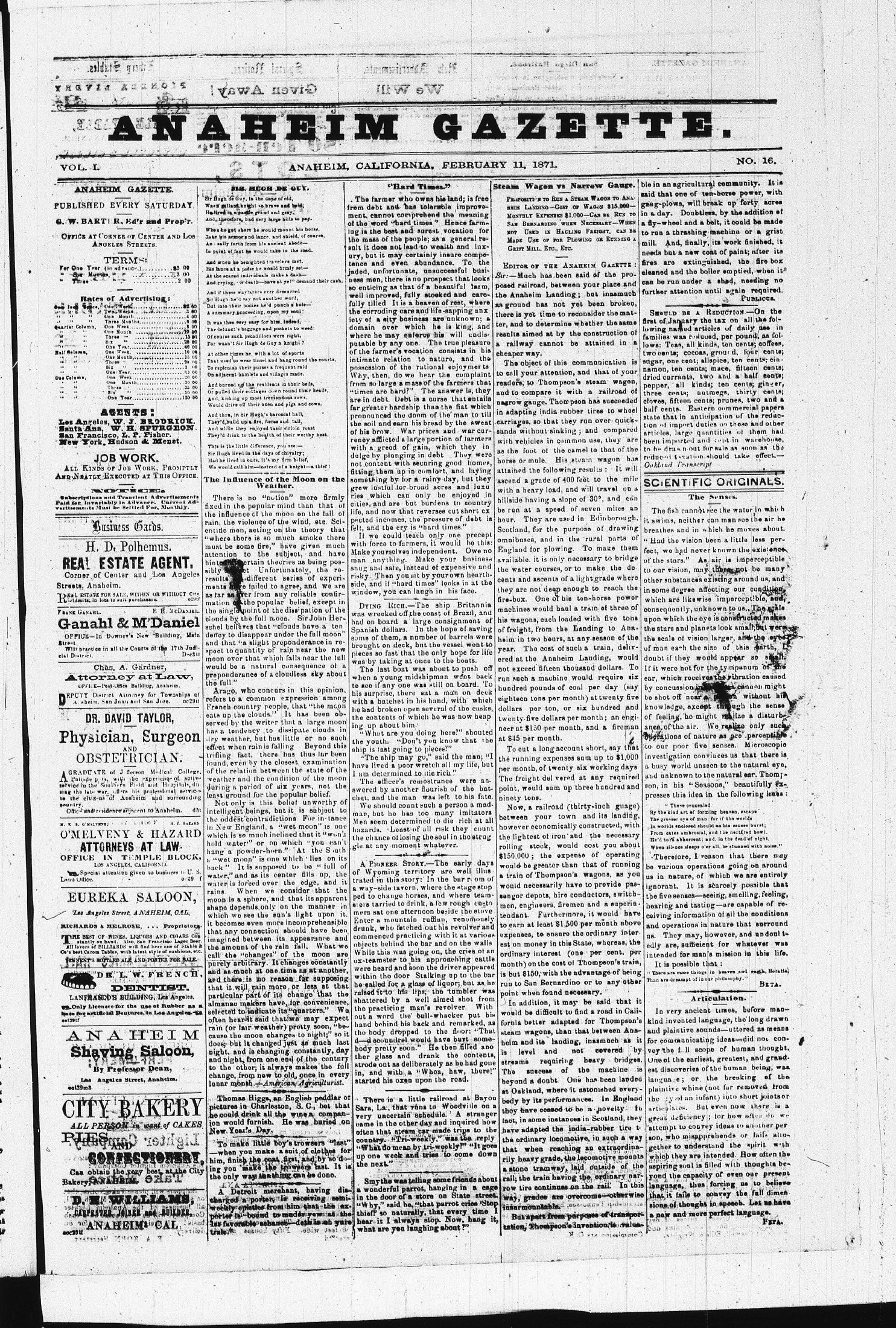
Searchable text
ANAHEIM GAZETTE.
PUBLISHED EVERY SATURDAY.
G. W. BARTI R. Ed'r and Prop'r.
OFFICE AT CORNER OF CENTER AND LOS ANGELES STREETS.
TERMS:
For One Year (in advance) $5 00
One Month $3 00
Three $2 00
Rates of Advertising:
One Inch Office, One Week $2 00
Two Weeks $3 00
One Month $4 00
Three Months $6 00
Quarter Column, One Week $8 00
One Month $10 00
Three $15 00
Six $20 00
One Year $40 00
Half Column, One Week $10 00
One Month $15 00
Three $20 00
Six $3 00
One Year $60 00
One Column, One Week $20 00
One Month $30 00
Three $35 00
Six $50 00
One Year $120 00
AGENTS:
Los Angeles, W. J. BRODRICK.
Santa Ana, W. H. SPURGEON.
San Francisco, L. P. Fisher.
New York, Hudson & Mcnet.
JOB WORK.
ALL KINDS OF JOB WORK, PROMPTLY AND NEATLY EXECUTED AT THIS OFFICE.
NOTICE:
SIR HEUGH DE GUY.
Sir Hugh de Guy, in the days of old,
Was gallant knight so brave and hold;
He lived in a grand and gray.
And, therefore, had very large bills to pay.
When he get short he would mount his horse,
Take his armor and lance, and shield, of course,
An sally forth from his ancient abode—
In point of fact he would take to the road.
And when he benighted travelers met,
His lance at a pulse he would firmly set—
At the scared individuals make a dash—
And crying, "S-death-have at ye!" demand their ca
And if these wayfarers ever demurred
Sir Hugh he'd say not another word,
But into their bodies he'd punch a hole—
A summary proceeding, upon my soul!
It was then very easy for him, indeed,
The defunct's bagrage and pockets to weed:
Of course such peradilloes were right.
For wasn't Sir Hugh de Guy a knight?
At other times he, with a lot of sports
That used to wear tinsel and hang round the courts
To replenish their purses a frequent raid
On adjacent hamlets and villages made.
And burned up the residents in their beds,
Or pulled their cottages down round their heads,
And, kicking up most tremendous rows,
Would drive off their oxen and pigs and cows.
And then, in Sir Hugh's baronial hall,
They'd build up a fire, fierce and tall,
And while they enjoyed their sirloin roast
They'd drink to the health of their worthy host.
This is the little difference, you see:—
Sir Hugh lived in the days of chivalry;
Had he lived in ours, it's my firm belief,
We would call him—lostead of a knight—a thief!
The Influence of the Moon on Weather.
AGENTS:
Los Angeles, W. J. BRODRICK.
Santa Ana, W. H. SPURGEON.
San Francisco, L. P. Fisher.
New York, Hudson & Menst.
JOB WORK.
ALL KINDS OF JOB WORK, PROMPTLY AND NEATLY EXECUTED AT THIS OFFICE.
NOTICE:
Subscriptions and Transient Advertisements Paid for Invariably in Advance. Current Advertisements Must be Settled For Monthly.
Business Gards.
H. D. Polhemus,
REAL ESTATE AGENT.
Corner of Center and Los Angeles Streets, Anaheim.
REAL ESTATE FOR SALE, WITHIN OR WITHOUT CITY LIMITS, in lots to suit purchasers.
FRANK GANAHL.
E. H. McDANIEL.
Ganahl & M'Daniel
OFFICE—In Downey's New Building, Main Street.
Will practice in all the Courts of the 17th Judicial District.
Chas, A. Gardner,
Attorney at Law,
OFFICE—Post-Offices Building, Anaheim.
DEPUTY District Attorney for Townships of Anaheim, San Juan and San Jose.
DR. DAVID TAYLOR,
Physician, Surgeon AND OBSTETRICIAN.
GRADUATE of Jefferson Medical College.
Pittsburgh, with the experience of active service in the Southern Field and Hospitals, during the late war, offers his professional services to the citizens of Anaheim and surrounding country.
Office and residence adjacent to Anaheim.
M. K. S. O'MELVENY.
H. F. HAZARD
O'MELVENY & HAZARD AT LAW.
OFFICE IN TEMPLE BLOCK, LOS ANGELES, CALIFORNIA.
Special attention given to business in U.S. Land Office.
EUREKA SALOON,
Los Angeles Street, Anaheim, Cal.
RICHARDS & MELROSE... Proprietors.
The Influence of the Moon on the Weather.
There is no "notion" more firm fixed in the popular mind than that the influence of the moon on the fall rain, the violence of the wind, etc. Such entities men, acting on the theory that "where there is so much smoke that must be some fire," have given much attention to the subject, and have hinted certain theories as being possibly incorrectly, the results of different series of experiments have failed to agree, and we as far as ever from any reliable conclusion on the popular belief, except the single point of the dissipation of clouds by the full moon. Sir John Hachel believes that "clouds have a tendency to disappear under the full moon and that 'a slight preponderance in respect to quantity of rain near the moon over that which falls near the moon would be a natural consequence of preponderance of a cloudless sky about the full."
Arago, who concurs in this opinion refers to a common expression among French country people, that "the meats up the clouds." It has been served by the writer that a large man has a tendency to dissipate clouds dry weather, but has little or no effect when rain is falling. Beyond this trifling fact, there has thus far been found, even by the closest examination of the relation between the state of weather and the condition of the month during a period of six years, not least ground for the popular belief.
Not only is this belief unworthy intelligent beings, but it is subject to the oddest contradictions. For instance in New England, a "wet moon" is which is so much inclined that it "hold water" or on which "you can hang a powder-horn." At the South a "wet moon" is one which lies on back." It is supposed to be "full water," and as its center fills up, water is forced over the edge, and rains. When we consider that the moon is a sphere, and that its apparent shape depends only on the manner which we see the sun's light upon it becomes even more incomprehensible that any connection should have borne between its appearance
ATTORNEYS AT LAW
OFFICE IN TEMPLE BLOCK,
LOS ANGELES, CALIFORNIA.
Special attention given to business in U.S.
Land Office.
EUREKA SALOON,
Los Angeles Street, Anaheim, Cal.
RICHARDS & MELROSE, ... Proprietors.
THE BEST OF WINES, LIQUORS AND CIGARS Constantly on hand. Also, San Francisco Lager Beer.
All lovers of BILLIJARDS will find here one of Stable &
Co.'s best Carom Tables, with latest style of cushions, etc.
KENNET'S BOTTLED ALE AND PORTER FOR SALE.
DE. L. W. FRENCH,
DENTIST.
LANFRANDO'S BUILDING, Los Angeles.
Only License for the use of Rubber as a
mate for artificial Dentures, in Los Angeles.
ANAHEIM
Shaving Saloon,
By Professor Dean,
Los Angeles Street, Anaheim.
est29m3
CITY BAKERY
ALL PERSON in want of CAKES,
PIES AND CONFECTIONERY.
Can obtain the very best at the City
Bakery, Anaheim.
D. E. WILLIAMS,
CARPENTER, JOINER and BUILDER
ANAHEIM, CAL.
HEIM GAZETTE
ANAHEIM, CALIFORNIA, FEBRUARY 11, 1871
“Hard Times.”
The farmer who owns his land; is free from debt and has tolerable improvement, cannot comprehend the meaning of the word “hard times”. Hence farming is the best and surest vocation for the mass of the people; as a general result it does not lead to wealth and luxury, but it may certainly insure competence and even abundance. To the jaded, unfortunate, unsuccessful business men, there is no prospect that looks so enticing as that of a beautiful farm, well improved, fully stocked and carefully tilled. It is a heaven of rest, where the corroding care and life-sapping anxiety of a city business are unknown; a domain over which he is king, and where he may enforce his will undisputable by any one. The true pleasure of the farmer’s vocation consists in his intimate relation to nature, and the possession of the rational enjoyments. Why, then, do we hear the complaint from so large a mass of the farmers that “times are hard?” The answer is, they are in debt. Debt is a curse that entails far greater hardship than the flat which pronounced the doom of the man to till the soil and earn his bread by the sweat of his brow. War prices and war currency afflicted a large portion of farmers with a greed of gain, which they in dulge by plunging in debt. They were not content with securing good homes, fitting them up in comfort, and laying something by for a rainy day, but they grew lustful for broad acres and luxuaries which can only be enjoyed in steam wagon vs narrow gauge.
EDITOR OF THE ANAHEIM GAZETTE
Sir: Much has been said of the proposed railroad between your place and the Anaheim Landing; but inasmuch as ground has not yet been broken there is yet time to reconsider the matter, and to determine whether the same results aimed at by the construction of a railway cannot be attained in cheaper way.
The object of this communication is to call your attention, and that of your readers, to Thompson's steam wagon and to compare it with a railroad or narrow gauge. Thompson has succeeded in adapting india rubber tires to whose carriages, so that they run over quick sands without sinking; and compare with vehicles in common use, they are as the foot of the camel to that of the horse or mule. His steam wagon has attained the following results: It will ascend a grade of 400 feet to the mil with a heavy load, and will travel on
of the Moon on the Weather.
"notion" more firmly scalar mind than that of the moon on the fall of the wind, etc. Scing on the theory that so much smoke there are," have given much the subject, and have in theories as being post-infortunately, the recent series of experi- led to agree, and we are from any reliable confi- popular belief, except in of the dissipation of the full moon. Sir John Her- at "clouds have a ten year under the full moon" but preponderance in re- of rain near the new which falls near the full natural consequence of a of a cloudless sky about concurs in this opinion, moon expression among people, that "the moon duds." It has been ob- writer that a large moon to dissipate clouds in it has little or no such falling Beyond this there has thus far been the closest examination between the state of the condition of the moon of six years, not the popular belief. This belief unworthy of signs, but it is subject to contradictions For instance, a "wet moon" is one which inclined that it "won't be on which you can't -horn." At the South is one which lies on its supposed to be "full of its center fills up, the cover the edge, and it we consider that the ice, and that its apparent only on the manner in the sun's light upon it. More incomprehensible action should have been its appearance and
"times are hard! The answer is, they are in debt. Debt is a curse that entails far greater hardship than the flat which pronounced the doom of the man to till the soil and earn his bread by the sweat of his brow. War prices and war currency afflicted a large portion of farmers with a greed of gain, which they in dulge by plangling in debt They were not content with securing good homes, fitting them up in comfort, and laying something by for a rainy day, but they grew lustful for broad acres and luxuries which can only be enjoyed in cities, and are but burdens to country life, and now that reverses cut short expected incomes, the pressure of debt is felt, and the cry is "hard times."
If we could teach only one precept with force to farmers, it would be this: Make yourselves independent. Owe no man anything. Make your business snug and safe, instead of expensive and risky. Then you sit by your own hearthside, and if "hard times" looks in at the window, you can laugh in his face.
DYING RICH.—The ship Britannia was wrecked off the coast of Brazil, and had on board a large consignment of Spanish dollars. In the hope of saving some of them, a number of barrels were brought on deck, but the vessel went to pieces so fast that the only hope for life was by taking at once to the boats.
The last boat was about to push off when a young midshipman went back to see if any one was still on board. To his surprise, there sat a man on deck with a hatchet in his hand, with which he had broken open several of the casks, the contents of which he was now heap ing up about him.
"What are you doing here?" shouted the youth. "Don't you know that the ship is fast going to pieces?"
"The ship may go," said the man; "I have lived a poor wretch all my life, but I am determined to die rich."
The officer's remostrance were answered by another flourish of the hatchet, and the man was left to his fate.
We should count such a person a madman, but he has too many imitators Men seem determined to die rich at all hazards. Least of all risk they count the chance of losing the soul in the struggle at any moment whatever.
A Pioneer Story.—The early days of Wyoming territory are well illustrated in this story: In the bar room of a way-side tavern, where the stage stop ped to change horses, and where teamsters tarried to drink, a few rough customers sat one afternoon beside the stove Enter a mountain ruffian, venomously drunk, who fetched out his revolver and commenced practicing with it at various and to compare it with a railroad or nagrow gauge. Thompson has succeeded in adapting india rubber tires to whose carriages, so that they run over quick sands without sinking; and compared with vehicles in common use, they are as the foot of the camel to that of the horse or mule. His steam wagon has attained the following results: It will ascend a grade of 400 feet to the mil- with a heavy load, and will travel on hillside having a slope of 30°, and can be run at a speed of seven miles an hour. They are used in Edinborough Scotland, for the purpose of drawing omnibuses, and in the rural parts of England for plowing. To make them available, it is only necessary to bridge the water courses, or to make the de- cents and ascents of a light grade where they are not deep enough to reach the fire-box. One of his ten-horse power machines would haul a train of three o' his wagons, each loaded with five tons of freight, from the Landing to Anaheim in two hours, at any season of the year. The cost of such a train, delivered at the Anaheim Landing, would not exceed fifteen thousand dollars. To run such a machine would require si- hundred pounds of coal per day (say eighteen tons per month) at twenty five dollars per ton, or six hundred and twenty-five dollars per month; an engineer at $150 per month, and a fireman at $45 per month.
To cut a long account short, say tha- the running expenses sum up to $1,000 per month, of twenty six working days. The freight del vered at any require- point, would sum up three hundred and ninety tons.
Now, a railroad (thirty-inch guage) between your town and its landin- however economically constructed, wit- the lightest of iron and the necesa- rolling stock, would cost you abo- $150,000; the expense of operati- would be greater than that of running a train of Thompson's wagons, as ye would necessarily have to provide pa- senger depots, hire conductors, switch men, engineers, firemen and a superi- tendant. Furthermore, it would ha- tto earn at least $1,500 per month abo- expenses, to ensure the ordinary inte
A Pioneer Story.—The early days of Wyoming territory are well illustrated in this story: In the bar room of a way-side tavern, where the stage stopped to change horses, and where teamsters tarried to drink, a few rough customers sat one afternoon beside the stove. Enter a mountain ruffian, venomously drunk, who fetched out his revolver and commenced practicing with it at various objects behind the bar and on the walls. While this was going on, the cries of an ox-teamster to his approaching cattle were heard and soon the driver appeared within the door. Stalking up to the bar he called for a glass of liquor; but as he raised it to his lips, the tumbler was shattered by a well aimed shot from the practicing man's revolver. With out a word the bull-whacker put his hand behind his back and remarked, as the body dropped to the floor: "That d-soundrel would have hurt somebody pretty soon." He then filled ano ther glass and drank the contents, strode out as deliberately as he had gone in, and with a "Whoa, haw, there!" started his oxen upon the road.
There is a little railroad at Bayou Sara, La., that runs to Woodville on a very uncertain schedule. A stranger came in the other day and inquired how often that steam car made trips to the country. "Tri-weekly," was the reply. "What do mean by tri-weekly?" "It goes up one week and tries to come down the next."
Smythe was telling some friends about a wonderful parrot, hanging in a cage in the door of a store on State street. "Why," said he, "that parrot cries 'Stop thief' so naturally, that every time I hear it I always stop. Now, hang it, what are you laughing about?"
Narrow Gauge.
A Steam Wagon to Anaheim of Wagon $15,000—Can be Run when Necessary—When Trailing Freight, can be Plowing or Running a Etc.
ANAHEIM GAZETTE:
Been said of the protection your place and building; but inasmuch it yet been broken, no reconsider the matine whether the same by the construction of it be attained in a communication is motion, and that of your Thompson's steam wagon, with a railroad of Thompson has succeeded rubber tires to wheel they run over quick-king; and compared common use, they are camel to that of the steam wagon haswing results: It will 400 feet to the mile, and will travel on a stable in an agricultural community. It is said that one of ten-borse power, with gang-plows, will break up forty acres in a day. Doubtless, by the addition of a fly-wheel and a belt, it could be made to run a thrashing machine or a grist mill. And, finally, its work finished, it needs but a new coat of paint; after its fires are extinguished, the fire box cleaned and the boiler emptied, when it can be run under a shed, needing no further attention until again required.
Publicus.
SHOULD BE A REDUCTION. On the first of January the tax on all the following named articles of daily use in families was reduced, per pound, as follows: Teas, all kinds, ten cents; coffees, two cents; cocoa, ground, four cents; sugar, one cent; allspice, ten cents; cinnamon, ten cents; mace, fifteen cents; dried currants, two and a half cents; pepper, all kinds; ten cents; ginger, three cents; nutmegs, thirty cents; cloves, fifteen cents; prunes, two and a half cents. Eastern commercial papers state that in anticipation of the reduction of import duties on those and other articles, large quantities of them had been imported and kept in warehouse, to be drawn out for sale as soon as the reduced taxation should take effect.
Oakland Transcript
SCIENTIFIC ORIGINALS.
SCIENTIFIC ORIGINALS.
The Senses.
The fish cannot see the water in which it swims, neither can man see the air he breathes and in which he moves about. "Had the vision been a little less perfect, we had never known the existence of the stars." As air is imperceptible to our vision, may there not be many other substances existing around us, and in some degree affecting our condition, which are likewise imperceptible, and consequently, unknown to us. The scale upon which the eye is constructed makes the stars and planets look small, but were the scale of vision larger, and the eyes of man each the size of this earth. I doubt if they would appear so small. If it were not for the tympanum of the ear, which receives the vibration caused by concussion inside a cannon might be shot off noear a bullet without his knowledge, except through the sense of feeling, he might realize a disturbance of the air. We realize only such operations of nature as are perceptible to our poor five senses. Microscopic investigation convinces us that there is a busy world unseen to the natural eye, and unknown to the natural ear. Thompson, in his "Seasons," beautifully expresses this idea in the following lines:
"These concealed
By the kind art of forming heaven, escape
The grosser eye of man; for if the worlds
In worlds enclosed should on his senses burst;
From cates ambrosial, and the nectared bowl,
He'd turn aborrent; and, in the dead of night,
When silence sleeps over all, be stunned with noise."
Therefore, I reason that there may be various operations going on around us in nature, of which we are entirely ignorant. It is scarcely possible that the five senses—seeing, smelling, feeling, hearing and tasting—are capable of receiving information of all the conditions and operations in nature that surround us. They may, however, and undoul-
and the necessary expense of operating it than that of running a person's wagons, as you may have to provide passersby conductors, switchmen and a superintendent more, it would have 1,500 per month above the ordinary interest in his State, whereas, the one per cent. per part of Thompson's train, the advantage of being tardino or to any other is necessary.
may be said that it is to find a road in Cali-apted for Thompson's mean that between Anas-ading, inasmuch as it not covered by heavy bridges, of the machine is One has been landed here it astomished every performances. In England it to be a novelty. Inances in Scotland, they are india-rubber tire motive, in such a way teaching an extraordina-tion the locomotive mounts by laid outside of the driving the ordinary par-ams on the rail. In this overcomes—otherwise purposes of transport's invention is valu-
Therefore, I reason that there may be various operations going on around us in nature, of which we are entirely ignorant. It is scarcely possible that the five senses—seeing, smelling, feeling, hearing and tasting—are capable of receiving information of all the conditions and operations in nature that surround us. They may, however, and undoul-edly are, sufficient for whatever was intended for man's mission in this life.
It is possible that:
"There are more things in heaven and earth, Horatile,
Than are dreamt of in our philosophy."
BETA.
Articulation.
In very ancient times, before man-kind invented language, the long drawn and plaintive sounds—uttered as means for communicating ideas—did not convey the full scope of human thought. One of the earliest, greatest, and grandest discoveries of the human being was language; or the breaking of the plaintive whine (not far removed from the cry of an infant) into short joints or articulates. But even now there is a great deficiency; for how often do we attempt to convey ideas to another person, who misapprehends or fails altogether to understand the spirit with which they are intended. How often the aspiring soul is filled with thoughts beyond the capacity of even our present language, thus forcing us to believe that it fails to convey the full dimensions of thought in speech. Let us have a new and more perfect language.