anaheim-gazette 1870-10-29
Scanned page
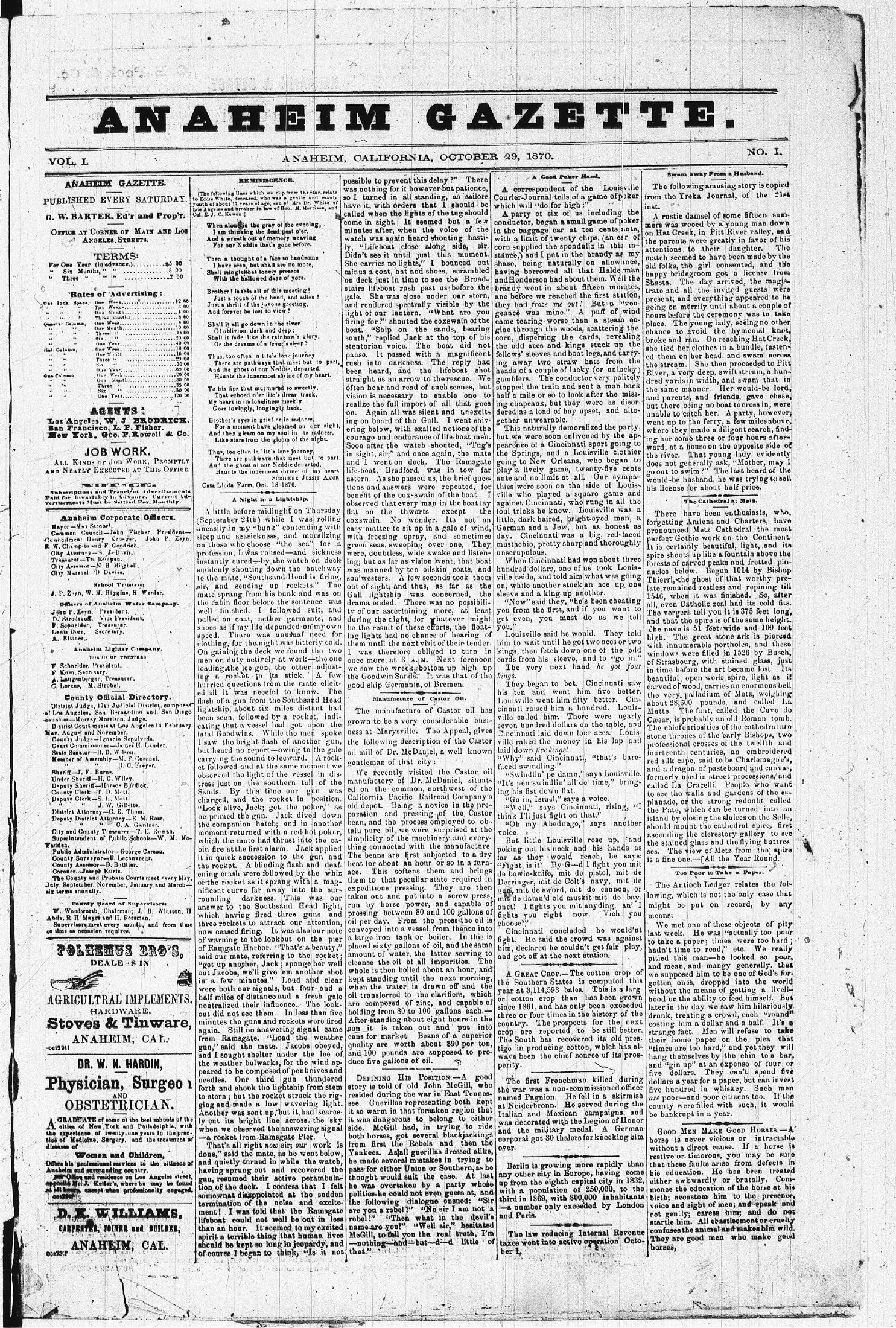
Searchable text
ANAHEIM GAZETTE.
PUBLISHED EVERY SATURDAY.
G. W. BARTER, Ed'r and Prop'r.
OFFICE AT CORNER OF MAIN AND LOS ANGELES STREETS.
TERMS:
For One Year (in advance.) $5 00
Six Months, $3 00
Three, $2 00
Rates of Advertising:
One Inch Space, One Week, $2 00
Two Weeks, $3 00
One Month, $4 00
Three Months, $6 00
Quarter Columns, One Week, $8 00
One Month, $10 00
Three, $15 00
Six, $20 00
One Year, $40 00
Half Columns, One Week, $10 00
One Month, $15 00
Three, $20 00
Six, $25 00
One Year, $40 00
One Column, One Week, $20 00
One Month, $30 00
Three, $35 00
Six, $45 00
One Year, $120 00
AGENTS:
Los Angeles, W. J. BRODRICK.
San Francisco, L. P. Fisher.
New York, Geo. P. Rowell & Co.
JOB WORK.
ALL KINDS OF JOB WORK, PROMPTLY AND NEATLY EXECUTED AT THIS OFFICE.
REMINISCENCE.
[The following lines which we clip from the Star, relate to Eddie White, deceased, who was a gentle and manly youth of about 17 years of age, son of Mrs Dr. White of Los Angeles and brother-in-law of Hon. M. Morrison, and Col. E.J.C. Kewen:]
When alone in the gray of the evening,
I am thinking the dead past o'er,
And a wreath out of memory weaving
For our Neddie that's gone before.
Then a thought of a face so handsome
I have seen, but shall see no more,
Shall mingle that lonely present
With the hallowed days of yore.
Brother! Is this all of this meeting?
Just a touch of the hand, and adieu!
Just a thrill of the joyous greeting.
And forever be lost to view?
Shall it all go down in the river
Of oblivion, dark and deep;
Shall it fade, like the rainbow's glory.
Or the dreams of a fever's sleep?
Thus, too often in life's lone journey
There are pathways that meet but to parade
And the ghost of our Neddie departed.
Haunts the innermost shrine of my heart.
To his lips that murmured so sweetly.
That echoed o'er life's drear track.
My heart in its loneliness meekly
Goes lovingly, longingly back.
Brother's eyes in grief or in sadness,
For a moment have gleamed on our sight
And they gleam on my soul in its sadness,
Like stars from the gloom of the night.
Thus, too often in life's lone journey,
There are pathways that meet but to parade
And the ghost of our Neddie departed.
Haunts the innermost shrine of my heart.
Scrubber Jussit Amor
Casa Llioda Farm, Oct. 18-1870.
AGENTS:
Los Angeles, W. J. BRODRICK.
San Francisco, L. P. Fisher.
New York, Geo. P. Rowell & Co.
JOB WORK.
ALL KINDS OF JOB WORK, PROMPTLY AND NEATLY EXECUTED AT THIS OFFICE.
SUBSCRIPTIONS and Transient Advertisements Paid for Invadably in Advance. Current Advertisements Must be Sought For Monthly.
Anaheim Corporate Officers.
Mayor—Max Strobel.
Common Council—John Fischer, President—Connie Meenan: Henry Kronger, John P. Zeyn.
R. W. Champin and F. Goodrich.
City Attorney—S. J. Davis.
Treasurer—Th. Rempau.
City Assessor—N. H. Mitchell.
City Marshal—D Davies.
School Trustees:
J. P. Zeyn, W. M. Higgins, H Werder.
Officers of Anaheim Water Company.
John P. Zeyn, President.
D. Strolthoff, Vice President.
P. Scaneider, Treasurer.
Louis Dorr, Secretary.
A. Bitner.
Anaheim Lighter Company.
BOARD OF TRUSTEES
F. Schneider, President.
F. Korn, Secretary.
A. Langenberger, Treasurer.
C. Lorus, M. Strobel.
County Official Directory.
District Judge, 17th Judicial District, composed of Los Angeles, San Bernardino and San Diego counties—Murray Morrison, Judge.
District Court meets at Los Angeles in February May, August and November.
County Judge—Ignacio Sepulveda.
Court Commissioner—James H. Lander.
State Senator—H. D. Wilson.
Member of Assembly—M. F. Coronal.
"R. C. Freyer."
Shariff—J. F. Burns.
Under Sheriff—H. C. Wiley.
Deputy Sheriff—Horace Burdick.
County Clerk—T. D. Mott.
Deputy Clerk—S. I. Mott.
"J. W. Gillette."
District Attorney—C. E. Thom.
Deputy District Attorney—E. M. Rose,
"C. A. Gardner.
City and County Treasurer—T. E. Rowan.
Superintendent of Public Schools—W. M. Mo-Wadden.
Public Administrator—George Carson.
County Surveyor—E. Lecouvreur.
County Assessor—D. Botiller.
Coroner—Joseph Kurtz.
The County and Probate Courts meet every May, July, September, November, January and March—six terms annually.
County Board of Supervisors:
W. Woodworth, Chairman; J. B. Winston, H Abila, R H Mayes and H Forman.
Supervisors meet every month, and from time to time as occasion requires.
A little before midnight on Thursday (September 24th) while I was rolling easily in my "bunk" contending with sleep and seasickness, and moralizing on those who choose "the sea" for a profession, I was roused—and sickened instantly cured—by the watch on deck suddenly shouting down the hatchway to the mate, "Southsand-Head is firing air, and sending up rockets." The mate sprang from his bunk and was on the cabin floor before the sentence was well finished. I followed suit, and pulled on coat, nether garments, and shoes as if my life depended-on my own speed. There was unusual need for clothing, for the night was bitterly cold.
On gaining the deck we found the two men on duty actively at work—the one loading the lee gun, the other adjusting a rocket to its stick. A few hurried questions from the mate elicited all it was necessary to know.
The flash of a gun from the Southsand Head lightship, about six miles distant had been seen, followed by a rocket, indicating that a vessel had got upon the fatal Goodwins. While the men spotted I saw the bright flash of another gun but heard no report—owing to the gas carrying the sound to leeward. A rocket followed and at the same moment we observed the light of the vessel in distress just on the southern tail of the Sands. By this time our gun was charged, and the rocket in position "Lock alive, Jack; get the poker," he primed the gun. Jack dived down the companion hatch; and in another moment returned with a red-hot poker which the mate had thrust into the cabin fire at the first alarm. Jack applied it in quick succession to the gun and the rocket. A blinding flash and despairing crash were followed by the whirl of the rocket as it sprang with a man significant curve far away into the surrounding darkness. This was our answer to the Southsand Head light which having fired three guns at three rockets to attract our attention now ceased firing. It was also our no
POLIEMUS BRO'S,
DEALERS IN
AGRICULTURAL IMPLEMENTS.
HARDWARE.
Stoves & Tinware,
ANAHEIM, CAL.
DR. W. N. HARDIN,
Physician, Surgeon
AND
OBSTETRIAN.
GRADUATE of some of the best schools of the cities of New York and Philadelphia, with the experience of twenty-one years in the practice of Medicine, Surgery, and the treatment of diseases of Women and Children.
Offers his professional services to the citizens of Anaheim and surrounding country.
Office and residence on Los Angeles street, opposite Mr. J. Keller's, where he may be found at all hours, except when professionally engaged.
D. K. WILLIAMS,
CARPENTER, JOINER and BUILDER,
ANAHEIM, CAL.
Superintendent of Public Schools—W. M. McFadden.
Public Administrator—George Carson.
County Surveyor—F. Lecouvreur.
County Assessor—D. Botiller.
Coroner—Joseph Kurtz.
The County and Probate Courts meet every May, July, September, November, January and March—six terms annually.
County Board of Supervisors:
W. Woodworth, Chairman; J. B. Winston, H Abila, R. H Mayos and H. Forsman.
Supervisors meet every month, and from time to time as occasion requires.
That's all right now sir, our work done," said the mate, as he went below and quietly turned in while the watch having sprung out and recovered the gun, resumed their active perambulation of the deck. I confess that I for some nat disappointed at the sudden termination of the noise and excitement! I was told that the Ramsgate lifeboat could not well be out in less than an hour. It seemed to my excite spirit a terrible thing that human life should be kept so long in jeopardy, as of course I began to think, "Is it n
NEIM GAZETTE
A NAHEIM, CALIFORNIA, OCTOBER 29, 1870.
POSSIBLE TO PREVENT THIS DELAY? There was nothing for it however but patience, so I turned in all standing, as sailore have it, with orders that I should be called when the lights of the tug should come in sight. It seemed but a few minutes after, when the voice of the watch was again heard shouting hastily, "Lifeboat close along side, sir. Didn't see it until just this moment. She carries no lights," I bounced out minus a coat, hat and shoes, scrambled on deck just in time to see the Broad-stairs lifeboat rush past us before the gale. She was close under our stern, and rendered spectrally visible by the light of our lantern. "What are you firing for?" shouted the coxswain of the boat. "Ship on the sands, bearing south," replied Jack at the top of his stentorian voice. The boat did not pause. It passed with a magnificent rush into darkness. The reply had been heard, and the lifeboat shot straight as an arrow to the rescue. We often hear and read of such scenes, but vision is necessary to enable one to realize the full import of all that goes on. Again all was silent and unexciting on board of the Gull. I went shivering below, with exalted notions of the courage and endurance of life-boat men. Soon after the watch shouted, "Tug's in sight, sir," and once again, the mate and I went on deck. The Ramsgate life-boat, Bradford, was in tow far astern. As she passed us, the brief questions and answers were repeated, for benefit of the coxswain of the boat.
A Good Poker Hand.
A correspondent of the Louisville Courier-Journal tells of a game of poker which will "do for high:"
A party of six of us including the conductor, began a small game of poking in the baggage car at ten cents until with a limit of twenty chips, (an ear corn supplied the spondulix in this instance), and I put in the brandy as my share, being naturally on allowance having borrowed all that Halderman and Henderson had about them. Well the brandy went in about fifteen minutes ane before we reached the first station they had froze me out! But a "voicegence was mine." A puff of wind came tearing worse than a steam engine through the woods, scattering the corn, dispersing the cards, revealing the odd aces and kings stuck up the fellows' sleeves and boot legs, and carrying away two straw hats from the heads of a couple of lucky (or unlucky) gamblers. The conductor very politely stopped the train and sent a man back half a mile or so to look after the missing chapaux, but they were as disdained as a load of hay upset, and altogether unwearable.
This naturally demoralized the part but we were soon enlivened by the appearance of a Cincinnati sport going to the Springs, and a Louisville clothie going to New Orleans, who began play a lively game, twenty-five cent ante and no limit at all. Our sympathy thies were soon on the side of Louisville who played a square game and
On a Lightship.
Guiding light on Thursday while I was rolling bunk" contending with illness, and moralizing use "the sea" for a roused—and sickness by the watch on deck down the hatchway Southsand Head is firing, up rockets." The his bunk and was on shore the sentence was followed suit, and neither garments, and depended-on my own was unusual need for night was bitterly cold. Jack we found the two lovely at work—the one man, the other adjust-its stick. A few from the mate elicit-feelful to know. The in the Southsand Head six miles distant had led by a rocket, indihel had got upon the While the men spoke flash of another gun, art—owing to the gale led to leeward. A rocker in the same moment we set of the vessel in dis-southern tail of the time our gun was a rocket in position. Get the poker," as Jack dived down catch; and in another with a red-hot poker, and thrust into the ca-alarm. Jack applied vision to the gun and ending flash and deaf-followed by the whiz sprang with a maga-away into the surress. This was our Southsand Head light, red three guns and attract our attention.
It was also our note lookout on the per vision is necessary to enable one to realize the full import of all that goes on. Again all was silent and unexciting on board of the Gull. I went shivering below, with exalted notions of the courage and endurance of life-boat men. Soon after the watch shouted, "Tug's in sight, sir;" and once again, the mate and I went on deck. The Ramsgate life-boat, Bradford, was in tow far astern. As she passed us, the brief questions and answers were repeated, for benefit of the cox-swain of the boat. I observed that every man in the boat lay flat on the thwarts except the coxswain. No wonder. Its not an easy matter to sit up in a gale of wind, with freezing spray, and sometimes green seas, sweeping over one. They were, doubtless, wide awake and listening; but as far as vision went, that boat was manned by ten oilskin coats, and sou'westers. A few seconds took them out of sight; and thus, as far as the Gull lightship was concerned, the drama ended. There was no possibility of our ascertaining more, at least during the light, for whatever might be the result of these efforts, the floating lights had no chance of hearing of them until the next visit of their tender. I was therefore obliged to turn in once more, at 3 A.M. Next forenoon we saw the wreck/bottom up high up the Goodwin Sands. It was that of the good ship Germania, of Bremen.
Manufacture of Castor Oil.
The manufacture of Castor oil has grown to be a very considerable business at Marysville. The Appeal, gives the following description of the Castor oil mill of Dr. McDaniel, a well known gentleman of that city:
We recently visited the Castor oil manufactory of Dr. McDaniel, situated on the common, northwest of the California Pacific Railroad Company's old depot. Being a novice in the preparation and pressing of the Castor bean, and the process employed to obtain pure oil, we were surprised at the simplicity of the machinery and everything connected with the manufacture. The beans are first subjected to a dry heat for about an hour or so in a furnace. This softens them and brings them to that peculiar state required in expeditious pressing. They are then taken out and put into a screw press, run by horse power, and capable of pressing between 80 and 100 gallons of oil per day. From the press the oil is conveyed into a vessel, from thence into a large iron tank or boiler. In this half a mile or so to look after the mis-inchageaux, but they were as disdered as a load of hay upset, and alt-gether unwearable.
This naturally demoralized the part but we were soon enlivened by the appearance of a Cincinnati sport going to the Springs, and a Louisville clothing going to New Orleans, who began play a lively game, twenty-five cent ante and no limit at all. Our symp-theses were soon on the side of Louisville who played a square game against Cincinnati, who rung in all toul tricks he knew. Louisville was little, dark haired, bright-eyed man, German and a Jew, but as honest day. Cincinnati was a big, red-face mustachio, pretty sharp and thorough unscrupulous.
When Cincinnati had won about thirty hundred dollars, one of us took Louisville aside, and told him what was going on, while another stuck an ace up on sleeve and a king up another.
"Now" said they, "he's been cheating you from the first, and if you want to get even, you must do as we tell you."
Louisville said he would. They to him to wait until he got two aces or two kings, then fetch down one of the oceans from his sleeve, and to "go in."
The very next hand he got four kings.
They began to bet. Cincinnati said his ten and went him five better. Louisville went him fifty better. Cincinnati raised him a hundred. Louisville called him: There were nearly seven hundred dollars on the table, and Cincinnati laid down four aces. Louisville raked the money in his lap and laid down five kings!
"Why" said Cincinnati, "that's bad faced swindling."
"Swindiin' pe damn," says Louisville.
"It's pen swindlin' all de time," bringing his fist down flat.
"Go in, Israel," says a voice.
"Well," says Cincinnati, rising,
think I'll just fight on that."
"Oh my Abednego," says another voice.
But little Louisville rose up, fast poking out his neck and his hands far as they would reach, he say "Fight, is it? By G-d I fight you m de bowie-knife, mit de pistol, mit Derringer, mit de Colt's navy, mit gun, mit de sword, mit de cannon, mit de damn'd old muskit mit de ba-onet! I fights you mit anyding, an' fights you right now. Vich ye choose?"
with a reel not poker,
and thrust into the cauldron.
Jack applied vision to the gun and sending flash and deaf-followed by the whiz sprang with a mag-away into the surress.
This was our southsand Head light, fed three guns and attract our attention.
It was also our note lookout on the pier or. "That's a beauty," murreing to the rocket; Jack; sponge her well give 'em another shot us." Loud and clear signals, but four-and aince and a fresh gale influence. The look-em. In less than five and rockets were fired answering signal came "Load the weather gate. Jacobs obeyed, later under the lee of marks, for the wind apposed of penknives and bird gun thundered the lightship from stem rocket struck the riglow wavering light. Up, but it had scarce-line across the sky and the answering signal Ramsgate Pier.
Now sir, our work is late, as he went below, did in while the watch, it and recovered the air active perambulation. I confess that I felt pointed at the sudden noise and excited that the Ramsgate ot well be out in less seemed to my excited seeing that human lives long in jeopardy, and to think, "Is it not simplicity of the machinery and everything connected with the manufacture. The beans are first subjected to a dry heat for about an hour or so in a furnace. This softens them and brings them to that peculiar state required in expeditious pressing. They are then taken out and put into a screw press, run by horse power, and capable of pressing between 80 and 100 gallons of oil per day. From the press the oil is conveyed into a vessel, from thence into a large iron tank or boiler. In this is placed sixty gallons of oil, and the same amount of water, the latter serving to cleanse the oil of all impurities. The whole is then boiled about an hour, and kept standing until the next morning, when the water is drawn off and the oil transferred to the clarifiers, which are composed of zinc, and capable of holding from 80 to 100 gallons each. After standing about eight hours in the sun it is taken out and put into cans for market. Beans of a superior quality are worth about $90 per ton, and 100 pounds are supposed to produce five gallons of oil.
DEFINING HIS POSITION: A good story is told of old John McGill, who resided during the war in East Tennessee. Guerillas representing both kept it so warm in that forsaken region that it was dangerous to belong to either side. McGill had, in trying to ride both horses, got several blackjackings from first the Rebels and then the Yankees. As all guerillas dressed alike, he made several mistakes in trying to pass for either Union or Southern, as he thought would suit the case. At last he was overtaken by a party whose politics he could not even guess at, and the following dialogue ensued: "Sir are you a rebel?" "No sir I am not a rebel!" "Then what in the devil's name are you?" "Well sir," hesitated McGill, to fall you the real truth, I'm nothing—and—but—d little of that."
But little Louisville rose up, said poking out his neck and his hands far as they would reach, he says "Fight, is it? By G—d I fight you me do bowie-knife, mit de pistol, mit Derringer, mit de Colt's navy, mit de gun, mit de sword, mit de cannon, mit de damn'd old muskit mit de baronet! I fights you mit anyding, an' fights you right now. Vich ye choose?"
Cinginnati concluded he wouldn't fight. He said the crowd was again him, declared he couldn't get fair play and got off at the next station.
A GREAT CROP. The cotton crop in the Southern States is computed to year at 3,114,593 bales. This is a lawer cotton crop than has been grown since 1861, and has only been exceeded three or four times in the history of the country. The prospects for the new crop are reported to be still better. The South has recovered its old privilege in producing cotton, which has ways been the chief source of its prosperity.
The first Frenchman killed during the war was a non-commissioned officer named Pagnion. He fell in a skirmish at Neiderbronn. He served during the Italian and Mexican campaigns, and was decorated with the Legion of Honor and the military medal. A German corporal got 30 thalers for knocking it over.
Berlin is growing more rapidly than any other city in Europe, having cooled up from the eighth capital city in 1889 with a population of 250,000, to third in 1869, with 800,000 inhabitants—a number only exceeded by London and Paris.
The law reducing Internal Revenue taxes went into active operation October 1.
Poker Hand.
of the Louisville
falls of a game of poker
high:"
of us including the
a small game of poker
at ten cents ante,
enty chips, (an ear of
spondulix in this inn
in the brandy as my
curally on allowance,
all that Halderman
about them. Well the
about fifteen minutes,
chched the first station,
out! But a "vene."
A puff of wind
than a steam enwoods, scattering the
the cards, revealing
kings stuck up the
ed boot legs, and carrystraw hats from the
of lucky (or unlucky)
conductor very politely
and sent a man back
to look after the missthey were as disorhay upset, and altose.
Demoralized the party,
enlivened by the apcinnati sport going to
a Louisville clothier
leans, who began to
one, twenty-five cents
at all. Our sympanion the side of Louisa square game and
Swam away From a Husband.
The following amusing story is copied from the Yreka Journal, of the 21st inst.
A rustic damsel of some fifteen summers was wooed by a young man down on Hat Creek, in Pitt River valley, and the parents were greatly in favor of his attentions to their daughter. The match seemed to have been made by the old folks, the girl consented, and the happy bridegroom got a license from Shasta. The day arrived, the magistrate and all the invited guests were present, and everything appeared to be going on merrily until about a couple of hours before the ceremony was to take place. The young lady, seeing no other chance to avoid the hymenial knot, broke and ran. On reaching Hat Creek, she tied her clothes in a bundle, fastened them on her head, and swam across the stream. She then proceeded to Pitt River, a very deep, swift stream, a hundred yards in width, and swam that in the same manner. Her would-be lord, and parents, and friends, gave chase, but there being no boat to cross in, were unable to catch her. A party, however, went up to the ferry, a few miles above, where they made a diligent search, finding her some three or four hours afterward, at a house on the opposite side of the river. That young lady evidently does not generally ask, "Mother, may I go out to swim?" The last heard of the would-be husband, he was trying to sell his license for about half price.
The Cathedral at Metz.
There have been enthusiasts, who, forgetting Amiens and Charters, have pronounced Metz Cathedral the most perfect Gothic work on the Continent. It is certainly beautiful, light, and its spire shoots up like a fountain above the forests of carved peaks and fretted pinnacles below. Begun 1014 by Bishop Thierri, the ghost of that worthy prelate remained restless and repining till 1546, when it was finished. So, after all, even Catholic zeal had its cold fits. The vergers tell you it is 375 feet long, and that the spire is of the same height. The nave is 51 feet wide and 109 feet high. The great stone ark is pierced with innumerable portholes, and these windows were filled in 1526 by Busch, of Strasbourg, with stained glass, just in time before the art became lost. Its beautiful open work spire, light as if carved of wood, carries an enormous bell the very palladium of Metz, weighing about 28,600 pounds, and called La Mutte. The font, called the Cuve de Caesar, is probably an old Roman tomb. The chief curiosities of the cathedral are stone thrones of the early Bishops, two professional crosses of the twelfth and fourteenth centuries, an embroidered red silk cape, said to be Charlemagne's, and a dragon of pasteboard and canvas, formerly used in street processions, and called La Cracelli. People who want to see the walls and gardens of the planade, or the strong redoubt called the Pate, which can be turned into an island by closing the sluices on the Selle, should mount the cathedral spire, first ascending the clerestory gallery to see the stained glass and the flying buttresses. The view of Metz from the spire is a fine one.—[All the Year Round.
Too Poor to Take a Paper.
The Antioch Ledger relates the following, which is not the only case that might be put on record, by any means:
We met one of these objects of pity last week. He was "actually too poor
The cotton crop of states is computed this week. This is a large than has been grown has only been exceeded in the history of the prospects for the next need to be still better. Recovered its old pres- cotton, which has al-ief source of its pros-
suchman killed during an commissioned officer. He fell in a skirmish. He served during the American campaigns, and with the Legion of Honor medal. A German soldier for knocking him
long more rapidly than Europe, having come with capital city in 1832, on of 250,000, to the fifth 800,000 inhabitants exceeded by London
going Internal Revenue active operation Octo-
ascending the clerestory gallery to see the stained glass and the flying buttresses. The view of Metz from the spire is a fine one.—[All the Year Round.
Too Poor to Take a Paper.
The Antioch Ledger relates the following, which is not the only case that might be put on record, by any means:
We met one of these objects of pity last week. He was "actually too poor to take a paper; times were too hard; hadn't time to read," etc. We really pitied this man—he looked so poor and mean, and mangy generally. that we supposed him to be one of God's forgotten ones, dropped into the world without the means of getting a livelihood or the ability to feed himself. But later in the day we saw him hilariously drunk, treating a crowd, each "round" costing him a dollar and a half. It's a strange fact. Men will refuse to take their home paper on the plea that "times are too hard," and yet they will hang themselves by the chin to a bar, and "gin up" at an expense of four or five dollars. They can't spend five dollars a year for a paper, but can invest five hundred in whiskey. Such men are poor—and poor citizens too. If the county were filled with such, it would be bankrupt in a year.
Good Men Make Good Horses.—A horse is never vicious or intractable without a direct cause. If a horse is restive or timorous, you may be sure that these faults arise from defects in his education. He has been treated either awkwardly or brutally. Commence the education of the horse at his birth; accustom him to the presence, voice and sight of men; and speak and ret gently; caress him; and do not startle him. All chastisement or cruelty confuses the animal and makes him wild. They are good men who make good horses,