anaheim-bulletin 1959-05-12
Scanned page
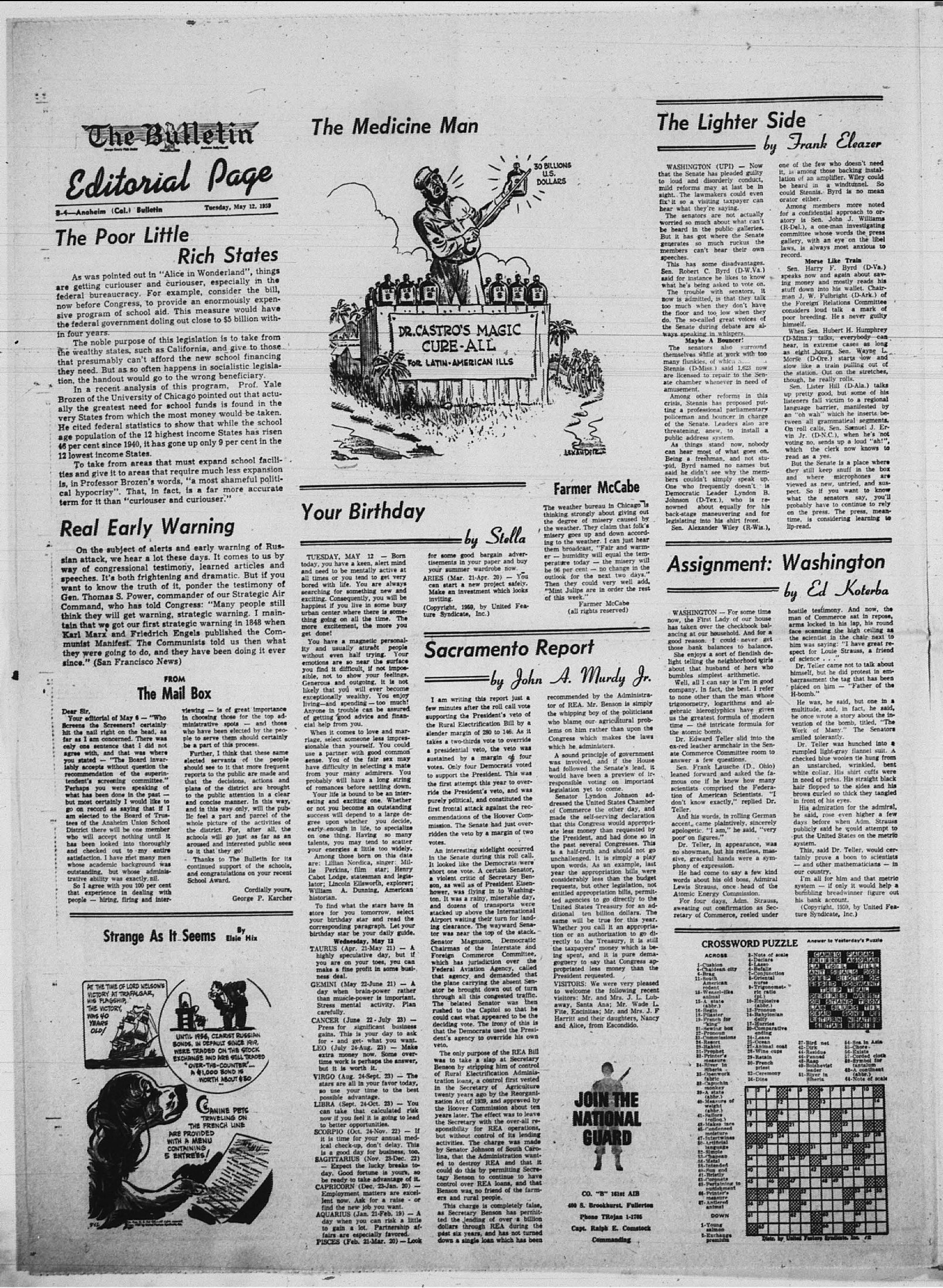
Searchable text
The Bulletin
Editorial Page
B-4—Anaheim (Cal.) Bulletin Tuesday, May 12, 1959
The Poor Little Rich States
As was pointed out in "Alice in Wonderland", things are getting curiouser and curiouser, especially in the federal bureaucracy. For example, consider the bill, now before Congress, to provide an enormously expensive program of school aid. This measure would have the federal government doling out close to $5 billion within four years.
The noble purpose of this legislation is to take from the wealthy states, such as California, and give to those that presumably can't afford the new school financing they need. But as so often happens in socialistic legislation, the handout would go to the wrong beneficiary.
In a recent analysis of this program, Prof. Yale Brozen of the University of Chicago pointed out that actually the greatest need for school funds is found in the very States from which the most money would be taken. He cited federal statistics to show that while the school age population of the 12 highest income States has risen 46 per cent since 1940, it has gone up only 9 per cent in the 12 lowest income States.
To take from areas that must expand school facilities and give it to areas that require much less expansion
In a recent analysis of this program, Prof. Yale Brozen of the University of Chicago pointed out that actually the greatest need for school funds is found in the very States from which the most money would be taken. He cited federal statistics to show that while the school age population of the 12 highest income States has risen 46 per cent since 1940, it has gone up only 9 per cent in the 12 lowest income States.
To take from areas that must expand school facilities and give it to areas that require much less expansion is, in Professor Brozen’s words, “a most shameful political hypocrisy”. That, in fact, is a far more accurate term for it than “curiouser and curiouser.”
Real Early Warning
On the subject of alerts and early warning of Russian attack, we hear a lot these days. It comes to us by way of congressional testimony, learned articles and speeches. It’s both frightening and dramatic. But if you want to know the truth of it, ponder the testimony of Gen. Thomas S. Power, commander of our Strategic Air Command, who has told Congress: “Many people still think they will get warning, strategic warning. I maintain that we got our first strategic warning in 1848 when Karl Marx and Friedrich Engels published the Communist Manifest. The Communists told us then what they were going to do, and they have been doing it ever since.” (San Francisco News)
FROM
The Mail Box
Dear Sir,
Your editorial of May 6 — “Who screens the Screeners? certainly hit the nail right on the head, as far as I am concerned. There was only one sentence that I did not agree with, and that was where you stated — “The Board invariably accepts without question the recommendation of the superintendent’s screening committee.” Perhaps you were speaking of what has been done in the past — but most certainly I would like to go on record as saying that if I am elected to the Board of Trustees of the Anaheim Union School District there will be one member who will accept nothing until it has been looked into thoroughly and checked out to my entire satisfaction. I have met many men whose academic background was outstanding, but whose administrative ability was exactly nil.
So I agree with you 100 per cent that experience in dealing with people — hiring, firing and inter-viewing — is of great importance in choosing those for the top administrative spots — and those who have been elected by the people to serve them should certainly be a part of this process.
Further, I think that these same elected servants of the people should see to it that more frequent reports to the public are made and that the decisions, actions and plans of the district are brought to the public attention in a clear and concise manner. In this way, and in this way only, will the public feel a part and parcel of the whole picture of the activities of the district. For, after all, the schools will go just as far as an aroused and interested public sees to it that they go!
Thanks to The Bulletin for its continued support of the schools, and congratulations on your recent School Award.
Cordially yours,
George P. Karcher
TUESDAY, MAY 7
today, you have a new and need to be all times or you bored with life. Searching for so exciting. Consequences happiest if you urban center whining going on more excitement get done!
You have a nice and usually without even emotions are so you find it difficult sible, not to ask Generous and likely that you exceptionally well living—and spend Anyone in trouble of getting good social help from you.
When it comes rage, select someone than use a partner sense. You of have difficulty from your ma probably will of romances be.
Your life is best resting and excelling or not yet because success will degree upon when early enough on one thing talents, you may your energies.
Among those are: Lillian Nielie Perkins, Cabot Lodge, lator; Lincoln William A. historian.
To find what
go on record as saying that if I am elected to the Board of Trustees of the Anaheim Union School District there will be one member who will accept nothing until it has been looked into thoroughly and checked out to my entire satisfaction. I have met many men whose academic background was outstanding, but whose administrative ability was exactly nil.
So I agree with you 100 per cent that experience in dealing with people — hiring, firing and inter-
Strange As It Seems
By Elsie Hix
AT THE TIME OF LORD NELSON'S VICTORY AT TRAFALGAR, HIS FLAGSHIP, THE VICTORY WAS 40 YEARS OLD!
UNTIL 1956, CZARIST RUSSIAN BONDS, IN DEFAULT SINCE 1918, WERE TRADED ON THE STOCK EXCHANGE AND ARE SILL TRADED "OVER-THE-COUNTER"—A $1,000 BOND IS WORTH ABOUT $20
CANINE PETS TRAVELING ON THE FRENCH LINE ARE PROVIDED WITH A MENU CONTAINING 5 ENTREES!
The Medicine Man
30 BILLIONS U.S. DOLLARS
DR.CASTRO'S MAGIC
CURE-ALL
FOR LATIN·AMERICAN ILLS
Your Birthday
by Stella
TUESDAY, MAY 12 — Born today, you have a keen, alert mind and need to be mentally active at all times or you tend to get very bored with life. You are always searching for something new and exciting. Consequently, you will be happiest if you live in some busy urban center where there is something going on all the time. The more excitement, the more you get done!
You have a magnetic personality and usually attract people without even half trying. Your emotions are so near the surface you find it difficult, if not impossible, not to show your feelings. Generous and outgoing, it is not likely that you will ever become exceptionally wealthy. You enjoy living—and spending—too much! Anyone in trouble can be assured of getting good advice and financial help from you.
When it comes to love and marriage, select someone less impressionable than yourself. You could use a partner with good common sense. You of the fair sex may have difficulty in selecting a mate from your many admirers. You probably will have a long string of romances before settling down.
Your life is bound to be an interesting and exciting one. Whether or not you become an outstanding success will depend to a large degree upon whether you decide, early enough in life, to specialize on one thing. Having so many talents, you may tend to scatter your energies a little too widely.
Among those born on this date are: Lillian Nordica, singer; Millie Perkins, film star; Henry Cabot Lodge, statesman and legislator; Lincoln Ellsworth, explorer; William A. Dunning, American historian.
To find what the stars have in for some good bargain advertisements in your paper and buy your summer wardrobe now.
ARIES (Mar. 21-Apr. 20) — You can start a new project safely. Make an investment which looks inviting.
(Copyright, 1959, by United Feature Syndicate, Inc.)
Farmer McCabe
(all rights reserved)
Sacramento Report
by John A. Murdy Jr.
I am writing this report just a few minutes after the roll call vote supporting the President's veto of the Rural Electrification Bill by a slender margin of 280 to 146. As it takes a two-thirds vote to override a presidential veto, the veto was sustained by a margin of four votes. Only four Democrats voted to support the President. This was the first attempt this year to override the President's veto, and was purely political, and constituted the first frontal attack against the recommendations of the Hoover Commission. The Senate had just overridden the veto by a margin of two votes.
An interesting sidelight occurred in the Senate during this roll call. It looked like the Democrats were short one vote. A certain Senator, a violent critic of Secretary Benson, as well as of President Eisenhower, was flying in to Washington. It was a rainy, miserable day, and dozens of transports were recommended by the Administrator of REA. Mr. Benson is simply the whipping boy of the politicians who blame our agricultural problems on him rather than upon the Congress which makes the laws which he administers.
A sound principle of government was involved, and if the House had followed the Senate's lead, it would have been a preview of irresponsible voting on important legislation yet to come.
Senator Lyndon Johnson addressed the United States Chamber of Commerce the other day, and made the self-serving declaration that this Congress would appropriate less money than requested by the President, and had done so in the past several Congresses. This is a half-truth and should not go unchallenged. It is simply a play upon words. As an example, last year the appropriation bills were considerably less than the budget requests, but other legislation, not entitled appropriation bills, permitted agencies to go directly to the United States Treasury for an ad-
or not you become an outstanding success will depend on a large degree upon whether you decide, early enough in life, to specialize on one thing. Having so many talents, you may tend to scatter your energies a little too widely.
Among those born on this date are: Lillian Nordica, singer; Millie Perkins, film star; Henry Cabot Lodge, statesman and legislator; Lincoln Ellsworth, explorer; William A. Dunning, American historian.
To find what the stars have in store for you tomorrow, select your birthday star and read the corresponding paragraph. Let your birthday star be your daily guide.
Wednesday, May 13
TAURUS (Apr. 21-May 21) — A highly speculative day, but if you are on your toes, you can make a fine profit in some business deal.
GEMINI (May 22-June 21) — A day when brain-power rather than muscle-power is important. Stress mental activity. Plan carefully.
CANCER (June 22-July 23) — Press for significant business gains. This is your day to ask for - and get- what you want.
LEO (July 24-Aug. 23) — Make extra money now. Some overtime work is perhaps the answer, but it is worth it.
VIRGO (Aug. 24-Sept. 23) — The stars are all in your favor today, so use your time to the best possible advantage.
LIBRA (Sept. 24-Oct. 23) — You can take that calculated risk now if you feel it is going to lead to better opportunities.
SCORPIO (Oct. 24-Nov. 22) — If it is time for your annual medical check-up, don't delay. This is a good day for business, too.
SAGITTARIUS (Nov. 23-Dec. 22) — Expect the lucky breaks today. Good fortune is yours, so be ready to take advantage of it.
CAPRICORN (Dec. 23-Jan. 20) — Employment matters are excellent now. Ask for a raise or find the new job you want.
AQUARIUS (Jan. 21-Feb. 19) — A day when you can risk a little to gain a lot. Partnership affairs are especially favored.
PISCES (Feb. 21-Mar. 20) — Look
An interesting sidelight occurred in the Senate during this roll call. It looked like the Democrats were short one vote. A certain Senator, a violent critic of Secretary Benson, as well as of President Eisenhower, was flying in to Washington. It was a rainy, miserable day, and dozens of transports were stacked up above the International Airport waiting their turn for landing clearance. The wayward Senator was near the top of the stack.
Senator Magnuson, Democratic Chairman of the Interstate and Foreign Commerce Committee, which has jurisdiction over the Federal Aviation Agency, called that agency and demanded that the plane carrying the absent Senator be brought down out of turn through all this congested traffic. The belated Senator was then rushed to the Capitol so that he could cast what appeared to be the deciding vote. The irony of this is that the Democrats used the President's agency to override his own veto.
The only purpose of the REA Bill was to take a slap at Secretary Benson by stripping him of control of Rural Electrification Administration loans, a control first vested in the Secretary of Agriculture twenty years ago by the Reorganization Act of 1939, and approved by the Hoover Commission about ten years later. The effect was to leave the Secretary with the over-all responsibility for REA operations, but without control of its lending activities. The charge was made by Senator Johnson of South Carolina, that the Administration wanted to destroy REA and that it could do this by permitting Secretary Benson to continue to have control over REA loans, and that Benson was no friend of the farmers and rural people.
This charge is completely false, as Secretary Benson has permitted the lending of over a billion dollars through REA during the past six years, and has not turned down a single loan which has been
The Lighter Side
by Frank Eleazer
WASHINGTON (UPI) — Now that the Senate has pleaded guilty to loud and disorderly conduct, mild reforms may at last be in sight. The lawmakers could even fix it so a visiting taxpayer can hear what they're saying.
The senators are not actually worried so much about what can't be heard in the public galleries. But it has got where the Senate generates so much ruckus the members can't hear their own speeches.
This has some disadvantages. Sen. Robert C. Byrd (D-W.Va.) said for instance he likes to know what he's being asked to vote on.
The trouble with senators, it now is admitted, is that they talk too much when they don't have the floor and too low when they do. The so-called great volces of the Senate during debate are always speaking in whispers.
Maybe A Bouncer!
The senators also surround themselves while at work with too many flunkies, of which Stennis (D-Miss.) said 1,623 now are licensed to repair to the Senate chamber whenever in need of amusement.
Among other reforms in this crisis, Stennis has proposed putting a professional parliamentary policeman and bouncer in charge of the Senate. Leaders also are threatening, anew, to install a public address system.
As things stand now, nobody can hear most of what goes on. Being a freshman, and not stupid, Byrd named no names but said he didn't see why the members couldn't simply speak up one of the few who doesn't need it, is among those backing installation of an amplifier. Wiley could be heard in a windtunnel. So could Stennis. Byrd is no mean orator either.
Among members more noted for a confidential approach to oratory is Sen. John J. Williams (R-Del.), a one-man investigating committee whose words the press gallery, with an eye on the libel laws, is always most anxious to record.
Morse Like Train
Sen. Harry F. Byrd (D-Va.) speaks now and again about saving money and mostly reads his stuff down into his wallet. Chairman J. W. Fulbright (D-Ark.) of the Foreign Relations Committee considers loud talk a mark of poor breeding. He's never guilty himself.
When Sen. Hubert H. Humphrey (D-Minn.) talks, everybody can hear, in extreme cases as long as eight hours, Sen. Wayne L. Morse (D-Ore.) starts low and slow like a train pulling out of the station. Out on the stretches, though, he really rolls.
Sen. Lister Hill (D-Ala.) talks up pretty good, but some of his listeners fall victim to a regional language barrier, manifested by an "oh wah" which he inserts between all grammatical segments. On roll calls, Sen. Samuel J. Ervin Jr. (D-N.C.), when he's not voting no, sends up a loud "ah!", which the clerk now knows to read as a yes.
But the Senate is a place where they still keep snuff in the box and where microphones are
Assignment: Washington by Ed Koterba
WASHINGTON — For some time now, the First Lady of our house has taken over the checkbook balancing at our household. And for a good reason I could never get those bank balances to balance.
She enjoys a sort of flandish delight telling the neighborhood girls about that husband of hers who bumbles simplest arithmetic.
Well, all I can say is I'm in good company. In fact, the best. I refer to none other than the man whose trigonometry, logarithms and algebraic hieroglyphics have given us the greatest formula of modern time—the intricate formula for the atomic bomb.
Dr. Edward Teller slid into the ox-red leather armchair in the Senate Commerce Committee room to answer a few questions.
Sen. Frank Lausche (D., Ohio) leaned forward and asked the famous one if he knew how many scientists comprised the Federation of American Scientists. "I don't know exactly," replied Dr. Teller.
And his words, in rolling German accent, came plaintively, sincerely apologetic. "I am," he said, "very poor on figures."
Dr. Teller, in appearance, was no showman, but his restless, massive, graceful hands were a symphony of expression.
He had come to say a few kind words about his old boss, Admiral Lewis Strauss, once head of the Atomic Energy Commission.
For four days, Adm. Strauss, sweating out confirmation as Sec. hostile testimony. And now, the man of Commerce sat in repose, arms locked in his lap, his round face scanning the high ceiling as the scientist in the chair next to him was saying: "I have great respect for Louie Strauss, a friend of science..."
Dr. Teller came not to talk about himself, but he did protest in embarrassment the tag that has been placed on him — "Father of the H-bomb."
He was, he said, but one in a multitude, and, in fact, he said, he once wrote a story about the invention of the bomb, titled, "The Work of Many." The Senators smiled tolerantly.
Dr. Teller was hunched into a rumpled light-gray flannel suit. A checked blue woolen tie hung from an unstarched, wrinkled, bent white collar. His shirt cuffs were in need of press. His straight black hair flopped to the sides and his brows curled so thick they tangled in front of his eyes.
His admiration for the admiral, he said, rose even higher a few days before when Adm. Strauss publicly said he would attempt to put the United States on the metric system.
This, said Dr. Teller, would certainly prove a boon to scientists—and other mathematicians—in our country.
I'm all for him and that metric system — if only it would help a bumbling breadwinner figure out his bank account.
(Copyright 1929, by United Fea.)
CROSSWORD PUZZLE
Answer to Yesterday's Puzzle
ACROSS
1. Cushion
2. Note of scale
3. Declare
4. Lasso
5. Befalls
6. Conjunction
7. Oriental nurses
8. Trigonometric ratio (pl.)
9. Explosive (abbr.)
10. Prussian
11. Babylonian deity
12. Hurries
13. Comparative ending
14. Lease
15. Ocean
16. Animal coat
17. Wine cups
18. Retain
19. French priest
20. Ceremony
21. Dine
22. Bird net
23. Dirk
24. Residue
25. Penned
26. Rasp
27. Bolhevist leader
28. Ripper in siberia
29. Sea in Asia
30. Choree
31. Exists
32. Corded cloth
33. Symbol for tantaulist leader
34. Continent (abbr.)
35. Note of scale
DOWN
1. Young salmon
2. Exchange premium
Date by United Feature Syndicate, Inc./2