anaheim-bulletin 1959-04-09
Scanned page
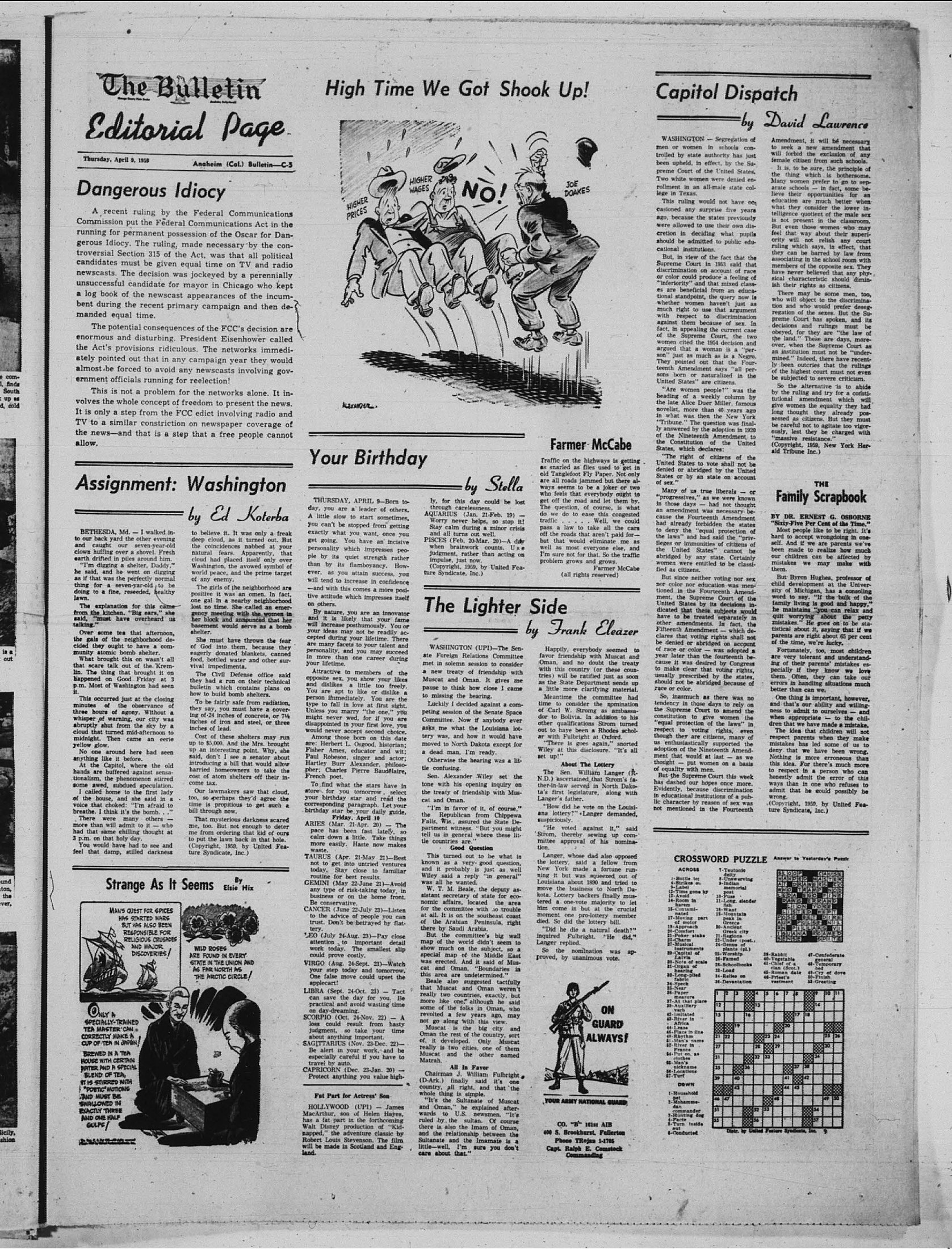
Searchable text
The Bulletin
Editorial Page
Thursday, April 9, 1959
Anaheim (Col.) Bulletin—C-5
Dangerous Idiocy
A recent ruling by the Federal Communications Commission put the Federal Communications Act in the running for permanent possession of the Oscar for Dangerous Idiocy. The ruling, made necessary by the controversial Section 315 of the Act, was that all political candidates must be given equal time on TV and radio newscasts. The decision was jockeyed by a perennially unsuccessful candidate for mayor in Chicago who kept a log book of the newscast appearances of the incumbent during the recent primary campaign and then demanded equal time.
The potential consequences of the FCC's decision are enormous and disturbing. President Eisenhower called the Act's provisions ridiculous. The networks immediately pointed out that in any campaign year they would almost be forced to avoid any newscasts involving government officials running for reelection!
This is not a problem for the networks alone. It involves the whole concept of freedom to present the news. It is only a step from the FCC edict involving radio and TV to a similar constriction on newspaper coverage of the news—and that is a step that a free people cannot allow.
Assignment: Washington
by Ed Koterba
BETHESDA, Md. — I walked in to our back yard the other evening and caught our seven-year-old clown huffing over a shovel. Fresh earth drifted in piles around him.
"I'm digging a shelter, Daddy," he said, and he went on digging as if that was the perfectly normal thing for a seven-yar-old to be doing to a fine, reseeded, healthy lawn.
The explanation for this came from the kitchen. "Big ears," she said, "must have overheard us talking."
Over some tea that afternoon, the gals of the neighborhood decided they ought to have a community atomic bomb shelter.
What brought this on wasn't all that scare talk out of the Kremlin. The thing that brought it on happened on Good Friday at 3 p.m. Most of Washington had seen it.
This occurred just at the closing minutes of the observance of three hours of agony. Without a whisper of warning, our city was abruptly shut from the sky by a cloud that turned mid-afternoon to midnight. Then came an eerie yellow glow.
No one around here had seen anything like it before.
At the Capitol, where the old hands are buffered against sensationalism, the phenomenon stirred some awed, subdued speculation.
I called home to the first lady of the house, and she said in a voice that choked: "I'm afraid to breathe. I think it's the bomb..." There were many others — more than will admit to it — who had that same chilling thought at 3 p.m. on that holy day.
You would have had to see and feel that damp, stilled darkness to believe it. It was only a freak deep cloud, as it turned out. But the coincidences nabbed at your natural fears. Apparently, that cloud had placed itself only over Washington, the avowed symbol of world peace, and the prime target of any enemy.
The girls of the neighborhood are positive it was an omen. In fact, one gal in a nearby neighborhood lost no time. She called an emergency meeting with the women in her block and announced that her basement would serve as a bomb shelter.
She must have thrown the fear of God into them, because they eagerly donated blankets, canned food, bottled water and other survival impediments.
The Civil Defense office said they had a run on their technical bulletin which contains plans on how to build bomb shelters.
To be fairly safe from radiation, they say, you must have a covering of 24 inches of concrete, or 7½ inches of iron and steel, or three inches of lead.
Cost of these shelters may run up to $5,000. And the Mrs. brought up an interesting point. Why, she said, don't I see a senator about introducing a bill that would allow harried homeowners to take the cost of atom shelters off their income tax.
Our lawmakers saw that cloud, too, so perhaps they'd agree the time is propitious to get such a bill through now.
That mysterious darkness scared me, too. But not enough to deter me from ordering that kid of ours to put the lawn back in that hole. (Copyright, 1959, by United Feature Syndicate, Inc.)
Strange As It Seems
By
Elsie Hix
MAN'S QUEST FOR SPICES
HAS STARTED WARS
BUT HAS ALSO BEEN
RESPONSIBLE FOR
RELIGIOUS CRUSADE
AND MAJOR
DISCOVERIES!
WILD ROSES
ARE FOUND IN EVERY
STATE IN THE UNION AND
AS FAR NORTH AS
THE ARCTIC CIRCLE!
ONLY A
SPECIALLY-TRAINED
TEA MASTER CAN
CORRECTLY MAKE A
CUP OF TEA IN JAPAN!
BREWED IN A TEA
HOUSE WITH CERTAIN
WATER AND A SPECIAL
BLEND OF TEA,
IT IS STIRRED WITH
"POETIC" NOTIONS
AND MUST BE SWALLOWED IN
EXACTLY THREE
AND ONE HALF GULPS!
High Time We Got Shook Up!
HIGHER PRICES
HIGHER WAGES
NO!
JOE DOAKES
Alexander.
Farmer-McCabe
Traffic on the highways is getting
Your Birthday
Your Birthday
by Stella
THURSDAY, APRIL 9—Born today, you are a leader of others. A little slow to start sometimes, you can't be stopped from getting exactly what you want, once you get going. You have an incisive personality which impresses people by its quiet strength rather than by its flamboyancy. However, as you attain success, you will tend to increase in confidence—and with this comes a more positive attitude which impresses itself on others.
By nature, you are an innovator and it is likely that your fame will increase posthumously. You or your ideas may not be readily accepted during your lifetime. There are many facets to your talent and personality, and you may succeed in more than one career during your lifetime.
Attractive to members of the opposite sex, you show your likes and dislikes a little too freely. You are apt to like or dislike a person immediately. You are the type to fall in love at first sight. Unless you marry "the one," you might never wed, for if you are disappointed in your first love, you would never accept second choice.
Among those born on this date are: Herbert L. Osgood, historian; Fisher Ames, educator and wit; Paul Robeson, singer and actor; Hartley Burr Alexander, philosopher; Charles Pierre Baudelaire, French poet.
To find what the stars have in store for you tomorrow, select your birthday star and read the corresponding paragraph. Let your birthday star be your daily guide.
Friday, April 10
ARIES (Mar. 21-Apr. 20) — The pace has been fast lately, so calm down a little. Take things more easily. Haste now makes waste.
TAURUS (Apr. 21-May 21)—Best not to get into untried ventures today. Stay close to familiar routine for best results.
GEMINI (May 22-June 14)
Farmer McCabe
Traffic on the highways is getting as snarled as files used to get in old Tanglefoot Fly Paper. Not only are all roads jammed but there always seems to be a joker or two who feels that everybody ought to get off the road and let them by. The question, of course, is what do we do to ease this congested traffic... Well, we could pass a law to take all the cars off the roads that aren't paid for—but that would eliminate me as well as most everyone else, and I'm sure not for that. So the traffic problem grows and grows.
Farmer McCabe
(all rights reserved)
The Lighter Side
by Frank Eleazer
WASHINGTON (UPI)—The Senate Foreign Relations Committee met in solemn session to consider a new treaty of friendship with Muscat and Oman. It gives me pause to think how close I came to missing the hearing.
Luckily I decided against a competing session of the Senate Space Committee. Now if anybody ever asks me what the Louisiana lottery was, and how it would have moved to North Dakota except for a dead man, I'm ready.
Otherwise the hearing was a little confusing.
Sen. Alexander Wiley set the tone with his opening inquiry on the treaty of friendship with Muscat and Oman.
"I'm in favor of it, of course," the Republican from Chippewa Falls, Wis., assured the State Department witness. "But you might tell us in general where these little countries are."
Good Question
This turned out to be what is known as a very good question, and it probably is just as well Wiley said a reply "in general" was all wanted.
Happily, everybody seemed to favor friendship with Muscat and Oman, and no doubt the treaty with this country (or these countries) will be ratified just as soon as the State Department sends up a little more clarifying material.
Meantime the committee had time to consider the nomination of Carl W. Stromg as ambassador to Bolivia. In addition to his other qualifications Strom turned out to have been a Rhodes scholar with Fulbright at Oxford.
"There is goes again," snorted Wiley at this disclosure. "It's all set up!"
About The Lottery
The Sen. William Langer (R.N.D.) ascertained that Strom's father-in-law served in North Dakota's first legislature, along with Langer's father.
"How did he vote on the Louisiana lottery?" *Langer demanded, suspiciously.*
"He voted against it," said Strom, thereby sewing up committee approval of his nomination.
Langer, whose dad also opposed the lottery, said a fellow from New York made a fortune running it but was squeezed out of Louisiana about 1800 and tried to
Fat Part for Actress' Son
HOLLYWOOD (UPI) — James MacArthur, son of Helen Hayes, has a fat part in the forthcoming Walt Disney production of "Kid-napped," the adventure classic by Robert Louis Stevenson. The film will be made in Scotland and England.
ARIES (Mar. 21-Apr. 20) — The pace has been fast lately, so calm down a little. Take things more easily. Haste now makes waste.
TAURUS (Apr. 21-May 21)—Best not to get into untrained ventures today. Stay close to familiar routine for best results.
GEMINI (May 22-June 21)—Avoid any type of risk-taking today, in business or on the home front. Be conservative.
CANCER (June 22-July 23)—Listen to the advice of people you can trust. Don't be betrayed by flattery.
LEO (July 24-Aug. 23)—Pay close attention to important detail work today. The smallest slip could prove costly.
VIRGO (Aug. 24-Sept. 23)—Watch your step today and tomorrow. One false move could upset the applecart!
LIBRA (Sept. 24-Oct. 23) — Tact can save the day for you. Be practical and avoid wasting time on day-dreaming.
SCORPIO (Oct. 24-Nov. 22) — A loss could result from hasty judgment, so take your time about anything important.
SAGITTARIUS (Nov. 23-Dec. 22)—Be alert in your work, and be especially careful if you have to travel by auto.
CAPRICORN (Dec. 23-Jan. 20) — Protect anything you value high-
Good Question
This turned out to be what is known as a very good question, and it probably is just as well Wiley said a reply "in general" was all he wanted.
W. T. M. Beale, the deputy assistant secretary of state for economic affairs, located the area for the committee with no trouble at all. It is on the southeast coast of the Arabian Peninsula, right there by Saudi Arabia.
But the committee's big wall map of the world didn't seem to show much on the subject, so a special map of the Middle East was erected. And it said of Muscat and Oman, "Boundaries in this area are undetermined."
Beale also suggested tactfully that Muscat and Oman weren't really two countries, exactly, but more like one, although he said some of the folks in Oman, who revolted a few years ago, may not go along with this view.
Muscat is the big city and Oman the rest of the country, sort of, it developed. Only Muscat really is two cities, one of them Muscat and the other named Matrah.
All In Favor
Chairman J. William Fulbright (D-Ark.) finally said it's one country, all right, and that 'the whole thing is simple.
"It's the Sultanate of Muscat and Oman," he explained afterwards to U.S. newsmen. "It's ruled by the sultan. Of course there is also the Imam of Oman, and the relationship between the Sultanate and the Imamate is a little—well, I'm sure you don't care about that."
Capitol Dispatch
by David Lawrence
WASHINGTON — Segregation of men or women in schools controlled by state authority has just been upheld, in effect, by the Supreme Court of the United States. Two white women were denied enrollment in an all-male state college in Texas.
This ruling would not have occasioned any surprise five years ago, because the states previously were allowed to use their own discretion in deciding what pupils should be admitted to public educational institutions.
But, in view of the fact that the Supreme Court in 1953 said that discrimination on account of race or color could produce a feeling of "inferiority" and that mixed classes are beneficial from an educational standpoint, the query now is whether women haven't just as much right to use that argument with respect to discrimination against them because of sex. In fact, in appealing the current case of the Supreme Court, the two women cited the 1954 decision and argued that a woman is a "person" just as much as is a Negro. They pointed out that the Fourteenth Amendment says "all persons born or naturalized in the United States" are citizens.
"Are women people?" was the heading of a weekly column by the late Alice Duer Miller, famous novelist, more than 40 years ago in what was then the New York "Tribune." The question was finally answered by the adoption in 1920 of the Nineteenth Amendment, to the Constitution of the United States, which declares:
"The right of citizens of the United States to vote shall not be Amendment, it will be necessary to seek a new amendment that will forbid the exclusion of any female citizen from such schools.
It is, to be sure, the principle of the thing which is bothersome. Many women prefer to go to separate schools — in fact, some believe their opportunities for an education are much better when they consider the lower intelligence quotient of the male sex is not present in the classroom. But even those women who may feel that way about their superiority will not relish any court ruling which says, in effect, that they can be barred by law from associating in the school room with members of the opposite sex. They have never believed that any physical characteristic should diminish their rights as citizens.
There may be some men, too, who will object to the discrimination and who would prefer desegregation of the sexes. But the Supreme Court has spoken, and its decisions and rulings must be obeyed, for they are "the law of the land." These are days, moreover, when the Supreme Court as an institution must not be "undermined." Indeed, there have recently been outcries that the rulings of the highest court must not even be subjected to severe criticism.
So the alternative is to abide by the ruling and try for a constitutional amendment which will give women the equality they had long thought they already possessed as citizens. But they must be careful not to agitate too vigorously, lest they be charged with "massive resistance."
(Copyright, 1959, New York Herald Tribune Inc.)
McCabe
ways is getting used to get in Paper. Not only did but there al- joker or two anybody ought to let them by. course, is what this congested Well, we could all the cars weren't paid for—minate me as anyone else, and so the traffic grows.
Farmer McCabe reserved)
The right of citizens of the United States to vote shall not be denied or abridged by the United States or by an state on account of sex."
Many of us true liberals — or "progressives," as we were known in those days — had not thought an amendment was necessary because the Fourteenth Amendment had already forbidden the states to deny the "equal protection of the laws" and had said the "privileges or immunities of citizens of the United States" cannot be abridged by any state. Certainly women were entitled to be classified as citizens.
But since neither voting nor sex nor color nor education was mentioned in the Fourteenth Amendment, the Supreme Court of the United States by its decisions indicated that these subjects would have to be treated separately in other amendments. In fact, the Fifteenth Amendment — which declares that voting rights shall not be denied or abridged on account of race or color — was adopted a year later than the fourteenth because it was desired by Congress to make clear that voting rights, usually prescribed by the states, should not be abridged because of race or color.
So, inasmuch as there was no tendency in those days to rely on the Supreme Court to amend the constitution to give women the "equal protection of the laws" in respect to voting rights, even though they are citizens, many of us enthusiastically supported the adoption of the Nineteenth Amendment that would at last — as we thought — put women on a basis of equality with men.
But the Supreme Court this week has dashed our hopes once more. Evidently, because discrimination in educational institutions of a public character by reason of sex was not mentioned in the Fourteenth
THE Family Scrapbook
BY DR. ERNEST G. OSBORNE
"Sixty-Five Per Cent of the Time."
Most people like to be right. It's hard to accept wrongdoing in oneself. And if we are parents we've been made to realize how much our children can be affected by mistakes we may make with them.
But Byron Hughes, professor of child development at the University of Michigan, has a consoling word to say. "If the bulk of the family living is good and happy," he maintains "you can relax and quit worrying about the petty mistakes." He goes on to be statistical about it, saying that if we parents are right about 65 per cent of the time, we're lucky.
Fortunately, too, most children are very tolerant and understanding of their parents' mistakes especially if they know we love them. Often, they can take our errors in handling situations much better than can we.
One thing is important, however, and that's our ability and willingness to admit to ourselves — and when appropriate — to the children that we have made a mistake.
The idea that children will not respect parents when they make mistakes has led some of us to deny that we have been wrong. Nothing is more erroneous than this idea. For there's much more to respect in a person who can honestly admit the error of this ways than in one who refuses to admit that he could possibly be wrong.
(Copyright, 1959, New York Herald Tribune Inc.)
CROSSWORD PUZZLE Answer to Yesterday's Puzzle
ACROSS
1- Bottle to
2- Strikes on
3- Label
4- Time gone by
5- Avoid
6- Room in harm
7- Contaminated
8- Moving part of motor
9- Approach
10- Comfort
11- Poker stake
12- Charm
13- Musical instruments
14- Capital of India
15- Note of scale
16- Organ of hearing
17- Long-piled fabric
18- Speck
19- Near
20- Paper measure
21- At that place
22- Auxillary verb
23- Imitated
24- River in Africa
25- Lease
26- Place in line
27- Rhythm
28- Man's name
29- River in France
30- Put on, as clothes
31- Man's nickname
32- Locations
33- Turf
DOWN
1- Household pet
2- Mohammedan commander
3- Hunting dog
4- Facts
5- Turn inside out
6- Conducted
BLOOP CAUSE
MANDED MASTER AT DRAWERS CO WMO TRAMP NOD LEDA EGO FINE RANS ERRAND LION YORE LISTED WEPT POSE BET DIRE AUK PULSE NIL RN PILLARS VI ISUANA ROAMED DENSE SDITG
Worship
Famed
Schoolbooks
Load
Relies on Devastation
Rabbit
Vegetable
Chief of a clan (Soot)
Roman date
Priest's vestment
Confederate general
Temporary bed
Cry of dove
Finish
Greeting