anaheim-bulletin 1959-04-08
Scanned page
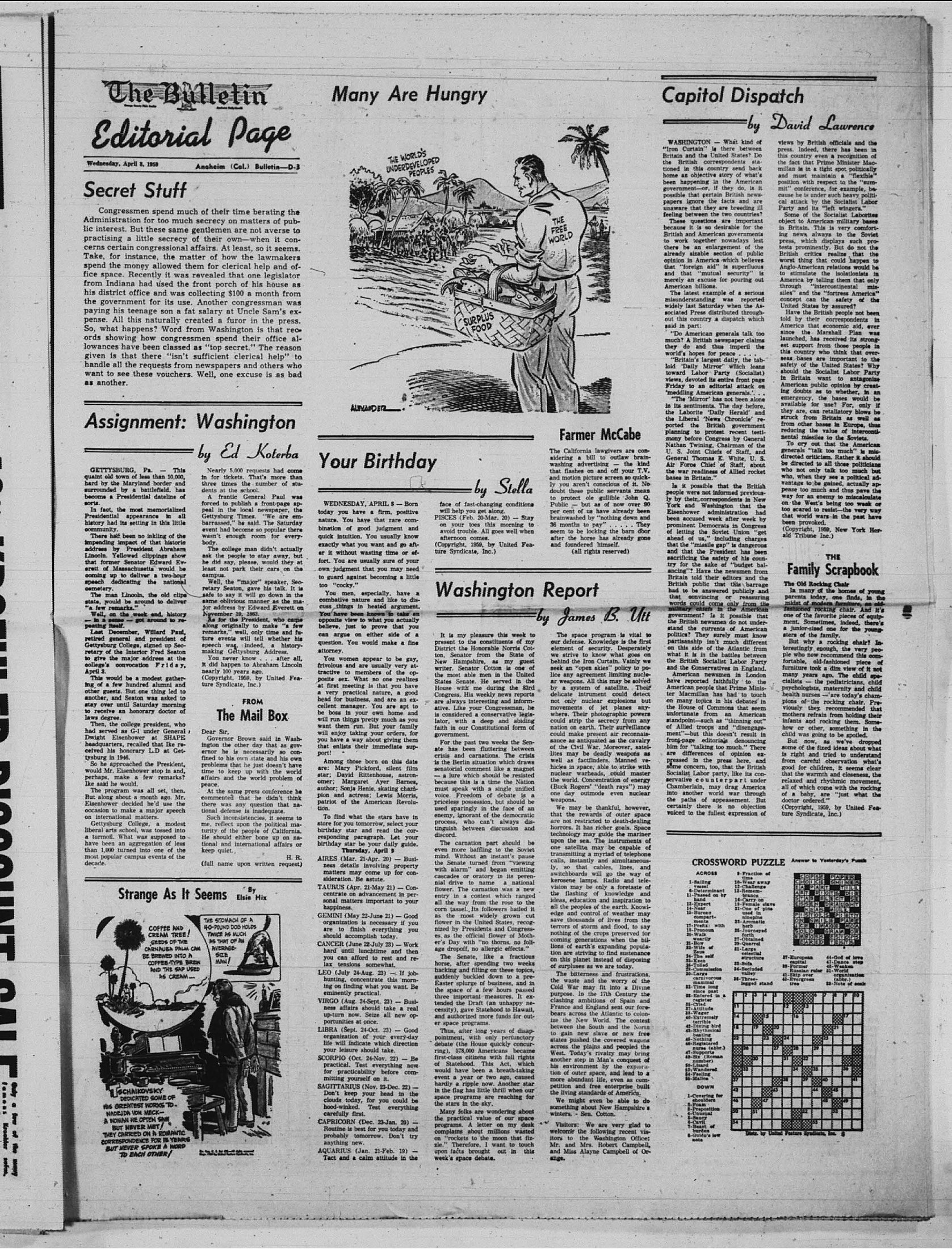
Searchable text
The Bulletin
Editorial Page
Wednesday, April 8, 1959 Anaheim (Cal.) Bulletin—D-3
Secret Stuff
Congressmen spend much of their time berating the Administration for too much secrecy on matters of public interest. But these same gentlemen are not averse to practising a little secrecy of their own—when it concerns certain congressional affairs. At least, so it seems. Take, for instance, the matter of how the lawmakers spend the money allowed them for clerical help and office space. Recently it was revealed that one legislator from Indiana had used the front porch of his house as his district office and was collecting $100 a month from the government for its use. Another congressman was paying his teenage son a fat salary at Uncle Sam's expense. All this naturally created a furor in the press. So, what happens? Word from Washington is that records showing how congressmen spend their office allowances have been classed as "top secret." The reason given is that there "isn't sufficient clerical help" to handle all the requests from newspapers and others who want to see these vouchers. Well, one excuse is as bad as another.
Assignment: Washington
by Ed Koterba
Assignment: Washington
by Ed Koterba
GETTYSBURG, Pa. — This quaint old town of less than 10,000, hard by the Maryland border and surrounded by a battlefield, has become a Presidential dateline of sorts.
In fact, the most memorialized Presidential appearance in all history had its setting in this little community.
There had been no inkling of the impending impact of that historic address by President Abraham Lincoln. Yellowed clippings show that former Senator Edward Everest of Massachusetts would be coming up to deliver a two-hour speech dedicating the national oemetry.
The man Lincoln, the old clips state, would be around to deliver "a few remarks."
Well, on the week end, history — in a sense — got around to repeating itself.
Last December, Willard Paul, retired general and president of Gettysburg College, signed up Secretary of the Interior Fred Seaton to give the major address at the college's convocation Friday, April 3.
This would be a modest gathering of a few hundred alumni and other guests. But one thing led to another, and Seaton was asked to stay over until Saturday morning to receive an honorary doctor of laws degree.
Then, the college president, who had served as G-1 under General Dwight Eisenhower at SHAPE headquarters, recalled that like received his honorary L.D at Gettysburg in 1946.
So he approached the President, would Mr. Eisenhower stop in and, perhaps, make a few remarks? Ike said he would.
The program was all set, then. But along about a month ago. Mr. Eisenhower decided he'd use the occasion to make a major speech on international matters.
Gettysburg College, a modest liberal arts school, was tossed into a turmoil. What was supposed to have been an aggregation of less than 1,000 turned into one of the most popular campus events of the decade.
Nearly 5,000 requests had come in for tickets. That's more than three times the number of students at the school.
A frantic General Paul was forced to publish a front-page appeal in the local newspaper, the Gettysburg Times. "We are embarrassed," he said. The Saturday event had become so popular there wasn't enough room for everybody.
The college man didn't actually ask the people to stay away, but he did say, please, would they at least not park their cars on the campus.
Well, the "major" speaker, Secretary Seaton, gave his talk. It is safe to say it will go down in the same oblivious manner as the major address by Edward Everett on November 19, 1863.
As for the President, who came along originally to make "a few remarks," well, only time and future events will tell whether his speech was indeed, a history-making Gettysburg Address.
You never know . . . after all, it did happen to Abraham Lincoln nearly 100 years ago.
(Copyright, 1959, by United Feature Syndicate, Inc.)
FROM
The Mail Box
Dear Sir,
Governor Brown said in Washington the other day that as governor he is necessarily so confined to his own state and his own problems that he just doesn't have time to keep up with the world affairs and the world problem of peace.
At the same press conference he commented that he didn't think there was any question that national defense is inadequate.
Such inconsistencies, it seems to me, reflect upon the political maturity of the people of California. He should either bone up on national and international affairs or keep quiet.
H. R.
(full name upon written request)
The program was all set, then. But along about a month ago, Mr. Eisenhower decided he'd use the occasion to make a major speech on international matters.
Gettysburg College, a modest liberal arts school, was tossed into a turmoil. What was supposed to have been an aggregation of less than 1,000 turned into one of the most popular campus events of the decade.
At the same press conference he commented that he didn't think there was any question that national defense is inadequate.
Such inconsistencies, it seems to me, reflect upon the political maturity of the people of California. He should either bone up on national and international affairs or keep quiet.
H. R. (full name upon written request)
Strange As It Seems By Elsie Hix
COFFEE AND CREAM TREE! SEEDS OF THE CARNAUBA PALM CAN BE BREWED INTO A COFFEE-TYPE BREW AND THE SAP USED AS CREAM...
THE STOMACH OF A 40-POUND DOG HOLDS TWICE AS MUCH AS THAT OF AN AVERAGE-SIZE MAN!
SCHAIKOVSKY DEDICATED SOME OF HIS GREATEST WORKS TO NADEJDA VON MECK—A WOMAN HE OFTEN SAW BUT NEVER MET/ THEY CARRIED ON A ROMANTIC CORRESPONDENCE FOR 18 YEARS BUT NEVER SPOKE A WORD TO EACH OTHER/
TAURUS (Apcentrate on sonal matter happiness.
GEMINI (Maorganization are to find should acco
CANCER (Julhard until you can add lax tension.
LEO (July 26 hunting, coing on finding eminently p
VIRGO (Augess affair up-turn now portunities
LIBRA (Sept organization life will find your leisure
SCORPIO (O practical for practice mitting you
SAGITTARIUS Don't keep clouds today hood-winked carefully fi
CAPRICORN Routine is probably anything n
AQUARIUS Tact and a
Many Are Hungry
THE WORLD'S UNDERDEVELOPED PEOPLES
THE FREE WORLD
SURPLUS FOOD
ALFYANDER
Farmer McCabe
Your Birthday
The California lawgivers are considering a bill to outlaw brainwashing advertising — the kind
Your Birthday
by Stella
WEDNESDAY, APRIL 8 — Born today you have a firm, positive nature. You have that rare combination of good judgment and quick intuition. You usually know exactly what you want and go after it without wasting time or effort. You are usually sure of your own judgment that you may need to guard against becoming a little too "cocky."
You men, especially, have a combative nature and like to discuss things in heated argument. You have been known to take an opposite view to what you actually believe, just to prove that you can argue on either side of a question. You would make a fine attorney.
You women appear to be gay, frivolous and are usually very attractive to members of the opposite sex. What no one realizes at first meeting is that you have a very practical nature, a good head for business, and are an excellent manager. You are apt to be boss in your own home and will run things pretty much as you want them run. But your family will enjoy taking your orders, for you have a way about giving them that enlistes their immediate support!
Among those born on this date are: Mary Pickford, silent film star; David Rittenhouse, astronomer; Margaret Ayer Barnes, author; Sonja Henie, skating champion and actress; Lewis Morris, patriot of the American Revolution.
To find what the stars have in store for you tomorrow, select your birthday star and read the corresponding paragraph. Let your birthday star be your daily guide.
Thursday, April 9
AIRES (Mar. 21-April. 20) — Business details involving property matters may come up for consideration. Be astute.
Farmer McCabe
The California lawgivers are considering a bill to outlaw brainwashing advertising — the kind that flashes on and off your T.V. and motion picture screen so quickly you aren't conscious of it. No doubt these public servants mean to protect ole gullible John Q. Public — but as of now over 90 per cent of us have already been brainwashed by "nothing down and 36 months to pay" ... They seem to be locking the barn door after the horse has already gone and foundered himself.
(all rights reserved)
Washington Report
by James B. Utt
It is my pleasure this week to present to the constituents of my District the Honorable Norris Cotton, Senator from the State of New Hampshire, as my guest writer. Senator Cotton is one of the most able men in the United States Senate. He served in the House with me during the 83rd Congress. His weekly news reports are always interesting and informative. Like your Congressman, he is considered a conservative legislator, with a deep and abiding faith in our Constitutional form of government.
For the past two weeks the Senate has been fluttering between crisis and carnations. The crisis is the Berlin situation which draws senatorial comment like a magnet—a lure which should be resisted because this is a time the Nation must speak with a single unified voice. Freedom of debate is a priceless possession, but should be used sparingly in the face of an enemy, ignorant of the democratic process, who can't always distinguish between discussion and discord.
The carnation part should be even more baffling to the Soviet mind. Without an instant's pause the Senate turned from "viewing with alarm" and began emitting cascades or oratory in its perennial drive to name a national space program is vital to our defense. Knowledge is the first element of security. Desperately we strive to know what goes on behind the Iron Curtain. Vainly we seek an "open skies" policy to police any agreement limiting nuclear weapons. All this may be solved by a system of satellite. Their delicate instrument could detect not only nuclear explosions but movements of jet planes anywhere. Their photographic powers could strip the secrecy from any nation on earth. Their surveillance could make present air reconnaissance as antiquated as the cavalry of the Civil War. Moreover, satellites may be deadly weapons as well as factfinders. Manned vehicles in space, able to strike with nuclear warheads, could master the world. Concentration of energy (Buck Rogers' "death rays") may one day outmode even nuclear weapons.
We may be thankful, however, that the rewards of outer space are not restricted to death-dealing horrors. It has richer goals. Space technology may guide the mariner upon the sea. The instruments of one satellite may be capable of transmitting a myriad of telephone calls, instantly and simultaneously, so that cables, lines, and switchboards will go the way of kerosene lamps. Radio and tele-
To find what the stars have in store for you tomorrow, select your birthday star and read the corresponding paragraph. Let your birthday star be your daily guide.
Thursday, April 9
AIRES (Mar. 21-Apr. 20) — Business details involving property matters may come up for consideration. Be astute.
TAURUS (Apr. 21-May 21) — Concentrate on advancement in personal matters important to your happiness.
GEMINI (May 22-June 21) — Good organization is necessary if you are to finish everything you should accomplish today.
CANCER (June 22-July 23) — Work hard until lunchtime and then you can afford to rest and relax tensions somewhat.
LEO (July 24-Aug. 23) — If job-hunting, concentrate this morning on finding what you want. Be eminently practical.
VIRGO (Aug. 24-Sept. 23) — Business affairs should take a real up-turn now. Seize all new opportunities at once.
LIBRA (Sept. 24-Oct. 23) — Good organization of your every-day life will indicate which direction your leisure should take.
SCORPIO (Oct. 24-Nov. 22) — Be practical. Test everything now for practicability before committing yourself on it.
SAGITTARIUS (Nov. 23-Dec. 22) — Don't keep your head in the clouds today, for you could be hood-winked. Test everything carefully first.
CAPRICORN (Dec. 23-Jan. 20) — Routine is best for you today and probably tomorrow. Don't try anything new.
AQUARIUS (Jan. 21-Feb. 19) — Tact and a calm attitude in the must speak with a single unified voice. Freedom of debate is a priceless possession, but should be used sparingly in the face of an enemy, ignorant of the democratic process, who can't always distinguish between discussion and discord.
The carnation part should be even more baffling to the Soviet mind. Without an instant's pause the Senate turned from "viewing with alarm" and began emitting cascades or oratory in its perennial drive to name a national flower. The carnation was a new entry in a contest which ranged all the way from the rose to the corn tassel. Its followers hailed it as the most widely grown cut flower in the United States, recognized by Presidents and Congresses as the official flower of Mother's Day with "no thorns, no foliage dropoff, no allergic effects."
The Senate, like a fractious horse, after spending two weeks backing and filling on these topics, suddenly buckled down to a pre-Easter splurge of business, and in the space of a few hours passed three important measures. It extended the Draft (an unhappy necessity), gave Statehood to Hawaii, and authorized more funds for outer space programs.
Thus, after long years of disappointment, with only perfunctory debate (the House quickly concurring), 578,000 Americans became first-class citizens with full rights of Statehood. This Act, which would have been a breath-taking event a year or two ago, caused hardly a ripple now. Another star in the flag has little thrill when our space programs are reaching for the stars in the sky.
Many folks are wondering about the practical value of our space programs. A letter on my desk complains about millions wasted on "rockets to the moon that fizzle." Therefore, I want to touch upon facts brought out in this week's space debate.
(Buck Rogers' "death rays") may one day outmode even nuclear weapons.
We may be thankful, however, that the rewards of outer space are not restricted to death-dealing horrors. It has richer goals. Space technology may guide the mariner upon the sea. The instruments of one satellite may be capable of transmitting a myriad of telephone calls, instantly and simultaneously, so that cables, lines, and switchboards will go the way of kerosene lamps. Radio and television may be only a foretaste of the flashing of knowledge and ideas, education and inspiration to all the peoples of the earth. Knowledge and control of weather may save thousands of lives from the terrors of storm and flood, to say nothing of the crops preserved for coming generations when the billions of earth's expanding population are striving to find sustenance on this planet instead of disposing of surpluses as we are today.
The bitterness and frustrations, the waste and the worry of the Cold War may fit into a Divine purpose. In the 17th Century the clashing ambitions of Spain and France and England sent our forebears across the Atlantic to colonize the New World. The contest between the South and the North to gain new slave or new free states pushed the covered wagons across the plains and peopled the West. Today's rivalry may bring another step in Man's conquest of his environment by the exploration of outer space, and lead to a more abundant life, even as competition and free enterprise built the living standards of America.
We might even be able to do something about New Hampshire's winters. - Sen. Cotton.
Visitors: We are very glad to welcome the following recent visitors to the Washington Office: Mr. and Mrs. Robert Campbell, and Miss Alayne Campbell of Orange.
Capitol Dispatch
by David Lawrence
WASHINGTON — What kind of "Iron Curtain" is there between Britain and the United States? Do the British correspondents stationed in this country send back home an objective story of what's been happening in the American government—or, if they do, is it possible that certain British newspapers ignore the facts and are unaware that they are breeding ill feeling between the two countries?
These questions are important because it is so desirable for the British and American governments to work together nowadays lest there be an enlargement of the already sizable section of public opinion in America which believes that "foreign aid" is superfluous and that "mutual security" is merely an excuse for pouring out American billions.
The latest example of a serious misunderstanding was reported widely last Saturday when the Associated Press distributed throughout this country a dispatch which said in part:
"Do American generals talk too much? A British newspaper claims they do and thus imperil the world's hopes for peace . . .
"Britain's largest daily, the tabloid 'Daily Mirror' which leans toward Labor Party (Socialist) views, devoted its entire front page Friday to an editorial attack on 'meddling American generals.' . .
"The 'Mirror' has not been alone in its sentiments. The day before, the Laborite 'Daily Herald' and the Liberal 'News Chronicle' reported the British government planning to protest recent testimony before Congress by General Nathan Twining, Chairman of the U. S. Joint Chiefs of Staff, and General Thomas E. White, U. S. Air Force Chief of Staff, about views by British officials and the press. Indeed, there has been in this country even a recognition of the fact that Prime Minister Macmillan is in a tight spot politically and must maintain a "flexible" position with respect to the "summit" conference, for example, because he is under such heavy political attack by the Socialist Labor Party and its "left wingers."
Some of the Socialist Laborites object to American military bases in Britain. This is very comforting news always to the Soviet press, which displays such protests prominently. But do not the British critics realize that the worst thing that could happen to Anglo-American relations would be to stimulate the isolationists in America by telling them that only through "intercontinental missiles" and the "fortress America" concept can the safety of the United States be assured?
Have the British people not been told by their correspondents in America that economic aid, ever since the Marshall Plan was launched, has received its strongest support from those people in this country who think that overseas bases are important to the safety of the United States? Why should the Socialist Labor Party in Britain want to antagonize American public opinion by creating doubts as to whether, in an emergency, the bases would be available for use? For, only if they are, can retaliatory blows be struck from Britain as well as from other bases in Europe, thus reducing the value of intercontinental missiles to the Soviets.
To cry out that the American generals "talk too much" is misdirected criticism. Rather it should be directed to all those politicians
McCabe
lawgivers are conto outlaw brainising — the kind
of now over your T.V.
are screen so quickconscious of it. No
public servants mean
gullible John Q.
has of now over 90
have already been
"nothing down and
away". They
sing the barn door
has already gone
himself.
is reserved)
The 'Mirror' has not been alone in its sentiments. The day before, the Laborite 'Daily Herald' and the Liberal 'News Chronicle' reported the British government planning to protest recent testimony before Congress by General Nathan Twining, Chairman of the U.S. Joint Chiefs of Staff, and General Thomas E. White, U.S. Air Force Chief of Staff, about the war readiness of Allied rocket bases in Britain."
Is it possible that the British people were not informed previously by their correspondents in New York and Washington that the Eisenhower administration had been accused week after week by prominent Democrats in Congress of letting the Soviet Union "get ahead of us," including charges that the "missile gap" is dangerous and that the President has been sacrificing the safety of his country for the sake of "budget balancing"? Have the newsmen from Britain told their editors and the British public that this barrage had to be answered publicly and that convincing or reassuring words could come only from the military chiefs in the American government? Is it possible that the British newsmen do not understand the currents of American politics? They surely must know partisanship isn't much different on this side of the Atlantic from what it is in the battles between the British Socialist Labor Party and the Conservatives in England.
American newsmen in London have reported faithfully to the American people that Prime Minister Macmillan has had to touch on many topics in his debates in the House of Commons that seem unfortunate from an American standpoint—such as "thinning out" of Allied troops and "disengagement"—but this doesn't result in front-page editorials denouncing him for "talking too much." There are differences of opinion expressed in the press here, and some concern, too, that the British Socialist Labor party, like its conservative counterpart under Chamberlain, may drag America into another world war through the paths of appeasement. But certainly there is no objection voiced to the fullest expression of toward Labor Party (Socialist) views, devoted its entire front page Friday to an editorial attack on 'meddling American generals.'...
"The 'Mirror' has not been alone in its sentiments. The day before, the Laborite 'Daily Herald' and the Liberal 'News Chronicle' reported the British government planning to protest recent testimony before Congress by General Nathan Twining, Chairman of the U.S. Joint Chiefs of Staff, and General Thomas E. White, U.S. Air Force Chief of Staff, about the war readiness of Allied rocket bases in Britain."
To cry out that the American generals "talk too much" is misdirected criticism. Rather it should be directed to all those politicians who not only talk too much but who, when they see a political advantage to be gained, actually appease too much and thus pave the way for an enemy to miscalculate on the West's being too weak or too scared to resist—the very way that world wars-in the past have provoked.
(Copyright, 1959, New York Herald Tribune Inc.)
THE Family Scrapbook
The Old Rocking Chair
In many of the homes of young parents today, one finds, in the midst of modern furniture, an old-fashioned rocking chair. And it's one of the favorite pieces of equipment. Sometimes, indeed, there's a junior-sized one for the youngsters of the family.
But why a rocking chair? Interestingly enough, the very people who now recommend this comfortable, old-fashioned piece of furniture took a dim view of it not many years ago. The child specialists — the pediatricians, child psychologists, maternity and child health nurses — are today's champions of the rocking chair. Previously they recommended that mothers refrain from holding their infants and rocking them. Somehow or other, something in the child was going to be spoiled.
But now, as we've dropped some of the fixed ideas about what is right and tried to understand from careful observation what's good for children, it seems clear that the warmth and closeness, the relaxed and rhythmic movement, all of which come with the rocking of a baby, are "just what the doctor ordered."
(Copyright, 1959, by United Feature Syndicate, Inc.)
CROSSWORD PUZZLE Answer to Yesterday's Puzzle
ACROSS
1. Sailing vessel
2. Determinant
3. Passed on by hand
4. Expert
5. Bursau compartments
6. Prefix: with
7. Pronouns
8. Walk wearily
9. Wife of Zeus
10. The self
11. Keen
12. Tolled
13. Commission
14. Large carnivorous mammal
15. Time long since past
16. Divered in a register
17. Cried
18. Attitude
19. Wager
20. Extremely terrible
21. Diving bird
22. Rhythmic beating
23. Nothing
24. Registered nurse (fabr.)
25. Supports
26. Six (Roman number)
27. Lighthard
28. Weavered
29. Feeling
30. Mallice
DOWN
1. Covering for shoulders
2. Foam
3. Preposition
4. Unusual
5. Beauty
6. Cardio
7. Beast of burden
8. Guido's lew note
COPSE PAPER
CHOICE SHINES
EA PART TILL
ART RIOTS DIE
STAB ELECT SE
ESSEN DRAGHT MEAS MULE
PISTOLS PIETY ON SWILE PARRE ICE IMAGE MOA SOLD GRAM OR EMBOSS ESTOPS EARED TESTS
European capital Former Russian ruler Skip over Evergreen tree
God of love Dance step Weaken World organization table.
Note of soak