anaheim-bulletin 1959-04-03
Scanned page
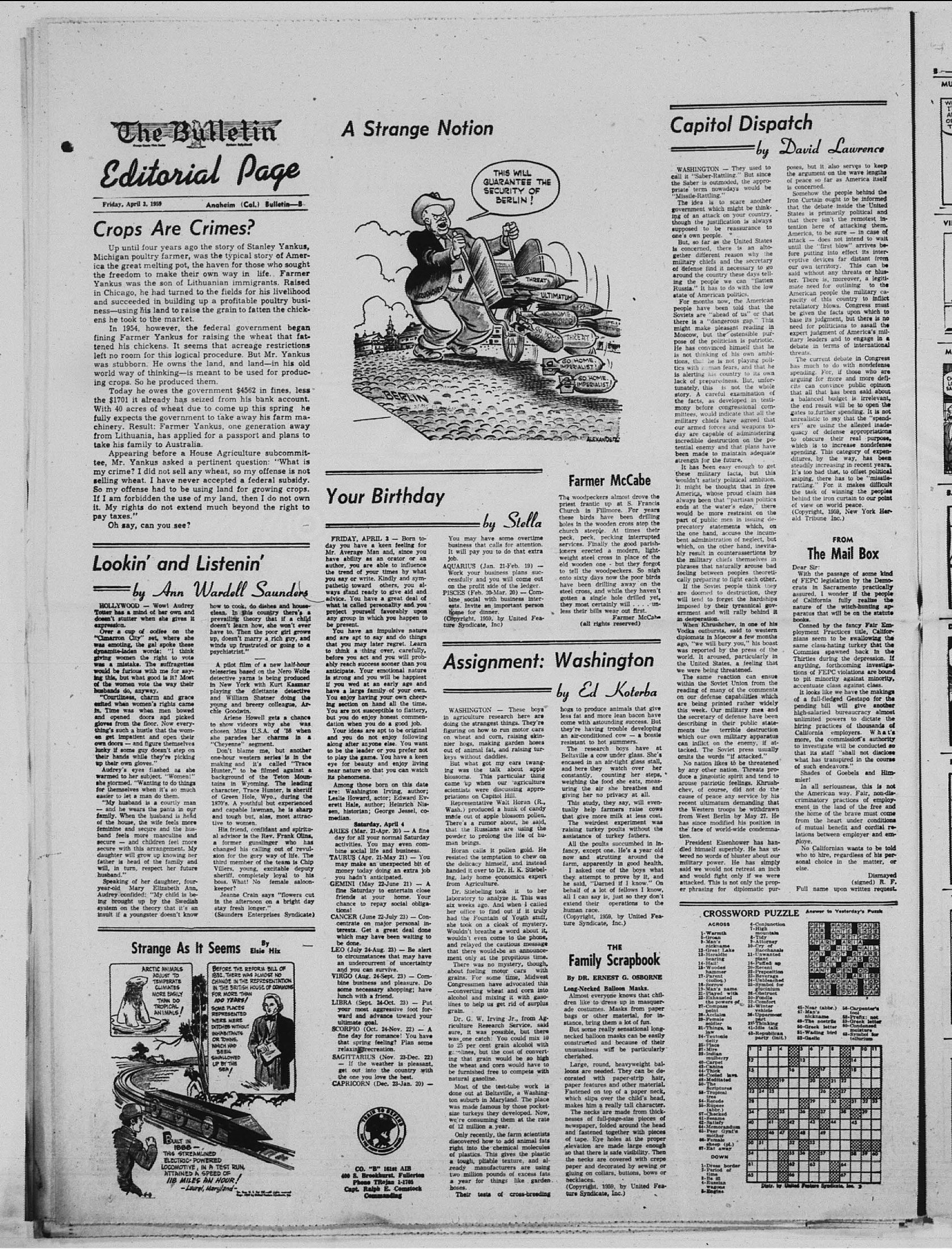
Searchable text
The Bulletin
Editorial Page
Friday, April 3, 1959 Anaheim (Cal.) Bulletin—B
Crops Are Crimes?
Up until four years ago the story of Stanley Yankus, Michigan poultry farmer, was the typical story of America the great melting pot, the haven for those who sought the freedom to make their own way in life. Farmer Yankus was the son of Lithuanian immigrants. Raised in Chicago, he had turned to the fields for his livelihood and succeeded in building up a profitable poultry business—using his land to raise the grain to fatten the chickens he took to the market.
In 1954, however, the federal government began fining Farmer Yankus for raising the wheat that fattened his chickens. It seems that acreage restrictions left no room for this logical procedure. But Mr. Yankus was stubborn. He owns the land, and land—in his old world way of thinking—is meant to be used for producing crops. So he produced them.
Today he owes the government $4562 in fines, less the $1701 it already has seized from his bank account. With 40 acres of wheat due to come up this spring he fully expects the government to take away his farm machinery. Result: Farmer Yankus, one generation away from Lithuania, has applied for a passport and plans to take his family to Australia.
Appearing before a House Agriculture subcommittee, Mr. Yankus asked a pertinent question: "What is
world way of thinking—is meant to be used for producing crops. So he produced them.
Today he owes the government $4562 in fines, less the $1701 it already has seized from his bank account. With 40 acres of wheat due to come up this spring he fully expects the government to take away his farm machinery. Result: Farmer Yankus, one generation away from Lithuania, has applied for a passport and plans to take his family to Australia.
Appearing before a House Agriculture subcommittee, Mr. Yankus asked a pertinent question: "What is my crime? I did not sell any wheat, so my offense is not selling wheat. I have never accepted a federal subsidy. So my offense had to be using land for growing crops. If I am forbidden the use of my land, then I do not own it. My rights do not extend much beyond the right to pay taxes."
Oh say, can you see?
Lookin' and Listenin'
by Ann Wardell Saunders
HOLLYWOOD — Wow! Audrey Totter has a mind of her own and doesn't stutter when she gives it expression.
Over a cup of coffee on the "Cimarron City" set, where she was emoting, the gal spoke these dynamite-laden words: "I think giving women the right to vote was a mistake. The suffragettes would be furious with me for saying this, but what good is it? Most of the women vote the way their husbands do, anyway.
"Courtiness, charm and grace existed when women's rights came in. Time was when men bowed and opened doors and picked gloves from the floor. Now everything's such a hustle that the women get impatient and open their own doors—and figure themselves lucky if some guy doesn't step on their hands while they're picking up their own gloves."
Audrey's eyes flashed as she warmed to her subject. "Women!" she stormed. "Wanting to do things for themselves when it's so much easier to let a man do them.
"My husband is a courtly man—and he wears the pants in our family. When the husband is head of the house, the wife feels more feminine and secure and the husband feels more masculine and secure—and children feel more secure with this arrangement. My daughter will grow up knowing her father is head of the family and will, in turn, respect her future husband."
Speaking of her daughter four-how to cook, do dishes and houseclean. In this country there's a prevailing theory that if a child doesn't learn how, she won't ever have to. Then the poor girl grows up, doesn't marry a rich guy, and winds up frustrated or going to a psychiatrist."
A pilot film of a new half-hour teleseries based on the Nero Wolfe detective yarns is being produced in New York with Kurt Kasmar playing the dilettante detective and William Shatner doing the young and breezy colleague, Archie Goodwin.
Arlene Howell gets a chance to show videos why she was chosen Miss U.S.A. of '58 when she parades her charms in a "Cheyenne" segment.
Don't blame me, but another one-hour western series is in the making and it's called "Trace Hunter," to be filmed against a background of the Teton Mountains in Wyoming. The leading character, Trace Hunter, is sheriff of Green Hole, Wyo., during the 1870's. A youthful but experienced and capable lawman, he is sharp and tough but, alas, most attractive to women.
His friend, confidant and spiritual advisor is the Rev. Frank Olins, a former gunslinger who has changed his calling out of revulsion for the gory way of life. The third member of the team is Chip Villers, young, excitable deputy sheriff, completely loyal to his boss. What! No female saloon-
"My husband is a courtly man — and he wears the pants in our family. When the husband is head of the house, the wife feels more feminine and secure and the husband feels more masculine and secure — and children feel more secure with this arrangement. My daughter will grow up knowing her father is head of the family and will, in turn, respect her future husband."
Speaking of her daughter, four-year-old Mary Elizabeth Ann, Audrey confided: "My child is being brought up by the Swedish system on the theory that it's an insult if a youngster doesn't know
Strange As It Seems By Elsie Hix
ARCTIC ANIMALS ADJUST TO TEMPERATE CLIMATES MORE EASILY THAN DO TROPICAL ANIMALS!
BEFORE THE REFORM BILL OF 1832, THERE WAS ALMOST NO CHANGE IN THE REPRESENTATION IN THE BRITISH HOUSE OF COMMONS FOR MORE THAN 100 YEARS!
SOME PLACES REPRESENTED WHERE MERE DITCHES WITHOUT INHABITANTS OR TOWNS,
WHICH HAD BEEN SWALOWED UP BY THE SEA!
BUILT IN 1860 — THIS STREAMLINED ELECTRIC-POWERED LOCOMOTIVE, IN A TEST RUN, ATTAINED A SPEED OF 118 MILES AN HOUR!
-Laurel, Maryland-
A Strange Notion
THIS WILL
GUARANTEE THE
SECURITY OF
BERLIN!
MERCURIOUSLY
THREAT
ULTIMATUM
GO HOME.
THREAT!
GO HOME.
IMPERIALIST!
GO HOME.
IMPERIALIST!
BERLIN
ALEXANDER
Your Birthday
by Stella
FRIDAY, APRIL 3 — Born today you have a keen feeling for Mr. Average Man and, since you have ability as an orator or an author, you are able to influence the trend of your times by what you say or write. Kindly and sympathetic toward others, you always stand ready to give aid and advice. You have a great deal of what is called personality and you project yourself favorably upon any group in which you happen to be present.
You have an impulsive nature and are apt to say and do things that you may later regret. Learn to think a thing over, carefully before you act and you will probably reach success sooner than you anticipate. Your emotional nature is strong and you will be happiest if you wed at an early age and have a large family of your own. You enjoy having your own cheering section on hand all the time. You are not susceptible to flattery, but you do enjoy honest commendation when you do a good job.
Your ideas are apt to be original and you do not enjoy following along after anyone else. You want to be the leader or you prefer not to play the game. You have a keen eye for beauty and enjoy living near nature so that you can watch its phenomena.
Among those born on this date are: Washington Irving, author; Leslie Howard, actor; Edward Everett Hale, author; Heinrich Nissen, historian; George Jessel, comedian.
Saturday, April 4
ARIES (Mar. 21-April. 20) — A fine day for all your normal Saturday activities. You may even combine social life and business.
TAURUS (Apr. 21-May 21) — You may make an unexpected bit of money today doing an extra job you hadn't anticipated.
Farmer McCabe
The woodpeckers almost drove the priest frantic up at S. Francis Church in Fillmore. For years these birds have been drilling holes in the wooden cross at the church steeple. At times their peck, peck, pecking interrupted services. Finally the good parishioners erected a modern, lightweight steel cross in place of the old wooden one - but they forgot to tell the woodpeckers. So nigh onto sixty days now the poor birds have been drilling away on the steel cross, and while they haven't gotten a single hole drilled yet, they most certainly will... unless their bills wear out first.
Farmer McCabe
(all rights reserved)
Assignment: Washington
by Ed Koterba
WASHINGTON — These boys in agriculture research here are doing the strangest things. They're figuring on how to run motor cars on wheat and corn, raising skinier hogs, making garden hoses out of animal fat, and raising turkeys without daddies.
But what got my ears twangling was the talk about apple blossoms. This particular thing came up when our agriculture scientists were discussing appropriations on Capitol Hill.
Representative Walt Horan (R., Wash.) produced a hunk of candy made out of apple blossom pollen. There's a rumor about, he said, that the Russians are using the powder to prolong the life of human beings.
Horan calls it pollen gold. He resisted the temptation to chew on the delicacy himself, and instead handed it over to Dr. H. K. Stiebeling, lady home economics expert dogs to produce animals that give less fat and more lean bacon have come with astounding success. But they're having trouble developing an air-conditioned cow — a bossile resistant to hot summers.
The research boys have at Beltaville a cow under glass. She's encased in an air-tight glass stall, and here they watch over her constantly, counting her steps, weighing the food she eats, measuring the air she breathes and giving her no privacy at all.
This study, they say, will eventually help farmers raise cows that give more milk at less cost.
The weirdest experiment was raising turkey poults without the assistance of turkey fathers.
All the poultes succumbed in infancy, except one. He's a year old now and strutting around the farm, apparently in good health.
I asked one of the boys what they attempt to prove by it, and
Among those born on this date are: Washington Irving, author; Leslie Howard, actor; Edward Everett Hale, author; Heinrich Nisse, historian; George Jessel, comedian.
Saturday, April 4
ARIES (Mar. 21-Apr. 20) — A fine day for all your normal Saturday activities. You may even combine social life and business.
TAURUS (Apr. 21-May 21) — You may make an unexpected bit of money today doing an extra job you hadn't anticipated.
GEMINI (May 22-June 21) — A fine Saturday to entertain close friends at your home. Your chance to repay social obligations!
CANCER (June 22-July 23) — Concentrate on major personal interests. Get a great deal done which may have been waiting to be done.
LEO (July 24-Aug. 23) — Be alert to circumstances that may have an undercurrent of uncertainty and you can survive.
VIRGO (Aug. 24-Sept. 23) — Combine business and pleasure. Do some necessary shopping; have lunch with a friend.
LIBRA (Sept. 24-Oct. 23) — Put your most aggressive foot forward and advance toward your ultimate goal.
SCORPIO (Oct. 24-Nov. 22) — A fine day for romance! You have that spring feeling? Plan some relaxing recreation.
SAGITTARIUS (Nov. 23-Dec. 22) — If the weather is pleasant, get out into the country with the one you love the best.
CAPRICORN (Dec. 23-Jan. 20) —
CO. "B" 161st AIB
409 S. Brookhurst, Fullerton
Phone TRejan 1-1765
Capt. Ralph E. Comstock Commanding
Representative Walt Horan (R., Wash.) produced a hunk of candy made out of apple blossom pollen. There's a rumor about him, said that the Russians are using the powder to prolong the life of human beings.
Horan calls it pollen gold. He resisted the temptation to chew on the delicacy himself, and instead handed it over to Dr. H. K. Stiebeling, lady home economics expert from Agriculture.
Dr. Stiebeling took it to her laboratory to analyze it. This was six weeks ago. And when I called her office to find out if it truly had the Fountain of Youth stuff, she took on a cloak of mystery. Wouldn't breathe a word about it, wouldn't even come to the phone, and relayed the cautious message that there would be an announcement only at the propitious time.
There was no mystery, though, about fueling motor cars with grains. For some time, Midwest Congressmen have advocated this—converting wheat and corn into alcohol and mixing it with gasoline to help us get rid of surplus grain.
Dr. G. W. Irving Jr., from Agriculture Research Service, said sure, it was possible, but there was_one catch: You could mix 10 to 25 per cent grain alcohol with gasoline, but the cost of converting that grain would be so high the wheat and corn would have to be furnished free to compete with natural gasoline.
Most of the test-tube work is done out at Beltsville, a Washington suburb in Maryland. The place was made famous by those pocket-size turkeys they developed. Now, we're consuming them at the rate of 12 million a year.
Only recently, the farm scientists discovered how to add animal fats right into the chemical molecules of plastics. This gives the plastic a tough, pliable texture, and already manufacturers are using two million pounds of excess fats a year for things like garden hoses.
Their tests of cross-breeding
This study, they say, will eventually help farmers raise cows that give more milk at less cost.
The weirdest experiment was raising turkey poults without the assistance of turkey fathers.
All the poults succumbed in infancy, except one. He's a year old now and strutting around the farm, apparently in good health.
I asked one of the boys what they attempt to prove by it, and he said, "Darned if I know." On behalf of a lot of fellows I know, all I can say is, just so they don't extend their operations to the human race.
(Copyright, 1959, by United Feature Syndicate, Inc.)
Capitol Dispatch
by David Lawrence
WASHINGTON — They used to call it "Saber-Rattling." But since the Saber is outmoded, the appropriate term nowadays would be "Missile-Rattling."
The idea is to scare another government which might be thinking of an attack on your country, though the justification is always supposed to be reassurance to one's own people.
But, so far as the United States is concerned, there is an altogether different reason why the military chiefs and the secretary of defense find it necessary to go around the country these days telling the people we can "flatten Russia." It has to do with the low state of American politics.
For months now, the American people have been told that the Soviets are "ahead of us" or that there is a "dangerous gap." This might make pleasant reading in Moscow, but the ostensible purpose of the politician is patriotic. He has convinced himself that he is not thinking of his own ambitions, that he is not playing politics with human fears, and that he is alerting his country to its own lack of preparedness. But, unfortunately, this is not the whole story. A careful examination of the facts, as developed in testimony before congressional committees, would indicate that all the military chiefs have agreed that our armed forces and weapons today are capable of administering incredible destruction on the potential enemy and that plans have been made to maintain adequate strength for the future.
poses, but it also serves to keep the argument on the wave lengths of peace so far as America itself is concerned.
Somehow the people behind the Iron Curtain ought to be informed that the debate inside the United States is primarily political and that there isn't the remotest intention here of attacking them. America, to be sure — in case of attack — does not intend to wait until the "first blow" arrives before putting into effect its interceptive devices far distant from our own territory. This can be said without any threats or bluster. There is, moreover, a legitimate need for outlining to the American people the military capacity of this country to inflict retaliatory blows. Congress must be given the facts upon which to base its judgment, but there is no need for politicians to assail the expert judgment of America's military leaders and to engage in a debate in terms of international threats.
The current debate in Congress has much to do with nondefense spending. For, if those who are arguing for more and more deficits can convince public opinion that all that has been said about a balanced budget is irrelevant, the end result will be to open the gates to further spending. It is not unrealistic to say that the "spenders" are using the alleged inadequacy of defense appropriations to obscure their real purpose, which is to increase nondefense spending. This category of expenditures, by the way, has been steadily increasing in recent years.
It has been easy enough to get these military facts, but this wouldn't satisfy political ambition. It might be thought that in free America, whose proud claim has always been that "partisan politics ends at the water's edge," there would be more restraint on the part of public men in issuing precarious statements which, on the one hand, accuse the incumbent administration of neglect, but which, on the other hand, inevitably result in counterassertions by the military chiefs themselves in phrases that naturally arouse bad feeling between peoples theoretically preparing to fight each other.
If the Soviet people think they are doomed to destruction, they will tend to forget the hardships imposed by their tyrannical government and will rally behind it in desperation.
When Khrushchev, in one of his Vodka outbursts, said to western diplomats in Moscow a few months ago, "we will bury you," his boast was reported by the press of the world. It aroused, particularly in the United States, a feeling that we were being threatened.
The same reaction can ensue within the Soviet Union from the reading of many of the comments on our defense capabilities which are being printed rather widely this week. Our military mea and the secretary of defense have been describing in their public statements the terrible destruction which our own military apparatus can inflict on the enemy, if attacked. The Soviet press usually omits the words "if attacked."
No nation likes to be threatened by any other nation. Threats produce a jingoistic spirit and tend to arouse patriotic feelings. Khrushchev, of course, did not do the cause of peace any service by his recent ultimatum demanding that the Western troops be withdrawn from West Berlin by May 27. He has since modified his position in the face of world-wide condemnation.
President Eisenhower has handled himself superbly. He has uttered no words of bluster about our military power. He has simply said we would not retreat an inch and would fight only if we were attacked. This is not only the norm with human fears, and that he is alerting his country to its own lack of preparedness. But, unfortunately, this is not the whole story. A careful examination of the facts, as developed in testimony before congressional committees, would indicate that all the military chiefs have agreed that our armed forces and weapons today are capable of administering incredible destruction on the potential enemy and that plans have been made to maintain adequate strength for the future.
It has been easy enough to get these military facts, but this wouldn't satisfy political ambition. It might be thought that in free America, whose proud claim has always been that "partisan politics ends at the water's edge," there would be more restraint on the part of public men in issuing precarious statements which, on the one hand, accuse the incumbent administration of neglect, but which, on the other hand, inevitably result in counterassertions by the military chiefs themselves in phrases that naturally arouse bad feeling between peoples theoretically preparing to fight each other.
If the Soviet people think they are doomed to destruction, they will tend to forget the hardships imposed by their tyrannical government and will rally behind it in desperation.
When Khrushchev, in one of his Vodka outbursts, said to western diplomats in Moscow a few months ago, "we will bury you," his boast was reported by the press of the world. It aroused, particularly in the United States, a feeling that we were being threatened.
The same reaction can ensue within the Soviet Union from the reading of many of the comments on our defense capabilities which are being printed rather widely this week. Our military mea and the secretary of defense have been describing in their public statements the terrible destruction which our own military apparatus can inflict on the enemy, if attacked. The Soviet press usually omits the words "if attacked."
No nation likes to be threatened by any other nation. Threats produce a jingoistic spirit and tend to arouse patriotic feelings. Khrushchev, of course, did not do the cause of peace any service by his recent ultimatum demanding that the Western troops be withdrawn from West Berlin by May 27. He has since modified his position in the face of world-wide condemnation.
President Eisenhower has handled himself superbly. He has uttered no words of bluster about our military power. He has simply said we would not retreat an inch and would fight only if we were attacked. This is not only the norm with human fears, and that he is alerting his country to its own lack of preparedness. But, unfortunately, this is not the whole story. A careful examination of the facts, as developed in testimony before congressional committees, would indicate that all the military chiefs have agreed that our armed forces and weapons today are capable of administering incredible destruction on the potential enemy and that plans have been made to maintain adequate strength for the future.
It has been easy enough to get these military facts, but this wouldn't satisfy political ambition. It might be thought that in free America, whose proud claim has always been that "partisan politics ends at the water's edge," there would be more restraint on the part of public men in issuing precarious statements which, on the one hand, accuse the incumbent administration of neglect, but which, on the other hand, inevitably result in counterassertions by the military chiefs themselves in phrases that naturally arouse bad feeling between peoples theoretically preparing to fight each other.
If the Soviet people think they are doomed to destruction, they will tend to forget the hardships imposed by their tyrannical government and will rally behind it in desperation.
When Khrushchev, in one of his Vodka outbursts, said to western diplomats in Moscow a few months ago, "we will bury you," his boast was reported by the press of the world. It aroused, particularly in the United States, a feeling that we were being threatened.
The same reaction can ensue within the Soviet Union from the reading of many of the comments on our defense capabilities which are being printed rather widely this week. Our military mea and the secretary of defense have been describing in their public statements the terrible destruction which our own military apparatus can inflict on the enemy, if attacked. The Soviet press usually omits the words "if attacked."
No nation likes to be threatened by any other nation. Threats produce a jingoistic spirit and tend to arouse patriotic feelings. Khrushchev, of course, did not do the cause of peace any service by his recent ultimatum demanding that the Western troops be withdrawn from West Berlin by May 27. He has since modified his position in the face of world-wide condemnation.
President Eisenhower has handled himself superbly. He has uttered no words of bluster about our military power. He has simply said we would not retreat an inch and would fight only if we were attacked. This is not only the norm with human fears, and that he is alerting his country to its own lack of preparedness. But, unfortunately, this is not the whole story. A careful examination of the facts, as developed in testimony before congressional committees, would indicate that all that has been said about a balanced budget is irrelevant, the end result will be to open the gates to further spending. It is not unrealistic to say that the "spenders" are using the alleged inadequacy of defense appropriations to obscure their real purpose, which is to increase nondefense spending. This category of expenditures, by the way, has been steadily increasing in recent years. It's too bad that, to offset political sniping, there has to be "missile-rattling." For it makes difficult the task of winning the peoples behind the iron curtain to our point of view on world peace.
(Copyright, 1959, New York Herald Tribune Inc.)
THE
BAY Scrapbook
ERNEST G. OSBORNE
and Balloon Masks.
Everyone knows that children dress up in masquerades. Masks from paper material, for inking them a lot of fun.
Really sensational long-balloon masks can be easily made and because of their will be particularly sound, heavyweight ballet-needed. They can be de-created with paper-strip hair, tapes and other material.
On top of a paper neck, over the child's head, a really tall character is made from thick-full-page-size pieces of folded around the head together with pieces eye holes at the proper size made large enough there is safe visibility. Then are covered with crepe decorated by sewing or collars, buttons, bows or stitching.
1959, by United Feagate, Inc.)
CROSSWORD PUZZLE
ACROSS
1-Warmth
2-Groan
3-Man's nickname
4-Great Lakes
5-Heraldic bearing
6-Hall
7-Wooden hammer
8-Parent (colloq.)
9-Kervor
10-Man's name
11-Played with
12-Exhausted the powers of
13-Compass point
14-Acclaim
15-Female soldier
16-Things, in law
17-Teutonic deity
18-Mire
19-Indian mulberry
20-Carpet
21-Canine
22-Thick
23-Cooked lava
24-Meditated
25>The Scriptures
26-Tropical tree
27-Reindee
28-Rupees (abbr.)
29-Checked
30-Sensame
31-Satisfy
32-Memorandum
33-Peer Gynt's mother
34-Female sheep (pl.)
35-Eat away
DOWN
1-Dress border
2-Period of time
3-Reil
4-Russian wagons
5-Engine
In all seriousness, this is not the American way. Fair, non-discriminatory practices of employment in the land of the free and the home of the brave must come from the heart under conditions of mutual benefit and cordial relations between employer and employee.
No Californian wants to be told who to hire, regardless of his personal choice in the matter, or else.
Dismayed (signed) R. F.
Full name upon written request.
PET MASS DAUB
BAR ANTE ESSSE
ASE STAFTCMED
START ARUA
TO NUG NAIL
MAY POT STAGE
AC CAT DAS ON
STREAL SUM END
KANT PEN OD
CORE ARISSE
WASH WOMAN TOO
ALBE GENDERA
DEAK EDDY DAM
45-Near (abbr.)
47-Man's nickname
48-The poetris
49-Greek letter
50-Greek letter
51-Wading bird
52-Gaelic
Distr. by United Feature Syndicate, Inc.