anaheim-bulletin 1954-06-11
Scanned page
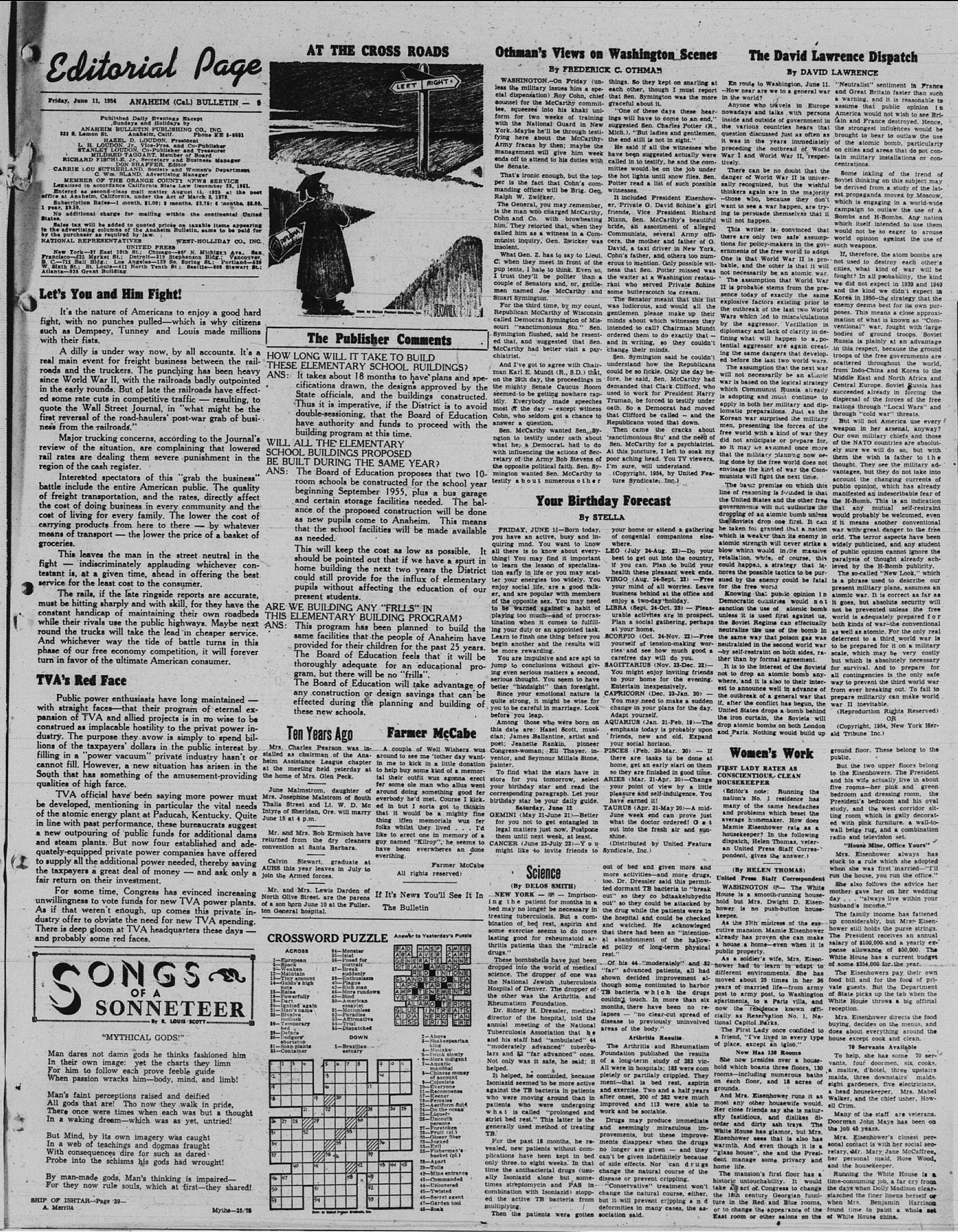
Searchable text
Editorial Page
Friday, June 11, 1954 ANAHEIM (Cal.) BULLETIN — $
Published Daily Evenings Except
Sundays and Holidays by
ANAHEIM BULLETIN PUBLISHING CO., INC.
822 S. Lemon St. Anaheim, Calif. Phone KE 5-6051
HAZEL D. LOUDON, President
L. H. LOUDON, Jr., Vice-President and Co-Publisher
STANLEY LOUDON, Co-Publisher and Treasurer
MILDRED TAGGART, Member of Board
RICHARD FISCHLE, Jr., Secretary and Business Manager
DON SHAFFER, Editor
CARRIE LOU SUTHERLAND, Society and Women's Department
C. Wm. BLAND, Advertising Manager
MEMBER OF THE ORANGE COUNTY NEWS SERVICE
Legalized in accordance California State Law December 28, 1951.
Entered as second-class mail matter August 14, 1923 at the post office at Anaheim, California, under the Act of March 2, 1879.
Subscription Rates—1 month, $1.00; 3 months, $2.75; 6 months, $5.00.
1 year, $9.50.
No additional charge for mailing within the continental United States.
Sales tax will be added to quoted prices on taxable items appearing in the advertising columns of the Anaheim Bulletin, same to be paid for by the purchaser as required by law.
NATIONAL REPRESENTATIVES
WEST-HOLLIDAY CO., INC.
UNITED PRESS
New York—27 East 10th St.; Chicago—86' N. Michigan Ave., San Francisco—525 Market St.; Detroit—319 Stephenson Blvd.; Vancouver, B.C.—711 Ball Blvd.; Los Angeles—139 So. Spring St.; Portland—520 W. Sixth St.; St. Louis—411 North Tenth St.; Seattle—608 Stewart St.; Atlanta—526 Grant Building
Let's You and Him Fight!
It's the nature of Americans to enjoy a good hard fight, with no punches pulled—which is why citizens such as Dempsey, Tunney and Louis made millions with their fists.
A dilly is under way now, by all accounts. It's a real main event for freight business between the railroads and the truckers. The punching has been heavy since World War II, with the railroads badly outpointed in the early rounds. But of late the railroads have effected some rate cuts in competitive traffic — resulting, to quote the Wall Street Journal, in "what might be the first reversal of the road-haulers' post-war grab of business from the railroads."
Major trucking concerns, according to the Journal's review of the situation, are complaining that lowered rail rates are dealing them severe punishment in the
real main event for freight business between the railroads and the truckers. The punching has been heavy since World War II, with the railroads badly outpointed in the early rounds. But of late the railroads have effected some rate cuts in competitive traffic — resulting, to quote the Wall Street Journal, in "what might be the first reversal of the road-haulers' post-war grab of business from the railroads."
Major trucking concerns, according to the Journal's review of the situation, are complaining that lowered rail rates are dealing them severe punishment in the region of the cash register.
Interested spectators of this "grab the business" battle include the entire American public. The quality of freight transportation, and the rates, directly affect the cost of doing business in every community and the cost of living for every family. The lower the cost of carrying products from here to there — by whatever means of transport — the lower the price of a basket of groceries.
This leaves the man in the street neutral in the fight — indiscriminately applauding whichever contestant is, at a given time, ahead in offering the best service for the least cost to the consumer.
The rails, if the late ringside reports are accurate, must be hitting sharply and with skill, for they have the constant handicap of maintaining their own roadbeds while their rivals use the public highways. Maybe next round the trucks will take the lead in cheaper service. And whichever way the tide of battle turns in this phase of our free economy competition, it will forever turn in favor of the ultimate American consumer.
TVA’s Red Face
Public power enthusiasts have long maintained — with straight faces—that their program of eternal expansion of TVA and allied projects is in no wise to be construed as implacable hostility to the privat power industry. The purpose they avow is simply to spend billions of the taxpayers’ dollars in the public interest by filling in a "power vacuum" private industry hasn't or cannot fill. However, a new situation has arisen in the South that has something of the amusement-providing qualities of high farce.
TVA official have been saying more power must be developed, mentioning in particular the vital needs of the atomic energy plant at Paducah, Kentucky. Quite in line with past performance, these bureaucrats suggest a new outpouring of public funds for additional dams and steam plants. But now four established and adequately-equipped private power companies have offered to supply all the additional power needed, thereby saving real main event for freight business between the railroads and the truckers. The punching has been heavy since World War II, with the railroads badly outpointed in the early rounds. But of late the railroads have effected some rate cuts in competitive traffic — resulting, to quote the Wall Street Journal, in "what might be the first reversal of the road-haulers' post-war grab of business from the railroads."
Major trucking concerns, according to the Journal's review of the situation, are complaining that lowered rail rates are dealing them severe punishment in the region of the cash register.
Interested spectators of this "grab the business" battle include the entire American public. The quality of freight transportation, and the rates, directly affect the cost of doing business in every community and the cost of living for every family. The lower the cost of carrying products from here to there — by whatever means of transport — the lower the price of a basket of groceries.
This leaves the man in the street neutral in the fight — indiscriminately applauding whichever contestant is, at a given time, ahead in offering the best service for the least cost to the consumer.
The rails, if the late ringside reports are accurate, must be hitting sharply and with skill, for they have the constant handicap of maintaining their own roadbeds while their rivals use the public highways. Maybe next round the trucks will take the lead in cheaper service. And whichever way the tide of battle turns in this phase of our free economy competition, it will forever turn in favor of the ultimate American consumer.
TVA’s Red Face
Public power enthusiasts have long maintained — with straight faces—that their program of eternal expansion of TVA and allied projects is in no wise to be construed as implacable hostility to the privat power industry. The purpose they avow is simply to spend billions of the taxpayers’ dollars in the public interest by filling in a "power vacuum" private industry hasn’t or cannot fill. However, a new situation has arisen in the South that has something of the amusement-providing qualities of high farce.
TVA official have been saying more power must be developed, mentioning in particular the vital needs of the atomic energy plant at Paducah, Kentucky. Quite in line with past performance, these bureaucrats suggest a new outpouring of public funds for additional dams and steam plants. But now four established and adequately-equipped private power companies have offered to supply all the additional power needed, thereby saving real main event for freight business between the railroads and the truckers. The punching has been heavy since World War II, with the railroads badly outpointed in the early rounds. But of late the railroads have effected some rate cuts in competitive traffic — resulting, to quote the Wall Street Journal, in "what might be the first reversal of the road-haulers' post-war grab of business from the railroads."
Major trucking concerns, according to the Journal's review of the situation, are complaining that lowered rail rates are dealing them severe punishment in the region of the cash register.
Interested spectators of this "grab the business" battle include the entire American public. The quality of freight transportation, and the rates, directly affect the cost of doing business in every community and the cost of living for every family. The lower the cost of carrying products from here to there — by whatever means of transport — the lower the price of a basket of groceries.
This leaves the man in the street neutral in the fight — indiscriminately applauding whichever contestant is, at a given time, ahead in offering the best service for the least cost to the consumer.
The rails, if the late ringside reports are accurate, must be hitting sharply and with skill, for they have the constant handicap of maintaining their own roadbeds while their rivals use the public highways. Maybe next round the trucks will take the lead in cheaper service. And whichever way the tide of battle turns in this phase of our free economy competition, it will forever turn in favor of the ultimate American consumer.
TVA’s Red Face
Public power enthusiasts have long maintained — with straight faces—that their program of eternal expansion of TVA and allied projects is in no wise to be construed as implacable hostility to the privat power industry. The purpose they avow is simply to spend billions of the taxpayers’ dollars in the public interest by filling in a "power vacuum" private industry hasn’t or cannot fill. However, a new situation has arisen in the South that has something of the amusement-providing qualities of high farce.
TVA official have been saying more power must be developed, mentioning in particular the vital needs of the atomic energy plant at Paducah, Kentucky. Quite in line with past performance, these bureaucrats suggest a new outpouring of public funds for additional dams and steam plants. But now four established and adequately-equipped private power companies have offered to supply all the additional power needed, thereby saving real main event for freight business between the railroads and the truckers. The punching has been heavy since World War II, with the railroads badly outpointed in the early rounds. But of late the railroads have effected some rate cuts in competitive traffic — resulting, to quote the Wall Street Journal, in "what might be the first reversal of the road-haulers' post-war grab of business from the railroads."
South that has something of the amusement-providing qualities of high farce.
TVA official have been saying more power must be developed, mentioning in particular the vital needs of the atomic energy plant at Paducah, Kentucky. Quite in line with past performance, these bureaucrats suggest a new outpouring of public funds for additional dams and steam plants. But now four established and adequately-equipped private power companies have offered to supply all the additional power needed, thereby saving the taxpayers a great deal of money — and ask only a fair return on their investment.
For some time, Congress has evinced increasing unwillingness to vote funds for new TVA power plants. As if that weren't enough, up comes this private industry offer to obviate the need for new TVA spending. There is deep gloom at TVA headquarters these days — and probably some red faces.
SONGS OF A SONNETEER
BY R. LOUIS SCOTT
"MYTHICAL GODS!"
Man dares not damn gods he thinks fashioned him
In their own image: yet the charts they limn
For him to follow each prove feeble guide
When passion wracks him—body, mind, and limb!
Man's faint perceptions raised and deified
All gods that are! Tho now they walk in pride,
There once were times when each was but a thought
In a waking dream—which was as yet, untried!
But Mind, by its own imagery was caught
In a web of teachings and dogmas fraught
With consequences dire for such as dared
Probe into the schisms his gods had wrought!
By man-made gods, Man's thinking is impaired—
For they now rule souls, which at first—they shared!
SHIP OF ISHTAR—Page 39—
A. Merritt
Myths—25/76
AT THE CROSS ROADS
Othman’s Views on Washington
BY FREDERICK C. OTHMAN
WASHINGTON.—On Friday (unless the military issues him a special dispensation) Roy Cohn, chief counsel for the McCarthy committee, squeezes into his khaki uniform for two weeks of training with the National Guard in New York. Maybe he’ll be through testifying here about the McCarthy-Army fracas by then; maybe the management will give him weekends off to attend to his duties with the Senate.
That’s ironic enough, but the topper is the fact that Cohn’s commanding officer will be Brig. Gen. Ralph W. Zwicker.
The General, you may remember, is the man who charged McCarthy, Cohn and Co. with browbeating him. They retorted that, when they called him as a witness in a Communist inquiry, Gen. Zwicker was insolent.
What Gen. Z. has to say to Lieut. C. when they meet in front of the pup tents, I hate to think. Even so, I trust they’ll be politer than a couple of Senators and, or, gentlemen named Joe McCarthy and Stuart Symington.
For the third time, by my count, Republican McCarthy of Wisconsin called Democrat Symington of Missouri “sanctimonious Stu.” Sen. Symington flushed, said he resented that, and suggested that Sen. McCarthy had better visit a psychiatrist.
And I’ve got to agree with Chairman Karl E. Mundt (R., S.D.) that, on the 29th day, the proceedings in the mighty Senate Caucus Room seemed to be getting nowhere rapidly. Everybody made speeches most of the day — except witness Cohn, who seldom got a chance to answer a question.
Sen. McCarthy wanted Sen. Symington to testify under oath about what he, a Democrat, had to do with influencing the actions of Secretary of the Army Bob Stevens of things. So they kept on each other, though I that Sen. Symington w graceful about it.
“One of these days’ things will have to come suggested Sen. Charles Mich.), ‘But ladies and the end still is not in se He said if all the w have been suggested a called in to testify, he mittee would be on the hot lights until snow Potter read a list of witnesses.
It included President Er, Private G. David B friends, Vice Preside Nixon, Sen. McCarthy bride, an assortment Communists, several cers, the mother and David, a taxi driver in Cohn’s father, and other erous to mention. Onlyness that Sen. Potter the waiter at a Washingtonrant who served Pri some butterscotch ice.
The Senator meant it was ludicrous, and w gentlemen please make minds about which w intended to call? Chair ordered them to do ex and in writing, so the change their minds.
Sen. Symington said understand how the could be so fickle. Only fore, he said, Sen. Mc demanded that Clark O used to work for Press Truman, be forced to go oath. So a Democrat that Clifford be called Republicans voted that.
Then came the cris 'sanctimonious Stu' and Sen. McCarthy for a At this juncture, I left poor aching head. You
ESE ELEMENTARY SCHOOL BUILDINGS?
S: It takes about 18 months to have plans and specifications drawn, the designs approved by the State officials, and the buildings constructed. Thus it is imperative, if the District is to avoid double-sessioning, that the Board of Education have authority and funds to proceed with the building program at this time.
ALL THE ELEMENTARY SCHOOL BUILDINGS PROPOSED BUILT DURING THE SAME YEAR?
S: The Board of Education proposes that two 10-room schools be constructed for the school year beginning September 1955, plus a bus garage and certain storage facilities needed. The balance of the proposed construction will be done as new pupils come to Anaheim. This means that the school facilities will be made available as needed.
This will keep the cost as low as possible. It should be pointed out that if we have a spurt in home building the next two years the District could still provide for the influx of elementary pupils without affecting the education of our present students.
WE BUILDING ANY "FRLLS" IN ESE ELEMENTARY BUILDING PROGRAM?
S: This program has been planned to build the same facilities that the people of Anaheim have provided for their children for the past 25 years. The Board of Education feels that it will be thoroughly adequate for an educational program, but there will be no "frills".
The Board of Education will take advantage of any construction or design savings that can be effected during the planning and building of these new schools.
Ten Years Ago
Charles Pearson was in as chairman of the Ana-Assistance League chapter meeting held yesterday at home of Mrs. Glen Peck.
The Malmstrom, daughter of Josephine Malstrom of South Street and Lt. W. D. Mc of Sheridan, Ore. will marry 5 at 4 p.m.
and Mrs. Bob Ermisch have died from the dry cleaners station at Santa Barbara.
in Stewart, graduate at this year leaves in July to
Farmer McCabe
A couple of Well Wishers wuz around to see me 'tother day want-in me to kick in a little donation to help buy some kind of a memorial their outfit wuz agonna erect fer some ole man who allus went around doing something good fer everybody he'd met. Course I Kicked in but I sorta got to thinkin that it would be a mighty fine thing ifffen memorials wuz fer folks whilst they lived . . . I'd like to erect one in memory of a guy named "Kilroy", he seems to have been everwheres an done everthing.
And I've got to agree with Chairman Karl E. Mundt (R., S.D.) that, on the 28th day, the proceedings in the mighty Senate Caucus Room seemed to be getting nowhere rapidly. Everybody made speeches most of the day -- except wtiness Cohn, who seldom got a chance to answer a question.
Sen. McCarthy wanted Sen. Syngton to testify under oath about what he, a Democrat, had to do with influencing the actions of Secretary of the Army Bob Stevens of the opposite political faith. Sen. Syngton wanted Sen. McCarthy to testify about numerous other things.
Your Birthday Forecast
By STELLA
FRIDAY, JUNE 11—Born today, you have an active, busy and inquiring mind. You want to know all there is to know about everything! You may find it important to learn the lesson of specialization early in life or you may scatter your energies too widely. You enjoy social life, are a good talker, and are popular with members of the opposite sex. You may need to be warned against a habit of playing too much—and of procrastination when it comes to fulfilling your duty or an appointed task. Learn to finish one thing before you begin another and the results will be more rewarding.
You are impulsive and are apt to jump to conclusions without giving even serious matters a second, serious thought. You seem to have better "hindsight" than foresight.
Since your emotional nature is quite strong, it might be wise for you to be careful in marriage. Look before you leap.
Among those who were born on this date are: Hazel Scott, musician; James Ballantine, artist and poet; Jeanette Rankin, pioneer Congress-woman; Ell Thayer, inventor, and Seymour Millals Stone, painter.
To find what the stars have in store for you tomorrow, select your birthday star and read the corresponding paragraph. Let your birthday star be your daily guide.
Saturday, June 12
GEMINI (May 21-June 21)—Better for you not to get entangled in legal matters just now. Postpone them until next week, at least.
CANCER (June 22-July 23)—You might like to invite friends to your home or attend of congenial company where.
LEO (July 24-Aug. 23) best to get out into it if you can. Plan so health these pleasant VIRGO (Aug. 24-Sept. your mind of all work business behind at the enjoy a two-day-holiday LIBRA (Sept. 24-Oct. 2)urable activities are Plan a social gathering at your home.
SCORPIO (Oct. 24-Novell yourself of tension-maries and see how my carefree day will do SAGITTARIUS (Nov. 23) You might enjoy inviting to your home for the Entertain inexpensive CAPRICORN (Dec. 23) You may need to make change in your plans Adapt yourself.
AQUARIUS (Jan. 21-Feb emphasis today is pro-friends, new and old your social horizon.
PISCES (Feb. 20-Mar.) there are tasks to home, get an early start so they are finished in ARIES (Mar. 21-Apr. 2) your point of view pleasure and self-indulgence have earned it!
TAURUS (Apr. 21-May 2) June week end can what the doctor order out into the fresh air shine.
(Distributed by United Syndicate, Inc.)
If It's News You'll See It In The Bulletin
CROSSWORD PUZZLE Answer to Yesterday's Puzzle
ACROSS
European Speak
Weaken Maintain
Tiny amount Guldo's high note
Beline Powerfully Dart Ignited again Man's name Bivalve mollusk Temporary Bed Deface Doggers' shortstop Soap plants Container
DOWN
1-Brazilian estuary
2-Abova
3-Nhakespearian king
4-Makeke
5-Drink slowly
6-More indigent
7-Aquatic mammal
8-Chinese money of account
9-Colonists
10-Everyone
11-Recompense
12-Keener
13-Females
14-Aeriform fluid
15-On the ocean
16-Liquefy
17-Uncouth persons
18-Poetoken
19-Fruit (pl.)
20-Glossy fiber
21-Jogged
22-Evil
23-Fisherman's basket (pl.)
24-Apart
25-Tolla
26-Mine entrance
27-Commanded
28-Uncovered
29-Twisted
29-Secret agent
27-Garden tool
28-Soak
Science
(By DELOS SMITH)
NEW YORK — Imprisoning the patient for months in a bed may no longer be necessary in treating tuberculosis. But a combination of bed rest, aspirin and some exercise seems to do more lasting good for reheumatoid arthritis patients than the "miracle drugs."
These bombshells have just been dropped into the world of medical science. The dropper of one was the National Jewish tuberculosis Hospital of Denver. The dropper of the other was the Arthritis and Rheumatism Foundation.
Dr. Sidney H. Dressler, medical director of the hospital, told the annual meeting of the National Tuberculosis Association that he and his staff had "ambulated" 44 "moderately advanced" tuberculosis and 52 "far advanced" ones. Not only was it safe, he said; it helped.
It helped, he continued, because Isoniazid seemed to be more active against the TB bacteria in patients who were moving around than in patients who were undergoing what is called "prolonged and strict bed rest." This latter is the generally used method of treating TB.
For the past 18 months, he revealed, new patients without complications have been kept in bed only three to eight weeks. In that time the antibacterial drugs (usually Isoniazid alone but sometimes streptomycin and PAS in combination with Isoniazid) stopped the active TB bacteria from multiplying.
Then the patients were gotten out of bed and given more activities—and much too. Dr. Dressler said they dormant TB bacteria out," so they co-bathed out" so they could be at the drug while the patient the hospital and could be watched. He added that there had been an al abandonment of the ed policy of long-term rest."
Of his 44 "moderately advanced" patients shown decided improve though some continued TB bacteria which could touch. In more months, there have been lapses — "no clear-cut disease to previously areas of the body."
Arthritis Result
The Arthritis and Rhinoplasty Foundation published this of a long-term study on All were in hospitals; 183 pletely or partially crippled—that is bed resilient and exercise. Two and a half after onset, 200 of 282 were improved and 113 were work and be sociable.
Drugs may produce and seemingly miracuprovements, but thesements disappear when no longer are given — can't be given indefinitely of side effects. Nor can change the natural course disease or prevent crippling "Conservative" treatment change the natural course but it will prevent crippling deformities in many cases.
Washington Scenes
The David Lawrence Dispatch
By DAVID LAWRENCE
things. So they kept on snarling at each other, though I must report that Sen. Symington was the more graceful about it.
"One of these days these hearings will have to come to an end," suggested Sen. Charles Potter (R., Mich.). "But ladies and gentlemen, the end still is not in sight."
He said if all the witnesses who have been suggested actually were called in to testify, he and the committee would be on the job under the hot lights until snow flies. Sen. Potter read a list of such possible witnesses.
It included President Eisenhower, Private G. David Schine's girl friends, Vice President Richard Nixon, Sen. McCarthy's beautiful bride, an assortment of alleged Communists, several Army officers, the mother and father of G. David, a taxi driver in New York, Cohn's father, and others too numerous to mention. Only possible witness that Sen. Potter missed was the waiter at a Washington restaurant who served Private Schine some butterscotch ice cream.
The Senator meant that this list was ludicrous, and would all the gentlemen please make up their minds about which witnesses they intended to call? Chairman Mundt ordered them to do exactly that -- and in writing, so they couldn't change their minds.
Sen. Symington said he couldn't understand how the Republicans could be so fickle. Only the day before, he said, Sen. McCarthy had demanded that Clark Clifford, who used to work for President Harry Truman, be forced to testify under oath. So a Democrat had moved that Clifford be called -- and the Republicans voted that down.
Then came the cracks about 'sanctimonious Stu' and the need of Sen. McCarthy for a psychiatrist. At this juncture, I left to soak my poor aching head. You TV viewers.
En route to Washington, June 11.
- How near are we to a general war in the world?
Anyone who travels in Europe nowadays and talks with persons inside and outside of government in the various countries hears that question discussed just as often as it was in the years immediately preceding the outbreak of World War I and World War II, respectively.
There can be no doubt that the danger of World War II is universally recognized, but the wishful thinkers again are in the majority—those who, because they don't want to see a war happen, are trying to persuade themselves that it will not happen.
This writer is convinced that there are only two safe assumptions for policy-makers in the governments of the free world to adopt One is that World War II is probable, and the other is that it will not necessarily be an atomic war.
The assumption that World War II is probable stems from the presence today of exactly the same explosive factors existing prior to the outbreak of the last two World Wars which led to miscalculations by the aggressor. Vacillation in diplomacy and lack of clarity in defining what will happen to a potential aggressor are again creating the same dangers that developed before the last two world wars.
The assumption that the next war will not necessarily be an atomic war is based on the logical strategy which Communist Russia already is adopting and must continue to apply in both her military and diplomatic preparations. Just as the Korean war surprised the military men, presenting the forces of the free world with a kind of war they did not anticipate or prepare for, so it may be assumed once more that the military planning now operates.
"Neutralist" sentiment in France and Great Britain faster than such a warning, and it is reasonable to assume that public opinion in America would not wish to see Britain and France destroyed. Hence, the strongest influences would be brought to bear to outlaw the use of the atomic bomb, particularly on cities and areas that do not contain military installations or concentrations.
Some inkling of the trend of Soviet thinking on this subject may be derived from a study of the latest propaganda moves by Moscow, which is engaging in a world-wide campaign to outlaw the use of A Bombs and H-Bombs. Any nation which itself intended to use them would not be so eager to arouse world opinion against the use of such weapons.
If, therefore, the atom bombs are not used to destroy each other's cities, what kind of war will be fought? In all probability, the kind we did not expect in 1939 and 1940 and the kind we didn't expect in Korea in 1950—the strategy that the enemy deems best for its own purposes. This means a close approximation of what is known as "Conventional" war, fought with large bodies of ground troops. Soviet Russia is plainly at an advantage in this respect, because the ground troops of the free governments are scattered throughout the world, from Indo-China and Korea to the Middle East and North Africa and Central Europe. Soviet Russia has succeeded already in forcing the dispersal of the forces of the free nations through "Local Wars" and through "cold war" threats.
But will not America use every weapon in her arsenal, anyway? Our own military chiefs and those of the NATO countries are absolutely sure we will do so, but with them the wish is father to the
understand how the Republicans could be sickle. Only the day before, he said, Sen. McCarthy had demanded that Clark Clifford, who used to work for President Harry Truman, be forced to testify under oath. So a Democrat had moved that Clifford be called — and the Republicans voted that down.
Then came the cracks about 'sanctimonious Stu' and the need of Sen. McCarthy for a psychiatrist. At this juncture, I left to soak my poor aching head. You TV viewers, I'm sure, will understand.
(Copyright, 1954, by United Feature Syndicate, Inc.)
Day Forecast
TELLA
your home or attend a gathering of congenial companions elsewhere.
LEO (July 24-Aug. 23)—Do your best to get out into the country, if you can. Plan to build your health these pleasant week ends.
VIRGO (Aug. 24-Sept. 23)—Free your mind of all worries. Leave business behind at the office and enjoy a two-day-holiday.
LIBRA (Sept. 24-Oct. 23)—Pleasurable activities are in prospect. Plan a social gathering, perhaps at your home.
SCORPIO (Oct. 24-Nov. 22)—Free yourself of tension-making worries and see how much good a carefree day will do you.
SAGITTARIUS (Nov. 23-Dec. 22)—You might enjoy inviting friends to your home for the evening. Entertain inexpensively.
CAPRICORN (Dec. 23-Jan. 20)—You may need to make a sudden change in your plans for the day. Adapt yourself.
AQUARIUS (Jan. 21-Feb. 19)—The emphasis today is probably upon friends, new and old. Expand your social horizon.
PISCES (Feb. 20-Mar. 20)—If there are tasks to be done at home, get an early start on them so they are finished in good time.
ARIES (Mar. 21-Apr. 20)—Change your point of view by a little pleasure and self-indulgence. You have earned it!
TAURUS (Apr. 21-May 20)—A mid-June week end can prove just what the doctor ordered! Gat out into the fresh air and sunshine.
(Distributed by United Feature Syndicate, Inc.)
The assumption that the next war will not necessarily be an atomic war is based on the logical strategy which Communist Russia already is adopting and must continue to apply in both her military and diplomatic preparations. Just as the Korean war surprised the military men, presenting the forces of the free world with a kind of war they did not anticipate or prepare for, so it may be assumed once more that the military planning now ongoing done by the free world does not envisage the kind of war the Communists will fight the next time.
The basic premise on which this line of reasoning is founded is that the United States and the other free governments will not authorize the dropping of an atomic bomb unless the Soviets drop one first. It can be taken for granted that a nation which is weaker than its enemy in atomic strength will never strike a blow which would inflict massive retaliation. While, of course, this could happen, a strategy that ignores the possible tactics to be pursued by the enemy could be fatal for the free world.
Knowing that public opinion in Democratic countries would not sanction the use of atomic bomb unless it is used first against us, the Soviet Regime can effectively neutralize the use of the bomb in the same way that poison gas was neutralized in the second world war—by self-restraint on both sides, rather than by formal agreement.
It is to the interest of the Soviets not to drop an atomic bomb anywhere, and it is also to their interest to announce well in advance of the outbreak of a general war that if, after the conflict has begun, the United States drops a bomb behind the iron curtain, the Soviets will drop atomic bombs on both London and Paris. Nothing would build up ground floor. These belong to the public.
But the two upper floors belong to the Eisenhowerers. The President and his wife actually live in about five rooms—her pink and green bedroom and dressing room, the President's bedroom and his oval study, and the west corridor sitting room which is gaily decorated with pink furniture, a wall-to-wall belge rug, and a combination radio and television set.
"House Mine, Office Yours"
Mrs. Eisenhower always has stuck to a rule which she adopted when she was first married—I'll understand how the Republicans could be soickle. Only the day before, he said, Sen. McCarthy had demanded that Clark Clifford, who used to work for President Harry Truman, be forced to testify under oath. So a Democrat had moved that Clifford be called — and the Republicans voted that down.
Then came the cracks about 'sanctimonious Stu' and the need of Sen. McCarthy for a psychiatrist. At this juncture, I left to soak my poor aching head. You TV viewers, I'm sure, will understand.
(Copyright, 1954, by United Feature Syndicate, Inc.)
out of bed and given more and more activities—and more drugs, too. Dr. Dressler said this permitted dormant TB bacteria to "break out" so they co bdtaakelubyedto out" so they could be attacked by the drug while the patients were in the hospital and could be checked and watched. He acknowleged that there had been an "intentional abandonment of the hallowed policy of long-term physical rest."
Of his 44 "moderately" and 52 "far" advanced patients, all had shown decided improvement although some continued to harbor TB bacteria which the drugs couldn't touch. In more than six months, there have been no relapses — "no clear-cut spread of disease to previously uninvolved areas of the body."
Arthritis Results.
The Arthritis and Rheumatism Foundation published the results of a long-term study of 282 vicall were in hospitals; 183 were completely or partially crippled. They ment—that is bed rest, aspirin and exercise. Two and a half years after onset, 200 of 282 were much improved and 113 were able to work and be sociable.
Drugs may produce immediate and seemingly miraculous improvements, but these improvements disappear when the drugs no longer are given — and they can't be given indefinitely because of side effects. Nor can drugs change the natural course of the disease or prevent crippling.
"Conservative" treatment won't change the natural course, either, but it will prevent cripping and deformities in many cases, the association said.
CONSCIENTIOUS, CLEAN HOUSEKEEPER
(Editor's note: Running the nation's No. 1 residence has many of the same headaches and problems which beset the average homemaker. How does Mamie Eisenhower rate as a housekeeper? In the following dispatch, Helen Thomas, veteran United Press Staff Correspondent, gives the answer.)
(By HELEN THOMAS)
United Press Staff Correspondent
WASHINGTON (P) — The White House is a smooth-running household but Mrs. Dwight D. Eisenhower is no push-button housekeeper.
As the 37th mistress of the executive mansion, Mamie Eisenhower already has proven she can make a house a home—even when it is public property.
As a soldier's wife, Mrs. Eisenhower had to learn to adapt to different environments. She has moved about 25 times in her 36 years of married life—from army post to army post, to Washington apartments, to a Paris villa, and now the residence known officially as Reservation No. 1, National Capitol Parks.
The First Lady once confided to a friend, "I've lived in every type of place, except an igloo."
Now Has 130 Rooms
She now presides over a household which boasts three floors, 130 rooms—including numerous baths on each floor, and 18 acres of grounds.
And Mrs. Eisenhower runs it as most any other housewife would. Her close friends say she is naturally fastidious, and dislikes disorder and dirty ash trays. The White House has glamor, but Mrs. Eisenhower sees that is also has warmth. And even though it is a "glass house", she and the President manage some privacy and home life.
The mansion's first floor has a historic untouchability. It would take an act of Congress to change the 18th century Georgian furniture in the Red and Blue rooms, or to change the appearance of the East room or other salons on the
Mrs. Eisenhower always has stuck to a rule which she adopted when she was first married—"I'll run the house, you run the office."
She also follows the advice her mother gave her on her wedding day . . . "always live within your husband's income."
The family income has fattened up considerably, but Mrs. Eisenhower still holds the purse strings. The President receives an annual salary of $100,000 and a yearly expense allowance of $50,000. The White House has a current budget of some $354,000 for the year.
The Eisenhowers pay their own food bill and for the food of private guests. But the Department of State picks up the tab when the White House throws a big official reception.
Mrs. Eisenhower directs the food buying, decides on the menus, and does about everything around the house except cook and clean.
70 Servants Available
To help, she has some 70 servants, four doormen, six cooks, a maitre d'hotel, three upstairs maids, three downstairs maids, eight gardeners, five electricians, a head housekeeper, Mrs. Mabel Walker, and the chief usher, Howell Crim.
Many of the staff are veterans. Doorman John Mays has been on the job 45 years.
Mrs. Eisenhower's closest personal contact is with her social secretary, Mr. Mary Jane McCaffree, her personal maid, Rose Wood, and the housekeeper.
Running the White House is a time-consuming job, a far cry from the days when Dolly Madison clear-starched the finer linens herself or when Mrs. Benjamin Harrison found time to paint a whole set of White House china.