oc-plain-dealer 1924-06-12
Scanned page
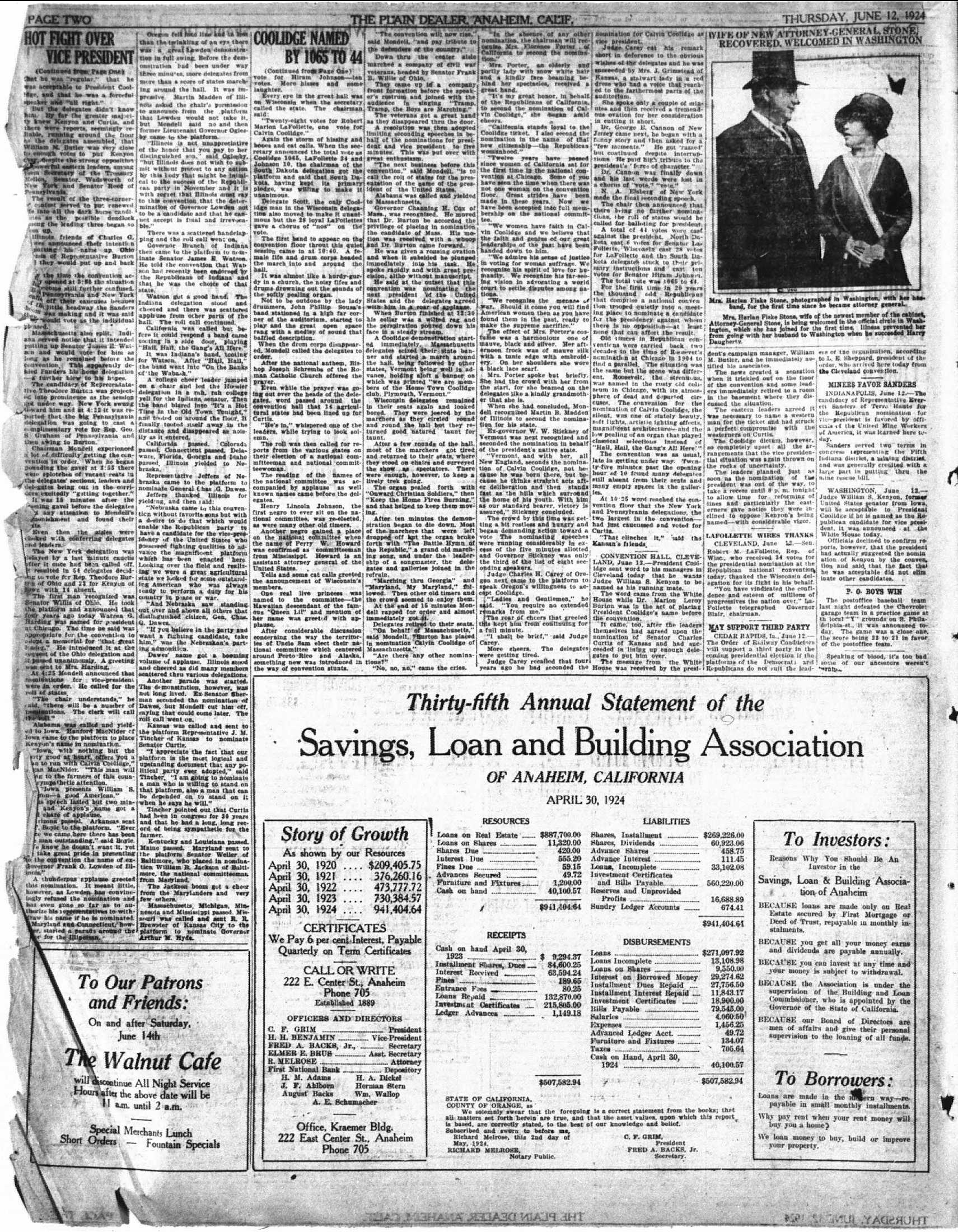
Searchable text
HOT FIGHT OVER VICE PRESIDENT
(Continued from Page One)
that he was "regular," that he was acceptable to President Coolidge, and that he was a forceful speaker and "all right."
But the delegates didn't know him. By far the greater majority knew Kenyon and Curtia, and there were reports, seemingly reliable, running around the floor as the delegates assembled, that William M. Butler was very close to enough votes to put Kenyon care, despite the strong opposition to powerful eastern leaders among Secretary of the Treasury Melton, Senator Wadsworth of New York and Senator Need of Pennsylvania.
The result of the three-corner contest served to purenewed life into all the dark horse candidates as the possible deadlock among the leading three began to form up.
Illinois friends of Charles G. Wees announced their intention notting his name up. Ohio ends of Representative Burton they would put up and back.
By the time the convention opened at 3:54 the situation in Pennsylvania still further confused. Calls off their caucuses because boom was making and it was said would vote as the individual planned.
Massachusetts also split. Indiana served notice that it intended putting up Senator James E. Watson and would vote for him as long as he remained before the convention. This apparently denied Sanders his home delegation—a further blow to his hopes.
The candidacy of Representative Theodore Burton was projected into prominence as the session got under way. New York swung toward him and at 4:22 it was reported that the big Pennsylvania delegation was going to cast a complimentary vote for Rep. Geo. S. Graham of Pennsylvania and then swing to Burton.
Chairman Mendell experienced a lot of difficulty getting the conference fell into line and in less than the twinkling of an eye there was a great Lowden demonstration in full swing. Before the demonstration had been under way three minutes, more delegates from more than a score of states marching around the hall. It was impressive. Martin Madden of Illinois asked the chair's permission to announce from the platform that Lowden would not take it, but Mondell said no and then former Lieutenant Governor Oglesby came to the platform.
"Illinois is not unappreciative of the honor that you pay to her distinguished son," said Oglesby. "but Illinois does not wish to submit without protest to any action by this body that might be intimal to the success of the Republican party in November and it is with regret that Illinois mustray to this convention that the determination of Governor Lowden not to be a candidate and that he cannot accept is final and irrevocable."
There was a scattered handlapping and the roll call went on.
Governor Branch of Indiana then came to the platform to nominate Senator James E. Watson. He told the convention that Watson had recently endorsed by the Republicans of Indiana and that he was the choice of that state.
Watson got a good hand. The Indiana delegation stood and cheered and there was scattered applause from other parts of the hall. The roll call continued.
California was called but before it could respond a band came to inside a side door, playing "Hall, Hall, the Gang's All Here."
It was Indiana's band, tooling for Watson. After "Hail, Hall," the band went into "On the Banks of the Wabash."
A college cheer leader jumped on a chair and led the Howitzer delegation in a rah, rah college yell for the Indiana senator. Then the band blared Into "It's Hot Time In the Old Town Tonight," and rooted on around the floor. It finally rooted itself away in the distance and disappeared as noisily as it entered.
California passed. Colorado passed. Connecticut passed. Delaware, Florida, Georgia and Idaho.
COOLIDGE NAMED BY 1065 TO 4
(Continued from Page One)
vote for Hiram Johnson—the votes More hisses and some laughter.
Every eye in the great hall was on Wisconsin when the secretary called the state. The chairman said:
"Twenty-eight votes for Robert Marion LaFollette, one vote for Calvin Coolidge."
Again the storm of hissing and booes and cat calls. When the secretary announced the total votes in Coolidge 1085, LaFollette 34 and Johnson 10, the chairman of South Dakota delegation got the platform and said that South Dakota, having kept its primary pledge, was willing to make it unanimous.
Delegate Scott, the only Coolidge man in Wisconsin delegation also moved to make it unanimous but the 28 loyal LaFollette gave a chorus of "nos" on the vote.
The first band to appear on the convention floor throut this quiet session came in at 10:40. A female life and drum corps headed the march into and around the hall.
It was almost like a hurdy-gurdy in a church, the noisy fife and drums drowning out the sounds of the softly pealing organ.
Not to be outdone by the ladies drummers, John Phillip Sousa's band stationed in a high far corner of the auditorium, started to play and the great open space rang with a medley of sound that baffled description.
When the drum corps disappeared, Mondell called the delegates to order.
After the national anthem, Bishop Joseph Schrembs of the Roman Catholic Church offered their prayer.
Even while the prayer was going out over the heads of the delegates, word passed around the convention hall that 14 agricultural states had been lined up for Curtis.
"He's in," whispered one of the leaders, while trying to look so emn.
The roll was then called for reports from the various states on their election of a national com
This apparently denied Funders his home delegation—a further blow to his hopes.
The candidacy of Representative Theodore Burton was projected into prominence as the session under way. New York swung toward him and at 4:22 it was reported that the big Pennsylvania delegation was going to cast a complimentary vote for Rep. Geo. N. Graham of Pennsylvania and thenwing to Burton.
Chairman Mendell experienced a lot of difficulty getting the convention in order. When he began pounding the gavel at 3:55 there were splashes of vacant seats in the delegates' sections, leaders and delegates being out in the corridors excitedly "getting together."
It was 15 minutes after the evening gavel before the delegates. A any attention to Mendell's obsession and found their fits.
Even then the aisles were choked with conferring delegates and leaders.
The New York delegation was delayed by a last minute cancissor after it once had been called off. It resulted in 54 delegates deciding to vote for Rep. Theodore Burton of Ohio and 23 for Kenyon of Iowa with 14 absent.
The first man recognized was Senator Willis of Ohio. He took the platform and announced that four years ago today Warren G. Harding was named for president at Chicago. The time he said was appropriate for the convention to adopt a memorial for "that great leader." He introduced it at the request of the Ohio delegation and it passed unanimously. A greeting was sent to Mrs. Harding.
At 4:25 Mendell announced that nominations for vice-president were in order. He called for the roll of states.
"The chair understands," he said, "there will be a number of nominations. The clerk will call the bill."
Alabama was called and yielded to Iowa. Hanford MacNider of Iowa came to the platform to place Kenyon's name in nomination.
"Iowa, with nothing but the worry good at heart, offers you a man to run with Calvin Coolidge,"igan MacNider. "This man will bring to the farmers of this country sympathetic attention."
"Iowa presents William S. Johnson—a good American."
His speech lasted but two minutes and Kenyon's name got a R share of applause.
Arizona passed. Arkansas sent P. Boyle to the platform. "Ever since we came here there has been a man outstanding," said Boyle. "We know he doesn't want it, yet take great pride in presenting the convention the name of ex-loweverner Frank O. Lowden of Illinoi"
the band went into "On the Banks of the Wabash."
A college cheer leader jumped on a chair and led the Howler delegation in a rab, rah college yell for the Indiana senator. Then the band blared into "It's a Hot Time In the Old Town Tonight," and trotted on around the floor. It finally tooted itself away in the distance and disappeared as noisily as it entered.
California passed. Colorado passed, Connecticut passed, Delaware, Florida, Georgia and Idaho passed. Illinois yielded to Nebraska.
Representative Jeffers of Nebraska came to the platform to nominate General Chas G. Dawea.
Jeffers thanked Illinois for yielding, and then said:
"Nebraska came to this convention without favorite sons but with a desire to do that which would enable the Republican party to have a candidate for the vice-presidency of the United States who possessed fighting qualities to advance the magnificent platform which has been enacted here. Looking over the field and realizing we were a great agricultural state we looked for some outstanding American who was always ready to perform a duty for his country in peace or war.
"And Nebraska saw standing out over and above all others that distinguished citizen, Gen. Chas G. Dawes.
"If you believe in the party and want a fighting candidate, take him," was the Nebraskan's parting admonition.
Dawes' name got a booming volume of applause. Illinois stood and cheered as did many members scattered thru various delegations.
Another parade was started. The demonstration, however, was not long lived. Ex-Senator Sherman seconded the nomination of Dawes, but Mendell cut him off, saying that could come later. The roll call went on.
Kansas was called and sent to the platform Representative J. M. Tincher of Kansas to nominate Senator Curtis.
"I appreciate the fact that our platform is the most logical and upstanding document that any political party ever adopted," said Tincher. "I am going to nominate a man who is willing to stand on that platform, also a man that can be depended on to stand on it when he says he will."
Tincher pointed out that Curtis had been in congress for 30 years and that he had a long, long record of being sympathetic for the farmer.
Kentucky and Louisiana passed. Maine passed. Maryland sent to the platform Senator Weller of Baltimore, who placed in nomination William B. Jackson of Baltimore.
He's in," whispered one of the leaders, while trying to look so emn.
The roll was then called for reports from the various states of their election of a national committee and national committeewoman.
The reading of the names of the national committee was accompanied by applause as well known names came before the delegates.
Henry Lincoln Johnson, the first negro to ever sit on the national committee, was re-elected as were many other old timers.
Another negro gained a place on the national committee when she name of Perry W. Howard was confirmed as committeeman from Mississippippl. Howard is an assistant attorney general of the United States.
Yells and some cat calls greet the announcement of Wisconsin members.
One real live princess was named to the committee—the Hawaiian descendant of the famous "Queen Lil" and mention of her name was greeted with applause.
After considerable discussion concerning the Sam territory of Unecle Sam elect their national committee which centered around Porto-Rico and Alaska something new was introduced in the way of convention stunts.
To Our Patrons and Friends:
On and after Saturday,
June 14th
The Walnut Cafe
will discontinue All Night Service
Hours after the above date will be
11 a.m. until 2 a.m.
Special Merchants Lunch
Short Orders — Fountain Specials
THE PLAIN DEALER, ANAHEIM, CALIF.
BIDGE NAMED BY 1065 TO 44
Included from Page One)
Mr Hiram Johnson—ten More hisses and some eye in the great hall was on when the secretary state. The chairman
enty-eight votes for Robert LaFollette, one vote for Coolidge.
The storm of hissing and cat calls. When the second announced the total vote as 1065, LaFollette 34 and 10, the chairman of the Dakota delegation got the aid and said that South Dakota kept its primary was willing to make it us.
State Scott, the only Coolidge in the Wisconsin delegation moved to make it unanimous at the 28 loyal LaFollettes chorus of "nos" on the first hand to appear on the floor throuth this quiet came in at 10:40. A feeble and drum corps with into and around almost like a hurdy-gurk church, the noisy fites and crowning out the sounds of pealing organ.
We be outdone by the lady Ms. John Phillip Sousa, named in a high far corpure auditorium, started to the great open space with a medley of sound that description.
The drom corps disappear well called the delegates to the national anthem, Bishop Schrembda of the Roholic Church offered the while the prayer was gover the heads of the delegation passed around the hall that 14 agricultees had been lined up for him," whispered one of the while trying to look solitary was then called for re-entry of various states on action of a national com-munity.
"The convention will now rise," said Mondell, "and pay tribute to the defenders of the country."
Down thru the center aisle marched a company of civil war veterans, headed by Senator Frank B. Willis of Ohio.
They came up if a company front formation before the speaker's rostrum and joined with the audience in singing "Tramp, Tramp, the Boys are Marching."
The veterans got a great hand as they disappeared thru the door.
A resolution was then adopted limiting seconding speeches in behalf of the nominations for president and vice president to five minutes. This was put over with great enthusiasm.
"The next business before this convention," said Mondell, "is to call the roll of states for the presentation of the name of the president of the United States.
Alabama was called and yielded to Massachusetts.
Governor Channing H. Cox of Mass., was recognized. He moved that Dr. Burton be accorded the privilege of placing in nomination the candidate of Mass. His motion was received with a whoo and Dr. Burton came forward.
He was given a rousing ovation and when it subsided he plunged immediately into his task. He rapidily and with great precision, alto without manuscript.
He said at the outset that this convention was nominating the next president of the United States and the delegates agreed with him in a roar of applause.
When Burton finished at 12:30 his collar was a wilted rag and the perspiration poured down his face in a steady stream.
A Coolidge demonstration started immediately. Massachusetts delegates seized their state banner and started a march around the hall, being followed by other states, Vermont being well in advance, holding a loft a banner on which was printed "we are members of the Home Town Coolidge club, Plymouth, Vermont."
Wisconsin delegates remained in their seats again and looked bored. They were jeered by the marchers as they circled round and round the hall but they returned good natured taunt for taunt.
After a few rounds of the hall, most of the marchers got tired and returned to their seats, where
In the absence of any other nomination, the chairman will recognize Mrs. Florence Porter of California to second the nomination.
Mrs. Porter, an elderly and portly lady with snow white hair and a kindly face beaming behind her spectacles, received a great hand.
"It's my great honor, in behalf of the Republicans of California, to second the nomination of Calvin Coolidge," she began amid cheers.
"California stands loyal to the Coolidge ticket. I also second the nomination in the name of that new citizenship—the Republican womanhood."
Twelve years have passed since women of California sat for the first time in the national convention at Chicago. Some of you have seen the time when there was not one woman on the convention floor. Great strides have been made in these years. Now we have been accepted into full membership on the national committee.
"We women have faith in Calvin Coolidge and we believe that the faith and genius of our great leaderships of the past have been handed down to him.
"We admire his sense of justice in voting for woman suffrage. We recognize his spirit of love for humanity. We recognize his far-seeking vision in advocating a world court to settle disputes among nations.
"We recognize the menace of war. Should it come you will find American women then as you have found them in the past, ready to make the supreme sacrifice."
The effect of Mrs. Porter's costume was a harmonious one of mauve, black and silver. Her afternoon frock was of mauve silk with a tunic edge with embroidery. On her shoulders she wore a black lace scarf.
Mrs. Porter spoke but briefly. She had the crowd with her from the start, for she beamed on the delegates like a kindly grandmother that she is.
When she had concluded, Mondell recognized Martin B. Madden of Illinois to second the nomination for his state.
Ex-governor W. W. Stickney of Vermont was next recognized and seconded the nomination in behalf of the president's native state.
Vermont, and with her, all nomination for Calvin Coolidge vice president.
Judge Carry eat his short in deference to their wishes of the delegates and succeeded by Mrs. J. Grimke Kansas, a stalwart lady in dress who had a voice that led to the farthermost part auditorium.
She spoke only a couple times and then received a touchous ovation for her constituency in cutting it short.
Dr. George E. Cannon Jersey came next, he funny story and then asked "few moments." He got but continued deep利息. He paid high tribunal president's force of charge.
Dr. Cannon was finally and his last words were a chorus of "vote," "vote," "vote."
N. A. Elsberg of New York made the final seconding sale.
The chair then announced there being no further fittings, the roll of states were called for balloting for pro-
A total of 44 votes were against the president. No kota cast 6 votes for Seniola Follotte. Wisconsin cast for LaFollette and the Soilola Follotte and the Soilola Follotte stuck to their unary instructions and votes for Senator Hiram J.
The total vote was 1065
For the first time in 2024 that comprise a national trooped quietly into an ing place to nominate a clerk for the presidency against there is no opposition—a none that can affect the old timers in Republic ventions were carried back decades to the time of Roakinson at Chicago in finding a clerk for the presidency against there is no opposition—a none that can affect the old timers in Republic ventions were carried back decades to the time of Roakinson at Chicago in finding a clerk for the presidency against there is no opposition—a none that can affect
Thirty-fifth Annual Statement
Savings, Loan and Building
OF ANAHEIM, CALIFORNIA
APRIL 30, 1924
Story of Growth
As shown by our Resources
April 30, 1920 ... $209,405.75
RESOURCES
Loans on Real Estate ... $887,700.00
Loans on Shares ... 11,320.00
Shares Due ... 420.00
Interest Due ... 555.20
Fines Due ... 59.15
LIABILITY
Shares, Installment ...
Shares, Dividends ...
Advance Shares ...
Advance Interest ...
Loans, Incomplete ...
Story of Growth
As shown by our Resources
April 30, 1920 ... $209,405.75
April 30, 1921 ... 376,260.16
April 30, 1922 ... 473,777.72
April 30, 1923 ... 730,384.57
April 30, 1924 ... 941,404.64
CERTIFICATES
Pay 6 per cent Interest, Payable Quarterly on Term Certificates
CALL OR WRITE
222 E. Center St., Anaheim
Phone 705
Established 1889
OFFICERS AND DIRECTORS
F. GRIM President
H. BENJAMIN Vice-President
ED A. BACKS, Jr., Secretary
MER E. BRUS Asst. Secretary
MELROSE Attorney
At National Bank Depository
H. M. Adams H. A. Dickel
J. F. Ahlborn Hermian Stern
August Backs Wm. Wallop
A. E. Schumacher
Office, Kraemer Bldg.
222 East Center St., Anaheim
Phone 705
RESOURCES
Loans on Real Estate ... $887,700.00
Loans on Shares ... 11,320.00
Shares Due ... 420.00
Interest Due ... 555.20
Fines Due ... 59.15
Advances Secured ... 49.72
Furniture and Fixtures ... 1,200.00
Cash on hand ... 40,100.57
$941,404.64
RECEIPTS
Cash on hand April 30,
1923 ... $ 9,294.37
Installment Shares, Dues ... 84,600.25
Interest Received ... 63,594.24
Pines ... 189.65
Entrance Fees ... 80.25
Loans Repaid ... 132,870.00
Investment Certificates ... 215,865.00
Ledger Advances ... 1,149.18
$507,582.94
STATE OF CALIFORNIA.
COUNTY OF ORANGE, ss
We solemnly swear that the foregoing is a correct statement from all matters set forth herein are true, and that the asset values upon which is based, are correctly stated, to the best of our knowledge and belief.
Subscribed and sworn to before ms,
Richard Melrose, this 2nd day of May, 1924.
RICHARD MELROSE,
Notary Public.
LIABILITY
Shares, Installment ...
Shares, Dividends ...
Advance Shares ...
Advance Interest ...
Loans, Incomplete ...
Investment Certificates and Bills Payable ...
Reserves and Unprovided Profits
Sundry Ledger Account
THURSDAY, JUNE 12, 1924
WIFE OF NEW ATTORNEY-GENERAL, STONE,
RECOVERED, WELCOMED IN WASHINGTON
Mrs. Harlan Fiske Stone, photographed in Washington, with her husband, for the first time since she became attorney general.
Mrs. Harlan Fiske Stone, wife of the newest member of the cabinet, Attorney-General Stone, is being welcomed in the official circle in Washington, which she has joined for the first time. Illness prevented her from going with her husband to Washington when he succeeded Harry Daugherty.
MINERS FAVOR SANDERS
INDIANAPOLIS, June 12.—The candidacy of Representative Everett Sanders of Terro Haute for the Republican nomination for vice-president is favored by officials of the United Mine Workers of America, it was learned here today.
Sanders served two terms in congress representing the Fifth Indiana district, a mining district.
Statement of the Building Association
CALIFORNIA
1924
LIABILITIES
Shares, Installment $269,226.00
Shares, Dividends 60,923.06
Advance Shares 458.75
Advance Interest 111.45
Insgesamt Incomplete 33,102.08
To Investors:
Reasons Why You Should Be An Investor in the
CALIFORNIA
1924
LIABILITIES
Shares, Installment $269,226.00
Shares, Dividends 60,923.06
Advance Shares 458.75
Advance Interest 111.45
Loans, Incomplete 33,102.08
Investment Certificates and Bills Payable 560,220.00
Reserves and Unprovided Profits 16,688.89
Handry Ledger Accounts 674.41
$941,404.64
DISBURSEMENTS
Loans $271,097.92
Loans Incomplete 13,108.98
Loans on Shares 9,550.00
Interest on Borrowed Money 29,274.62
Installment Dues Repaid 27,756.50
Installment Interest Repaid 11,843.17
Investment Certificates 18,900.00
Loans Payable 79,545.00
Charles 4,060.50
Expenses 1,456.25
Advanced Ledger Acct. 49.72
Furniture and Fixtures 134.07
Taxes 705.64
Rush on Hand, April 30,
1924 40,100.57
$507,582.94
To Investors:
Reasons Why You Should Be An Investor in the Savings, Loan & Building Association of Anaheim
BECAUSE loans are made only on Real Estate secured by First Mortgage or Deed of Trust, repayable in monthly instalments.
BECAUSE you get all your money earns and dividends are payable annually.
BECAUSE you can invest at any time and your money is subject to withdrawal.
BECAUSE the Association is under the supervision of the Building and Loan Commissioner, who is appointed by the Governor of the State of California.
BECAUSE our Board of Directors are men of affairs and give their personal supervision to the loaning of all funds.
To Borrowers:
Loans are made in the modern way—repayable in small monthly installments.
Why pay rent when your rent money will buy you a home?
We loan money to buy, build or improve your property.
C. F. GRIM,
President
FRED A. BACKS, Jr.
Secretary.