oc-plain-dealer 1923-10-01
Scanned page
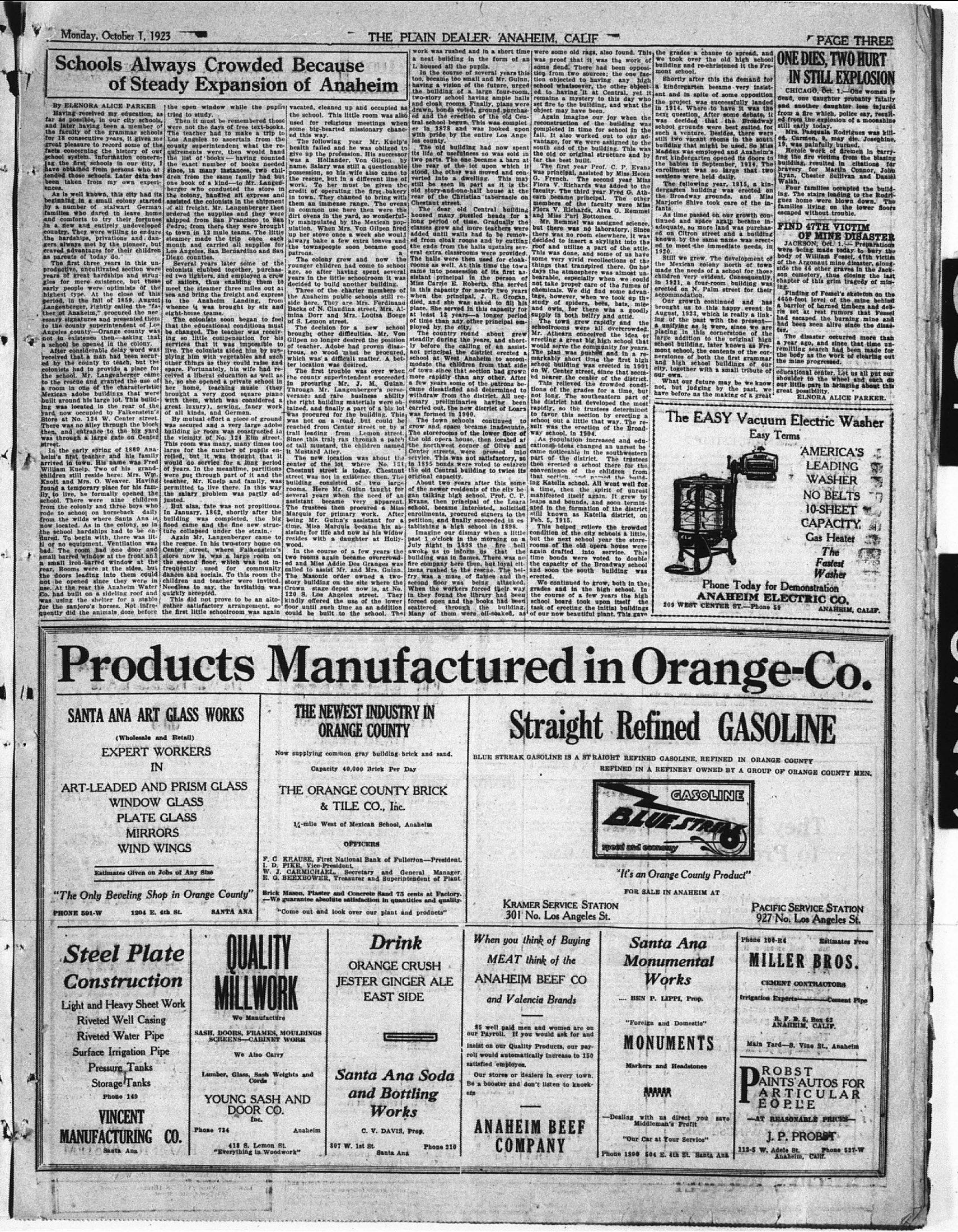
Searchable text
Schools Always Crowded Because of Steady Expansion of Analogy
By ELENORA ALICE PARKER
Having received my education, as far as possible, in our city schools, and later having been a member of the faculty of the grammar schools for 18 consecutive years, it gives me great pleasure to record some of the facts concerning the history of our school system. Information concerning the first schools in our city, I have obtained from persons who attended those schools. Later data has been taken from my own experiences.
As is well known, this city had its beginning in a small colony started by a number of stalwart German families who dared to leave home and comforts to try their fortunes in a new and entirely undeveloped country. They were willing to endure the hardships, privations and dangers always met by the pioneer, but craved advantages for their children as parents of today do.
The first three years in this unproductive, uncultivated section were years of great hardships and struggles for mere existence, but these early people were optimists of the highest type. At the close of this period, in the fall of 1859, August Langenberger, rightly called the "father of Anaheim," procured the necessary signatures and presented them to the county superintendent of Los Angeles county—Orange county was not in existence then—asking that a school be opened in the colony.
After considerable delay word was received that a man had been secured by the county to teach, but the colonists had to provide a place for the school. Mr. Langenberger came to the rescue and granted the use of a room in one of the characteristic Mexican adobe buildings that were built around his large lot. This building was located in the rear of the yard now occupied by Falkenstein's Store at No. 124 W. Center street. There was no alley through the block then, and entrance to the big yard was through a large gate on Center street.
In the early spring of 1860 Anaheim's first teacher and his family tried to study.
Then it must be remembered those were not the days of free text-books. The teacher had to make a trip to Los Angeles to ascertain from the county superintendent what the requirements were, then would hand the list of books—having counted the exact number of books needed since, in many instances, two children from the same family had but one book of a kind—to Mr. Langenberger who conducted the store in the colony, handled all express and assisted the colonists in the shipment of all freight. Mr. Langenberger then ordered the supplies and they were shipped from San Francisco to San Pedro; from there they were brought to town in 12 mule teams. The little steamer made the trip once each month and carried all supplies for Los Angeles, San Bernardino and San Diego counties.
Several years later some of the colonists clubbed together, purchased two lighters, and employed a crew of sailors, thus enabling them to meet the steamer three miles out at sea and bring the freight and express to the Anaheim Landing, from whence it was brought by six and eight-hoise teams.
The colonists soon began to feel that the educational conditions must be changed. The teacher was receiving so little compensation for his services that it was impossible to live. The colonists almed him by supplying him with vegetables and such other things as they could raise and spare. Fortunately, his wife had received a liberal education as well as he, so she opened a private school in her home, teaching music (they brought a very good square piano with them, which was considered a great luxury), sewing, fancy work of all kinds, and German.
By mutual effort a piece of ground was secured and a very large adobe building or room was constructed in the vicinity of No. 124 Elm street. This room was many, many times too large for the number of pupils enrolled, but it was thought that it vacated, cleaned up at the school. This little used for religious use some big-hearted misdied this way.
The following year health failed and he gave up the profession was a Hollander. Salary was still possession, so his wife rescued, but in a work. To her must credit of operating it in town. They chance them an immense rank in common use here dirt ovens in the yardly manipulated by theiation. When Mrs. W up her stove once a week always bake a few en townspeople soon patrons.
The colony grew a younger children had age, so after having years in the little school decided to build another.
Three of the chart the Anaheim public side here. They are Backs of N. Claudina mina Dorr and Mrs. Of S. Lemon street.
The decision for a brought other difficulty Gilpen no longer desired of teacher. Adobe had trous, so wood must which was a difficult location was desirie.
The first trouble wthe county superintendent in procuring Mr. Through Mr. Langen veranda and rare but the right building maintained, and finally a pail was procured for the was not on a road, reached from Center trail leading from Since this trail ran on it tall mustard, the it Mustard Alley.
The new location
ed by the county to teach, but the colonists had to provide a place for the school. Mr. Langenberger came to the rescue and granted the use of a room in one of the characteristic Mexican adobe buildings that were built around his large lot. This building was located in the rear of the yard now occupied by Falkenstein's Store at No. 124 W. Center street. There was no alley through the block then, and entrance to the big yard was through a large gate on Center street.
In the early spring of 1860 Anaheim's first teacher and his family arrived in town. His name was Fred William Kuelp. Two of his grandchildren still reside here: Mrs. Wm. Knott and Mrs. O. Weaver. Having found a temporary place for his family to live, he formally opened the school. There were nine children from the colony and three boys who rode to school on horseback daily from the wilds where Santa Ana is now located. As in the colony, so in the school hardships had to be endured. To begin with, there was little or no equipment. Ventilation was bad. The room had one door and small barred window at the front and a small iron-barred window at the rear. Rooms were at the sides, but the doors leading into them could not be opened since they were in use. At the rear the Anaheim Water Co. had built on a siding roof and was using the shelter for a stable for the zanjero's horses. Not infrequently did the animals doze before
SANTA ANA ART GLASS WORKS
(Wholesale and Retail)
EXPERT WORKERS
IN
ART-LEADED AND PRISM GLASS
WINDOW GLASS
PLATE GLASS
MIRRORS
WIND WINGS
THE NEWEST ORANGE
Now supplying common g
Capacity 40,000
THE ORANGE &
TILE
14-mile West of Me
OFF
F. C. KRAUSE, First Nation
I. D. PIKE, Vice-President
ART-LEADED AND PRISM GLASS
WINDOW GLASS
PLATE GLASS
MIRRORS
WIND WINGS
Estimates Given on Jobs of Any Size
"The Only Beveling Shop in Orange County"
PHONE 591-W 1204 E. 4th St. SANTA ANA
Steel Plate Construction
Light and Heavy Sheet Work
Riveted Well Casing
Riveted Water Pipe
Surface Irrigation Pipe
Pressure Tanks
Storage Tanks
Phone 149
VINCENT MANUFACTURING CO.
Santa Ana
QUALITY MILLWORK
We Manufacture
SASH, DOORS, FRAMES, MOULDINGS
SCREENS—CABINET WORK
We Also Carry
Lumber, Glass, Sash Weights and Cords
YOUNG SASH AND DOOR CO.
Inc.
Phone 724 Anaheim
418 S. Lemon St.
"Everything in Woodwork"
Because of Anaheim
vacated, cleaned up and occupied as the school. This little room was also used for religious meetings when some big-hearted missionary chanced this way.
The following year Mr. Kuelp's health failed and he was obliged to give up the profession. His successor was a Hollander, Von Gilipen by name. Salary was still a questionable possession, so his wife also came to the rescue, but in a different line of work. To her must be given the credit of operating the first bakery in town. They chanced to bring with them an immense range. The ovens in common use here then were the dirt ovens in the yard, so wonderfully manipulated by the Mexican population. When Mrs. Von Gilipen fired up her stove once a week she would always bake a few extra loaves and the townspeople soon became good patrons.
The colony grew and now the younger children had come to school age, so after having spent several years in the little schoolroom it was decided to build another building.
Three of the charter members of the Anaheim public schools still reside here. They are Mrs. Ferdinand Backs of N. Claudina street, Mrs. Almina Dorr and Mrs. Loutsa Boege of S. Lemon street.
The decision for a new school brought other difficulties. Mr. Von Gilipen no longer desired the position of teacher. Adobe had proven disastrous, so wood must be procured, which was a difficult matter. A better location was desired.
The first trouble was over when the county superintendent succeeded in procuring Mr. J. M. Guinn. Through Mr. Langenberger's perseverance and rare business ability the right building materials were obtained, and finally a part of a big lot was procured for the building. This was not on a road, but could be reached from Center street or by a trail leading from Lemon street. Since this trail ran through a patch of tall mustard, the children named it Mustard Alley.
The new location was about the work was rushed and in a short time a neat building in the form of an L housed all the pupils.
In the course of several years this too, became too small and Mr. Guinn, having a vision of the future, urged the building of a large four-room, two-story school having ample halls and cloak rooms. Finally, plans were drawn, bonds voted, ground purchased and the erection of the old Central school begun. This was completed er in 1878 and was looked upon with pride by the entire Los Angeles county.
The old building had now spent its life of usefulness so was sold in two parts. The one became a barn at the rear of the lot upon which it stood, the other was moved and converted into a dwelling. This may still be seen in part as it is the old story-and-one-half house at the rear of the Christian tabernacle on Chestnut street.
The dear old Central building housed many puzzled heads for a long period of time. Gradually the classes grew and more teachers were added until walls had to be removed from cloak rooms and by cutting the ends from the halls upstairs several extra classrooms were provided.
The halls were then used for cloak rooms as well. At this time the town came into possession of its first assistant principal in the person of Miss Carrie E. Roberts. She served in this capacity for nearly two years when the principal, J. R. Grogan, died, and she was asked to fill his place. She served in this capacity for at least 12 years—a longer period of time than any other principal employed by the city.
The country round about grew steadily during the years, and shortly before the calling of an assistant principal the district erected a school at West Anaheim to accommodate the children from that side of town since that section had grown more rapidly than any other. After a few years some of the patrons became dissatisfied and determined to withdraw from the district. All necessary preliminaries having been carried out, the new district of Loara was formed in 1900.
The town schools continued to grow and space became inadequate. The storerooms of the lower floor of the old opera house, then located at the northwest corner of Olive and Center streets, were pressed into service. This was not satisfactory, so were some old rags, also found. This was proof that it was the work of some fiend. There had been opposition from two sources; the one faction objected to having any high school whatsoever, the other objected to having it at Central, yet remains a mystery to this day who set fire to the building, and what the object may have been.
Again imagine our joy when the reconstruction of the building was completed in time for school in the fall. It also worked out to our advantage, for we were assigned to the south end of the building. This was the old or original structure and by far the best built.
The first year Prof. C. P. Evana was principal, assisted by Miss Helen G. French. The second year Miss Floria V. Richards was added to the faculty. The third year Fred G. Athorne became principal. The other members of the faculty were Miss Flora V. Richards, Alva G. Remmel and Miss Purl Bottomes.
Mr. Remmel was assigned science, but there was no laboratory. Since there was no room elsewhere, it was decided to insert a skylight into the roof and utilize a part of the attic. This was done, and some of us have some very vivid recollections of things that transpired there. On hot days the atmosphere was almost unbearable, especially when we could not take proper care of the fumes of chemicals. We did find some advantage, however, when we took up study of spiders, bees, bats, mice and owls, for there was a good supply in both belly and attic.
The town grew rapidly and the schoolrooms were all overrowded. Mr. Athorne conceived the idea or erecting a great big high school that would serve the community for years. The plan was pushed and in a remarkably short time the first high school building was erected in 1901 on W. Center street, since that seemed nearer the center of the district.
This relieved the crowded conditions of the grades for a time, but not long. The southeastern part of the district had developed most rapidly, so the trustees determined to favor this section by erecting a school out a little that way. The result was the erection of the Broadway school, in 1904.
As population increased and educations ideas changed an unrest became noticeable in the southwestern part of the district. The trustees
ter location was desired.
The first trouble was over when the county superintendent succeeded in procuring Mr. J. M. Guinn. Through Mr. Langenberger's perseverance and rare business ability the right building materials were obtained, and finally a part of a big lot was procured for the building. This was not on a road, but could be reached from Center street or by a trail leading from Lemon street. Since this trail ran through a patch of tall mustard, the children named it Mustard Alley.
The new location was about the center of the lot where No. 131 Chestnut street is today. Chestnut street was not in existence then. The building consisted of two large rooms. Here Mr. Guinn taught for several years when the need of an assistant became very apparent. The trustees then procured a Miss Marquis for primary work. After being Mr. Guinn's assistant for a time, Miss Marquis became his assistant for life and now as his widow resides with a daughter at Hollywood.
In the course of a few years the two rooms again became overcrowded and Miss Addie Des Granges was called to assist Mr. and Mrs. Guinn. The Masonite order owned a two-story building on the site where the Crown stage depot now is, at No. 120 S. Los Angeles street. They kindly offered the use of the lower floor until such time as an addition could be built to the school. The modulate the children from that side of town since that section had grown more rapidly than any other. After a few years some of the patrons became dissatisfied and determined to withdraw from the district. All necessary preliminaries having been carried out, the new district of Loara was formed in 1900.
The town schools continued to grow and space became inadequate. The storerooms of the lower floor of the old opera house, then located at the northwest corner of Olive and Center streets, were pressed into service. This was not satisfactory, so in 1895 bonds were voted to enlarge the old Central building to twice its original capacity.
About two years after this some of the newer residents of the city began talking high school. Prof. C. P. Evans, then principal of the Loara school, became interested, solicited enrollments, procured signers to the petition, and finally succeeded in establishing a high school in 1898.
Imagine our dismay when a little past 1 o'clock in the morning on a July night in 1898 the fire bell awoke us to inform us that the building was in flames. There was no fire company here then, but loyal citizens rushed to the rescue. The belfry was a mass of flames and the second floor was being attacked. When the workers forced their way in they found the library had been forced open and the books had been scattered through the building. Many of them were oil-soaked, as
Manufactured in Orange County
Now supplying common gray building brick and sand.
Capacity 40,000 Brick Per Day
THE ORANGE COUNTY BRICK & TILE CO., Inc.
1¼-mile West of Mexican School, Anaheim
OFFICERS
KRAUSE, First National Bank of Fullerton—President.
PIKE, Vice-President.
Straight Refine
BLUE STREAK GASOLINE IS A STRAIGHT REFINED GASOIL REFINED IN A REFINING
THE ORANGE COUNTY BRICK & TILE CO., Inc.
1¼-mile West of Mexican School, Anaheim
OFFICERS
KRAUSE, First National Bank of Fullerton—President.
PIKE, Vice-President.
CARMICHAEL, Secretary and General Manager.
BEEXBOWER, Treasurer and Superintendent of Plant.
Mason, Plaster and Concrete Sand 75 cents at Factory. Guarantee absolute satisfaction in quantities and quality. Come out and look over our plant and products"
KRAMER SERVICE STATION
301 No. Los Angeles St.
Drink
ORANGE CRUSH
JESTER GINGER ALE
EAST SIDE
Santa Ana Soda
and Bottling Works
C. V. DAVIS, Prop.
807 W. 1st St Phone 210 Santa Ana
When you think of Buying MEAT think of the ANAHEIM BEEF CO
and Valencia Brands
$5 well paid men and women are on our Payroll. If you would ask for and insist on our Quality Products, our payroll would automatically increase to 150 satisfied employees.
Our stores or dealers in every town. Be a booster and don't listen to knockers
ANAHEIM BEEF COMPANY
Santa Ana Monument Work
... BEN P. LIPP
"Foreign and D"
MONUM
Markers and H
—Dealing with us d
Middleman's
"Our Car at Youu
Phone 1800 504 E. 41l
also found. This was the work of had been oppose; the one facing any high other object Central, yet it to this day who ing, and what the or joy when the building was for school in the out to our ad assigned to the building. This was structure and by of. C. P. Evana by Miss Helen second year Miss was added to the Fred G. Athal. The otherulty were Miss Alva G. Remmelimes.
assigned science, laboratory. Since elsewhere, it was skylight into the part of the attic. Some of us have collections of the there. On hot was almost unwhen we could of the fumes of and some advan-we took up these, bats, mice was a goodly, and attie. piddly and the overloved. ed the idea or high school thatunity for years. and in a re- the first high erected in 1901 since seem-of the district. overrowded condior a time, but eastern part of hoped the most bees determined by erecting a way. The re- of the Broad- ceased and edu-an unrest be southwestern The trustees
the grades a chance to spread, and we took over the old high school building and re-christened it the Fre-mont school.
Shortly after this the demand for a kindergarten became very insistent and in spite of some opposition the project was successfully landed in 1914. Where to have it was the next question. After some debate, it was decided that the Broadway school grounds were best suited for such a venture. Besides, there were still two vacant rooms in the south building that might be used. So Miss Maddux was employed and Anaheim's first kindergarten opened its doors to the babies in September, 1914. The enrollment was so large that two sessions were held daily.
The following year, 1915, a kindergarten building was erected on the Broadway grounds, and Miss Marjorie Shive took care of the infants.
As time passed on our growth continued and space again became inadequate, so more land was purchased on Citron street and a building known by the same name was erected to meet the immediate needs, in 1920.
Still we grew. The development of the Mexican colony north of town made the needs of a school for those children very evident. Consequently, in 1921, a four-room building was erected on N. Palm street for their accommodation.
Our growth continued and has brought us to this happy event in August, 1923, which is really a linking of the past with the present—a unifying as it were, since we are placing in this cornerstone of the large addition to the original high school building, later known as Fre-mont school, the contents of the cornerstones of both the first grammar and high school buildings of our city, together with a small tribute of our own.
What our future may be we know not, but judging by the past, we have before us the making of a great educational center. Let us all put our shoulder to the wheel and each do our little part in bringing about this great possibility.
ELNORA ALICE PARKER.
ONE DIES, TWO HURT IN STILL EXPLOSION
CHICAGO, Oct. 1.—One woman is dead, one daughter probably fatally and another daughter less injured from a fire which, police say, resulted from the explosion of a moonshine still early today.
Mrs. Pasquala Rodriguez was killed. Carmen, 9, may die. Josephine, 19, was painfully burned.
Herole work of firemen in carrying the fire victims from the blazing building, resulted in citations for bravery for Martin Connor, John Ryan, Chester Sullivan and Daniel Walsh.
Four families occupied the building. The stair leading to the Rodriguez home were blown down. The families living on the lower floors escaped without trouble.
FIND 47TH VICTIM OF MINE DISASTER
JACKSON, Oct. 1.—Preparations were being made today to bury the body of William Fessel, 47th victim of the Argonaut mine disaster, alongside the 46 other graves in the Jackson cemetery, thus closing the last chapter of this grim tragedy of mining.
Finding of Fessel's skeleton on the 4650-foot level of the mine behind a barrier of burned timbers and debris set at rest rumors that Fessel had escaped the burning mine and had been seen alive since the disaster.
The disaster occurred more than a year ago, and since that time unremitting search had been made for the body as the work of clearing out the mine progressed.
educational center. Let us all put our shoulder to the wheel and each do our little part in bringing about this great possibility.
ELNORA ALICE PARKER.
The EASY Vacuum Electric Washer
Easy Terms
AMERICA'S
LEADING
WASHER
NO BELTS
10-SHEET
CAPACITY.
Gas Heater
The
Fastest
Washer
Phone Today for Demonstration
ANAHEIM ELECTRIC CO.
209 WEST CENTER ST.—Phone 59
ANAHEIM, CALIF.
Refined GASOLINE
RIGHT REFINED GASOLINE, REFINED IN ORANGE COUNTY
REFINED IN A REFINERY OWNED BY A GROUP OF ORANGE COUNTY MEN.
GASOLINE
BLUE STRONG
expand and economy
GASOLINE
BLUE STRING
speed and economy
"It's an Orange County Product"
FOR SALE IN ANAHEIM AT
TION
St.
PACIFIC SERVICE STATION
927 No. Los Angeles St.
Santa Ana Monumental Works
... BEN P. LIPPI, Prop.
"Foreign and Domestic"
MONUMENTS
Markers and Headstones
—Dealing with us direct you save Middleman's Profit
"Our Car at Your Service"
Phone 1800 504 E. 4th St. Santa Ana
Phone 100-R4 Estimates Free
MILLER BROS.
CEMENT CONTRACTORS
Irrigation Experts——Cement Pipe
R. F. D. 5, Box 62
ANAHEIM, CALIF.
Main Yard—S. Vine St., Anaheim
PROBST PAINTS' AUTOS FOR PARTICULAR PEOPLE
AT REASONABLE PRICES
J. P. PROBST
113-5 W. Adele St. Phone 527-W
Anaheim, Calif.