oc-plain-dealer 1923-09-10
Scanned page
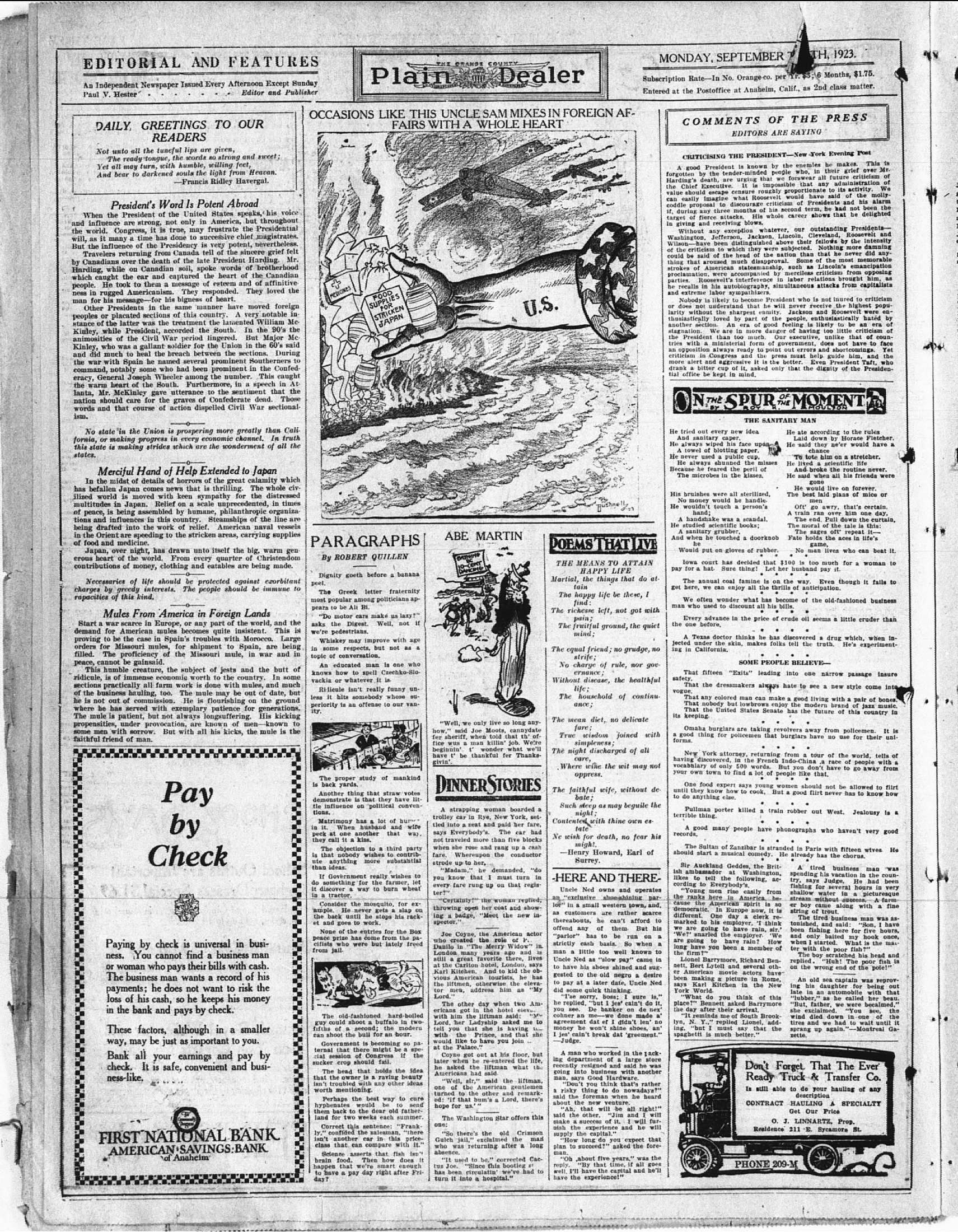
Searchable text
EDITORIAL AND FEATURES
An Independent Newspaper Issued Every Afternoon Except Sunday
Paul V. Hester Editor and Publisher
DAILY, GREETINGS TO OUR READERS
Not unto all the tuneful lips are given,
The ready tongue, the words so strong and sweet;
Yet all may turn, with humble, willing feet,
And bear to darkened souls the light from Heaven.
—Francis Ridley Havergal.
President's Word Is Potent Abroad
When the President of the United States speaks, his voice and influence are strong, not only in America, but throughout the world. Congress, it is true, may frustrate the Presidential will, as it many a time has done to successive chief magistrates. But the influence of the Presidency is very potent, nevertheless.
Travelers returning from Canada tell of the sincere grief felt by Canadians over the death of the late President Harding. Mr. Harding, while on Canadian soil, spoke words of brotherhood which caught the ear and captured the heart of the Canadian people. He took to them a message of esteem and of affinity in rugged Americanism. They responded. They loved the man for his message—for his bigness of heart.
Other Presidents in the same manner have moved foreign peoples or placated sections of this country. A very notable instance of the latter was the treatment the lamented William McKinley, while President, accorded the South. In the 90's the animosities of the Civil War period lingered. But Major McKinley, who was a gallant soldier for the Union in the 60's said and did much to heal the breach between the sections. During the war with Spain he named several prominent Southerners to command, notably some who had been prominent in the Confederacy, General Joseph Wheeler among the number. This caught the warm heart of the South. Furthermore, in a speech in Atlanta, Mr. McKinley gave utterance to the sentiment that the nation should care for the graves of Confederate dead. Those words and that course of action dispelled Civil War sectionalism.
No state in the Union is prospering more greatly than California, or making progress in every economic channel. In truth this state is making strides which are the wonderment of all the states.
No state in the Union is prospering more greatly than California, or making progress in every economic channel. In truth this state is making strides which are the wonderment of all the states.
Merciful Hand of Help Extended to Japan
In the midst of details of horrors of the great calamity which has befallen Japan comes news that is thrilling. The whole civilized world is moved with keen sympathy for the distressed multitudes in Japan. Relief on a scale unprecedented, in times of peace, is being assembled by humane, philanthropic organizations and influences in this country. Steamships of the line are being drafted into the work of relief. American naval vessels in the Orient are speeding to the stricken areas, carrying supplies of food and medicine.
Japan, over night, has drawn unto itself the big, warm generous heart of the world. From every quarter of Christendom contributions of money, clothing and eatables are being made.
Necessaries of life should be protected against exorbitant charges by greedy interests. The people should be immune to rapacities of this kind.
Mules From America in Foreign Lands
Start a war scarce in Europe, or any part of the world, and the demand for American mules becomes quite insistent. This is proving to be the case in Spain's troubles with Morocco. Large orders for Missouri mules, for shipment to Spain, are being filled. The proficiency of the Missouri mule, in war and in peace, cannot be gainsaid.
This humble creature, the subject of jests and the butt of ridicule, is of immense economic worth to the country. In some sections practically all farm work is done with mules, and much of the business hauling, too. The mule may be out of date, but he is not out of commission. He is flourishing on the ground where he has served with exemplary patience for generations. The mule is patient, but not always longsuffering. His kicking propensities, under provocation, are known of men—known to some men with sorrow. But with all his kicks, the mule is the faithful friend of man.
Pay by Check
Pay by Check
Paying by check is universal in business. You cannot find a business man or woman who pays their bills with cash. The business man wants a record of his payments; he does not want to risk the loss of his cash, so he keeps his money in the bank and pays by check.
These factors, although in a smaller way, may be just as important to you.
Bank all your earnings and pay by check. It is safe, convenient and business-like.
FIRST NATIONAL BANK
AMERICAN SAVINGS BANK
of Anaheim
URES
Sept Sunday
Publisher
THE ORANGE COUNTY
Plain Dealer
MO
Subscripti
Entered at
OCCASIONS LIKE THIS UNCLE SAM MIXES IN FOREIGN AFFAIRS WITH A WHOLE HEART
FOOD SUPPLIES FOR STRICKEN JAPAN
U.S.
PARAGRAPHS
By ROBERT QUILLEN
Dignity goeth before a banana peel.
The Greek letter fraternity most popular among politicians appears to be Ali Bi.
"Do motor cars make us lazy?" asks the Digest. Well, not if we're pedestrians.
Whiskey may improve with age in some respects, but not as a topic of conversation.
An educated man is one who knows how to spell Czechko-Slovackia or whatever it is.
Riicule isn't really funny unless it hits somebody whose superiority is an offense to our vanity.
The proper study of mankind is back yards.
Another thing that straw votes demonstrate is that they have little influence on political conventions.
Matrimony has a lot of humor in it. When husband and wife peck at one another that way, they call it a kiss.
The objection to a third party is that nobody wishes to contribute anything more substantial than ideas.
ABE MARTIN
POEMS THAT LIVE
THE MEANS TO ATTAIN HAPPY LIFE
Martial, the things that do attain
The happy life be these, I find:
The richesse left, not got with pain;
The fruitful ground, the quiet mind;
The equal friend; no grudge, no strife;
No charge of rule, nor governance;
Without disease, the healthful life;
The household of continuance;
The mean diet, no delicate fare;
True wisdom joined with simpleness;
The night discharged of all care,
Where wine the wit may not oppress.
DINNER STORIES
A strapping woman boarded a trolley car in Rye, New York, settled into a seat and paid her fare, says Everybody's. The car had not traveled more than five blocks when she rose and rang up a cash fare. Whereupon the conductor strode up to her.
Madam," he demanded, "do
The proper study of mankind is back yards.
Another thing that straw votes demonstrate is that they have little influence on political conventions.
Matrimony has a lot of hurry in it. When husband and wife peck at one another that way, they call it a kiss.
The objection to a third party is that nobody wishes to contribute anything more substantial than ideas.
If Government really wishes to do something for the farmer, let it discover a way to burn wheat in a tractor.
Consider the mosquito, for example. He never gets a slap on the back until he stops his racket and goes to work.
None of the entries for the Box peace prize has come from the pacifists who were but lately freed from jail.
The old-fashioned hard-bolled guy could shoot a buffalo in two-fifths of a second; the modern can shoot the bull for an hour.
Government is becoming so paternal that there might be a special session of Congress if the sucker crop should fail.
The head that holds the idea that the owner is a raving beauty isn't troubled with any other ideas worth mentioning.
Perhaps the best way to cure hyphenates would be to send them back to the dear old fatherland for two weeks each summer.
Correct this sentence: "Frankly," confided the salesman, "there isn't another car in this price-class that can compare with it."
Science asserts that fish isn't brain food. Then how does it happen that we're smart enough to have a pay day right after Friday?
A strapping woman boarded a trolley car in Rye, New York, settled into a seat and paid her fare, says Everybody's. The car had not traveled more than five blocks when she rose and rang up a cash fare. Whereupon the conductor strode up to her,
"Madam," he demanded, "do you know that I must turn in every fare rung up on that register?"
"Certainly!" the woman replied, throwing open her coat and showing a badge, "Meet the new inspector."
Joe Coyne, the American actor who created the role of P. Danilo in "The Merry Widow" in London many years ago and is still a great favorite there, lives at the Carlton hotel, London, says Karl Kitchen. And to kid the obvious American tourists, he has the liftmen, otherwise the elevator men, address him as "My Lord."
The other day when two Americans got in the hotel elevator with him the liftman said: "Mr. Lord, her Ladyship asked me to tell you that she is having trouble with the Prince, and that she would like to have you join at the Palace."
Coyne got out at his floor, but later when he re-entered the life, he asked the liftman what the Americans had said.
"Well, sir," said the liftman, one of the American gentlemen turned to the other and remarked: "If that bum's a Lord, there's hope for us."
The Washington Star offers this one:
"So there's the old Crimson Gulch jail," exclaimed the man who was returning after a long absence.
"It used to be," corrected Cusat Joe. "Since this bootleg stitches been circulatin' we've had to turn it into a hospital."
The faithful wife, without debate;
Such steep as may beguile the night;
Contented with thine own estate
Ne wish for death, no fear his might.
—Henry Howard, Earl of Surrey.
-HERE AND THEREUncle Ned owns and operates an "exclusive shoe-shining parlor" in a small western town, and as customers are rather scarce thereabouts, he can't afford to offend any of them. But his "parlor" has to be run on a strictly cash basis. So when a man a little too well known to Uncle Ned as "slow pay" came in to have his shoes shined and suggested to the old negro a desire to pay at a later date, Uncle Ned did some quick thinking.
"I see sorry, boss; I sure is," he replied, "but I Jes' cain't do it, you see. De banker on de nex cohner an me—we done made a agreement dat if I didn't len' no money he won't shine shoes, an' I Jes' cain't break dat 'greement." —Judge.
A man who worked in the packing department of a large store recently resigned and said he was going into business with another man, says Good Hardware.
"Don't you think that's rather a risky thing to do nowadays?" said the foreman when he heard about the new venture.
"Ah, that will be all right!" said the other. "Jim and I will make a success of it. I will furiousize the experience and he will supply the capital."
"How long do you expect that plan to succeed?" asked the foreman.
"Oh, about five years," was the reply. "By that time, if all goes well, I'll have the capital and he'll have the experience!"
MONDAY, SEPTEMBER 1923.
Subscription Rate—In No. Orange co. per Yr. $3; 6 Months, $1.75.
Entered at the Postoffice at Anaheim, Calif., as 2nd class matter.
COMMENTS OF THE PRESS
EDITORS ARE SAYING
CRITICISING THE PRESIDENT—New York Evening Post
A good President is known by the enemies he makes. This is forgotten by the tender-minded people who, in their grief over Mr. Harding's death, are urging that we forswear all future criticism of the Chief Executive. It is impossible that any administration of value should escape censure roughly proportionate to its activity. We can easily imagine what Roosevelt would have said of the mollycoddle proposal to discourage criticism of Presidents and his alarm if, during any three months of his second term, he had not been the target of fierce attacks. His whole career shows that he delighted in giving and receiving blows.
Without any exception whatever, our outstanding Presidents—Washington, Jefferson, Lincoln, Cleveland, Roosevelt and Wilson—have been distinguished above their fellows by the intensity of the criticism to which they were subjected. Nothing more damning could be said of the head of the nation than that he never did anything that aroused much disapproval. Some of the most memorable strokes of American statesmanship, such as Lincoln's emancipation proclamation, were accompanied by merciless criticism from opposing parties. Roosevelt's interference in labor relations brought him, as he recalls in his autobiography, simultaneous attacks from capitalists and extreme labor sympathizers.
Nobody is likely to become President who is not inured to criticism or does not understand that he will never receive the highest popularity without the sharpest enmity. Jackson and Roosevelt were enthusiastically loved by part of the people, enthusiastically hated by another section. An era of good feeling is likely to be an era of stagnation. We are in more danger of having too little criticism of the President than too much. Our executive, unlike that of countries with a ministerial form of government, does not have to face an opposition always ready to point out errors and shortcomings. Yet criticism in Congress and the press must help guide him, and the more alert and aggressive it is the better. Even President Taft, who drank a bitter cup of it, asked only that the dignity of the Presidential office be kept in mind.
ON THE SPUR OF THE MOMENT
BY ROBERT HOULTON
THE SANITARY MAN
He tried out every new idea
And sanitary caper.
He always wiped his face upon
A towel of blotting paper.
He never used a public cup,
He ate according to the rules
Laid down by Horace Fletcher.
He said they ne'er would have a chance
To tote him on a stretcher.
ON THE SPUR OF THE MOMENT
THE SANITARY MAN
He tried out every new idea
And sanitary caper.
He always wiped his face upon
A towel of blotting paper.
He never used a public cup,
He always shunned the misses
Because he feared the peril of
The microbes in the kisses.
His bruishes were all sterilized,
No money would he handle.
He wouldn't touch a person's
hand;
A handshake was a scandal.
He studied scientific books;
A sanitary grubber,
And when he touched a doorknob
he
Would put on gloves of rubber.
He ate according to the rules
Laid down by Horace Fletcher.
He said they ne'er would have a chance
To tote him on a stretcher.
He lived a scientific life
And broke the routine never.
He said when all his friends were gone
He would live on forever.
The best laid plans of mice or men
Oft' go awry, that's certain.
A train ran over him one day.
The end. Pull down the curtain.
The moral of the tale is this:
The sages oft' repeat it—
Fate holds the aces in life's game,
No man lives who can beat it.
Iowa court has decided that $100 is too much for a woman to pay for a hat. Sure thing! Let her husband pay it.
The annual coal famine is on the way. Even though it falls to get here, we can enjoy all the thrills of anticipation.
We often wonder what has become of the old-fashioned business man who used to discount all his bills.
Every advance in the price of crude oil seems a little cruder than the one before.
A Texas doctor thinks he has discovered a drug which, when injected under the skin, makes folks tell the truth. He's experimenting in California.
SOME PEOPLE BELIEVE—
That fifteen "Exits" leading into one narrow passage insure safety.
That the dressmakers always hate to see a new style come into vogue.
That any colored man can make a good living with a pair of bones.
That nobody but lowbrows enjoy the modern brand of jazz music.
That the United States Senate has the future of this country in its keeping.
Omaha burglars are taking revolvers away from policemen. It is a good thing for policemen that burglars have no use for their uniforms.
New York attorney, returning from a tour of the world, tells of having discovered, in the French Indo-China, a race of people with a vocabulary of only 500 words. But you don't have to go away from your own town to find a lot of people like that.
One food expert says young women should not be allowed to flirt until they know how to cook. But a good flirt never has to know how to do anything else.
Pullman porter killed a train robber out West. Jealousy is a terrible thing.
A good many people have phonographs who haven't very good records.
The Sultan of Zanzibar is stranded in Paris with fifteen wives. He should start a musical comedy. He already has the chorus.
Sir Auckland Geddes, the Brittle business man was
One food expert says young women should not be allowed to flirt until they know how to cook. But a good flirt never has to know how to do anything else.
Pullman porter killed a train robber out West. Jealousy is a terrible thing.
A good many people have phonographs who haven't very good records.
The Sultan of Zanzibar is stranded in Paris with fifteen wives. He should start a musical comedy. He already has the chorus.
Sir Auckland Geddes, the British ambassador at Washington, likes to tell the following, according to Everybody's.
"Young men rise easily from the ranks here in America because the American spirit is so democratic. In Europe now, it is different. One day a clerk remarked to his employer, 'I think we are going to have rain, sir.' 'We?' snarled the employer. 'We are going to have rain? How long have you been a member of the firm?'
Lionel Barrymore, Richard Bennett, Bert Lytell and several other American movie actors have been making a picture in Rome, says Karl Kitchen in the New York World.
"What do you think of this place?" Bennett asked Barrymore the day after their arrival.
"It reminds me of South Brooklyn, N. Y.," replied Lionel, adding, "but I must say that the spaghetti is much better."
A tired business man was spending his vacation in the country, says Judge. He had been fishing for several hours in very shallow water in a picturesque stream without success. A farmer boy came along with a fine string of trout.
The tired business man was astonished, and said: "Son, I have been fishing here for five hours, and only baited my hook once, when I started. What is the matter with the poor fish?"
The boy scratched his head and replied, "Huh! The poor fish is on the wrong end of the pole!"
An old sea captain was reproving his daughter for being late in an automobile with that "lubber," as he called her beau. "But, father, we were becalmed," she exclaimed. "You see, the wind died down in one of the tires and we had to wait until it sprang up again."—Montreal Gazette.
Don't Forget That The Ever Ready Truck & Transfer Co.
Is still able to do your hauling of any description
CONTRACT HAULING A SPECIALTY
Get Our Price
O. J. LINNARTZ, Prop.
Residence 211 E. Sycamore St.