oc-plain-dealer 1923-08-03
Scanned page
Searchable text
PROGRESS OF ANAHEIM
AS TOLD BY BUILDING
Year Permits Total
1922 675 $1,413,046
1821 564 1,253,870
1920 362 879,950
1919 174 464,500
PRESIDENT BURY
FUNERAL TRAIN WIL
SUDDEN DEATH SHOCK TO NATION
End Comes Quietly and With Shock That Stuns Whole World
COOLIDGE IS SWORN IN AT 2:45
Oath Administered by New President's Father, Who Is Notary Public
End Comes Quietly and With Shock That Stuns Whole World
SAN FRANCISCO, Aug. 3.—While a great nation bowed reverently in its grief today, the body of Warren G. Harding, twenty-ninth president of the United States, lay in stately simplicity on the topmost floor of a great hotel, 3,000 miles away from the capital.
The president died quietly, easily, and with a suddenness that was shocking at 7:30 o'clock last night; only a few hours after the physicians who had been hovering over him for days, had issued the most favorable news yet of his brief illness.
At about the same hour tonight, 7:30 p.m., there will start from this far western city a funeral procession across the continent such as the nation has never before witnessed—a funeral train bearing the body of a president of the United States across 3,000 miles of desert, plain and mountains.
The immediate cause of the president's shocking death was officially announced today to be cerebral apoplexy—a rupture of a blood vessel in the axis of the brain near the respiratory center.
He was half reclining in his bed at the time. A few feet from him was Mrs. Harding, reading to him a magazine article. In the room were two nurses, no one else.
Suddenly and totally without warning there was a slump in the half reclining figure on the bed. A scarcely audible noise, something of a moan, yet not a moan, came from the president. There was a startled exclamation from Mrs. Harding, a sudden rush from the nurses to the ledside, then one of them dashed the few feet into the hallway.
"Doctor Boone, Doctor Boone," she screamed, calling the name of the naval doctor who has been constantly on night duty since the president first became ill.
"Get all the doctors quickly, for God's sake," she said in a voice that was not a scream, but which penetrated every corner of the quiet eighth floor of the Palace Hotel.
Across the corridor was Dr. Chas. E. Sawyer, who has been the president's family physician for many years and who was acting chiefly
Oath Administered by New President's Father, Who Is Notary Public
(By Thomas L. Wrigley)
(I. N. S. Staff Correspondent)
PLMYOUTH, Vermont, Aug. 3.—At 2:45 this morning (eastern standard time) Calvin Coolidge became president of the United States.
In a dimly lamp-lighted room in the old Coolidge homestead, in the midst of the Vermont hills, and in the presence of only a few witnesses, the oath was administered by John C. Coolidge, the new president's father.
The elder Coolidge is a notary public, which qualified him to officiate at this momentous event.
The proper form of oath was not at hand and an urgent telegram was sent to Washington to obtain it.
With no other visible form of emotion save the paleness of countenance, Mr. Coolidge stood beside a little table with his right hand upraised as his aged father read the oath:
"I do solemnly swear that I will faithfully execute the office of president of the United States and will, to the best of my ability, preserve, protect and defend the constitution of the United States."
In the deep silence which followed, Mr. Coolidge said:
"I will, so help me God."
Mr. Coolidge immediately began preparations to leave for Washington.
Word had been received of President Harding's death at midnight and in the interval until the oath of office was administered there was a tragic air of solemnity in the little farm house.
As President Coolidge took the oath, his wife stood near by.
Mr. Coolidge was dressed in a black sack suit and black necktie in token of mourning for the late Mr. Harding. Mrs. Coolidge wore black also. Others present were Congressman Porter H. Dale, L. L. Lane, president of the Railway Mall Association of New England; Joseph H. Fountain, editor of a Springfield (Vt.) newspaper and E. G. Geisser, assists secretary to Mr. Coolidge.
The new president hastily packed and at 7:30 departed by automobile for Rutland to take a 3:35 train for Washington.
By the time he departed from the Coolidge home, news of the tragic event had spread over the countryside and many persons had gathered
"The president did from a stroke of c
"Doctor Boone, Doctor Boone" she screamed, calling the name of the naval doctor who has been constantly on night duty since the president first became ill.
"Get all the doctors quickly, for God's sake," she said in a voice that was not a scream, but which penetrated every corner of the quiet eighth floor of the Palace Hotel.
Across the corridor was Dr. Chas. E. Sawyer, who has been the president's family physician for many years, and who was acting as chief of the president's medical staff. He heard the commotion and leaped across the few feet into the president's bed-chamber.
"Warren, Warren," said Mrs. Harding. It was the name she most frequently used in addressing the president. Sawyer grabbed the limp hand, bending over the bed.
The president of the United States was dead.
Without a groan, without a cry, without a struggle, he had passed away in that one brief instant when half reclining on the bed his great figure had slumped. No word had passed his lips to give those in the room a warning.
Something had snapped in his brain. The doctors say it was probably the instantaneous rupture of a blood vessel, flooding the brain with a sudden gush of engulfing blood. Death, they believe was instantaneous.
This is the story of the president's death, as gathered from the few who are in a position to know.
The first bulletin of his death said "Mrs. Harding and the two nurses, Miss Ruth Powderly and Miss Sue Daussier, were in the room at the time." Later a correction was issued on this bulletin stating that General Sawyer also was present.
No sudden climax ever conceived by the brain of a dramatist could have equalled that of the passing of the president. Only a few hours before the doctors had reported him gaining rapidly and steadily on the combination of illnesses that only five days ago forced him to abandon the most opoelic trip ever undertaken by a president of the United States and which was more than half (Continued on Page Two)
Mr. Harding, Mrs. Coolidge were black also. Others present were Congressman Porter H. Dale, L. L. Lane, president of the Railway Mail Association of New England; Joseph H. Fountain, editor of a Springfield (Vt.) newspaper and E. G. Geisser, assistant secretary to Mr. Coolidge.
The new president hastily packed and at 7:30 departed by automobile for Rutland to take a 9:35 train for Washington.
By the time he departed from the Coolidge home, news of the tragic event had spread over the countryside and many persons had gathered at Plymouth.
Immediately after news of President Harding's death was received at Washington, secret service agents were detailed to protect the new national executive. They were to meet the Coolidge party, and in accordance with law and custom, take him under their guard.
Mr. Coolidge received the first news of President Harding's death from a telegram from San Francisco sent by Geo. Christian, Jr. the late president's secretary. Immediately afterward, newspaper correspondents began arriving at the Coolidge home with the information.
The information from Mr. Christian read:
"Palace Hotel, San Francisco:
Mr. Calvin Coolidge, Plymouth, Vermont.
The president died instantly and without warning and while conversing with members of his family at 7:30 p.m. His physicians report that death was apparently due to some brain bolism, probably apoplexy.
"George B. Christian, Jr."
An answering telegram was sent to Mrs. Harding at San Francisco.
"Mrs. Warren G. Harding, San Francisco.
"We offer you our deepest sympathy. May God bless and keep you."
(Signed) "Calvin Coolidge."
"Grace Coblidge."
BUSINESS HALTS IN SAN FRANCISCO
SAN FRANCISCO, Aug. 3—Business and industry paid sorrowing tribute to President Harding in San Francisco today.
The chamber of commerce and its affiliated institutions leading the movement, business and industry closed today.
All scheduled public and private functions cancelled.
The cabinet office retains Work, Hoover and Attorney Gen meanwhile had gate adjoining that when body lay covered evenly drawn over nurses. They had a coat it consisted of the gram to Vice President, now by the wable fate, the chief greatest republic in America.
The president did from a stroke of oak The end came peace warning.
Each of the four—the attorney general that trembled. Those who knew of her early affection between Harding and Harry not wonder at him men in American been closer to each "Warren" and "Harry M. Daugherty the Warwick who no instrument in life Harding from his seat the senate, and from the White House.
His grief was pitied by the shock none who saw his fire slump down to felt a silent wave by a strange fear had not seen this his arrival in San could have—but he didn't want to be he was dead, and through the half hour ofure of the man he death.
In the death roomitions were shortly for the transporting to the capital where state while a great bute.
Mrs. Harding, wago had been despaired suffered one partial present trip, was leaving her lips and hands to restrain well within her arm controlling only by effort.
She was crying but lapse, earlier report Mrs. E. E. Kemsl
FULL REPORT OF INTERNATIONAL NEWS SERVICE—FIRST LEASED WIRE IN ANAHEIM
THE ORANGE COUNTY
lain Deale
LEADING NEWSPAPER OF NORTHERN ORANGE COUNTY
Anaheim, Calif., Friday, August 3, 1923,
BURIED AT MARION
WILL START FOR EAST
4 CABINET OFFICERS WERE WITH PRESIDENT
The cabinet officers present, Secretaries Work, Hoover and Wallace, and Attorney General Daugherty meanwhile had gathered in a room adjoining that where the president's body lay covered with a sheet, reversely drawn over it by the crying nurses. They had a duty to perform. It consisted of the following telegram to Vice President Calvin Coolidge, now by the whim of an inscrutable fate, the chief executive of the greatest republic in the world.
"The president died at 7:30 p.m. from a stroke of cerebral apoplexy. The end came peacefully and without president, who had come from her home in Santa Ana only a few days ago to see her brother for the first time in two years, assisted her to her room. She too, was crying but as the president's sister she undertook to give a few directions.
Then the undertaker and his assistants came in and the room which shall forever be historic was closed while they began their work of preparing the body for its long, sorrowful journey across the continent.
The same party that accompanied the president from Washington on that memorable June day six weeks"
Mrs. Harding Takes Charge of Details
SAN FRANCISCO, Aug. 3.—Facing her ordeal with a courage and fortitude that were truly remarkable, Mrs. Warren G. Harding, took personal charge of many of the little details incident to the long train journey back to the capital.
To answer the constant inquiries that were coming in to the hotel, and to quiet rumors of her collapse and death, the following official statement was given at 9:45 a.m.
"Mrs. Harding retired at one o'clock this morning and slept
The cabinet officers present, Secretary Work, Hoover and Wallace, and Attorney General Daugherty meanwhile had gathered in a room adjoining that where the president's body lay covered with a sheet, severely drawn over it by the crying nurses. They had a duty to perform. It consisted of the following telegram to Vice President Calvin Coolidge, now by the whim of an inscrutable fate, the chief executive of the greatest republic in the world.
"The president died at 7:30 p.m. from a stroke of cerebral apoplex. The end came peaceably and without warning."
Each of the four signed it silently—the attorney general with fingers that trembled. His eyes were wet. Those who knew of the almost brotherly affection between Warren G. Harding and Harry M. Daugherty did not wonder at his emotion. Few men in American public life have been closer to each other than were "Warren" and "Harry." By some, Harry M. Daugherty was considered the Warwick who had been largely instrumental in lifting Warren G. Harding from his editorial chair into the senate, and from the senate into the White House.
His grief was pitiful. He seemed dazed by the shock, and there was none who saw his grief-stricken figure slump down the hall but who felt a silent wave of sympathy.
By a strange freak of fate, Daugherty had not seen the president since his arrival in San Francisco. He could have—but he said no, that he didn't want to "bother" him. Now he was dead, and Daugherty saw through the half open door-the figure of the man he loved, cold in death.
In the death room itself preparations were shortly begun to make the physical arrangements necessary for the transporting of the body back to the capital where it will lay in state while a great nation pays tribute.
Mrs. Harding, whose life a year ago had been despaired of, and who suffered one partial collapse on the present trip, was led from the room, biting her lips and clenching her hands to restrain the emotion that welled within her and which she was controlling only by the most visible effort.
She was crying but she did not collapse, earlier reports to the contrary.
Mrs. E. E. Remsberg, sister of the president, who had come from her home in Santa Ana only a few days ago to see her brother for the first time in two years, assisted her to her room. She too, was crying but as the president's sister she undertook to give a few directions.
Then the undertaker and his assistants came in and the room which shall forever be historic was closed while they began their work of preparing the body for its long, sorrowful journey across the continent.
The same party that accompanied the president from Washington on that memorable June day six weeks ago will make the return journey on the funeral train. In addition, there will be Attorney General Daugherty, General Perching and Mr. and Mrs. E. E. Remsberg and their daughters.
The route to be followed will be the quickest. San Francisco to (Continued on Page Two)
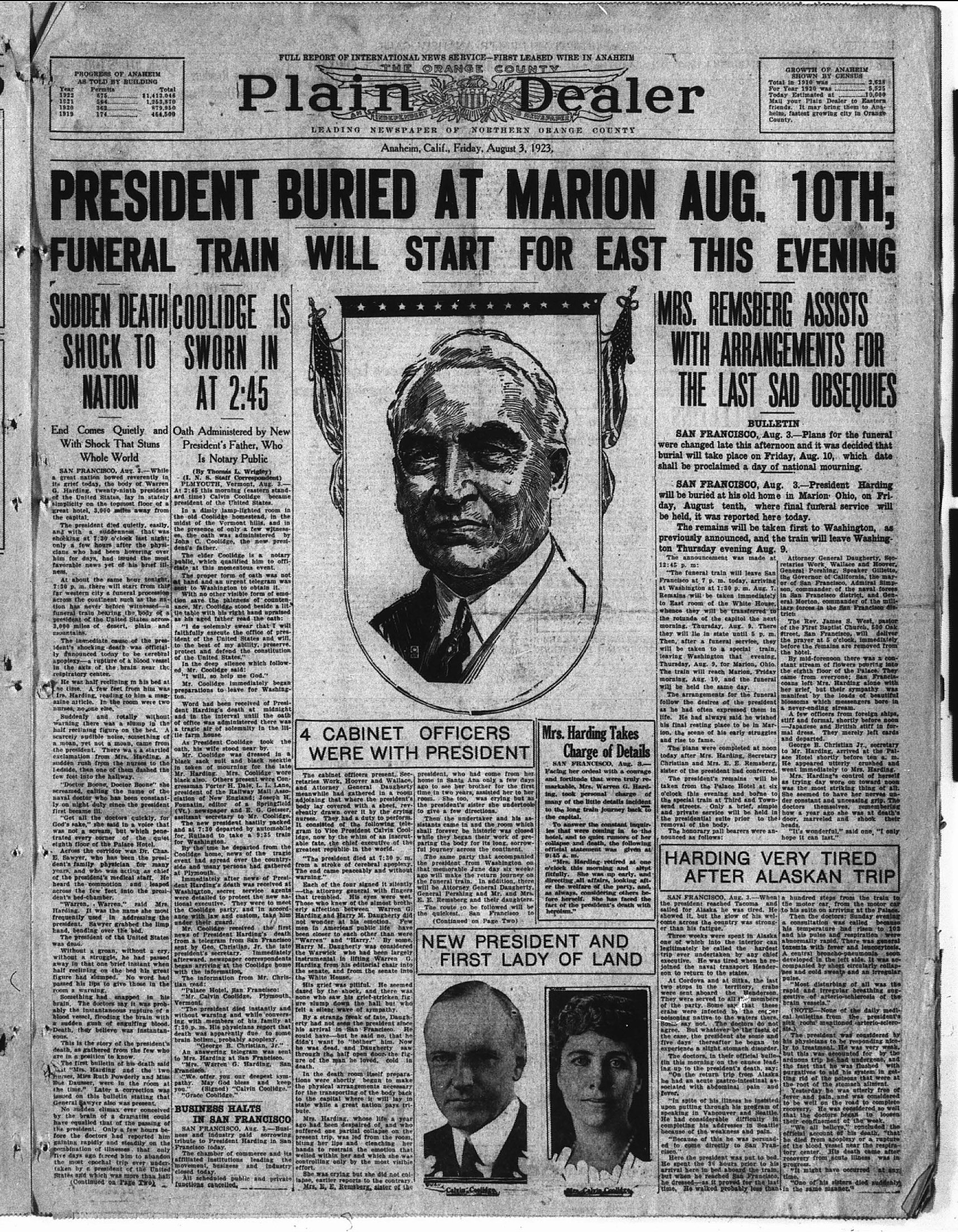
NEW PRESIDENT AND FIRST LADY OF LAND
Calvin Coolidge
Mrs. Calvin Coolidge
GROWTH OF ANAHEIM
SHOWN BY CENSUS
Total in 1910 was ..... 2,628
For Year 1920 was ..... 5,525
Today Estimated at ..... 10,000
Mail your Plain Dealer to Eastern friends. It may bring them to Anaheim, fastest growing city in Orange County.
ION AUG. 10TH;
EAST THIS EVENING
MRS. REMSBERG ASSISTS
WITH ARRANGEMENTS FOR
THE LAST SAD OBSEQUIES
BULLETIN
SAN FRANCISCO, Aug. 3.—Plans for the funeral were changed late this afternoon and it was decided that burial will take place on Friday, Aug. 10., which date
BULLETIN
SAN FRANCISCO, Aug. 3.—Plans for the funeral were changed late this afternoon and it was decided that burial will take place on Friday, Aug. 10, which date shall be proclaimed a day of national mourning.
SAN FRANCISCO, Aug. 3.—President Harding will be buried at his old home in Marion Ohio, on Friday, August tenth, where final funeral service will be held, it was reported here today.
The remains will be taken first to Washington, as previously announced, and the train will leave Washington Thursday evening Aug. 9.
The announcement was made at 12:45 p.m:
"The funeral train will leave San Francisco at 7 p.m. today, arriving at Washington at 1:30 p.m. Aug. 7. Remains will be taken immediately to East room of the White House, whence they will be transferred to the rotunda of the capitol the next morning. Thursday, Aug. 9. There they will lie in state until 5 p.m. Then, after a funeral service, they will be taken to a special train, leaving Washington that evening. Thursday, Aug. 9, for Marion, Ohio. The train will reach Marion, Friday morning, Aug. 10, and the funeral will be held the same day.
The arrangements for the funeral follow the desires of the president as he had often expressed them in life. He had always said he wished his final resting place to be in Marion, the scene of his early struggles and rise to fame.
The plans were completed at noon today after Mrs. Harding, Secretary Christian and Mrs. E. E. Remsberg, sister of the president had conferred.
The president's remains will be taken from the Palace Hotel at six o'clock this evening and borne to the special train at Third and Townsend streets. Only a brief, simple and private service will be held in the presidential suite prior to the removal of the body.
The honorary pall bearers were announced as follows:
Attorney General Daugherty, Secretaries Work, Wallace and Hoover, General Pershing, Speaker Gillette, the Governor of California; the mayor of San Francisco, Admiral Simpson, commander of the naval forces in San Francisco district; and General Morton, commander of the military forces in the San Francisco district.
The Rev. James S. West, pastor of the First Baptist Church, 500 Oak street, San Francisco, will deliver the prayer at 5 o'clock, immediately before the remains are removed from the hotel.
By mid-forenoon there was a constant stream of flowers pouring into the eighth floor of the Palace. They came from everyone; San Franciscoans left Mrs. Harding alone with her grief, but their sympathy was manifest by the loads of beautiful blossoms which messengers bore in a never-ending stream.
A few officers from foreign ships, stiff and formal, shortly before noon — Japanese and British stiff in formal dress. They merely left cards and departed.
George B. Christian Jr., secretary to Mr. Harding, arrived at the Palace Hotel shortly before ten a.m. He appeared utterly crushed and went immediately to Mrs. Harding.
Mrs. Harding's control of herself as trying day wore on toward noon was the most striking thing of all. She seemed to have her nerves under constant and unceasing grip. The doctors themselves, remembering how a year ago she was at death's door, marveled and shook their heads.
"It's wonderful," said one, "I only hope it can last."
The president's remains will be taken from the Palace Hotel at six o'clock this evening and borne to the special train at Third and Townsend streets. Only a brief, simple and private service will be held in the presidential suite prior to the removal of the body.
The honorary pall bearers were announced as follows:
HARDING VERY TIRED AFTER ALASKAN TRIP
SAN FRANCISCO, Aug. 3.—When the president reached Tacoma and sailed for Alaska he was tired. He showed it, but the glow of his welcome across the country was stronger than his fatigue.
Three weeks were spent in Alaska one of which into the interior can legitimately be called the hardest trip ever undertaken by any chief executive. He was tired when he rejoined the naval transport Henderson to return to the states.
At Cordova and at Sitka, the last two stops in the territory, crabs were sent aboard the Henderson. They were served to all the members of the party. Some say that these crabs were infected by the corpse poisoning native to the waters there. Some say not. The doctors do not agree. But whatever be the facts of the case, the president ate some and five days thereafter he began to experience a slight stomach disorder.
The doctors, in their official bulletin this morning on the causes leading up to the president's death, say:
"On the return trip from Alaska he had an acute gastro-intestinal associated with abdominal pain and fever.
"In spite of his illness he insisted upon putting through his program of speaking in Vancouver and Seattle. He had considerable difficulty in completing his addresses in Seattle because of the weakness and pain.
"Because of this he was persuaded to come directly to San Francisco."
Here the president was put to bed. He spent the 36 hours prior to his arrival here in bed aboard the train, but when he reached San Francisco, he dressed—as it proved for the last time. He walked probably less than a hundred steps from the train to the motor car, from the motor car to his suite on arriving at the Palace.
Then the doctors: Sunday evening a consultation was called because his temperature had risen to 102 and his pulse and respiration were abnormally rapid. There was general toxemia with fever and leucocytosis. A central broncho-pneumonia soon developed in the left side. It was accompanied by short circularly collapses and cold sweats and an irregular pulse.
"Most disturbing of all was the rapid and irregular breathing suggestive of arterio-schlerosis of the brain vessels."
(NOTE—None of the daily medical bulletins from the president's sick room mentioned arterio-sclerosis.) The president was considered by his physicians to be responding nicely to treatment. He was very weak, but this was accounted for by the arduous trip he had undergone, and the fact that he was flushed with purgatives to aid his system in getting rid of the poisons that were at the root of the stomach ailment.
Vesterday he was utterly free of fever and pain, and was considered to be well on the road to complete recovery. He was considered so well that the doctors began to loosen their confinement of the week.
"We all believe," concluded the official account of his death, "that he died from apoplexy or a rupture of the blood vessel near the respiratory center. His death came after recovery from acute illness was in progress.
"It might have occurred at any time.
"One of his sisters died suddenly in the same manner."