oc-plain-dealer 1922-01-16
Scanned page
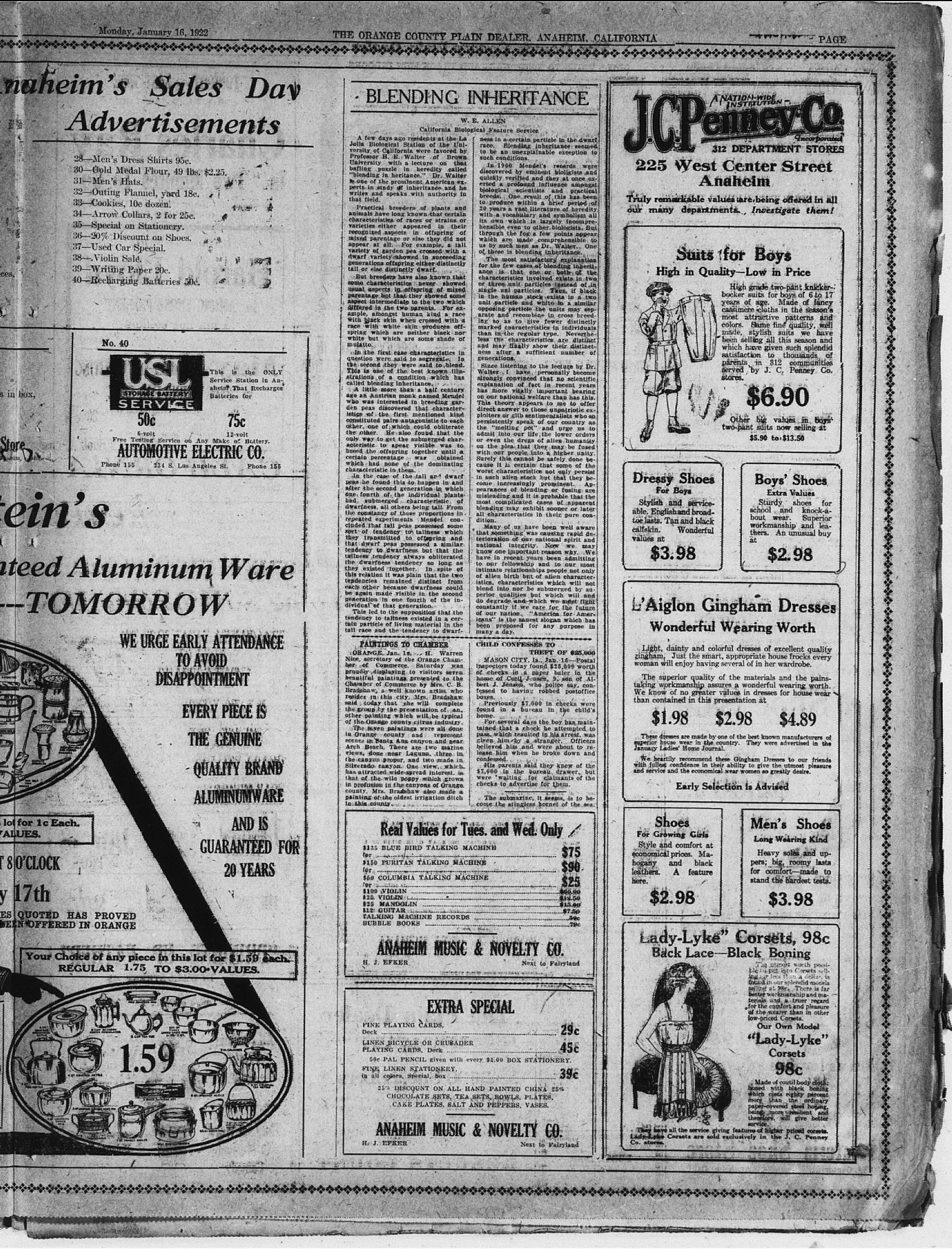
Searchable text
naheim’s Sales Day
Advertisements
28—Men's Dress Shirts 95c.
30—Gold Medal Flour, 49 lbs. $2.25.
31—Men's Hats.
32—Outing Flannel, yard 18c.
33—Cookies, 10c dozen.
34—Arrow Collars, 2 for 25c.
35—Special on Stationery.
36—20% Discount on Shoes.
37—Used Car Special.
38—Violin Sale.
39—Writing Paper 20c.
40—Recharging Batteries 50c.
No. 40
USL
STORAGE BATTERY
SERVICE
This is the ONLY
Service Station in Anaheim That Recharges
Batteries for
50c 75c
6-volt 12-volt
Free Testing Service on Any Make of Battery.
AUTOMOTIVE ELECTRIC CO.
STORAGE BATTERY
SERVICE
50c
75c
6-volt
12-volt
Free Testing Service on Any Make of Battery.
AUTOMOTIVE ELECTRIC CO.
Phone 155 234 S. Los Angeles St. Phone 155
stein's
anteed Aluminum Ware
TOMORROW
WE URGE EARLY ATTENDANCE
TO AVOID
DISAPPOINTMENT
EVERY PIECE IS
THE GENUINE
QUALITY BRAND
ALUMINUMWARE
AND IS
GUARANTEED FOR
20 YEARS
lot for 1c Each.
VALUES.
8 O'CLOCK
y 17th
ES QUOTED HAS PROVED
BEEN OFFERED IN ORANGE
ALUMINUMWARE
AND IS
GUARANTEED FOR
20 YEARS
Your Choice of any piece in this lot for $1.59 each.
REGULAR 1.75 TO $3.00·VALUES.
1.59
BLENDING INHERITANCE
W. E. ALLEN
California Biological Feature Service
A few days ago residents at the La Jolla Biological Station of the University of California were favored by Professor H. E. Walter of Brown University with a lecture on that baffling puzzle in heredity called "blending inheritance." Dr. Walter is one of the prominent American experts in study of inheritance and he writes and speaks with authority in that field.
Practical breeders of plants and animals have long known that certain characteristics of races or strains or varieties either appeared in their recognized aspects in offspring of mixed parentage or else they did not appear at all. For example, a tall variety of garden pea crossed with a dwarf variety showed in succeeding generations offspring either distinctly tall or else distinctly dwarf.
But breeders have also known that some characteristics never showed usual aspects in offspring of mixed parentage but that they showed some aspect intermediate to the two which differed in the two parents. For example, amongst human kind a race with black skin when crossed with a race with white skin produces offspring which are neither black nor white but which are some shade of mulatto.
In the first case characteristics in question were said to segregate. In the second they were said to blend. This is one of the best known illustrations of a condition which has called blending inheritance.
A little more than a half century ago an Austrian monk named Mendel who was interested in breeding garden peas discovered that characteristics of the first mentioned kind constituted pairs antagonistic to each other, one of which could obliterate the other. He also found that the only way to get the submerged characteristic to appear visible was to breed the offspring together until a certain percentage was obtained which had none of the dominatingness in a certain particle in the dwarf race. Blending inheritance seemed to be an unexplainable exception to such conditions.
In 1900 Mendel's records were discovered by eminent biologists and quickly verified and they at once exerted a profound influence among biological scientists and practical breeds. One result of this has been to produce within a brief period of 20 years a vast literature of heredity with a vocabulary and symbolism all its own which is largely incompressible even to other biologists. But through the fog a few points appear which are made comprehensible to us by such men as Dr. Walter. One of these is blending inheritance.
The most satisfactory explanation for the few cases of blending inheritance is that one or both of the characteristics involved exists in two or three unit particles instead of in single unit particles. Thus, if black in the human stock exists in a two unit particle and white in a similar opposing particle the units may separate and recombine in cross breeding so as to give fewer distinctly marked characteristics in individuals than in the regular type. Nevertheless the characteristics are distinct and may finally show their distinctness after a sufficient number of generations.
Since listening to the lecture by Dr. Walter I have personally become strongly convinced that no scientific explanation of fact in recent years has more vitally important bearing on our national welfare than has this. This theory appears to me to offer direct answer to those unpatriotic exploiters or glib sentimentalists who so persistently speak of our country as the "melting pot" and urge us to admit into our life the lower orders or even the dregs of alien humanity on the plea that they may be fused with our people into a higher unity. Surely this cannot be safely done because it is certain that some of the
This is one of the best known illustrations of a condition which has called blending inheritance.
A little more than a half century ago an Austrian monk named Mendel who was interested in breeding garden peas discovered that characteristics of the first mentioned kind constituted pairs antagonistic to each other, one of which could obliterate the other. He also found that the only way to get the submerged characteristic to appear visible was to breed the offspring together until a certain percentage was obtained which had none of the dominating characteristic in them.
In the case of the tall and dwarf peas he found this to happen in and after the second generation in which one fourth of the individual plants had submerged characteristic of dwarfness, all others being tall. From the constancy of those proportions in repeated experiments Mendel concluded that tall peas possessed some sort of tendency to tailness which they transmitted to offspring and that dwarf peas possessed a similar tendency to dwarfness but that the tailness tendency always obliterated the dwarfness tendency so long as they existed together. In spite of this relation it was plain that the two tendencies remained distinct from each other because dwarfness could be again made visible in the second generation in one fourth of the individual of that generation.
This led to the supposition that the tendency to tailness existed in a certain particle of living material in the tall race and the tendency to dwarfness.
PAINTINGS TO CHAMBER
ORANGE, Jan. 16, ... H. Warren Nice, secretary of the Orange Chamber of Commerce. Saturday was proudly displaying to visitors seven beautiful paintings presented to the Chamber of Commerce by Mrs. C. B. Bradshaw, a well-known artist who resides in this city. Mrs. Bradshaw said today that she will complete the group by the presentation of an other painting which will be typical of the Orange county citrus industry.
The seven paintings were all done in Orange county and represent scenes in Santa Ana canyon and near Arch Bench. There are two marine views, done near Laguna, three in the canyon proper, and two made in Silverado canyon. One view, which has attracted wide-spread interest, is that of the wild poppy which grows in profusion in the canyons of Orange county. Mrs. Bradshaw also made a painting of the oldest irrigation ditch in this county.
CHILD CONFESSES TO
THEFT OF $25,000
MASON CITY, Ia., Jan. 16—Postal inspectors today found $25,000 worth of checks in a paper baler in the home of Cecil Jensen, 9, son of Albert J. Jensen, who police say, confessed to having robbed postoffice boxes.
Previously $7,000 in checks were found in a bureau in the child's home.
For several days the boy has maintained that a check he attempted to pass, which resulted in his arrest, was given him by a stranger. Officers believed him and were about to release him when he broke down and confessed.
His parents said they knew of the $7,000 in the bureau drawer, but were waiting for clamants of the checks to advertise for them.
The submarine, it seems, is to become the stingless hornet of the sea.
Real Values for Tues. and Wed. Only
$135 BLUE BIRD TALKING MACHINE
for ..... $75
$150 PURITAN TALKING MACHINE
for ..... $90
$60 COLUMBIA TALKING MACHINE
for ..... $25
Real Values for Tues. and Wed. Only
$135 BLUE BIRD TALKING MACHINE $75
for ...
$150 PURITAN TALKING MACHINE $90
for ...
$60 COLUMBIA TALKING MACHINE $25
for ...
$100 VIOLIN $40.00
$25 VIOLIN $12.50
$25 MANDOLIN $15.00
$12 GUITAR $7.50
FALKING MACHINE RECORDS .50c
BUBBLE BOOKS .79c
ANAHEIM MUSIC & NOVELTY CO.
H. J. EFKER Next to Fairyland
EXTRA SPECIAL
FINE PLAYING CARDS,
Deck 29¢
LINEN BICYCLE OR CRUSADER
PLAYING CARDS, Deck 45¢
50¢ PAL PENCIL given with every $1.00 BOX STATIONERY.
FINE LINEN STATIONERY,
in all colors, Special, box 39¢
25% DISCOUNT ON ALL HAND PAINTED CHINA 25%
CHOCOLATE SETS, TEA SETS, BOWLS, PLATES,
CAKE PLATES, SALT AND PEPPERS, VASES.
ANAHEIM MUSIC & NOVELTY CO.
H. J. EFKER Next to Fairyland
A NATION-WIDE INSTITUTION
J.C. Penney Co.
Incorporated
312 DEPARTMENT STORES
225 West Center Street
Anaheim
Truly remarkable values are being offered in all our many departments... Investigate them!
Suits for Boys
High in Quality—Low in Price
High grade two-pant knicker-bocker suits for boys of 6 to 17 years of age. Made of fancy cassimere cloths in the season's most attractive patterns and colors. Same fine quality, well made, stylish suits we have been selling all this season and which have given such splendid satisfaction to thousands of parents in 312 communities served by J. C. Penney Co. stores.
$6.90
Other big values in boys' two-pant suits now selling at
$5.90 to $13.50
$6.90
Other big values in boys' two-pant suits now selling at $5.90 to $13.50
Dressy Shoes
For Boys
Stylish and serviceable. Englishand broad-toe lasts. Tan and black calfskin. Wonderful values at $3.98
Boys' Shoes
Extra Values
Sturdy shoes for school and knock-about wear. Superior workmanship and leathers. An unusual buy at $2.98
L'Aiglon Gingham Dresses
Wonderful Wearing Worth
Light, dainty and colorful dresses of excellent quality gingham. Just the smart, appropriate house frocks every woman will enjoy having several of in her wardrobe.
The superior quality of the materials and the painstaking workmanship assures a wonderful wearing worth. We know of no greater values in dresses for house wear than contained in this presentation at $1.98 $2.98 $4.89
These dresses are made by one of the best known manufacturers of superior house wear in the country. They were advertised in the January Ladies' Home Journal.
We heartily recommend these Gingham Dresses to our friends with fullest confidence in their ability to give the utmost pleasure and service and the economical wear women so greatly desire.
Early Selection is Advised
Shoes
For Growing Girls
Style and comfort at economical prices. Mahogany and black leather. A feature here.
Men's Shoes
Long Wearing Kind
Heavy soles and uppers; big, roomy lasts for comfort—made to stand the hardest tests.
Shoes
For Growing Girls
Style and comfort at economical prices. Mahogany and black leathers. A feature here.
$2.98
Men’s Shoes
Long Wearing Kind
Heavy soles and uppers; big, roomy lasts for comfort—made to stand the hardest tests.
$3.98
Lady-Lyke” Corsets, 98c
Back Lace—Black Boning
The most worth possible input into Corsets selling car less than a dollar is found in our splendid models selling at 28c. There is far better workmanship and materials and a truer regard for the comfort and pleasure of the wearer than in other low-priced Corsets.
Our Own Model
“Lady-Lyke”
Corsets
98c
Made of coutil body cloth; boned with black boning which costs eighty percent more than the ordinary paper-covered steel boning, being more resilient and therefore will give better service.
They have all the service giving features of higher priced corsets. Lady-Lyke Corsets are sold exclusively in the J. C. Penney Co. stores.