anaheim-daily-herald 1921-12-19
Scanned page
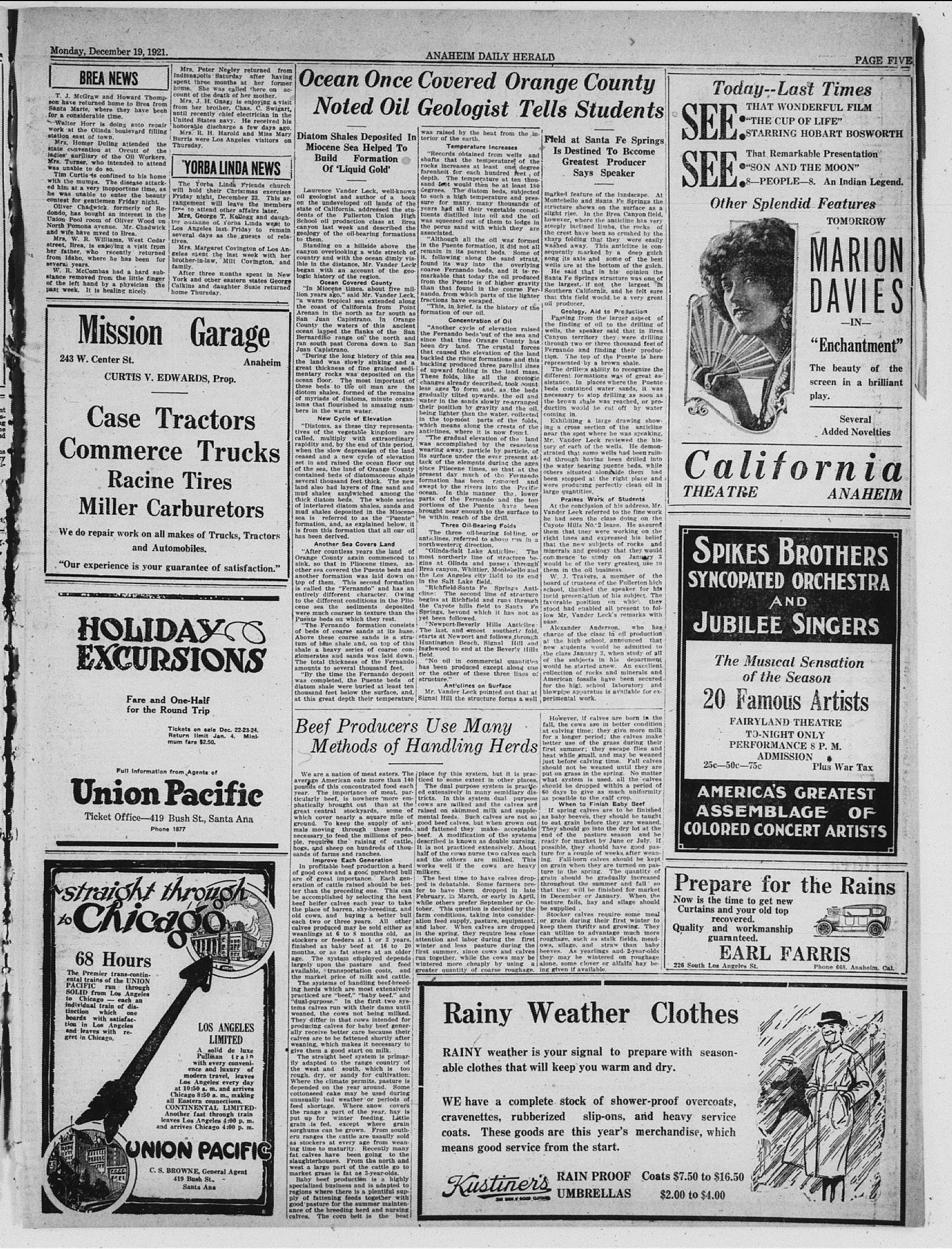
Searchable text
Monday, December 19, 1921.
BREA NEWS
T. J. McGraw and Howard Thompson have returned home to Brea from Santa Marie, where they have been for a considerable time.
Walter Horr is doing auto repair work at the Olinda boulevard filling station east of town.
Mrs. Homer Duling attended the state convention at Orcutt of the ladies' auriliary of the Oil Workers. Mrs. Turner, who intended to attend was unable to do so.
Tim Curtis is confined to his home with the mumps. The disease attacked him at a very inopportune time, as he was unable to enter the beauty contest for gentlemen Friday night.
Oliver Chadwick, formerly of Redondo, has bought an interest in the Union Pool room of Oliver Wood on North Pomona avenue. Mr. Chadwick and wife have moved to Brea.
Mrs. W. R. Williams, West Cedar street, Brea, is enjoying a visit from her father, who recently returned from Idaho, where he has been for several years.
W. R. McCombas had a hard substance removed from the little finger of the left hand by a physician the past week. It is healing nicely.
Mrs. Peter Negley returned from Indianapolis Saturday after having spent three months at her former home. She was called there on account of the death of her mother.
Mrs. J. H. Gnagy is enjoying a visit from her brother, Chas. C. Swigart, until recently chief electrician in the United States navy. He received his honorable discharge a few days ago.
Mrs. R. H. Harold and Miss Mary Burris were Los Angeles visitors on Thursday.
YORBA LINDA NEWS
The Yorba Linda Friends church will hold their Christmas exercises Friday night, December 23. This arrangement will leave the members free to attend other affairs later.
Mrs. George T. Kollogg and daughter Suanne of Yorba Linda went to Los Angeles last Friday to remain several days as the guests of relatives.
Mrs. Margaret Covington of Los Angeles spent the last week with her brother-in-law, Milt Covington, and family.
After three months spent in New York and other eastern states George Calkins and daughter Susie returned home Thursday.
Mission Garage
243 W. Center St.
Anaheim
CURTIS V. EDWARDS, Prop.
Case Tractors Commerce Trucks
CURTIS V. EDWARDS, Prop.
Case Tractors
Commerce Trucks
Racine Tires
Miller Carburetors
We do repair work on all makes of Trucks, Tractors and Automobiles.
"Our experience is your guarantee of satisfaction."
HOLIDAY EXCURSIONS
Fare and One-Half
for the Round Trip
Tickets on sale Dec. 22-23-24.
Return limit Jan. 4. Minimum fare $2.50.
Full Information from Agents of Union Pacific
Ticket Office—419 Bush St., Santa Ana
Phone 1877
Union Pacific
Ticket Office—419 Bush St., Santa Ana
Phone 1877
straight through to Chicago
68 Hours
The Premier trans-continental trains of the UNION PACIFIC run through SOLID from Los Angeles to Chicago — each individual train of distinction which one boards with satisfaction in Los Angeles and leaves with regret in Chicago.
LOS ANGELES LIMITED
A solid de luxe Pullman train with every convenience and luxury of modern travel, leaves Los Angeles every day at 10:50 a.m. and arrives Chicago 8:50 a.m., making all Eastern connections.
CONTINENTAL LIMITED
Another fast through train leaves Los Angeles 4:00 p.m. and arrives Chicago 4:00 p.m.
UNION PACIFIC
C. S. BROWNE, General Agent
419 Bush St., Santa Ana
Ocean Once Covered Orange County
Noted Oil Geologist Tells Students
Diatom Shales Deposited In Miocene Sea Helped To Build Formation Of 'Liquid Gold'
Laurence Vander Leck, well-known oil geologist and author of a book on the undeveloped oil lands of the state of California, addressed the students of the Fullerton Union High School oil production class at Brea canyon last week and described the geology of the oil-bearing formations to them.
Standing on a hillside above the canyon overlooking a wide stretch of country and with the ocean dimly visible in the distance, Mr. Vander Leck began with an account of the geologic history of the region.
Ocean Covered County
"In Miocene times, about five million years ago," said Mr. Vander Leck, "a warm tropical sea extended along the coast of California from Point Arenan in the north as far south as San Juan Capistrano. In Orange County the waters of this ancient ocean lapped the flanks of the San Bernardino range on the north and ran south past Corona down to San Juan Capistrano.
"During the long history of this sea the land was slowly sinking and a great thickness of fine grained sedimentary rocks was deposited on the ocean floor. The most important of these beds to the oil man are the diatom shales, formed of the remains of myriads of diatoms, minute organisms that flourished in amazing numbers in the warm water.
New Cycle of Elevation
"Diatoms, as these tiny representatives of the vegetable kingdom are called, multiply with extraordinary rapidity and, by the end of this period, when the slow depression of the land ceased and a new cycle of elevation set in and raised the ocean floor out was raised by the heat from the interior of the earth."
Temperature Increases
"Records obtained from wells and shafts that the temperature of the rocks increases at least one degree fahrenheit for each hundred feet of depth. The temperature at ten thousand feet would then be at least 180 degrees. The diatom beds, subjected to such a high temperature and pressure for many, many thousands of years hgd all their vegetable constituents distilled into oil and the oil was squeezed out of them to lodge in the porus sand with which they are associated.
"Although all the oil was formed in the Puente formation, it did not all remain in its parent beds. Some of it, following along the sand strata, found its way into the overlying coarse Fernando beds, and it is remarkable that today the oil produced from the Puente is of higher gravity than that found in the coarse Fernando, from which parts of the lighter fractions have escaped.
"This, in brief, is the history of the formation of our oil."
Concentration of Oil
"Another cycle of elevation raised the Fernando beds' out of the sea and since that time Orange County has been dry land. The crustal forces that caused the elevation of the land buckled the rising formations and this buckling produced three parallel lines of upward folding in the land mass. These folds, like all the geologic changes already described, took countless ages to form and, as the beds gradually tilted upwards, the oil and water in the sands slowly re-arranged their position by gravity and the oil, being lighter than the water, collected in the top-most parts of the folds, which means along the crests of the anticlines, where it is now found."
The gradual elevation of the land was accomplished by the ceaseless wearing away, particle by particle, of its surface under the ever present attack of the elements during the ages
Field at Santa Fe Springs Is Destined To Become Greatest Producer Says Speaker
marked feature of the landscape. At Montebello and Santa Fe Springs the structure shows on the surface as a slight rise. In the Brea Canyon field, however, where the anticline has very steeply inclined limbs, the rocks of the crest have been so crushed by the sharp folding that they were easily washed away. This anticline is consequently marked by a deep gulch along its axis and some of the best wells are at the bottom of the gulch.
He said that in his opinion the Santa Fe Springs structure was one of the largest, if not the largest in Southern California, and he felt sure that this field would be a very great oil producer.
Geology, Aid to Production
Passing from the larger aspect of the finding of oil to the drilling of wells, the speaker said that in Brea Canyon territory they were drilling through two or three thousand feet of Fernando and finding their production. The top of the Puente is here represented by a brown shale.
The drillers ability to recognize the different formations was of great assistance. In places where the Puente beds contained water sands, it was necessary to stop drilling as soon as the brown shale was reached, or production would be cut off by water coming in.
Exhibiting a large drawing showing a cross section of the anticline near the spot where he was speaking, Mr. Vander Leck reviewed the history of each of the wells. He demonstrated that some wells had been ruined through having been drilled into water bearing puente beds while
great thickness of fine grained sedimentary rocks was deposited on the ocean floor. The most important of these beds to the oil man are the diotom shales, formed of the remains of myriads of diatoms, minute organisms that flourished in amazing numbers in the warm water.
New Cycle of Elevation
"Diatoms, as these tiny representatives of the vegetable kingdom are called, multiply with extraordinary rapidity and, by the end of this period, when the slow depression of the land ceased and a new cycle of elevation set in and raised the ocean floor out of the sea, the land of Orange County contained beds of diatomaceous shale several thousand feet thick. The new land also had layers of fine sand and mud shales sandwich among the thick diatom beds. The whole series of interlared diatom shales, sands and mud shales deposited in the Miocene sea is referred to as the "Puente" formation, and, as explained below, it is from this formation that all our oil has been derived.
Another Sea Covers Land
"After countless years the land of Orange County again commenced to sink, so that in Pliocene times, another sea covered the Puente beds and another formation was laid down on top of them. This second formation is called the "Fernando" and has an entirely different character. Owing to the different conditions in the Pliocene sea the sediments deposited were much coarser in texture than the Puente beds on which they rest.
The Fernando formation consists of beds of coarse sands at its base. Above these coarse sands is a stratum of blue shale and, on top of this shale a heavy series of coarse conglomerates and sands was laid down. The total thickness of the Fernando amounts to several thousand feet.
By the time the Fernando deposit was completed, the Puente beds of diatom shale were buried at least ten thousand feet below the surface, and, at this great depth their temperature place for this system, but it is practiced to some extent in other places.
The dual purpose system is practiced extensively in many semiidiary districts. In this system dual purpose cows are milked and the calves are raised on skimmed milk and supplemental feeds. Such calves are not so good beef calves, but when grown out and fattened they make acceptable beef. A modification of the systems described is known as double nursing. It is not practiced extensively. About half of the cows nurse two calves each and the others are milked. This works well if the cows are heavy milkers.
The best time to have calves drop off, if calves are born in the fall, the cows are in better condition at calving time; they give more milk for a longer period; the calves make better use of the grass during their first summer; they escape flies and heat while small, and may be weaned just before calving time. Fall calves should not be weaned until they are put on grass in the spring. No matter what system is used, all the calves should be dropped within a period of 60 days to give as much uniformity as possible to the calf crop.
Beef Producers Use Many Methods of Handling Herds
We are a nation of meat eaters. The average American eats more than 140 pounds of this concentrated food each year. The importance of meat, particularly beef, is nowhere more emphatically brought out than at the great central stockyards, some of which cover nearly a square mile of ground. To keep the supply of animals moving through these yards, necessary to feed the millions of people, requires the raising of cattle, hogs, and sheep on hundreds of thousands of farms and ranches.
Improve Each Generation
In profitable beef production a herd of good cows and a good purebred bull are of great importance. Each gen-
pounds of this concentrated food each year. The importance of meat, particularly beef, is nowhere more emphatically brought out than at the great central stockyards, some of which cover nearly a square mile of ground. To keep the supply of animals moving through these yards, necessary to feed the millions of people, requires the raising of cattle, hogs, and sheep on hundreds of thousands of farms and ranches.
Improve Each Generation
In profitable beef production a herd of good cows and a good purebred bull are of great importance. Each generation of cattle raised should be better than the preceding one. This can be accomplished by selecting the best beef heifer calves each year to take the place of barren, shy-breeding, and old cows, and buying a better bull each two or three years. All other calves produced may be sold either as weanlings at 6 to 8 months old, as stocklers or feeders at 1 or 2 years, finished as baby beef at 16 to 20 months, or as fat steers at an older age. The system employed depends largely upon the pasture and feed available, transportation costs, and the market price of milk and cattle.
The systems of handling beef-breeding herds which are most extensively practiced are "beef," "baby beef," and "dual-purpose." In the first two systems calves run with their dams until weaned, the cows not being milked. They differ in that cows intended for producing calves for baby beef generally receive better care because their calves are to be fattened shortly after weaning, which makes it necessary to give them a good start on milk.
The straight beef system is primarily adapted to the range country of the west and south, which is too rough, dry, or sandy for cultivation. Where the climate permits, pasture is depended on the year around. Some cottonseed cake may be used during unusually bad weather or periods of feed shortage. Where snow covers the range a part of the year, hay is put up for winter feeding. Little grain is fed, except where grain sorghums can be grown. From southern ranges the cattle are usually sold as stockers at every age from weaning time to maturity. Recently many fat calves have been going to the slaughterhouses. From the north and west a large part of the cattle go to market grass is fat as 3-year-olds.
Baby beef production is a highly specialized business and is adapted to regions where there is a plentiful supply of fattening feeds together with good pasture for the summer maintenance of the breeding herd and nursing calves. The corn belt is the best
The dual purpose system is practiced extensively in many semi-diary districts. In this system dual purpose cows are milked and the calves are raised on skimmed milk and supplemental feeds. Such calves are not so good beef calves, but when grown out and fattened they make acceptable beef. A modification of the systems described is known as double nursing. It is not practiced extensively. About half of the cows nurse two calves each and the others are milked. This works well if the cows are heavy milkers.
The best time to have calves dropped is debatable. Some farmers prefer to have them dropped in late February, in March, or early in April, while others prefer September or October. This question is decided by the farm conditions, taking into consideration feed supply, pasture, equipment, and labor. When calves are dropped in the spring, they require less close attention and labor during the first winter and less pasture during the first summer, since cows and calves run together, while the cows may be wintered more cheaply by using a greater quantity of coarse roughage.
Rainy Weather Closure
RAINY weather is your signal to prepare w able clothes that will keep you warm and dry.
WE have a complete stock of shower-proof cravenettes, rubberized slip-ons, and hea coats. These goods are this year's merchandise good service from the start.
Kustiner's Rain Proof Coats UMBRELLAS $25.00
Today--Last Times
THAT WONDERFUL FILM
“THE CUP OF LIFE”
STARRING HOBART BOSWORTH
That Remarkable Presentation
“SON AND THE MOON”
8—PEOPLE—8. An Indian Legend.
Other Splendid Features
TOMORROW
MARION
DAVIES
—IN—
“Enchantment”
The beauty of the screen in a brilliant play.
Several
Added Novelties
California
THEATRE
ANAHEIM
SPIKES BROTHERS
SYNCOPATED ORCHESTRA
AND
JUBILEE SINGERS
The Musical Sensation
of the Season
20 Famous Artists
FAIRYLAND THEATRE
TO-NIGHT ONLY
PERFORMANCE 8 P.M.
ADMISSION
25c—50c—75c Plus War Tax
AMERICA'S GREATEST
ASSEMBLAGE OF
COLORED CONCERT ARTISTS
AMERICA'S GREATEST
ASSEMBLAGE OF
COLORED CONCERT ARTISTS
Prepare for the Rains
Now is the time to get new
Curtains and your old top
recovered.
Quality and workmanship
guaranteed.
EARL FARRIS
226 South Los Angeles St.
Phone 668. Anaheim. Cal.
Summer Clothes
al to prepare with seasonwarm and dry.
of shower-proof overcoats,
p-ons, and heavy service
year's merchandise, which
start.
PROOF Coats $7.50 to $16.50
ELLAS $2.00 to $4.00