anaheim-daily-herald 1921-11-07
Scanned page
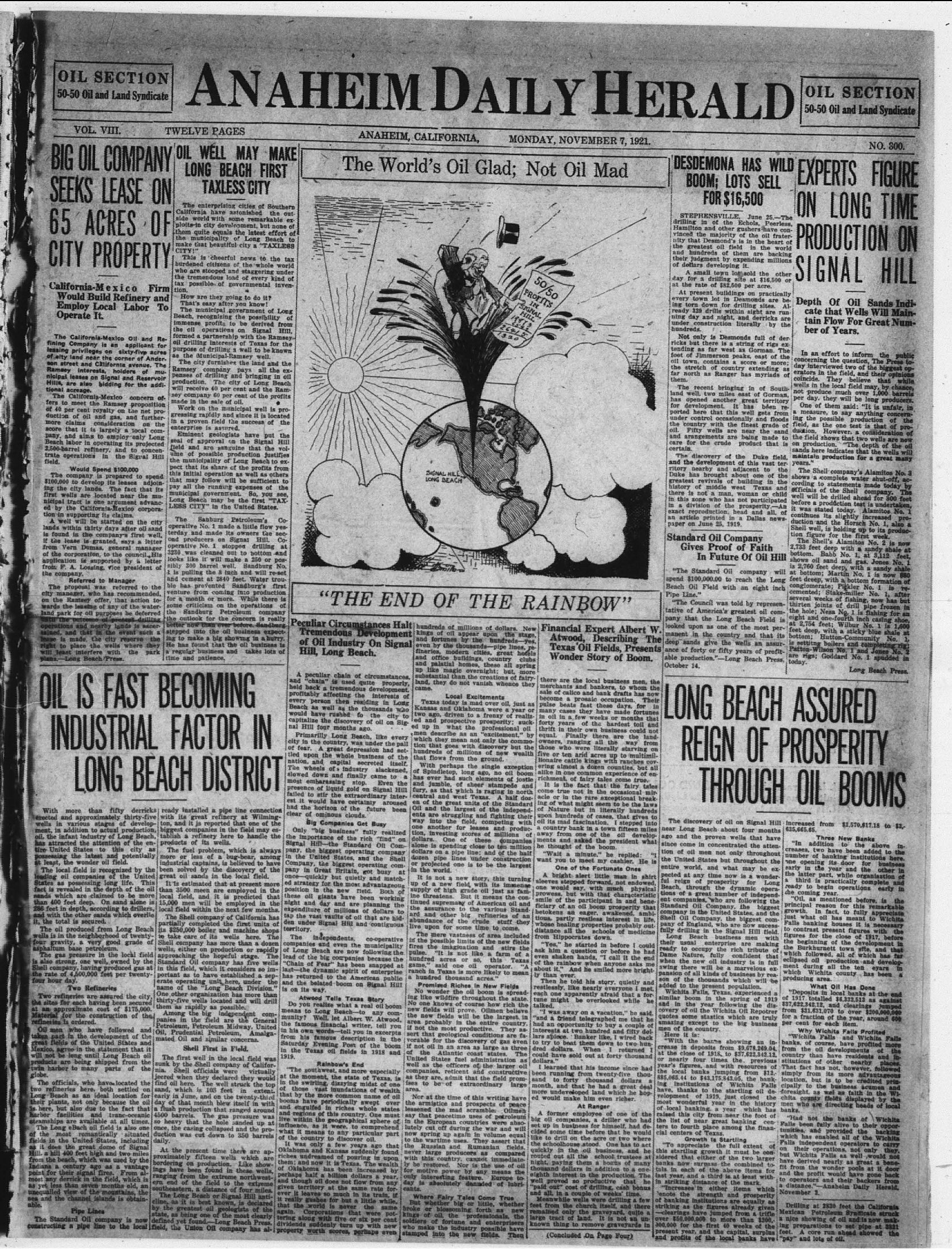
Searchable text
OIL SECTION
50-50 Oil and Land Syndicate
VOL. VIII. TWELVE PAGES
BIG OIL COMPANY
SEEKS LEASE ON
65 ACRES OF
CITY PROPERTY
California-Mexico Firm Would Build Refinery and Employ Local Labor To Operate It.
The California-Mexico Oil and Refining Company is an applicant for leasing privileges on sixty-five acres of city land near the corner of Anderson street and California avenue. The Ramsey interests, holders of municipal leases on Signal and Reservoir Hills, are also bidding for the additional acreage.
The California-Mexico concern offers to meet the Ramsey proposition of 40 per cent royalty on the net production of oil and gas, and furthermore claims consideration on the score that it is largely a local company, and aims to employ only Long Beach labor in operating its projected 2,500-barrel refinery, and to concentrate operations in the Signal Hill field.
OIL WELL MAY MAKE LONG BEACH FIRST TAXLESS CITY
The enterprising cities of Southern California have astonished the outside world with some remarkable exploits in city development, but none of them quite equals the latest effort of the municipality of Long Beach to make that beautiful city a "TAXLESS CITY!"
This is cheerful news to the tax burdened citizens of the whole world who are stooped and staggering under the tremendous load of every kind of tax possible of governmental invention.
How are they going to do it?
That's easy after you know!
The municipal government of Long Beach, recognizing the possibility of immense profits to be derived from the oil operations on Signal Hill, formed a partnership with the Ramsey oil drilling interests of Texas for the purpose of drilling a well to be known as the Municipal-Ramsey well.
The city furnishes the land and the Ramsey company pays all the expenses of drilling and bringing in oil production. The city of Long Beach will receive 40 per cent and the Ramsey company 60 per cent of the profits made in the sale of oil.
Work on the municipal well is progressing rapidly and since it is located in a proven field the success of the enterprise is assured.
Eminent geologists have put the seal of approval on the Signal Hill field and are sanguine that the volume of possible production justifies the municipality of Long Beach to ex-
Ramsey interests holders of municipal leases on Signal and Reservoir Hills, are also bidding for the additional acreage.
The California-Mexico concern offers to meet the Ramsey proposition of 40 per cent royalty on the net production of oil and gas, and furthermore claims consideration on the score that it is largely a local company, and aims to employ only Long Beach labor in operating its projected 2,500-barrel refinery, and to concentrate operations in the Signal Hill field.
Would Spend $100,000
The company is prepared to spend $100,000 to develop its leases joining the city land. The fact that its first wells are located near the municipal tract is one argument advanced by the California-Mexico corporation in supporting its claims.
A well will be started on the city lands within thirty days after oil sand is found in the company's first well. If the lease is granted, says a letter from Vern Dumas, general manager of the corporation, to the council. His application is supported by a letter from F. A. Losing, vice president of the company.
Referred to Manager
The proposal was referred to the city manager, who has recommended, on the Ramsey offer, that action towards the leasing of any of the waterland park for oil purposes be deferred with the outcome of present drilling operations and nearby lands as accepted, and that in the event such a lease is made, the city reserve the right to place the wells where they will least interfere with the park plans.—Long Beach Press.
OIL IS FAST BECOMING INDUSTRIAL FACTOR IN LONG BEACH DISTRICT
With more than fifty derricks erected and approximately thirty-five wells in various stages of development, in addition to actual production, oil, the infant industry of Long Beach, has attracted the attention of the entire United States to this city as possessing the latest and potentially at least, the wonder oil field.
The local field is recognized by the leading oil companies of the United States as possessing long life. This ready installed a pipe line connection with its great refinery at Wilmington, and it is reported that one of the biggest companies in the field may establish a refinery here to handle the products of its wells.
The fuel problem, which is always more or less of a bug-bear, among industrial captains, is believed to have been solved by the discovery of the great oil sands in the local field.
Ramsey company pays all the expenses of drilling and bringing in oil production. The city of Long Beach will receive 40 per cent and the Ramsey company 60 per cent of the profits made in the sale of oil.
Work on the municipal well is progressing rapidly and since it is located in a proven field the success of the enterprise is assured.
Eminent geologists have put the seal of approval on the Signal Hill field and are sanguine that the volume of possible production justifies the municipality of Long Beach to expect that its share of the profits from this initial operation as well as others that may follow will be sufficient to pay all the running expenses of the municipal government. So, you see, Long Beach may be the first "TAX-LESS CITY" in the United States.
The Sanburg Petroleum's Cooperative No. 1 made a little flow yesterday and made its owners the second producers on Signal Hill. Cooperative No. 1 stopped drilling at 3230 was cleaned out to bottom and looks like it will make a 250 or possibly 300 barrel well. Sandburg No. 1 is pulling the 8 inch and will re-set and cement at 2840 feet. Water trouble has prevented Sandburg's first venture from coming into production for a month or more. While there is some criticism on the operations of the Sandburg Petroleum company the outlook for the concern is really better now than ever before. Sandburg stepped into the oil business expecting to make a big showing in a hurry. He has found that the oil business is a regular business and takes lots of time and patience.
Peculiar Circumstances of Oil Industry Hill, Long Bay
Primarily Long Bay city in the country, woe of fear. A great depth upon the whole nation, and capital. The wheels of a industry slowed down and financed most embarrassing presence of liquid gold failed to stir the extraest it would have ceased had the horizon of the clear of ominous clouds.
Big Companies
Only "big business" the importance of the Signal Hill—the Star pany, the biggest open in the United States Company, the biggest pany in Great Britain once—quickly but quietly...
With more than fifty derricks erected and approximately thirty-five wells in various stages of development, in addition to actual production, oil, the infant industry of Long Beach, has attracted the attention of the entire United States to this city as possessing the latest and potentially at least, the wonder oil field.
The local field is recognized by the leading oil companies of the United States as possessing long life. This fact is revealed in the depth of the oil sands which are claimed to be more than 400 feet deep. On sand alone is 286 feet in depth, according to drillers, and with the other sands which overlie it, the total is secured.
The oil produced from Long Beach wells is in the neighborhood of twenty-four gravity, a very good grade of asphaltum base petroleum.
The gas pressure in the local field is also strong, one well, owned by the Shell company, having produced gas at the rate of 4,500,000 feet per twenty-four hour day.
Two Refineries
Two refineries are assured the city, the sites for each having been secured at an approximate cost of $175,000. Material for the construction of the refineries is ordered.
Oil men who have followed and taken part in the development of the great fields of the United States and Mexico, agree in the statement that it will not be long until Long Beach oil products are being shipped from the twin harbor to many parts of the globe.
The officials, who have located the two refineries here, both settled on Long Beach as an ideal location for their plants, not only because the oil is here, but also due to the fact that harbor facilities and tranc-oceanic steamships are available at all times.
The Long eBach oil field is also one of the most romantically situated fields in the United States, including as it does the great dome of Signal Hill—a hill 400 feet high and two miles from the beach, which was used by the Indians a century ago as a vantage point for their signal fires. From almost any derrick in the field, which is as yet less than seven months old, an unequalled view of the mountains, the sea and the channel islands is obtainable.
Pipe Lines
The Standard Oil company is now constructing a pipe line to the local ready installed a pipe line connection with its great refinery at Wilmington, and it is reported that one of the biggest companies in the field may establish a refinery here to handle the products of its wells.
The fuel problem, which is always more or less of a bug-bear, among industrial captains, is believed to have been solved by the discovery of the great oil sands in the local field.
It is estimated that at present more than 3500 meen are employed in the local field, and it is predicted that 15,000 men will be employed in the local field within the next few months.
The Shell company of California has partially completed the first units of its $250,000 boiler and machine shops to take care of its wells here. The Shell company has more than a dozen wells, either on production or rapidly approaching the hopeful stage. The Standard Oil company has five wells in this field, which it considers so important as to have established a separate operating unit here, under the name of the "Long Beach Division."
One other organization has more than thirty-five wells located and will drill them as rapidly as possible.
Among the big independent companies in the field are the General Petroleum, Petroleum Midway, United Oil, Prudential Petroleum, Amalgamated Oil and similar concerns.
Shell First in Field.
The first well in the local field was sunk by the Shell company of California. Shell officials were virtually jeered when they declared they would find oil here. The well struck the top sand, which is 103 feet in extent early in June, and on the twenty-third day of that month blew itself in with a flush production that ranged around 4500 barrels. The gas pressure was so heavy that the hole sanded up at once, causing collapsed and the production was cut down to 350 barrels daily.
At the present time there are approximately fifteen wells which are bordering on production. Like showings have been found in these wells, ranging from the extreme northwestern end of the field to the extreme southeastern a distance of four miles.
The Long Beach or Signal Hill anticline, as it is best known, is declared by the greatest oil geologists of the state, as being one of the most clearly defined yet found—Long Beach Pressfield, the Union Oil company has already installed a pipe line connection with its great refinery at Wilmington, and it is reported that one of the biggest companies in the field may establish a refinery here to handle the products of its wells.
The fuel problem, which is always more or less of a bug-bear, among industrial captains, is believed to have been solved by the discovery of the great oil sands in the local field within the next few months.
The Shell company of California has partially completed the first units of its $250,000 boiler and machine shops to take care of its wells here. The Shell company has more than a dozen wells, either on production or rapidly approaching the hopeful stage. The Standard Oil company has five wells in this field, which it considers so important as to have established a separate operating unit here, under the name of the "Long Beach Division."
One other organization has more than thirty-five wells located and will drill them as rapidly as possible.
Among the big independent companies in the field are the General Petroleum, Petroleum Midway, United Oil, Prudential Petroleum, Amalgamated Oil and similar concerns.
Shell First in Field.
The first well in the local field was sunk by the Shell company of California. Shell officials were virtually jeered when they declared they would find oil here. The well struck the top sand, which is 103 feet in extent early in June, and on the twenty-third day of that month blew itself in with a flush production that ranged around 4500 barrels. The gas pressure was so heavy that the hole sanded up at once, causing collapsed and the production was cut down to 350 barrels daily.
At the present time there are approximately fifteen wells which are bordering on production. Like showings have been found in these wells, ranging from the extreme northwestern end of the field to the extreme southeastern a distance of four miles.
The Long Beach or Signal Hill anticline, as it is best known, is declared by the greatest oil geologists of the state, as being one of the most clearly defined yet found—Long Beach Pressfield, the Union Oil company has already installed a pipe line connection with its great refinery at Wilmington, and it is reported that one of the biggest companies in the field may establish a refinery here to handle the products of its wells here. The Shell company has more than a dozen wells, either on production or rapidly approaching the hopeful stage. The Standard Oil company has five wells in this field, which it considers so important as to have established a separate operating unit here, under the name of the "Long Beach Division."
One other organization has more than thirty-five wells located and will drill them as rapidly as possible.
Among the big independent companies in the field are the General Petroleum, Petroleum Midway, United Oil, Prudential Petroleum, Amalgamated Oil and similar concerns.
Shell First in Field.
The first well in the local field was sunk by the Shell company of California. Shell officials were virtually jeered when they declared they would find oil here. The well struck the top sand, which is 103 feet in extent early in June, and on the twenty-third day of that month blew itself in with a flush production that ranged around 4500 barrels. The gas pressure was so heavy that the hole sanded up at once, causing collapsed and the production was cut down to 350 barrels daily.
At the present time there are approximately fifteen wells which are bordering on production. Like showings have been found in these wells, ranging from the extreme northwestern end of the field to the extreme southeastern a distance of four miles.
The Long Beach or Signal Hill anticline, as it is best known, is declared by the greatest oil geologists of the state, as being one of the most clearly defined yet found—Long Beach Pressfield, the Union Oil company has already installed a pipe line connection with its great refinery at Wilmington, and it is reported that one of the biggest companies in the field may establish a refinery here to handle the products of its wells here. The Shell company has more than a dozen wells, either on production or rapidly approaching the hopeful stage. The Standard Oil company has five wells in this field, which it considers so important as to have established a separate operating unit here, under the name of the "Long Beach Division."
One other organization has more than thirty-five wells located and will drill them as rapidly as possible.
Among the big independent companies in the field are the General Petroleum, Petroleum Midway, United Oil, Prudential Petroleum, Amalgamated Oil and similar concerns.
Shell First in Field.
The first well in the local field was sunk by the Shell company of California. Shell officials were virtually jeered when they declared they would find oil here. The well struck the top sand, which is 103 feet in extent early in June, and on the twenty-third day of that month blew itself in with a flush production that ranged around 4500 barrels. The gas pressure was so heavy that the hole sanded up at once, causing collapsed and the production was cut down to 350 barrels daily.
At this present time there are approximately fifteen wells which are bordering on production. Like showings have been found in these wells, ranging from the extreme northwestern end of the field to the extreme southeastern a distance of four miles.
The Long Beach or Signal Hill anticline, as it is best known, is declared by the greatest oil geologists ofthe state, as being one ofthe most clearly defined yet found—Long Beach Pressfield,the Union Oil company has already installed a pipe line connection with its great refinery at Wilmington,and it is reported that one ofthe biggest companies inthe field may establisha refineryheretohandletheproductsofitswellshere. The Shell company has more than a dozen wells,either onproductionorrapidlyapproachingthehopefulstage.TheStandardOilcompanyhasfifewellsinthisfield,ratherthanmanycommobileshaveperiodicallyandengulfedinrichesandregionsofthecountrylivewithinthegeographiainfluence.asitwere,tophiestgivesustoanypriortothecountrytoconserve.itwasonlya fewyear.OklahomaandKansassurfichesundreamedofpoorthem;andnowitTexasofOklahomahasbeenperhapshalfa billiondontgivetreatmentattheeveritleavesso muchitreallyguesstohurtsbutthattheworldisnowagain.Corporationsthertoringalongwithfiveordividends suddenlyturnpropertyworthscore,s
AHEIM DAILY HEAD
ANAHEIM, CALIFORNIA, MONDAY, NOVEMBER 7, 1921.
The World's Oil Glad; Not Oil Mad
50/50 PROFITS IN SIGNAL HILL
1920
"THE END OF THE RAINBOW"
Peculiar Circumstances Halt Tremendous Development of Oil Industry On Signal Hill, Long Beach.
A peculiar chain of circumstances, and "chain" is used quite properly, held back a tremendous development, profitably affecting the interests of every person then residing in Long Beach as well as the thousands who would have rushed to the city to capitalize the discovery of oil on Signal Hill four months ago.
Primarily Long Beach, like every city in the country, was under the pull of fear. A great depression had settled upon the whole business of the nation, and capital secreted itself. The wheels of industry slackened, slowed down and finally came to a most embarassing stop. Even the presence of liquid gold on Signal Hill failed to stir the extraordinary interest it would have certainly aroused had the horizon of the future been clear of ominous clouds.
Big Companies Get Busy
Only "big business" fully realized the importance of the rich "find" on Signal Hill—the Standard Oil Company, the biggest operating company in the United States, and the Shell Company, the biggest operating company in Great Britain, got busy at once—quickly but quietly and matchless of millions of dollars. New kings of oil appear upon the stage, and fortunes by the hundreds-yes, even by the thousands—pipe lines, refineries, modern cities, great hotels and office buildings, country clubs and palatial homes, these all spring up like magic overnight; but, more substantial than the creations of fairy-land, they do not vanish whence they came.
Local Excitements
Texas today is mad over oil, just as Kansas and Oklahoma were a year or two ago, driven to a frenzy of realized and prospective prosperity; sucked up in what the professional oil men describe as an "excitement," by which they mean not only the commotion that goes with discovery but the hundreds of millions of new wealth that flows from the ground.
With perhaps the single exception of Spindletop, long ago, no oil boom has ever had such elements of joist and jumble, of sheer stampede and fury, as that which is raging in north central and west Texas. A half dozen of the great units of the Standard Oil and the largest of the independents are struggling and fighting their way into the field, competing with one another for leases and production, investing scores of millions of dollars. One of these companies alone is spending close to ten million dollars on a pipe line; and of the half dozen pipe lines under construction or projected one is to be the largest in the world.
Financial Expert Albert W. Atwood, Describing The Texas Oil Fields, Presents Wonder Story of Boom.
There are the local business men, the merchants and bankers, to whom the sale of calico and bank drafts has now become a prosaic occupation. Their pulse beats fast these days, for in many cases they have made fortunes in oil in a few weeks or months that forty years of the hardest toll and thrift in their own business could not equal. Finally there are the landowners, ranging all the way from those who were literally starving on five or ten arid acres up to multimillionaire cattle kings with ranches covering almost a dozen counties, but all alike in one common experience of enrichment, of fairy tales come true.
It is the fact that the fairy tales come true not in the occasional miracle or in the rare exceptional breaking of what might seem to be the laws of Nature but in literally hundreds upon hundreds of cases, that gives to oil its mad fascination. I stepped into a country bank in a town fifteen miles away from one of the oil developments and asked the president what he thought of the boom.
"Wait a minute," he replied: "I want you to meet my cashier. He is One of the Fortunate Ones
A bright alert little man in shirt sleeves stepped forward not endowed."
Even the presence of liquid gold on Signal Hill failed to stir the extraordinary interest it would have certainly aroused had the horizon of the future been clear of ominous clouds.
Big Companies Get Busy
Only "big business" fully realized the importance of the rich "find" on Signal Hill—the Standard Oil Company, the biggest operating company in the United States, and the Shell Company, the biggest operating company in Great Britain, got busy at once—quickly but quietly and matched strategy for the most advantageous position in the new field. Both of these oil giants have been working night and day and are planning the expenditure of millions of dollars to tap the vast vaults of oil that are hidden under Signal Hill and contiguous territory.
The independents, co-operative companies and even the municipality of Long Beach are now following the lead of the big companies because the "Chain of Fear" has been snapped at last—the dynamic spirit of enterprise has returned to the American public and the belated boom on Signal Hill is on its way.
Atwood Tells Texas Story
Do you realize what a real oil boom means to Long Beach—to any community? Well, let Albert W. Atwood, the famous financial writer, tell you in his own words—tell you in excerpts from his famous description in the Saturday Evening Post of the boom in the Texas oil fields in 1918 and 1919.
Rainbow's End
"The southwest, and more especially at the moment, the state of Texas, is in the swirling, dizzying midst of one of those vast inundations of wealth that by the more common name of oil booms have periodically swept over and engulfed in riches whole states and regions of this country. One must live within the geographical sphere of influence, as it were, to comprehend what it means to any particular part of the country to discover oil.
It was only a few years ago that Oklahoma and Kansas suddenly found riches undreamed of pouring in upon them; and now it is Texas. The wealth of Oklahoma has been increased by perhaps half a billion dollars a year, and though oil does not flow from any given territory at the same rate forever it leaves so much in its train, if it really gushes for but a little while, that the world is never the same again. Corporations that were potering along with five or six per cent dividends suddenly turn up with new property worth scores, perhaps even
Promised Riches in New Fields
No wonder the oil boom is spreading like wildfire throughout the state. No one knows of course how rich the new fields will prove. Oilmen believe the new fields will be the largest in area probably in the entire country, if not the most productive. They assert that geological conditions are favorable for the discovery of gas even if not oil in an area as large as three of the Atlantic coast states. The United States fuel administration as well as the officers of the larger oil companies, reticent and constructive as they are, admit that the field promises to be of extraordinary large area.
Nor at the time of this writing have the armistice and prospects of peace lessened the mad scramble. Oilmen say that peacetime uses of petroleum in the European countries were absolutely cut off during the war and will now spring up again in volume equal to the wartime uses. They assert that the Russian and Rumanian fields never large producers as compared with this country, cannot immediately be restored. Nor is the use of oil for motive power by any means the only interesting feature. Europe today is absolutely denuded of lubricants.
Where Fairy Tales Come True
But whether big or little, whether broke or blossoming forth as new kings of oil, the professionals, who make the industry possible have stamped into the new fields. Then
It is the fact that the fairy tales come true not in the occasional miracle or in the rare exceptional breakage of what might seem to be the laws of Nature but in literally hundreds upon hundreds of cases, that gives to oil its mad fascination. I stepped into a country bank in a town fifteen miles away from one of the oil developments and asked the president what he thought of the boom.
"Wait a minute," he replied: "I want you to meet my cashier. He is one of the Fortunate Ones
A bright alert little man in shirt sleeves stepped forward, not endowed, one would say, with much physical prowess, but with that characteristic smile of the participant in and beneficiary of an oil boom prosperity that betokens an eager, awakened, ambitions, partly restless interest in life, whose healing properties probably outdistance all the schools of medicine from Hippocrates down.
"Yes," he started in before I could ask him a question or before he had even shaken hands. "I call it the end of the rainbow when anyone asks me about it." And he smiled more brightly than ever.
Then he told his story, quietly and restlessly, like nearly everyone I met. Each one apparently afraid that a fortune might be overlooked while he talked.
"I was away on a vacation," he said, "and a friend telegraphed me that he had an opportunity to buy a couple of interests at two hundred and fifty dollars aplace. Banker like, I wired back to try to beat them down to two hundred dollars. When I returned I could have sold out at forty thousand dollars."
I learned that his income since had been running from twenty-five thousand to forty thousand dollars a month, and that he had a great deal more undeveloped land which he hoped would make him even richer.
At Ranger
A former employee of one of the big oil companies, a driller who had set up in business for himself, had decided some time before that he would like to drill on the acre or two where the schoolhouse stood. One has to act quickly in the oil business, and he routed out all the school trustees at night, paying them a bonus of many thousand dollars in addition to a one-eighth interest in the production. The well proved so productive that he "paid out" cost of drilling, cash bonus and all in a couple of weeks' time.
Meanwhile wells were drilling a few feet from the church itself, and there remained only the graveyard, quite a large tract of land. It is not an unknown thing to remove graveyards in piles over 600,000 present and
HERALD
OIL SECTION
50-50 Oil and Land Syndicate
BER 7, 1921.
NO. 300.
Mad
DESDEMONA HAS WILD BOOM; LOTS SELL FOR $16,500
STEPHENSVILLE, June 25.—The drilling in of the Echols, Peerless, Hamilton and other gushers have convinced the majority of the oil fraternity that Desmond's is in the heart of the greatest oil field in the world and hundreds of them are backing their judgment by expending millions of dollars developing it.
A small town lost sold the other day for a drilling site at $16,500 or at the rate of $82,500 per acre.
At present buildings on practically every town lot in Desmonds are being torn down for drilling sites. Already 329 drills within sight are running day and night, and derricks are under construction literally by the hundreds.
Not only is Desmonds full of derricks but there is a string of rigs extending as far west as Gorman. The foet of Jimmerson peaks, east of the oil town, contains a score or more; the stretch of country extending as far north as Ranger has myriads of them.
The recent bringing in of Southland well, two miles east of Gorman, has opened another great territory for development. It has been reported here that this well gets from under control occasionally and floods the country with the finest grade of oil. Fifty wells are near the sand and arrangements are being made to care for the crude product that is certain.
The discovery of the Duke field, and the development of this vast ter...
EXPERTS FIGURE ON LONG TIME PRODUCTION ON SIGNAL HILL
Depth Of Oil Sands Indicate that Wells Will Maintain Flow For Great Number of Years.
In an effort to inform the public concerning the question, The Press today interviewed two of the biggest operators in the field, and their opinions coincide. They believe that while wells in the local field may, by chance, not produce much over 1,000 barrels per day, they will be long producers.
One of them said: "It is unfair, in a measure, to say anything concerning the possible production of the field, as the one test is that of production. However, a consideration of the field shows that two wells are now on production. "The depth of the oil sands here indicates that the wells will maintain production for a great many years."
The recent bringing in of Southland well, two miles east of Gorman, has opened another great territory for development. It has been reported here that this well gets from under control occasionally and floods the country with the finest grade of oil. Fifty wells are near the sand and arrangements are being made to care for the crude product that is certain.
The discovery of the Duke field, and the development of this vast territory nearby and adjacent to the Duke has brought about one of the greatest revivals of building in the history of middle west Texas and there is not a man, woman or child in this zone who has not participated in a division of the prosperity.—An exact reproduction, head and all, of an article printed in a Dallas newspaper on June 25, 1919.
Standard Oil Company Gives Proof of Faith In Future Of Oil Hill
"The Standard Oil company will spend $100,000.00 to reach the Long Beach Oil Field with an eight inch Pipe Line."
"The Council was told by representative of America's greatest oil company that the Long Beach Field is looked upon as one of the most permanent in the country and that its deep sands give the wells an assurance of forty or fifty years of profitable production."—Long Beach Press, October 14.
The Shell's Alamitos No. 2 is now 2,733 feet deep with a sandy shale at bottom. Babb No. 1, at 3,112 feet, shows oil sand and gas. Jones No. 1 is 2,760 feet deep, with a sandy shale at bottom; Martin No. 1 is now 880 feet deep, with a bottom formation of conglomerate; Pickler No. 1 is re-cemented; Stake-miller No. 1, after several weeks of fishing, now has but thirteen joints of drill pipe frozen in the hole; Nesa No. 1 is fishing for an eight and one-fourth inch casing shoe, at 2,754 feet; Wilbur No. 1 is 1,600 feet deep, with a sticky blue shale at bottom; Hutton-Community No. 1, is settling boilers and completing rig; Patton-Wilson No. 1 and Jones No. 2 are rigs; Goddard No. 1 spudded in today.
Long Beach Press.
LONG BEACH ASSURED REIGN OF PROSPERITY THROUGH OIL BOOMS
The discovery of oil on Signal Hill near Long Beach about four months ago and the proven wells that have since come in concentrated the attention of oil men not only throughout the United States but throughout the entire world, and what may be expected at any time now is a wonderful reign of prosperity for Long Island increased from $1,570,617.18 to $3,635,665.65.
Three New Banks
"In addition to the above increases, two have been added to the number of banking institutions here. One opening its door for business early in the year and the other in the latter part, while organization of a third is practically complete and
The discovery of oil on Signal Hill near Long Beach about four months ago and the proven wells that have since come in concentrated attention of oil men not only throughout the United States but throughout the entire world, and what may be expected at any time now is a wonderful reign of prosperity for Long Beach, through the dynamic operations of a great number of independent companies, who are following the Standard Oil Company, the biggest company in the United States, and the Shell Oil Company, the biggest company of England, who are now successfully drilling in the Signal Hill field.
Long Beach business men with their usual enterprise are making ready to occupy the rich tribute of Dame Nature, fully confident that when the new oil industry is in full swing there will be a marvelous expansion of all kinds of business by reason of the thousands which will be added to the present population.
Wichita Falls, Texas, experienced a similar boom in the spring of 1919 and in the year following the discovery of oil the Wichita Oil Repotrer quotes some statics which are truly amazing except to the big business men of the country.
Here it is:
"With the banns showing an increase in deposits from $9,678,269.04, at the close of 1918, to $37,622,342.13, or nearly four times the previous year's figures, and with resources of the local banks jumping from $12.855,645.44 to $43,175,843.05, the banking institutions of Wichita Falls have thanks to the startling oil development of 1919, just closed the most wonderful year in the history of local banking, a year which has raised this city from near the foot of the list of near great banking centers to fourth place among the financial centers of Texas.
Growth is Startling
"To appreciate the full extent of this startling growth it must be considered that either of the two larger banks now surpasses the combined totals in each of the above items for last year, and a third is at least within striking distance of the mark."
Increases in either items which denote the strength and prosperity of banking institutions are equally as striking as the figures already given—clearings have jumped from a trifle over $50,000,000 to more than $200,000,000 for the first 40 weeks of the present year, and the capital surplus and profits of the local banks have increased from $1,570,617.18 to $3,635,665.65.
Three New Banks
"In addition to the above increases, two have been added to the number of banking institutions here. One opening its door for business early in the year and the other in the latter part, while organization of a third is practically complete and ready to begin operations early in the coming year."
Oil, as mentioned before, is the principal reason for this remarkable growth. In fact, to fully appreciate just what oil has meant to Wichita Falls banking houses it is necessary to contrast present figures with the figures for the close of 1917, before the beginning of the development in the Burkhurnett town site, and that which followed, all of which has far eclipsed oil production and development during all the ten years in which Wichita county has been a producing area.
What Oil Has Done
"Deposits in local banks at the end of 1917 totalled $6,332,513 as against $37,622,342.12, and clearings jumped from $31,631,070 to over $200,000,060 for a fraction of the year, around 600 per cent for each item."
Why Wichita Falls Profited
"Wichita Falls and Wichita Falls banks, of course, have profited more from the oil developments of the country than have residents and institutions of other nearby places. That fact has not, however, followed simply from its more advantageous location, but is to be credited principally to the business acumen and foresight, as well as faith in the Wichita county fields displayed by the men who are directing heads of local banks."
Had not the banks of Wichita Falls been fully alive to their opportunities, and provided the backing which has enabled all of the Wichita Falls independent operators to carry on their operations, not only they, but Wichita Falls as well would not have derived nearly as great a benefit from the wonder pools at it door and the profit would have gone back to operators and their backers from a distance."—Anaheim Daily Herald, November 2.
Drilling at 2830 feet the California Mexican Petroleum Syndicate struck a nice showing of oil and is now making preparations to set pipe at 331 feet. A core run ahead showed the "pay" and lots of oil.