anaheim-daily-herald 1921-11-07
Scanned page
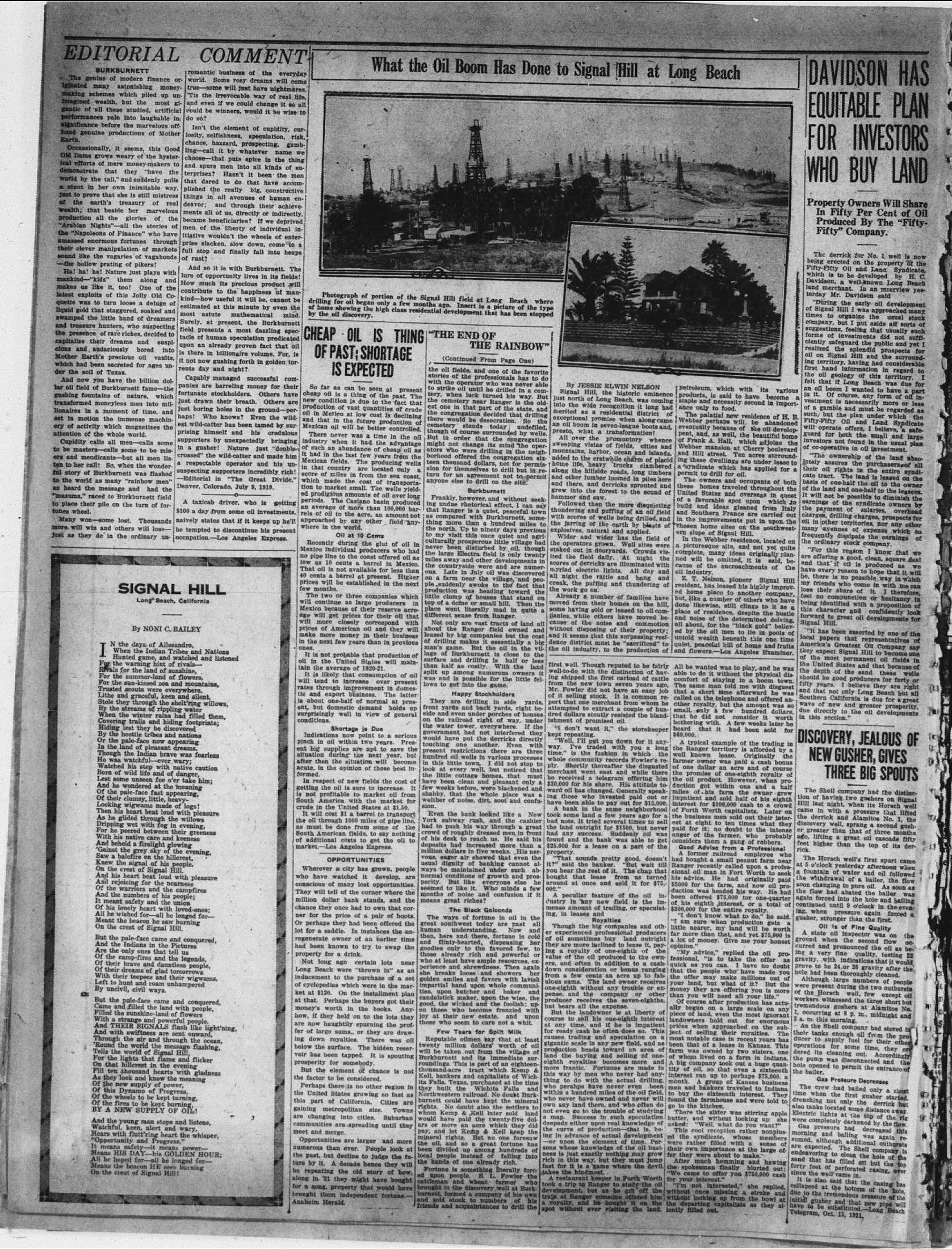
Searchable text
EDITORIAL COMMENT
BURKBURNETT
The genius of modern finance originated many astonishing money-making schemes which piled up unimagined wealth, but the most gigantic of all these studied, artificial performances pale into laughable insignificance before the marvelous off-hand genuine productions of Mother Earth.
Occasionally, it seems, this Good Old Dame grows weary of the hysterical efforts of mere money-makers to demonstrate that they "have the world by the tail," and suddenly pulls a stunt in her own inimitable way, just to prove that she is still mistress of the earth's treasury of real wealth; that beside her marvelous production all the glories of the "Arabian Nights"—all the stories of the "Napoleons of Finance" who have amassed enormous fortunes through their clever manipulation of markets sound like the vagaries of vagabonds—the hollow prating of pikers!
Ha! ha! ha! Nature just plays with mankind—"kids" them along and makes us like it, too! One of the latest exploits of this Jolly Old Coquette was to turn loose a deluge of liquid gold that staggered, soaked and swamped the little band of dreamers and treasure hunters, who suspecting the presence of rare riches, decided to capitalize their dreams and suspicions and audaciously bored into Mother Earth's precious oil vaults, which had been secreted for ages under the soil of Texas.
And now you have the billion dollar oil field of Burkburnett fame—the gushing fountains of nature, which transformed moneyless men into millionaires in a moment of time, and set in motion the immense machinery of activity which magnetizes the attention of the whole world.
Capidity calls all men—calls some to be masters—calls some to be misers and mendicants—but all men listen to her call! So when the wonder-romantic business of the everyday world. Some rosy dreams will come true—some will just have nightmares. 'Tis the irrevocable way of real life, and even if we could change it so all could be winners, would it be wise to do so?
Isn't the element of cupidity, curiosity, selfishness, speculation, risk, chance, hazzard, prospecting, gambling—call it by whatever name we choose—that puts spice in the thing and spurs men into all kinds of enterprises? Hasn't it been the men that dared to do that have accomplished the really big, constructive things in all avenues of human endeavor; and through their achievements all of us, directly or indirectly, became beneficiaries? If we deprived men of the liberty of individual initiative wouldn't the wheels of enterprise slacken, slow down, come to a full stop and finally fall into heaps of rust?
And so it is with Burkburnett. The lure of opportunity lives in its fields! How much its precious product will contribute to the happiness of mankind—how useful it will be, cannot be estimated at this minute by even the most astute mathematical mind. Surely, at present, the Burkburnett field presents a most dazzling spectacle of human speculation predicated upon an already proven fact that oil is there in billionaire volume. For, is it not now gushing forth in golden torrents day and night?
Capably managed successful companies are barreling money for their fortunate stockholders. Others have just drawn their breath. Others are just boring holes in the ground—perhaps! Who knows? Even the wildest wild-catter has been tamed by surprising himself and his credulous supporters by unexpectedly bringing in a gusher! Nature just "double-crossed" the wild-catter and made him a respectable operator and his unrestrained business of the everyday world. Some rosy dreams will come true—some will just have nightmares. 'Tis the irrevocable way of real life, and even if we could change it so all could be winners, would it be wise to do so?
So far as can cheap oil is a thief new condition is production of vanilla oil in Mexico at and in the Mexican oil will there never wander when it had such an abundance had in the last Mexican fields.
SIGNAL HILL
Long Beach, California
By NONI C. BAILEY
In the days of Allesandro,
When the Indian Tribes and Nations
Hunted game, and watched and listened
For the warning hint of rivals—
Rivals for the land of sunshine,
For the summer-land of flowers.
For the sun-kissed sea and mountains,
Trusted scouts were everywhere.
Lithe and graceful, keen and silent,
Stole they through the shelt'ring willows,
By the streams of rippling water
When the winter rains had filled them,
Covering trails and hiding footprints;
Hiding lest they be discovered
By the hostile tribes and nations
Or the pale-face now appearing
In the land of pleasant dreams.
Though the Indian brave was fearless
He was watchful—ever wary;
Watched his step with native caution
Born of wild life and of danger,
Lest some unseen foe o'er take him;
And he wondered at the meaning
Of the pale-face fast appearing,
Of their clumsy, little, heavyLooking wigwams made of logs!
Then his heart beat loud with pleasure
As he glided through the willows
Dripping wet with fog in evening,
For he peered between their greenness
With his native care and keenness
And behold a firelight glowing
'Gainst the grey sky of the evening,
Saw a balefire on the hillcrest,
Knew the signal of his people.
On the crest of Signal Hill.
And his heart beat loud with pleasure
And rejoicing for the moment.
Capably managed successful companies are barreling money for their fortunate stockholders. Others have just drawn their breath. Others are just boring holes in the ground—perhaps! Who knows? Even the wildest wild-catter has been tamed by surprising himself and his credulous supporters by unexpectedly bringing in a gusher! Nature just "double-crossed" the wild-catter and made him a respectable operator and his unsuspecting supporters incredibly rich!
—Editorial in "The Great Divide," Denver, Colorado, July 9, 1919.
A taxicab driver, who is getting $100 a day from some oil investments, naively states that if it keeps up he'll be tempted to discontinue his present occupation.—Los Angeles Express.
So far as can be cheap oil is a thin new condition is production of vapour oil in Merico at and that in the Mexican oil will there never win industry when it is of such an abundance it had in the last Mexican fields. In that country score of miles in which made the town market more ad殖igious amber periods. The Carte an average of m ore rels of oil to the approached by any where in the world.
Oil at Recently during Mexico individual no pipe line to the low as 10 cents That oil is not avail 40 cents a barrel prices will be est few months.
The two or three will continue as Mexico because of age will get price will more close prices of America make more money in the next few years.
It is not probable oil in the Unitedtain the average o It is likely that will tend to increase rates through impatience and export bu is about one-half ent, but domestic surprisingly well conditions.
Shortage Indications now pinch in oil within big supplies a situation during t after then the situ acute, in the opinio formed.
In respect of new getting the oil is s is not profitable to South America wi crude in the United It will cost $1 a the oil through 1000 as must be done South American fi eld of additional costs market.—Los Angels.
And he wondered at the meaning
Of the pale-face fast appearing,
Of their clumsy, little, heavyLooking wigwams made of logs!
Then his heart beat loud with pleasure
As he glided through the willows
Dripping wet with fog in evening,
For he peered between their greenness
With his native care and keenness
And beheld a firelight glowing
'Gainst the grey sky of the evening,
Saw a balefire on the hillcrest,
Knew the signal of his people,
On the crest of Signal Hill.
And his heart beat loud with pleasure
And rejoicing for the nearness
Of the warriors and the campfires
And the numbers of his people;
It meant safety and the union
Of his lonely heart with loved-ones;
All he wished for—all he longed for—
Meant the beacon he saw burning
On the crest of Signal Hill.
But the pale-face came and conquered,
And the Indians in the Pictures
Are the only ones that tell us
Of the camp-fires and the legends,
Of their brave and dauntless people,
Of their dreams of glad tomorrows
With their teepees and their wigwams,
Left to hunt and roam unhampered
By uncivil, civil ways.
But the pale-face came and conquered,
Came and filled the land with people,
Filled the sunshine-land of flowers
With a strange and powerful people.
And THEIR SIGNALS flash like light'ning,
And with swiftness are sent onward,
Through the air and through the ocean,
'Round the world the message flashing,
Tells the world of Signal Hill.
For the lights that flame and flicker
On that hillcrest in the evening
Fill ten thousand hearts with gladness
As they look and know the meaning
Of the new supply of power,
Of this Dynamo of Progress,
Of the wheels to be kept turning,
Of the fires to be kept burning,
BY A NEW SUPPLY OF OIL!
And the young man stops and listens,
Watchful, keen, alert and wary,
Hears with flutt'ring heart the whisper,
"Opportunity and Progress."
It means safety—it means power—
Means HIS DAY—his GOLDEN HOUR;
All he hoped for—all he longed for—
Means the beacon HE sees burning
On the crest of Signal Hill!
What the Oil Boom Has Done to Signal Hill at Long Beach
Photograph of portion of the Signal Hill field at Long Beach where drilling for oil began only a few months ago. Insert is a picture of the type of home showing the high class residential development that has been stopped by the oil discovery.
CHEAP · OIL IS THING OF PAST; SHORTAGE IS EXPECTED
So far as can be seen at present cheap oil is a thing of the past. The new condition is due to the fact that production of vast quantities of crude oil in Mexico at low cost is declining and that in the future production of Mexican oil will be better controlled.
There never was a time in the oil industry when it had the advantage of such an abundance of cheap oil as it had in the last few years from the Mexican fields. The producing wells
"THE END OF THE RAINBOW"
(Continued From Page One)
the oil fields, and one of the favorite stories of the professionals has to do with the operator who was never able to strike oil until he drilled in a cemetery, when luck turned his way. But the cemetery near Ranger is the oldest one in that part of the state, and the congregation decided that drilling there would be desecration. So the cemetery stands today undefiled, though of course surrounded by wells.
But in order that the congregation might not change its mind the operators who were drilling in the neighborhood offered the congregation sixteen thousand dollars, not for permits.
By JESSIE ELWIN NELSON
Signal Hill, the historic eminence just north of Long Beach, was coming into the wide recognition it long had merited as a residential district of exceptional promise when along came an oil boom in seven-league boots and, presto, what a transformation!
All over the promontory whence sweeping vistas of fields, cities and mountains, harbor, ocean and islands, added to the erstwhile charm of placid home life, heavy trucks clogged
So far as can be seen at present cheap oil is a thing of the past. The new condition is due to the fact that production of vast quantities of crude oil in Mexico at low cost is declining and that in the future production of Mexican oil will be better controlled.
There never was a time in the oil industry when it had the advantage of such an abundance of cheap oil as it had in the last few years from the Mexican fields. The producing wells in that country are located only a score of miles in from the sea coast, which made the cost of transportation to market small. The wells yielded prodigious amounts of oil over long periods. The Casiano basin produced an average of more than 100,000 barrels of oil to the acre, an amount not approached by any other field anywhere in the world.
Oil at 10 Cents
Recently during the glut of oil in Mexico individual producers who had no pipe line to the coast offered oil as low as 10 cents a barrel in Mexico. That oil is not available for less than 40 cents a barrel at present. Higher prices will be established in the next few months.
The two or three companies which will continue as large producers in Mexico because of their reserve acreage will get prices for their oil that will more closely correspond with prices of American oil and they will make more money in their business in the next few years than in previous ones.
It is not probable that production of oil in the United States will maintain the average of 1920-21.
It is likely that consumption of oil will tend to increase over present rates through improvement in domestic and export business. The latter is about one-half of normal at present, but domestic demand holds up surprisingly well in view of general conditions.
Shortage is Due
Indications now point to a serious pinch in oil within two years. Present big supplies are apt to save the situation during the next year, but after then the situation will become acute, in the opinion of those best informed.
In respect of new fields the cost of getting the oil is sure to increase. It is not profitable to market oil from South America with the market for crude in the United States at $1.50.
It will cost $1 a barrel to transport the oil through 1000 miles of pipe line, as must be done from some of the South American fields, to say nothing of additional costs to get the oil to market—Los Angeles Express.
OPPORTUNITIES
Wherever a city has grown, people who have watched it develop, are so far as can be seen at present cheap oil is a thing of the past. The new condition is due to the fact that production of vast quantities of crude oil in Mexico at low cost is declining and that in the future production of Mexican oil will be better controlled.
There never was a time in the oil industry when it had the advantage of such an abundance of cheap oil as it had in the last few years from the Mexican fields. The producing wells in that country are located only a score of miles in from the sea coast, which made the cost of transportation to market small. The wells yielded prodigious amounts of oil over long periods. The Casiano basin produced an average of more than 100,000 barrels of油 to the acre, an amount not approached by any other field anywhere in the world.
Oil at 10 Cents
Recently during the glut of oil in Mexico individual producers who had no pipe line to the coast offered oil as low as 10 cents a barrel in Mexico. That oil is not available for less than 40 cents a barrel at present. Higher prices will be established in the next few months.
The two or three companies which will continue as large producers in Mexico because of their reserve acreage will get prices for their oil that will more closely correspond with prices of American oil and they will make more money in their business in the next few years than in previous ones.
It is not probable that production of oil in the United States will maintain the average of 1920-21.
It is likely that consumption of oil will tend to increase over present rates through improvement in domestic and export business. The latter is about one-half of normal at present, but domestic demand holds up surprisingly well in view of general conditions.
Shortage is Due
Indications now point to a serious pinch in oil within two years. Present big supplies are apt to save the situation during the next year, but after then the situation will become acute, in the opinion of those best informed.
In respect of new fields the cost of getting the oil is sure to increase. It is not profitable to market oil from South America with the market for crude in the United States at $1.50.
It will cost $1 a barrel to transport the oil through 1000 miles of pipe line, as must be done from some of the South American fields, to say nothing of additional costs to get the oil to market—Los Angeles Express.
OPPORTUNITIES
Wherever a city has grown, people who have watched it develop, are so far as can be seen at present cheap oil is a thing of the past. The new condition is due to the fact that production of vast quantities of crude oil in Mexico at low cost is declining and that in the future production of Mexican oil will be better controlled.
There never was a time in the oil industry when it had the advantage of such an abundance of cheap油 as it had in the last few years from the Mexican fields. The producing wells in that country are located only a score of miles in from the sea coast, which made the cost of transportation to market small. The wells yielded prodigious amounts of油 over long periods. The Casiano basin produced an average of more than 100,000 barrels of油 to the acre, an amount not approached by any other field anywhere in the world.
Oil at 10 Cents
Recently during the glut of oil in Mexico individual producers who had no pipe line to the coast offered油 as low as 10 cents a barrel in Mexico. That oil is not available for less than 40 cents a barrel at present. Higher prices will be established in the next few months.
The two or three companies which will continue as large producers in Mexico because of their reserve acreage will get prices for their oil that will more closely correspond with prices of American油 and they will make more money in their business in the next few years than in previous ones.
It is not probable that production of oil in the United States will maintain the average of 1920-21.
It is likely that consumption of油 will tend to increase over present rates through improvement in domestic and export business. The latter is about one-half of normal at present, but domestic demand holds up surprisingly well in view of general conditions.
Shortage is Due
Indications now point to a serious pinch in油 within two years. Present big supplies are apt to save the situation during the next year, but after then the situation will become acute, in the opinion of those best informed.
In respect of new fields the cost of getting the油 is sure to increase. It is not profitable to market油 from South America with the market for crude in the United States at $1.50.
It will cost $1 a barrel to transport the油 through 1000 miles of pipe line, as must be done from some of the South American fields, to say nothing of additional costs to get the油 to market—Los Angeles Express.
OPPORTUNITIES
Wherever a city has grown, people who have watched it develop, are so far as can be seen at present cheap油 is a thing of the past. The new condition is due to the fact that production of vast quantities of crude油在墨西哥at low cost是 declining和that在未来几年时就会出现异常的情况。
There never was a time in the oil industry when it had the advantage of such an abundance of cheap油 as it had in the last few years from the Mexican fields. The producing wells in that country are located only a score of miles in from the sea coast, which made the cost of transportation to market small. The wells yielded prodigious amounts of油 over long periods. The Casiano basin produced an average of more than 100,000 barrels of油至墨西哥at low cost是 declining和that在未来几年时就会出现异常的情况。
There never was a time in the oil industry when it had the advantage of such an abundance of cheap油 as it had in the last few years from the Mexican fields. The producing wells in that country are located only a score of miles in from the sea coast, which made the cost of transportation to market small. The wells yielded prodigious amounts of油 over long periods. The Casiano basin produced an average of more than 100,000 barrels OF油至墨西哥at low cost是 declining和that在未来几年时就会出现异常的情况。
There never was a time in the oil industry when it had the advantage of such an abundance of cheap油 as it had in the last few years fromthe Mexican fields. The producing wells in that country are located only a score of miles in fromthe sea coast, which made the cost of transportation to market small. The wells yielded prodigious amounts of油 over long periods. The Casiano basin produced an averageof more than 100,000 barrels OF油至墨西哥at low cost是 declining和that在未来几年时就会出现异常的情况。
There never was a time in the oil industry when it hadthe advantageofsuchanabundanceofcheapoilasithemainconditionoftheprofessionalshastodowiththeoperatorwhowannerechangedhilitemisstheoldestoneinthatpartofthestate,andthecongregationdecidedthattrainingtherewouldbedesecration.Sothecemeterystandstodayundefiled,thoughofcoursesurroundedbywells.Butinorderthatthecongregationmightnotchangeitsmindtheoperatorswhoweredrillingintheneighbourhoodoffoundedthecongregation sixteen thousand dollars,notforpermissionforthemselvestodrillbutinreturnforanagreementnottopermitanyoneelsetodrillonthesite.
Burkburnett
Frankly,however,andwithoutseekingundue rhetorical effect,iCan saythatRangerisaisquiet,tpeaculturallyprosperouslittlevillagehadneverbe disturbedbyoil,thoughthelargeElectrafieldisonlytwentymilesawayandotherdevelopmentsinthe countrysidewereandarenumerous.LateinJulyoilwasdiscoveredonafarmnearthevillage,andpeople,suddenlyawoketothefactthatproductionwouldheadtowardthelittleclumpofhousesthatstandontopofa domeorsmall hill.TheplacewentliterallymadinquitedifferentsensefromRanger.
Notonlyarevast tractsoflandallabouttheRangerfieldownedandleasedbybigcompaniesbutthecostofdrillingmakeitessentiallyabigman'sgame.ButtheoilinthevillageofBurkburnettisclosetothesurfaceanddrillingishalforlessthanhalfascostly.Withthelandsplitupamongnumerousownersitwasandispossibleforthefittlefelowstogetintothegame.
Happy Stockholders
Theyaredrillinginsideyardsfrontyardsandbackyardsrightbesideandevenunderporchesofhousesontherailroadrightofway,underthewater塔,everywhere.InIf政府hadnotinterferedtheywouldhaveputthederricksdirecttouchingone another.Evenwithpresentrestrictionstherearethreehundredoilwellsinvariousprocessesinthis little town.I didnotstoplookateverywell,butnoticedthatthelittlecottagehomes,musthavebeencleanandpleasantonlya fewweeksbefore,wereblackenedandshabby,thewholeplacewasawelderofnoise,dirt,sootandconfusion.
EventhebanklookedlikeANewYorksubwayrush,andthecashierhadtopushhiswaythrougha great crowdofroughlydressedmeninfrontofhis desktoreachus.Hew saidhisdepositshadincreasedmorethanamilliondollarsinhive weeks.Hisnervous,eagerairshowedthateventheusual dignityofbank cannotalwaysbemaintainedundersuch abnormalconditionsofgrowthandprosperity.Butlikelyeveryoneelsehefoundbeenabletopayoutfor$15,000.Abankinthesame neighborhood tooksome landa fewyearsagoforabadnote.Itriedseveraltimestosellthelandoutrightfor$1500,但neverhadanysuccess.Suddenlyoliverwassoundandfoundandearnedpayoutfor$15,000.Abankinthesame neighborhood tooksome landa fewyearsagoforabadnote.Itriedseveraltimestosellthelandoutrightfor$1500,但neverhadanysuccess.Suddenlyoliverwassoundandfoundandearnedpayoutfor$15,000.Abankinthesame neighborhood tooksome landa fewyearsagoforabadnote.Itriedseveraltimestosellthelandoutrightfor$1500,但neverhadanysuccess.Suddenlyoliverwassoundandfoundandearnedpayoutfor$15,000.Abankinthesame neighborhood tooksome landa fewyearsagoforabadnote.Itriedseveraltimestosellthelandoutrightfor$15
getting the oil is sure to increase. It is not profitable to market oil from South America with the market for crude in the United States at $1.50.
It will cost $1 a barrel to transport the oil through 1000 miles of pipe line, as must be done from some of the South American fields, to say nothing of additional costs to get the oil to market.—Los Angeles Express.
OPPORTUNITIES
Wherever a city has grown, people who have watched it develop, are conscious of many lost opportunities. They will tell of the corner where the million dollar bank stands, and the chance they once had to own that corner for the price of a pair of boots. Or perhaps they had been offered the lot for a saddle. In instances the unregenerate owner of an earlier time had been known to try to swap the property for a drink.
Not long ago certain lots near Long Beach were "thrown in" as an inducement to the purchase of a set of cyclopedias which were in the market at $120. On the installment plan at that. Perhaps the buyers got their money's worth in the books. Anyhow, if they held on to the lots they are now haughtily spurring the profer of large sums., or they are drawing down royalties. There was oil below the surface. The hidden reservoir has been tapped. It is spouting prosperity for somebody.
But the element of chance is not the factor to be considered.
Perhaps there is no other region in the United States growing so fast as this part of California. Cities are gaining metropolitan size. Towns are changing into cities. Suburban communities are spreading until they meet and merge.
Opportunities are larger and more numerous than ever. People look at the past, but decline to judge the future by it. A decade hence they will be repeating the old story of how, along in '21 they might have bought for a song, property that would have brought them independent fortune.—Anaheim Herald.
The Black Golconda
The ways of fortune in oil in the great southwest today are past all human understanding. Now and then, here and there, fortune is cold and flinty-hearted, dispensing her goodies only to the favored few, to those already rich and powerful or who at least have ample resources, experience and shrewdness. Then again she breaks loose and showers her golden smiles and favors with lavish impartial hand upon whole communities, upon butcher and baker and candelstick maker, upon the wise, the good, the wicked and the foolish; upon those who become frenzied with joy at their new estate, and upon those who seem to care not a whit.
Few Tears for Split Milk
Reputable olmene say that at least twenty million dollars' worth of oil will be taken out from the village of Burkburnett and its immediate surroundings. This is part of an eighteen thousand-acre tract which Kemp & Kell, bankers and capitalists of Wichita Falls, Texas, purchased at the time they built the Wichita Falls and Northwestern railroad. No doubt Burkburnett could have kept the mineral rights. No doubt also the settlers to whom Kemp & Kell later sold land would have paid the twenty-five dollars or more an acre which they did pay, and let Kemp & Kell keep the mineral rights. But no one foresaw the oil, and so a great fortune has been divided up among hundreds of local people instead of falling into the hands of one already rich.
Fortune is something literally forced upon people. S. L. Fowler the cattleman and wheat farmer who brought in the discovery well at Burkburnett, formed a company of his own and sold stock to numbers of his friends and acquaintances to drill the few weeks before, were blackened and shabby, that the whole place was a welter of noise, dirt, soot and confusion.
Even the bank looked like a New York subway rush, and the cashier had to push his way through a great crowd of roughly dressed men in front of his desk to reach us. He said his deposits had increased more than a million dollars in five weeks. His nervous, eager air showed that even the usual dignity of banking cannot always be maintained under such abnormal conditions of growth and prosperity. But like everyone else he seemed to like it. Who minds a few months of noise and confusion if it means great riches?
Royalties
Though the big companies and other experienced professional producers of oil sometimes buy land outright they are more inclined to lease it, paying a royalty one-eighth of the value of the oil produced to the owners, and often in addition to a cash-down consideration or bonus ranging from a few cents an acre up to fabulous sums. The land owner receives one-eighth without any trouble or expense, and the company or other producer receives the seven-eighths, but bears all the expense.
But the landowner is at liberty of course to sell his one-eighth interest at any time, and if he is impatient for ready cash he often does so. This causes trading and speculation on a gigantic scale in any new field, and as production heads toward an area of land the buying and selling of one-eighth royalties becomes more and more frantic. Fortunes are made in this way by men who never had anything to do with the actual drilling, who perhaps have never even been within a hundred miles of the oil field, who never have owned and never will own any land there, and who often do not even go to the trouble of studying a map. Success in such speculation deepens either upon real knowledge of the curve of production—that is, being in advance of actual development—or upon the element of time. Persons whose knowledge of the oil business is just exactly nothing may grow rich in this way, but they must jump fast for it is a game where the devil takes the hindmost.
A restaurant keeper in Forth Worth took a trip to Ranger to study the oil development, but as he got off the train at Ranger someone offered him a royalty, and he bought it on the spot without ever visiting the land.
DAVIDSON HAS EQUITABLE PLAN FOR INVESTORS WHO BUY LAND
Property Owners Will Share In Fifty Per Cent of Oil Produced By The "Fifty-Fifty" Company.
The derrick for No. 1 well is now being erected on the property of the Fifty-Fifty Oil and Land Syndicate, which is to be developed by H. C. Davidson, a well-known Long Beach land merchant. In an interview yesterday Mr. Davidson said:
"During the early oil development of Signal Hill I was approached many times to organize the usual stock company, but I put aside all sorts of suggestions, feeling that usually such forms of investments did not sufficiently safeguard the public and yet I realized the splendid prospects for oil on Signal Hill and the surrounding territory, having had considerable first hand information in regard to the oil geology of this territory. I felt that if Long Beach was due for an oil boom I wanted to have a part in it. Of course, any form of oil investment is necessarily more or less of a gamble and must be regarded as such, but the plan under which the Fifty-Fifty Oil and Land Syndicate will operate offers, I believe, a safeguard for both the small and large investors not found in the usual plan of co-operative in oil investment."
"The ownership of the land absolutely assures the purchasers of all
THE ELWIN NELSON
the historic eminence Long Beach, was coming to recognition it long had residential district of promise when along came seven-league boots and a transformation!
The promontory whence of fields, cities and harbor, ocean and islands, firstwhile charm of placid heavy trucks clambered side roads, long timbers be loomed in piles here derricks sprouted and forest to the sound of law.
The more disquieting puffing of an oil field wells being drilled, and the earth by blasts of natural and applied.
Wider has the field of grown. Well sites were moorings. Crowds visually. At night the rocks are illuminated with lights. All day and straddle and bang and firing and thundering of number of families have their homes on the hill, old or leased to oil companies have moved be noise and commotion of their property; that this surpassing resilient must be "sacrificed" to try, to the production of high reputed to be fairly the distinction of hav- first carload of cattle town seven years ago, not have an easy job stock. It is common reerchant from whom he extract a couple of hun- nutly resisted the bland-mised oil.
It it," the storekeeper you down for it any-died with you a long fashion in which the fifty records Fowler's re-reereafter the disgusted east and while there telegram offering him share. His attitude to anger. Generally speak-invested paid out or pay out for $15,000. The same neighborhood a few years ago for a had several times to sell it for $1500, but never less. Suddenly oil was bank was able to get base on a part of the petroleum, which with its various products, is said to have become a staple and necessity second in importance only to food.
The palatial new residence of H. B. Webber perhaps will be abandoned eventually because of the oil development, and, as well, the beautiful home of Frank A. Hall, which adjoins the Webber mansion at Cherry boulevard and Hill street. Ten acres surrounding these dwellings are under lease to a syndicate which has applied for a permit to drill for oil.
The owners and occupants of both these homes traveled throughout the United States and overseas in quest of a favorable spot upon which two build and ideas gleaned from Italy and Southern France are carried out in the improvements put in upon the chosen home sites on the southwestern slope of Signal Hill.
In the Webber residence, located on a picturesque site, and not yet quite complete, many ideas originally planned will be omitted, it is said, because of the encroachments of the oil industry.
Z. T. Nelson, pioneer Signal Hill resident, has leased his highly improved home place to another company, but, like a number of others who have done likewise, still clings to it as a place of residence, despite the bustle and noise of the determined delving, all about, for the "black gold" believed by the oil men to lie in pools of untold wealth beneath this one time quiet, peaceful hill of home and fruits and flowers.-Los Angeles Examiner.
All he wanted was to play, and he was able to do it without the physical discomfort of staying in a boom town. The same man told me with disgust that a short time afterward he was called on the telephone and offered another royalty, but the amount was so small, only a few hundred dollars, that he did not consider it worth bothering with. A few weeks later he heard that it had been sold for $69,000.
A typical example of the trading in the Ranger territory is afforded by a well known lease. Originally the farmer owner was paid a cash bonus of one dollar an acre and of course the promise of one-eighth royalty of the oil product. However, when production got within one and a half miles of his farm the owner grew impatient and sold half of his eighth interest for $100,000 cash to a crowd of Fort Worth capitalists. Later on the business men sold out their interest at eight to ten times what they paid for it; no doubt to the intense anger of the farmer, who probably considers them a gang of robbers.
Good Advise from a Professional
A former railroad employee who had bought a small peanut farm near Ranger recently called upon a professional oil man in Fort Worth to seek his advice. He had originally paid first hand information in regard to the oil geology of this territory. I felt that if Long Beach was due for an oil boom I wanted to have a part in it. Of course, any form of oil investment is necessarily more or less of a gamble and must be regarded as such, but the plan under which the Fifty-Fifty Oil and Land Syndicate will operate offers, I believe, a safeguard for both the small and large investors not found in the usual plan of co-operative in oil investment.
"The ownership of the land absolutely assures the purchasers of all their oil rights in the entire syndicate tract. The land is leased on the basis of one-half the油 to the owner of the land and one-half to the leases. It will not be possible to diminish the earnings of the syndicate owners by the payment of salaries, overhead charges, drilling charges, prospects for oil in other territories, nor any other many avenues of expense which so frequently dissipate the earnings of the ordinary stock company.
"For this reason I know that we are offering a good, clean, square deal and that if oil is produced as we have every reason to hope that it will be, there is no possible way in which my friends who come in with me can lose their share of it. I therefore feel no compunction or hesitancy in being identified with a proposition of this character and confidently look forward to great oil developments for Signal Hill.
"It has been asserted by one of the local papers that representatives of America's Greatest Oil Company say they expect Signal Hill to become one of the most permanent oil fields in the United States and that because of the depth of the sand these wells should be good producers for forty or fifty years. I believe they are right and that not only Long Beach but all Southern California is due for a great wave of new and greater prosperity, due directly to the oil developments in this section."
DISCOVERY, JEALOUS OF NEW GUSHER, GIVES THREE BIG SPOUTS
The Shell company had the distinction of having two gushers on Signal Hill last night, when its Horsch well came in with a pressure that lifted the derrick and Alamitos No. 1, the discovery well, springing a second gusher greater than that of three months ago, lifting a great oil cascade fifty feet higher than the top of its derrick.
The Horsch well's first spurt came at 5 o'clock yesterday afternoon when a fountain of water and oil followed the withdrawal of a bailer, the flow
His attitude to management. Generally speak-invested paid out or to pay out for $15,000. The same neighborhood a few years ago for a several times to sell it for $1500, but never bank was able to get lease on a part of the pretty good, doesn't tanker. "But wait till it of it. The chap that came from us turned and sold it for $75."
Feature of the oil in new field is the im-ment of trading, or speculat-land royalties.
Big companies and other professional producers buy land outright declined to lease it, pay-of one-eighth of the produced to the own addition to a cash-cash or bonus ranging an acre up to fab-lice land owner receives any trouble or ex-cess company or other issues the seven-eighths, its expense.
Owner is at liberty of his one-eighth interest and if he is impatient often does so. This and speculation on a new field, and as toward an area of selling of one-becomes more and shortages are made in who never had any-thing may grow ever even been miles of the oil field. Owned and never will there, and who often do the trouble of studying in such speculation on real knowledge of production—that is, be-ef actual development element of time. Per-ledge of the oil busi-ly nothing may grow but they must jump name where the devil stalker in Forth Worth to study the oil as he got off the someone offered him he bought it on our visiting the land.
The production got within one and a half miles of his farm the owner grew impatient and sold half of his eighth interest for $100,000 cash to a crowd of Forth Worth capitalists. Later on the business men sold their interest at eight to ten times what they paid for it; no doubt to the intense anger of the farmer, who probably considers them a gang of robbers.
Good Advise from a Professional
A former railroad employee who had bought a small peanut farm near Ranger recently called upon a professional oil man in Fort Worth to seek his advice. He had originally paid $5000 for the farm, and now oil production was headed his way. He had been offered $75,000 to one-quarter of his eighth interest, or a total of $300,000 for the entire royalty.
"I don't know what to do," he said. "I am sure when production gets a little nearer, my land will be worth far more than that, and yet $75,000 is a lot of money. Give me your honest opinion."
"My advice," replied the oil professional, "is to take the offer as quick as you can. I have no doubt that the people who have made you the offer may make millions out of your land, but what of it? But the money they are offering you is more than you will need all your life."
Of course after production has actually begun on a large scale on any piece of land, even the most ignorant landowners hold out for enormous prices when approached on the subject of selling their royalties. The most notable case in recent years has been that of a lease in Kansas. This farm was owned by two sisters, one of whom lived on a farm in Indiana. A big company took out a huge quantity of oil, so that even a sixteenth interest ran up to perhaps $75,000, a month. A group of Kansas business men and bankers traveled to Indiana to buy the sixteenth interest. They found the farmhouse and were told to go to the kitchen.
There the sister was stirring apple butter, and without looking up she asked: "Well, what do you want?"
This cool reception rather nonplussed the syndicate, whose members were rather filled with a sense of their own importance at the large offer they were about to make.
After much hemming and hawing the spokesman finally blurted out: "We came to offer you $750,000 cash for your interest."
"I'm not interested," she replied, without once missing a stroke and without looking up from the bowl at the departing capitalists as they silently filled out.
The Shell company had the distinction of having two gushers on Signal Hill last night, when its Horsch well came in with a pressure that lifted the derrick and Alamitos No. 1, the discovery well, sprang a second gusher greater than that of three months ago, lifting a great oil cascade fifty feet higher than the top of its derrick.
The Horsch well's first spurt came at 5 o'clock yesterday afternoon when a fountain of water and oil followed the withdrawal of a bailer, the flow soon changing to pure oil. As soon as the flow had abated the bailer was again forced into the hole and balling continued until 9 o'clock in the evening, when pressure again forced a gusher stronger than the first.
Oil is of Fine Quality
A state oil inspector was on the ground when the second flow occurred and pronounced the oil as being a very fine quality, testing 22 gravity, with indications that it would prove to be 24 or 25 gravity after the hole had been thoroughly cleaned.
Although large numbers of people were present during the two outbursts of the Horsch well, few except oil workers witnessed the three short but tremendous gushers at Alamitos No. 1, occurring at 8 p.m., midnight and 3 a.m. this morning.
As the Shell company had stored in their tanks enough oil from the producer to supply fuel for their other operations for some time, they ordered its cleaning out. Accordingly the pump was disconnected and the hole opened to permit the entrance of the bailer.
Gas Pressure Decreases
The crew had bailed only a short time when the first gusher started. drenching not only the derrick but also tanks located some distance away. Electric lights at the top of the rig were completely darkened by the flow.
Gas pressure had decreased this morning and bailing was again resumed, although additional outbursts are expected. The Shell company is endeavoring to clean the hole of the sand that has filled air but the top forty feet of perforated casing, ever since the well came in.
It is also said that the casing has collapsed at the bottom of the hole due to the tremendous pressure of the initial gusher and that new pipe will have to be substituted—Long Beach Telegram, Oct. 15, 1921.