anaheim-bulletin 1959-05-01
Scanned page
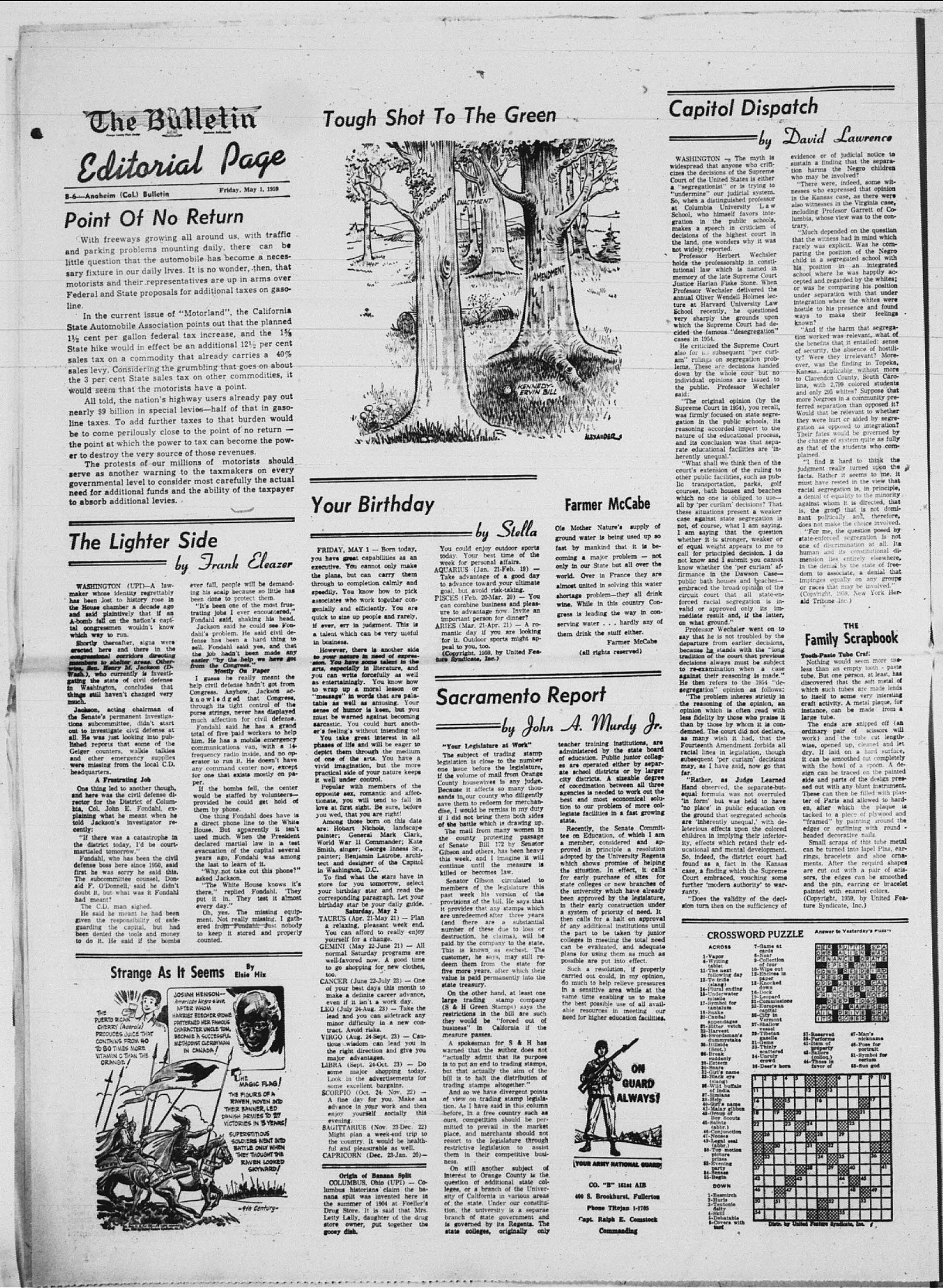
Searchable text
The Bulletin
Editorial Page
B-6—Anaheim (Col.) Bulletin Friday, May 1, 1959
Point Of No Return
With freeways growing all around us, with traffic and parking problems mounting daily, there can be little question that the automobile has become a necessary fixture in our daily lives. It is no wonder, then, that motorists and their representatives are up in arms over Federal and State proposals for additional taxes on gasoline.
In the current issue of "Motorland", the California State Automobile Association points out that the planned 1½ cent per gallon federal tax increase, and the 1⅛ State hike would in effect be an additional 12½ per cent sales tax on a commodity that already carries a 40% sales levy. Considering the grumbling that goes on about the 3 per cent State sales tax on other commodities, it would seem that the motorists have a point.
All told, the nation's highway users already pay out nearly $9 billion in special levies—half of that in gasoline taxes. To add further taxes to that burden would be to come perilously close to the point of no return—the point at which the power to tax can become the power to destroy the very source of those revenues.
The protests of our millions of motorists should serve as another warning to the taxpayers on every level to consider most carefully the actual
The Lighter Side
by Frank Eleazer
WASHINGTON (UPI)—A lawmaker whose identity regrettably has been lost to history rose in the House chamber a decade ago and said plaintively that if an A-bomb fell on the nation's capital congressmen wouldn't know which way to run.
Shortly thereafter, signs were erected here and there in the congressional corridors directing members to shelter areas. Otherwise, Ben. Henry M. Jackson (D-Wash.), who currently is investigating the state of civil defense in Washington, concludes that things still haven't changed very much.
Jackson, acting chairman of the Senate's permanent investigations subcommittee, didn't start out to investigate civil defense at all. He was just looking into published reports that some of the Gelger counters, walkie talkies and other emergency supplies were missing from the local C.D. headquarters.
A Frustrating Job
One thing led to another though, and here was the civil defense director for the District of Columbia, Col. John E. Fondahl, explaining what he meant when he told Jackson's investigator recently:
"If there was a catastrophe in the district today, I'd be court-martialed tomorrow."
Fondahl, who has been the civil defense boss here since 1950, said first he was sorry he said this. The subcommittee counsel, Donald F. O'Donnell, said he didn't doubt it, but what was it Fondahl had meant?
The C.D. man sighed.
ever fall, people will be demanding his scalp because so little has been done to protect them.
"It's been one of the most frustrating jobs I ever encountered," Fondahl said, shaking his head.
Jackson said he could see Fondahl's problem. He said civil defense has been a hard thing to sell. Fondahl said yes, and that the job hadn't been made any easier "by the help we have got from the Congress."
Mostly On Paper
I guess he really meant the help civil defense hadn't got from Congress. Anyhow, Jackson acknowledged that Congress, through its tight control of the purse strings, never has displayed much affection for civil defense.
Fondahl said he has a grand total of five paid workers to help him. He has a mobile emergency communications van, with a 14-frequency radio inside, and no operator to run it. He doesn't have any command center now, except for one that exists mostly on paper.
If the bombs fell, the center would be staffed by volunteers—provided he could get hold of them by phone.
One thing Fondahl does have is a direct phone line to the White House. But apparently it isn't used much. When the President declared martial law in a test evacuation of the capital several years ago, Fondahl was among the last to learn of it.
"Why not take out this phone?" asked Jackson.
"The White House knows it's there," replied Fondahl. They put it in. They test it almost every day."
"If there was a catastrophe in the district today, I'd be court-martialed tomorrow."
Fondahl, who has been the civil defense boss here since 1950, said first he was sorry he said this. The subcommittee counsel, Donald F. O'Donnell, said he didn't doubt it, but what was it Fondahl had meant?
The C.D. man sighed.
He said he meant he had been given the responsibility of safeguarding the capital, but had been denied the tools and money to do it. He said if the bombs
Strange As It Seems
By Elsie Hix
THE PUERTO RICO CHERRY (Acerola) PRODUCES JUICE THAT CONTAINS FROM 40 TO 80 TIMES MORE VITAMIN C THAN THE ORANGE!
JOSIAH HENSON--
American Nero slave,
AFTER WHOM
HARRIET BEECHER SOWE
PATTERNED HER FAMOUS CHARACTER UNCLE TOM,
BECAME A SUCCESSFUL METHODIST CLERGYMAN IN CANADA!
THE MAGIC FLAG!
THE FIGURE OF A RAVEN, NOVEN AND THEIR BANNER, LED DANISH ARMIES TO 27 VICTORIES IN 3 YEARS!
SUPERSTITIOUS SOLDIERS WENT INTO BATTLE ONLY WHEN THEY THOUGHT THE RAVEN LOOKED SKYWARD!
-9th Century-
Tough Shot To The Green
Your Birthday
FRIDAY, MAY 1 — Born today, you have great capabilities as an executive. You cannot only make the plans, but can carry them through to completion calmly and speedily. You know how to pick associates who work together congenially and efficiently. You are quick to size up people and rarely, if ever, err in judgment. This is a talent which can be very useful in business.
However, there is another side to your nature in need of expression. You have some talent in the arts, especially in literature, and you can write forcefully as well as entertainingly. You know how to wrap up a moral lesson or "message" in words that are palatable as well as amusing. Your sense of humor is keen, but you must be warned against becoming sarcastic. You could hurt another's feeling's without intending to!
You take great interest in all phases of life and will be eager to depict them through the medium of one of the arts. You have a vivid imagination, but the more practical side of your nature keeps it well under control.
Popular with members of the opposite sex, romantic and affectionate, you will tend to fall in love at first sight. Be sure, before you wed, that you are right!
Among those born on this date are: Hobart Nichols, landscape painter; General Mark Clark, World War II Commander; Kate Smith, singer; George Inness Sr., painter; Benjamin Latrobe, architect and designer of the Capitol in Washington, D.C.
To find what the stars have in store for you tomorrow, select your birthday star and read the corresponding paragraph. Let your birthday star be your daily guide.
Farmer McCabe
You could enjoy outdoor sports today. Your best time of the week for personal affairs.
AQUARIUS (Jan. 21-Feb. 19) — Take advantage of a good day to advance toward your ultimate goal, but avoid risk-taking.
PISCES (Feb. 20-Mar. 20) — You can combine business and pleasure to advantage now. Invite an important person for dinner?
ARIES (Mar. 21-Apr. 21) — A romantic day if you are looking for it. Outdoor sports might appeal to you, too.
(Copyright, 1959, by United Feature Syndicate, Inc.)
Ole Mother Nature's supply of ground water is being used up so fast by mankind that it is becoming a major problem — not only in our State but all over the world. Over in France they are almost united in solving this water shortage problem—they all drink wine. While in this country Congress is leading the way in conserving water . . . hardly any of them drink the stuff either.
Farmer McCabe
(all rights reserved)
Sacramento Report
by John A. Murdy Jr.
"Your Legislature at Work"
The subject of trading stamp legislation is close to the number one issue before the legislature, if the volume of mail from Orange County housewives is any judge. Because it affects so many thousands in our county who diligently save them to redeem for merchandise, I would be remiss in my duty if I did not bring them both sides of the battle which is drawing up.
The mail from many women in the county protesting passage of Senate Bill 172 by Senator Gibson and others, has been heavy this week, and I imagine it will continue until the measure is killed or becomes law.
Senator Gibson circulated to members of the legislature this past week his version of the provisions of the bill. He says that it provides that any stamps which teacher training institutions, are administered by the state board of education. Public junior colleges are operated either by separate school districts or by larger city districts. A sizeable degree of coordination between all three agencies is needed to work out the best and most economical solution to our problem of more collegiate facilities in a fast growing state.
Recently, the Senate Committee on Education, of which I am a member, considered and approved in principle a resolution adopted by the University Regents which shows promise of helping the situation. In effect, it calls for early purchase of sites for state colleges or new branches of the university which have already been approved by the legislature, in their early construction under
Among those born on this date are: Hobart Nichols, landscape painter; General Mark Clark, World War II Commander; Kate Smith, singer; George Inness Sr., painter; Benjamin Latrobe, architect and designer of the Capitol in Washington, D.C.
To find what the stars have in store for you tomorrow, select your birthday star and read the corresponding paragraph. Let your birthday star be your daily guide.
Saturday, May 2
TAURUS (Apr. 21-May 21) — Plan a relaxing, pleasant week end. You can afford to really enjoy yourself for a change.
GEMINI (May 22-June 21) — All normal Saturday programs are well-favored now. A good time to go shopping for new clothes, too.
CANCER (June 22-July 23) — One of your best days this month to make a definite career advance, even if it isn't a work day.
LEO (July 24-Aug. 23) — Take the lead and you can sidetrack any minor difficulty in a new contract. Avoid risks.
VIRGO (Aug. 24-Sept. 23) — Cautious wisdom can lead you in the right direction and give you major advantages.
LIBRA (Sept. 24-Oct. 23) — Do some major shopping today. Look in the advertisements for some excellent bargains.
SCORPIO (Oct. 24-Nov. 22) — A fine day for you. Make an advance in your work and then enjoy yourself socially this evening.
SAGITTARIUS (Nov. 23-Dec. 22) Might plan a week-end trip to the country. It would be healthful and pleasurable as well.
CAPRICORN (Dec. 23-Jan. 20)
Origin of Banana Split
COLUMBUS, Ohio (UPI) — Columbus historians claim the banana split was invented here in the summer of 1904 at Foeller's Drug Store. It is said that Mrs. Letty Lally, daughter of the drug store owner, put together the goosey dish.
Senator Gibson circulated to members of the legislature this past week his version of the provisions of the bill. He says that it provides that any stamps which are unredeemed after three years (and there are a substantial number of these due to loss or destruction, he claims), will be paid by the company to the state. This is known as eschest. The customer, he says, may still redeem them from the state for five more years, after which their value is paid permanently into the state treasury.
On the other hand, at least one large trading stamp company (S & H Green Stamps) says the restrictions in the bill are such they would be "forced out of business" in California if the measure passes.
A spokesman for S & H has warned that the author does not "actually admit that its purpose is to put an end to trading stamps, but that actually the aim of the bill is to halt the distribution of trading stamps altogether."
And so we have divergent points of view on trading stamp legislation. As I have said in this column before, in a free country such as ours, competition should be permitted to prevail in the market place, and merchants should not resort to the legislature through restrictive legislation to assist them in their competitive business.
On still another subject of interest to Orange County is the question of additional state colleges, or a branch of the University of California in various areas of the state. Under our constitution, the university is a separate branch of state government and is governed by its Regents. The state colleges, originally only
Capitol Dispatch
by David Lawrence
WASHINGTON — The myth is widespread that anyone who criticizes the decisions of the Supreme Court of the United States is either a "segregationist" or is trying to "undermine" our judicial system. So, when a distinguished professor at Columbia University Law School, who himself favors integration in the public schools, makes a speech in criticism of decisions of the highest court in the land, one wonders why it was not widely reported.
Professor Herbert Wechsler holds the professorship in constitutional law which is named in memory of the late Supreme Court Justice Harlan Fiske Stone. When Professor Wechsler delivered the annual Oliver Wendell Holmes lecture at Harvard University Law School recently, he questioned very sharply the grounds upon which the Supreme Court had decided the famous "desegregation" cases in 1954.
He criticized the Supreme Court also for its subsequent "per curiam" rulings on segregation problems. These are decisions handed down by the whole court but no individual opinions are issued to the public. Professor Wechsler said:
"The original opinion (by the Supreme Court in 1954), you recall, was firmly focused on state segregation in the public schools, its reasoning accorded import to the nature of the educational process, and its conclusion was that separate educational facilities are inherently unequal."
"What shall we think then of the court's extension of the ruling to other public facilities, such as pub-evidence or of judicial notice to sustain a finding that the separation harms the Negro children who may be involved?
"There were, indeed, some witnesses who expressed that opinion in the Kansas case, as there were also witnesses in the Virginia case, including Professor Garrett of Columbia, whose view was to the contrary.
"Much depended on the question that the witness had in mind which rarely was explicit. Was he comparing the position of the Negro child in a segregated school with his position in an integrated school where he was happily accepted and regarded by the whites; or was he comparing his position under separation with that under integration where the whites were hostile to his presence and found ways to make their feelings known?
"And if the harm that segregation worked was relevant, what of the benefits that it entailed: sense of security, the absence of hostility? Were they irrelevant? Moreover, was the finding in Topeka, Kansas, applicable without more to Clarendon County, South Carolina, with 2,799 colored students and only 295 whites? Suppose that more Negroes in a community preferred separation than opposed it? Would that be relevant to whether they were hurt or aided by segregation as opposed to integration? Their fates would be governed by the change of system quite as fully as that of the students who complained."
"I find it hard to think the judgment really turned upon the facts. Rather it seems to me, it
"The original opinion (by the Supreme Court in 1954), you recall, was firmly focused on state segregation in the public schools, its reasoning accorded import to the nature of the educational process, and its conclusion was that separate educational facilities are 'inherently unequal.'
"What shall we think then of the court's extension of the ruling to other public facilities, such as public transportation, parks, golf courses, bath houses and beaches which no one is obliged to use—all by 'per curiam' decisions? That these situations present a weaker case against state segregation is not, of course, what I am saying. I am saying that the question whether it is stronger, weaker or of equal weight appears to me to call for principled decision. I do not know and I submit you cannot know whether the 'per curiam' affirmance in the Dawson Case—public bath houses and beaches—embraced the broad opinion of the circuit court that all state-enforced racial segregation is invalid or approved only its immediate result and, if the latter, on what ground."
Professor Wechsler went on to say that he is not troubled by the departure from earlier decisions, because he stands with the "long tradition of the court that previous decisions always must be subject to re-examination when a case against their reasoning is made." He then refers to the 1954 "de-segregation" opinion as follows:
"The problem inheres strictly in the reasoning of the opinion, an opinion which is often read with less fidelity by those who praise it than by those by whom it is condemned. The court did not declare, as many wish it had, that the Fourteenth Amendment forbids all racial lines in legislation, though subsequent 'per curiam' decisions may, as I have said, now go that far.
"Rather, as Judge Learned Hand observed, the separate-but-equal formula was not overruled 'in form' but was held to have 'no place' in public education on the ground that segregated schools are 'inherently unequal,' with deleterious effects upon the colored children in implying their inferiority, effects which retard their educational and mental development. So, indeed, the district court had found as a fact in the Kansas case, a finding which the Supreme Court embraced, vouching some further 'modern authority' to warranty.
"Does the validity of the decision turn then on the sufficiency of individual opinions are issued to the public. Professor Wechsler said:
"The original opinion (by the Supreme Court in 1954), you recall, was firmly focused on state segregation in the public schools, its reasoning accorded import to the nature of the educational process, and its conclusion was that separate educational facilities are 'inherently unequal.'"
"What shall we think then of the court's extension of the ruling to other public facilities, such as public transportation, parks, golf courses, bath houses and beaches which no one is obliged to use—all by 'per curiam' decisions? That these situations present a weaker case against state segregation is not, of course, what I am saying. I am saying that the question whether it is stronger, weaker or of equal weight appears to me to call for principled decision. I do not know and I submit you cannot know whether the 'per curiam' affirmance in the Dawson Case—public bath houses and beaches—embraced the broad opinion of the circuit court that all state-enforced racial segregation is invalid or approved only its immediate result and, if the latter, on what ground."
Professor Wechsler went on to say that he is not troubled by the departure from earlier decisions, because he stands with the "long tradition of the court that previous decisions always must be subject to re-examination when a case against their reasoning is made." He then refers to the 1954 "de-segregation" opinion as follows:
"The problem inheres strictly in the reasoning of the opinion, an opinion which is often read with less fidelity by those who praise it than by those by whom it is condemned. The court did not declare, as many wish it had, that the Fourteenth Amendment forbids all racial lines in legislation, though subsequent 'per curiam' decisions may, as I have said, now go that far.
"Rather, as Judge Learned Hand observed, the separate-but-equal formula was not overruled 'in form' but was held to have 'no place' in public education on the ground that segregated schools are 'inherently unequal,' with deleterious effects upon the colored children in implying their inferiority, effects which retard their educational and mental development. So, indeed, the district court had found as a fact in the Kansas case, a finding which the Supreme Court embraced, vouching some further 'modern authority' to warranty."
"Does the validity of the decision turn then on the sufficiency of individual opinions are issued to the public. Professor Wechsler said:
"The original opinion (by the Supreme Court in 1954), you recall, was firmly focused on state segregation in the public schools, its reasoning accorded import to the nature of the educational process, and its conclusion was that separate educational facilities are 'inherently unequal.'"
"What shall we think then of the court's extension of the ruling to other public facilities, such as public transportation, parks, golf courses, bath houses and beaches which no one is obliged to use—all by 'per curiam' decisions? That these situations present a weaker case against state segregation is not, of course, what I am saying. I am saying that the question whether it is stronger, weaker or of equal weight appears to me to call for principled decision. I do not know and I submit you cannot know whether the 'per curiam' affirmance in the Dawson Case—public bath houses and beaches—embraced the broad opinion of the circuit court that all state-enforced racial segregation is invalid or approved only its immediate result and, if the latter, on what ground."
Professor Wechsler went on to say that he is not troubled by the departure from earlier decisions, because he stands with the "long tradition of the court that previous decisions always must be subject to re-examination when a case against their reasoning is made." He then refers to the 1954 "de-segregation" opinion as follows:
"The problem inheres strictly in the reasoning of the opinion, an opinion which is often read with less fidelity by those who praise it than by those by whom it is condemned. The court did not declare, as many wish it had, that the Fourteenth Amendment forbids all racial lines in legislation, though subsequent 'per curiam' decisions may, as I have said, now go that far.
"Rather, as Judge Learned Hand observed, the separate-but-equal formula was not overruled 'in form' but was held to have 'no place' in public education on the ground that segregated schools are 'inherently unequal,' with deleterious effects upon the colored children in implying their inferiority, effects which retard their educational and mental development. So, indeed, the district court had found as a fact in the Kansas case, a finding which the Supreme Court embraced, vouching some further 'modern authority' to warranty."
"Does the validity of the decision turn then on the sufficiency of individual opinions are issued to the public. Professor Wechsler said:
"The original opinion (by the Supreme Court in 1954), you recall, was firmly focused on state segregation in the public schools, its reasoning accorded import to the nature of the educational process, and its conclusion was that separate educational facilities are 'inherently unequal.'"
"What shall we think then of the court's extension of the ruling to other public facilities, such as public transportation, parks, golf courses, bath houses and beaches which no one is obliged to use—all by 'per curiam' decisions? That these situations present a weaker case against state segregation is not, of course, what I am saying. I am saying that the question whether it is stronger, weaker or of equal weight appears to me to call for principled decision. I do not know and I submit you cannot know whether the 'per curiam' affirmance in the Dawson Case—public bath houses and beaches—embraced the broad opinion of the circuit court that all state-enforced racial segregation is invalid or approved only its immediate result and, if the latter, on what ground."
Professor Wechsler went on to say that he is not troubled by the departure from earlier decisions, because he stands with the "long tradition of the court that previous decisions always must be subject to re-examination when a case against their reasoning is made." He then refers to the 1954 "de-segregation" opinion as follows:
"The problem inheres strictly in the reasoning of the opinion, an opinion which is often read with less fidelity by those who praise it than by those by whom it is condemned. The court did not declare, as many wish it had, that the Fourteenth Amendment forbids all racial lines in legislation, though subsequent 'per curiam' decisions may, as I have said, now go that far.
"Rather, as Judge Learned Hand observed, the separate-but-equal formula was not overruled 'in form' but was held to have 'no place' in public education on the ground that segregated schools are 'inherently unequal,' with deleterious effects upon the colored children in implying their inferiority, effects which retard their educational and mental development. So, indeed, the district court had found as a fact in the Kansas case, a finding which the Supreme Court embraced, vouching some further 'modern authority' to warranty."
"Does the validity of the decision turn then on the sufficiency of individual opinions are issued to the public. Professor Wechsler said:
"The original opinion (by the Supreme Court in 1954), you recall, was firmly focused on state segregation in the public schools, its reasoning accorded import to the nature of the educational process, and its conclusion was that separate educational facilities are 'inherently unequal.'"
"What shall we think then of the court's extension of the ruling to other public facilities, such as public transportation, parks, golf courses, bath houses and beaches which no one is obliged to use—all by 'per curiam' decisions? That these situations present a weaker case against state segregation is not,of course,what I am saying. I am saying that the question whether it is stronger,weaker or of equal weight appears to me to call for principled decision. I do not know and I submit you cannot know whether the 'per curiam' affirmance in the Dawson Case—public bath houses and beaches—embraced the broad opinion of the circuit court that all state-enforced racial segregation is invalid or approved only its immediate result and,if the latter,on what ground."
Professor Wechsler went on to say that he is not troubled by the departure from earlier decisions,because he stands with the "long tradition ofthe court that previous decisions always must be subject to re-examination when a case against their reasoning is made." He then refers to the 1954 "de-segregation" opinion as follows:
"The problem inheres strictly in the reasoning ofthe opinion,an opinion which is often read with less fidelity by those who praise it than by those by whom it is condemned. The court did not declare,as many wish it had,thatthe Fourteenth Amendment forbids all racial lines in legislation,though subsequent 'per curiam' decisions may,as I have said,now go that far.
"Rather,as Judge Learned Hand observed,the separate-but-equal formula was not overruled 'in form' but was held to have 'no place' in public education onthe ground that segregated schools are 'inherently unequal,' with deleterious effects uponthe colored children in implying their inferiority,效果which retard their educational and mental development.So,indeed,the district court had found as a fact inthe Kansas case,a finding whichthe Supreme Court embraced,vouching some further'modern authority'to warranty."
"Doesthevalidityofthedecisionturnthenonthesufficiencyofindividualopinionsareissuedtothepublic.ProfessorWechslersaid:"
"Theoriginalopinion(bytheSupremeCourtin1954)yourecallwasfirmlyfocusedonthesepublicfacilities,suchaspublictransportation,parks,golfcourses,bathhousesandbeacheswhichnooneisobligedtouse-allbypercuriamaffirmanceintheDawsonCase-public浴housesandbeaches-embracedthebroadopinionthatallstate-enforcedracialsegregationisinvalidorapprovedonlyitsimmediateresultand,thelattergroundwhatground."
Professor Wechsler went on to say that he is not troubled by the departure from earlier decisions,because he stands with the "long tradition ofthe court that previous decisions always must be subject to re-examination when a case against their reasoning is made." He then refers to the 1954 "de-segregation" opinion as follows:
"The problem inheres strictly inthe reasoningoftheopinion,anopinionwhichis oftenreadwithlessfidelitybythosewhopraiseitthanbythosebywhomitiscondemned.Thecourtdidnotdeclare.asmanywishithad,theFourteenthAmendmentforbidsallraciallinesinlegislation,thediscussionmayasIhavesaid.nowgothatfar."
Professor Wechsler went on to say that he is not troubled by the departure from earlier decisions,because he stands with the "long tradition ofthe court that previous decisions always must be subject to re-examination when a case against their reasoning is made." He then refers to the 1954 "de-segregation" opinion as follows:
"The problem inheres strictly inthe reasoningoftheopinion,anopinionwhichis oftenreadwithlessfidelitybythosewhopraiseitthanbythosebywhomitiscondemned.Thecourtdidnotdeclare.asmanywishithad,theFourteenthAmendmentforbidsallraciallinesinlegislation,thediscussionmayasIhavesaid.nowgothatfar."
Professor Wechsler went on to say that he is not troubled by the departure from earlier decisions,because he stands with the "long tradition ofthe court that previous decisions always must be subject to re-examination when a case against their reasoning is made." He then refers to the 1954 "de-segregation" opinion as follows:
"The problem inheres strictly inthe reasoningoftheopinion,anopinionwhichis oftenreadwithlessfidelitybythosewhopraiseitthanbythosebywhomitiscondemned.Thecourtdidnotdeclare.asmanywishithad,theFourteenthAmendmentforbidsallraciallinesinlegislation,thediscussionmayasIhavesaid.nowgothatfar."
Professor Wechsler went on to say that he is not troubled by the departure from earlier decisions,because he stands with the "long tradition ofthe court that previous decisions always must be subject to re-examination when a case against their reasoning is made." He then refers to the 1954 "de-segregation" opinion as follows:
"The problem inheres strictly inthe reasoningoftheopinion,anopinionwhichis oftenreadwithlessfidelitybythosewhopraiseitthanbythosebywhomitiscondemned.Thecourtdidnotdeclare.asmanywishithad,theFourteenthAmendmentforbidsallraciallinesinlegislation,thediscussionmayasIhavesaid.nowgothatfar."
Professor Wechsler went on to say that he is not troubled by the departure from earlier decisions,because he stands with the "long tradition ofthe court that previous decisions always must be subject to re-examination when a case against their reasoning is made." He then refers to the 1954 "de-segregation" opinion as follows:
"The problem inheres strictly inthe reasoningoftheopinion,anopinionwhichis oftenreadwithlessfidelitybythosewhopraiseitthanbythosebywhomitiscondemned.Thecourtdidnotdeclare.asmanywishithad,theFourteenthAmendmentforbidsallraciallinesinlegislation,thediscussionmayasIhavesaid.nowgothatfar."
Professor Wechsler went on to say that he is not troubled by the departure from earlier decisions,because he stands with the "long tradition ofthe court that previous decisions always must be subject to re-examination when a case against their reasoning is made." He then refers to the 1954 "de-segregation" opinion as follows:
"The problem inheres strictly inthe reasoningoftheopinion,anopinionwhichis oftenreadwithlessfidelitybythosewhopraiseitthanbythosebywhomitiscondemned.Thecourtdidnotdeclare.asmanywishithad,theFourteenthAmendmentforbidsallraciallinesinlegislation,thediscussionmayasIhavesaid.nowgothatfar."
Professor Wechsler went on to say that he is not troubled by the departure from earlier decisions,because he stands with the "long tradition ofthe court that previous decisions always must be subject to re-examination when a case against their reasoning is made." He then refers to the 1954 "de-segregation" opinion as follows:
"The problem inheres strictly inthe reasoningoftheopinion,anopinionwhichis oftenreadwithlessfidelitybythosewhopraiseitthanbythosebywhomitiscondemned.Thecourtdidnotdeclare.asmanywishithad,theFourteenthAmendmentforbidsallraciallinesinlegislation,thediscussionmayasIhavesaid.nowgothatfar."
Professor Wechsler went on to say that he is not troubled by the departure from earlier decisions,because he stands with the "long tradition ofthe court that previous decisions always must be subject to re-examination when a case against their reasoning is made." He then refers to the 1954 "de-segregation" opinion as follows:
"The problem inheres strictly inthe reasoningoftheopinion,anopinionwhichis oftenreadwithlessfidelitybythosewhopraiseitthanbythosebywhomitiscondemned.Thecourtdidnotdeclare.asmanywishithad,theFourteenthAmendmentforbidsallraciallinesinlegislation,thediscussionmayasIhavesaid.nowgothatfar."
Professor Wechsler went on to say that he is not troubled by the departure from earlier decisions,because he stands with the "long tradition ofthe court that previous decisions always must be subject to re-examination when a case against their reasoning is made." He then refers to the 1954 "de-segregation" opinion as follows:
"The problem inheres strictly inthe reasoningoftheopinion,anopinionwhichis oftenreadwithlessfidelitybythosewhopraiseitthanbythosebywhomitiscondemned.Thecourtdidnotdeclare.asmanywish它had,theFourteenthAmendmentforbidsallraciallinesinlegislation,thediscussionmayasIhavesaid.nowgothatfar."
Professor Wechsler went on to say that he is not troubled by the departure from earlier decisions,because he stands with the "long tradition ofthe court that previous decisions always must be subject to re-examination when a case against their reasoning is made." He then refers to the 1954 "de-seguration" opinion as follows:
"The problem inheres strictly inthe reasoningoftheopinion,anopinionwhichis oftenreadwithlessfidelitybythosewhopraiseitthanbythosebywhomitiscondemned.Thecourtdidnotdeclare.asmanywish它had,theFourteenthAmendmentforbidsallraciallinesinlegislation,thediscussionmayasIhavesaid.nowgothatfar."
Professor Wechsler went on to say that he is not troubled by the departure from earlier decisions,because he stands with the "long tradition ofthe court that previous decisions always must be subject to re-examination when a case against their reasoning is made." He then refers to the 1954 "de-seguration" opinion as follows:
"The problem inheres strictly inthe reasoningoftheopinion,anopinionwhichis oftenreadwithlessfidelitybythosewhopraiseitthanbythosebywhomitiscondemned.Thecourtdidnotdeclare.asmanywish它had,theFourteenthAmendmentforbidsallraciallinesinlegislation,thediscussionmayasIhavesaid.nowgothatfar."
Professor Wechsler went on to say that he is not troubled by the departure from earlier decisions,because he stands with the "long tradition ofthe court that previous decisions always must be subject to re-examination when a case against their reasoning is made." He then refers to The "Family Scrapbook"
Tooth-Paste Tube Craft:
Nothing would seem more useful than an empty tooth-paste tube. But one person at least has discovered that this material can also serve as an adhesive for rubber bands. It does not hurt or damage harden after being exposed for extended periods. In addition,
a band can easily attach itself without any glue or adhesive.
The fourteen Amendment forbids all racial lines in legislation; though subsequent 'per curiam' affixations may be used for bonding purposes. This band can also serve as an adhesive for rubber bands.
The band can easily attach itself without any glue or adhesive.
The fourteen Amendment forbids all racial lines in legislation; though subsequent 'per curiam' affixations may be used for bonding purposes.
The band can easily attach itself without any glue or adhesive.
The fourteen Amendment forbids all racial lines in legislation; though subsequent 'per curiam' affixations may be used for bonding purposes.
The band can easily attach itself without any glue or adhesive.
The fourteen Amendment forbids all racial lines in legislation; though subsequent 'per curiam' affixations may be used for bonding purposes.
The band can easily attach itself without any glue or adhesive.
The fourteen Amendment forbids all racial lines in legislation; though subsequent 'per curiam' affixations may be used for bonding purposes.
The band can easily attach itself without any glue or adhesive.
The fourteen Amendment forbids all racial lines in legislation; though subsequent 'per curiam' affixations may be used for bonding purposes.
The band can easily attach itself without any glue or adhesive.
The fourteen Amendment forbids all racial lines in legislation; though subsequent 'per curiam' affixations may be used for bonding purposes.
The band can easily attach itself without any glue or adhesive.
The fourteen Amendment forbids all racial lines in legislation; though subsequent 'per curiam' affixations may be used for bonding purposes.
The band can easily attach itself without any glue or adhesive.
The fourteen Amendment forbids all racial lines in legislation; though subsequent 'per curiam' affixations may be used for bonding purposes.
The band can easily attach itself without any glue or adhesive.
The fourteen Amendment forbids all racial lines in legislation; though subsequent 'per curiam' affixations may be used for bonding purposes.
The band can easily attach itself without any glue or adhesive.
The fourteen Amendment forbids all racial lines in legislation; though subsequent 'per curiam' affixations may be used for bonding purposes.
The band can easily attach itself without any glue or adhesive.
The fourteen Amendment forbids all racial lines in legislation; though subsequent 'per curiam' affixations may be used for bonding purposes.
The band can easily attach itself without any glue or adhesive.
The fourteen Amendment forbids all racial lines in legislation; though subsequent 'per curiam' affixations may be used for bonding purposes.
The band can easily attach itself without any glue or adhesive.
The fourteen Amendment forbids all racial lines in legislation; though subsequent 'per curiam' affixations may be used for bonding purposes.
The band can easily attach itself without any glue or adhesive.
The fourteen Amendment forbids all racial lines in legislation; though subsequent 'per curiam' affixations may be used for bonding purposes.
The band can easily attach itself without any glue or adhesive.
The fourteen Amendment forbids all racial lines in legislation; though subsequent 'per curiam' affixations may be used for bonding purposes.
The band can easily attach itself without any glue or adhesive.
The fourteen Amendment forbids all racial lines in legislation; through subsequent 'per curiam' affixations may be used for bonding purposes.
The band can easily attach itself without any glue or adhesive.
The fourteen Amendment forbids all racial lines in legislation; through subsequent 'per curiam' affixations may be used for bonding purposes.
The band can easily attach itself without any glue or adhesive.
The fourteen Amendment forbids all racial lines in legislation; through subsequent 'per curiam' affixations may be used for bonding purposes.
The band can easily attach itself without any glue or adhesive.
The fourteen Amendment forbids all racial lines in legislation; through subsequent 'per curiam' affixations may be used for bonding purposes.
The band can easily attach itself without any glue or adhesive.
The fourteen Amendment forbids all racial lines in legislation; through subsequent 'per curiam' affixations may be used for bonding purposes.
The band can easily attach itself without any glue or adhesive.
The fourteen Amendment forbids all racial lines in legislation; through subsequent 'per curiam' affixations may be used for bonding purposes.
The band can easily attach itself without any glue or adhesive.
The fourteen Amendment forbids all racial lines in legislation; through subsequent 'per curiam' affixations may be used for bonding purposes.
The band can easily attach itself without any glue or adhesive.
The fourteen Amendment forbids all racial lines in legislation; through subsequent 'per curiam' affixations may be used for bonding purposes.
The band can easily attach itself without any glue or adhesive.
The fourteen Amendment forbids all racial lines in legislation; through subsequent 'per curiam' affixations may be used for bonding purposes.
The band can easily attach itself without any glue or adhesive.
The fourteen Amendment forbids all racial lines in legislation; through subsequent 'per curiam' affixations may be used for bonding purposes.
The band can easily attach itself without any glue or adhesive.
The fourteen Amendment forbids all racial lines in legislation; through subsequent 'per curiam' affixations may be used for bonding purposes.
The band can easily attach itself without any glue or adhesive.
The fourteen Amendment forbids all racial lines in legislation; through subsequent 'per curiam' affixations may be used for bonding purposes.
The band can easily attach itself without any glue or adhesive.
The fourteen Amendment forbids all racial lines in legislation; through subsequent 'per curiam' affixations may be used for bonding purposes.
The band can easily attach itself without any glue or adhesive.
The fourteen Amendment forbids all racial lines in legislation; through subsequent 'per curiam' affixations may be used for bonding purposes.
The band can easily attach itself without any glue or adhesive.
The fourteen Amendment forbids all racial lines in legislation; through subsequent 'per curiam' affixations may be used for bonding purposes.
The
CROSSWORD PUZZLE
ACROSS
1-Vapor
4-Writing tablet
11-The next following day
12-To trifle (slang)
14-Plural ending
15-Underwater missile
17-Symbol for tantalum
18-Snake
20-Caudal appendages
21-Hitter wrench
22-Harvest
24-Swordman's dummystake
26-Hillside (Boot.)
26-Break suddenly
28-Esteem
30-Snares
32-Girl's name
33-Black eye (shame)
36-Wild buffalo of India
37-Simians
38-Help
40-Girl's name
42-Malay Gibbon
43-Group of Boy Scouts
45-Saints (abbr.)
46-Conjunction
47-Noses
48-Legal seal (abbr.)
50-Top motion picture prizes
53-Evening party
54-Senses
55-Begin
DOWN
1-Besmirch
2-Hurls
3-Teutonic deity
4-Skill
5-Debatable
6-Overs with turf
Answer to Yesterday's Puzzle
HER BUTTIS SPA
OWE ALIEN WAD
PENANCE ORATE
EPERE SWUM
SDWS REEDBIRD
TREES WHERE DE
ODD UREDO GAL
ME ACER PURSE
PRINCESS ROTS
DBED TOGS
SHOTE RAMESSES
AIL DRIVE ERA
ITS SOBER SEW
37-Reserved
38-Performs
41-Item of property (collog.)
43-Sailors (collog.)
44-Those in favor of
47-Man's nickname
48-Pose for portrait
51-Symbol for cerium
58-Sun god