anaheim-bulletin 1959-04-27
Scanned page
Searchable text
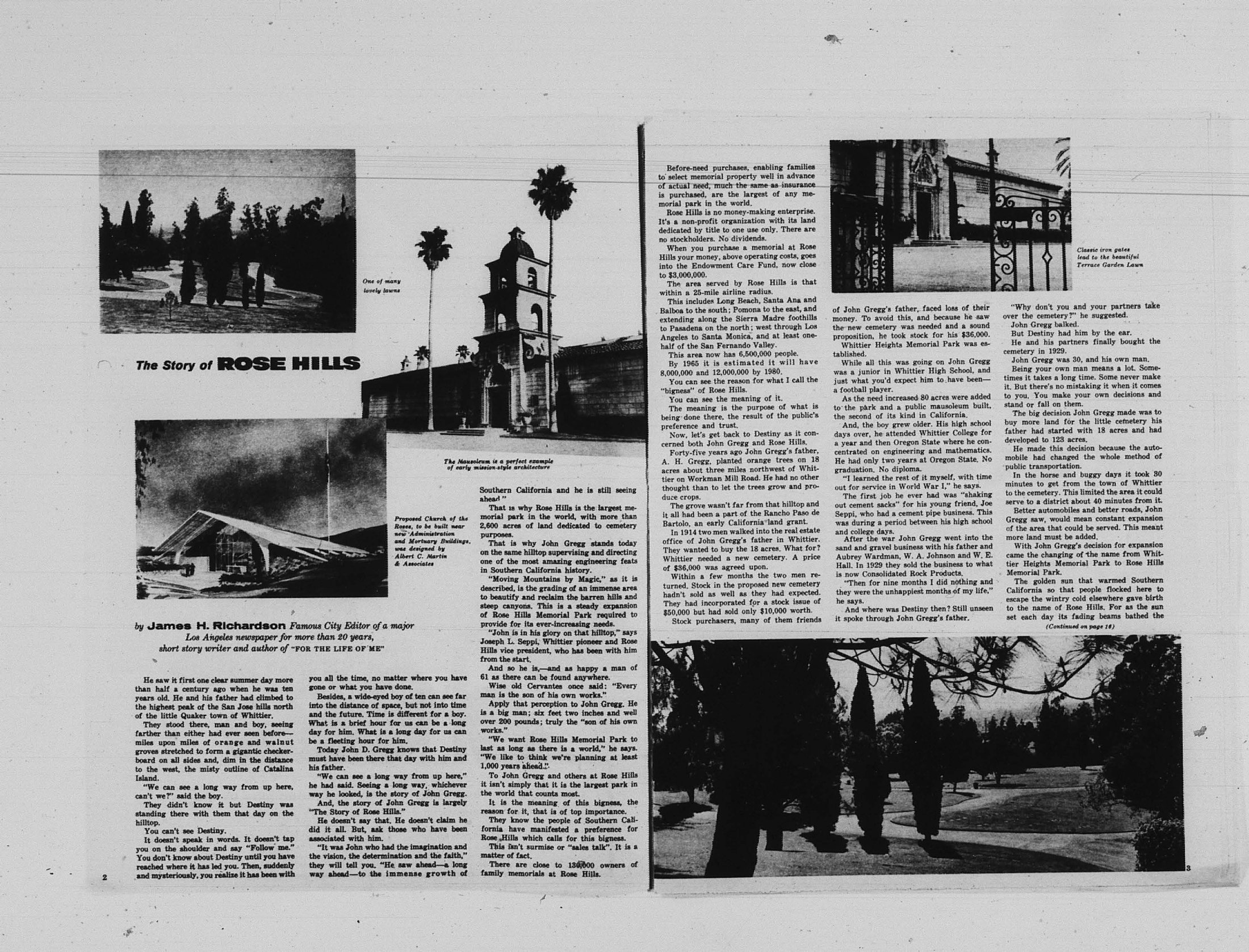
One of many lovely lawns
The Story of ROSE HILLS
by James H. Richardson Famous City Editor of a major
Los Angeles newspaper for more than 20 years,
short story writer and author of "FOR THE LIFE OF ME"
He saw it first one clear summer day more than half a century ago when he was ten years old. He and his father had climbed to the highest peak of the San Jose hills north of the little Quaker town of Whittier.
They stood there, man and boy, seeing farther than either had ever seen before—miles upon miles of orange and walnut groves stretched to form a gigantic checkerboard on all sides and, dim in the distance to the west, the misty outline of Catalina Island.
"We can see a long way from up here, can't we?" said the boy.
They didn't know it but Destiny was standing there with them that day on the hilltop.
You can't see Destiny.
It doesn't speak in words. It doesn't tap you on the shoulder and say "Follow me." You don't know about Destiny until you have reached where it has led you. Then, suddenly and mysteriously, you realize it has been with you all the time, no matter where you have gone or what you have done.
Besides, a wide-eyed boy of ten can see far into the distance of space, but not into time and the future. Time is different for a boy. What is a brief hour for us can be a long day for him. What is a long day for us can be a fleeting hour for him.
Today John D. Gregg knows that Destiny must have been there that day with him and his father.
"We can see a long way from up here," he had said. Seeing a long way, whichever way he looked, is the story of John Gregg.
And, the story of John Gregg is largely "The Story of Rose Hills."
He doesn't say that. He doesn't claim he did it all. But, ask those who have been associated with him.
"It was John who had the imagination and the vision, the determination and the faith," they will tell you. "He saw ahead—a long way ahead—to the immense growth of
Before-need purchases, enabling families to select memorial property well in advance of actual need, much the same as insurance is purchased, are the largest of any memorial park in the world.
Rose Hills is no money-making enterprise. It's a non-profit organization with its land dedicated by title to one use only. There are no stockholders. No dividends.
When you purchase a memorial at Rose Hills your money, above operating costs, goes into the Endowment Care Fund, now close to $3,000,000.
The area served by Rose Hills is that within a 25-mile airline radius.
This includes Long Beach, Santa Ana and Balboa to the south; Pomona to the east, and extending along the Sierra Madre foothills to Pasadena on the north; west through Los Angeles to Santa Monica, and at least one-half of the San Fernando Valley.
The area served by Rose Hills is that within a 25-mile airline radius.
This includes Long Beach, Santa Ana and Balboa to the south; Pomona to the east, and extending along the Sierra Madre foothills to Pasadena on the north; west through Los Angeles to Santa Monica, and at least one-half of the San Fernando Valley.
This area now has 6,500,000 people.
By 1965 it is estimated it will have 8,000,000 and 12,000,000 by 1980.
You can see the reason for what I call the "bigness" of Rose Hills.
You can see the meaning of it.
The meaning is the purpose of what is being done there, the result of the public's preference and trust.
Now, let's get back to Destiny as it concerned both John Gregg and Rose Hills.
Forty-five years ago John Gregg's father, A. H. Gregg, planted orange trees on 18 acres about three miles northwest of Whittier on Workman Mill Road. He had no other thought than to let the trees grow and produce crops.
The grove wasn't far from that hilltop and it all had been a part of the Rancho Paso de Bartolo, an early California land grant.
In 1914 two men walked into the real estate office of John Gregg's father in Whittier. They wanted to buy the 18 acres. What for? Whittier needed a new cemetery. A price of $36,000 was agreed upon.
Within a few months the two men returned. Stock in the proposed new cemetery hadn't sold as well as they had expected. They had incorporated for a stock issue of $50,000 but had sold only $10,000 worth.
Stock purchasers, many of them friends
Southern California and he is still seeing ahead"
That is why Rose Hills is the largest memorial park in the world, with more than 2,600 acres of land dedicated to cemetery purposes.
That is why John Gregg stands today on the same hilltop supervising and directing one of the most amazing engineering feats in Southern California history.
"Moving Mountains by Magic," as it is described, is the grading of an immense area to beautify and reclaim the barren hills and steep canyons. This is a steady expansion of Rose Hills Memorial Park required to provide for its ever-increasing needs.
"John is in his glory on that hilltop," says Joseph L. Seppi, Whittier pioneer and Rose Hills vice president, who has been with him from the start.
And so he is—and as happy a man of
John is in his glory on that hilltop," says Joseph L. Seppi, Whittier pioneer and Rose Hills vice president, who has been with him from the start.
And so he is—and as happy a man of 61 as there can be found anywhere.
Wise old Cervantes once said: "Every man is the son of his own works."
Apply that perception to John Gregg. He is a big man; six feet two inches and well over 200 pounds; truly the "son of his own works."
"We want Rose Hills Memorial Park to last as long as there is a world," he says.
"We like to think we're planning at least 1,000 years ahead."
To John Gregg and others at Rose Hills it isn't simply that it is the largest park in the world that counts most.
It is the meaning of this bigness, the reason for it, that is of top importance.
They know the people of Southern California have manifested a preference for Rose Hills which calls for this bigness.
This isn't surmise or "sales talk". It is a matter of fact.
There are close to 130,000 owners of family memorials at Rose Hills.
of John Gregg's father, faced loss of their money. To avoid this, and because he saw the new cemetery was needed and a sound proposition, he took stock for his $36,000.
Whittier Heights Memorial Park was established.
"Why don't you and your partners take over the cemetery?" he suggested.
John Gregg balked.
But Destiny had him by the ear.
He and his partners finally bought the cemetery in 1929.
of John Gregg's father, faced loss of their money. To avoid this, and because he saw the new cemetery was needed and a sound proposition, he took stock for his $36,000.
Whittier Heights Memorial Park was established.
While all this was going on John Gregg was a junior in Whittier High School, and just what you'd expect him to have been—a football player.
As the need increased 80 acres were added to the park and a public mausoleum built, the second of its kind in California.
And, the boy grew older. His high school days over, he attended Whittier College for a year and then Oregon State where he concentrated on engineering and mathematics. He had only two years at Oregon State. No graduation. No diploma.
"I learned the rest of it myself, with time out for service in World War I," he says.
The first job he ever had was "shaking out cement sacks" for his young friend, Joe Seppi, who had a cement pipe business. This was during a period between his high school and college days.
After the war John Gregg went into the sand and gravel business with his father and Aubrey Wardman, W. A. Johnson and W. E. Hall. In 1929 they sold the business to what is now Consolidated Rock Products.
"Then for nine months I did nothing and they were the unhappiest months of my life," he says.
And where was Destiny then? Still unseen it spoke through John Gregg's father.
"Why don't you and your partners take over the cemetery?" he suggested.
John Gregg balked.
But Destiny had him by the ear.
He and his partners finally bought the cemetery in 1929.
John Gregg was 30, and his own man.
Being your own man means a lot. Sometimes it takes a long time. Some never make it. But there's no mistaking it when it comes to you. You make your own decisions and stand or fall on them.
The big decision John Gregg made was to buy more land for the little cemetery his father had started with 18 acres and had developed to 123 acres.
He made this decision because the automobile had changed the whole method of public transportation.
In the horse and buggy days it took 30 minutes to get from the town of Whittier to the cemetery. This limited the area it could serve to a district about 40 minutes from it.
Better automobiles and better roads, John Gregg saw, would mean constant expansion of the area that could be served. This meant more land must be added.
With John Gregg's decision for expansion came the changing of the name from Whittier Heights Memorial Park to Rose Hills Memorial Park.
The golden sun that warmed Southern California so that people flocked here to escape the wintry cold elsewhere gave birth to the name of Rose Hills. For as the sun set each day its fading beams bathed the
back issue of 10 worth.
them friends
he says.
And where was Destiny then? Still unseen
it spoke through John Gregg's father.
escape the wintry cold elsewhere gave birth
to the name of Rose Hills. For as the sun
set each day its fading beams bathed the
(Continued on page 16)