anaheim-bulletin 1955-07-25
Scanned page
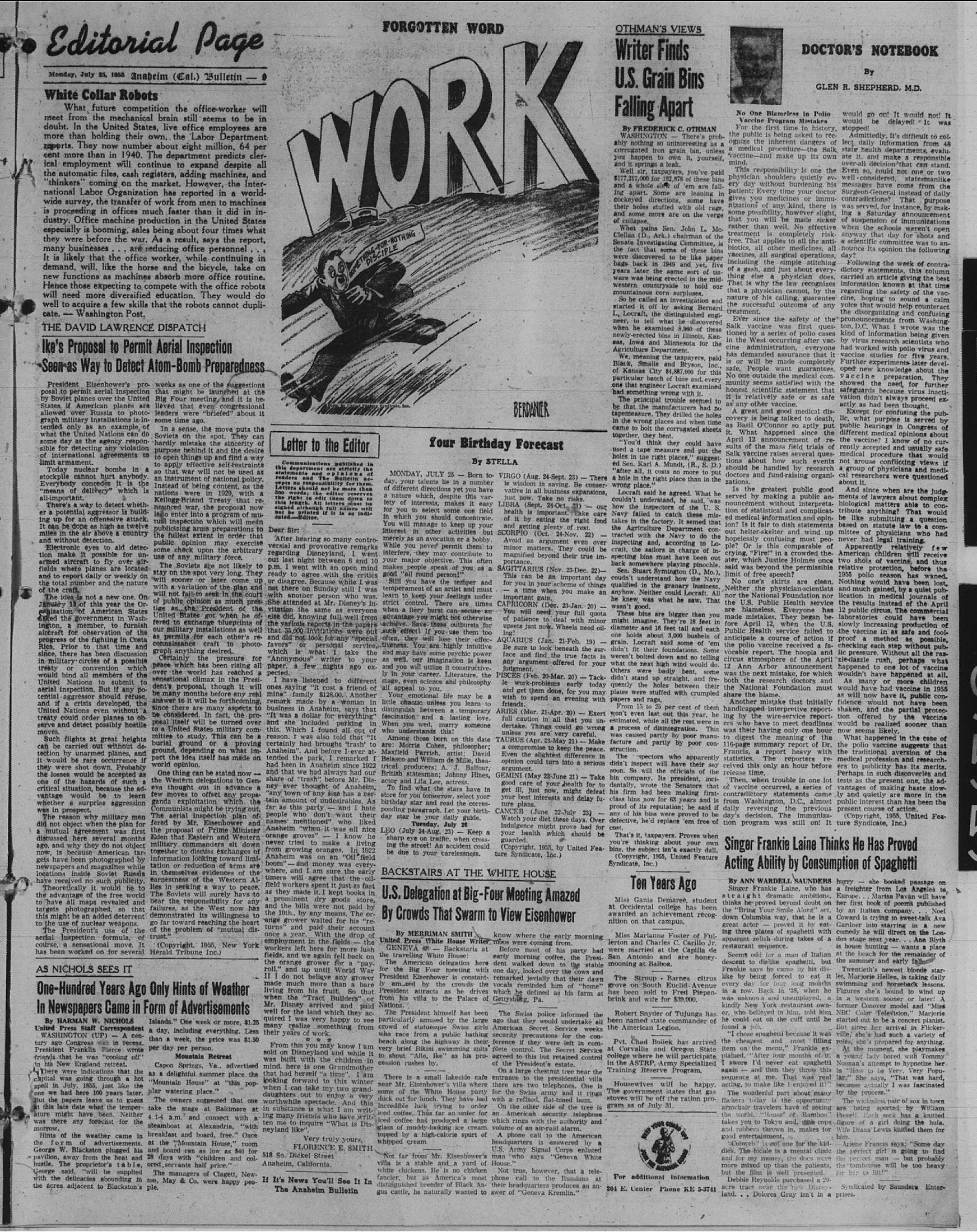
Searchable text
Editorial Page
Monday, July 25, 1955 Anaheim (Cal.) Bulletin — 9
White Collar Robots
What future competition the office-worker will meet from the mechanical brain still seems to be in doubt. In the United States, live office employees are more than holding their own, the Labor Department reports. They now number about eight million, 64 per cent more than in 1940. The department predicts clerical employment will continue to expand despite all the automatic files, cash registers, adding machines, and "thinkers" coming on the market. However, the International Labor Organization has reported in a worldwide survey, the transfer of work from men to machines is proceeding in offices much faster than it did in industry. Office machine production in the United States especially is booming, sales being about four times what they were before the war. As a result, says the report, many businesses . . . are reducing office personnel . . .
It is likely that the office worker, while continuing in demand, will, like the horse and the bicycle, take on new functions as machines absorb more office routine. Hence those expecting to compete with the office robots will need more diversified education. They would do well to acquire a few skills that the robots cannot duplicate. — Washington Post.
THE DAVID LAWRENCE DISPATCH
Ike's Proposal to Permit Aerial Inspection Seen as Way to Detect Atom-Bomb Preparedness
President Eisenhower’s proposal to permit aerial inspection by Soviet planes over the United States if American planes are allowed over Russia to photograph military installations is intended only as an example of what the United Nations can do some day as the agency responsible for detecting any violation of international agreements to weeks as one of the suggestions that might be launched at the Big Four meeting, and it is believed that even congressional leaders were “briefed” about it some time ago.
In a sense, the move puts the Soviets on the spot. They can hardly mistake the sincerity of purpose behind it and the desire to open things up and find a way
President Eisenhower's proposal to permit aerial inspection by Soviet planes over the United States if American planes are allowed over Russia to photograph military installations is intended only as an example of what the United Nations can do some day as the agency responsible for detecting any violation of international agreements to limit armament.
Today nuclear bombs in a stockpile cannot hurt anybody. Everybody concedes it is the "means of delivery" which is all-important.
There's a way to detect whether a potential aggressor is building up for an offensive attack. It can be done as high as twelve miles in the air above a country and without detection.
Electronic eyes to aid detection make it possible for unarmed aircraft to fly over fields where planes are located and to report daily or weekly on the total number and the nature of the craft.
The idea is not a new one. On January 13 of this year the Organization of American States asked the government in Washington, a member, to furnish aircraft for observation of the progress of the fighting in Costa Rica. Prior to that time and since, there has been discussion in military circles of a possible treaty or convention which would bind all members of the United Nations to submit to aerial inspection. But if any potential aggressor should refuse, and if a crisis developed, the United Nations even without a treaty could order planes to observe and detect possibly hostile moves.
Such flights at great heights can be carried out without detection by unarmed planes, and it would be rare occurrence if they were shot down. Probably the losses would be accepted as one of the hazards of such a critical situation, because the advantage would be to learn whether a surprise aggression was in prospect.
The reason why military men did not object when the plan for a mutual agreement was first discussed here several months ago, and why they do not object now, is because American targets have been photographed by newspapers and magazines while President Eisenhower's proposal to permit aerial inspection by Soviet planes over the United States if American planes are allowed over Russia to photograph military installations is intended only as an example of what the United Nations can do some day as the agency responsible for detecting any violation of international agreements to limit armament.
Today nuclear bombs in a stockpile cannot hurt anybody. Everybody concedes it is the "means of delivery" which is all-important.
There’s a way to detect whether a potential aggressor is building up for an offensive attack. It can be done as high as twelve miles in the air above a country and without detection.
Electronic eyes to aid detection make it possible for unarmed aircraft to fly over fields where planes are located and to report daily or weekly on the total number and the nature of the craft.
The idea is not a new one. On January 13 of this year the Organization of American States asked the government in Washington, a member, to furnish aircraft for observation of the progress of the fighting in Costa Rica. Prior to that time and since, there has been discussion in military circles of a possible treaty or convention which would bind all members of the United Nations to submit to aerial inspection. But if any potential aggressor should refuse, and if a crisis developed, the United Nations even without a treaty could order planes to observe and detect possibly hostile moves.
Such flights at great heights can be carried out without detection by unarmed planes, and it would be rare occurrence if they were shot down. Probably the losses would be accepted as one of the hazards of such a critical situation, because the advantage would be to learn whether a surprise aggression was in prospect.
The reason why military men did not object when the plan for a mutual agreement was first discussed here several months ago, and why they do not object now, is because American targets have been photographed by newspapers and magazines while President Eisenhower's proposal to permit aerial inspection by Soviet planes over the United States if American planes are allowed over Russia to photograph military installations is intended only as an example of what the United Nations can do some day as the agency responsible for detecting any violation of international agreements to limit armament.
Today nuclear bombs in a stockpile cannot hurt anybody. Everybody concedes it is the "means of delivery" which is all-important.
There’s a way to detect whether a potential aggressor is building up for an offensive attack. It can be done as high as twelve miles in the air above a country and without detection.
Electronic eyes to aid detection make it possible for unarmed aircraft to fly over fields where planes are located and to report daily or weekly on the total number and the nature of the craft.
The idea is not a new one. On January 13 of this year the Organization of American States asked the government in Washington, a member, to furnish aircraft for observation of the progress of the fighting in Costa Rica. Prior to that time and since, there has been discussion in military circles of a possible treaty or convention which would bind all members of the United Nations to submit to aerial inspection. But if any potential aggressor should refuse, and if a crisis developed, the United Nations even without a treaty could order planes to observe and detect possibly hostile moves.
Such flights at great heights can be carried out without detection by unarmed planes, and it would be rare occurrence if they were shot down. Probably the losses would be accepted as one of the hazards of such a critical situation, because the advantage would be to learn whether a surprise aggression was in prospect.
The reason why military men did not object when the plan for a mutual agreement was first discussed here several months ago, and why they do not object now, is because American targets have been photographed by newspapers and magazines while President Eisenhower's proposal to permit aerial inspection by Soviet planes over the United States if American planes are allowed over Russia to photograph military installations is intended only as an example of what the United Nations can do some day as the agency responsible for detecting any violation of international agreements to limit armament.
Today nuclear bombs in a stockpile cannot hurt anybody. Everybody concedes it is the "means of delivery" which is all-important.
There’s a way to detect whether a potential aggressor is building up for an offensive attack. It can be done as high as twelve miles in the air above a country and without detection.
Electronic eyes to aid detection make it possible for unarmed aircraft to fly over fields where planes are located and to report daily or weekly on the total number and the nature of the craft.
The idea is not a new one. On January 13 of this year the Organization of American States asked the government in Washington, a member, to furnish aircraft for observation of the progress of the fighting in Costa Rica. Prior to that time and since, there has been discussion in military circles of a possible treaty or convention which would bind all members of the United Nations to submit to aerial inspection. But if any potential aggressor should refuse, and if a crisis developed, the United Nations even without a treaty could order planes to observe and detect possibly hostile moves.
Such flights at great heights can be carried out without detection by unarmed planes, and it would be rare occurrence if they were shot down. Probably the losses would be accepted as one of the hazards of such a critical situation, because the advantage would be to learn whether a surprise aggression was in prospect.
The reason why military men did not object when the plan for a mutual agreement was first discussed here several months ago, and why they do not object now, is because American targets have been photographed by newspapers and magazines while President Eisenhower's proposal to permit aerial inspection by Soviet planes over the United States if American planes are allowed over Russia to photograph military installations is intended only as an example of what the United Nations can do some day as the agency responsible for detecting any violation of international agreements to limit armament.
Today nuclear bombs in a stockpile cannot hurt anybody. Everybody concedes it is the "means of delivery" which is all-important.
There’s a way to detect whether a potential aggressor is building up for an offensive attack. It can be done as high as twelve miles in the air above a country and without detection.
Electronic eyes to aid detection make it possible for unarmed aircraft to fly over fields where planes are located and to report daily or weekly on the total number and the nature of the craft.
The idea is not a new one. On January 13 of this year the Organization of American States asked the government in Washington, a member, to furnish aircraft for observation of the progress of the fighting in Costa Rica. Prior to that time and since, there has been discussion in military circles of a possible treaty or convention which would bind all members of the United Nations to submit to aerial inspection. But if any potential aggressor should refuse, and if a crisis developed, the United Nations even without a treaty could order planes to observe and detect possibly hostile moves.
Such flights at great heights can be carried out without detection by unarmed planes, and it would be rare occurrence if they were shot down. Probably the losses would be accepted as one of the hazards of such a critical situation, because the advantage would be to learn whether a surprise aggression was in prospect.
The reason why military men did not object when the plan for a mutual agreement was first discussed here several months ago, and why they do not object now, is because American targets have been photographed by newspapers and magazines while President Eisenhower's proposal to permit aerial inspection by Soviet planes over the United States if American planes are allowed over Russia to photograph military installations is intended only as an example of what the United Nations can do some day as the agency responsible for detecting any violation of international agreements to limit armament.
Today nuclear bombs in a stockpile cannot hurt anybody. Everybody concedes it is the "means of delivery" which is all-important.
There’s a way to detect whether a potential aggressor is building up for an offensive attack. It can be done as high as twelve miles in the air above a country and without detection.
Electronic eyes to aid detection make it possible for unarmed aircraft to fly over fields where planes are located and to report daily or weekly on the total number and the nature of the craft.
The idea is not a new one. On January 13 of this year the Organization of American States asked the government in Washington, a member, to furnish aircraft for observation of the progress of the fighting in Costa Rica. Prior to that time and since, there has been discussion in military circles of a possible treaty or convention which would bind all members of the United Nations to submit to aerial inspection. But if any potential aggressor should refuse, and if a crisis developed, the United Nations even without a treaty could order planes to observe and detect possibly hostile moves.
Such flights at great heights can be carried out without detection by unarmed planes, and it would be rare occurrence if they were shot down. Probably the losses would be accepted as one of the hazards of such a critical situation, because the advantage would be to learn whether a surprise aggression was in prospect.
The reason why military men did not object when the plan for a mutual agreement was first discussed here several months ago, and why they do not object now, is because American targets have been photographed by newspapers and magazines while President Eisenhower's proposal to permit aerial inspection by Soviet planes over the United States if American planes are allowed over Russia to photograph military installations is intended only as an example of what the United Nations can do some day as the agency responsible for detecting any violation of international agreements to limit armament.
Today nuclear bombs in a stockpile cannot hurt anybody. Everybody concedes it is the "means of delivery" which is all-important.
There’s a way to detect whether a potential aggressor is building up for an offensive attack. It can be done as high as twelve miles in the air above a country and without detection.
Electronic eyes to aid detection make it possible for unarmed aircraft to fly over fields where planes are located and to report daily or weekly on the total number and the nature of the craft.
The idea is not a new one. On January 13 of this year the Organization of American States asked the government in Washington, a member, to furnish aircraft for observation of the progress of the fighting in Costa Rica. Prior to that time and since, there has been discussion in military circles of a possible treaty or convention which would bind all members of the United Nations to submit to aerial inspection. But if any potential aggressor should refuse, and if a crisis developed, the United Nations even without a treaty could order planes to observe and detect possibly hostile moves.
Such flights at great heights can be carried out without detection by unarmed planes, and it would be rare occurrence if they were shot down. Probably the losses would be accepted as one of the hazards of such a critical situation, because the advantage would be to learn whether a surprise aggression was in prospect.
The reason why military men did not object when the plan for a mutual agreement was first discussed here several months ago, and why they do not object now, is because American targets have been photographed by newspapers and magazines while President Eisenhower's proposal to permit aerial inspection by Soviet planes over the United States if American planes are allowed over Russia to photograph military installations is intended only as an example of what the United Nations can do some day as the agency responsible for detecting any violation of international agreements to limit armament.
Today nuclear bombs in a stockpile cannot hurt anybody. Everybody concedes it is the "means of delivery" which is all-important.
There’s a way to detect whether a potential aggressor is building up for an offensive attack. It can be done as high as twelve miles in the air above a country and without detection.
Electronic eyes to aid detection make it possible for unarmed aircraft to fly over fields where planes are located and to report daily or weekly on the total number and the nature of the craft.
The idea is not a new one. On January 13 of this year the Organization of American States asked the government in Washington, a member, to furnish aircraft for observation of the progress ofthe fighting in Costa Rica. Prior to that time and since, there has been discussion in military circles of a possible treaty or convention which would bind all members ofthe United Nations to submit to aerial inspection. But if any potential aggressor should refuse, and if a crisis developed, the United Nations even without a treaty could order planes to observe and detect possibly hostile moves.
Such flights at great heights can be carried out without detection by unarmed planes, and it would be rare occurrence if they were shot down. Probably the losses would be accepted as one of the hazards of such a critical situation, because the advantage would be to learn whether a surprise aggression was in prospect.
The reason why military men did not object whenthe plan fora mutual agreement was first discussed here several months ago,and why they do not object now,iis becauseAmerican targets have been photographedby newspapersandmagazineswhilePresidentEisenhowerandtheproposalofPrimeMinisterEdwardEisenhowerasmopetheBigFour meeting,anditoutlastnightbetween6andp.m.Iwentwithanopenmreadytoagreewiththecrueldisagreement.BecausewhileInotthereonSundaystillIwerewithanotherpersonwhowiyesterdayfullwellforthevariousreportsinthepaperthat3500invittationswereanddidnotlookforanyspeciforsaviorsorpersonalserviceswhichiswhat.ItakeAnAnonymouswritertoyourpaper,a few nightsagoexpected.Ihavelistenedtodifferentones saying“Itcosta friendminute”family$128.00.AnotherremarkmadebyawomanbusinessinAnaheim,saystothe“Itwasa dollarforeverythingandsheincludedparkingthisWhich。WhichIfoundalloutreason.Iwasalso toldthatitcertainlyhad brought“trash”Anaheim”.AndbeforeIevertendedthepark.Iremarkedeadlyknownfullwellforyearsoftailanysizehasattainamountofundesirablesfarasthisparty—andIhivelistenedtooneonsaying“Itcosta friendminute”family$128.00.AnotherremarkmadebyawomanbusinessinAnaheim,saystothe“Itwasa dollarforeverythingandsheincludedparkingthisWhich。WhichIfoundalloutreason.Iwasalso toldthatitcertainlyhad brought“trash”Anaheim”.AndbeforeIevertendedthepark.Iremarkedeadlyknownfullwellforyearsoftailanysizehasattainamountofundesirablesfarasthisparty—andIhivelistenedtooneonsaying“Itcosta friendminute”family$128.00.Anotherremarkmadebya womanbusinessinAnaheim,saystothe“Iwasa dollarforeverythingandsheincludedparkingthisWhich。WhichIfoundalloutreason.Iwasalso toldthatitcertainlyhad brought“trash”Anaheim”.AndbeforeIevertendedthepark.Iremarkedeadlyknownfullwellforyearsoftailanysizehasattainamountoffundesirablesfarasthisparty—andIhivelistenedtooneonsaying“Itcosta friendminute”family$128.00.Anotherremarkmadebya womanbusinessinAnaheim,saystothe“Iwasa dollarforeverythingandsheincludedparkingthisWhich。WhichIfoundalloutreason.Iwasalso toldthatitcertainlyhad brought“trash”Anaheim”.AndbeforeIevertendedthepark.Iremarkedeadlyknownfullwellforyearsoftailanysizehasattainamountoffundesirablesfarasthisparty—andIhivelistenedtooneonsaying“Itcosta friendminute”family$128.00.Anotherremarkmadebya womanbusinessinAnaheim,saystothe“Iwasa dollarforeverythingandsheincludedparkingthisWhich。WhichIfoundalloutreason.Iwasalso toldthatitcertainlyhad brought“trash”Anaheim”.AndbeforeIevertendedthepark.Iremarkedeadlyknownfullwellforyearsoftailanysizehasattainamountoffundesirablesfarasthisparty—andIhivelistenedtooneonsaying“Itcosta friendminute”family$128.00.Anotherremarkmadebya womanbusinessinAnaheim,saystothe“Iwasa dollarforeverythingandsheincludedparkingthisWhich。WhichIfoundalloutreason.Iwasalso toldthatitcertainlyhad brought“trash”Anaheim”.AndbeforeIevertendedthepark.Iremarkedeadlyknownfullwellforyearsoftailanysizehasattainamountoffundesirablesfarasthisparty—andIhivelistenedtooneonsaying“Itcosta friendminute”family$128.00.Anotherremarkmadebya womanbusinessinAnaheim,saystothe“Iwasa dollarforeverythingandsheincludedparkingthisWhich。WhichIfoundalloutreason.Iwasalso toldthat它certainlyhad brought“trash”Anaheim”.AndbeforeIevertendedthepark.Iremarkedeadlyknownfullwellforyearsoftailanysizehasattainamountoffundesirablesfarasthisparty—andIhivelistenedtooneonsaying“Itcosta friendminute”family$128.00.Anotherremarkmadebya womanbusinessinAnaheim,saystothe“Iwasa dollarforeverythingandsheincludedparkingthisWhich。WhichIfoundalloutreason.Iwasalso toldthat它certainlyhad brought“trash”Anaheim”.AndbeforeIevertendedthepark.Iremarkedeadlyknownfullwellforyearsoftailanysizehasattainamountoffundesirablesfarasthisparty—andIhivelistenedtooneonsaying“Itcosta friendminute”family$128.00.Anotherremarkmadebya womanbusinessinAnaheim,saystothe“Iwasa dollarforeverythingandsheincludedparkingthisWhich。WhichIfoundalloutreason.Iwasalso toldthat它certainlyhad brought“trash”Anaheim”.AndbeforeIevertendedthepark.Iremarkedeadlyknownfullwellforyearsoftailanysizehasattainamountoffundesirablesfarasthisparty—andIhivelistenedtooneonsaying“Itcosta friendminute”family$128.00.Anotherremarkmadebya womanbusinessinAnaheim,saystothe“Iwasa dollarforeverythingandsheincludedparkingthisWhich。WhichIfoundalloutreason.Iwasalso toldthat它certainlyhad brought“trash”Anaheim”.AndbeforeIevertendedthepark.Iremarkedeadlyknownfullwellforyearsoftailanysizehasattainamountoffundesirablesfarasthisparty—andIhivelistenedtooneonsaying“Itcosta friendminute”family$128.00.Anotherremarkmadebya womanbusinessinAnaheim,saystothe“Iwasa dollarforeverythingandsheincludedparkingthisWhich。WhichIfoundalloutreason.Iwasalso toldthat它certainlyhad brought“trash”Anaheim”.AndbeforeIevertendedthepark.Iremarkedeadlyknownfullwellforyearsoftailanysizehasattainamountoffundesirablesfarasthisparty—andIhivelistenedtooneonsaying“Itcosta friendminute”family$128.00.Anotherremarkmadebya womanbusinessinAnaheim,saystothe“Iwasa dollarforeverythingandsheincludedparkingthisWhich。WhichIfoundalloutreason.Iwasalso toldthat它certainlyhad brought“trash”Anaheim”.AndbeforeIevertendedthepark.Iremarkedeadlyknownfullwellforyearsoftailanysizehasattainamountoffundesirablesfarasthisparty—andIhivelistenedtooneonsaying“Itcosta friendminute”family$128.00.Anotherremarkmadebya womanbusinessinAnaheim,saystothe“Iwasa dollarforeverything和sheincludedparkingthisWhich。WhichIfoundalloutreason.Iwasalso toldthat它certainlyhad brought“trash”Anaheim”.AndbeforeIevertendedthepark.Iremarkedeadlyknownfullwellforyearsoftailanysizehasattainamountoffundesirablesfarasthisparty—andIhivelistenedtooneonsaying“Itcosta friendminute”family$128.00.Anotherremarkmadebya womanbusinessinAnaheim,saystothe“Iwasa dollarforeverything和sheincluded parkingsThiswhich。WhichIfoundalloutreason.Iwasalso toldthat它certainlyhad brought“trash”Anaheim”。AndbeforeIevertendedthepark.Iremarkedeadlyknownfullwellforyearsoftailanysizehasattainamountoffundesirablesfarasthisparty—andIhivelistenedtooneonsaying“Itcosta friendminute”family$128.00.Anotherremarkmadebya womanbusinessinAnaheim,saystothe“Iwasa dollarforeverything和sheincluded parkingsThiswhich。 WhichI foundalloutreason.Iwasalso toldthat它certainlyhad brought“trash”Anaheim”。AndbeforeIevertendedthepark.Iremarkedeadlyknownfullwellforyearsoftailanysizehasattainamountoffundesirablesfarasthisparty—andIhivelistenedtooneonsaying“Itcosta friendminute”family$128.00.Anotherremarkmadebya womanbusinessinAnaheim,saystothe“Iwasa dollarforeverything和sheincluded parkingsThiswhich。 WhichI foundalloutreason.Iwasalso toldthat它certainlyhad brought“trash”Anaheim”。AndbeforeIevertendedthepark.Iremarkedeadlyknownfullwellforyearsoftailanysizehasattainamountof fundesirables farasthisparty—andIhivelistenedtooneonsaying“Itcosta friendminute”family$128.00.Anotherremarkmadebya womanbusinessinAnaheim,saystothe“Iwasa dollarforeverything和 sheincluded parkingsThiswhich。 WhichI foundalloutreason.Iwasalso toldthat它certainlyhad brought“trash”Anaheim”。AndbeforeIevertendedthepark.Iremarkedeadlyknownfullwellforyearsoftailanysizehasattainamountof fundesirables farasthisparty—andIhivelistenedtooneonsaying“Itcosta friendminute” family$128.00.Anotherremarkmadebya womanbusinessinAnaheim,saystothe“Iwasa dollarforeverything和 sheincluded parkingsThiswhich。 WhichI foundalloutreason.Iwas also told that它certainlyhad brought“trash”Anaholm”。 AndbeforeIevertendedthepark.Iremarkedeadlyknownfullwellforyearsoftailanysizehasattainamountof fundesirables farasthisparty—andIhivelistenedtooneonsaying“Itcosta friendminute” family$128.00.Anotherremarkmadebya womanbusinessinAnaholm,saystothe“Iwasa dollarforeverything和 sheincluded parkingsThiswhich。 Which I foundalloutreason.Iwas also told that它certainlyhad brought“trash”Anaholm”。 AndbeforeIevertendedthepark.Iremarkedeadlyknown full well foryear softail any size has at undeniable reasons I was able thought that it might want names mentioned" who like Anaholm "when it was all right with orange groves" - I know no other name than "Ollie Bloom" - I am never tried to make lives from growing oranges.In I Anaholm was on an "Ollie Bloom" boom"- I am never tried to make lives from growing oranges.In I Anaholm was on an "Ollie Bloom" boom"- I am never tried to make lives from growing oranges.In I Anaholm was on an "Ollie Bloom" boom"- I am never tried to make lives from growing oranges.In I Anaholm was on an "Ollie Bloom" boom"- I am never tried to make lives from growing oranges.In I Anaholm was on an "Ollie Bloom" boom"- I am never tried
AS NICHOLS SEES IT
One-Hundred Years Ago Only Hints of Weather In Newspapers Came in Form of Advertisements
By HARMAN W. NICHOLS
United Press Staff Correspondent
WASHINGTON (UP) — A century ago Congress was in recess. President Franklin Pierce wrote friends that he was "cooling off" in his New England retreat.
There were indications that the capital was going through a hot spell in July, 1855, just like the one we had here 100 years later. But the papers leave us to guess at this late date what the temperature might have been. Neither was there any forecast for the morrow.
Hints of the weather came in the form of advertisements. George W. Blackston plugged his pavilion, away from the heat and bustle. The proprietor's table, George said, "will be supplied with the delicacies abounding in the acres adjacent to Blackston's Islands." One week or more, $1.25 a day, including everything. Less than a week, the price was $1.50 per day per person.
Mountain Retreat
Capon Springs, Va., advertised as a delightful summer place the "Mountain House" at "this popular watering place."
The owners suggested that one take the stage at Baltimore at 4:14 a.m. and connect with a steamboat at Alexandria, "with breakfast and board, free." Once at the "Mountain House," room and board ran as low as $40 for 28 days with "children and colored servants half price."
The managers of Clagett, Newton, May & Co. were happy people.
Share of "trash" before Mr. L. Anaheim "any town of any size has a tain amount of undesirables." Far as this party — and I hope people who don't want their names mentioned — who like Anaheim "when it was all orange groves" — I know never tried to make a live from growing oranges. In Anaheim was on an "Oil-fired boom" — and money was everywhere, and I am sure the timers will agree that the field workers spent it just as fast as they made it. I kept books on a prominent dry goods store and the bills were not paid for the 10th., by any means. The orange grower waited for his turn's and paid their account once a year. With the drop employment in the fields — the workers left here for more lucrative fields, and we again fell back on the orange grower for a "proll," and up until World War II I do not believe any grower made much more than a bar living from his fruit. So when the "Tract Builders" Mr. Disney arrived and peeled well for the land which they required I was very happy to many realize something from their years of work.
From this you may know I sold on Disneyland and while was built with the children mind, here is one Grandmother that had herself "a time." I looked forward to this winter when I can take my two grandaughters out to enjoy a very worthwhile spectacle. And then in substance is what I am writing many friends who have written me to inquire "What is Disneyland like?"
Very truly yours,
FLORENCE E. SMITH
518 So. Dickel Street
Anaheim, California.
If It's News You'll See It
The Anaheim Bulletin
FORGOTTEN WORD
WORK
SOMETHING FOR NOTHING DISCIPLE
BERDANIER.
OTHMAN'S VIEW
Writer Finds U.S. Grain Bins Falling Apart
By FREDERICK C. O'NEIL
WASHINGTON — The ably nothing so uninterrupted corrugated iron grain you happen to own it and it springs a leak.
Well sir, taxpayers, you $177,217,000 for 192,878 of and a whole slew of 'er ing apart. Some are cockeyed directions, some their holes stuffed with and some more are on of collapse.
What pains Sen. John Clellan (D., Ark.) chairin Senate Investigating Com the fact that some of were discovered to be bags back in 1949 and years later the same s ware was being erected western countryside to mountainous corn surplus.
So he called an investi started it off by asking L. Locraft, the distinguis neer, to tell what he when he examined 8,960 newly-erected bins in Illinois, Iowa and Minnesota Agriculture Department.
We, meaning the taxpa Black, Smalls and Bry of Kansas City $4,887,000 particular batch of bins one that engineer Locraft had something wrong wit
The principal trouble be that the manufacture tapemeasure. They drilled in the wrong places and came to bolt the corrugate together, they bent.
"You'd think they co used a tape measure and holes in the right places."
Your Birthday Forecast
By STELLA
MONDAY, JULY 25 — Born today, your talents lie in a number of different directions yet you have a nature which, despite this variety of interests, makes it easy for you to select some one field in which you should concentrate. You will manage to keep up your interest in other activities but merely as an avocation or a hobby. While you never permit them to interfere, they may contribute to your major objective. This often makes people speak of you as a good "all round person!".
Still you have the temper and temperament of an artist and must learn to keep your feelings under strict control. There are times when a fiery burst can secure an advantage you might not otherwise save. Save these outbursts for such effect! If you use them too often, they will lose their effectiveness. You are highly intuitive and may have some psychic power as well. Our imagination is keen and you will utilize it constructively in your career. Literature, the stage, even science and philosophy all appeal to you.
Your emotional life may be a little chaotic unless you learn to distinguish between a temporary fascination and a lasting love. When you wed, marry someone who understands this!
Among those born on this date are: Morris Cohen, philosopher; Maxfield Parrish, artist; David Belasco and William de Mille, theatrical producers; A. J. Balfour, British statesman; Johnny Hines, actor and Lila Lee, actress.
To find what the stars have in store for you tomorrow, select your birthday star and read the corresponding paragraph. Let your birthday star be your daily guide.
Tuesday, July 28
LEO (July 24-Aug. 23) — Keep a sharp eye on traffic, when crossing the street! An accident could be due to your carelessness.
VIRGO (Aug. 24-Sept. 23) — There is wisdom in saving. Be conservative in all business expansions, just now. Take no risks.
LIBRA (Sept. 24-Oct. 23) — our health is important. Take care of it by eating the right food and getting plenty of rest.
SCORPIO (Oct. 24-Nov. 22) — Avoid an argument even over minor matters. They could be magnified beyond their true importance.
SAGITTARIUS (Nov. 23-Dec. 22) — This can be an important day for you in your scheme of things—a time when you make an important gain.
CAPRICORN (Dec. 23-Jan. 20) — You will need your full quota of patience to deal with minor upsets just now. Wheels need oiling!
AQUARIUS (Jan. 21-Feb. 19) — Be sure to look beneath the surface and find the true facts in any argument offered for your judgment.
PISCES (Feb. 20-Mar. 20) — Tackle work-problems early today and get them done, for you may wish to spend an evening with friends.
ARIES (Mar. 21-Apr. 20) — Exert full caution in all that you undertake. Things could go wrong unless you are very careful.
TAURUS (Apr. 21-May 21) — Make a compromise to keep the peace. Even the slightest difference in opinion could turn into a serious argument.
GEMINI (May 22-June 21) — Take good care of your health for to get ill, just now, might defeat your best interests and delay future plans.
CANCER (June 22-July 23) — Watch your diet these days. Over indulgence might prove bad for your health which should be guarded.
Copyright, 1955, by United Feature Syndicate, Inc.)
BACKSTAIRS AT THE WHITE HOUSE
U.S. Delegation at Big-Four Meeting Amazed By Crowds That Swarm to View Eisenhower
By MERRIMAN SMITH
United Press White House Writer
GENEVA — Backstaris at the travelling White House:
The American delegation here for the Big Four meeting with President Eisenhower is constantly amazed by the crowds the President attracts as he drives from his villa to the Palace of Nations.
The President himself has been particularly amused by the large crowd of statuesque Swiss girls who race from a public bathing beach along the highway in their very brief Bikini swimming suits to shout "Allo, Ike" as his procession rushes by.
There is a small lakeside cafe near Mr. Eisenhower's villa where some of the White House party duck out for lunch. They have had incredible luck trying to order iced coffee. Thus far an order for iced coffee has produced a large glass of muddy-looking ice cream topped by a high-calorie spurt of whipped cream.
Not far from Mr. Eisenhower's villa is a stable and a yard of white chickens. He is no chicken fancier, but as America's most distinguished breeder of Black Angus cattle, he naturally wanted to know where the early morning moos were coming from.
Before most of his party had early morning coffee, the President walked down to the stable one day, looked over the cows and remarked joyfully that their dawn vocals reminded him of "home" which he defined as his farm at Gettysburg, Pa.
The Swiss police informed the ago that they would undertake all American Secret Service weeks security precautions for the conference if they were left in complete control. The Secret Service agreed to this but retained control of the President's estate.
On a large chestnut tree near the entrance to the presidential villa there are two telephones. One is for the Swiss army and it rings with a refined, flat-toned buzz.
On the other side of the tree is an American security telephone which rings with the authority and volume of an air-raid alarm.
A phone call to the American headquarters is answered by a U.S. Army Signal Corps enlisted man who says "Geneva White House."
Not true, however, that a telephone call to the Russians at their headquarters produces an answer of "Geneva Kremlin."
OTHMAN'S VIEWS
Writer Finds U.S. Grain Bins Falling Apart
By FREDERICK C. OTHMAN
WASHINGTON — There's probably nothing so uninteresting as a corrugated iron grain bin, unless you happen to own it, yourself, and it springs a leak.
Well sir, taxpayers, you've paid $177,217,000 for 192,878 of these bins and a whole slew of 'em are falling apart. Some are leaning in cockeyed directions, some have their holes stuffed with old rags, and some more are on the verge of collapse.
What pains Sen. John L. McClellan (D., Ark.) chairman of the Senate Investigating Committee, is the fact that some of these bins were discovered to be like paper bags back in 1949 and yet, five years later the same sort of tinware was being erected in the midwestern countryside to hold our mountainous corn surpluses.
So he called an investigation and started it off by asking Bernard L. Locraft, the distinguished engineer, to tell what he discovered when he examined 8,960 of these newly-erected bins in Illinois, Kansas, Iowa and Minnesota for the Agriculture Department.
We, meaning the taxpayers, paid Black, Smalls and Bryson, Inc., of Kansas City $4,887,000 for this particular batch of bins and every one that engineer Locraft examined had something wrong with it.
The principal trouble seemed to be that the manufacturers had no tapemeasure. They drilled the holes in the wrong places and when time came to bolt the corrugated sheets together, they bent.
“You'd think they could have used a tape measure and put the holes in the right places,” suggest-
No One Blameless in Polio Vaccine Program Mistakes
For the first time in history, the public is being asked to recognize the inherent dangers of a medical procedure—the Salk vaccine—and make up its own mind.
This responsibility is one the physician shoulders quietly every day without burdening his patient; Every time your doctor gives you medicines or immunizations of any kind, there is some possibility, however slight, that you will be made sicker rather than well. No effective treatment is completely risk-free. That applies to all the antibiotics, all other medicines, all vaccines, all surgical operations, including the simple stitching of a gash, and just about everything else a physician does.
That is why the law recognizes that a physician cannot, by the nature of his calling, guarantee the successful outcome of any treatment.
Ever since the safety of the Salk vaccine was first questioned by a series of polio cases in the West occurring after vaccine administration, everyone has demanded assurance that it is or will be made completely safe. People want guarantees. No one outside the medical community seems satisfied with the honest scientific statement that it is relatively safe or as safe as any other vaccine.
A great and good medical discovery is being talked to death, as Basil O'Connor so aptly put it. What happened since the April 12 announcement of results of the mass field trials of Salk vaccine raises several questions about how it would go on! It would not! It would be delayed! It was stopped!
Admittedly, it's difficult to collect daily information from 48 state health departments, evaluate it, and make a responsible over-all decision that can stand.
Even so, could not one or two well-considered statesmanlike messages have come from the Surgeon-General instead of daily contradictions? That purpose was served, for instance, by making a Saturday announcement of suspension of immunizations when the schools weren't open anyway that day for shots and a scientific committee was to announce its opinion the following day?
Following the week of contradictory statements, this column carried an article giving the best information known at that time regarding the safety of the vaccine, hoping to sound a calm voice that would help counteract the disorganizing and confusing pronouncements from Washington, D.C. What I wrote was the kind of information being given by virus research scientists who had worked with polio virus and vaccine studies for five years.
Further experiments later developed new knowledge about the vaccine preparation. They showed the need for further safeguards because virus inactivation didn't always proceed exactly as had been thought.
Except for confusing the public, what purpose is served by public hearings in Congress of different medical opinions about the vaccine? I know of no currently accepted and usually safe medical procedure that would
Black, Smalls and Bryson, Inc., of Kansas City $4,887,000 for this particular batch of bins and every one that engineer Locraft examined had something wrong with it.
The principal trouble seemed to be that the manufacturers had no tapemeasure. They drilled the holes in the wrong places and when time came to bolt the corrugated sheets together, they bent.
“You’d think they could have used a tape measure and put the holes in the right places,” suggested Sen. Karl A. Mundt, (R., S. D.) “after all, it costs no more to put a hole in the right place than in the wrong place.”
Locraft said he agreed. What he couldn't understand, he said, was how the inspectors of the U. S. Navy failed to catch these mistakes in the factory. It seemed that the Agriculture Department contracted with the Navy to do the inspecting and, according to Locraft, the sailors in charge of inspecting bins must have been out back somewhere playing pinchle.
Sen. Stuart Symington (D., Mo.), couldn’t understand how the Navy qualified in the granary business, anyhow. Neither could Locraft. All he knew was what he saw. That wasn’t good.
These bins are bigger than you might imagine. They’re 18 feet in diameter and 16 feet tall and each one holds about 3,000 bushels of grain. Locraft said some of 'em didn’t fit their foundations. Some weren't bolted down and no telling what the next high wind would do. Others were badly bent, some didn't stand up straight, and frequently the holes between their plates were stuffed with crumpled papers and rags.
From 15 to 25 per cent of them won't even last out this year, he estimated, while all the rest were in a process of disintegration. This was caused partly by poor manufacture and partly by poor construction.
The inspectors who apparently didn't inspect will have their say soon. So will the officials of the bin company. Its president, incidentally, wrote the Senators that his firm had been making first-class bins now for 63 years and is proud of its reputation; he said if any of his bins were proved to be defective, he'd replace 'em free of post.
That's it, taxpayers. Proves when you're thinking about your own bins, the subject isn't a exactly dull. (Copyright, 1955, United Feature Syndicate, Inc.)
Ten Years Ago
Miss Gania Demaree, student at Occidental college has been awarded an achievement recognition on that campus.
Miss Marianne Foster of Fullerton and Charles C. Carillo Jr. were married at the Capilla de San Antonio and are honey-booning at Balboa.
The Stroup • Barnes citrus grove on South Euclid-Avenue has been sold to Fred Piepenrink and wife for $39,000.
Robert Snyder of Tujunga has been named state commander of the American Legion.
Pvt. Chad Boliek has arrived at Corvallis and Oregon State College where he will participate in the ASTRP, Army Specialized training Reserve Program.
Housewives will be happy, the government states that gas moves will be off the ration program as of July 31.
By ANN WARDELL SAUNDERS
Singer Frankie Laine, who has straight dramatic ambitions, thinks he proved beyond doubt on the "Bring Your Smile Along" set, down Columbia way, that he is a great actor — proved it by eating three plates of spaghetti with apparent relish during takes of a restaurant sequence.
Seems odd for a man of Italian descent to dislike spaghetti, but Frankie says he came by his dislike by being forced to eat it every day for four long months in a row. Back in '38, when he was unknown and unemployed, a kindly New York restaurant owner, who believed in him, told him he could eat on the cuff until he found a job.
"I chose spaghetti because it was the cheapest and most filling item on the menu," Frankie explained. "After four months of it, I swore I'd never eat spaghetti again — and then they throw this sequence at me. That was real acting, to make like I enjoyed it."
The wonderful part about many flickers today is the opportunity armchair travelers have of seeing the world. "House" of Bamboo takes you to Tokyo and with cops and robbers thrown in, makes for good entertainment.
"Cobweb" is not one for the kid-dies. The locale is a mental clinic and for my money, the docs were more mixed up than the patients, but the film is well presented.
Debbie Reynolds purchased a 20-acre tract near the new Disneyland. Dolores Gray isn't in a hurry — she booked passage on a freighter from Los Angeles to Europe... Marisa Pavan will have her first book of poems published by an Italian company... Noel Coward is trying to sweet-talk Ava Gardner into starring in a new comedy he will direct on the London stage next year... Ann Blyth is house hunting — wants a place at the beach for the remainder of the summer and early fall.
Twentieth's newest blonde starlet, Marjorie Hellen, is taking daily swimming and horseback lessons. Figures she bound to wind up in a western sooner or later! A former Conover model and "Miss NBC Color Television." Marjorie started out to be a concert pianist. But since her arrival in Flickerville, she's had such a variety of roles, she's prepared for anything.
At the moment, she playmakes a young lady bored with Tommy Noonan's attempt to hypnotize her in "How to be Very. Very Popular." She says, "That was hard, because actually I was fascinated by the process."
The wickedest pair of sox in town are being sported by William Powell. Each sock has a knitted figure of a girl doing the hula. Wife Diana Lewis knitted them for him.
Ariene Francis says: "Some day the perfect girl is going to find the perfect man — but probably the tombstone will be too heavy for her to lift!"