anaheim-bulletin 1955-07-15
Scanned page
Searchable text
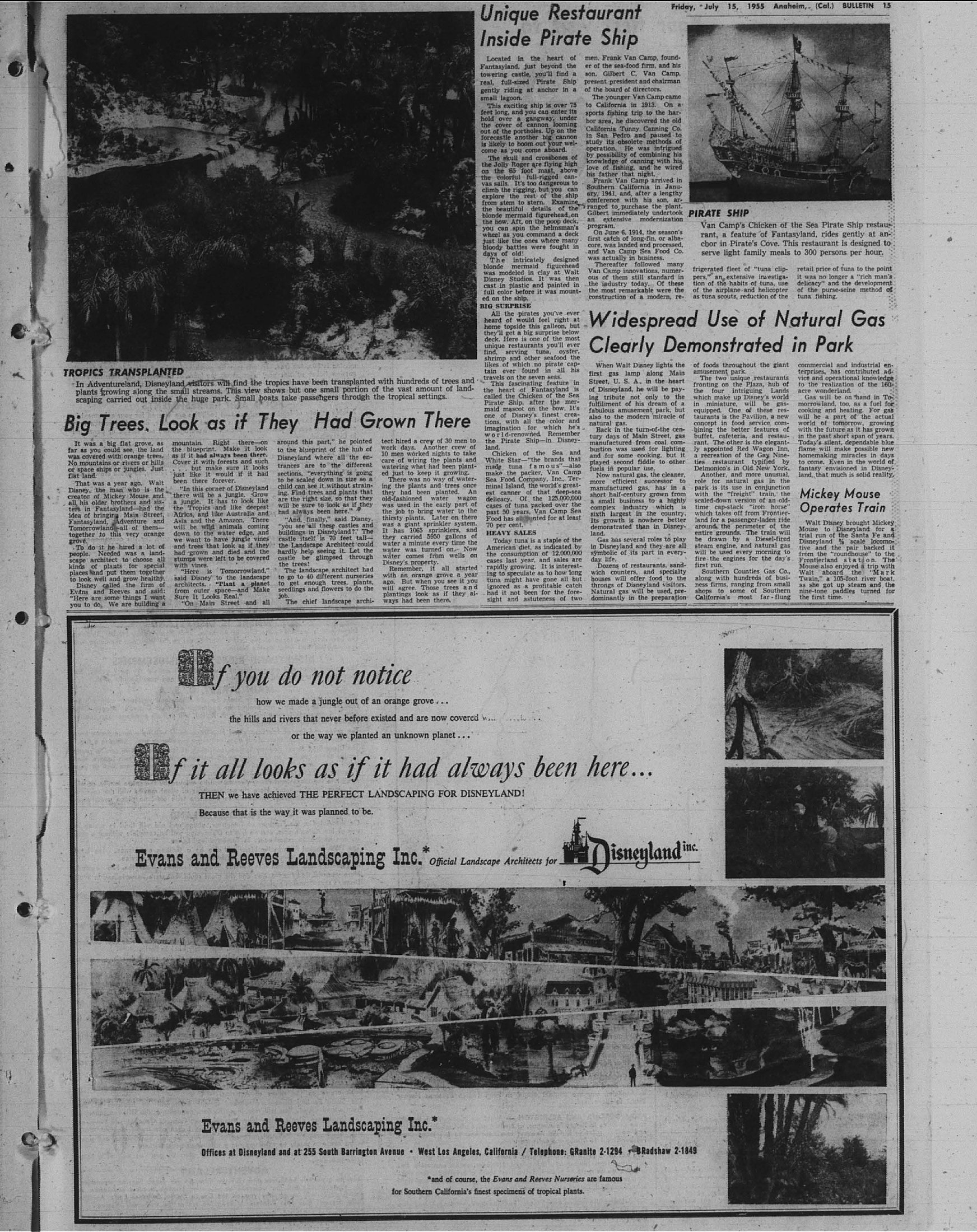
TROPICS TRANSPLANTED
In Adventureland, Disneyland visitors will find the tropics have been transplanted plants growing along the small streams. This view shows but one small portion scaping carried out inside the huge park. Small boats take passengers through
Big Trees. Look as if They Had Grown
It was a big flat grove, as far as you could see, the land was covered with orange trees.
mountain. Right there—on the blueprint. Make it look as if it had always been there.
around this part," he point to the blueprint of the hub Disneyland where all the
TROPICS TRANSPLANTED
In Adventureland, Disneyland visitors will find the tropics have been transplanted plants growing along the small streams. This view shows but one small portion scaping carried out inside the huge park. Small boats take passengers through Big Trees. Look as if They Had Grown.
It was a big flat grove, as far as you could see, the land was covered with orange trees. No mountains or rivers or hills or space ships or jungles. Just flat land.
That was a year ago. Walt Disney, the man who is the creator of Mickey Mouse and all his older brothers and sisters in Fantasyland—had the idea of bringing Main Street, Fantasyland, Adventure and Tomorrowland, all of them—together to this very orange grove.
To do it he hired a lot of people. Needed was a landscape architect to choose all kinds of plants for special places and put them together to look well and grow healthy.
Disney called the firm of Evans and Reeves and said: "Here are some things I want you to do. We are building a mountain. Right there—on the blueprint. Make it look as if it had always been there. Cover it with forests and such... but make sure it looks just like it would if it had been there forever.
"In this corner of Disneyland there will be a jungle. Grow a jungle. It has to look like the Tropics and like deepest Africa, and like Australia and Asia and the Amazon. There will be wild animals coming down to the water edge, and we want to have jungle vines and trees that look as if they had grown and died and the stumps were left to be covered with vines.
"Here is Tomorrowland," said Disney to the landscape architects. "Plant a planet from outer space—and Make Sure It Looks Real."
"On Main Street and all around this part," he points to the blueprint of the hub Disneyland where all the sections are to the different sections, "everything is going to be scaled down in size so child can see it without straining. Find trees and plants that are the right size, so that they will be sure to look as if they had always been here."
"And, finally," said Disney "you see all these castles and buildings in Disneyland?" The castle itself is 70 feet tall; the Landscape Architect co-ordination hardly help seeing it. Let the castle be glimpsed through the trees!
The landscape architect has to go to 40 different nurseries to get enough trees, plant seedlings and flowers to do job.
The chief landscape archeologist does not need how we made a jungle out of the hills and rivers that never before or the way we plan it all looks as if THEN we have achieved THE PERFECT Because that is the way it was planned to
THEN we have achieved THE PERFECT
Because that is the way it was planned to
Evans and Reeves Landscapi
Evans and Reeves Landsc
Offices at Disneyland and at 255 South Barring
Unique Restaurant Inside Pirate Ship
Located in the heart of Fantasyland, just beyond the towering castle, you'll find a real, full-sized Pirate Ship gently riding at anchor in a small lagoon.
This exciting ship is over 75 feet long, and you can enter its hold over a gangway, under the cover of cannon looming out of the portholes. Up on the forecastle another big cannon is likely to boom out your welcome as you come aboard.
The skull and crossbones of the Jolly Roger are flying high on the 65 foot mast, above the colorful full-rigged canvas sails. It's too dangerous to climb the rigging, but you can explore the rest of the ship from stem to stern. Examine the beautiful details of the blonde mermaid figurehead on the bow. Aft, on the poop deck, you can spin the helmsman's wheel as you command a deck just like the ones where many bloody battles were fought in days of old!
The intricately designed blonde mermaid figurehead was modeled in clay at Walt Disney Studios. It was then cast in plastic and painted in full color before it was mounted on the ship.
BIG SURPRISE
All the pirates you've ever heard of would feel right at home topside this galleon, but they'll get a big surprise below deck. Here is one of the most unique restaurants you'll ever find, serving tuna, oyster, shrimp and other seafood the likes of which no pirate captain ever found in all his travels on the seven seas.
This fascinating feature in the heart of Fantasyland is called the Chicken of the Sea Pirate Ship, after the mermaid mascot on the bow. It's one of Disney's finest creations, with all the color and imagination for which he's world-renowned. Remember the Pirate Ship—in Disneyland.
Chicken of the Sea and White Star—the brands that men, Frank Van Camp, founder of the sea-food firm, and his son, Gilbert C. Van Camp, present president and chairman of the board of directors.
The younger Van Camp came to California in 1913. On a sports fishing trip to the harbor area, he discovered the old California Tunny Canning Co., in San Pedro and paused to study its obsolete methods of operation. He was intrigued by possibility of combining his knowledge of canning with his love of fishing, and he wired his father that night.
Frank Van Camp arrived in Southern California in January, 1941, and, after a lengthy conference with his son, arranged to purchase the plant. Gilbert immediately undertook an extensive modernization program.
On June 6, 1914, the season's first catch of long-fin, or alba-core, was landed and processed, and Van Camp Sea Food Co. was actually in business.
Thereafter followed many Van Camp innovations, numerous of them still standard in the industry today. Of these the most remarkable were the construction of a modern, re-
Widespread Clearly Den
When Walt Disney lights the first gas lamp along Main Street, U. S. A., in the heart of Disneyland, he will be paying tribute not only to the fulfilment of his dream of a fabulous amusement park, but also to the modern miracle of natural gas.
Back in the turn-of-the-century days of Main Street, gas manufactured from coal combustion was used for lighting and for some cooking, but it
has been transplanted with hundreds of trees and but one small portion of the vast amount of land make passengers through the tropical settings.
Hey Had Grown There
Found this part," he pointed to the blueprint of the hub of Disneyland where all the enclosures are to the different tions, "everything is going be scaled down in size so a old can see it without strain. Find trees and plants that the right size, so that they will be sure to look as if they always been here."
And, finally," said Disney, you see all these castles and buildings in Disneyland?" The little itself is 70 feet tall—Landscape Architect could help seeing it. Let the little be glimpsed through the trees!
The landscape architect had go to 40 different nurseries get enough trees, plants, woodings and flowers to do the work.
The chief landscape architect hired a crew of 30 men to work days. Another crew of 10 men worked nights to take care of wiring the plants and watering what had been planted just to keep it growing.
There was no way of watering the plants and trees once they had been planted. An old-fashioned water wagon was used in the early part of the job to bring water to the thirsty plants. Later on there was a giant sprinkler system. It has 1065 sprinklers, and they carried 5950 gallons of water a minute every time the water was turned on. Now water comes from wells on Disney's property.
Remember, it all started with an orange grove a year ago. But when you see it you will agree. Those trees and plantings look as if they always had been there.
Do not notice
made a jungle out of an orange grove...
vers that never before existed and are now covered w...
or the way we planted an unknown planet...
ks as if it had always been here...
ved THE PERFECT LANDSCAPING FOR DISNEYLAND!
by it was planned to be.
Landscaping Inc.* Official Landscape Architects for
Disneyland in
Landscaping Inc.* Official Landscape Architects for Disneyland
eeves Landscaping Inc.*
d at 255 South Barrington Avenue • West Los Angeles, California / Telephone: GRanite 2-1294 • BRadshaw 2-184
*and of course, the Evans and Reeves Nurseries are famous
for Southern California's finest specimens of tropical plants.
Friday, July 15, 1955 Anaheim (Cal.) BULLETIN 15
PIRATE SHIP
Van Camp's Chicken of the Sea Pirate Ship restaurant, a feature of Fantasyland, rides gently at anchor in Pirate's Cove. This restaurant is designed to serve light family meals to 300 persons per hour.
frigerated fleet of "tuna clipers," an extensive investigation of the habits of tuna, use of the airplane and helicopter as tuna scouts, reduction of the retail price of tuna to the point it was no longer a "rich man's delicacy" and the development of the purse-seine method of tuna fishing.
widespread Use of Natural Gas nearly Demonstrated in Park
On Walt Disney lights the gas lamp along Main U. S. A., in the heart of Reyland, he will be payable not only to the extent of his dream of a amusement park, but the modern miracle of gas.
In the turn-of-the-century days of Main Street, gas setured from coal combustion was used for lighting some cooking, but it of foods throughout the giant amusement park.
The two unique restaurants fronting on the Plaza, hub of the four intriguing Lands which make up Disney's world in miniature, will be gas-equipped. One of these restaurants is the Pavilion, a new concept in food service combining the better features of buffet, cafeteria, and restaurant. The other is the elegantly appointed Red Wagon Inn, a recreation of the Gay Nine-commercial and industrial enterprises, has contributed advice and operational knowledge to the realization of the 160-acre wonderland.
Gas will be on hand in Tomorrowland, too, as a fuel for cooking and heating. For gas will be a part of the actual world of tomorrow, growing with the future as it has grown in the past short span of years. Today's silent, dependable blue flame will make possible new homemaking miracles in days
Walt Disney lights the gas lamp along Main U. S. A., in the heart of New York, he will be payable not only to the extent of his dream of a amusement park, but the modern miracle of gas.
In the turn-of-the-century days of Main Street, gas captured from coal community was used for lighting or some cooking, but it second fiddle to other popular use. Natural gas, the cleaner, efficient successor to fractured gas, has in a half-century grown from a small business to a highly industrial which is largest in the country. Growth is nowhere better estimated than in Disneyland.
Has several roles to play in New York and they are all part in every day of restaurants, sand-counters, and specialty will offer food to the visitors of Disneyland visitors. Gas will be used, preently in the preparation of foods throughout the giant amusement park.
The two unique restaurants fronting on the Plaza, hub of the four intriguing Lands which make up Disney's world in miniature, will be gas-equipped. One of these restaurants is the Pavilion, a new concept in food service combining the better features of buffet, cafeteria, and restaurant. The other is the elegantly appointed Red Wagon Inn, a recreation of the Gay Nine-ties restaurant typified by Delmonico's in Old New York.
Another, and more unusual, role for natural gas in the park is its use in conjunction with the "freight" train, the scaled-down version of an old-time cap-stack "iron horse" which takes off from Frontierland for a passenger-laden ride around the perimeter of the entire grounds. The train will be drawn by a Diesel-fired steam engine, and natural gas will be used every morning to fire-the engines for the day's first run.
Southern Counties Gas Co., along with hundreds of business firms, ranging from small shops to some of Southern California's most far-flung commercial and industrial enterprises, has contributed advice and operational knowledge to the realization of the 160-acre wonderland.
Gas will be on hand in Tomorrowland, too, as a fuel for cooking and heating. For gas will be a part of the actual world of tomorrow, growing with the future as it has grown in the past short span of years. Today's silent, dependable blue flame will make possible new homemaking miracles in days to come. Even in the world of fantasy envisioned in Disneyland, that much is solid reality.
Mickey Mouse Operates Train
Walt Disney brought Mickey Mouse to Disneyland for a trial run of the Santa Fe and Disneyland % scale locomotive and the pair backed it from the "roundhouse" to the Frontierland station. The Mouse also enjoyed a trip with Walt aboard the "Mark Twain," a 105-foot river boat, as she got up steam and the nine-tone paddles turned for the first time.
isneyland inc.
294 BRadshaw 2-1849